

A student-led IEP meeting puts the young person at the center of the conversation about their own education. Picture a typical annual review: six adults around a table, a thick folder of reports, and a thirteen-year-old sitting quietly at the end, nodding when asked if everything sounds okay. The plan is about her, yet she barely speaks.
This guide is for special education teachers, case managers, and families who want to change that picture. You will learn how to prepare a student to lead part or all of their meeting, which self-advocacy skills to teach first, how to practice, how to run the meeting, and how to measure growth afterward.
Examples are fictional. Adapt to the student’s goals and agreed supports. This is guidance, not a diagnosis.
At a glance
- Students can lead a small part of the meeting first, then take on more each year.
- Teach the student to describe strengths, needs, and helpful accommodations in their own words.
- Practice with role-play several times before the real meeting.
- Prepare the adults too, so they wait, listen, and direct questions to the student.
- Measure growth in self-advocacy skills, not only in how the meeting went.
1. Decide what the student will lead
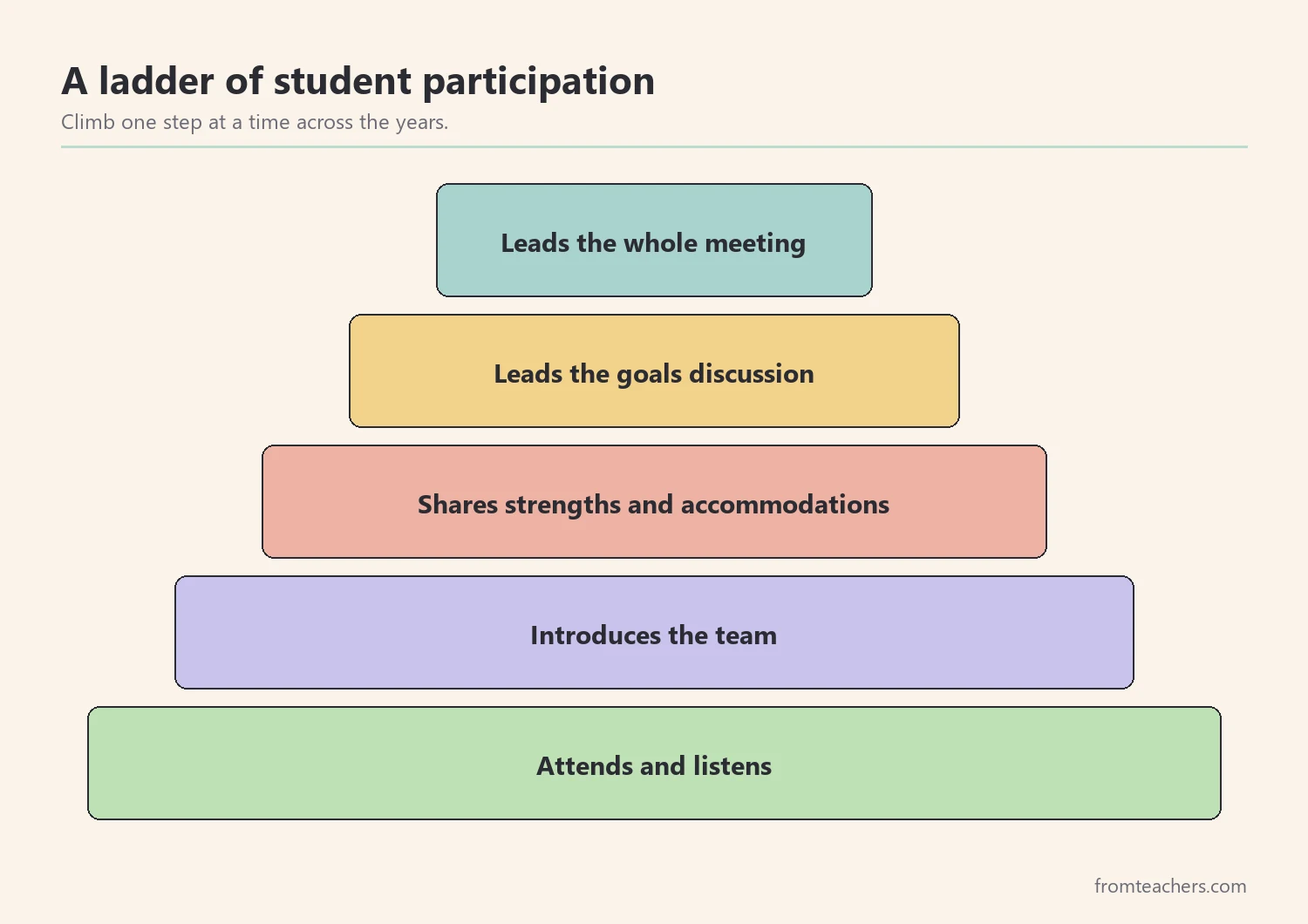
A student-led IEP meeting does not have to mean the student runs every minute. Instead, think of participation as a ladder. At first, the student might simply introduce everyone. Later, they might share their strengths, describe what helps them learn, and eventually lead the goal discussion.
Next, choose the right starting step with the student. Ask what feels comfortable and what feels like a stretch. A student who is nervous about speaking might prepare a short slideshow or a written statement to read. A confident student might lead the whole agenda with support.
Also, check the timeline. Under IDEA, transition planning becomes part of the IEP for older students, and students are invited to meetings where transition is discussed. Even before that age, many teams find that student participation builds skills early. Check your state and district guidance for specific ages and requirements.
Aisha (fictional, grade 8) had never spoken at her IEP meetings. With her case manager, she chose three parts to lead this year: introductions, her strengths, and the accommodations that help her most. That was a big step for her, and it was realistic.
| Meeting part | Student role this year | Adult support |
|---|---|---|
| Introductions | Leads | Prepares a name list |
| Strengths | Leads with notes | Practices beforehand |
| Accommodations | Leads with slides | Prompts if needed |
| Goals | Shares an opinion | Case manager leads |
2. Teach the self-advocacy skills behind a student-led IEP meeting
Leading a meeting draws on several self-advocacy skills. The student needs to understand their disability in simple terms, know their strengths and challenges, know their rights and accommodations, and communicate clearly with adults. Each skill can be taught directly.
A structured toolkit makes this teaching easier. The self-advocacy skills intervention toolkit for students with disabilities includes twenty intervention guides covering topics such as understanding self-advocacy, rights and accommodations under IDEA, ADA, and Section 504, communicating with teachers and staff, identifying strengths and challenges, decision-making, and asking for help without feeling embarrassed. Each guide pairs a common issue with a strategy and its purpose.
Next, focus on the skills the student will need in this specific meeting. For Aisha, that meant three things: naming two strengths, describing her learning needs in one sentence, and explaining why extended time and a quiet testing space help her.
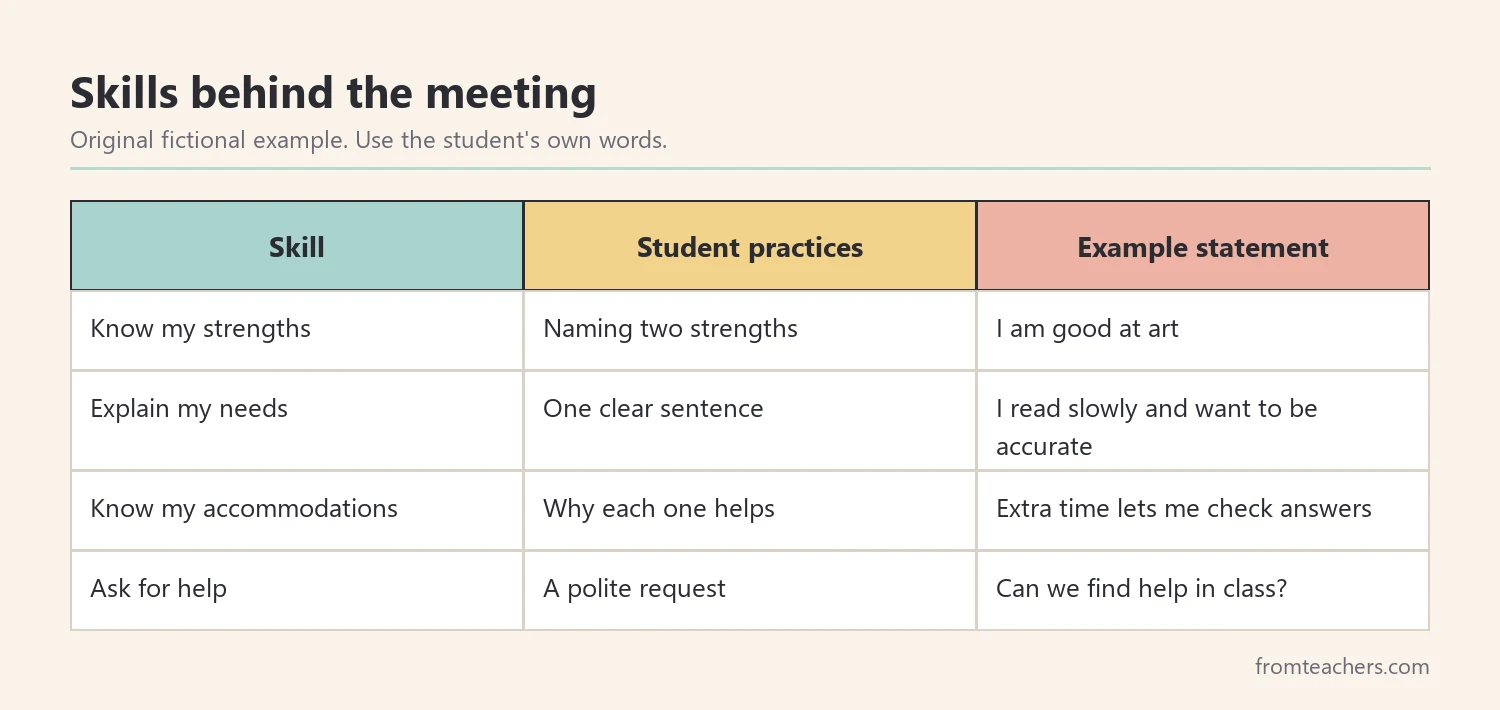
Also, use the student’s own words. Adults often describe needs in technical language, but students should say things in a way that feels natural. “I need more time because I read slowly and want to get the answers right” is clear and honest.
In addition, teach the student what is in their IEP. Many students have never read their own plan. A simplified one-page version, written with the student, can be a powerful teaching tool and a script for the meeting.
3. Build the student’s meeting script and materials
Once the student knows what they will lead, help them prepare materials. Options include a short slideshow, a poster, a one-page “about me” sheet, or simple note cards. The format should suit the student’s strengths and communication style.
Next, create a simple script. It does not need to be long. For example:
- “Thank you for coming. Let’s introduce ourselves.”
- “My strengths are art and helping others.”
- “I learn best when I have extra time and a quiet place for tests.”
- “One thing I want to work on is asking for help in math.”
Also, include a question for the team. A question like “Can we talk about how I could get help in math without leaving the room?” shows real engagement and turns the student-led IEP meeting into a conversation rather than a speech.
Similarly, keep the materials short. Four to six slides or cards are usually enough. Too many pages can make the student rush or lose their place, while a small set lets them speak slowly and look up at the people they are talking to.
For students who use AAC or prefer not to speak at length, prepare pre-programmed messages, a recorded video, or a written statement someone can read with the student. Participation can take many forms.
Aisha made four slides with pictures she chose: her art, a clock for extended time, a quiet room, and a hand raised for asking for help. She practiced saying one or two sentences per slide.
4. Practice with role-play
Practice turns nerves into confidence. Therefore, schedule at least two or three rehearsal sessions before the meeting. Start in a familiar room with one trusted adult, then add one or two more people.
During role-play, adults can play team members and ask realistic questions. For example, “What makes math hard for you?” or “Do you use your extra time on tests?” The student practices answering briefly and honestly.
Also, practice what to do when the student feels stuck. Teach a few phrases, such as “Can I think about that for a moment?” or “Can you ask that another way?” These phrases are self-advocacy skills in themselves and are useful far beyond the meeting.
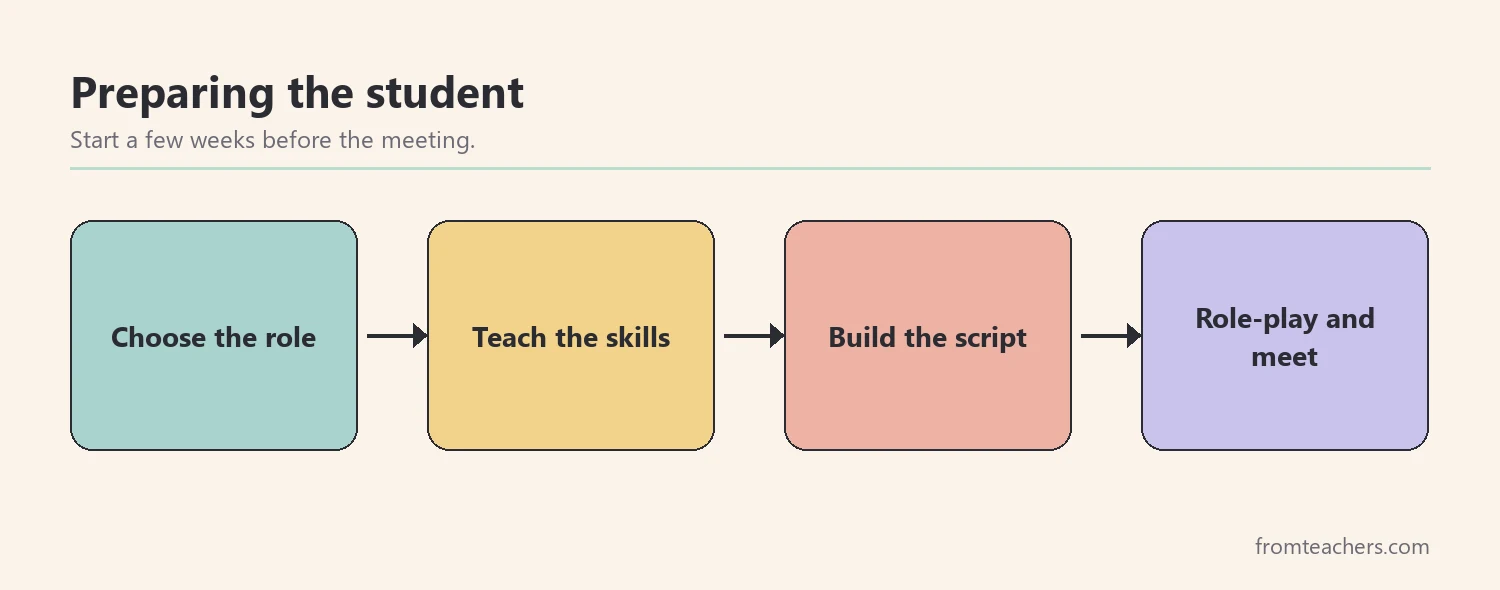
In addition, involve the family in practice. Parents can rehearse at home, ask questions, and encourage their child. Many families say they learn new things about their child’s perspective during these practice sessions.
Moreover, practice the hard moments, not only the easy ones. An adult can gently disagree during role-play, for example, “I am not sure extra time is still needed.” The student then practices a calm reply, such as explaining when the accommodation helps. Rehearsing disagreement makes the real student-led IEP meeting far less frightening.
Aisha practiced three times at school and once at home with her mother. By the third practice, she could present her slides without reading word for word, and she had prepared an answer for questions about math.
5. Run the student-led IEP meeting
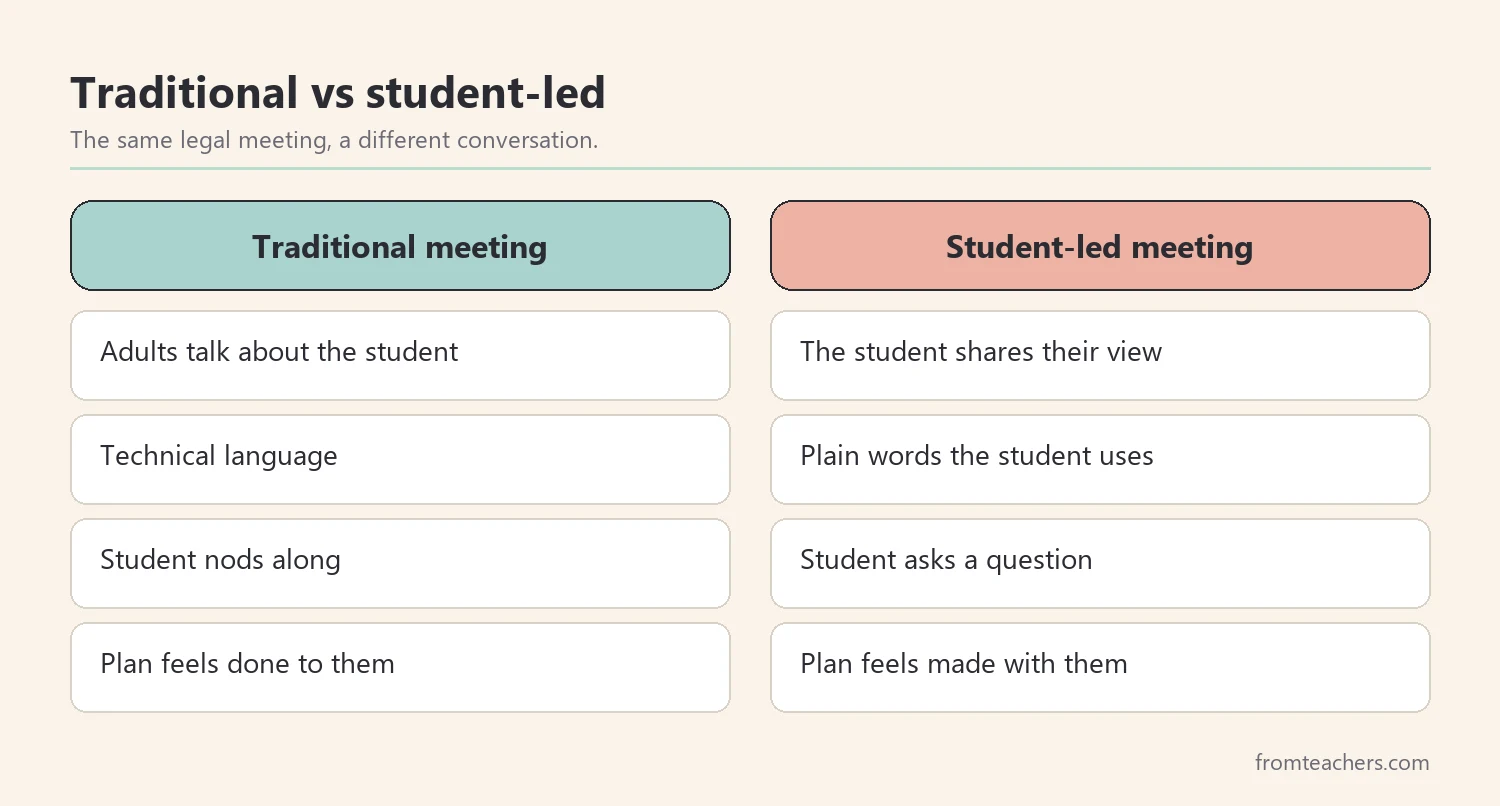
Before the meeting, brief the adults. Explain which parts the student will lead and ask everyone to direct questions to the student, wait patiently, and avoid jumping in. This preparation is just as important as the student’s practice.
Next, set up the room thoughtfully. The student might sit at the head of the table or next to a trusted adult. A printed agenda in front of everyone shows the student’s role clearly.
During the meeting, the case manager can act as a co-facilitator. If the student pauses, give wait time first. Then, offer a gentle prompt, such as pointing to the next slide or note card. Avoid taking over the student’s part.
Also, honor the student’s input. When a student shares an opinion about goals or accommodations, the team should discuss it seriously, even if the final decision differs. Being heard is the core of a student-led IEP meeting.
At Aisha’s meeting, she introduced everyone, presented her slides, and asked her question about math support. The team discussed her idea and added an in-class help signal to her accommodations. Afterward, her general education teacher said it was the most useful IEP meeting she had attended.
| Adult action | Why it matters |
|---|---|
| Direct questions to the student | Shows the student is the expert on their experience |
| Wait before prompting | Gives time to think and respond |
| Use plain language | Keeps the student included |
| Discuss the student’s ideas | Builds trust and ownership |
6. Measure self-advocacy growth after the meeting
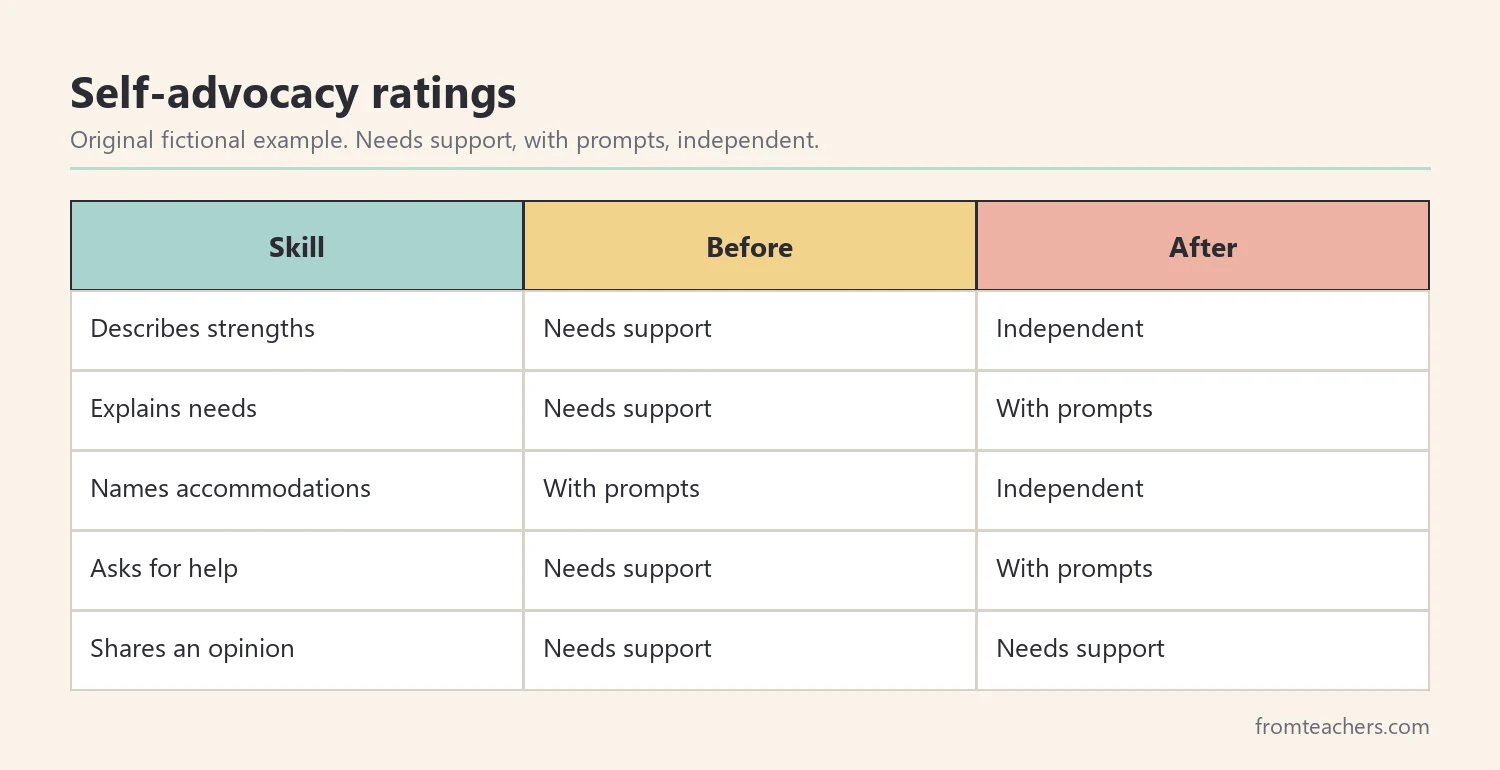
A successful meeting is wonderful, but the real goal is lasting self-advocacy. So, measure growth in the skills, not only in how the meeting went. A simple rubric across the year can show progress.
For example, rate a few skills on a three-point scale: needs support, with prompts, or independent. Skills might include describing strengths, explaining needs, naming accommodations, asking for help, and sharing an opinion with adults.
Next, debrief with the student soon after the meeting. Ask what went well, what felt hard, and what they want to lead next year. Write their answers down and use them to plan the next step on the ladder.
In addition, share the results with the student in a positive way. Showing a student their own ratings, with clear examples of growth, often motivates them to aim higher next year. It also models how a student-led IEP meeting connects to real goals rather than being a one-day performance.
Also, look for self-advocacy in daily life. Does the student now ask for extended time without a reminder? Do they explain their needs to a substitute teacher? These everyday moments show whether the skills are transferring beyond the meeting.
For Aisha, the ratings showed growth in four of five skills, and she began asking for help in math using the new signal. Next year, she plans to lead the goals discussion too.
Common mistakes and how to avoid them
- Asking the student to lead everything at once. It can overwhelm. Fix: start with one to three parts and grow each year.
- Skipping practice. Nerves take over. Fix: rehearse two or three times with familiar adults.
- Adults taking over. The student goes quiet. Fix: brief adults to wait, listen, and direct questions to the student.
- Using technical language. The student feels left out. Fix: use plain words and explain terms.
- Treating it as a one-time event. Skills fade. Fix: teach self-advocacy all year and measure growth.
Questions teachers and parents ask about a student-led IEP meeting
What age can students start leading their IEP meetings?
There is no single right age. Younger students can start with a small role, such as introductions or sharing a favorite subject. Older students can take on more as their skills grow. Check your district’s guidance on student attendance and transition planning.
What if the student is very anxious?
Start with a very small role and lots of practice. A recorded video or written statement can let the student participate without speaking live. Celebrate any participation as a success.
Does the student have to attend the whole meeting?
Not always. Some teams invite the student for part of the meeting, especially if sensitive topics will be discussed. Talk with the family and the student about what feels right.
How do parents support a student-led IEP meeting?
Parents can help their child practice, encourage them, and share their own observations during the meeting. They can also ask the team to direct questions to their child.
Is a student-led meeting legally different from a regular IEP meeting?
The legal requirements of the IEP meeting stay the same. The difference is in how the meeting is run and who speaks. The team still makes decisions together according to IDEA and district procedures.
Related reading: Transition to Adulthood, Parent-Teacher Collaboration in Special Education, and Accommodations vs Modifications in Special Education.
You may also need: Classroom Accommodation Feedback Form IEP 504 Effectiveness Tracker.
A companion resource for a student-led IEP meeting:
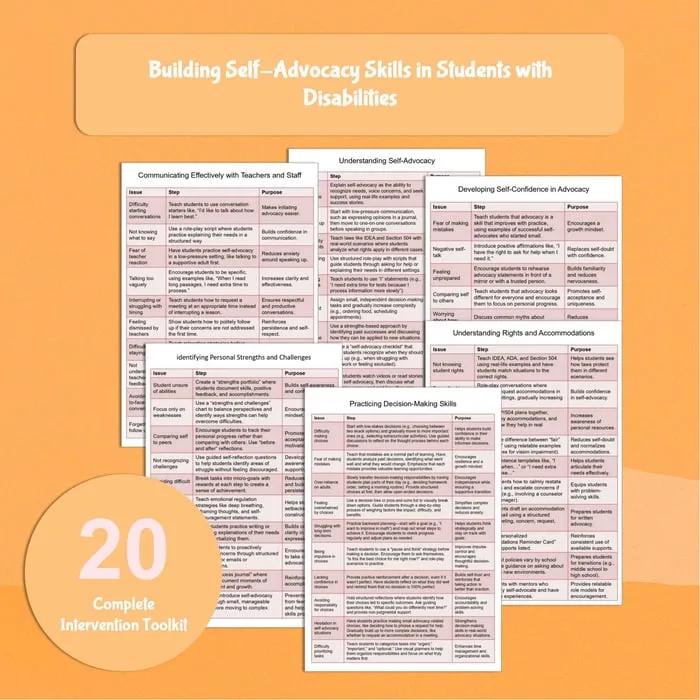
Self-Advocacy Skills for Students with Disabilities: SPED Intervention Toolkit: twenty intervention guides, each with a common issue, a step-by-step strategy, and its purpose, covering rights and accommodations, communication, confidence, decision-making, and more.
Sources and scope
- IDEA, U.S. Department of Education: federal guidance on IEPs, student participation, and transition planning.
- IRIS Center, Vanderbilt University: free modules on IEPs and student involvement in planning.
- National Technical Assistance Center on Transition: resources on transition planning and student self-determination.
- Understood.org: family-friendly articles on self-advocacy and IEP meetings.
This guide covers preparing students to participate in and lead parts of their IEP meetings. It does not provide legal advice or replace district procedures and the decisions of the IEP team.
Key takeaways
- A student-led IEP meeting can start small and grow each year.
- Teach the self-advocacy skills the student needs for their chosen role.
- Build a short script and materials in the student’s own words.
- Practice with role-play and prepare adults to listen and wait.
- Measure self-advocacy growth across the year, not just the meeting.










Leave a Comment