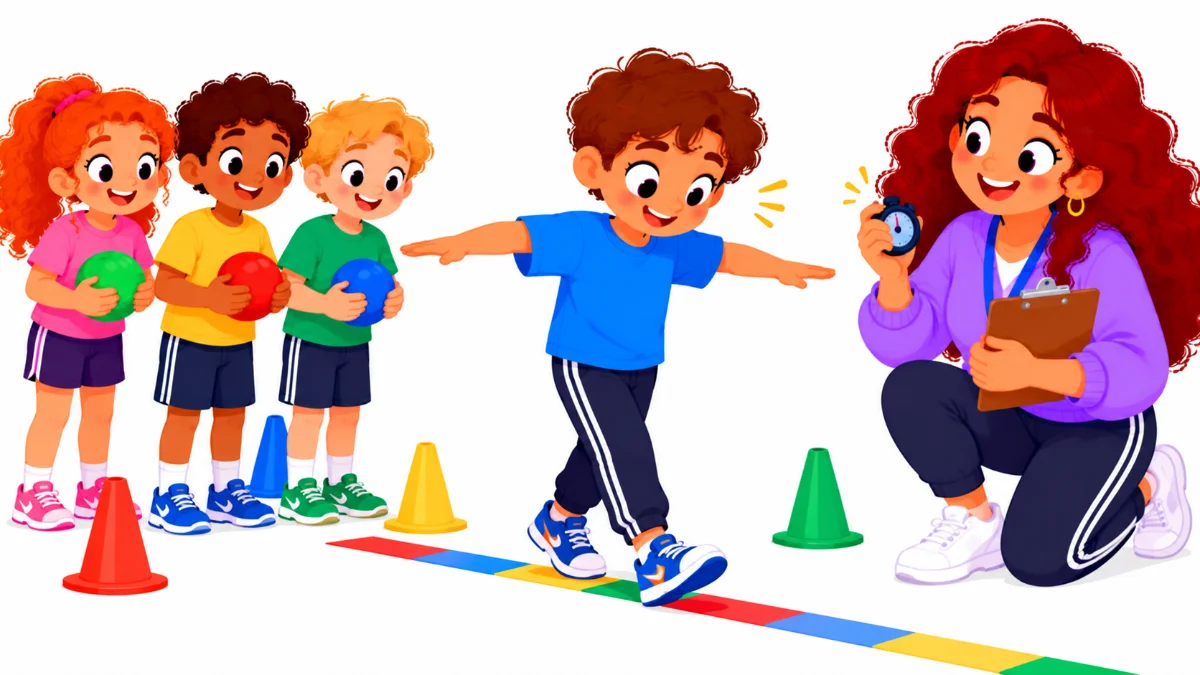

Tracking gross motor progress helps you see real growth in students whose movement skills change slowly and quietly. Picture a mixed-ability movement class in October. Mateo still steps off the balance line after a few steps, and you sense he is improving, but you cannot say by how much or which activities are making the difference.
This guide is for classroom teachers, adaptive PE staff, and paraprofessionals who run inclusive movement time. By the end, you will know how to pick a few skills to watch, set up quick and fair checks, record results in under a minute, and use the numbers to adjust activities and share good news with families and therapists.
Examples are fictional. Adapt to the student’s goals and agreed supports. This is guidance, not a diagnosis or a therapy plan.
At a glance
- Choose three or four skills per student, not the whole curriculum.
- Run each check the same way every time so results are comparable.
- Record counts or seconds, plus the support used.
- Look at trends over several weeks, not single days.
- Celebrate personal progress, never compare students with each other.
1. Choose the skills worth tracking
First, decide what matters most for each student. Gross motor skills cover a wide range: balance, coordination, strength, moving through space, and handling objects like balls and beanbags. Trying to measure everything leads to piles of paper and no clear picture.
Instead, pick three or four skills that connect to daily life at school. For example, balance matters for climbing stairs and standing in line. Catching matters for recess games. Jumping and hopping matter for playground play. If a student has an IEP with motor goals, or works with a physical or occupational therapist, start with the skills already named there.
Next, write each skill as something you can see. “Better balance” is hard to measure. “Walks heel-to-toe along a floor line” is clear. “Catches a large soft ball tossed from two meters” is clear too. Clear wording means another adult could run the same check and get a similar result.
Meet Mateo (fictional, grade 2). His teacher, Ms. Reyes, chose four skills after talking with the school physical therapist:
- Walking along a straight floor line.
- Standing on one foot.
- Catching a soft ball.
- Jumping forward with both feet together.
Each one linked to something Mateo wanted to do, such as joining a ball game at recess. That link kept him motivated and gave the team a reason to care about the numbers.
Finally, keep the list visible. Ms. Reyes wrote Mateo’s four skills on an index card clipped to her movement-time clipboard. When tracking gross motor progress is part of the materials you already carry, it actually happens.
2. Set up fair, repeatable checks for tracking gross motor progress
A check is only useful if it is run the same way each time. Otherwise, a better score might simply mean an easier setup. Therefore, decide the details once and write them down.
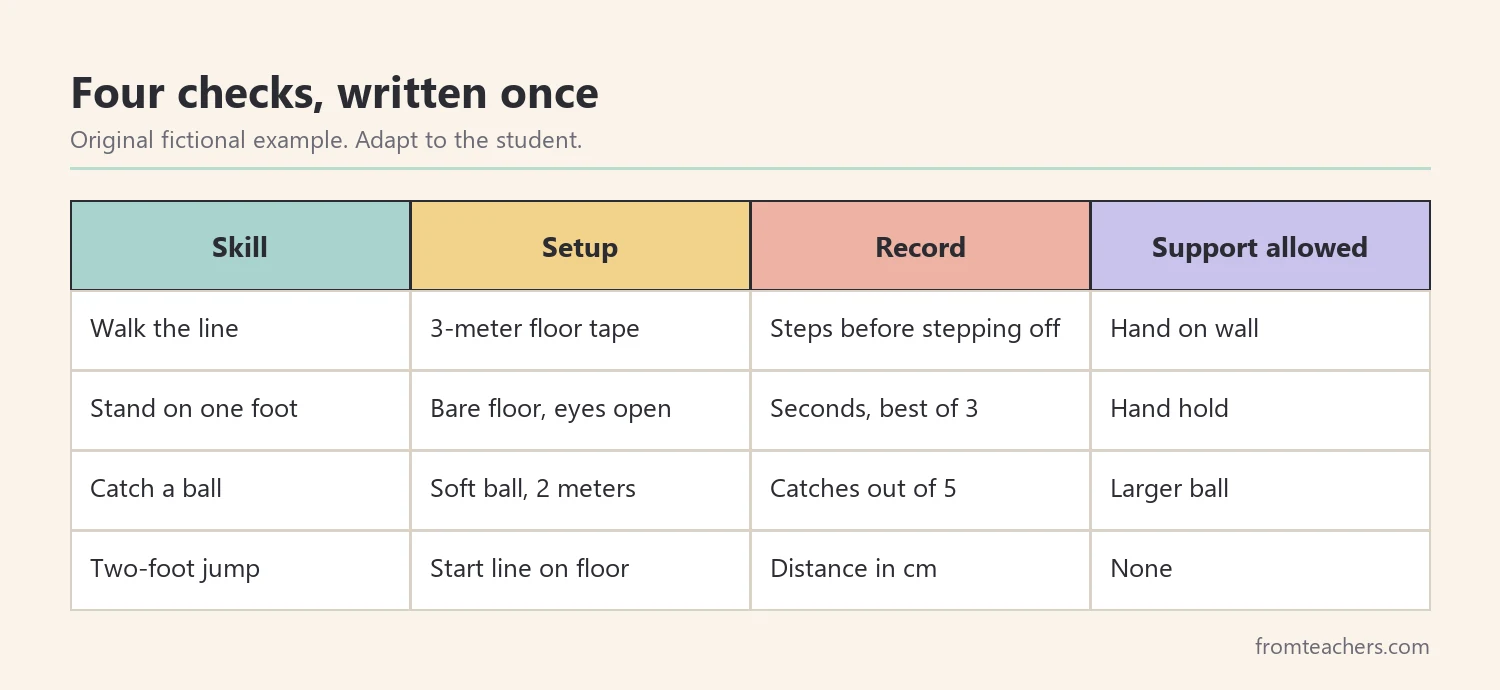
For each skill, settle these points:
| Detail | Example (fictional) |
|---|---|
| Setup | 3-meter tape line on the gym floor |
| Instruction | “Walk the line, heel to toe.” |
| Number of tries | Three tries, record the best |
| What you record | Steps before stepping off |
| Support allowed | Hand on a wall, or none |
In addition, choose the unit that fits the skill. Counts work well for catches out of five tosses or steps along a line. Seconds work for standing on one foot. Distance works for jumping. A simple “independent, with support, not yet” scale works for skills that are harder to count.
The Gross Motor Skills: Inclusive Activities for All guide groups activities into balance and coordination, strength and core, moving your body, and object control, and it ends with a review and goal-setting section. That structure maps neatly onto a short tracking card with one row per area.
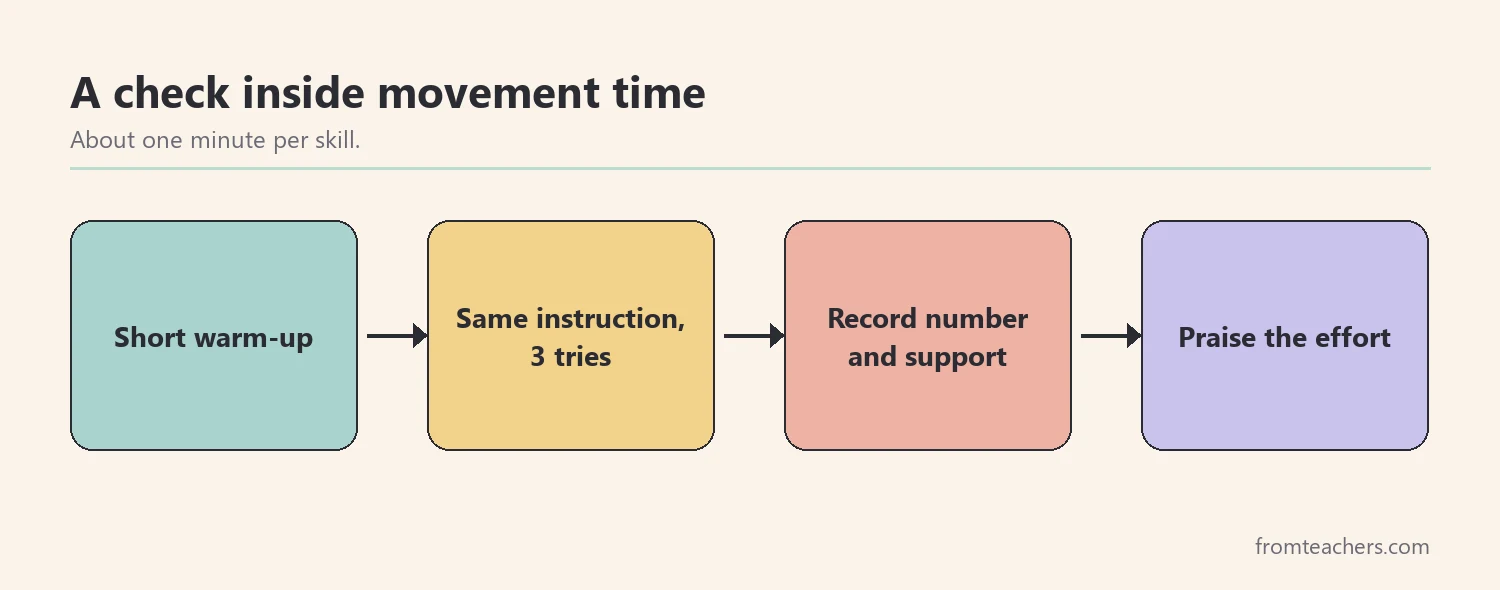
Also, check at a calm moment. A student who has just come in from a noisy assembly may not show their best. Ms. Reyes ran her checks during the first ten minutes of movement time, after a short warm-up.
3. Record results in under a minute
Recording must be fast, or it will not survive a busy term. A small table with dates across the top and skills down the side is usually enough. Write the number, then add a letter for the support used, such as “W” for wall or “H” for hand hold.
For example, an entry might read “6 W” for six steps along the line with a hand on the wall. Two characters tell you both the result and the conditions. As a result, a future reader will not mistake a supported score for an independent one.
Moreover, decide how often to check. Every day is too much for most classrooms. Once every week or two is often enough to show a trend. Mark the dates in your planner so checks do not slip.
Share the job when you can. A paraprofessional who runs a station can record one skill while you record another. However, agree on the instructions first. If one adult counts a catch only when the ball is held against the chest and another counts any touch, the numbers will not match.
Also, include the student. Older students can record their own score on a simple chart, with a sticker or a tick. Seeing their own numbers rise is motivating, and it turns tracking into something done with the student, not to them.
4. Read the trend and adjust activities
Single scores bounce around. A student may be tired, excited, or wearing slippery shoes. So, look at several checks in a row before drawing conclusions. A trend over four to six weeks tells you far more than one great or poor day.
Here is Mateo’s record across six weeks:
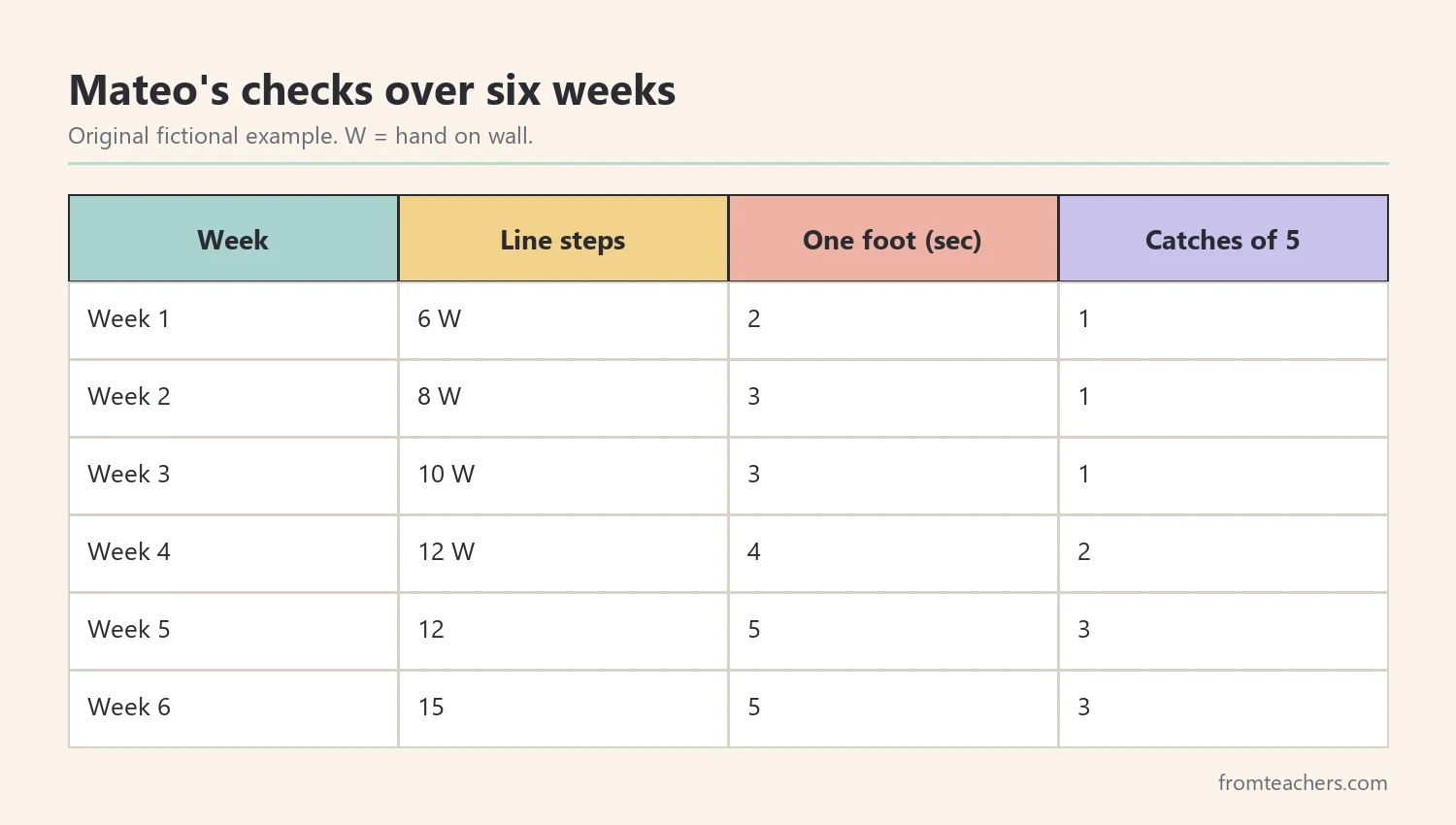
The pattern helped Ms. Reyes make decisions. Mateo’s line walking improved steadily, and by week five he no longer needed the wall. Catching, on the other hand, stayed flat for the first three weeks. So, from week four, she changed the practice activity: a larger, slower ball tossed from a shorter distance during warm-ups. After that, his catches in the standard check started to rise.
In general, use trends like this:
- Rising steadily: keep the activity, then reduce support or add a small challenge.
- Flat for three or more checks: change one thing, such as equipment, distance, or practice time.
- Falling: look for a reason, such as illness or a schedule change, and talk with the team.
- Jumping up and down: check whether the setup is truly the same each time.
When your data shows a plateau, resist the urge to add more practice of the same thing. Often a small change to the task, like a lighter ball, makes more difference than repetition.
Furthermore, keep inclusion in mind. Activities should let every student join, with different targets for different bodies. A student in a wheelchair may work on reaching and throwing while others work on hopping, and both can be part of the same group game.
Adapting checks for different bodies
Inclusive movement time means students start from very different places. Because of that, the same check will not fit everyone. Instead of dropping a student from tracking, adapt the check so it still measures something meaningful for them.
For example, a student who uses a wheelchair might be checked on reaching for a beanbag at different heights, or on throwing into a hoop from a set distance. A student who tires quickly might do one try instead of three, with the same rule every time. Likewise, a student who is anxious about being watched might be checked during a group game, with the adult quietly counting from the side.
In each case, write the adapted version on the student’s card. That way, the check stays consistent for that student, even though it differs from the rest of the class. Ask the physical or occupational therapist to suggest adaptations when you are unsure, since they know which movements are safe and useful for each student.
Also, think about the order of activities. Many students do better on balance checks before they are tired, so place those early. Ball skills can come later, inside a game, when energy and interest are high. Small decisions like these make the numbers more reliable and the session more enjoyable for everyone.
Finally, remember that some skills simply take a long time. A flat line on the chart is not a failure. It is information that helps the team decide whether to keep going, change the activity, or choose a different target for now.
5. Share progress with families and the team
Numbers mean more when they are shared. Families often wonder what happens in movement time, and a short update can be a highlight of their week. Moreover, therapists value classroom data because it shows how skills carry over beyond their sessions.
Keep updates short and positive. For example, “Mateo walked the full balance line without holding the wall this week, up from six steps in September.” One clear sentence, with a before and after, tells the story.
Also, compare the student only with themselves. Tracking gross motor progress is about personal growth, not ranking. Avoid charts that show the whole class side by side, which can embarrass students who move differently.
When you meet with the team, bring a one-page summary: the skills tracked, the trend for each, and what support or activity changed. Then ask a clear question, such as “Should we raise the target for line walking?” or “Is there a better way to practice catching?” That keeps the conversation practical.
Here is how a classroom check differs from a formal motor assessment:
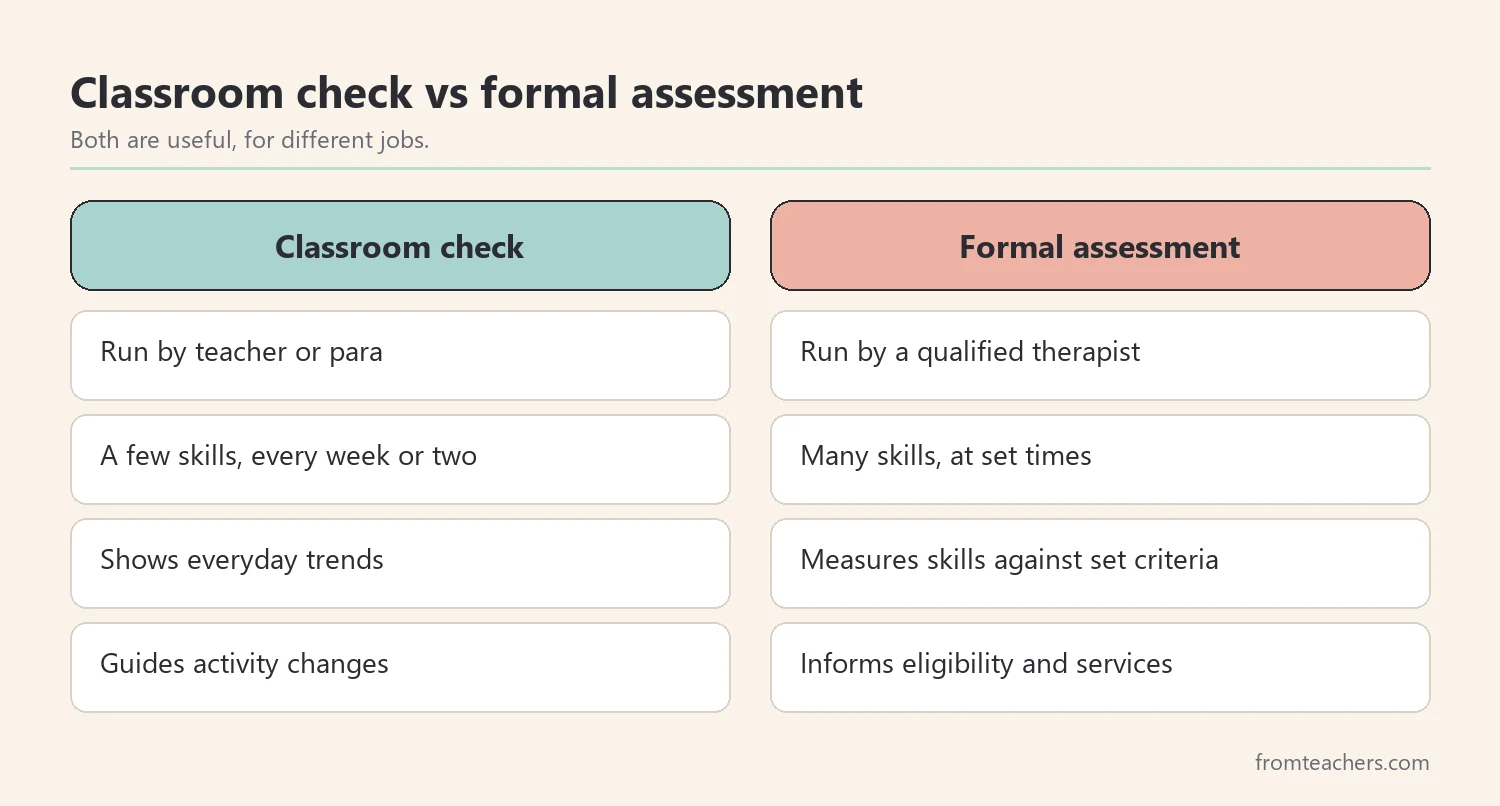
Finally, update the plan. When a skill is secure, celebrate it and choose a new one. A fresh target keeps movement time interesting for the student and keeps your tracking focused on what matters next.
Common mistakes and how to avoid them
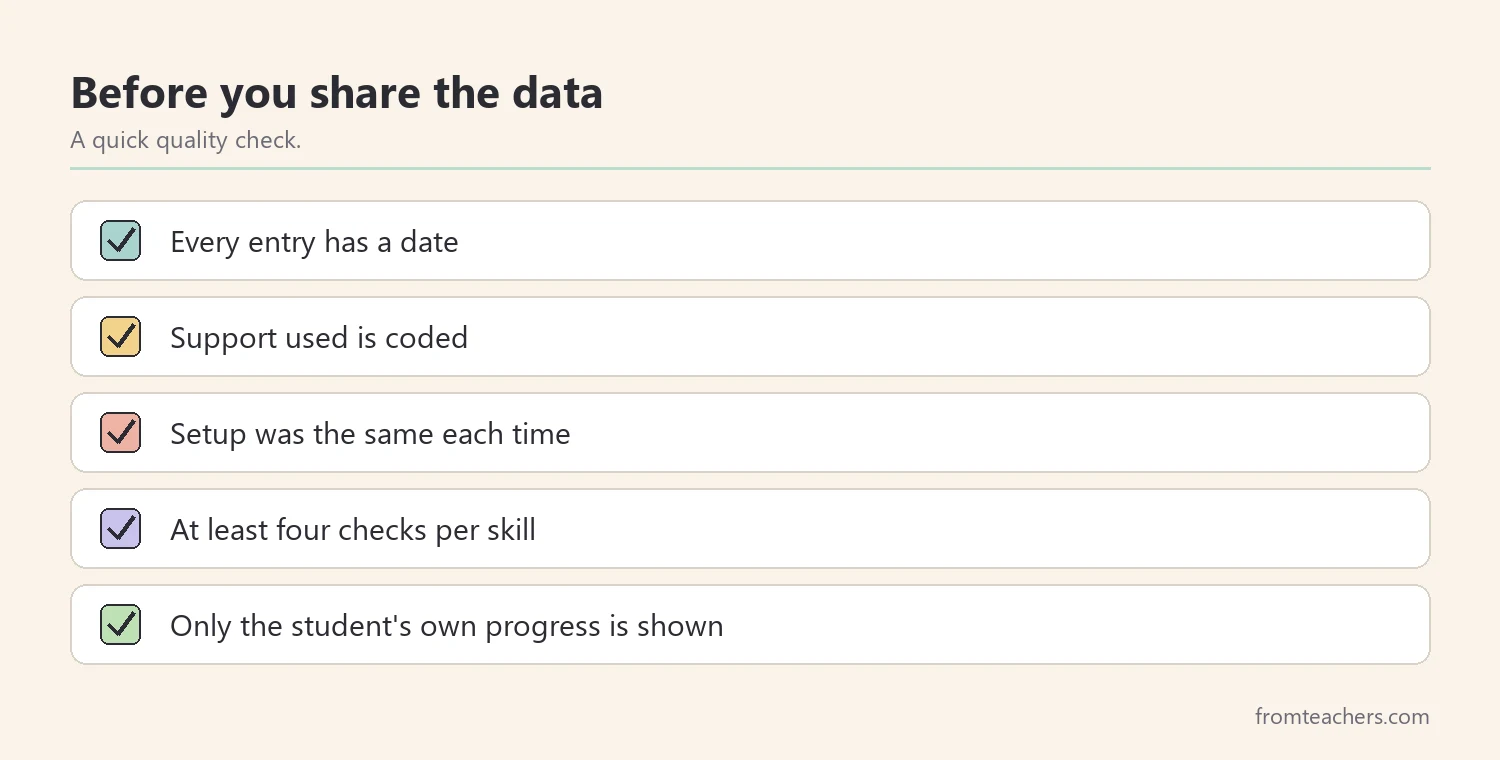
- Tracking too many skills. Ten skills per student is not sustainable. Fix: choose three or four linked to daily life.
- Changing the setup between checks. A shorter line or softer ball makes scores look better. Fix: write the setup down and repeat it exactly.
- Forgetting the support used. A supported score can look like independence later. Fix: add a support code to every entry.
- Judging from one day. Single checks bounce around. Fix: wait for at least four checks before deciding.
- Comparing students. Rankings discourage students who move differently. Fix: show each student only their own progress.
Questions teachers and parents ask about tracking gross motor progress
How often should I run checks?
For most classrooms, once every week or two is enough. That gives a clear trend without taking over movement time. If a student is working on a new skill with fast change, weekly checks may be more useful.
Do I need special equipment?
Usually not. Floor tape, a stopwatch or phone timer, soft balls, and beanbags cover most simple checks. The key is using the same equipment each time.
Can parents track gross motor skills at home?
Yes. Parents can use the same simple checks, such as counting catches in the yard or timing one-foot standing. Ask the teacher or therapist which skills to focus on so home and school practice match.
What if a student does not want to be checked?
Make the check part of a game rather than a test. Let the student choose the order, or record their own score. If they still decline, try another day and keep the mood relaxed.
Does this replace an assessment by a physical therapist?
No. Classroom checks show everyday progress, but they do not replace formal assessment by qualified professionals. They are one helpful source of information among several.
Related reading: The Power of Data Tracking in Special Education, Bridging Gaps in Special Education: Practical Strategies for Teachers, and How Parents and Teachers Can Team Up for Special Education Success.
You may also need: Sensory Processing Support Guide for Special Education Classrooms | Sensory Diet.
A companion resource for tracking gross motor progress:
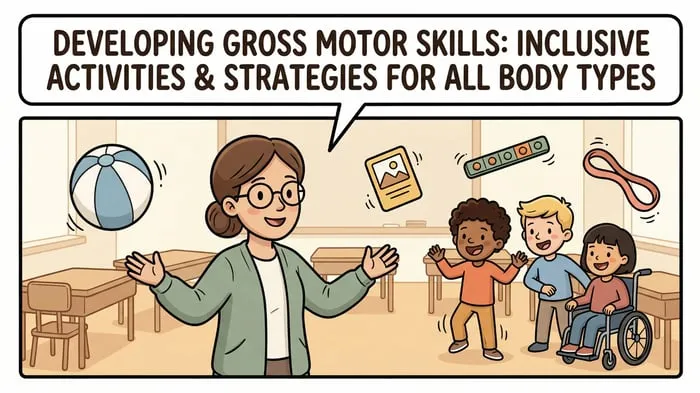
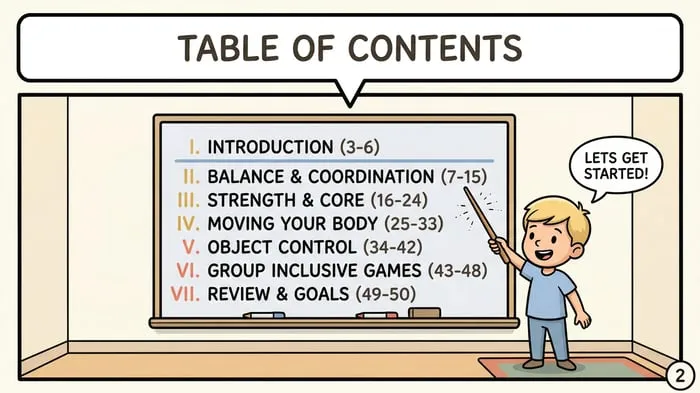
Gross Motor Skills: Inclusive Activities for All: a 50-page visual guide covering gross motor development, balance and coordination, strength and core, moving your body, object control, group inclusive games, and a review with goal setting.
Sources and scope
- Individuals with Disabilities Education Act (IDEA), U.S. Department of Education: federal guidance on IEPs, related services, and progress reporting.
- CDC Learn the Signs. Act Early.: information on child development, including movement, for families and educators.
- CDC Physical Activity Basics: general guidance on physical activity for children.
- IRIS Center, Vanderbilt University: free modules on progress monitoring and data-based decisions.
This guide covers informal classroom tracking of gross motor skills during inclusive movement time. It does not cover formal motor assessment, therapy plans, or medical advice, which belong to qualified therapists and health professionals.
Key takeaways
- Tracking gross motor progress starts with three or four meaningful skills.
- Repeatable checks, with the same setup each time, make results fair.
- A number plus a support code takes seconds and tells the full story.
- Trends over several weeks guide changes to activities.
- Share personal progress with families and the team, never rankings.



Leave a Comment