

Implementing a behavior intervention plan is where many good plans quietly fail. Picture a team that spent weeks on a functional behavior assessment and a careful BIP. Two months later, the plan sits in a binder, each adult handles the behavior in their own way, and everyone agrees that “the plan isn’t working.” Often, the plan was never really tried.
This guide is for special education teachers, general education teachers, paraprofessionals, and behavior specialists who share responsibility for a student’s BIP. By the end, you will know how to turn the written plan into daily actions, train every adult, check that the plan is followed, and read the data before deciding whether to change it.
Examples are fictional. Follow your district’s procedures and the guidance of your behavior specialist. This is guidance, not a clinical recommendation.
At a glance
- A plan only works if every adult does it the same way.
- Turn each strategy into a short “what I do” card.
- Practice responses before the behavior happens.
- Check fidelity as well as student behavior.
- Give the plan a fair trial before changing it.
1. Turn the written plan into daily actions
First, read the BIP as a team and translate it into plain actions. Plans written from an FBA often use technical language: setting events, antecedents, replacement behaviors, consequences. These terms are useful for planning. However, a paraprofessional at lunch needs to know exactly what to do in the moment.
So, for each part of the plan, answer three questions: when does this happen, who does it, and what exactly do they say or do? For example, “Antecedent intervention: offer choice of writing tool” becomes “At the start of every writing task, Ms. Lee offers Marcus a choice of pencil, marker, or keyboard.”
Meet Marcus (fictional, grade 5). His FBA found that he often leaves his seat and argues when given long writing tasks, and that the behavior seems to help him escape the task. His BIP, built on a function-based behavior intervention plan template, includes a competing behavior pathway with a replacement behavior: asking for a short break using a break card.
The template’s intervention page is organized into four function-based sections: eliminating or neutralizing setting events, antecedent interventions, teaching behavior, and altering consequences. That structure made it easier for Marcus’s team to list concrete actions for each one.
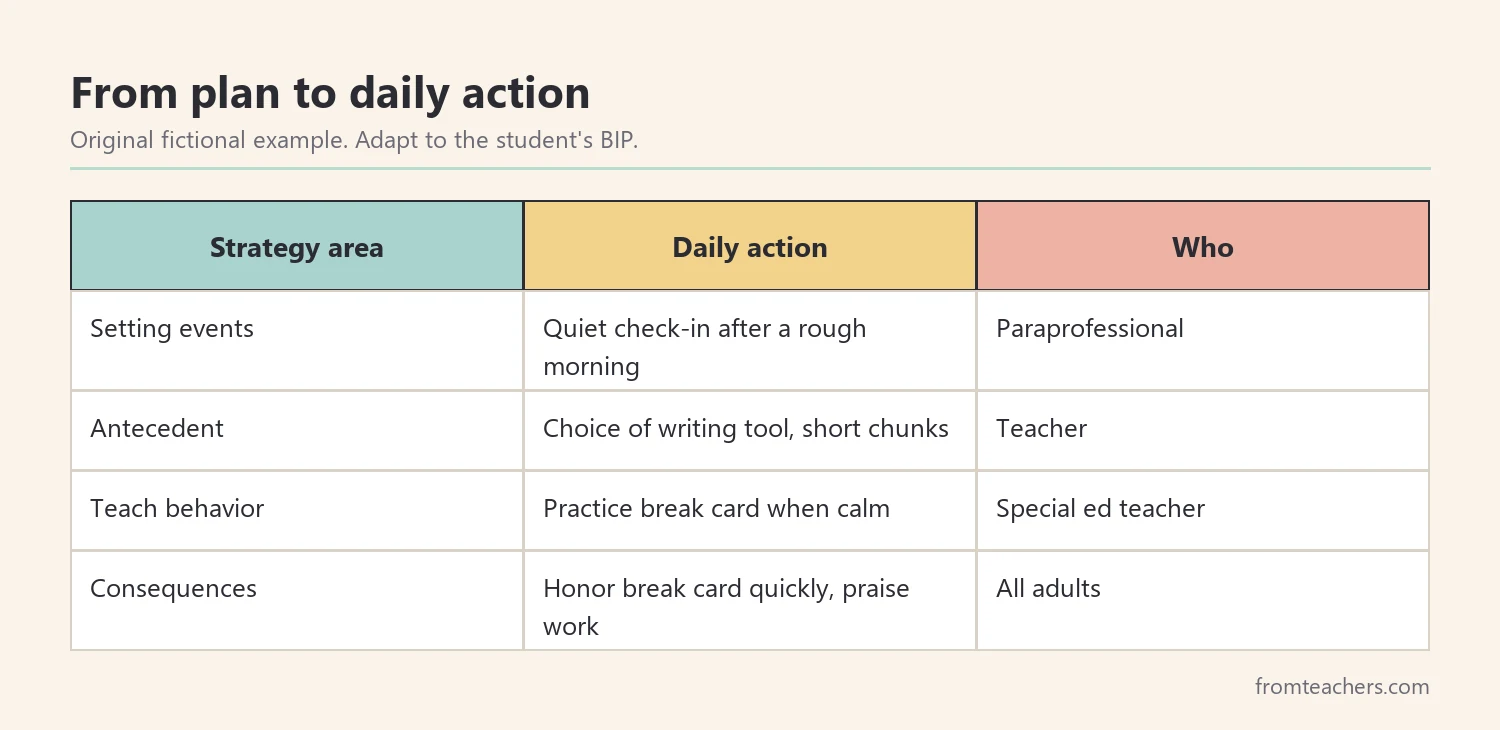
Finally, put the key actions on one page. A short card that fits in a lanyard or on a clipboard is more useful during the school day than a ten-page plan. When implementing a behavior intervention plan, the card is what adults will actually read.
2. Train every adult who works with the student
A BIP is only as strong as its weakest link. If the classroom teacher follows the plan but the lunch supervisor does not, the student learns that the behavior still works in some places. Therefore, everyone who regularly works with the student needs to know the plan.
Make a list of every adult who works with the student: classroom teacher, special education teacher, paraprofessionals, specialists, lunch and recess staff, and the bus driver if relevant. Then plan a short training for each, focused only on what they need to do.
In addition, practice, do not just explain. A short role-play makes a huge difference. One adult plays the student, another responds using the plan. Practice both the prevention steps and the response to the behavior. Many adults find that their first instinct, such as arguing back or removing the task, is exactly what the plan asks them not to do.
For Marcus, the team held a 20-minute training for the classroom teacher and two paraprofessionals. They role-played three scenes: starting a writing task, Marcus using his break card, and Marcus leaving his seat. By the end, each adult could describe the response in one sentence.
Also, plan for absences. Substitutes and new staff need a quick version of the plan. Keep a one-page summary in the substitute folder with the key prevention steps and the response to the behavior.
Moreover, involve the student and family where appropriate. Teaching the replacement behavior is part of the plan, and the student needs to know what to do instead. Families can support the same language at home, which helps the new skill grow.
Make the plan easy to follow
Even well-trained adults forget steps on a busy day. Therefore, build reminders into the environment so the plan does not depend on memory alone. A break card that lives on the student’s desk, a sticky note on the teacher’s planner, or a short visual on the paraprofessional’s clipboard can all prompt the right action at the right time.
In addition, keep the number of key actions small. A plan with fifteen strategies is hard to carry out with fidelity, while a plan with four or five core actions is realistic. If the BIP lists many strategies, ask the team which ones matter most in each routine and start there.
Also, check the plan against the real schedule. Marcus’s team noticed that the plan said “offer a choice of writing tool,” but the keyboard was in another room during science. Moving one keyboard to the science table made the action possible. Small practical details like this often decide whether a plan is followed.
3. Teach and reinforce the replacement behavior
The heart of most BIPs is the replacement behavior: a more acceptable way for the student to get the same result the problem behavior was getting. If a student leaves the room to escape a hard task, the replacement might be asking for a short break. If a student calls out for attention, the replacement might be raising a hand or using a signal card.
However, students rarely use a new behavior just because it is written in a plan. They need to be taught it directly, practiced it when calm, and see that it works better than the old behavior.
Start by teaching the skill at a calm time. Show the student the break card, explain when to use it, and practice a few times. Then, prompt it early in real situations. For Marcus, Ms. Lee placed the break card on his desk at the start of each writing task and pointed to it as she gave the directions.
Next, honor the replacement behavior quickly, especially at first. If Marcus uses his break card and has to wait five minutes, the old behavior will look more attractive. In the first weeks, the team agreed to honor every card within a few seconds.
Then, fade gradually. Once the replacement behavior is reliable, the team can slowly increase work time before breaks or reduce the number of breaks. These changes should be small and planned, not sudden.
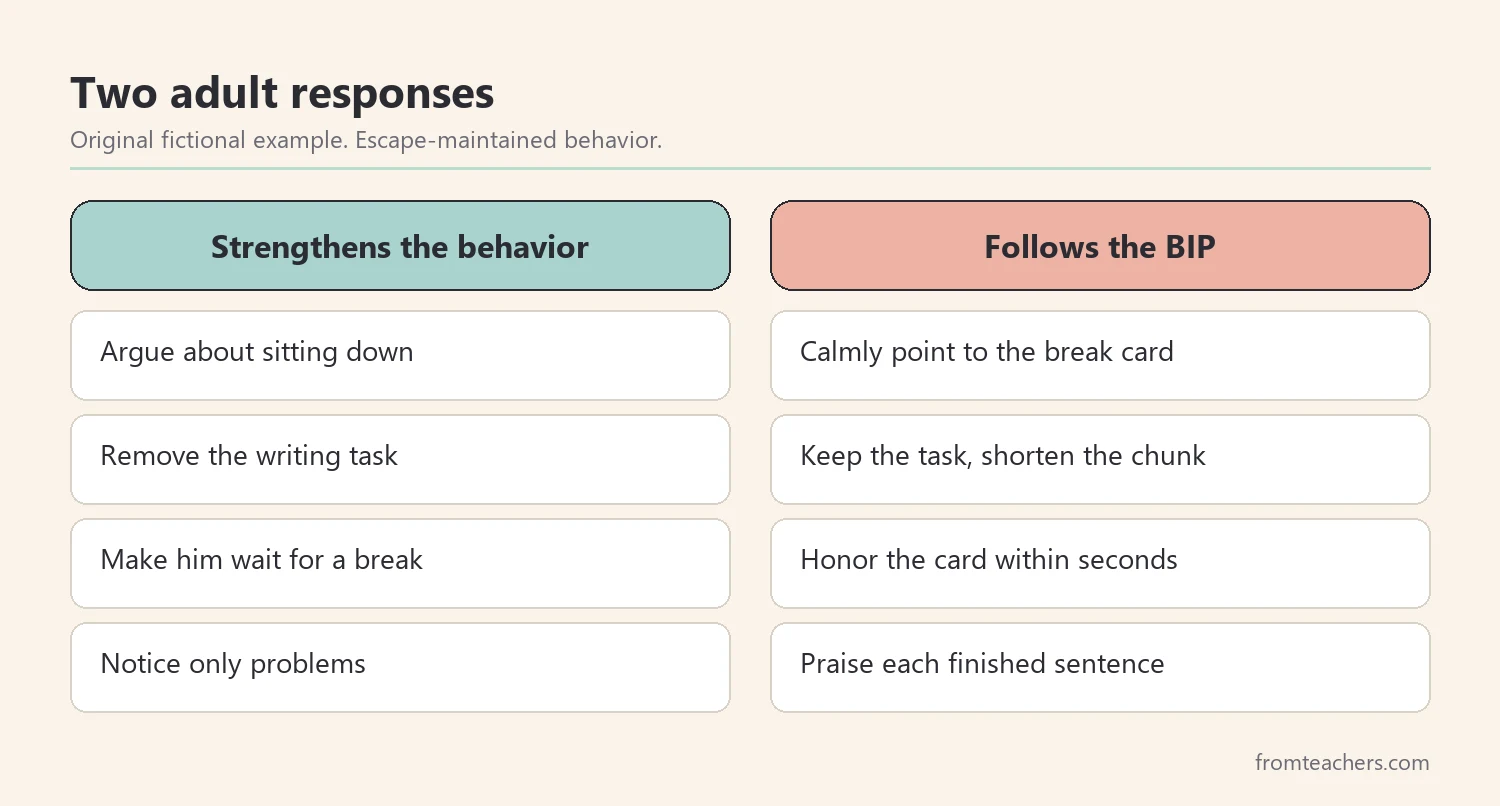
Also, reinforce the desired behavior. Beyond the replacement, most plans name a longer-term goal, such as completing writing tasks with fewer breaks. Notice and praise small steps toward that goal: “You wrote three sentences before your break today.”
4. Check fidelity, not just behavior
When a plan does not seem to work, the first question should be, “Is the plan being followed?” This is called implementation fidelity. Without checking it, a team can easily blame a good plan for poor results.
Keep fidelity checks simple. Use a short checklist of the key actions from the plan, and have someone observe for ten to fifteen minutes once a week. Each item gets a yes or no. The result is a percentage: how many of the planned actions actually happened.
For Marcus, the checklist had five items: choice of writing tool offered, break card on desk, directions given in short chunks, break honored quickly, and praise for work completed. A behavior specialist or co-teacher observed one writing block each week.
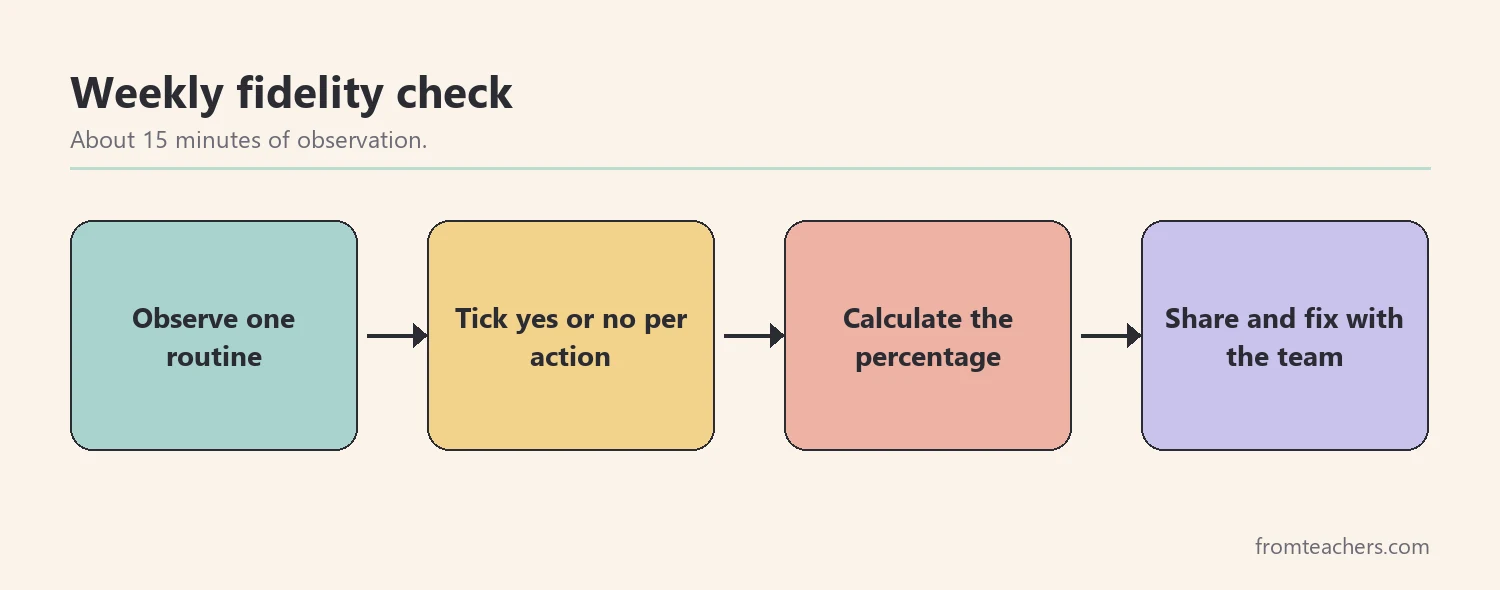
Share results kindly. Fidelity checks are not about catching adults out. Instead, they show where the plan is hard to follow and where more support is needed. For instance, Marcus’s team found that the break card was often missing from his desk on Mondays, because a different paraprofessional set up the room. A small fix solved it.
In addition, look for patterns. If one part of the plan is rarely followed, ask why. It may be unclear, impractical, or simply forgotten. Revising the action or adding a reminder often fixes the problem.
When implementing a behavior intervention plan, fidelity data and behavior data belong together. One without the other tells only half the story.
5. Read the data before you change the plan
Finally, give the plan a fair trial before deciding it does not work. Changing strategies every week makes it impossible to know what helps. Many teams agree on a review date, such as four to six weeks after the plan starts, unless safety concerns require faster action.
Track the target behavior the same way the FBA did, such as counting incidents per day or per writing block. Also track the replacement behavior, such as break card use. Put fidelity next to these numbers.
Here is Marcus’s data across six weeks:
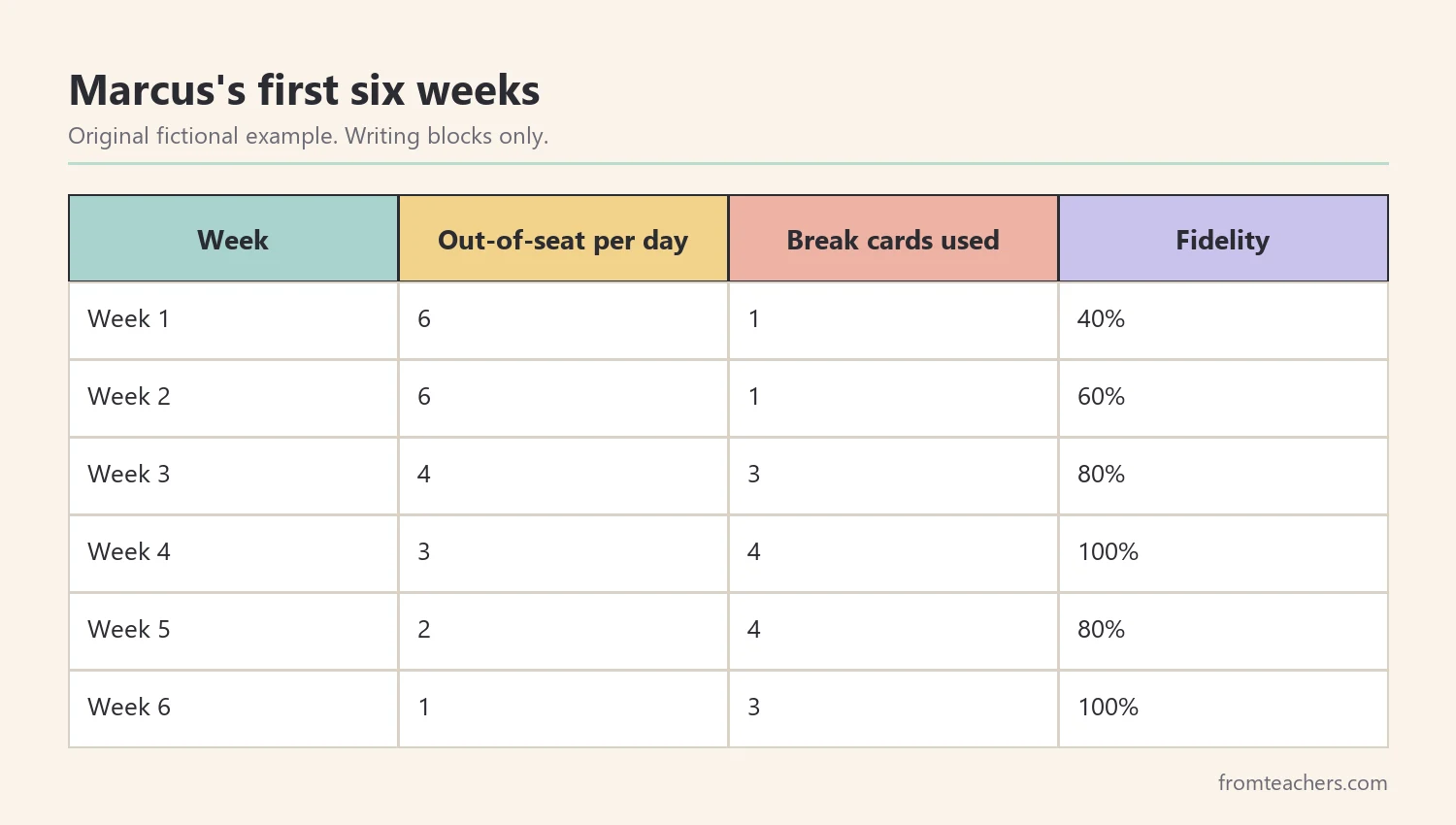
The data told a clear story. In weeks one and two, fidelity was low and incidents stayed high. After the Monday fix and a refresher training, fidelity stayed at 80 percent or higher. At the same time, break card use went up and out-of-seat incidents dropped. The plan was working once it was actually followed.
Use simple decision rules at review meetings:
- Fidelity low, behavior high: improve implementation before changing the plan.
- Fidelity high, behavior improving: keep going and plan gradual fading.
- Fidelity high, no improvement: revisit the FBA hypothesis and the plan with the team.
- New or more serious behavior: meet quickly and follow district procedures.
Moreover, keep the family informed. Share both good weeks and hard weeks, along with what the team is doing. Families who understand the data can support the plan more effectively at home.
Common mistakes and how to avoid them
- Filing the plan and forgetting it. A plan in a binder does not change behavior. Fix: turn it into a one-page action card for every adult.
- Training only the lead teacher. Other adults respond differently. Fix: train everyone who regularly works with the student.
- Not teaching the replacement behavior. Students cannot use a skill they have not learned. Fix: teach and practice it during calm times.
- Ignoring fidelity. Teams may blame the plan for poor implementation. Fix: run a short weekly fidelity check.
- Changing the plan too fast. Weekly changes make data meaningless. Fix: set a review date and decision rules in advance.
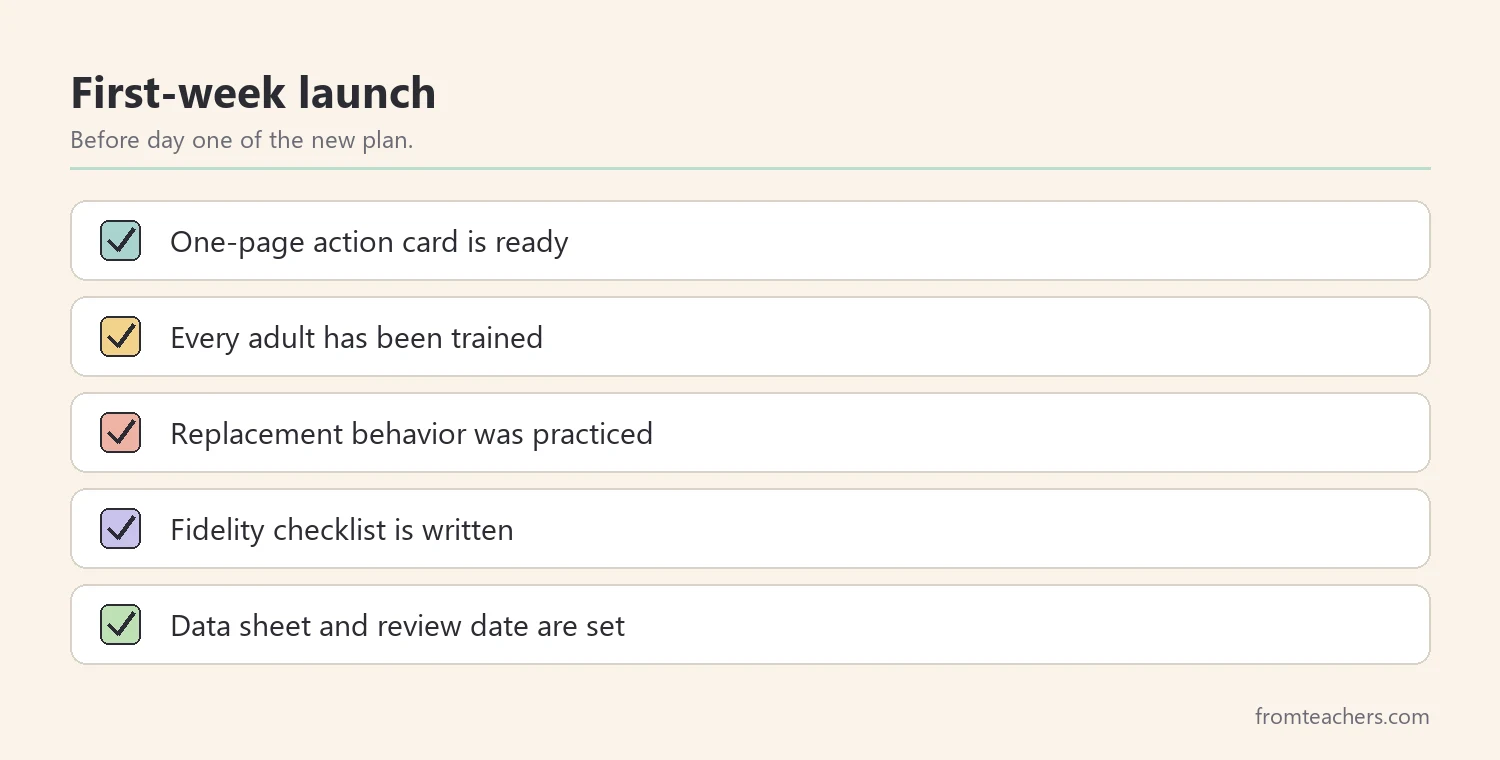
Questions teams ask about implementing a behavior intervention plan
How long should we try a BIP before changing it?
Many teams set a review date four to six weeks after the start, unless safety issues need faster action. The key is to check fidelity first, so you know the plan was actually tried.
Who should be trained on the plan?
Every adult who regularly works with the student, including paraprofessionals, specialists, and lunch or recess staff. Substitutes need a short summary.
What if behavior gets worse at first?
Some students test new responses at first, and behavior may increase briefly. Talk with your behavior specialist, keep the plan consistent, and watch the data closely. Always follow safety procedures.
Should the student know about the plan?
Where appropriate, yes. The student needs to learn the replacement behavior and understand how it helps. The level of detail depends on age and understanding.
How do we involve families?
Share the key parts of the plan, especially the replacement behavior and language used. Regular updates on data help families support the plan and share what they see at home.
Related reading: Moving Beyond Shame and Behavior Charts, The Power of Data Tracking in Special Education, and Meltdowns vs Tantrums: A Guide to Understanding and Responding.
You may also need: Behavior Contracts and Individual Behavior Plans Toolkit.
A companion resource for implementing a behavior intervention plan:
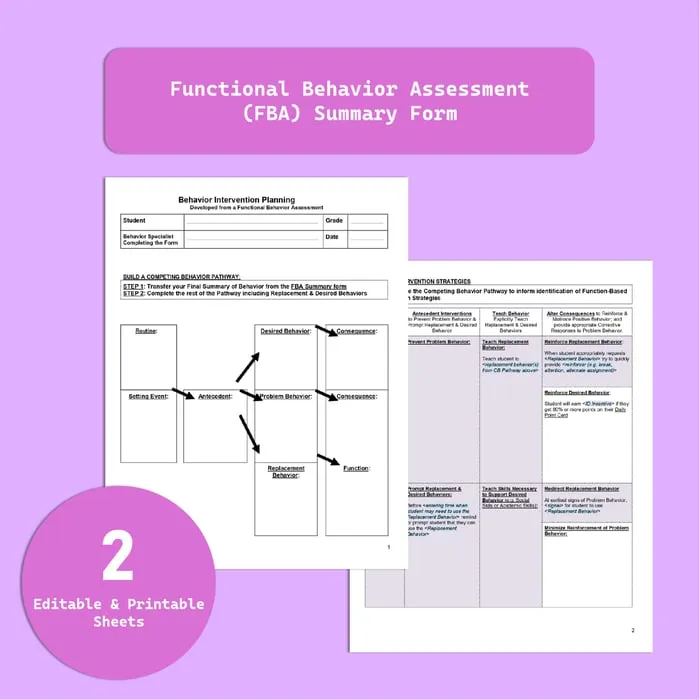
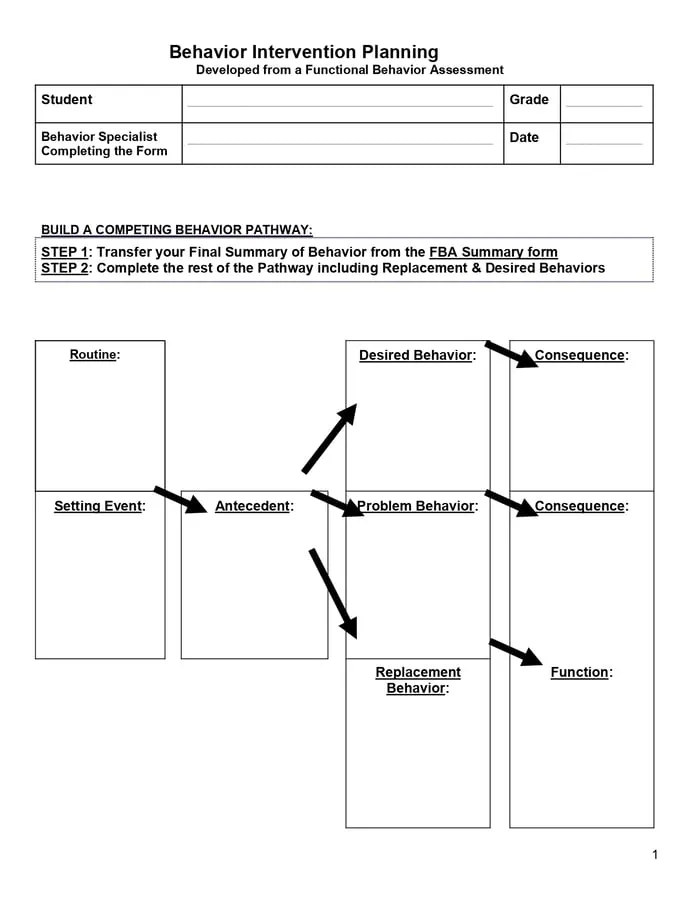
Behavior Intervention Plan (BIP) Template: Function-Based Strategies from FBA: a two-page template with space for your FBA summary, a full competing behavior pathway, and intervention strategies in four function-based sections, with sentence starters throughout.
Sources and scope
- Center on PBIS: resources on positive behavioral interventions and supports, including individual student supports.
- IRIS Center, Vanderbilt University: free modules on functional behavioral assessment and behavior intervention.
- National Center on Intensive Intervention: tools on data-based individualization and behavior support.
- Individuals with Disabilities Education Act (IDEA), U.S. Department of Education: federal guidance on behavior and the IEP.
This guide covers putting an existing BIP into daily practice. It does not cover conducting an FBA, crisis intervention, or legal requirements, which follow your district’s procedures and qualified professionals.
Key takeaways
- Implementing a behavior intervention plan means turning it into daily actions.
- Every adult who works with the student needs short, practical training.
- Replacement behaviors must be taught, prompted, and honored quickly.
- Fidelity checks show whether the plan is really being followed.
- Give the plan a fair trial and use clear decision rules at review.










Leave a Comment