

Teaching replacement behaviors starts with a simple question: what is this behavior getting the student? Picture a third grader who tears his writing page in half the moment the prompt goes up. The adults see a torn page and a lost lesson. The student, however, has learned that tearing the page ends a task that feels too hard.
This guide walks your team through a five-step process: define the behavior, find its function, choose a skill that meets the same need, teach it like any other lesson, and then reinforce, track, and review. By the end, you will be able to write the replacement behavior section of a behavior plan that everyone on the team can actually use.
Examples are fictional. Adapt to the student’s goals and agreed supports. This is guidance, not a diagnosis.
At a glance
- Describe the behavior in words two adults would record the same way.
- Find what the behavior gets or avoids before you pick a new skill.
- Choose a replacement that meets the same need and is easier to use.
- Teach the new skill with modeling, practice, prompts, and quick reinforcement.
- Track one or two simple measures and review them as a team.
1. Define the behavior before teaching replacement behaviors
First, write down exactly what the student does. A vague label such as “defiant” or “disruptive” cannot be counted, and it hides the details your plan needs. Instead, describe the action so clearly that a substitute could recognize it on the first day.
Next, test your definition with a simple check. Could two adults watch the same lesson and agree on how many times it happened? If not, the wording is still too loose. In addition, note what the behavior is not, so small moments do not get counted by mistake.
| Vague label | Observable definition |
|---|---|
| Defiant during writing | Tears or crumples the writing page |
| Disruptive | Calls out during teacher talk |
| Aggressive | Pushes a peer with hands |
| Off task | Leaves seat without asking |
Then, decide how you will measure it, because teaching replacement behaviors without a baseline leaves the team guessing. Frequency works well for short, clear actions like tearing a page. Duration works better for longer events such as crying or refusing to start. Keep the measure simple enough that busy adults will record it every day.
Worked example. Leo is a fictional student in grade 3. His team first wrote “Leo refuses writing.” After talking it through, they changed it to “Leo tears or crumples his writing page within the first five minutes of a writing task.” Now the classroom teacher, the paraprofessional, and the special education teacher all count the same thing.
In short, a clear definition is the foundation for teaching replacement behaviors. Without it, nobody can tell whether the plan is working.
2. Find the function of the behavior
Every behavior that repeats is doing a job for the student. Most teams group these jobs into four common functions: escaping or avoiding something, gaining attention, getting access to an item or activity, and sensory input. Teaching replacement behaviors only works when the new skill does the same job.
To find the function, collect ABC notes for several days. Write what happened just before the behavior (the antecedent), the behavior itself, and what happened right after (the consequence). Over time, a pattern usually appears. For example, if the behavior often ends a task, escape is a strong possibility.
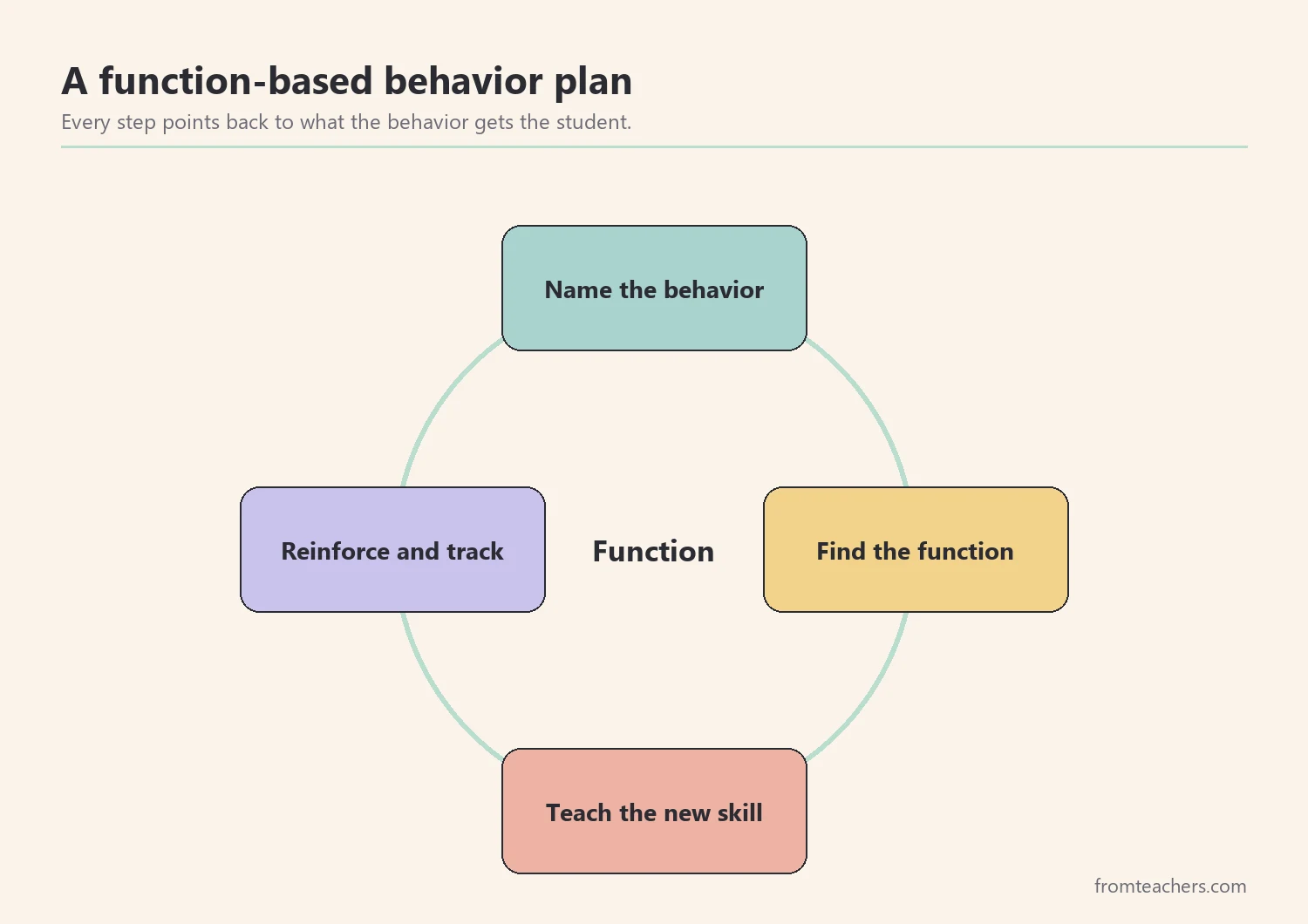
However, treat your first guess as a hypothesis, not a fact. Teaching replacement behaviors based on the wrong function wastes weeks. A behavior can serve more than one function, and the pattern can change across settings. For students with significant or dangerous behavior, the team usually completes a functional behavior assessment (FBA) led by a trained professional.
- Antecedent: what was the task, who was nearby, and what was asked?
- Behavior: what did the student do, using your agreed definition?
- Consequence: what did adults and peers do right after?
- Outcome: what did the student get or avoid as a result?
Worked example. Over eight writing lessons, Leo tore his page six times. In five of those six, the teacher sent him to the reading corner to calm down, so the writing task ended. The team’s hypothesis: Leo tears the page to escape writing that feels too hard, especially a blank page with no starter.
As a result, the team now knows what the new skill must do. It must give Leo a safe, accepted way to get a break or get help with writing.
3. Choose a replacement that meets the same need
This is the heart of teaching replacement behaviors. The new behavior must give the student the same outcome as the old one, and it must be easier and faster to use. If the old behavior still works better, the student will keep using it.
A good replacement behavior is functionally equivalent, quick to perform, and easy for adults to honor right away. It should also be socially acceptable in the setting. For example, a student who escapes hard work might learn to ask for a short break, ask for help, or choose an easier starting point.
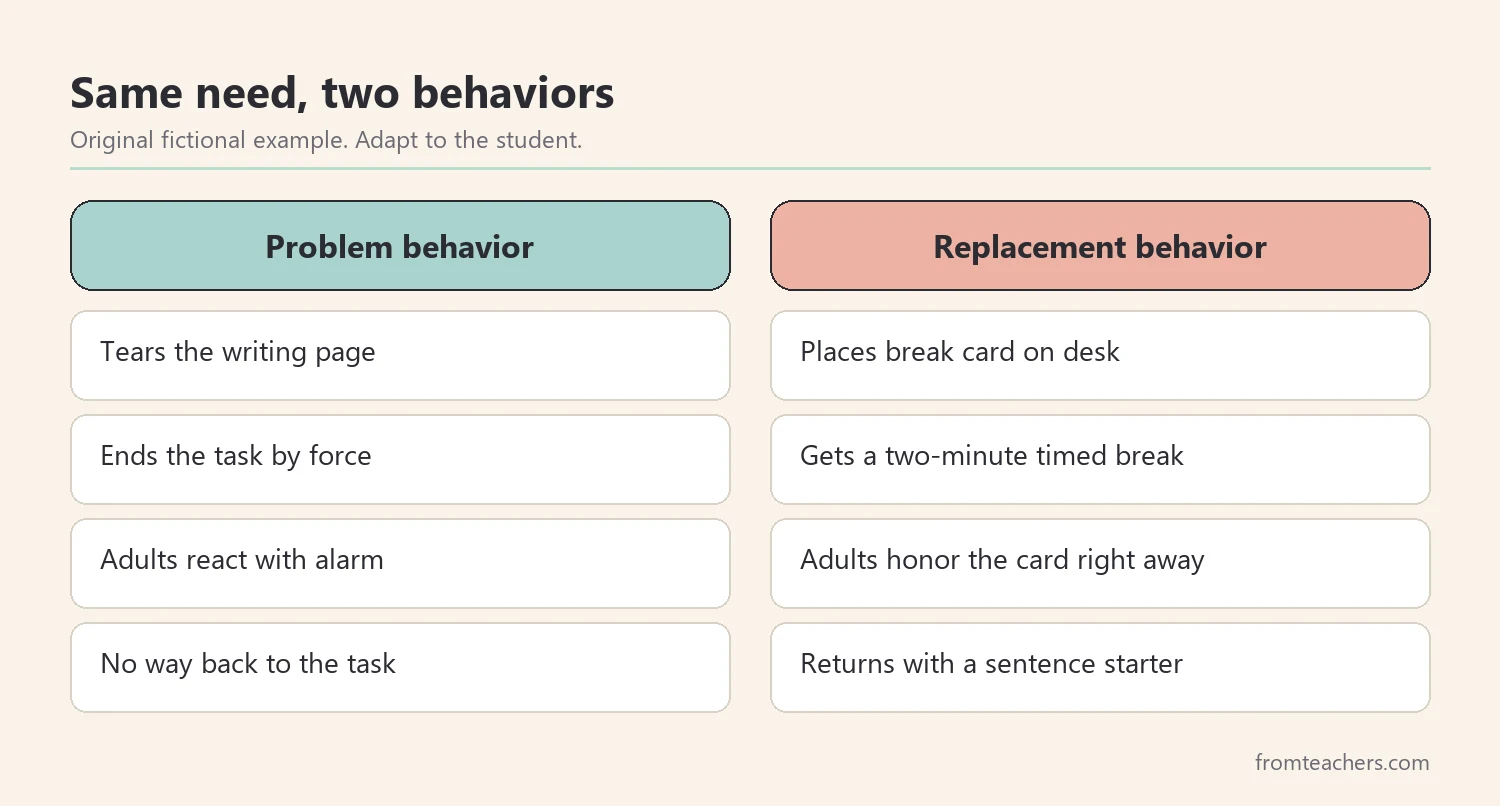
Next, match the replacement to the student’s communication skills, which is easy to overlook when teaching replacement behaviors. A student who speaks easily might say “Can I have a break?” Meanwhile, a student who struggles with words in hard moments might hand over a break card or point to a picture. The easier the skill, the faster it can compete with the old behavior.
| Function | Possible replacement |
|---|---|
| Escape a hard task | Hand a break card or ask for help |
| Gain attention | Raise a hand or use a check-in signal |
| Access an item | Request it with words or a picture |
| Sensory input | Use an agreed fidget or movement break |
Also, write the replacement into the plan clearly, with the teaching method beside it. A form such as the Comprehensive BIP Form template keeps the function, the replacement behavior, and the teaching methods on one page, so every adult reads the same plan.
Worked example. Leo’s team chooses a break card. When writing feels too hard, he places the card on the corner of his desk and gets a two-minute break at the reading corner with a timer. When the timer ends, he returns and gets a sentence starter to begin.
4. Teach replacement behaviors step by step
A replacement behavior is a skill, so teach it the way you teach any skill. Announcing a new rule once is not enough. Instead, plan short lessons, practice when the student is calm, and support the skill in real moments.
Teaching replacement behaviors usually follows five moves. First, model the skill yourself. Next, practice it with the student during calm times. Then, prompt it in real situations, reinforce every correct use, and finally fade your prompts as the student becomes independent.
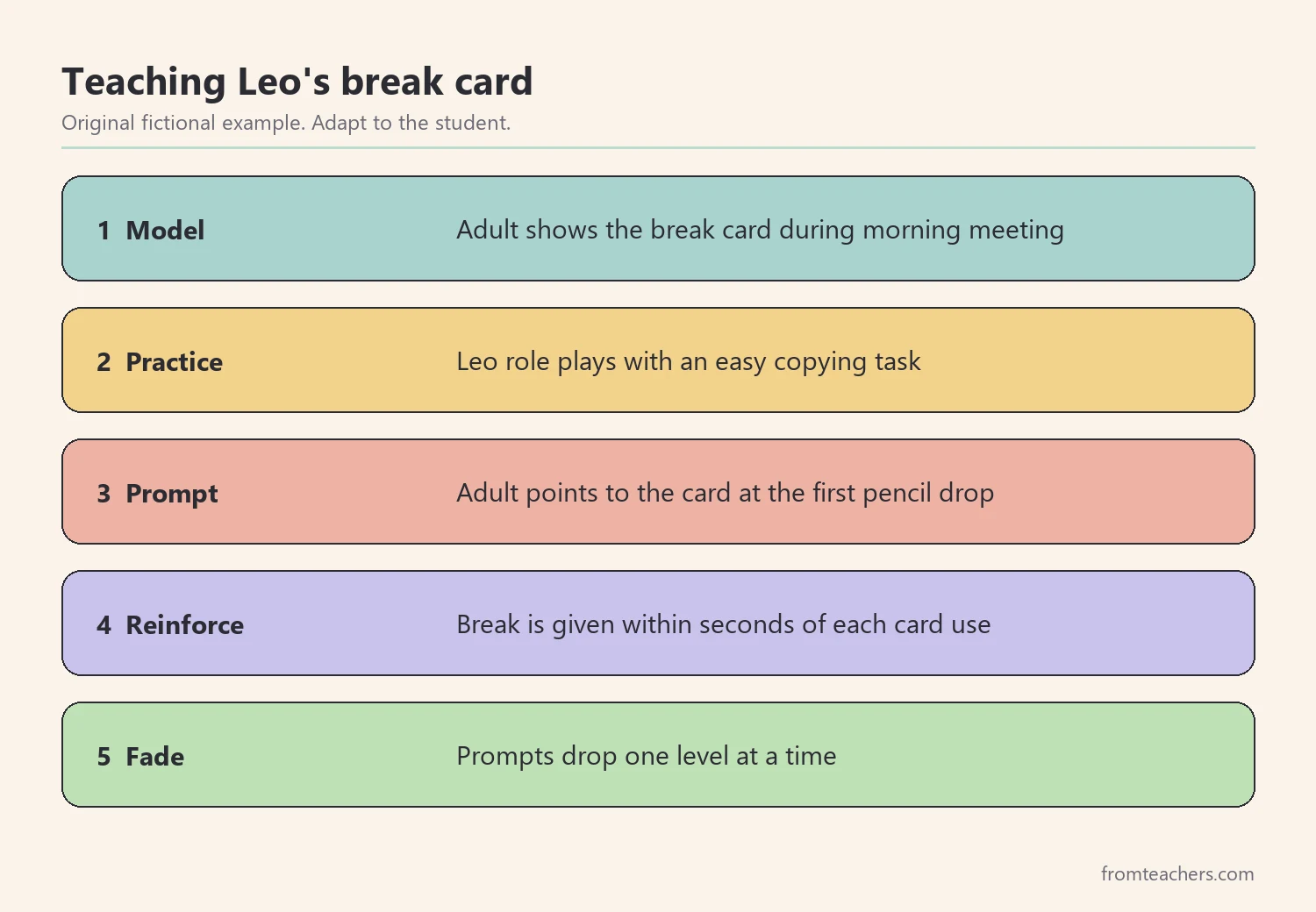
During practice, keep sessions brief, around five minutes. Short, frequent practice is one of the quiet secrets of teaching replacement behaviors. Use role play with easy tasks first, then with tasks that look a little harder. Meanwhile, praise the exact action: “You put the break card down. That is how you ask for a break.”
In real moments, prompt early. Watch for early signs, such as a sigh, a pencil drop, or staring at a blank page. At that point, point to the card or say “Card?” quietly. Prompting before the old behavior starts gives the new skill a chance to win.
Teaching checklist
- Model the skill at least twice before asking the student to try it.
- Practice daily for the first week, in calm moments.
- Honor every correct use right away, especially early on.
- Use the same words and signals across all adults.
- Fade prompts slowly, one level at a time.
Worked example. The special education teacher models the break card during a morning meeting. Leo then practices with a short copying task three times in one week. During writing, the paraprofessional watches for his pencil drop and points to the card. Each time Leo uses it, he gets his break within seconds.
5. Reinforce, track, and review as a team
At first, the replacement behavior must pay off every single time. If a student hands over a break card and waits two minutes for an answer, the old behavior will look faster. Therefore, honor the new skill immediately and generously in the early weeks.
Meanwhile, keep reinforcement for the new skill separate from the problem behavior. When the old behavior happens, respond calmly and briefly, and avoid letting it bring the same outcome. In Leo’s case, tearing the page no longer leads to the reading corner. Instead, an adult calmly offers the break card.
Next, track one or two measures. For teaching replacement behaviors, two numbers tell most of the story: how often the problem behavior happens and how often the student uses the new skill. In addition, note whether the student needed a prompt.
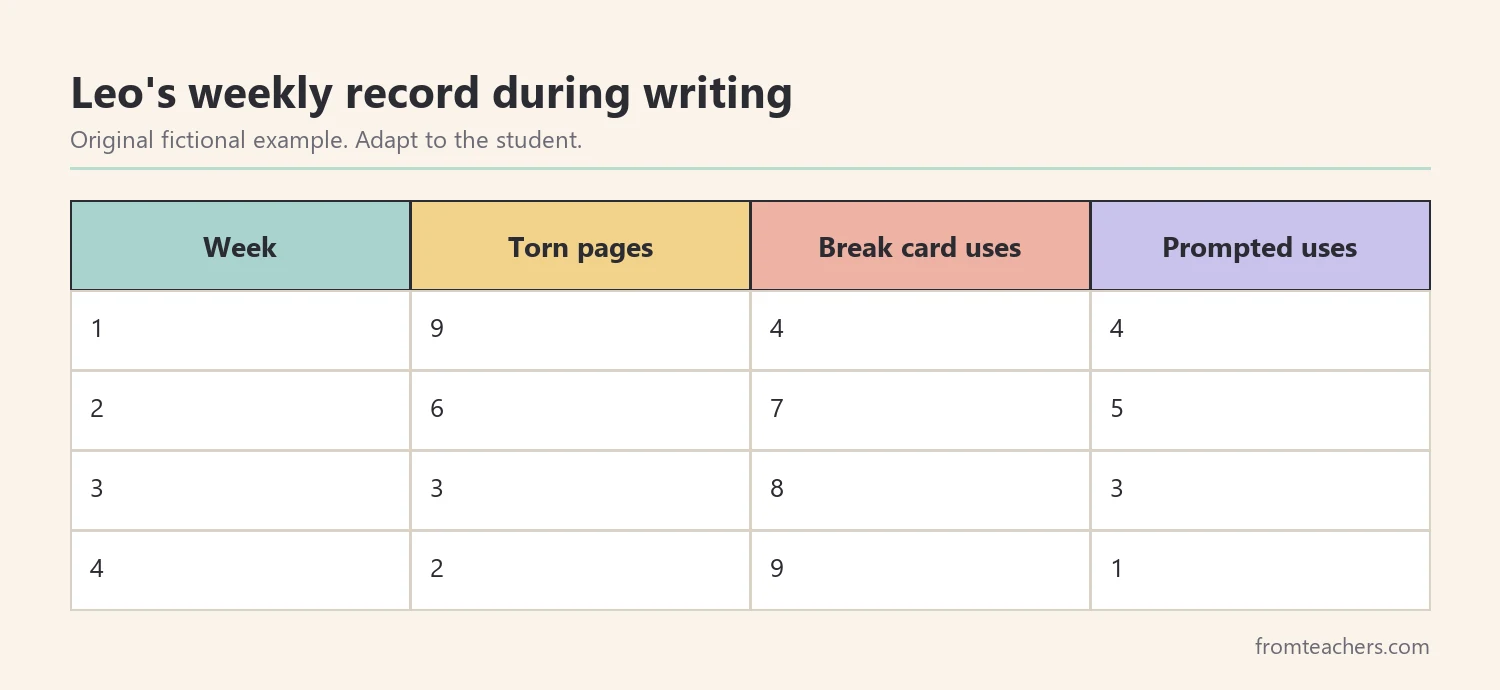
Then, review the data every two to four weeks as a team, since teaching replacement behaviors is a shared job. Ask whether the problem behavior is dropping, whether the new skill is rising, and whether prompts are fading. Once the skill is steady, start shaping it. For example, slowly stretch work time before a break or teach a second skill, such as asking for help.
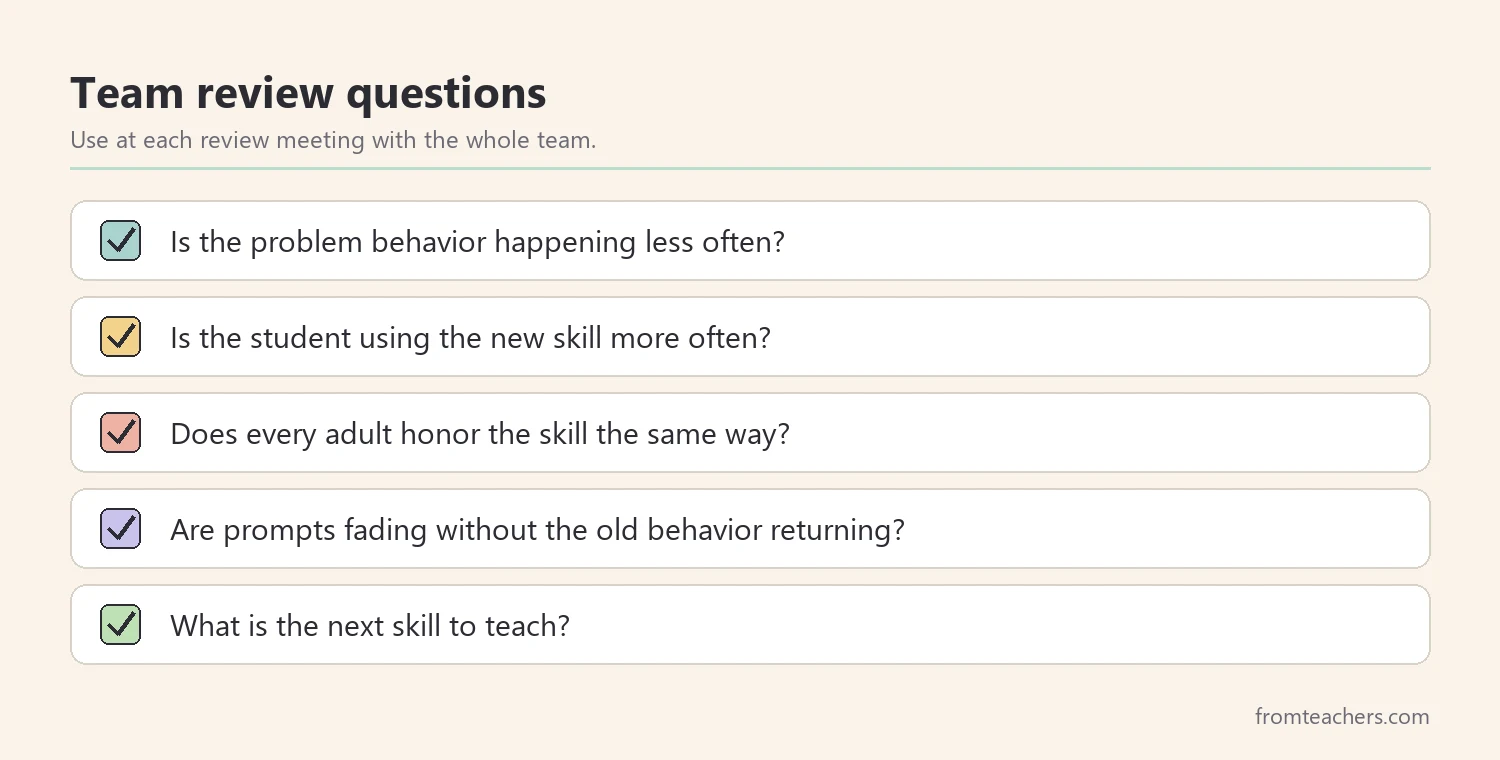
Worked example. Across four weeks, Leo’s torn pages drop from 9 to 2 per week. His break card use rises from 4 to 9, and prompted uses fall from 4 to 1. At the review meeting, the team decides to add a “help” card next, so Leo can stay with the task more often instead of always leaving it.
Finally, share progress with the family. Teaching replacement behaviors at school goes further when home uses the same words. Parents can use a similar card or phrase at home during homework, which helps the skill transfer across settings.
Common mistakes and how to avoid them
- Picking a replacement that does not match the function. Teaching a student to “sit quietly” does not meet an escape need. Fix: choose a skill that gives the same outcome, such as a break or help.
- Making the new skill harder than the old behavior. If asking takes longer than tearing, tearing wins. Fix: make the replacement quick, simple, and honored right away.
- Teaching only during a crisis. Students cannot learn new skills when they are upset. Fix: practice in calm moments and prompt early in real ones.
- Inconsistent adults. One adult honors the card and another ignores it. Fix: share one written plan and the same script with everyone.
- Fading support too fast. Removing prompts and reinforcement early can bring the old behavior back. Fix: fade one step at a time and watch the data.
- Stopping at the break. A student who always leaves the task misses learning. Fix: once the break skill is steady, teach help-seeking and slowly stretch work time.
Questions teachers and parents ask about teaching replacement behaviors
How long does teaching replacement behaviors usually take?
It varies by student, behavior, and how consistent the team is. Some students use a new skill within days, while others need several weeks of practice. Your weekly data will show whether teaching replacement behaviors is paying off for this student.
What if the student uses the break card too often?
Early on, frequent use is a good sign, because it means the skill works. Once the skill is steady, the team can slowly stretch work time or add a help request. Also, check whether the task itself needs adjusting.
Is a replacement behavior the same as a consequence?
No. A consequence is how adults respond after a behavior. A replacement behavior is a new skill the student learns to use instead, so both belong in a complete behavior plan.
Can parents use teaching replacement behaviors at home?
Yes. Families can use the same card, phrase, or signal during homework or chores. Using the same skill at home and school helps the student generalize it faster.
Do we need an FBA before teaching replacement behaviors?
For mild, everyday behaviors, careful ABC notes are often enough to form a hypothesis. For serious, frequent, or unsafe behavior, teams usually complete a formal FBA. Your school’s procedures and the student’s IEP team guide that decision.
Related reading: Moving Beyond Shame and Behavior Charts: Positive Alternatives for Effective Classroom Management, Meltdowns vs Tantrums: A Guide to Understanding and Responding, and The Power of Data Tracking in Special Education.
A companion resource for teaching replacement behaviors:
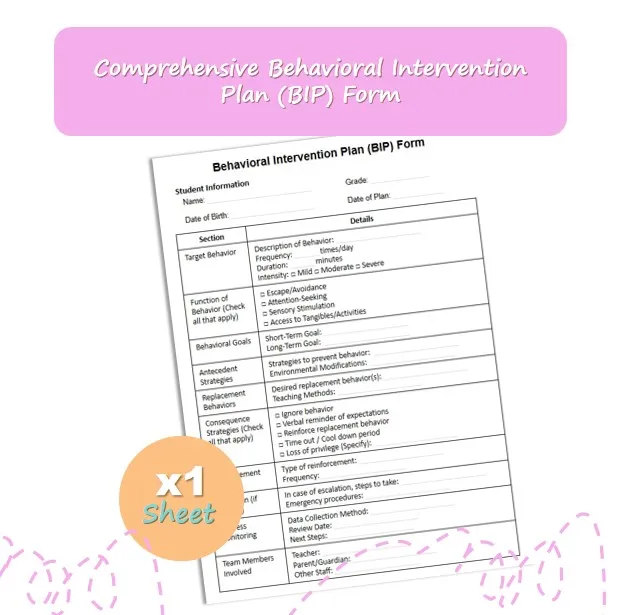
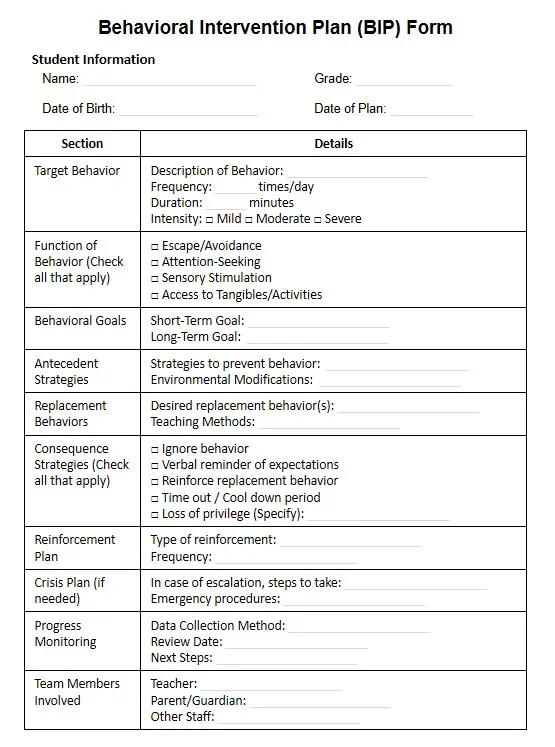
Comprehensive BIP Form: Function-Based Behavior Intervention Plan Template: a one-page, ready-to-fill BIP form with sections for the target behavior, its function, goals, antecedent strategies, replacement behaviors and teaching methods, consequence strategies, reinforcement, a crisis plan, progress monitoring, and team members.
Sources and scope
- IRIS Center, Vanderbilt University: free modules on functional behavior assessment, behavior plans, and classroom behavior.
- Center on PBIS: resources on positive behavioral interventions and supports for schools.
- IDEA, U.S. Department of Education: the law behind special education services, IEPs, and behavior supports.
- What Works Clearinghouse: reviews of education research, including behavior-related practices.
This guide covers everyday steps for choosing and teaching replacement behaviors in school. It does not replace a formal FBA, crisis training, or the judgment of the student’s IEP team and qualified behavior professionals.
Key takeaways
- Teaching replacement behaviors begins with a clear, countable definition.
- Find the function first, because the new skill must meet the same need.
- When teaching replacement behaviors, make the new skill faster and easier than the old one.
- Teach it with modeling, calm practice, early prompts, and quick reinforcement.
- Track the old behavior and the new skill, and review the data as a team.







Leave a Comment