

Teacher self-care strategies matter most on the days when there is no time for them. Picture a special education teacher at 6:40 p.m., still at her desk, with two IEP drafts open, a parent email waiting, and a progress report due tomorrow. She loves the job. However, she is starting to wonder how long she can keep doing it this way.
This guide treats self-care as a work system, not a bubble bath. You will audit where your energy goes, organize your caseload, set clear boundaries, build small recovery habits into the school day, and review your week with a short self-check. By the end, you will have a realistic plan you can start on Monday.
Examples are fictional. Adapt them to your own role, school, and contract. This is general guidance, not medical or mental health advice.
At a glance
- Start by tracking one week of work, so you fix the real drains.
- Put every due date on one master calendar and batch similar tasks.
- Write down your boundaries and share them kindly with your team.
- Build tiny recovery habits into the school day, not only after it.
- Use a five-minute weekly self-check to catch warning signs early.
1. Audit your week before choosing teacher self-care strategies
First, find out where your time and energy actually go. Many teachers try teacher self-care strategies that do not touch the real problem, such as a new morning routine when the true drain is evening paperwork. A one-week audit shows you what to fix first.
Next, keep a simple log for five school days. At the end of each day, write how long you spent on the main tasks outside direct teaching: paperwork, meetings, parent communication, and planning. In addition, mark each task as energizing, neutral, or draining.
| Task type | Questions to ask |
|---|---|
| Paperwork | Which forms take longest? Can any be batched? |
| Meetings | Which ones need me? Which could be shorter? |
| Parent communication | When do I answer? Can templates help? |
| Planning | Am I rebuilding things I could reuse? |
Then, look for patterns. Perhaps most of your draining hours land on two evenings, or a single recurring meeting eats an hour without a clear purpose. These patterns tell you which of the teacher self-care strategies in this guide to start with.
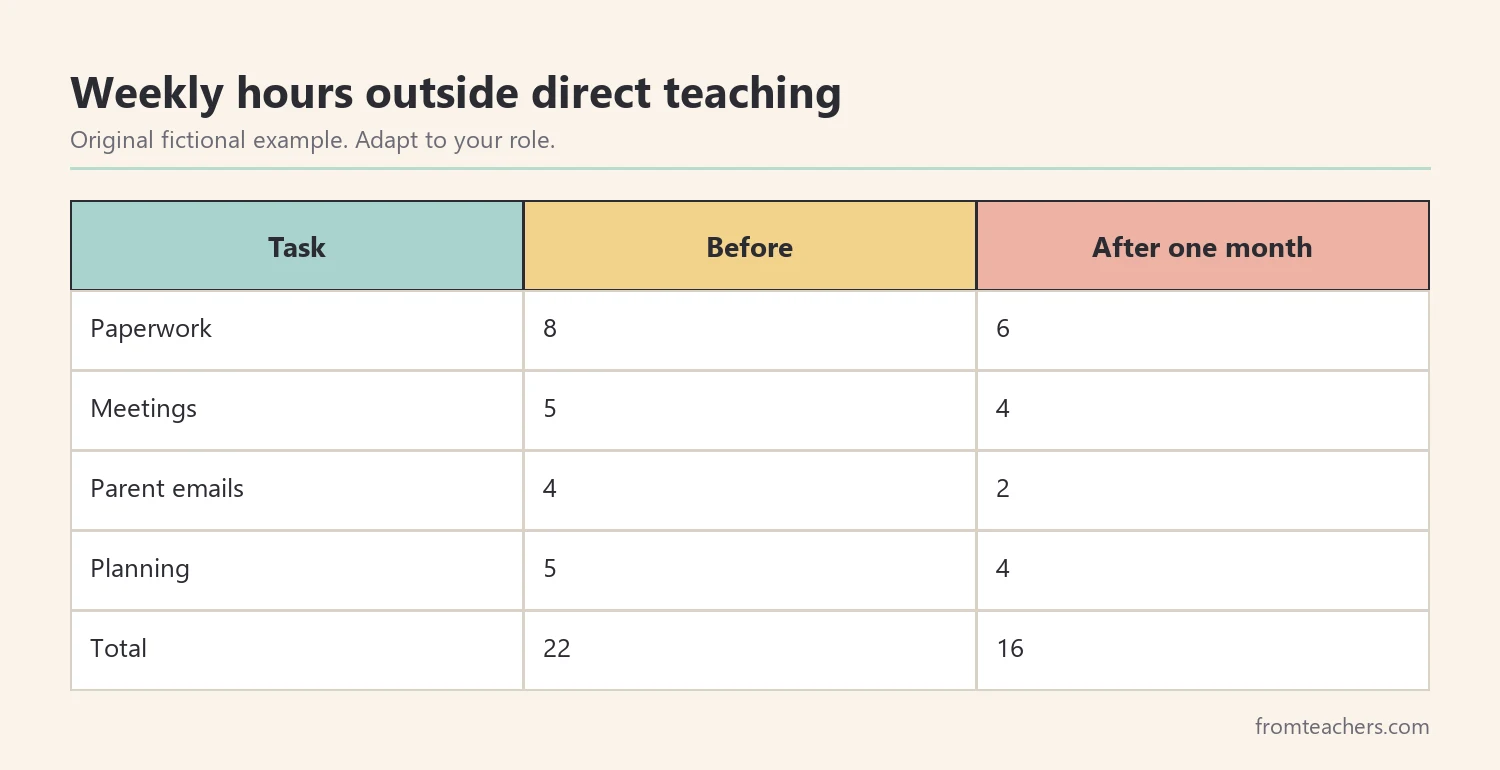
Worked example. Ms. Rivera is a fictional special education teacher with a caseload of 18 students. Her audit shows 22 hours a week of work outside direct teaching: 8 hours of paperwork, 5 of meetings, 4 of parent emails, and 5 of planning. Most of the paperwork happens at home after 8 p.m., and she marks it as her most draining task.
In short, the audit turns a vague feeling of overload into a short list of specific targets. Moreover, it gives you real numbers to compare later, which makes it easier to see whether your teacher self-care strategies are paying off.
Be honest while you log. It is tempting to round down the hours spent on email or to skip the evening when you worked late. However, the audit only helps if it shows the week as it really was. Nobody else needs to see it.
2. Organize your caseload with one master calendar
For special education staff, many teacher self-care strategies start with organization. Missed deadlines and surprise meetings create stress that no weekend can fully undo. Therefore, put every key date in one place you check daily.
Start with a master calendar for the whole year. Add each student’s annual IEP review date, reevaluation date, and progress report dates. Then, work backward and add reminders, for example drafting the IEP three weeks before the meeting and sending the draft to the family one week before.
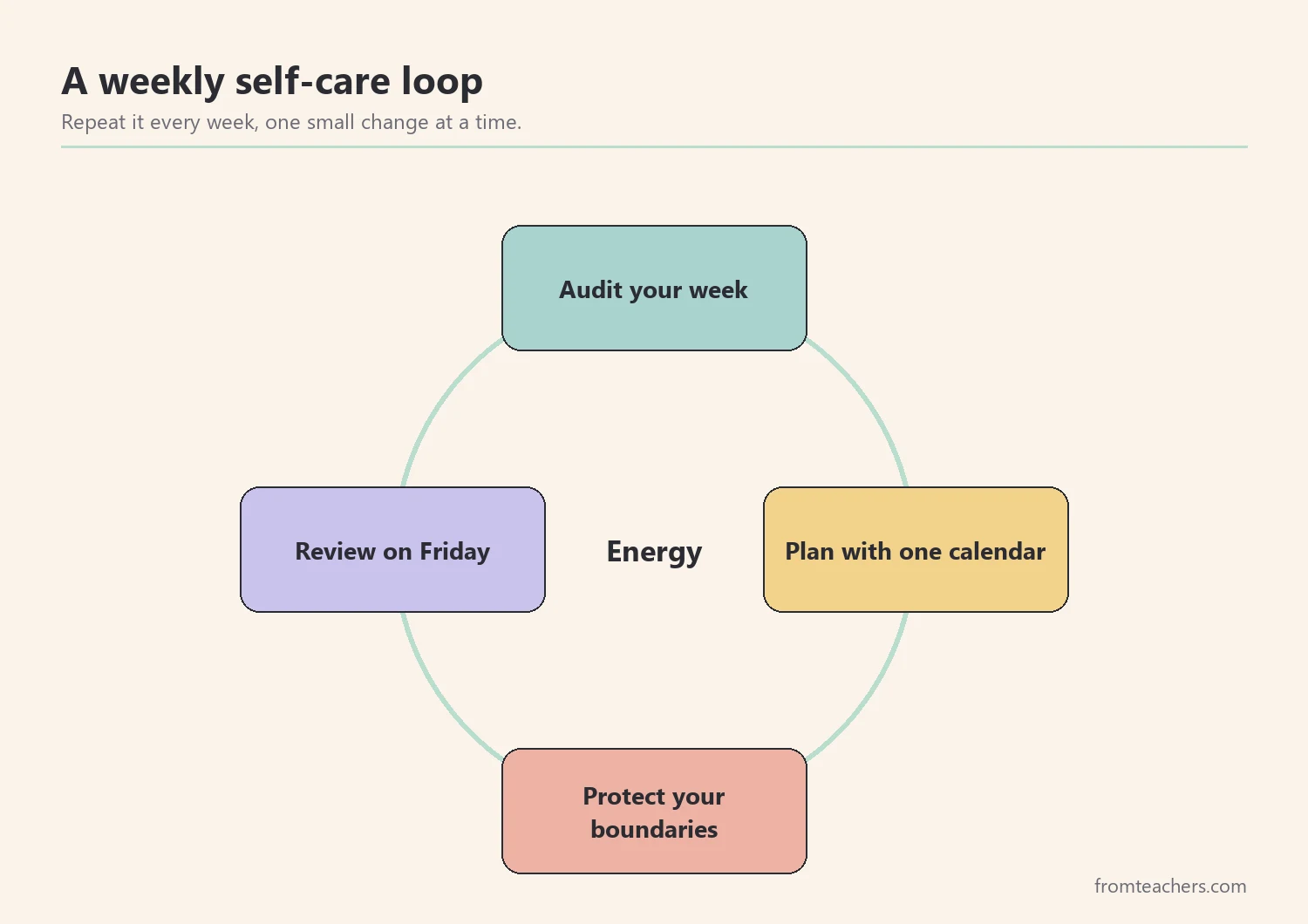
Next, batch similar tasks. Writing three progress reports in one focused block is usually faster than writing them on three different nights. Likewise, answer routine parent emails at set times instead of all day long. Batching reduces the mental cost of switching between tasks, which is why it appears in so many teacher self-care strategies for busy case managers.
- One master calendar for IEP, reevaluation, and progress report dates.
- A caseload tracker with each student’s services and key contacts.
- Two or three set blocks a week for paperwork.
- Saved templates for common emails and meeting notices.
- A reusable goal language bank you edit for each student.
Also, keep your tools simple. A guide such as the Special Education Teacher Survival Guide includes a caseload master tracker, a compliance calendar, and parent communication templates, so you do not have to build every system from scratch.
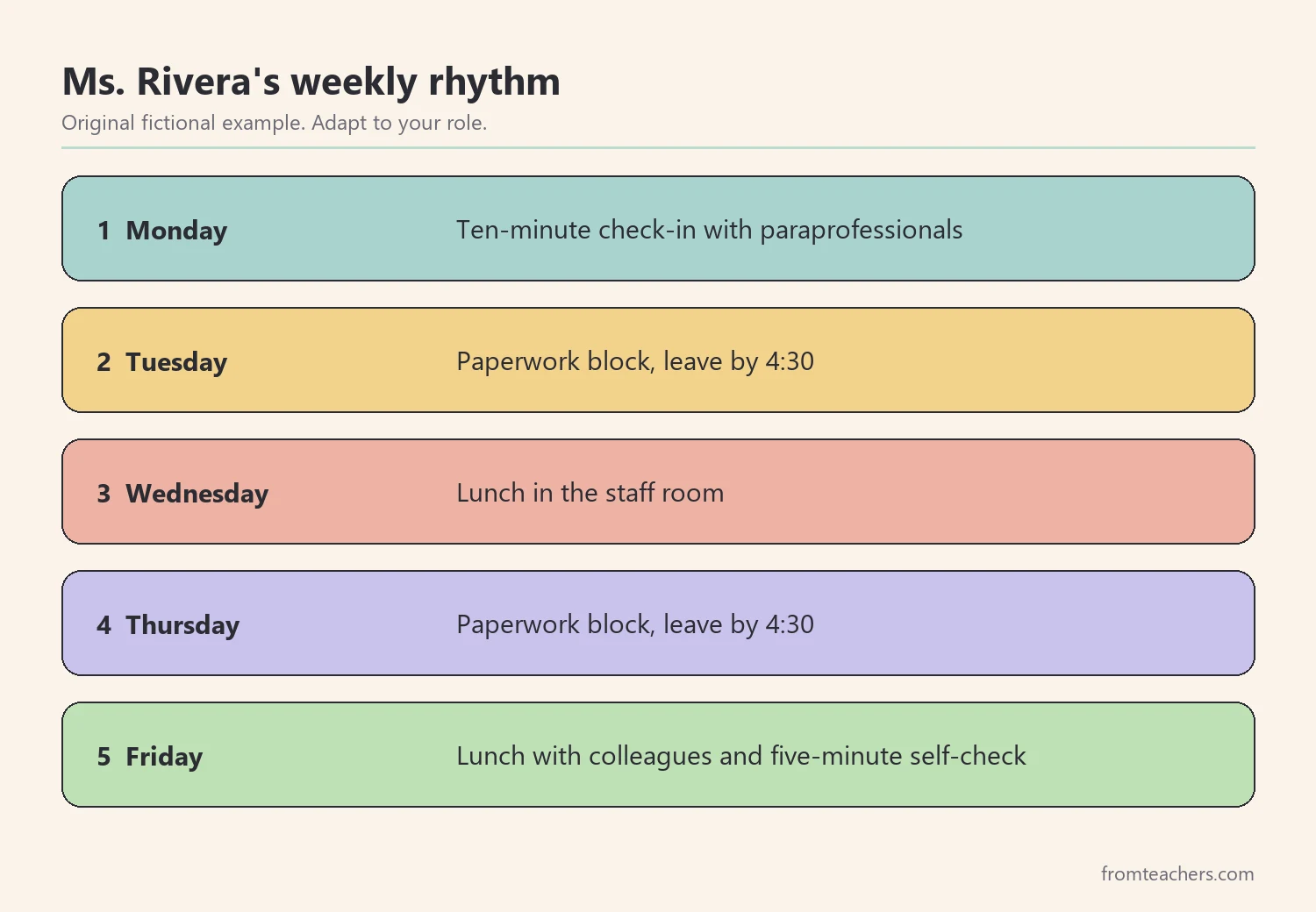
Worked example. Ms. Rivera builds a master calendar in August with all 18 annual review dates. She sets two paperwork blocks a week during her planning period and uses templates for meeting notices. After a month, her paperwork drops from 8 to 6 hours a week, and very little of it happens at home.
3. Set boundaries as core teacher self-care strategies
Boundaries are not about caring less. Instead, they protect the energy you need to keep caring well. Without them, work slowly spreads into every evening and weekend.
Begin by writing down three or four boundaries in plain words. For example: “I answer non-urgent emails between 7:30 and 8:00 a.m. and 3:30 and 4:00 p.m.” or “I leave school by 4:30 on Tuesdays and Thursdays.” Written boundaries are easier to keep than vague intentions.
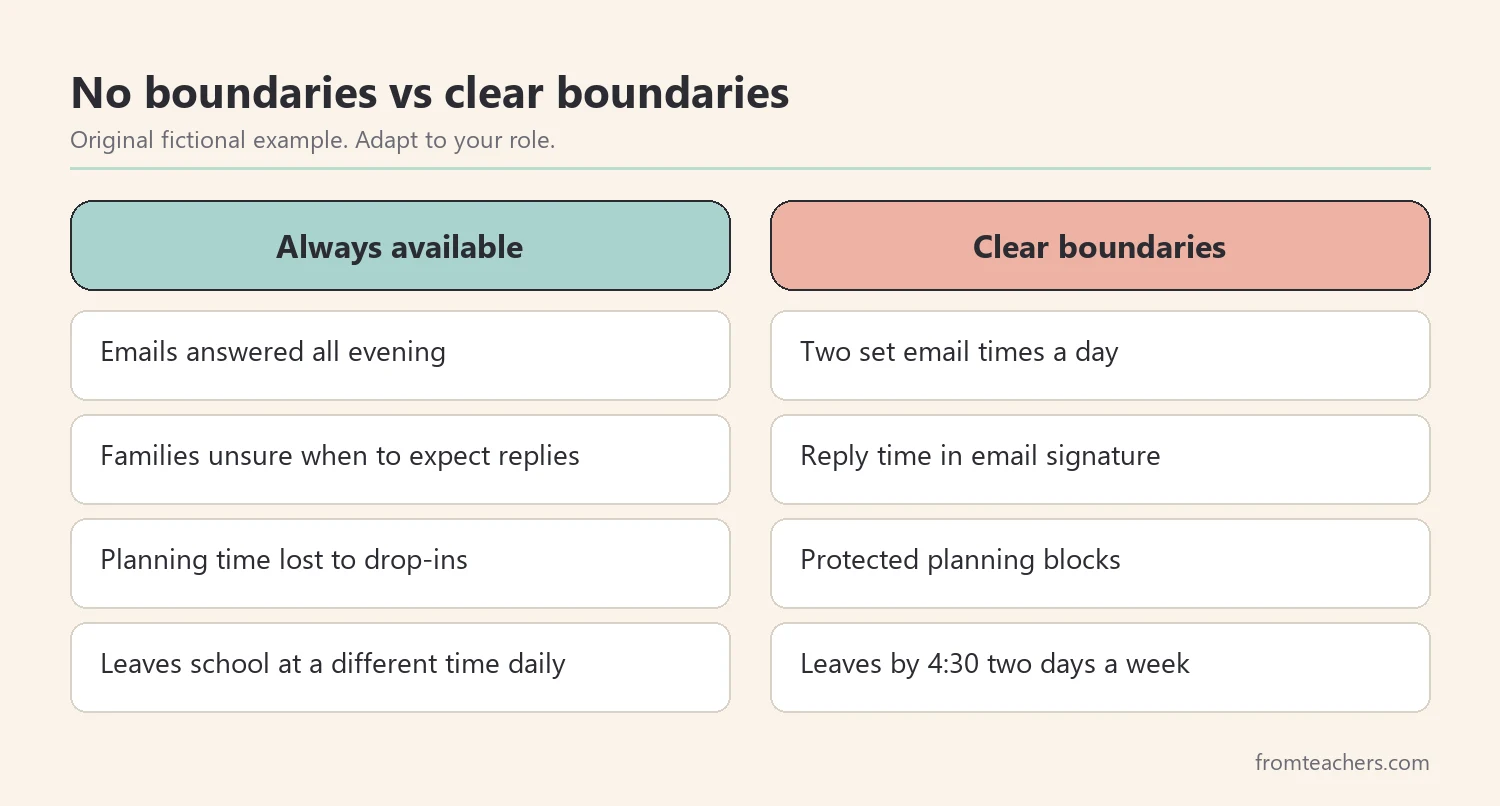
Next, share your boundaries kindly. Tell families when they can expect a reply, and include it in your email signature. Meanwhile, let your team know which times you protect for planning. Most colleagues respect a boundary that is clear and consistent. In fact, predictable availability often builds more trust with families than instant replies, because they know exactly when they will hear back.
However, plan for real exceptions. Safety concerns and urgent family situations will always come first. The goal of these teacher self-care strategies is to make urgent work the exception, not the daily pattern.
Worked example. Ms. Rivera adds a line to her email signature: “I reply to messages within one school day.” She also leaves by 4:30 two days a week. Her parent email time falls from 4 to 2 hours a week, because she answers in batches instead of all evening. She also asks colleagues to book time instead of dropping in during her planning period, and her planning time falls from 5 to 4 hours because fewer interruptions mean fewer restarts.
4. Build recovery into the school day
Many teacher self-care strategies focus on evenings and weekends. Yet the school day itself can include small recovery moments. These short habits keep stress from building up until the final bell.
Try micro-breaks between demanding moments. For instance, take three slow breaths before a tough meeting, drink water during a transition, or step into the hallway for one minute after a hard behavior moment. These habits take seconds, so they fit into even a busy schedule.
Next, share the load. Paraprofessionals, related service providers, and general education co-teachers are part of your team. Clear roles, written schedules, and a short weekly check-in help everyone know what to do without asking you every time.
| Moment | Small recovery habit |
|---|---|
| Before a meeting | Three slow breaths and one goal |
| After a hard moment | One minute in a quiet space |
| Lunch | Eat away from your desk twice a week |
| End of day | Write tomorrow’s top three tasks |
Meanwhile, notice which moments in your day feel heaviest. If the hardest stretch is always the last period, place your shortest recovery habit right before it. Matching teacher self-care strategies to your own schedule makes them far more likely to stick.
Also, protect at least some lunches. Eating with colleagues or simply away from your desk gives your mind a real pause. Connection with supportive peers is one of the most underrated teacher self-care strategies.
Worked example. Ms. Rivera holds a ten-minute Monday check-in with her two paraprofessionals to review the week’s schedule. As a result, fewer questions interrupt her teaching, and the check-in replaces several informal hallway meetings. Her meeting time falls from 5 to 4 hours a week. She also eats lunch in the staff room on Wednesdays and Fridays.
5. Review your week and watch for warning signs
Finally, teacher self-care strategies only work if you check whether they are working. A five-minute weekly self-check helps you notice small problems before they grow.
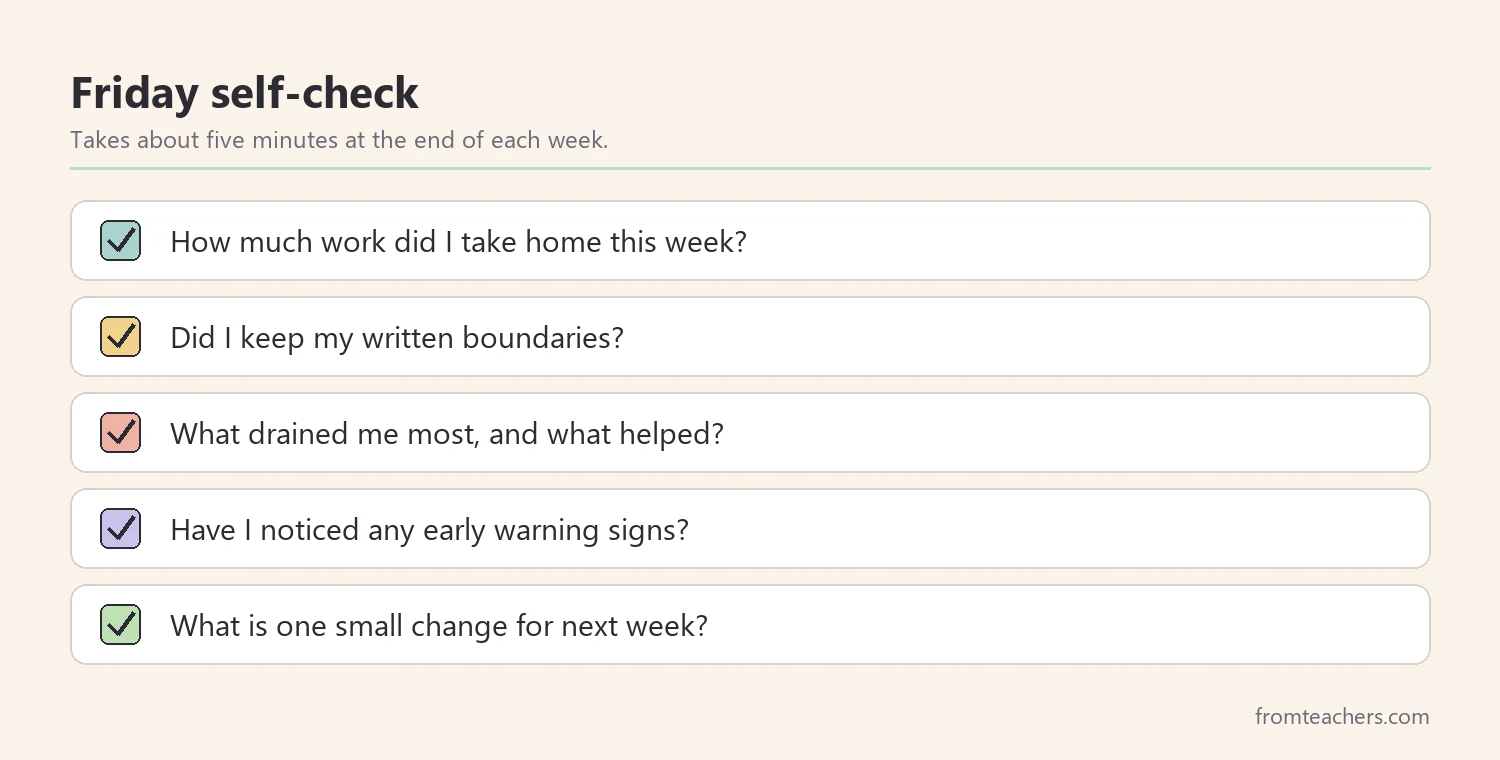
Every Friday, ask yourself a few short questions. How much work did I take home? Did I keep my boundaries? What drained me most this week? What helped? Then, choose one small change for next week instead of trying to fix everything at once. Over a semester, small weekly changes add up to teacher self-care strategies that fit your real job.
In addition, learn your own early warning signs. For many people, these include dreading the week on Sunday, trouble sleeping, feeling numb toward students, or getting sick more often. If several signs appear and last, talk with someone you trust. Your school’s employee assistance program or a health professional can also help.
Worked example. After one month, Ms. Rivera compares her hours. Her work outside teaching has dropped from 22 to 16 hours a week: paperwork from 8 to 6, meetings from 5 to 4, parent emails from 4 to 2, and planning from 5 to 4. She keeps the changes that helped and picks one new goal: reusing last year’s unit plans.
Above all, be patient with yourself. Some weeks will fall apart, especially around IEP season or the end of a grading period, and that is normal. When it happens, return to the calendar and the self-check rather than starting over. Teacher self-care strategies are habits, and habits grow with repetition, not perfection.
Common mistakes and how to avoid them
- Treating self-care as an extra task. A long list of wellness goals adds pressure. Fix: choose one change that removes work, such as batching emails.
- Keeping deadlines in your head. Memory fails under stress. Fix: use one master calendar with reminders set weeks ahead.
- Unspoken boundaries. Others cannot respect limits they do not know. Fix: write them down and share them kindly.
- Doing everything alone. Many teachers hesitate to delegate to paraprofessionals. Fix: give clear roles and a short weekly check-in.
- Waiting for a break to recover. Stress builds daily. Fix: add micro-breaks inside the school day.
- Ignoring warning signs. Small signs can grow into burnout. Fix: use a weekly self-check and reach out early.
Questions teachers and parents ask about teacher self-care strategies
What is the quickest of the teacher self-care strategies to start?
Set fixed times for answering non-urgent email. It costs nothing, takes a minute to set up, and often frees an hour or more each week. Add it to your email signature so families know what to expect.
How can special education teachers reduce paperwork stress?
Use one master calendar, batch similar reports, and keep templates and a goal language bank. Also, start drafts well before deadlines. Small systems remove many last-minute rushes.
Is burnout a sign I am in the wrong job?
Not necessarily. Burnout often reflects workload and conditions more than personal fit. Changing systems, boundaries, and support can make a big difference, and a trusted mentor can help you decide what to change.
How can parents support their child’s teachers?
Clear, kind communication helps a lot. Respect reply times, share useful information early, and say thank you when something works. Teachers notice and value these small gestures.
Do teacher self-care strategies really help students?
A rested, organized teacher can respond more calmly and plan more carefully. While self-care is not a cure-all, it supports the steady, patient teaching that students with disabilities need.
Related reading: How Teachers Communicate With Parents in Special Education: Building a Strong Partnership, Special Education Accommodation and Modification Tracker, and The Crucial Role of Special Educators in the USA.
A companion resource for teacher self-care strategies:

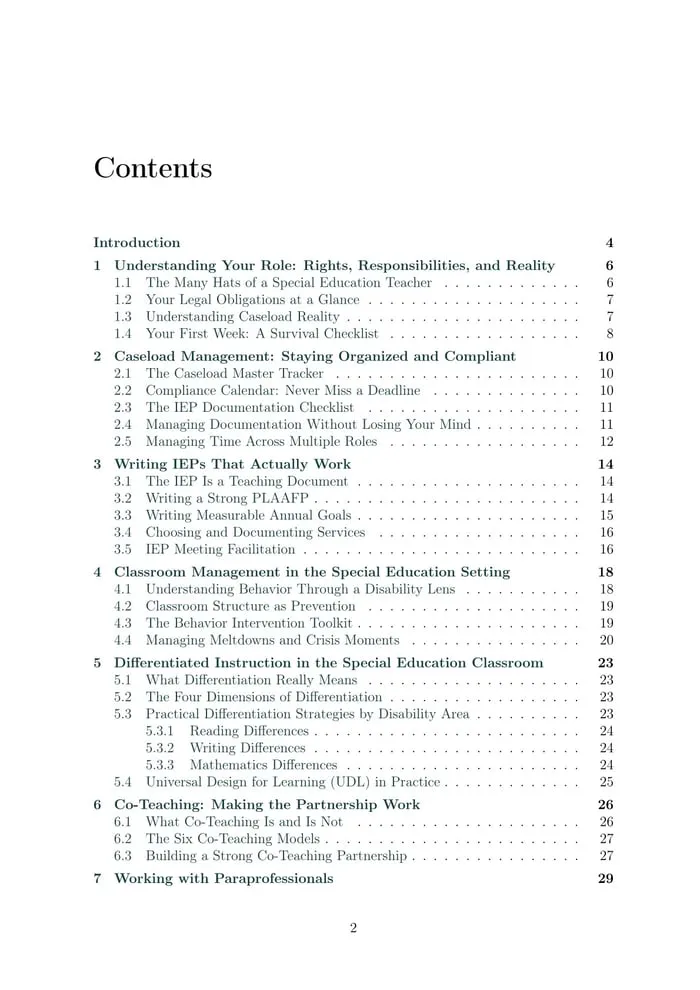
Special Education Teacher Survival Guide: Caseload, IEPs, Classroom and Burnout Prevention: a 63-page reference covering caseload management, IEP writing, classroom management, collaboration, parent communication, and burnout prevention, with printable tools such as a caseload master tracker, a compliance calendar, parent communication templates, a weekly self-check tool, and an IEP goal language bank.
Sources and scope
- National Education Association: articles and resources for educators on workload, wellbeing, and professional life.
- Council for Exceptional Children: the professional association for special educators, with resources on practice and careers.
- CDC Mental Health: general public health information on stress, coping, and mental wellbeing.
- IRIS Center, Vanderbilt University: free modules for educators, including topics on collaboration and working with paraprofessionals.
This guide covers practical workload and boundary habits for school staff. It does not diagnose or treat burnout, depression, or anxiety, and anyone with ongoing symptoms should talk with a qualified health professional.
Key takeaways
- Teacher self-care strategies work best when they target the real drains on your week.
- One master calendar and batched tasks cut deadline stress.
- Written, shared boundaries protect your evenings and weekends.
- Small recovery habits and shared roles help during the school day.
- A short weekly self-check catches warning signs early.








Leave a Comment