

Positive reinforcement tracking answers a question every teacher eventually asks: is this reward actually working? You hand out stickers, praise, and extra minutes of drawing time, and some days the behavior improves. Other days it does not, and you cannot tell why.
This guide gives you a simple system to find out. After reading, you will be able to define the behavior you want to see, choose reinforcers with the student, record each reinforcement in seconds, spot patterns in the data, and adjust the plan with confidence before a meeting with the family or the team.
Examples are fictional. Adapt to the student’s goals and agreed supports. This is guidance, not a diagnosis.
At a glance
- Describe the target behavior so any adult would record it the same way.
- Choose reinforcers with the student, not just for the student.
- Record each reinforcement right away, with the student’s response.
- Review the log every week and change only one thing at a time.
- Fade the reinforcement slowly once the behavior is steady.
1. Define the behavior you want to reinforce
First, name the behavior in words anyone could observe. “Be respectful” or “behave well” means something different to every adult in the room. In contrast, “raises a hand and waits to be called on” is clear. Two adults watching the same moment will agree on whether it happened.
A good target behavior is also positive. It describes what the student should do, not what they should stop doing. This matters because reinforcement only works on a behavior you can catch and reward.
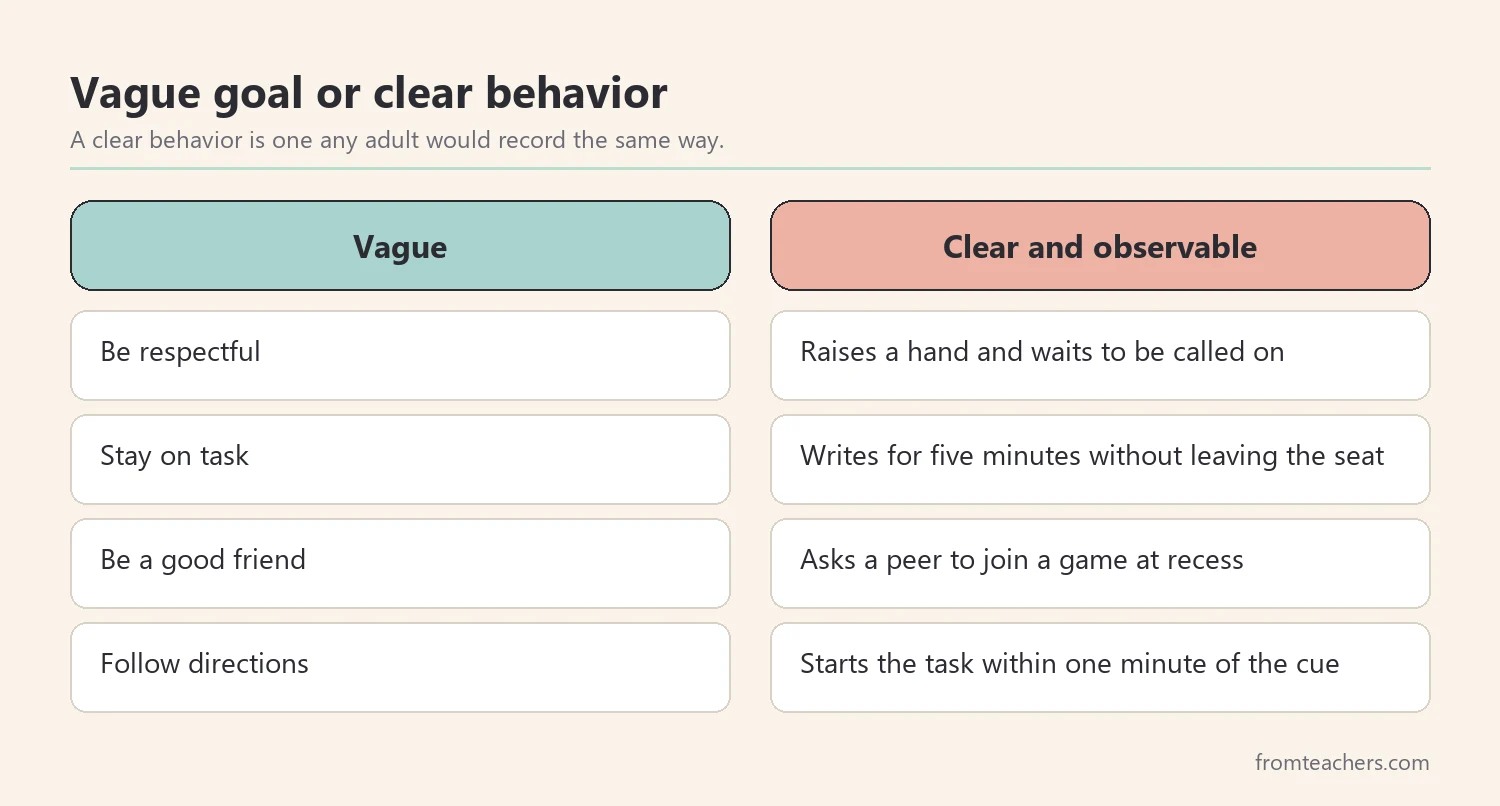
For example, Sam is a fictional second grader who often calls out answers during whole-group lessons. His teacher, Ms. Reed, could write a goal about calling out less. Instead, she writes the replacement behavior: “Sam raises his hand and waits quietly until he is called on.” Now she has something to catch and reinforce.
Questions to test your definition
- Could a substitute teacher record it without asking you?
- Does it say what the student does, not what they avoid?
- Is it small enough to happen several times a day?
- Does it match the student’s plan or IEP goal, if there is one?
2. Choose reinforcers with the student
Next, choose what you will offer when the behavior happens. A reinforcer is anything that makes a behavior more likely to happen again. However, what motivates one student may mean nothing to another. That is why the student’s own preferences matter so much.
Start with a short conversation or a simple choice board. Ask the student what they enjoy at school. Watch what they choose during free time. Ask the family what works at home. Then build a short menu of three to five options, mixing social, activity, and tangible rewards.
| Type | Examples | Good to know |
|---|---|---|
| Social | Specific praise, a thumbs up, a note home | Free and always available |
| Activity | Line leader, helper job, drawing time | Often very motivating |
| Tangible | Sticker, stamp, small token | Pair with praise to fade later |
For Sam, Ms. Reed asks him to pick from picture cards. He chooses drawing time, being the class helper, and stickers. She also adds specific praise, such as “Sam, you waited for your turn. Thank you.” As a result, every reinforcement includes praise plus one item from his menu.
In addition, always pair tangible or activity rewards with specific praise. Praise names exactly what the student did, so it teaches as well as rewards. Later, when you fade the sticker or the extra minutes, the praise stays, and the behavior is more likely to continue. This pairing also makes positive reinforcement tracking easier, because every entry includes the same praise step.
Finally, write the menu at the top of the sheet. That way every adult offers the same options, and the student hears the same message all day.
Also, plan to check the menu often. Preferences change. A reward that excited a student in September may feel boring by October, and the data will usually show it before you notice.
3. Set up your positive reinforcement tracking sheet
Now set up a sheet you can fill in quickly during a busy lesson. If recording takes more than a few seconds, it will not happen consistently. Keep the top of the page for the plan and the rest for the log.
At the top, write the student’s name, the target behavior, and the chosen reinforcers. Below that, use a log with columns for the date, the behavior rewarded, the type of reward, how often it was given, the student’s response, notes and adjustments, and the name of the staff member. Those columns give you enough detail to see patterns later.
If you would rather not build this from scratch, the editable positive reinforcement tracking sheet includes exactly these sections, with space for multiple entries so you can see patterns over time.
Finally, decide where the sheet lives. A clipboard near your teaching spot works well. Some teachers keep a copy in a binder for each student so every adult who works with the student records in the same place.
4. Record each reinforcement in the moment
Consistency is the heart of positive reinforcement tracking. Record right after you give the reinforcement, not at the end of the day. Memory fades quickly, and end-of-day notes tend to be general rather than useful.
Each entry needs only a few words. Write the time or date, what the student did, what you gave, and how the student responded. A response might be “smiled and kept hand up next time,” “shrugged,” or “asked for a different reward.” Those small notes are what make the data meaningful.
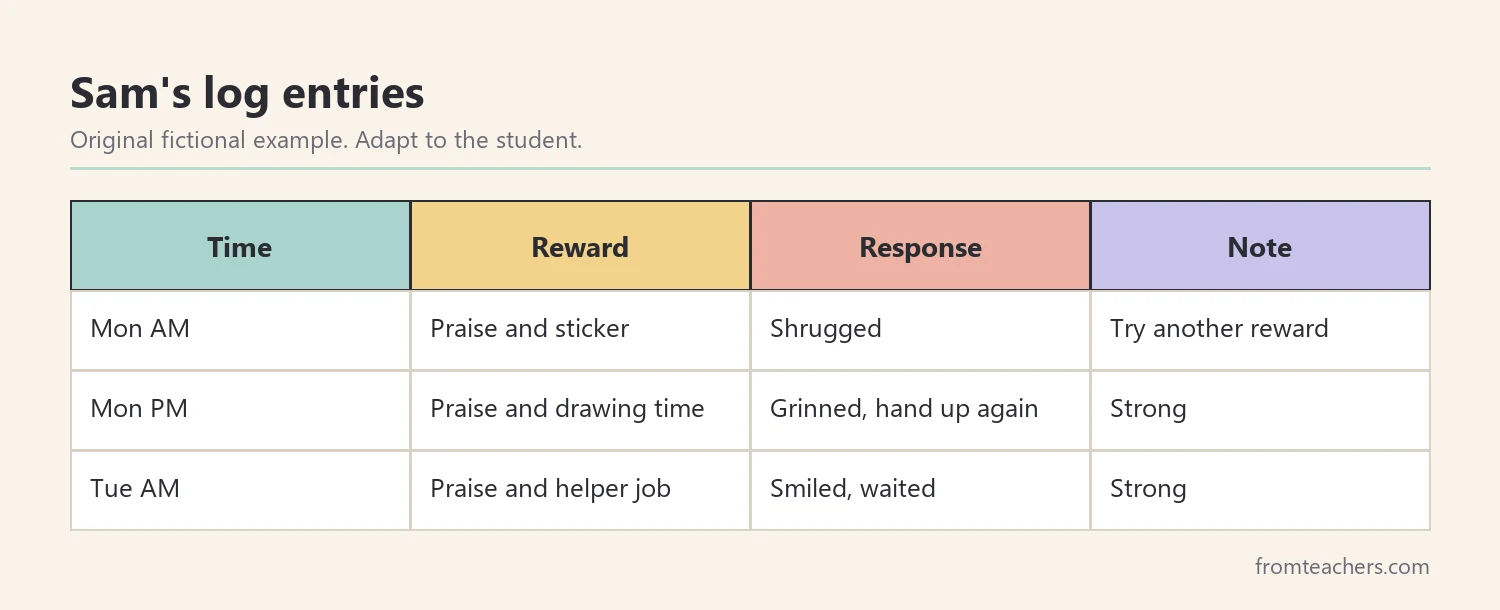
For example, on Monday morning Sam raises his hand during math. Ms. Reed calls on him, praises him, and gives a sticker. Sam shrugs. In the afternoon, she offers two minutes of drawing time for the same behavior. Sam grins and raises his hand again a few minutes later. She records both entries in under a minute.
Keeping recording quick
- Use short codes, such as S for sticker and D for drawing time.
- Write the response in three to five words.
- Ask other adults to initial their entries.
- Record at least a few entries each day, even on busy days.
When several adults share the sheet
Many students work with more than one adult each day. A paraprofessional, a specials teacher, and a therapist may all see the target behavior. Because of that, agree on the same behavior words, the same reward menu, and the same short codes before anyone starts recording.
In addition, keep the sheet in one shared place. If every adult has a separate note, the data ends up scattered and hard to compare. One shared log also shows whether the student responds differently with different adults, which is useful information on its own.
5. Review the positive reinforcement tracking data every week
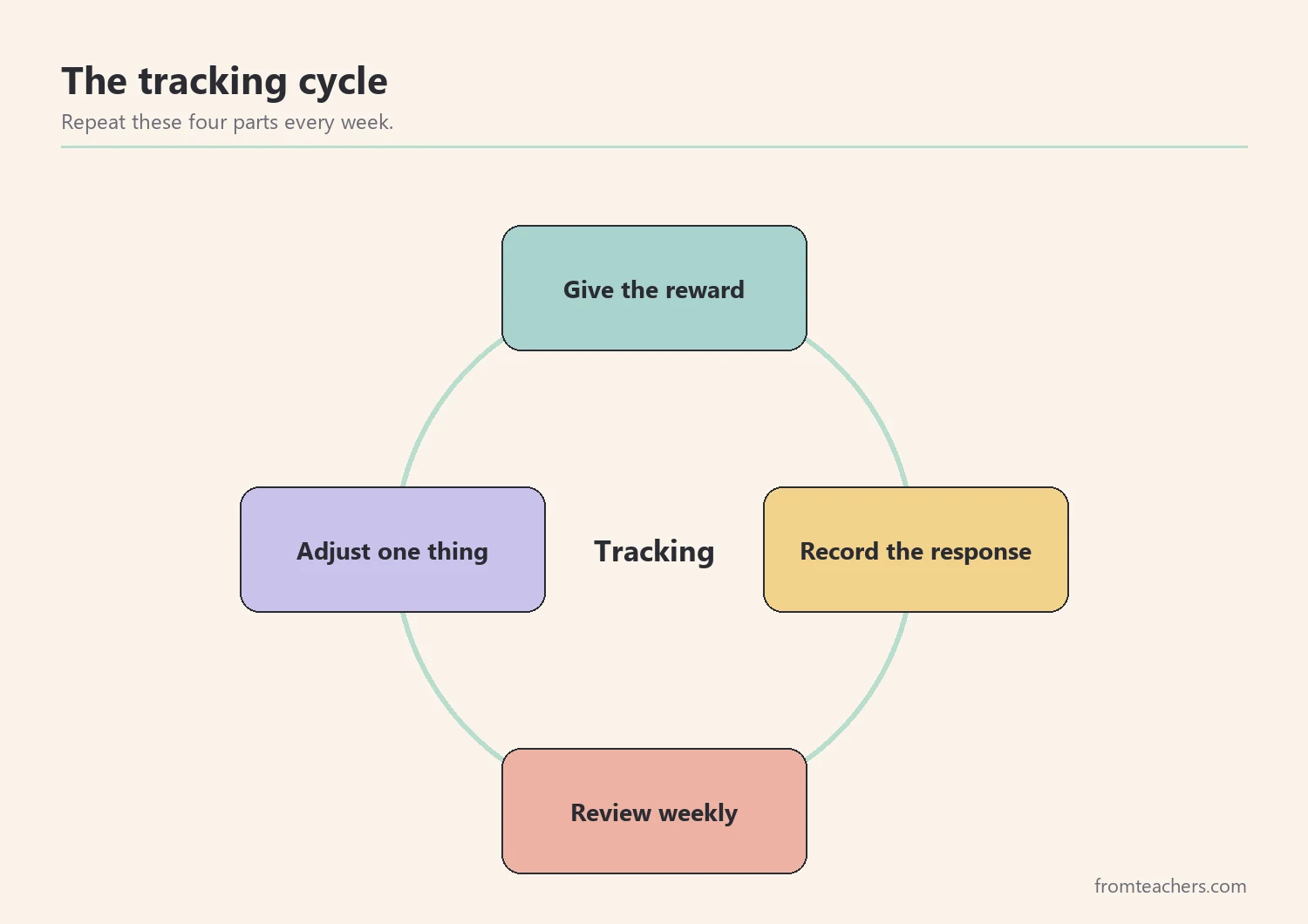
Once a week, read through the log and look for patterns. Which rewards got a strong response? Which ones got a shrug? Did the behavior happen more often this week than last week? A short weekly review keeps the plan from running on autopilot.
Then make one change at a time. If a reward is not working, swap it for another option from the menu. If the behavior is improving, keep the plan steady for another week. Changing several things at once makes it hard to tell what helped.
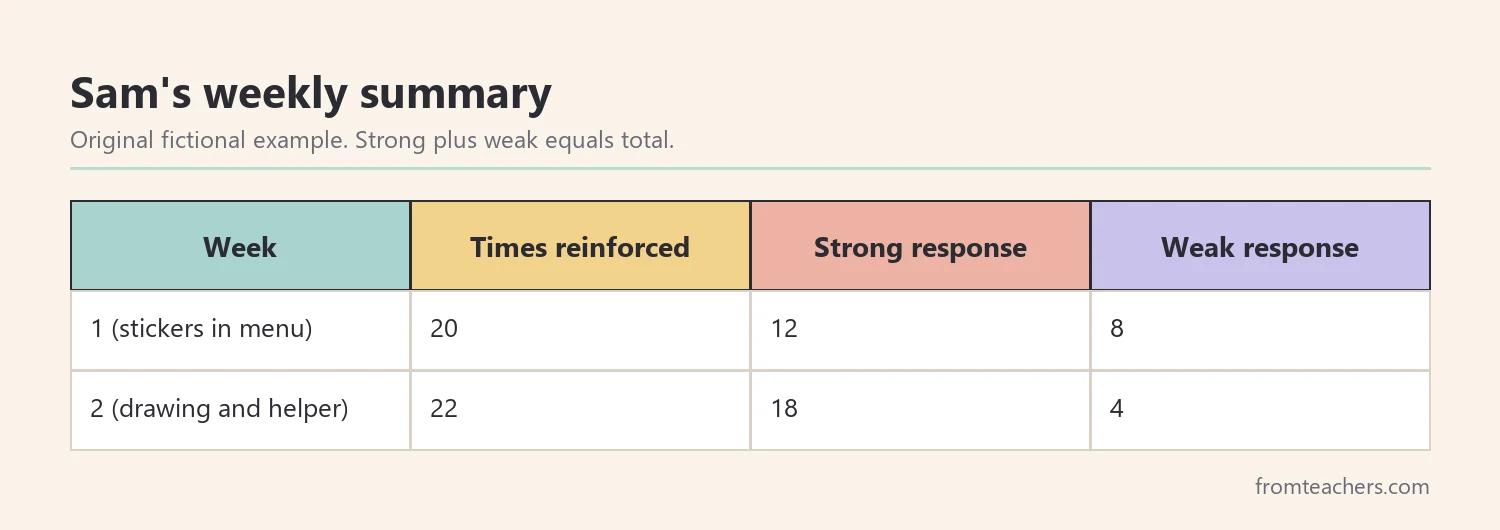
In Figure 3, Sam is reinforced 20 times in week 1. He shows a strong response 12 times and a weak response 8 times, which adds up to 20. Most weak responses follow stickers. So in week 2, Ms. Reed replaces stickers with drawing time and helper jobs. That week, Sam is reinforced 22 times, with 18 strong responses and 4 weak ones. The change is clear in the numbers.
Questions for the weekly review
- How many times was the behavior reinforced this week?
- Which rewards got the strongest responses?
- Which rewards got weak responses more than once?
- Were there days or times with very few entries?
- What is the one change for next week?
Also, look at the time of day. Some students respond well in the morning and struggle after lunch. If you see that pattern, you might offer more frequent reinforcement in the afternoon.
6. Share the data and fade the support
Good data is useful beyond your own classroom. When you prepare for an IEP meeting, a behavior plan review, or a talk with parents, the log gives you real evidence instead of memories. You can show which rewards worked, how often the behavior happened, and what changed.
For instance, Ms. Reed brings Sam’s log to a family conference. She shows the switch from stickers to drawing time and the rise in strong responses. Sam’s parents mention that he loves drawing at home too. Together, they agree to use the same praise phrase at home and school.
Bringing the log to a meeting
Before a meeting, turn the log into a short summary. A few numbers and one or two sentences are easier to discuss than pages of entries. Keep the full log nearby in case someone asks a question.
| Include | Example |
|---|---|
| Target behavior | Raises hand and waits to be called on |
| Weekly totals | Times reinforced and strong responses |
| What changed | Stickers replaced by drawing time |
| Next step | Begin fading to most times |
As a result, the meeting stays focused on decisions. The team can agree on the next step instead of debating what happened in class.
Once the behavior is steady, start fading the reinforcement. Move from reinforcing every time to most times, then to every few times, and finally to occasional praise. Keep recording during fading. If the behavior drops, step back one level for a while.
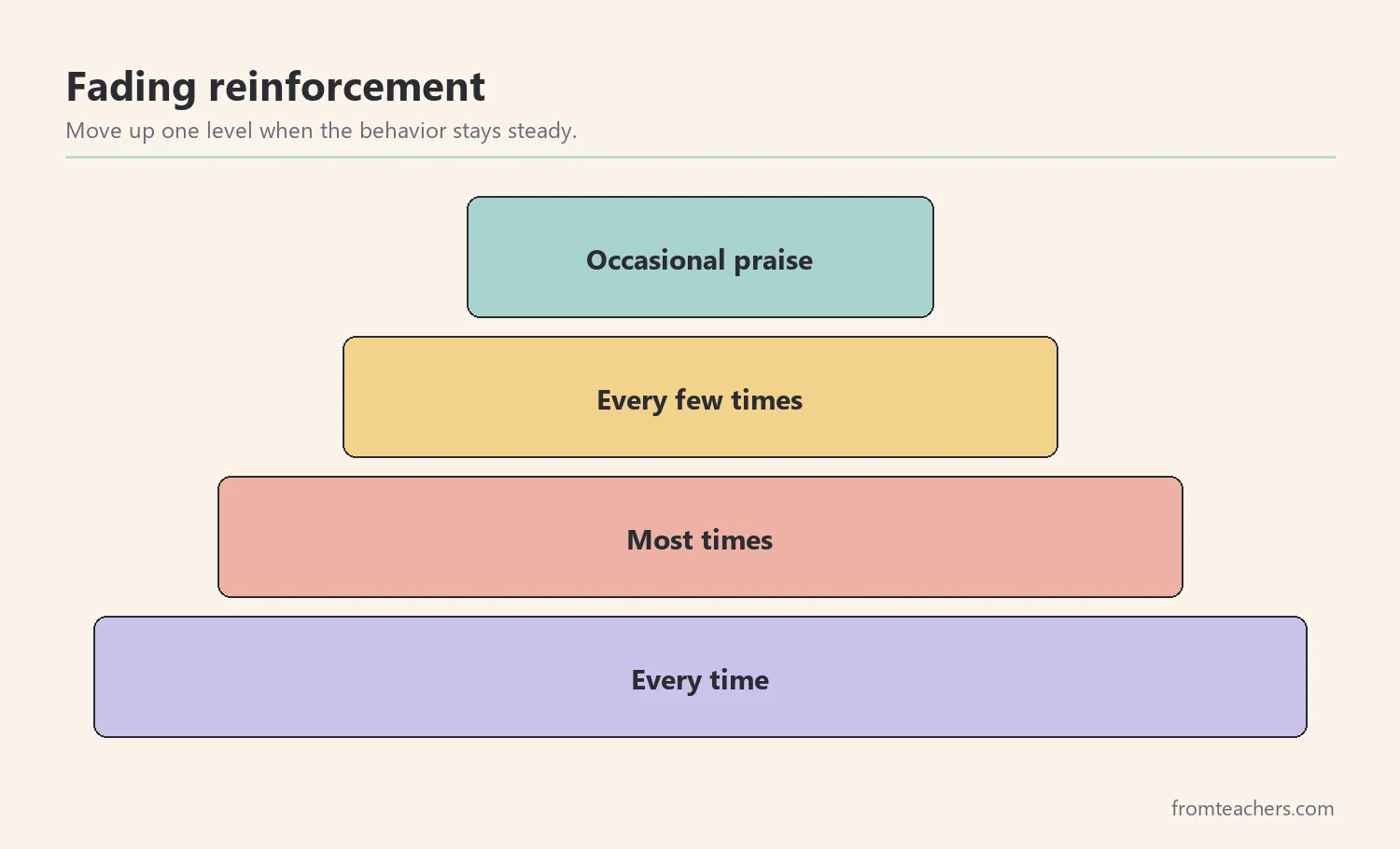
Finally, celebrate progress with the student. Show them the log in a simple way, such as a chart of strong days. Students who see their own growth often feel proud, and that pride becomes its own reward.
Common mistakes and how to avoid them
- Using a vague target behavior. Fix: describe one observable action the student can do.
- Choosing rewards without the student. Fix: offer a choice board and ask the family what works.
- Recording at the end of the day. Fix: write a short entry right after each reinforcement.
- Changing many things at once. Fix: adjust one part of the plan per week.
- Stopping rewards suddenly. Fix: fade slowly and keep tracking while you fade.
Questions teachers and parents ask about positive reinforcement tracking
How often should I record?
Record every time you give a planned reinforcement during the first weeks. Later, a sample of entries each day may be enough. The key is to stay consistent so the data reflects what really happens.
What if no reward seems to work?
Go back to the student’s preferences and try new options. Also check whether the target behavior is too hard or too vague. Sometimes a smaller first step makes success possible.
Is this the same as a token economy?
Not exactly. A token economy is one way to deliver reinforcement. Tracking is how you record and review any reinforcement, including praise, activities, or tokens.
Can parents use the same tracking sheet at home?
Yes. A shared sheet helps home and school use the same behavior words and rewards. It also makes conversations easier because everyone looks at the same information.
How long should I track before changing the plan?
About one week of steady data is usually enough to notice a pattern. If the behavior is unsafe or getting much worse, talk with your team sooner.
Related reading: Moving Beyond Shame and Behavior Charts: Positive Alternatives for Effective Classroom Management, The Power of Data Tracking in Special Education, and How Teachers Communicate With Parents in Special Education: Building a Strong Partnership.
A companion resource for positive reinforcement tracking:
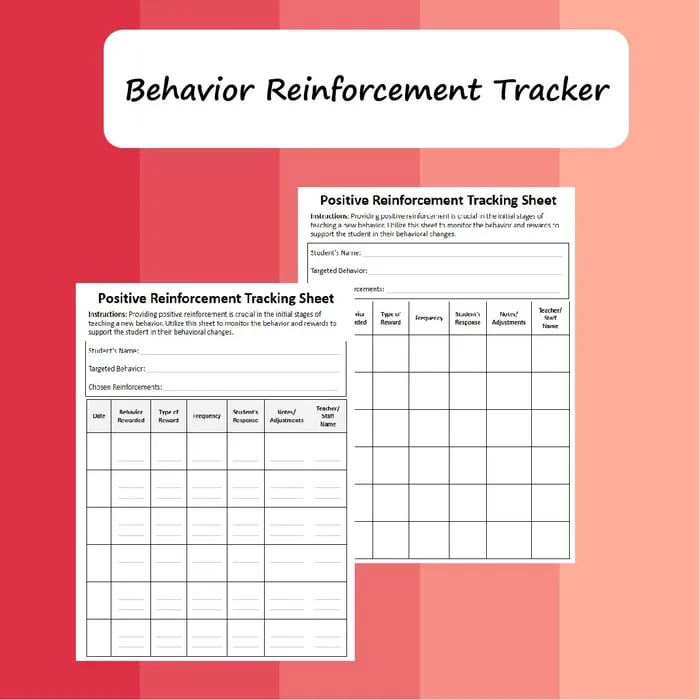
Positive Reinforcement Tracking Sheet: Editable Behavior Data Form: a two-page editable form with space for the student’s name, target behavior, and chosen reinforcements, plus a log for date, behavior rewarded, reward type, frequency, student response, notes and adjustments, and staff name.
Sources and scope
- IRIS Center: free training modules on behavior and classroom management.
- Center on PBIS: resources on positive behavioral interventions and supports.
- What Works Clearinghouse: reviews of research on education practices.
- Individuals with Disabilities Education Act: the U.S. Department of Education site on IDEA.
This guide covers recording and reviewing positive reinforcement in classrooms and at home. It does not replace a functional behavior assessment, a formal behavior intervention plan, or advice from your school team.
Key takeaways
- Define one clear, positive, observable target behavior.
- Build a reward menu with the student and family.
- Record each reinforcement and response right away.
- Review weekly and change one thing at a time.
- Fade slowly and keep tracking until the behavior holds.









Leave a Comment