

FBA background information is often the piece a team rushes past on the way to observations. Picture a sixth grader with a thick discipline file, three past behavior plans, and a new referral on the table. Everyone wants to start watching him in class tomorrow, yet nobody has looked at what the records already say.
This guide walks you through a five-step records review you can finish before the first observation. By the end, you will know which documents to pull, how to read each one for patterns, and how to turn your notes into a short summary that shapes the rest of the functional behavior assessment.
Examples are fictional. Adapt to the student’s goals and agreed supports. This is guidance, not a diagnosis.
At a glance
- Gather every relevant record before you plan any observation.
- Read discipline data for patterns in time, setting, and response, not just totals.
- Check what has already been tried so the team does not repeat it.
- Look at attendance, academics, and health for context that changes the picture.
- End with a one-page summary and a list of questions to test in class.
1. Gather FBA Background Information Before Anything Else
A functional behavior assessment asks why a behavior happens. FBA background information cannot answer that question alone. However, they tell you where to look, when to look, and what has already failed.
First, agree on who is collecting what. The school psychologist may pull discipline and attendance data, while the case manager brings the IEP and progress reports. Meanwhile, the school nurse can share any health information the family has agreed to release. Set a short deadline, such as one week, so collecting FBA background information does not stall the whole process.
Set up one secure folder
Before anyone starts pulling files, decide where the FBA background information will live. A single secure digital folder works well, as long as it follows your district privacy rules. Name each file the same way, such as record type and date, so anyone on the team can find it quickly.
Also, decide how far back to look. For many students, the current and previous school year are enough. However, if a behavior has a long history, earlier records may show when it first appeared and what was happening at the time.
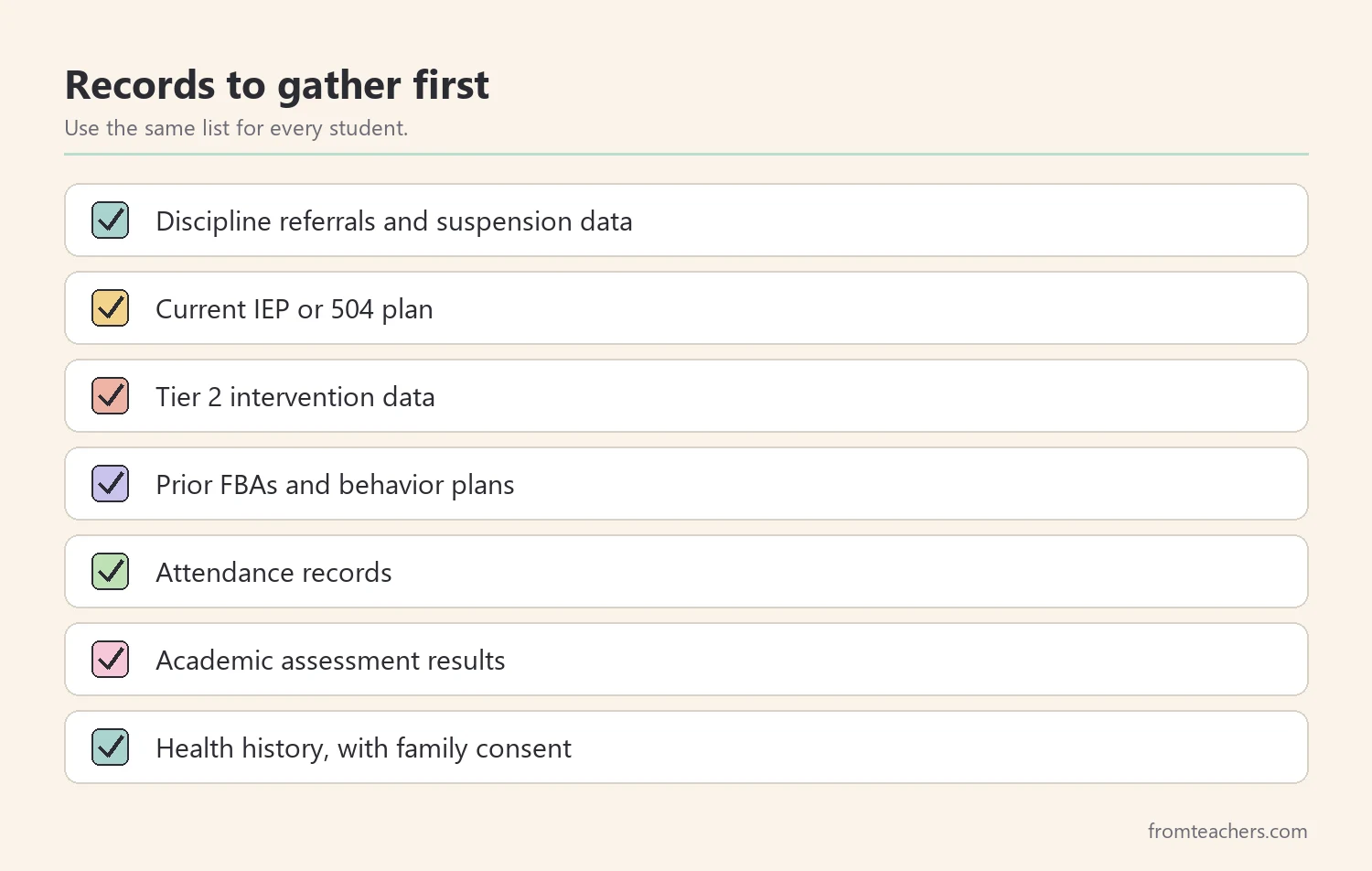
Next, use one checklist for every case. A shared list keeps the review consistent across students and across team members. It also shows families that the team looked at the full picture, not just the latest incident.
| Record type | Usually held by | What it can show |
|---|---|---|
| Discipline referrals | Office or psychologist | Time, place, and response patterns |
| IEP or 504 plan | Case manager | Goals, supports, and past concerns |
| Intervention data | Intervention team | What was tried and how it went |
| Attendance | Office | Absences, tardies, and timing |
| Assessments | Teachers and psychologist | Skill gaps that may drive avoidance |
| Health history | Nurse, with consent | Sleep, medication, or medical context |
For example, the team supporting Jordan, a fictional sixth grader, used this table to split the work among three people. As a result, all of Jordan’s FBA background information was in one folder within five school days.
2. Read Discipline Records for Patterns
Discipline data is usually the largest part of the FBA background information. Still, a stack of referrals is not useful until you sort it. Instead of counting incidents, look for repeating details.
Start with four questions for every referral. When did it happen? Where did it happen? What happened right before? Then, what did adults do afterward? These questions follow the familiar antecedent, behavior, and consequence pattern that the rest of the FBA will use.
Then, tally the answers in a simple table. Patterns tend to jump out once the data is grouped. For instance, a student may have many referrals in one class period, or most incidents may end with the student leaving the room.
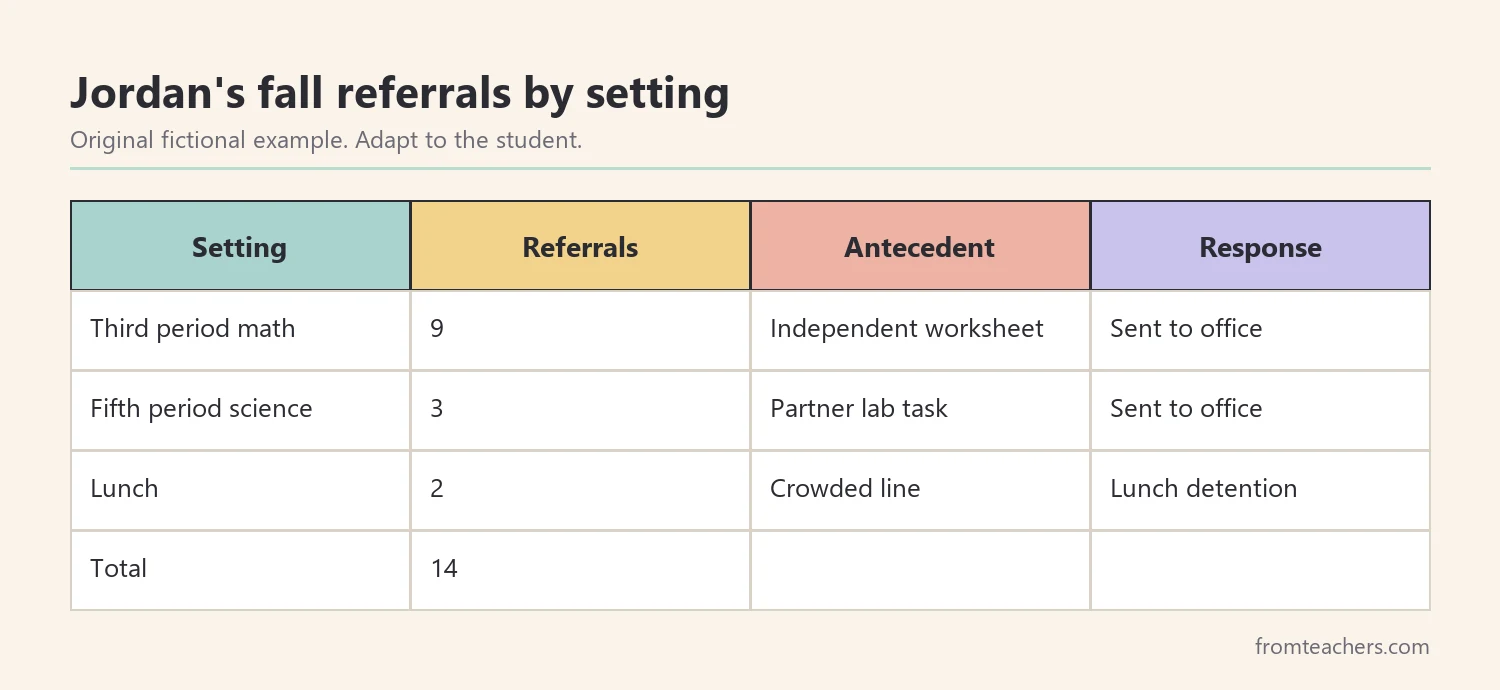
Consider Jordan’s fall semester. He had 14 office referrals in total. Of those, 9 happened in third period math, 3 happened in fifth period science, and 2 happened during lunch. That adds up to 14, and it shows a strong cluster in one class.
| Setting | Referrals | Common antecedent | Common response |
|---|---|---|---|
| Third period math | 9 | Independent worksheet | Sent to office |
| Fifth period science | 3 | Partner lab task | Sent to office |
| Lunch | 2 | Crowded line | Lunch detention |
| Total | 14 |
It also helps to look at time of day within each setting. If most math incidents happen in the first ten minutes of independent work, that is a sharper detail than “math is hard.” Write these details next to the tally while they are fresh, because they will become your observation targets later.
Notice the response column too. In 12 of Jordan’s 14 referrals, he left the classroom. That detail matters, because leaving a hard task can be a powerful outcome for a student. The records cannot confirm a function, yet they give the team a clear hypothesis to test.
3. Review Past Interventions and Plans
Many students referred for an FBA have already received support. Tier 2 check-ins, small group lessons, or an earlier behavior plan may be in the file. Therefore, this part of the FBA background information protects the team from recommending something that was already tried.
For each past intervention, record four things: what it was, how long it ran, how consistently it was used, and what the data showed. Be careful with the third point. An intervention that “did not work” may simply have been used for two weeks or by one adult only.
Jordan, for example, had a check-in and check-out plan in fifth grade. The notes show it ran for six weeks and that his daily point percentage rose while it was in place. However, it ended when his mentor changed schools. That is useful FBA background information, because it suggests adult connection may help him.
If you want a ready-made structure for this step, the fillable Records Review for FBA form includes separate sections for Tier 2 intervention data and for prior FBA and BIP history. Having those sections side by side makes it easier to compare what changed and what stayed the same.
In addition, look for interventions that were planned but never started. A plan written into an IEP is not the same as a plan delivered every day. When the FBA background information shows a gap between the plan and the practice, the team should name that gap honestly and without blame.
Finally, note any earlier FBA hypotheses. If a past team suggested the behavior served to escape demands, check whether the new data still points that way. Agreement across years is worth noting, and so is disagreement.
4. Add Attendance, Academic, and Health Context
Discipline and intervention data tell only part of the story. Attendance, academic results, and health history often explain why a pattern exists. As a result, this step can change how the team reads everything before it.
Attendance
Look at absences and tardies by day of the week and by class period. Frequent late arrivals to one subject, for instance, may point to avoidance. Similarly, absences after weekends may suggest something worth asking the family about.
Academic results
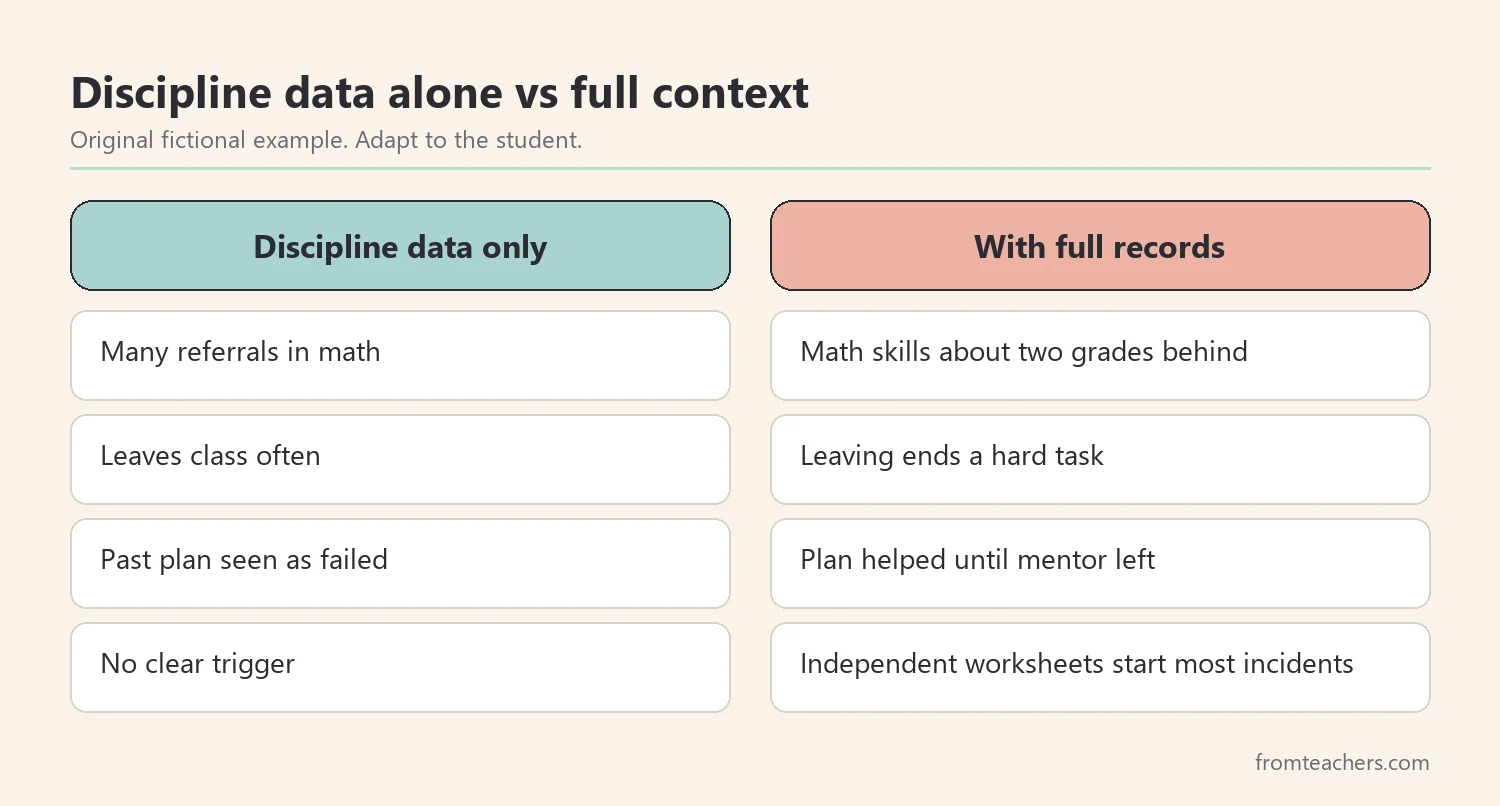
Next, compare behavior patterns with skill data. If incidents cluster in math and math scores are well below grade level, the task itself may be too hard. In Jordan’s case, his most recent math screening placed him about two grade levels behind, while his reading was close to grade level. That fits the cluster in third period math.
Health and medical history
Then, with family consent, review relevant health information. Sleep problems, medication changes, vision or hearing concerns, and chronic pain can all affect behavior. Keep this section factual and brief, and avoid guessing about diagnoses.
One caution applies to all three areas. Context explains, but it does not excuse or label. The purpose of this FBA background information is to understand the student better, so write every note as something a family member could read without feeling judged.
Together, these three sources turn a list of incidents into a picture of a whole student. For Jordan, the team now saw a student who struggled with math, missed a former mentor, and left class when worksheets appeared.
5. Summarize FBA Background Information and Plan Observations
FBA background information is only useful if it leads somewhere. So, close the review with a short summary that the whole team can read in two minutes.
First, write three to five pattern statements in plain language. Each one should name a setting, an antecedent, and a likely response. For example: “Most referrals happen in math during independent worksheets and end with Jordan leaving class.”
Next, turn each statement into a question to test. The question tells observers what to watch for. For instance: “Does Jordan’s behavior begin within a few minutes of independent math work, and does it stop when he leaves the room?”
Then, plan observations to match. Because 9 of Jordan’s 14 referrals came from third period math, the team scheduled two observations in that class and one in science for comparison. They also planned one observation during a preferred class, so they could see what was different there.
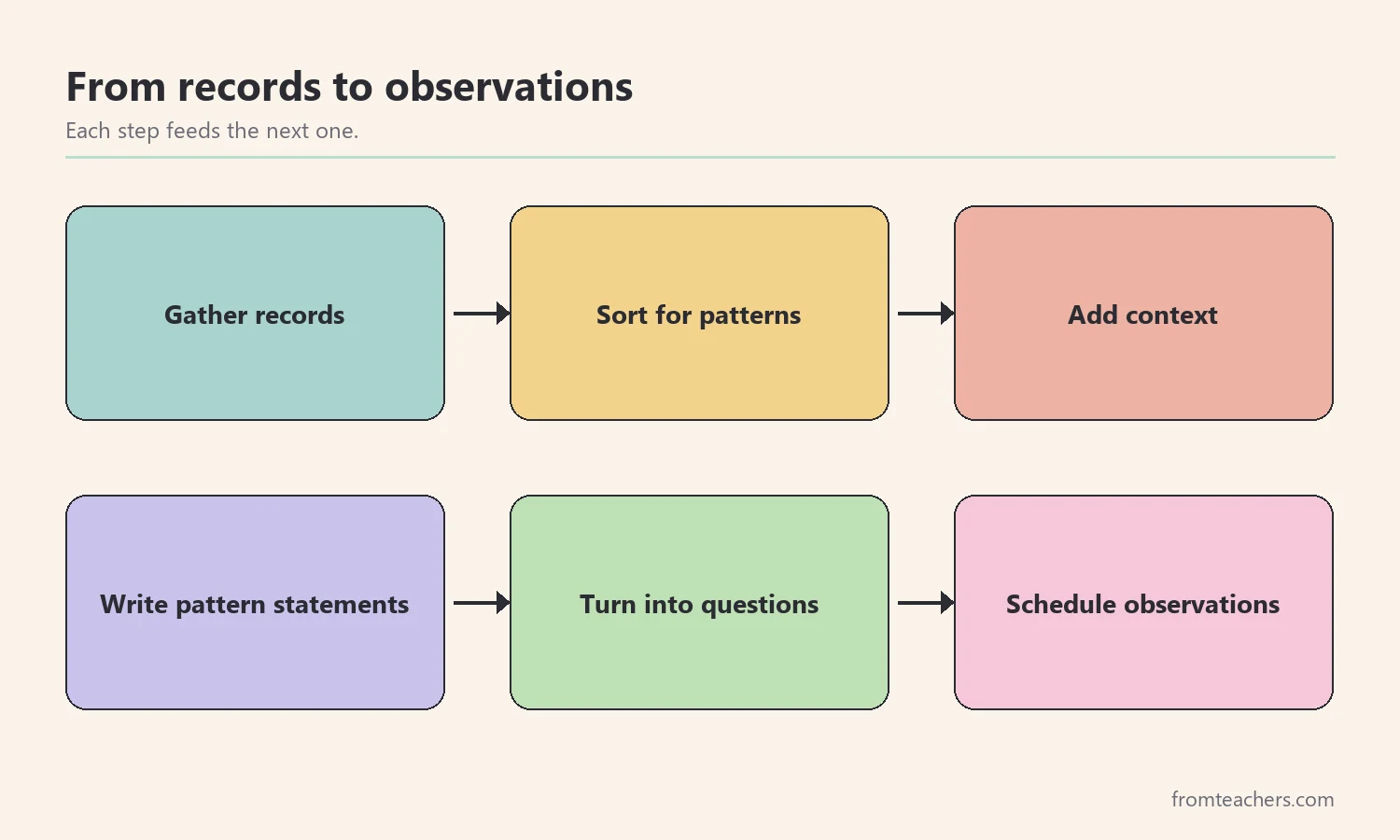
Keep the summary short. A single page with the pattern statements, the questions, and the observation schedule is easier to use than a long report. In practice, a short summary of FBA background information is also more likely to be read by every adult who works with the student.
Finally, share the summary with the family and invite their view. Parents and caregivers often know about patterns that never appear in school records, such as a hard morning routine or a recent change at home. Their input belongs in the FBA background information as well.
Once observations begin, return to the summary each week. If what you see in class does not match the records, update the pattern statements. The FBA background information is a starting point, and good teams treat it as a draft that new data can improve.
Common mistakes and how to avoid them
- Counting incidents without reading them. Fix: group every referral by time, setting, antecedent, and response.
- Calling an intervention a failure too early. Fix: check how long it ran and how consistently it was used.
- Treating FBA background information as the answer. Fix: use it to form questions, then test them through observation.
- Skipping academic data. Fix: compare behavior clusters with skill levels in the same subjects.
- Guessing about health. Fix: record only what the family and nurse have shared, with consent.
- Leaving the summary in a folder. Fix: write pattern statements and turn each into an observation question.
Questions teachers and parents ask about FBA background information
How long should a records review take?
For most students, a team can gather and review FBA background information within one to two weeks. Splitting the work among two or three people speeds it up. The goal is a clear summary, not an exhaustive history.
Can we skip the records review if the behavior is new?
Even a new behavior has context. Attendance, academics, and health records may still explain what changed. A short review is better than none.
Who should see FBA background information?
Share it with the team members involved in the assessment and with the family. Follow your district’s privacy and records policies. Health details in particular should be shared only as consent allows.
What if the records are incomplete?
Note what is missing from the FBA background information and why. Then rely more heavily on interviews and direct observation. Missing data is itself useful information for future planning.
Does the records review replace observation?
No. Records suggest patterns, while observation and data collection test them. FBA background information tells you where to look, and observation tells you what is really happening.
Related reading: The Power of Data Tracking in Special Education, Moving Beyond Shame and Behavior Charts: Positive Alternatives for Effective Classroom Management, and How Parents and Teachers Can Team Up for Special Education Success.
A companion resource for FBA background information:
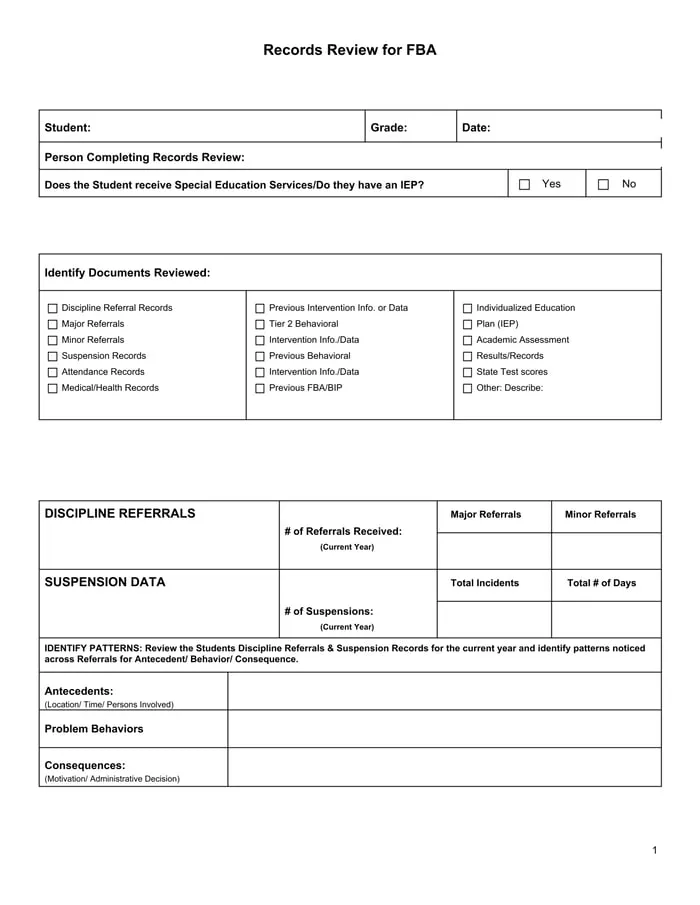
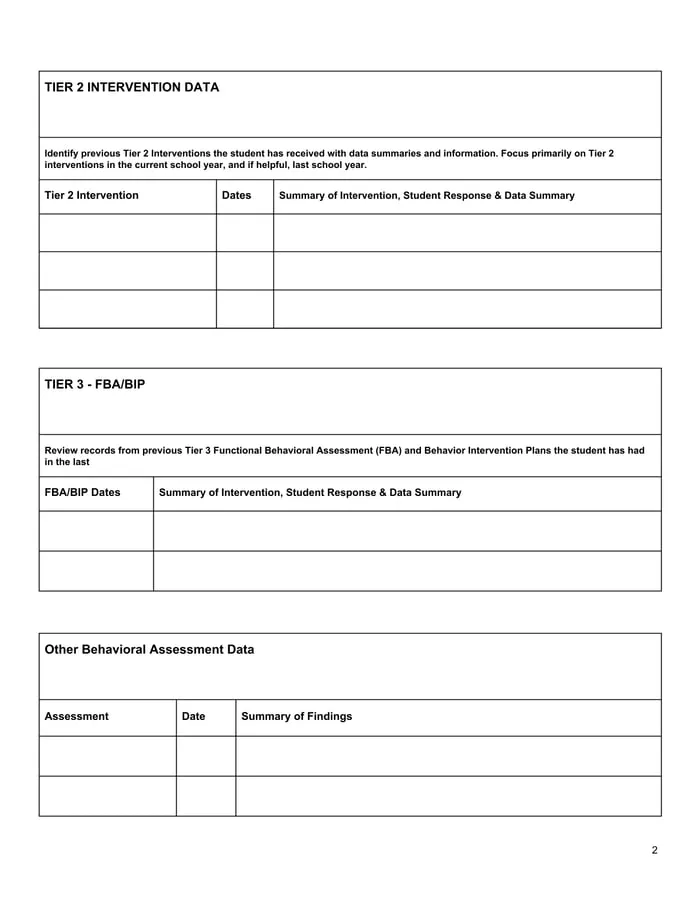
Records Review for FBA: a fillable PDF form with a documents reviewed checklist and sections for discipline referrals and suspensions, Tier 2 intervention data, Tier 3 FBA and BIP history, attendance, academic assessment results, and medical or health history.
Sources and scope
- IDEA, U.S. Department of Education: the law behind special education services, evaluations, and behavior supports in IEPs.
- IRIS Center, Vanderbilt University: free modules on functional behavior assessment and classroom behavior.
- Center on PBIS: guidance on tiered behavior supports, including Tier 2 and Tier 3 practices.
- What Works Clearinghouse: reviews of education research, including behavior interventions.
This guide covers the records review stage of an FBA. It does not replace interviews, direct observation, or the professional judgment of a qualified team, and it does not cover state-specific legal timelines.
Key takeaways
- Gather all FBA background information before planning observations.
- Sort discipline data by time, setting, antecedent, and response.
- Check how past interventions were used before judging them.
- Add attendance, academic, and health context with care and consent.
- Finish with pattern statements and observation questions the team can test.







Leave a Comment