

Knowing how to write a BIP turns a stack of behavior notes into a plan that the whole team can actually follow. Picture a fifth grader who leaves his seat and tears up worksheets every math block, while three adults each respond differently: one reprimands, one ignores, and one sends him to the office. Nothing changes, because nobody is working from the same plan.
This guide shows you how to write a BIP in five practical steps. By the end, you will be able to define the target behavior, link it to its function, set measurable goals, choose prevention and teaching strategies, plan responses and reinforcement, and set up progress monitoring. The same fictional student appears throughout, so you can see one plan take shape from start to finish.
Examples are fictional. Adapt to the student’s goals and agreed supports. This is guidance, not a diagnosis.
At a glance
- A behavior intervention plan (BIP) is built on what the team learned about why the behavior happens.
- Describe the behavior so clearly that any adult could count it.
- Teach a replacement behavior that meets the same need.
- Plan prevention, responses, and reinforcement so every adult acts the same way.
- Track data and review the plan on a set schedule.
1. How to write a BIP: define the target behavior
First, describe the behavior in observable, measurable terms. Learning how to write a BIP starts here, because a vague label like “defiant” or “disruptive” means something different to every adult. Instead, write what the student does, so anyone walking into the room could see it and count it.
Next, add frequency, duration, and intensity. How often does it happen? How long does it last? How serious is it? This baseline helps the team see whether the plan is working later. If you are unsure, collect a few days of simple data before you write.
| Vague | Observable |
|---|---|
| Defiant in math | Leaves seat and walks around the room during math tasks |
| Destroys work | Tears worksheets into pieces |
| Aggressive | Pushes a peer with both hands |
Also, focus on one or two priority behaviors. A plan that tries to change everything at once is hard to follow. Choose the behavior that most affects safety or learning, and start there.
In addition, note where and when the behavior happens most. Knowing how to write a BIP includes recording the setting, because a behavior that appears only in math or only after lunch points to different causes than one that appears everywhere.
Put this step into practice
Then, check that the description works for everyone. Read it aloud to a colleague who does not know the student and ask whether they could count it. If they hesitate, the wording still needs work.
Worked example. Jayden is a fictional student in grade 5. His team writes: “Jayden leaves his seat and tears his worksheet during independent math work.” Baseline data shows this happens about 4 times a week, with each episode lasting about 10 minutes.
2. Link the behavior to its function
Once the behavior is clear, connect it to its function, or the reason it happens. Knowing how to write a BIP well depends on this link. A plan that ignores the function often makes behavior worse, for example by sending a student out of class when the student wanted to escape the task in the first place.
In addition, the function usually comes from a functional behavior assessment (FBA). Common functions include escape or avoidance, attention, access to items or activities, and sensory input. Look at the patterns: what happens right before the behavior, and what happens right after.
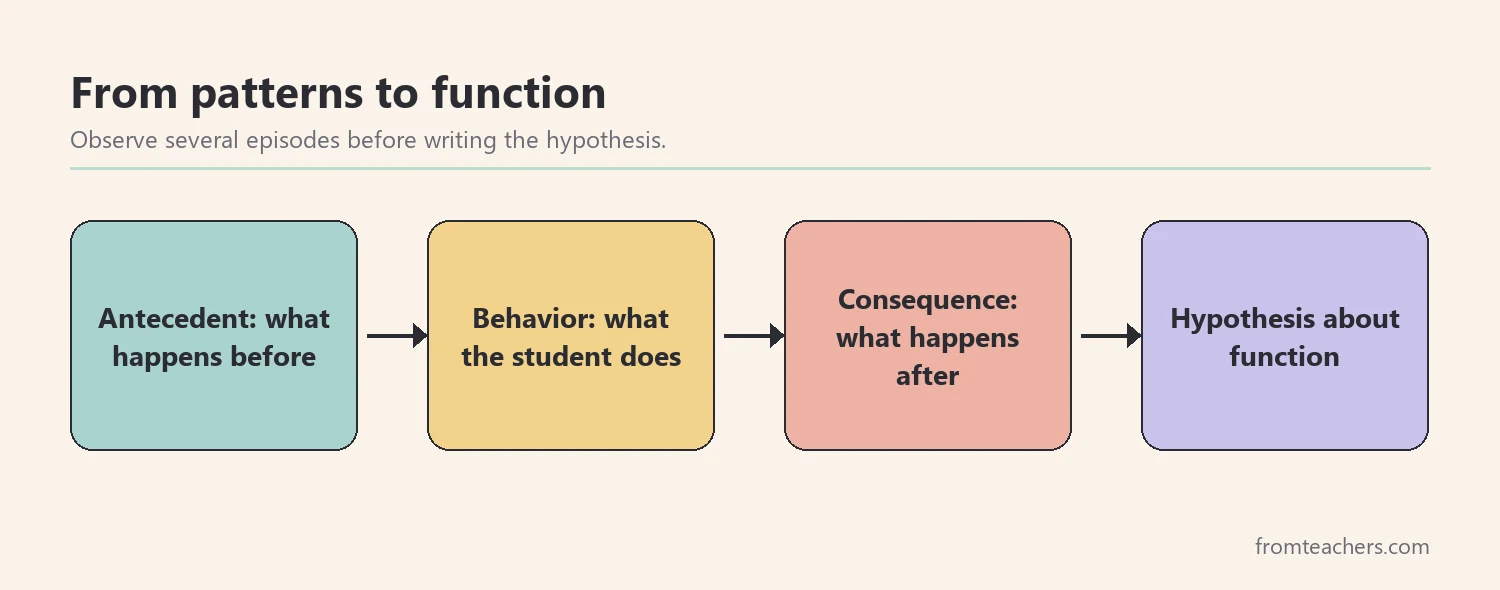
If the team disagrees about the function, look at more data rather than guessing. Anyone learning how to write a BIP soon finds that a wrong hypothesis leads to strategies that do not fit, even when they are carried out perfectly.
Then, write a short hypothesis statement. A useful format is: “When [antecedent], the student [behavior], in order to [function].” This sentence becomes the backbone of the whole plan, because every strategy should connect to it.
| Function | What the student gets or avoids |
|---|---|
| Escape | Avoids a task, demand, or setting |
| Attention | Gets adult or peer attention |
| Tangible | Gets an item or activity |
| Sensory | Gets or avoids a sensory experience |
Worked example. The FBA shows Jayden’s behavior happens during long written math tasks and usually ends with him being sent to the hallway. The hypothesis is: “When given a math worksheet with more than ten problems, Jayden leaves his seat and tears the paper in order to escape the task.”
3. How to write a BIP with clear goals and strategies
Next, set measurable goals. When you learn how to write a BIP, think of goals in two layers: a short-term goal for the next few weeks and a long-term goal for the end of the plan period. Each goal should name the behavior, the condition, and the target level.
Then, choose strategies in two groups. Antecedent strategies prevent the behavior by changing what happens before it. Replacement behaviors give the student a better way to meet the same need. For an escape function, the replacement might be asking for a break or asking for help.
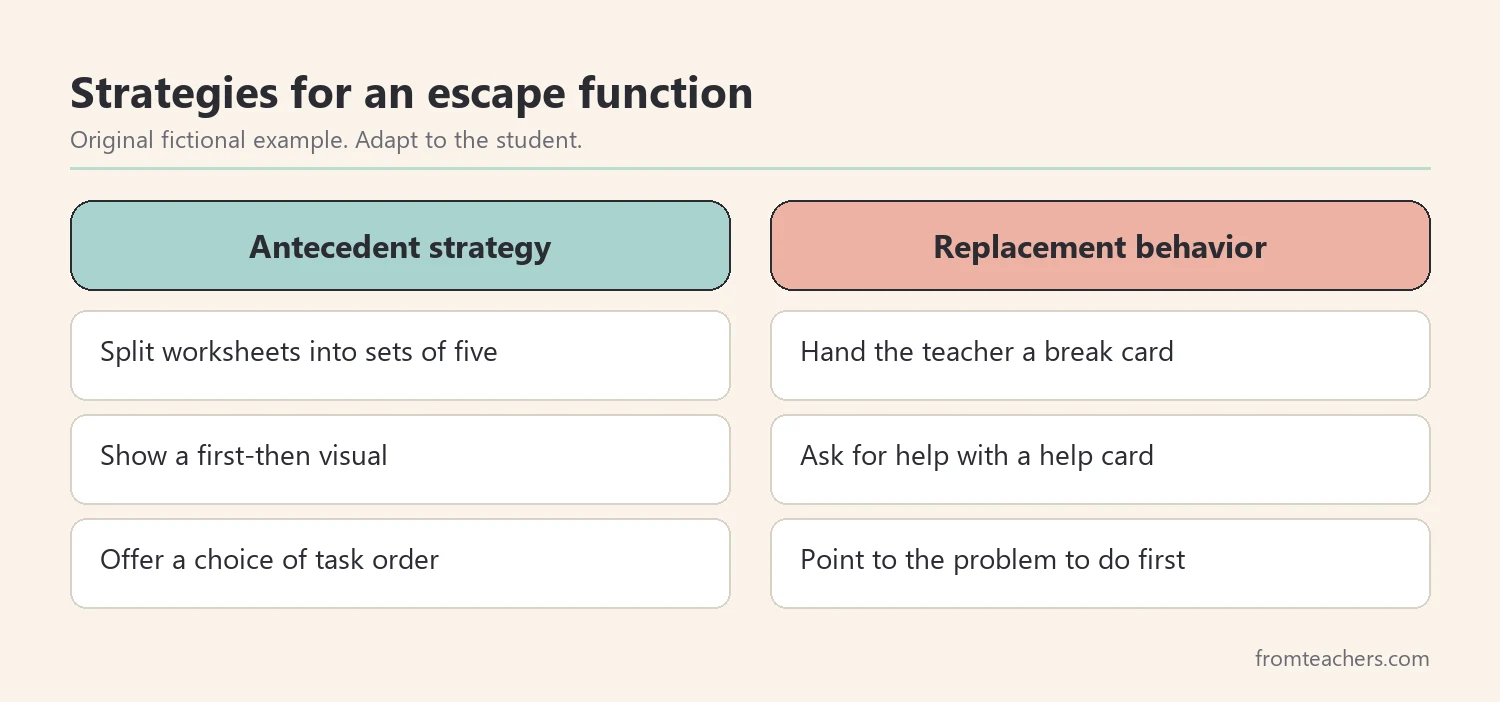
Pick strategies the team can realistically use every day. A clever idea that needs a second adult in the room is not helpful if that adult is only there twice a week. Part of knowing how to write a BIP is matching each strategy to the people and time you actually have.
A quick classroom example
For example, make sure the replacement behavior is easier and faster than the problem behavior. If asking for a break takes three steps and tearing a worksheet takes one second, the student will keep tearing. Teach the replacement directly, practice it in calm moments, and honor it every time at first.
Next, a structured form keeps these sections together. The fillable BIP form for school teams has sections for target behavior, function checkboxes, short-term and long-term goals, antecedent strategies, and replacement behaviors, so nothing important is left out.
Worked example. Jayden’s short-term goal: in four weeks, he will use a break card instead of leaving his seat in at least 3 of 4 opportunities. Antecedent strategies include splitting worksheets into sets of five problems and giving a first-then visual. His replacement behavior is handing the teacher a break card.
4. Plan responses, reinforcement, and crisis steps
Then, decide how adults will respond. A key part of how to write a BIP is making responses consistent. Write what adults do when the replacement behavior happens, and what they do when the problem behavior happens. Consistency matters more than any single strategy.
Reinforce the replacement behavior quickly and clearly. For an escape function, that might mean giving a short break right away when the student asks. Over time, the team can stretch the work time before a break, but only after the replacement behavior is reliable.
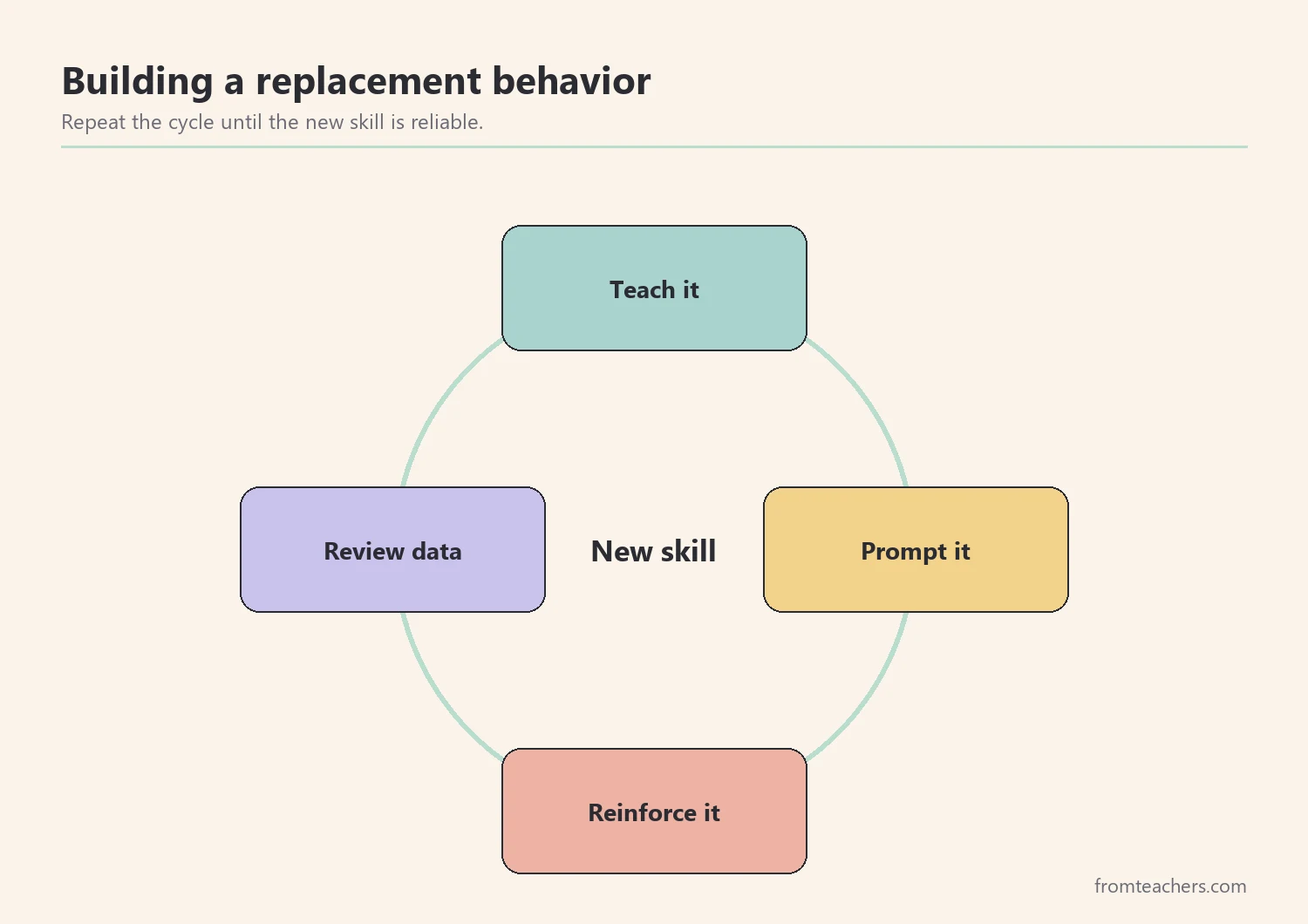
Choose reinforcers with the student when possible. Ask, offer a short menu, or watch what the student chooses during free time. A reinforcer only works if the student truly wants it, so check and update the list every few weeks.
Also, avoid responses that accidentally reward the problem behavior. If tearing a worksheet always ends with a trip to the hallway, the student gets exactly what they wanted. Instead, calmly redirect, keep the demand present in a smaller form, and prompt the replacement behavior.
Finally, include a crisis plan if there is any risk of harm. Describe warning signs, who responds, how to keep everyone safe, and how the team will follow up. Follow your school and district policies on safety procedures.
Response planning checklist
- What adults say and do when the replacement behavior happens.
- Also, what adults say and do when the problem behavior happens.
- Which reinforcers the student values, and how often they are given.
- Who leads if behavior becomes unsafe.
- How the team communicates after an incident.
Worked example. When Jayden hands over the break card, his teacher says “Thanks for asking” and gives a two-minute break at a quiet table. If he leaves his seat, an adult calmly hands him the break card and points to the first-then visual. He earns computer time at the end of math when he finishes his five-problem sets.
5. How to write a BIP that the team reviews and updates
Finally, decide how the team will know whether the plan works. The last step in how to write a BIP is progress monitoring. Choose a simple data method, such as a tally of the target behavior and the replacement behavior each day, and decide who collects it.
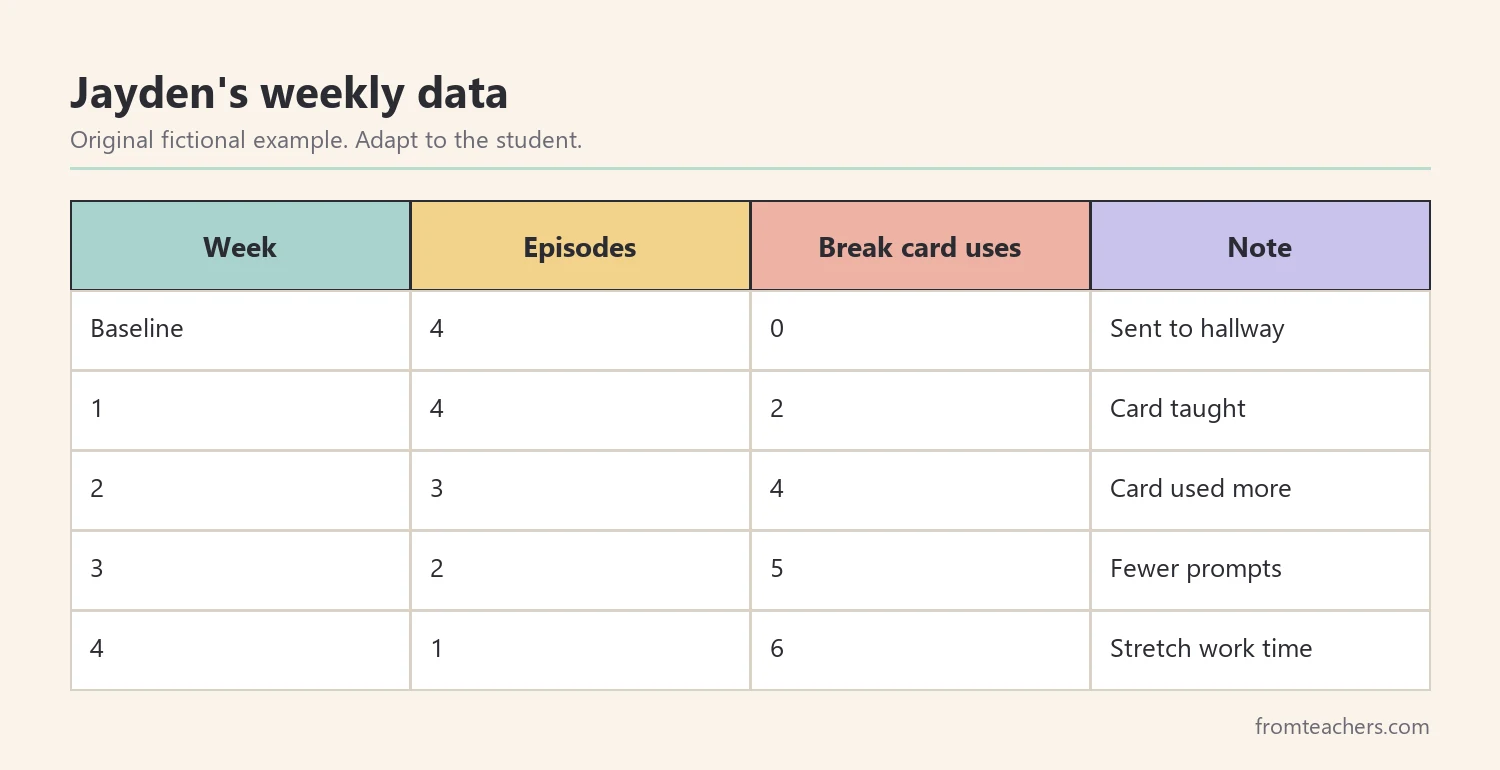
Next, set a review date, often every few weeks at first. Bring the data to the meeting and ask simple questions. Is the target behavior going down? Is the replacement behavior going up? Are adults following the plan the same way?
Share the results with the family in plain language. A good guide on how to write a BIP always includes the family, because consistent expectations at home and school often speed up progress.
Also, list the team members and their roles. A plan with names attached is much more likely to be followed. Include the teacher, the family, and any other staff who work with the student, such as a counselor, behavior specialist, or paraprofessional.
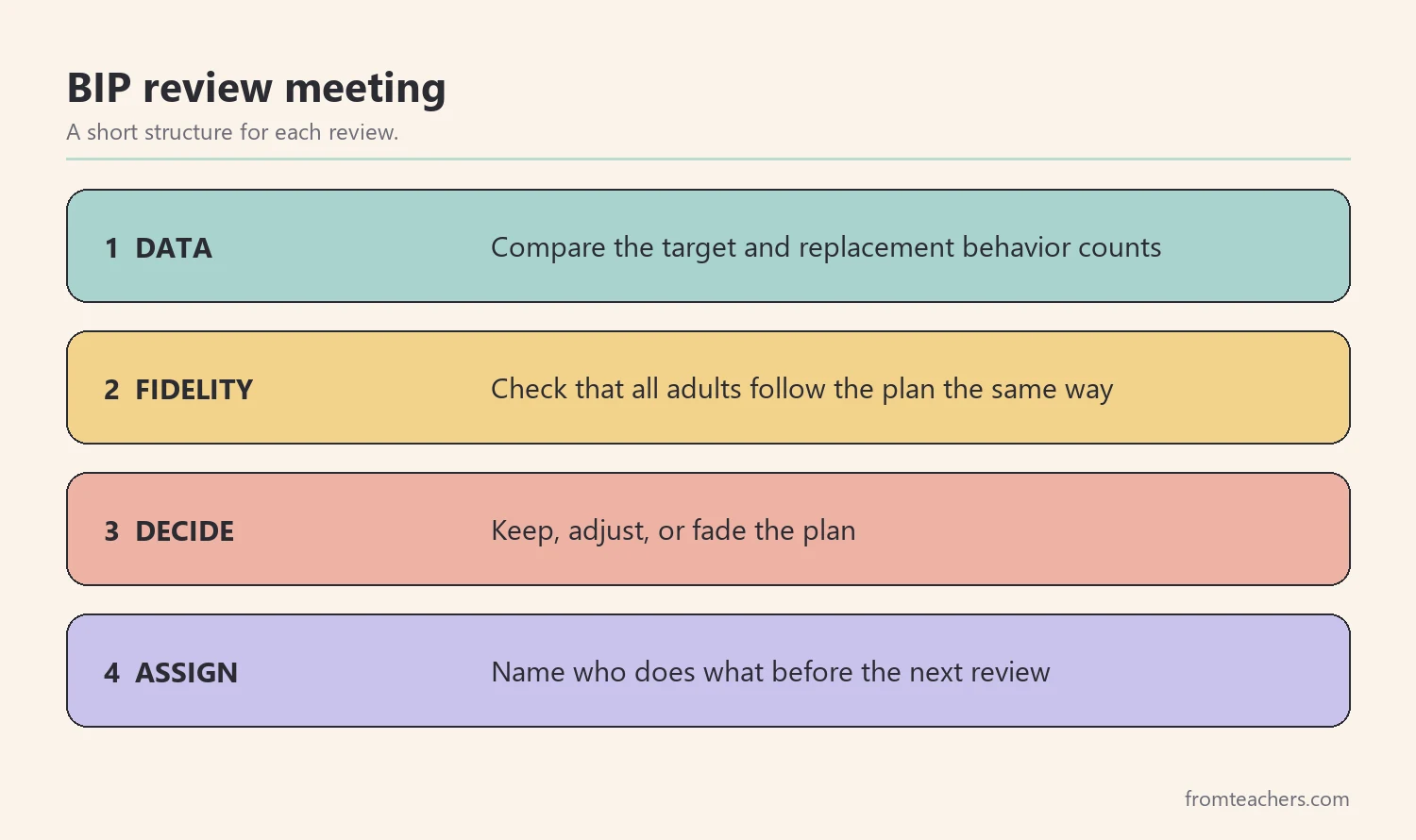
Worked example. Jayden’s baseline was 4 episodes a week. In week 1 of the plan, there are 4 episodes and he uses the break card 2 times. By week 2, there are 3 episodes and 4 card uses. In week 3, there are 2 episodes and 5 card uses. By week 4, there is 1 episode and 6 card uses. The team keeps the plan and starts stretching work time.
Common mistakes and how to avoid them
- Describing the behavior with labels. Fix: write what the student does in observable terms.
- Skipping the function. Fix: base every strategy on the hypothesis from the FBA.
- Choosing only consequences. Fix: include prevention and a taught replacement behavior.
- Making the replacement harder than the behavior. Fix: keep it quick, easy, and always honored at first.
- Writing a plan nobody reads. Fix: share a short summary with every adult who works with the student.
- Never reviewing the plan. Fix: set review dates and bring data to each meeting.
Questions teachers and parents ask about how to write a BIP
Do I need an FBA before I learn how to write a BIP?
In most cases, a BIP is based on an FBA, because the plan needs to address why the behavior happens. Follow your school and district procedures, and talk with your special education team about requirements for your student.
Who should be involved when you learn how to write a BIP?
Usually the teacher, the family, and other staff who know the student, such as a behavior specialist, counselor, school psychologist, or paraprofessional. The student can also share ideas when appropriate.
How long should a BIP be?
When deciding how to write a BIP, aim for a plan long enough to be complete and short enough to be used. A clear form with defined sections helps. Many teams also make a one-page summary for adults who work with the student daily.
What if the BIP is not working?
Check whether the plan is being followed the same way by all adults, and look at the data. If it still is not working, the hypothesis about function may need revisiting, so meet as a team.
How often should a BIP be reviewed?
Many teams review every few weeks at first, then less often once progress is steady. Your school procedures and the IEP team decide the exact schedule.
Related reading: Moving Beyond Shame and Behavior Charts: Positive Alternatives for Effective Classroom Management, The Power of Data Tracking in Special Education, and How Parents and Teachers Can Team Up for Special Education Success.
A companion resource for writing a BIP:
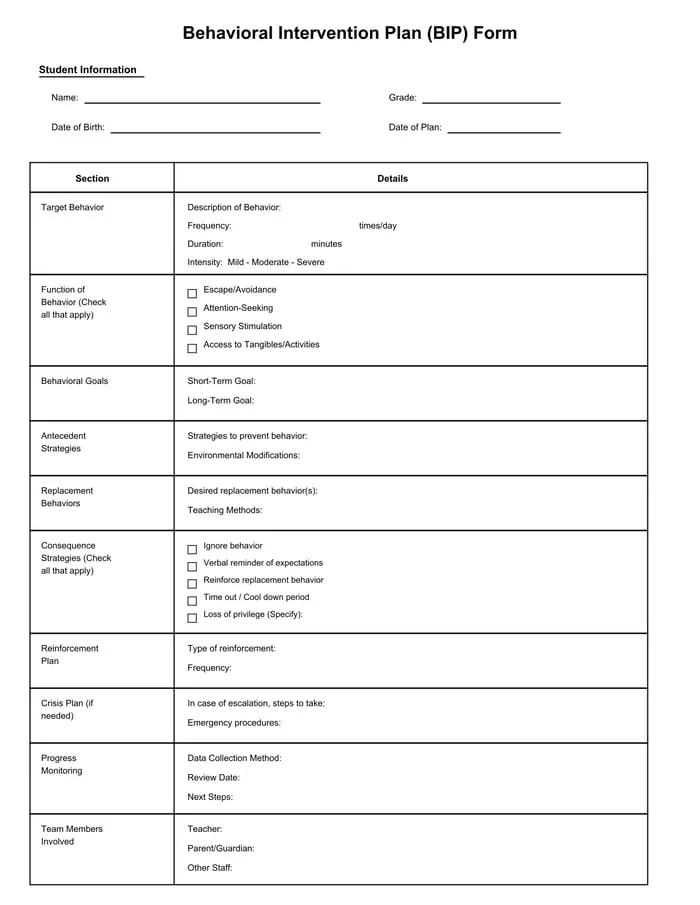
Behavioral Intervention Plan BIP Form: a fillable PDF with sections for student information, target behavior, function, goals, antecedent strategies, replacement behaviors, consequence strategies, reinforcement, crisis planning, progress monitoring, and team members.
Sources and scope
- Individuals with Disabilities Education Act (IDEA): federal information on special education, including behavior and the IEP.
- IRIS Center, Vanderbilt University: free modules on functional behavioral assessment and behavior supports.
- Center on PBIS: resources on positive behavioral interventions and supports.
- What Works Clearinghouse: reviews of research on education practices.
This guide covers the general structure of a behavior intervention plan for school teams. It does not replace your district’s procedures, legal requirements, or the professional judgment of the student’s team.
Key takeaways
- Learning how to write a BIP starts with an observable, measurable behavior.
- Every strategy should connect to the function of the behavior.
- Teach a replacement behavior that is quicker and easier than the problem behavior.
- Plan consistent responses, reinforcement, and crisis steps.
- Collect simple data and review the plan on a set schedule.










Leave a Comment