

An individual learning plan is often the missing piece for the student who clearly needs more support but has no IEP or 504 plan. Picture a fifth grader who reads well aloud yet cannot answer a single question about the page, while the class moves on without her. Everyone agrees she needs help, but nothing is written down, so each adult tries something different and nobody knows what worked.
This guide walks you through five steps to write a plan that people actually use: describe the student honestly, set goals you can measure, match supports to those goals, track progress in minutes a week, and review the plan with the family. By the end, you will have a one-page plan instead of scattered notes.
Examples are fictional. Adapt to the student’s goals and agreed supports. This is guidance, not a diagnosis.
At a glance
- Start with strengths and specific challenges, written as things you can see.
- Keep the plan to two or three goals, each with a clear success criterion and timeframe.
- Choose supports that serve a named goal, not a generic list.
- Record progress briefly and on a fixed schedule.
- Review with the family and the student, then decide what changes next.
1. Describe the student before you write an individual learning plan
Every useful plan starts with a clear picture of the learner. Before you write a single goal, gather what you already know: work samples, quick assessment results, your own observation notes, and what the family has told you. Then sort that information into two short lists, strengths and challenges.
Strengths matter more than many teams expect. They tell you what the student can lean on while you build the harder skill. For example, a student who loves drawing can sketch a scene before retelling it, and a student who talks easily can explain an answer aloud before writing it.
Next, write challenges as behaviors you can observe, not labels. “Struggles with reading” gives the team nothing to work with. In contrast, “answers 1 of 5 literal questions after reading a grade-level page” tells everyone exactly where the student is today.
Consider Leila, a fictional fifth grader. Her teacher, Ms. Ortiz, collected three weeks of notes before drafting anything.
| Strengths | Challenges (observable) |
|---|---|
| Reads aloud fluently | Answers 1 of 5 literal questions after reading |
| Strong oral vocabulary | Rarely rereads to find an answer |
| Enjoys drawing | Stops writing after one sentence |
| Helpful in small groups | Says “I don’t know” when unsure |
Before moving on, check the description with a colleague or the family. Ask whether it sounds like the student they know. If a parent says “she reads a lot at home but only comics,” that detail belongs in the individual learning plan, because it hints at what kind of text will hold her attention.
Notice that each challenge points toward a possible goal. That is the purpose of this step. As a result, the rest of the plan grows from evidence rather than from a hunch, and the family can see their child described fairly.
2. Write two or three measurable goals
Once the picture is clear, choose the two or three challenges that matter most right now. A plan with eight goals usually ends up with none of them tracked. Fewer goals, written well, get more attention from every adult in the room.
A strong goal has four parts: the skill, the condition, the success criterion, and the timeframe. In other words, say what the student will do, with what support or material, how well, and by when. If two adults could watch the student and disagree about whether the goal was met, rewrite it.
Here is how Ms. Ortiz turned Leila’s challenges into goals.
| Goal | Success criterion | Timeframe |
|---|---|---|
| Answer literal questions about a grade-level page | 4 of 5 correct, 3 sessions in a row | 8 weeks |
| Write a response with a claim and one detail | 2 sentences, both on topic | 8 weeks |
| Ask for help with a set phrase | Uses phrase in 3 of 4 work periods | 6 weeks |
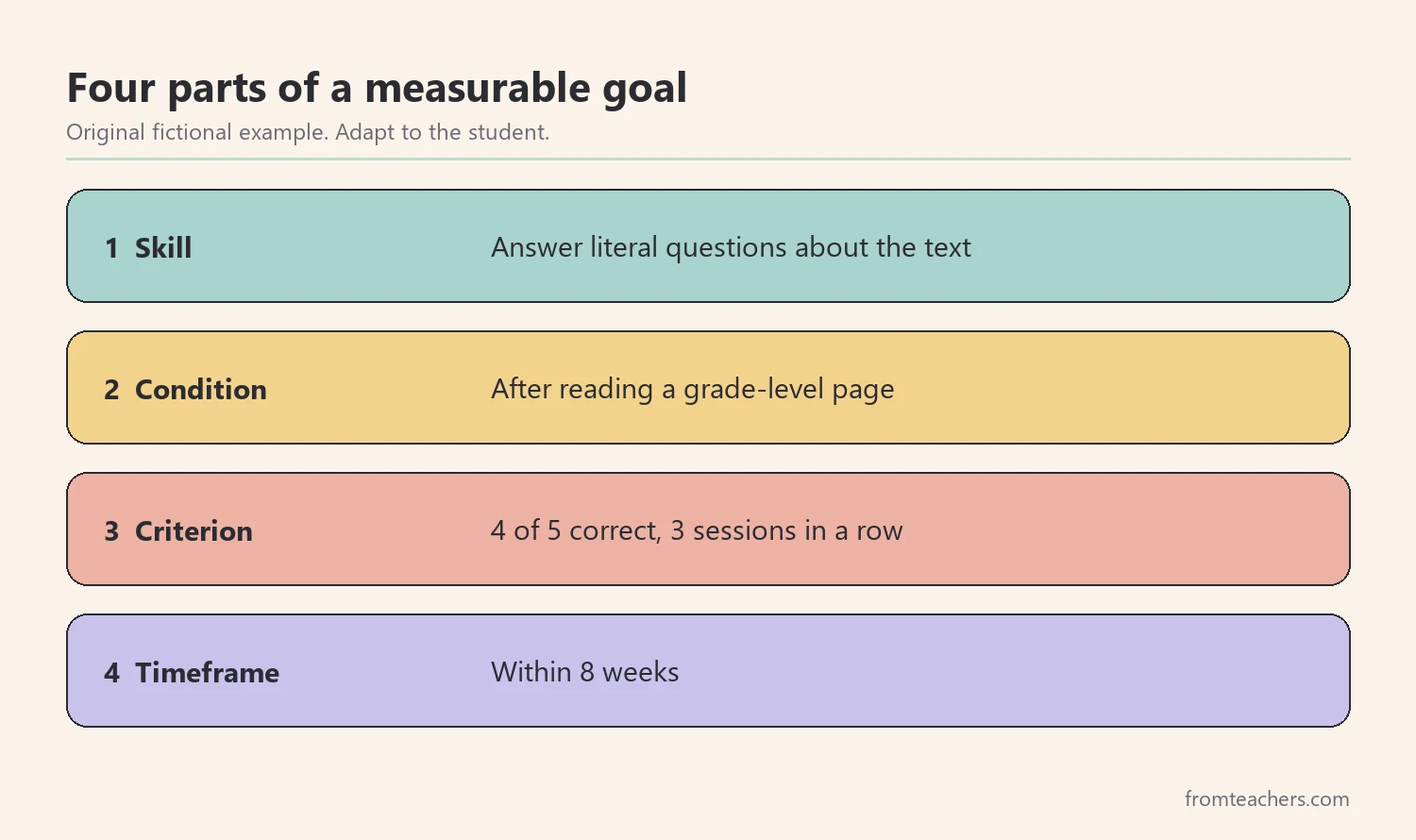
Also, keep the baseline next to each goal. Leila starts at 1 of 5 literal answers, so 4 of 5 is a real stretch but a reachable one. Without the starting point, nobody can tell later whether the student grew or simply had a good day.
Moreover, check that each goal can be practiced every week. A goal that only comes up once a month will not move. In Leila’s individual learning plan, all three goals can be practiced in small-group reading, so she gets several chances each week to show growth.
Finally, write goals in plain language. The student should be able to hear the goal and repeat it in her own words. Leila’s version of her first goal was simple: “I can find the answer in the page and show where it is.”
3. Match supports in your individual learning plan to each goal
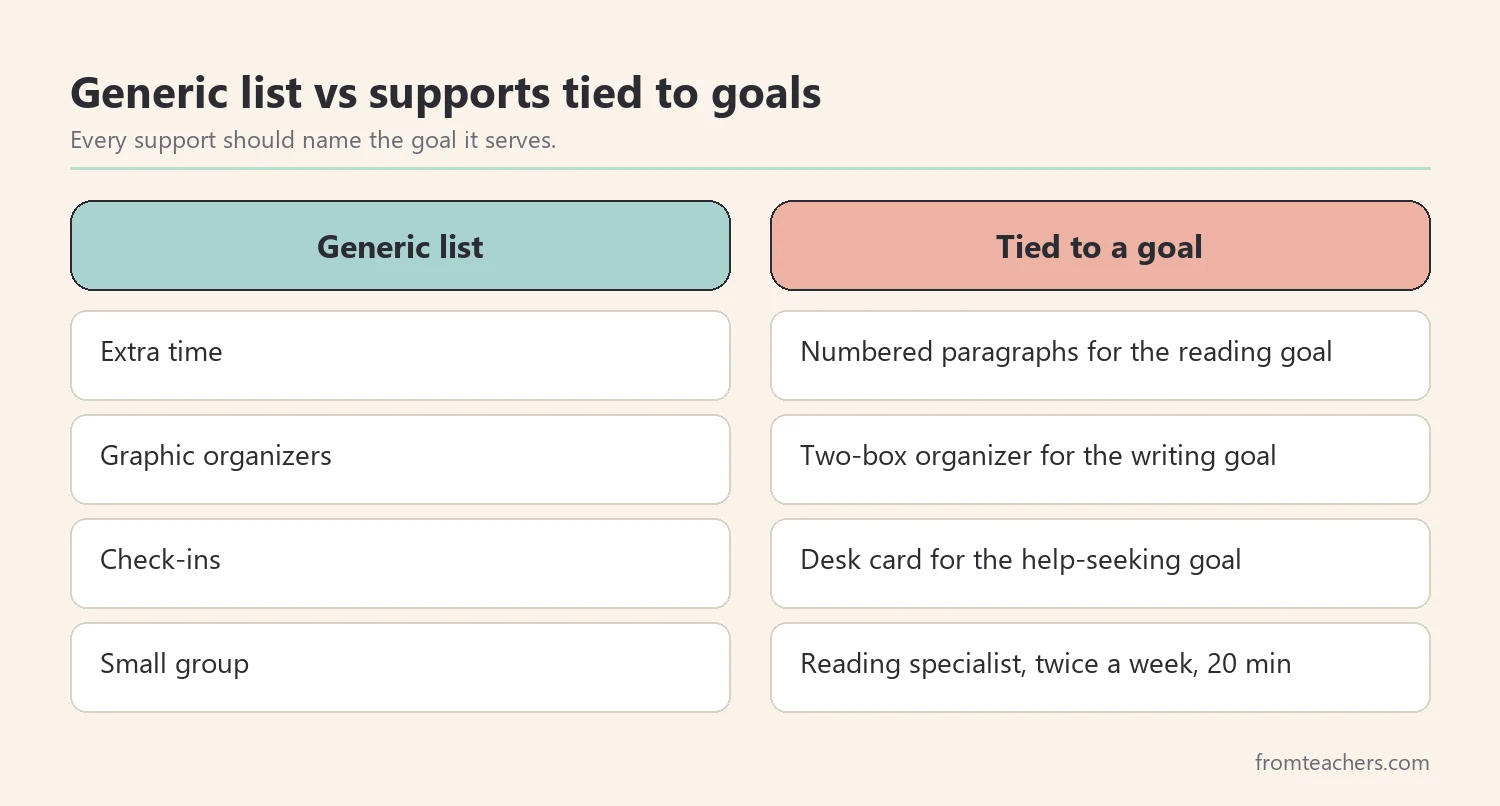
With goals set, decide how adults will help the student reach them. This is where many plans go wrong. They list every strategy anyone has heard of, and none of them is tied to a goal. Instead, give each goal two or three supports, and write down who provides them and how often.
It helps to separate supports into three kinds. Instructional supports change how you teach, such as modeling a strategy or giving a graphic organizer. Environmental supports change the setting, such as a quieter seat or a visual reminder on the desk. Services describe who works with the student and when, such as a reading specialist twice a week.
For Leila, Ms. Ortiz matched supports like this:
- Literal questions: teach “find it, point to it, say it”; number the paragraphs; small-group reading with the reading specialist, 2 times a week for 20 minutes.
- Written response: a two-box organizer (claim, detail); oral rehearsal with a partner before writing.
- Asking for help: a desk card with the phrase “Can you show me where to start?”; praise each time she uses it.
Then write the frequency in a way that anyone can check. “Daily” is clearer than “often,” and “Tuesday and Thursday, 20 minutes” is clearer still. When a substitute opens the individual learning plan, they should know exactly what to do that day without asking.
Because every support names a goal, the team can later ask a precise question: is this support helping this goal? If the answer is no, you change one thing, not everything.
If you would rather not build the layout yourself, an editable individual learning plan template with goals and accommodations tables already separates instructional and environmental supports and lists service providers with frequency.
4. Track progress in a few minutes a week
An individual learning plan only works if someone checks whether it is working. However, progress tracking does not need to be complicated. For each goal, decide on one measure, one schedule, and one place to write it down.
Choose a measure that matches the success criterion you already wrote. For Leila’s reading goal, the measure is the number of literal questions answered correctly out of 5. Every Friday, Ms. Ortiz gives one short passage and records the score. The check takes about five minutes.
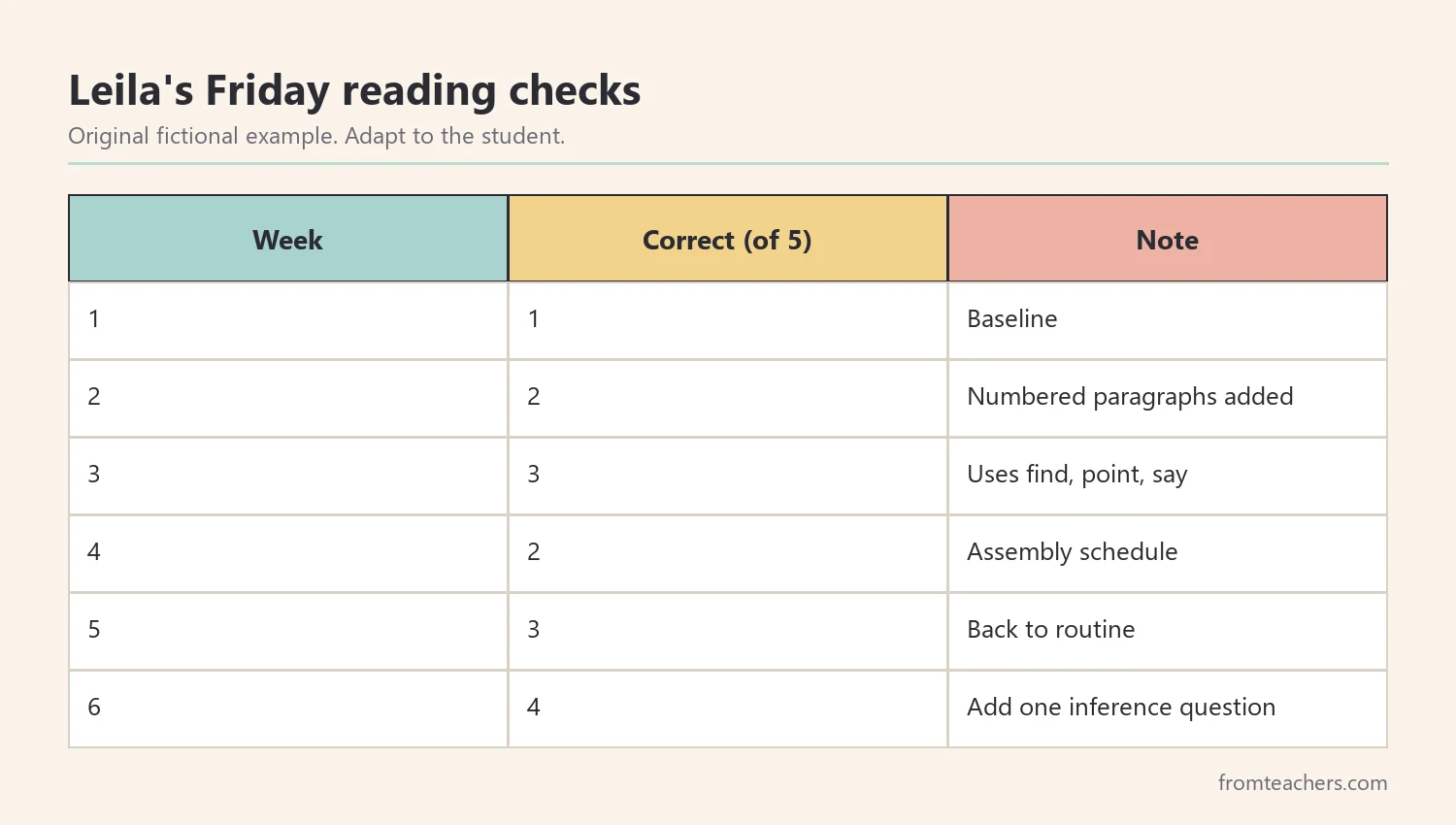
Look at the pattern, not single scores. Leila moved from 1 correct in week 1 to 3 correct in week 3, dipped to 2 during week 4 with an assembly schedule, and reached 4 of 5 in week 6. That one reading of 4 does not meet the goal yet, because the criterion asks for three sessions in a row. Still, the trend is clearly upward.
In addition, write a “next step” whenever you record. A next step can be small: “keep numbering paragraphs,” “add one inference question,” or “try without the organizer once.” These notes turn the progress table into a record of decisions, which is exactly what the team will need at review time.
Equally important, record what actually happened, not only the score. If the reading specialist was absent and the small group was skipped, write that down. Otherwise, a flat week in the individual learning plan data could look like the strategy failed when it was simply never delivered.
Keep the tracking where you will see it. A clipboard by your small-group table, a tab in your planning binder, or a digital copy you open every Friday all work. What matters is that it happens on the same day each week.
5. Review the individual learning plan with the family and student
Every six to eight weeks, or sooner if something is clearly not working, sit down to review. Invite the family, and include the student for at least part of the meeting. A review is not a report card. It is a short conversation about what the data shows and what to try next.
Bring the progress table, one or two work samples, and a short list of questions. Then decide for each goal whether to keep it, raise the criterion, change a support, or close it because it is met.
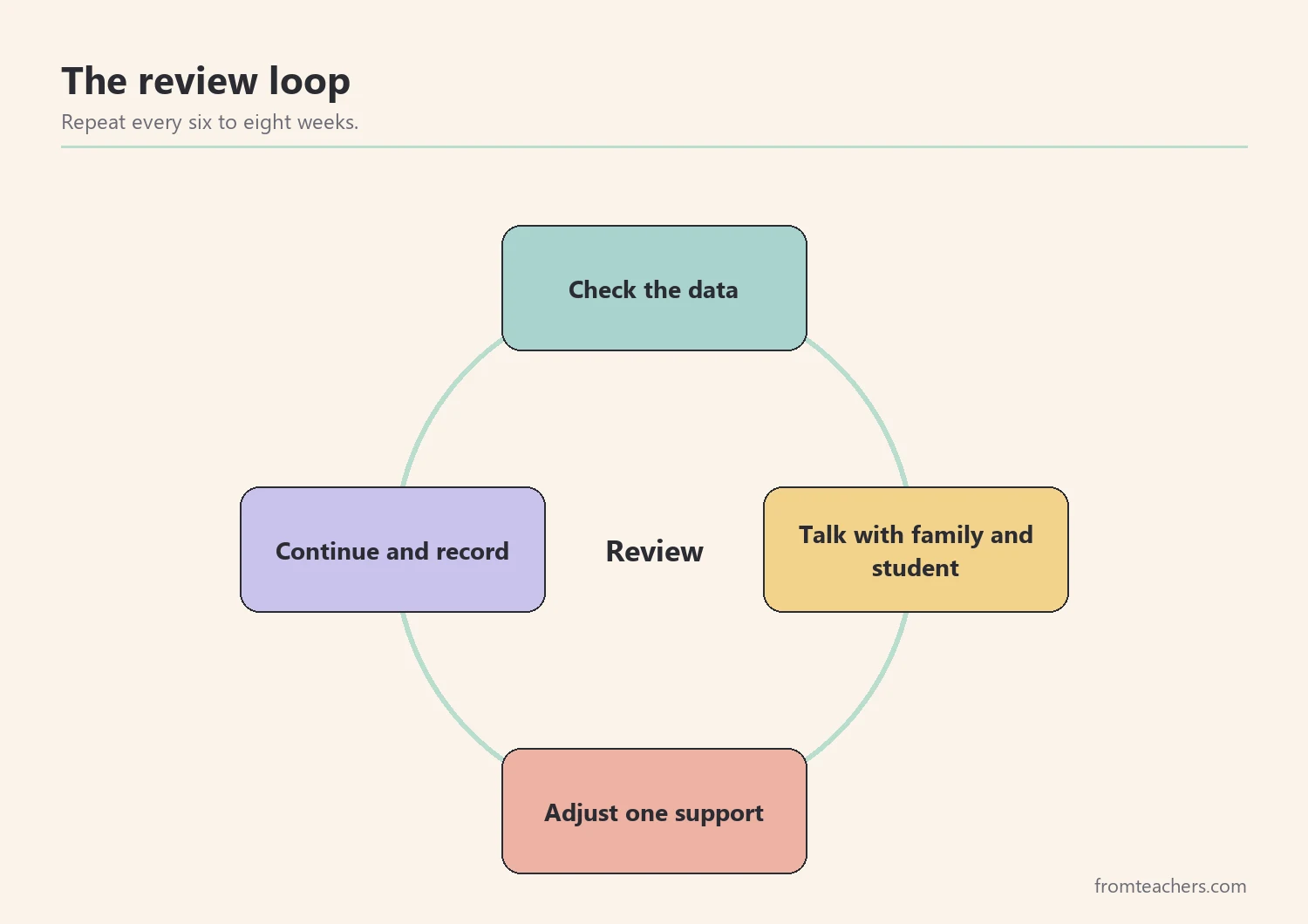
At Leila’s first review, her mother shared that Leila now asks “where does it say that?” when they read together at home. As a result, the team kept the reading goal, added one simple inference question each week, and agreed that the help-seeking goal was met. Both her mother and Ms. Ortiz signed the updated plan.
After the meeting, send the family a short summary in plain language: what changed, what stays the same, and when the next review will be. Keep a copy with the individual learning plan so the history stays in one place.
Also, ask the student what helps. Leila said the numbered paragraphs made it “easier to find my place.” That comment is evidence too, and it belongs in the notes.
Finally, decide whether the plan is enough. If a student makes little progress after well-delivered supports, the team may need to consider a referral for further evaluation through your school’s process. An individual learning plan supports a student; it does not replace an evaluation when one is needed.
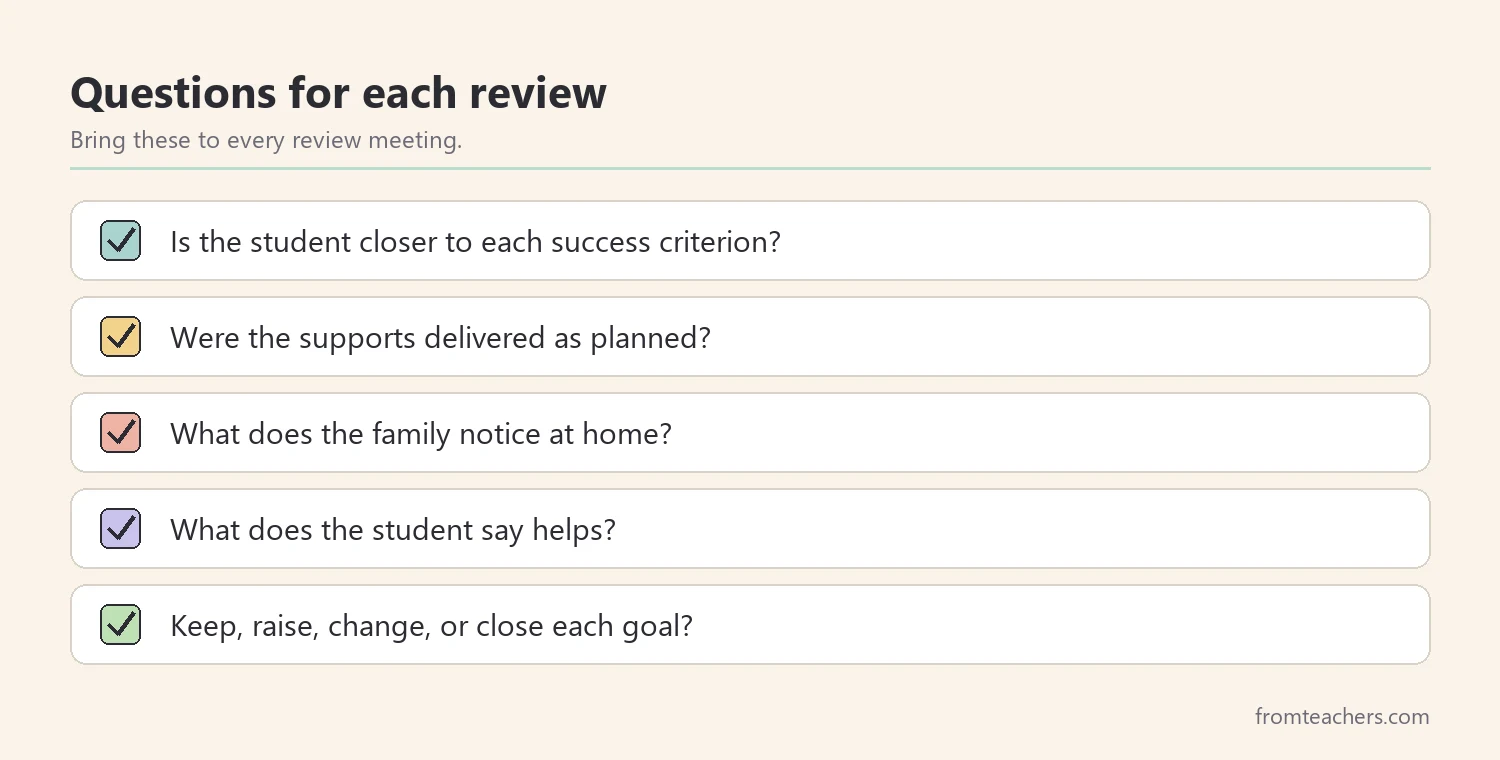
Over a school year, the individual learning plan becomes a short story of the student’s progress. Each review adds a chapter: what was tried, what changed, and what came next. That record is useful for next year’s teacher, who can start where you left off instead of starting over.
Common mistakes and how to avoid them
- Too many goals. Eight goals means none get tracked. Fix: choose two or three that matter most now and park the rest.
- Vague success criteria. “Will improve reading” cannot be measured. Fix: name the skill, condition, criterion, and timeframe.
- Supports with no goal attached. Long lists make it impossible to tell what helped. Fix: link every support to a goal.
- Tracking that stops after October. Plans fade when checks are irregular. Fix: set one fixed weekly check of five minutes or less.
- Writing the plan without the family. Families notice things school does not. Fix: ask for their input before drafting and at every review.
Questions teachers and parents ask about an individual learning plan
Is an individual learning plan the same as an IEP?
No. An IEP is a legal document under special education law, written after an eligibility evaluation. An individual learning plan is a school or classroom tool for any student who needs a more personalized approach. It can sit alongside Tier 2 intervention or a 504 plan.
Who should write the plan?
Usually the classroom teacher drafts it, with input from intervention staff, the family, and the student. One person should own it, so updates do not fall through the cracks.
How long should an individual learning plan be?
Short enough to read in a few minutes. In practice, one or two pages with strengths, goals, supports, and a progress table is plenty.
How often should we review it?
Every six to eight weeks works for most goals. However, if the data shows no movement after three or four weeks, meet sooner and change one support.
Can I use one for behavior or social goals?
Yes. The same structure works for academic, behavioral, or skill-based goals. Just make sure the behavior goal is observable and has a clear criterion.
Related reading: Accommodations vs Modifications in Special Education: The Difference Explained, The Power of Data Tracking in Special Education, and How Parents and Teachers Can Team Up for Special Education Success.
A companion resource for your individual learning plan:
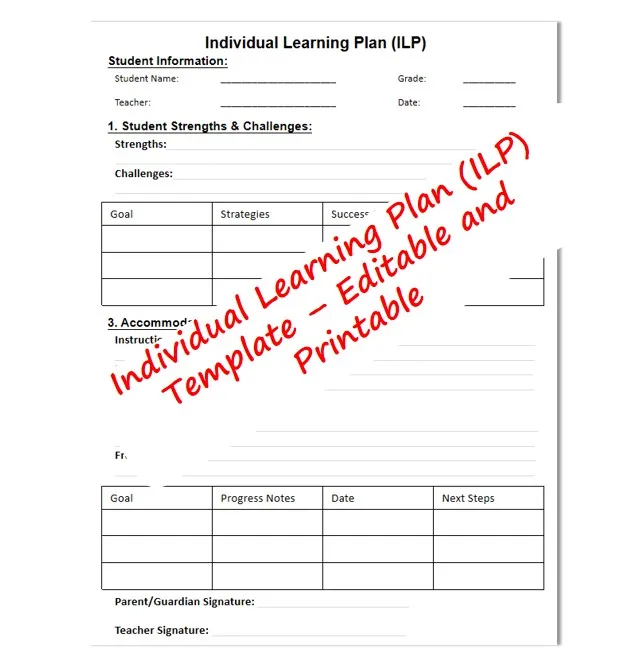
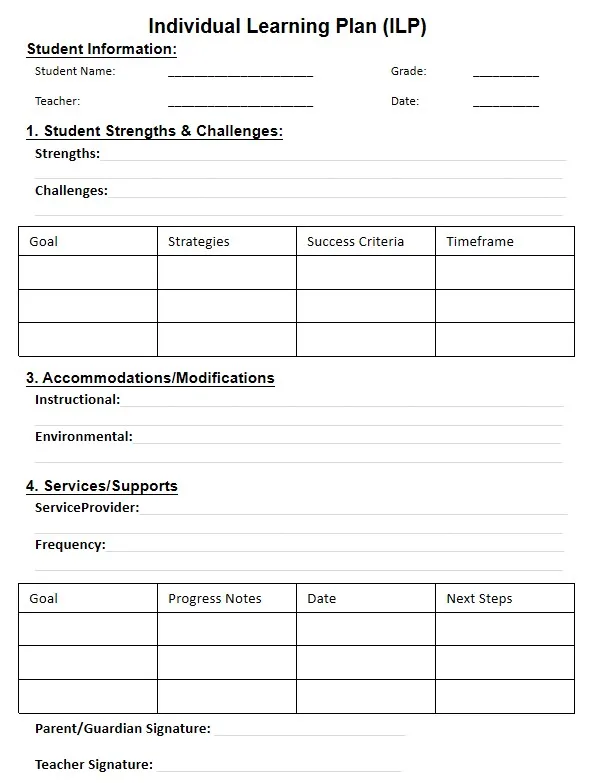
Individual Learning Plan (ILP) Template: an editable and print-ready template with fields for strengths and challenges, a goals table with strategies, success criteria, and timeframe, instructional and environmental accommodations, services and supports, a progress table, and signature lines.
Sources and scope
- IRIS Center (Vanderbilt University): free modules on progress monitoring, intervention, and data-based decisions.
- National Center on Intensive Intervention: guidance on data-based individualization and progress monitoring tools.
- Center on Multi-Tiered System of Supports: resources on tiered intervention within a school-wide framework.
- What Works Clearinghouse: reviews of research on instructional practices, including reading.
Scope: this guide covers writing and reviewing a classroom-level plan for students who need extra support. It does not cover legal requirements for IEPs or 504 plans, or evaluation for special education eligibility.
Key takeaways
- Describe strengths and challenges as things you can observe.
- Limit the plan to two or three measurable goals with baselines.
- Tie each support to a goal and name who provides it.
- Check progress weekly in five minutes and note the next step.
- Review every six to eight weeks with the family and the student.









Leave a Comment