

Demand avoidance supports help children who feel intense stress when they are asked to do things, even things they enjoy. Picture a morning at school: the teacher says, “Take out your math book,” and one child freezes, jokes, slides under the desk, or says, “No, I won’t.” To an adult, it looks like defiance. To the child, the request can feel like a threat.
After reading this guide, you will be able to spot the patterns behind demand avoidance, lower everyday pressure, use calmer language, plan transitions, share control, and track what helps. The steps work at school and at home.
Examples are fictional. Adapt to the student’s goals and agreed supports. This is guidance, not a diagnosis.
At a glance
- See avoidance as a stress response, not simple stubbornness.
- Reduce the number and intensity of direct demands.
- Use declarative, invitational language instead of commands.
- Give heads-up warnings and real choices to share control.
- Track stress and participation, and adjust with the family.
1. Notice the patterns behind demand avoidance
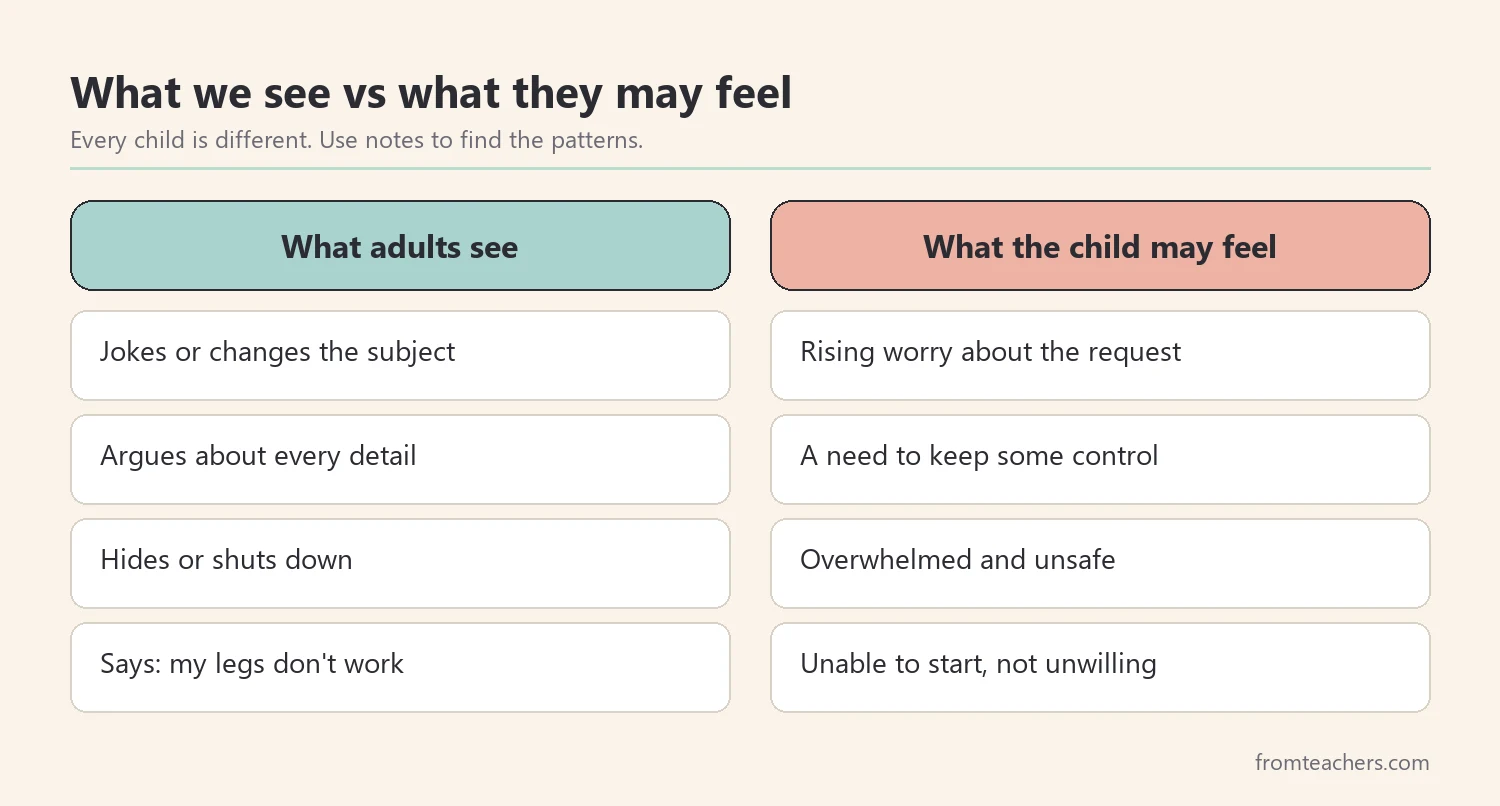
The first step is to understand what you are seeing. Many children who avoid demands are not choosing to be difficult. Instead, a request can trigger a strong rush of worry, often linked to a need for control or predictability. Some people use the term Pathological Demand Avoidance, or PDA, especially in autism communities, but the ideas below can help any child who reacts strongly to demands.
Avoidance can look very different from child to child:
- Distracting or changing the subject.
- Making excuses, such as “My legs don’t work.”
- Negotiating or arguing about every detail.
- Withdrawing, hiding, or shutting down.
- Meltdowns when pressure keeps building.
Also, notice the times when the child joins in easily. These moments are just as useful, because they show which conditions already work. Strong demand avoidance supports often grow from what is going right.
To find patterns, keep short notes for a week. Write down the request, how it was said, what happened, and what helped. Patterns often appear quickly.
Here is a fictional example. Noah is 9 and in grade 3. His teacher, Ms. Lee, notices that he avoids writing tasks most, especially when she says “now” or “you need to.” On the other hand, he joins in easily when tasks are framed as a puzzle or a choice.
That small insight changes everything. Rather than asking “How do I make Noah comply?”, the team asks “What makes requests feel safe for Noah?” Good demand avoidance supports start with that question.
2. Lower the demand load with demand avoidance supports
Next, look at how many demands the child faces in a day. Every instruction, question, and expectation adds to the load. When the load is high, even small requests can tip a child into stress. Therefore, many demand avoidance supports begin by reducing that load.
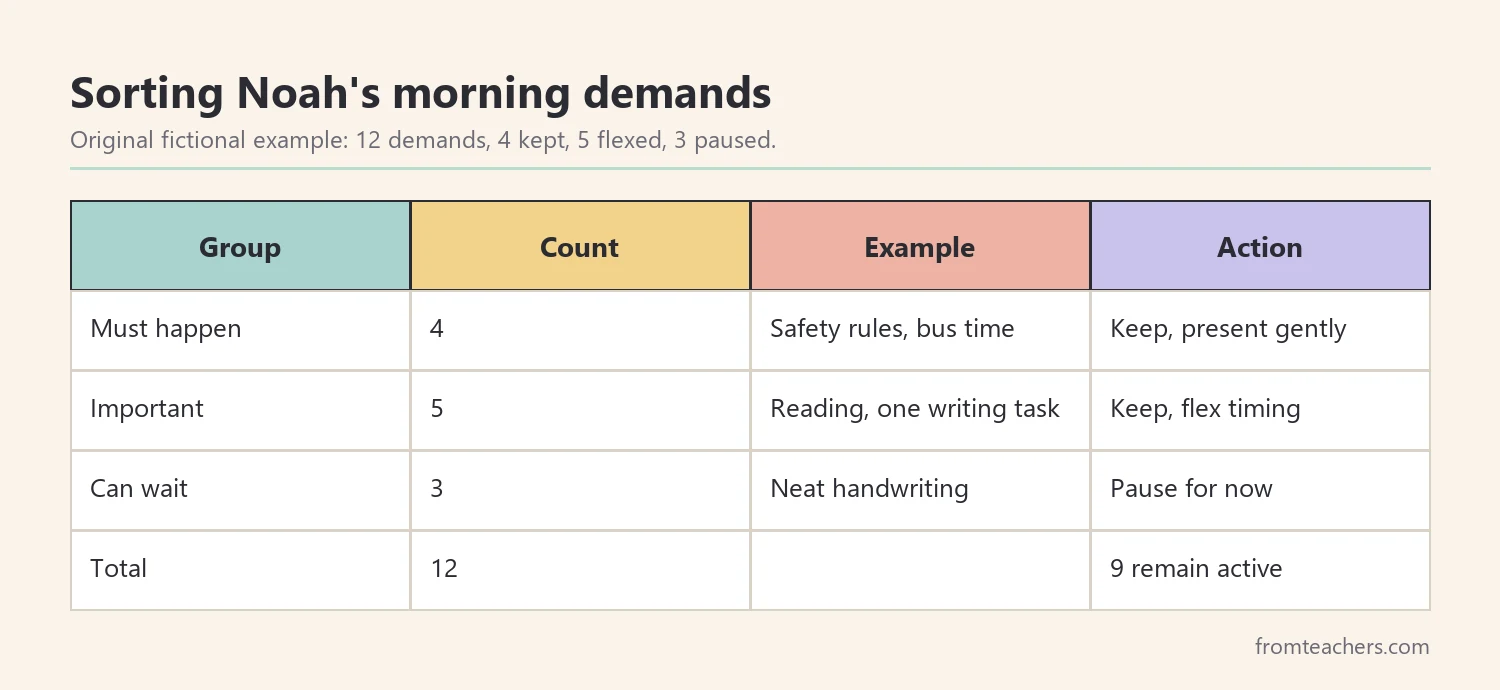
Sort demands into three groups:
| Group | Example | Action |
|---|---|---|
| Must happen | Safety rules, leaving for the bus | Keep, but present gently |
| Important | Daily reading, one writing task | Keep, but flex timing and format |
| Can wait | Neat handwriting, tidy desk | Drop or pause for now |
Then, look at how demands are delivered. A crowded morning with many quick instructions feels very different from a calm start with a visual schedule. In addition, hidden demands count too, such as being watched, being praised in front of others, or being asked questions.
For Noah, Ms. Lee listed 12 typical morning demands. She kept 4 as must-happen, kept 5 as important but flexible, and paused 3. So, 12 became 9 demands, delivered more gently. Within a week, mornings felt calmer for both of them.
Share the sorted list with the family too. They may spot demands at home that can wait, such as tidying a room before school. When school and home both lower the load, demand avoidance supports tend to work faster.
Lowering demands is not lowering expectations forever. It is about creating enough safety for the child to engage. Once trust grows, you can slowly add demands back.
3. Use declarative language as a demand avoidance support
Words matter a lot. Direct commands, such as “Put on your shoes now,” often trigger resistance. In contrast, declarative language describes a situation or shares a thought, which leaves room for the child to decide. This is one of the most useful demand avoidance supports.
| Try this | Avoid this |
|---|---|
| “I notice the paint is out on the table.” | “Go paint now.” |
| “I wonder which shoes would be comfy today.” | “Put your shoes on right now.” |
| “We could start with drawing or reading.” | “You have to finish this first.” |
| “The bus comes in ten minutes.” | “Hurry up or you will be late.” |
Why does it help? Declarative language removes the feeling of being ordered. As a result, the child feels more in control and less threatened. Also, a calm tone and relaxed body language matter as much as the words.
Other gentle approaches include:
- Thinking aloud: “Hmm, I’m not sure how to start this puzzle.”
- Asking for help: “Could you show me how this works?”
- Using humor and play, when the child enjoys it.
- Writing the request on a note instead of saying it.
Remember that adults need practice too. Changing years of command habits takes time, so pick two or three phrases to use all week, and add more later.
Ms. Lee changed “Take out your math book” to “Math books are on the shelf, and today’s puzzle is page 12.” Noah often walked over on his own. For a ready-made set of examples, the Demand Avoidance Supports guide for classroom and home uses a Try This, Avoid This, and Why It Helps format across many topics.
4. Plan calm transitions and respect “not yet”
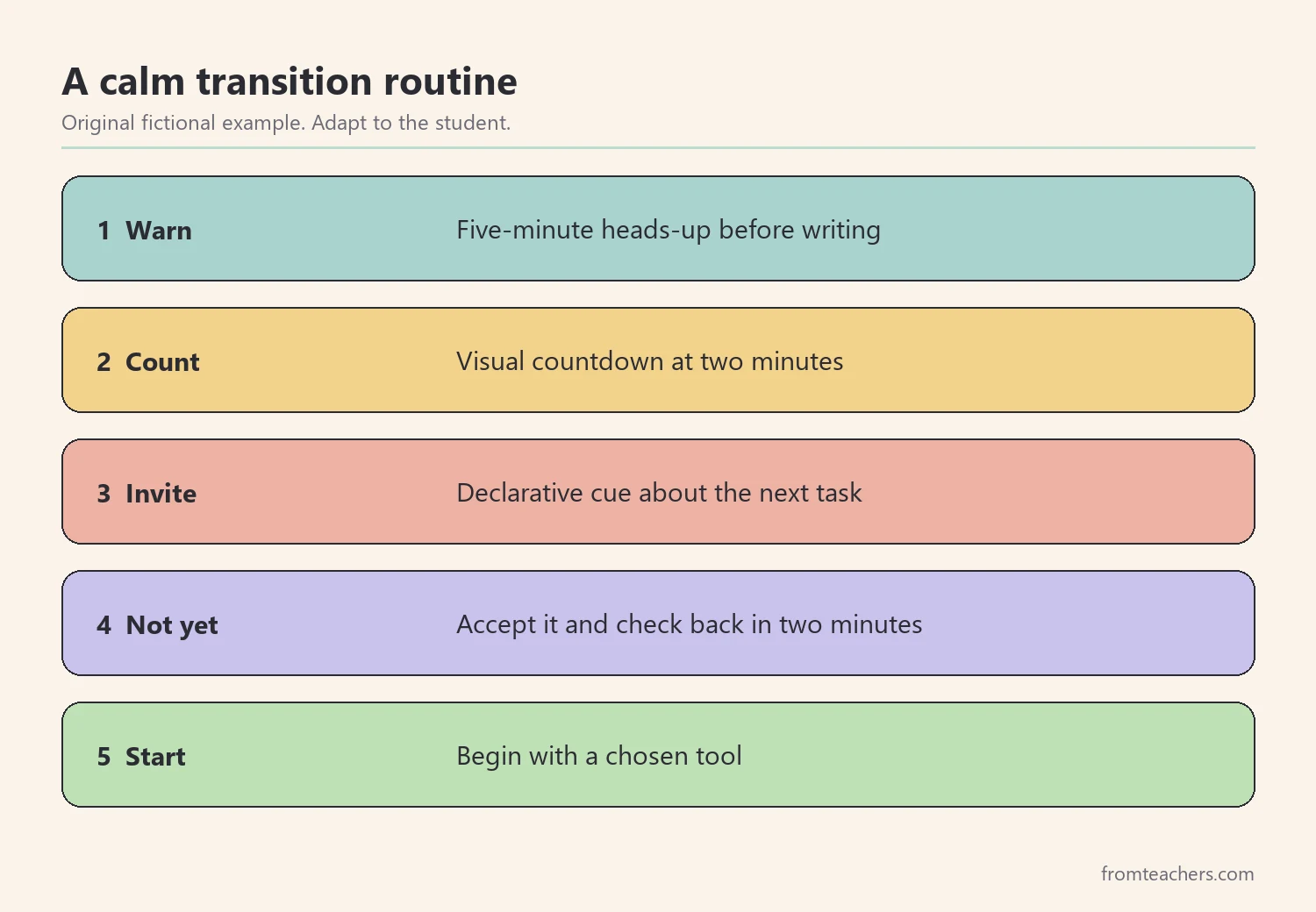
Transitions are often the hardest moments for children who avoid demands. Stopping a favorite activity and starting a new one is a demand stacked on a demand. So, plan transitions carefully.
Helpful transition supports include:
- Heads-up warnings: “In five minutes, we will tidy up.”
- Visual countdowns: a timer or a strip of numbers to remove one by one.
- Bridging objects: bringing a small item from one activity to the next.
- A clear next step: a picture of what comes next.
Equally important is respecting “not yet.” Sometimes a child is truly not ready. Pushing harder often leads to a bigger shutdown. Instead, acknowledge the feeling, offer a short wait, and try again. For example, “Not yet is okay. I’ll check back in two minutes.”
This does not mean every demand disappears. Safety demands still stand. However, for flexible tasks, a short wait often works better than a power struggle. Over time, these demand avoidance supports build trust, because the child learns that adults will listen.
For Noah, Ms. Lee began giving a five-minute and a two-minute warning before writing. She also allowed one “not yet” per task, with a check-back in two minutes. Most days, Noah started writing after the check-back.
5. Share control through real choices
Many children who avoid demands have a strong need for control. Rather than fighting that need, work with it. Offering real choices is one of the most respectful demand avoidance supports.
Choices can be small:
- Which task to do first.
- Where to work: desk, rug, or standing table.
- What to use: pencil, marker, or keyboard.
- How to show learning: write, draw, or tell an adult.
Keep choices real and limited. Two or three options are usually enough. Also, avoid fake choices, such as “Do you want to do your work now or get in trouble?” Children notice these right away, and they damage trust.
In addition, involve the child in planning. Ask, “What makes this easier for you?” Children often have useful ideas. For example, Noah suggested writing on a small whiteboard instead of paper, because it felt less permanent. Ms. Lee agreed, and his writing output grew.
Some children find even choices stressful on hard days. In that case, offer one gentle suggestion and let them accept or decline. Watching the child’s stress level tells you how much choice feels helpful.
Shared control also means adults stay flexible. If a plan is not working, change it together. That way, the child learns that problems can be solved without a battle.
6. Track what helps and review with the team
Finally, check whether your demand avoidance supports are working, because good intentions are not the same as good results. Tracking does not need to be heavy. A simple daily record of stress level and participation can show trends.
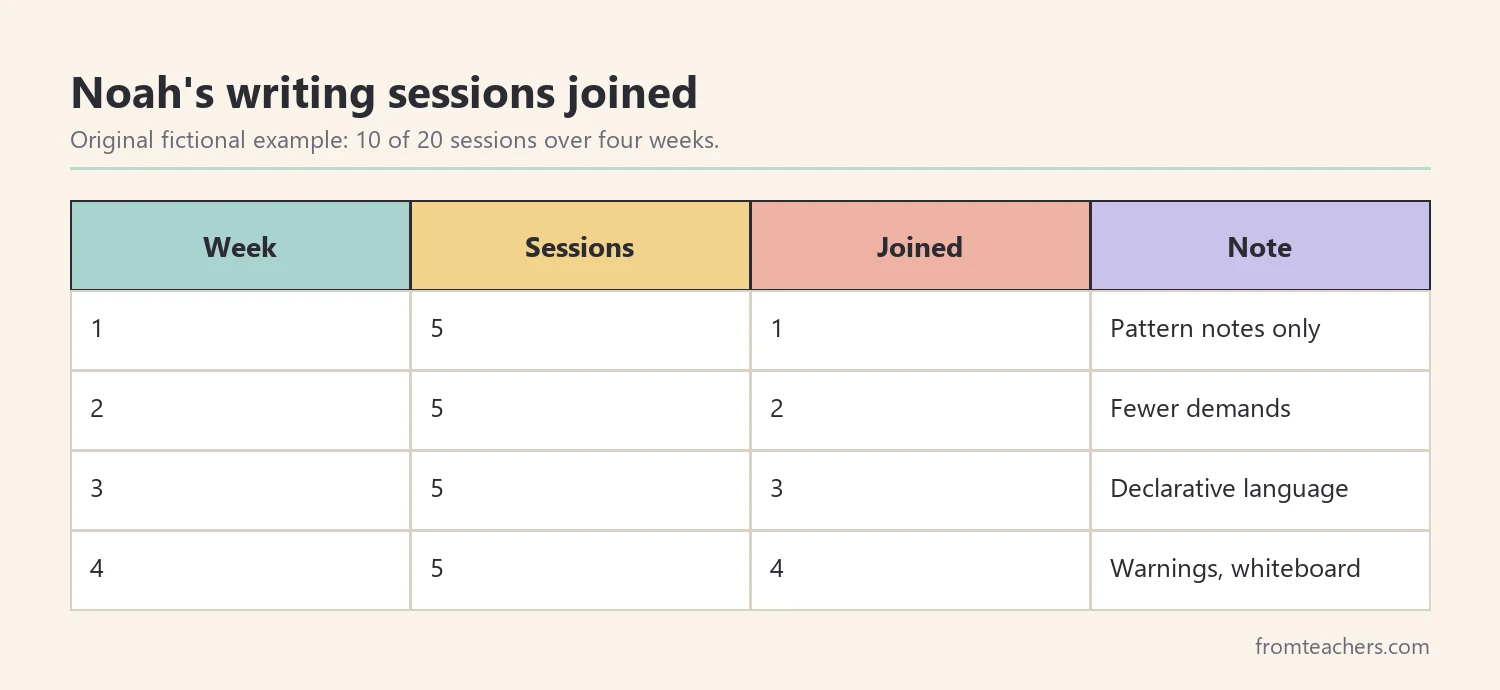
Ms. Lee tracked Noah’s writing time across four weeks. Each week, she recorded how many of the five writing sessions he joined.
| Week | Sessions | Joined | Note |
|---|---|---|---|
| 1 | 5 | 1 | Notes on patterns only |
| 2 | 5 | 2 | Fewer morning demands |
| 3 | 5 | 3 | Declarative language |
| 4 | 5 | 4 | Warnings and whiteboard |
Across the four weeks, Noah joined 10 of 20 sessions, and the trend rose each week. That is clear, useful information to share with his family. Also, the notes column shows which supports came before each change.
Look beyond the numbers as well. Notes about mood, sleep, and changes at home can explain a hard week. For example, a substitute teacher or a schedule change may add hidden demands, so adjust demand avoidance supports on those days.
Review the plan with the family and team every few weeks. Ask what is working at home, what is hard, and what to try next. Change one thing at a time, so you can see what helps. If stress stays high, involve school support staff or outside professionals the family already works with.
Common mistakes and how to avoid them
- Treating avoidance as defiance. Fix: look for the stress behind the behavior and keep notes on patterns.
- Adding more pressure when a child resists. Fix: lower the demand, wait, and try again later.
- Using fake choices or threats. Fix: offer two or three real, acceptable options.
- Dropping all expectations for good. Fix: keep safety demands and add others back slowly as trust grows.
- Changing many supports at once. Fix: change one thing at a time and track the result.
Questions teachers and parents ask about demand avoidance supports
Is demand avoidance the same as defiance?
Not usually. Defiance is often seen as a choice to break rules, while demand avoidance is often driven by anxiety and a need for control. The behavior may look similar, but the support needed is different.
Do demand avoidance supports mean letting kids do whatever they want?
No. Safety rules stay in place, and learning still happens. The difference is how demands are presented, how many there are, and how much control the child shares. Over time, the goal of demand avoidance supports is more participation, not less.
Can these supports help children without a PDA profile?
Yes. Many children feel stress when demands pile up. Calm language, warnings, and real choices can help a wide range of children, with or without a diagnosis.
How do I use demand avoidance supports at home?
Start by noticing which requests cause the most stress. Then, reduce non-essential demands, use declarative language, and offer real choices. Also, share notes with the child’s teacher so both settings use similar approaches.
When should we seek more help?
If stress is high, school attendance drops, or the child seems very unhappy, talk with the school team and the child’s doctor or other professionals. They can help plan further support.
Related reading: Understanding Demand Avoidance and School Refusal: Strategies for PDA-Style Profiles, Meltdowns vs Tantrums: A Guide to Understanding and Responding, and Understanding Autistic Burnout and School Exhaustion: Prevention and Support Strategies.
A companion resource for demand avoidance supports:
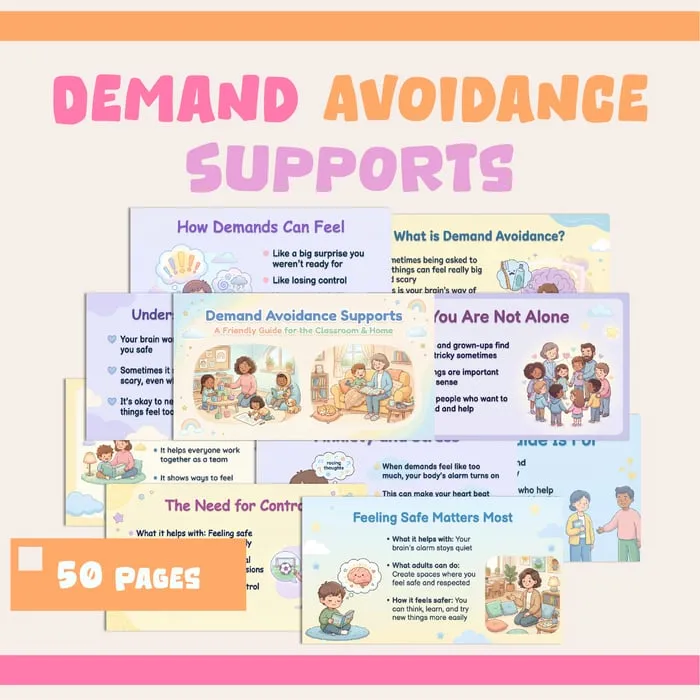
Demand Avoidance Supports: A Friendly Guide for the Classroom and Home: a 50-page resource with child-friendly pages on what demand avoidance feels like, plus Try This, Avoid This, and Why It Helps strategies for teachers and parents, including calm transitions, respecting “not yet,” and the need for control.
Sources and scope
- PDA Society: information and resources on the PDA profile for families and professionals.
- National Autistic Society: guidance on autism, including demand avoidance, for families and schools.
- IRIS Center, Vanderbilt University: free modules on behavior support and classroom practices.
- Understood.org: practical articles for families and teachers on anxiety, behavior, and learning differences.
This guide covers everyday supports for children who find demands stressful at school and home. It does not cover diagnosis, therapy, or medical care, which belong to qualified professionals and the child’s team.
Key takeaways
- Demand avoidance supports start with seeing avoidance as stress, not stubbornness.
- Reduce the demand load and present essential demands gently.
- Use declarative language, warnings, and a respectful “not yet.”
- Share control with real, limited choices.
- Track participation and review with the family, one change at a time.










Leave a Comment