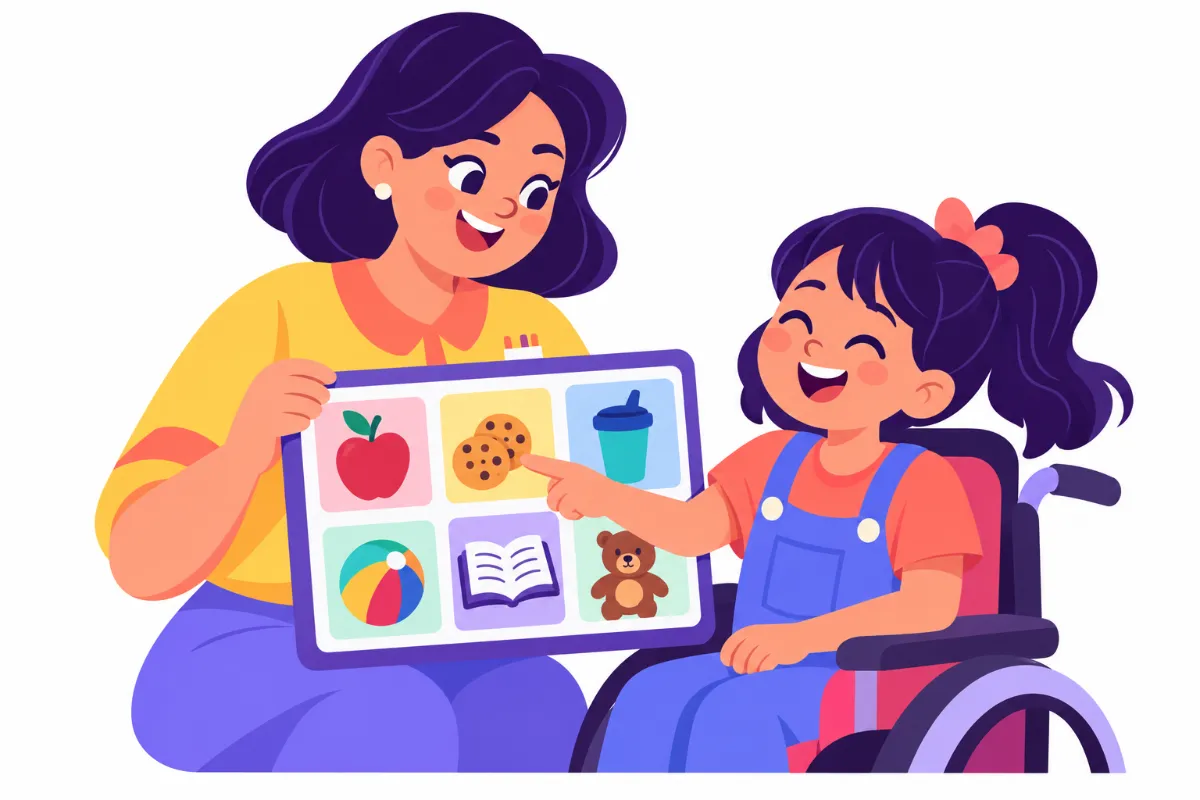

Choice boards for nonverbal students turn a guessing game into a real conversation. Picture snack time in a first-grade classroom. A seven-year-old reaches toward the shelf and cries, and the adults try crackers, then juice, then an apple, while the child grows more upset. She has a clear preference. She simply has no way yet to show it.
This guide gives you a five-step path you can follow at school or at home: learn how the student communicates now, build a first board, model it during real routines, use it across settings, and track progress as you build toward AAC (augmentative and alternative communication). By the end, you will know where to begin with a new communicator and how to grow from there.
Examples are fictional. Adapt to the student’s goals and agreed supports. This is guidance, not a diagnosis.
At a glance
- Every student communicates already, through gestures, sounds, looks, or behavior.
- Start small: two clear choices about something the student truly wants.
- Adults model the board by pointing to symbols while they talk.
- Use the same symbols at school and at home so the student sees consistency.
- Track simple data and work with the student’s team, including the speech-language pathologist, as you move toward AAC.
1. Learn how the student communicates now
Before you build choice boards for nonverbal students, observe how this particular student already sends messages. Nonverbal does not mean non-communicating. Students reach, look, lead adults by the hand, vocalize, push items away, or show distress when something is wrong. Each of these is a message you can respond to and build on.
For three to five days, jot down what the student does in a few routine moments, such as arrival, snack, play, and dismissal. Note the behavior, what you think it means, and what happened next. Keep notes short and factual.
| Moment | What the student did | Likely message |
|---|---|---|
| Snack | Reached toward shelf, cried | “I want something there” |
| Play | Pulled adult to the bubbles | “Bubbles, please” |
| Circle | Pushed the book away | “Not this one” |
| Dismissal | Looked at the door, smiled | “Going home” |
Worked example. Maya is seven and in first grade. Her teacher, Mr. Haddad, notices that she communicates most clearly about food and favorite toys, especially bubbles and a toy car. As a result, those become the first topics for her board, because Maya already cares about them.
It also helps to notice what the student avoids. Loud spaces, certain textures, or long waits may trigger distress, and those moments are messages too. Later, a “no” or “all done” symbol can give the student a calmer way to say the same thing. For now, simply record the pattern without judging it.
In addition, ask the family what they see at home. Parents often know which gestures and sounds mean “yes,” “no,” or “more” long before school staff do.
2. Build a first set of choice boards for nonverbal students
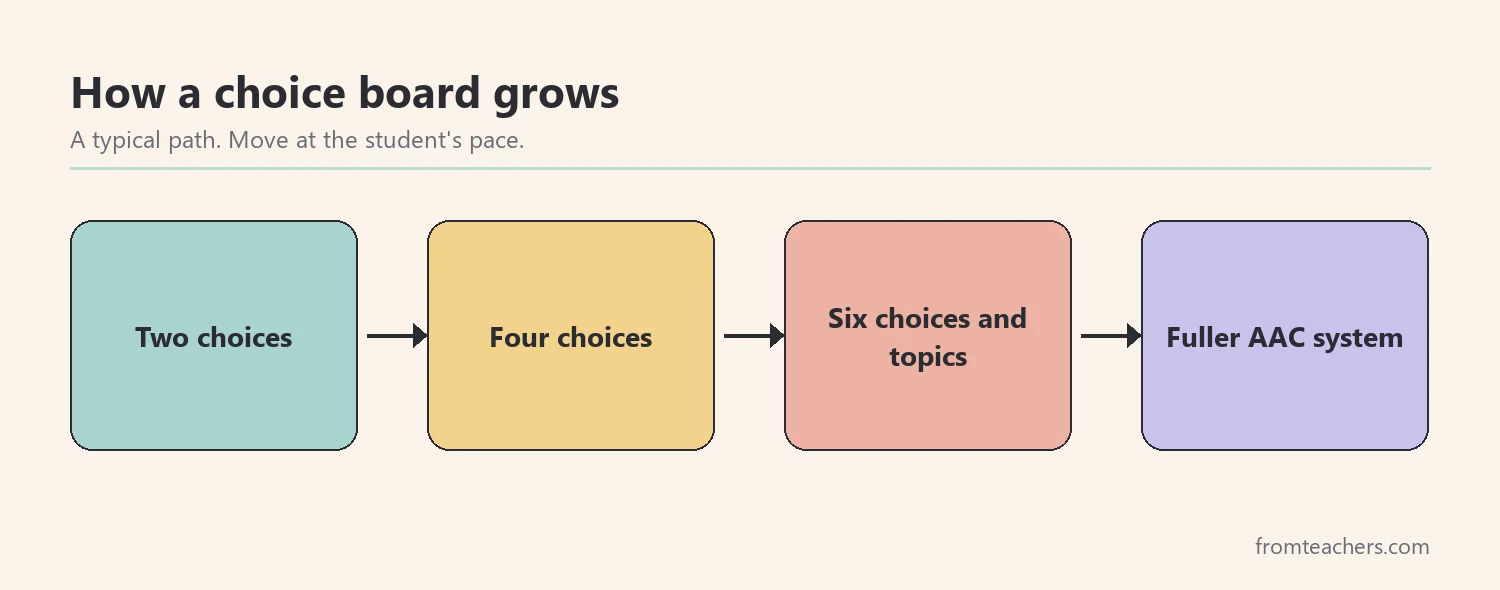
Next, create a simple board. The first choice boards for nonverbal students should feel easy to use. Start with two choices, not ten. Two clear options let the student learn the most important idea first: pointing to a picture makes something happen. Once that idea is solid, you can add more.
Use symbols the student can recognize. Because the symbols are the heart of choice boards for nonverbal students, choose them carefully. Some students understand real photos best, while others do well with clear line drawings. Keep each symbol large, put one item per square, and add the printed word under each picture so every adult says the same word.
- Pick a motivating topic: snack, toys, songs, or activities the student already seeks out.
- Offer two real options: both items should be available right now.
- Keep the layout stable: once a symbol has a place, try not to move it.
- Make copies: one for the classroom, one for therapy, one for home.
Worked example. Mr. Haddad prints a snack board with two photos: crackers and apple slices. On another card he puts bubbles and the toy car. Each photo is about the size of a playing card, with the word printed below. He laminates two copies of each board, one for school and one to send home.
Above all, honor every choice. Reliability is what makes choice boards for nonverbal students meaningful. If Maya points to crackers, she gets crackers right away, even if the adult expected the apple. That quick, reliable result is what teaches the board’s power.
3. Model choice boards for nonverbal students in daily routines
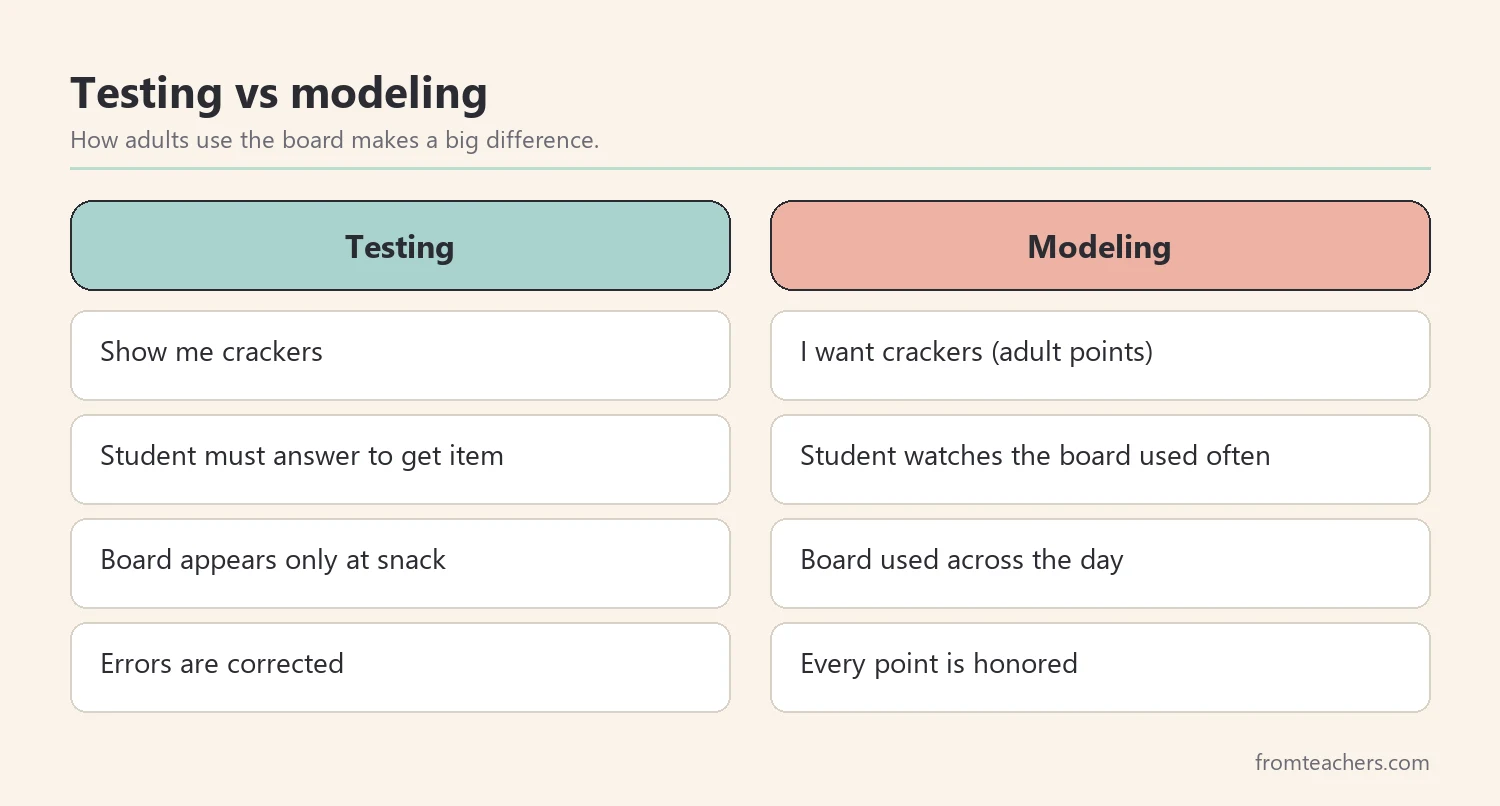
Modeling is where choice boards for nonverbal students come to life. Many adults hand a student a board and wait for an answer. However, students learn to use symbols the same way children learn to speak: by seeing others use them many times first. This approach is often called aided language modeling. The adult points to symbols while talking, without requiring the student to copy.
During snack, for example, the adult might point to “crackers” and say, “I want crackers,” then point to “apple” and say, “You picked apple yesterday.” The student watches the board being used naturally. Later, when the student points, it feels like joining a familiar game rather than taking a test.
For a step-by-step look at modeling and routines, the Empowering Nonverbal Communicators with AAC Tools guide covers using choice boards in the classroom and at home before introducing AAC.
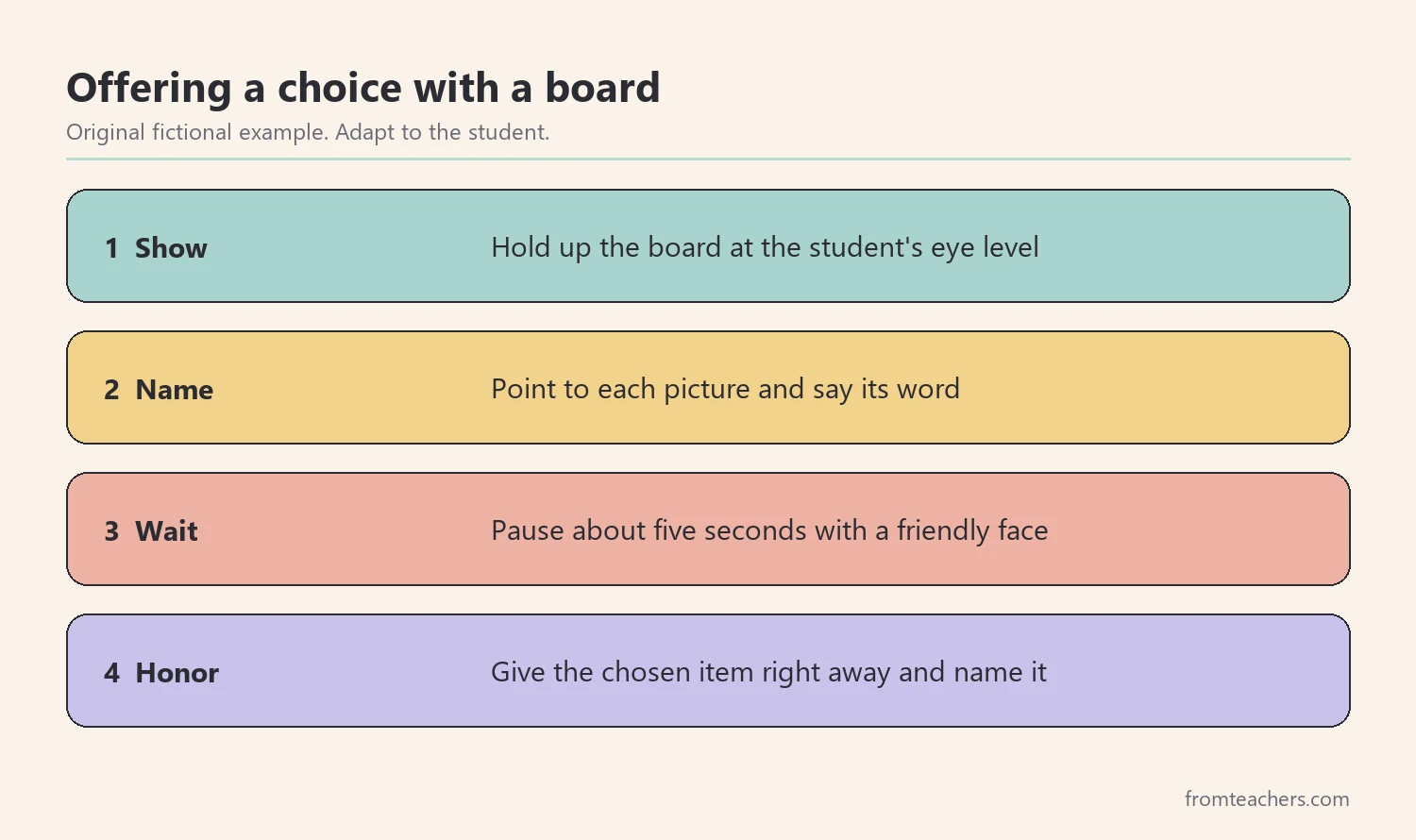
Worked example. At snack, Mr. Haddad holds up the board, points to each photo, and names it. He waits about five seconds with a friendly, expectant face. Maya reaches toward the crackers photo, and he says, “Crackers! You told me crackers,” as he hands them over. If she reaches for the real food instead, he gently guides her hand toward the photo once, then gives the item.
4. Use choice boards for nonverbal students across school and home
Choice boards for nonverbal students work best when they travel. Communication grows faster when the student meets the same tools in more than one place. If the board appears only at snack time in one classroom, the student learns that symbols belong to that table. On the other hand, if the board shows up at home, in therapy, and on the playground, the student learns that pictures work everywhere.
Share the exact symbols and words with the family. A short note can explain the routine: show the board, name each choice, wait, honor the choice. Families do not need to run lessons. They simply use the board during meals, play, or getting dressed.
| Setting | Board topic | Who models |
|---|---|---|
| Classroom | Snack, centers | Teacher, paraprofessional |
| Therapy | Games, songs | Speech-language pathologist |
| Home | Breakfast, bath toys | Parents, siblings |
| Playground | Swing, slide | Recess staff |
Worked example. Maya’s mother uses the home copy at breakfast with cereal and toast. Within two weeks, she reports that Maya brings the board to her when she is hungry. Meanwhile, the paraprofessional adds a recess board with the swing and the slide, using the same photo style as the classroom.
Similarly, keep everyone on the same page about words. Shared vocabulary is what makes choice boards for nonverbal students feel predictable. If the board says “swing,” every adult should say “swing,” not “swings” or “let’s go up high.” Consistent language helps the student connect the picture with the word.
Adapting choice boards for nonverbal students with different needs
Not every student points with a finger. Some students look at the picture they want, some touch it with a whole hand, and others reach toward it. Fortunately, choice boards for nonverbal students can be adjusted to fit the way each student moves and sees.
| If the student… | Try this |
|---|---|
| Looks rather than points | Space the two pictures far apart and watch eye gaze |
| Has limited hand control | Use larger squares or attach pictures to objects |
| Is distracted by clutter | Use a plain background and only the two symbols |
| Prefers objects to pictures | Offer the real items first, then pair them with photos |
For example, on days when Maya is tired, Mr. Haddad holds the two cards wide apart and watches where she looks. When her gaze rests on one picture, he names it and gives the item. The format changes, yet the message stays the same: your choice matters.
In addition, involve the speech-language pathologist and, when relevant, the occupational therapist. They can suggest the right symbol size, position, and access method for choice boards for nonverbal students with motor or vision needs.
5. Track progress with choice boards for nonverbal students and build toward AAC
Finally, collect a little data on how the student uses the board in real routines so you can see growth. A simple approach is to count how many choice opportunities you offered in a routine and how many times the student made a clear choice using the board. Keep the number of opportunities the same each week so the results compare fairly.
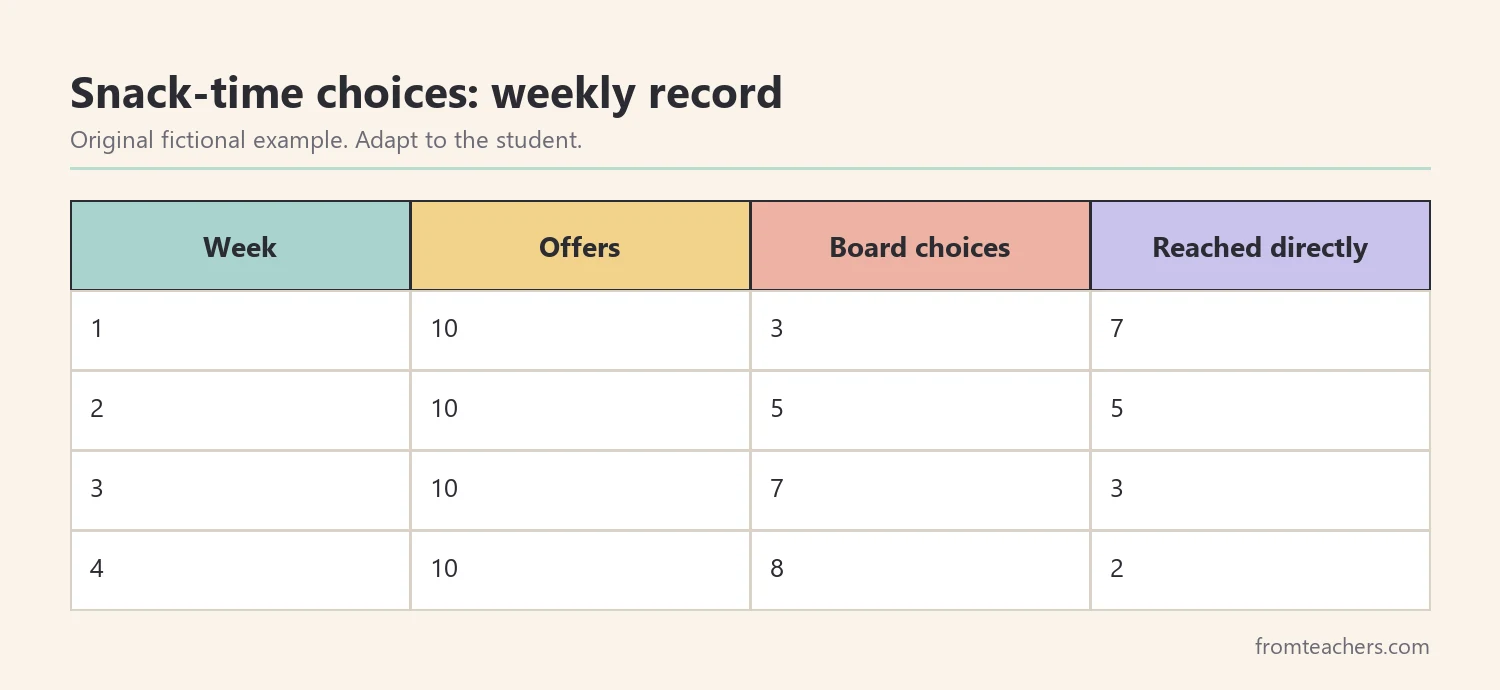
Worked example. Mr. Haddad offers ten snack choices each week. Maya makes a clear board choice 3 times in week 1, 5 times in week 2, 7 times in week 3, and 8 times in week 4. In the other opportunities she reaches for the food directly. Because she is now choosing reliably from two options, the team adds a third and fourth symbol in week 5.
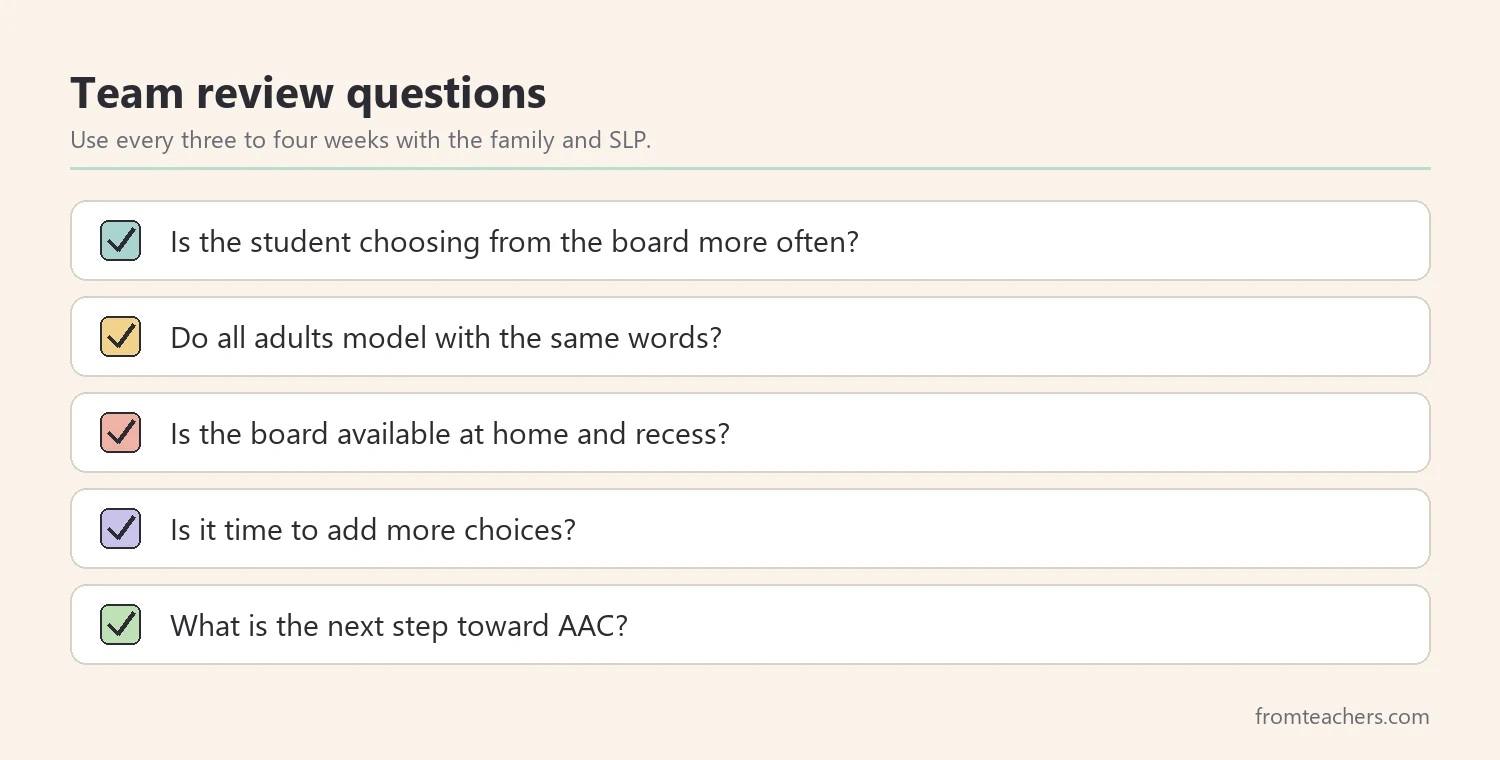
When a student uses choice boards for nonverbal students with confidence, talk with the team, especially the speech-language pathologist, about richer AAC. This might be a larger core-word board, a communication book, or a speech-generating device. The choice board is not a dead end. Instead, it is the first step on a longer path.
Common mistakes and how to avoid them
- Starting with too many choices. Fix: begin with two clear options and add more only when the student chooses reliably.
- Offering items that are not available. Fix: only show choices you can honor right now.
- Testing instead of modeling. Fix: point to symbols as you talk all day, and do not require the student to copy.
- Keeping the board in one place. Fix: make copies for home, therapy, and recess.
- Treating the board as the final goal. Fix: plan with the team to grow toward fuller AAC.
Questions teachers and parents ask about choice boards for nonverbal students
Will using choice boards for nonverbal students stop them from talking?
Families often worry about this. Many speech and language professionals, including those represented by ASHA, describe AAC as a support for communication rather than a replacement for speech. Talk with the student’s speech-language pathologist about the individual plan.
How many choices should the first board have?
Two is a good starting point for most choice boards for nonverbal students. Once the student chooses reliably, add a third and fourth. Some students move quickly, while others need more time with two.
Should I use photos or drawings?
Use whatever the student recognizes most easily. Some students need real photos of the exact item, while others understand clear line drawings. Watch how the student responds and adjust.
What if the student points to everything?
Honor the first clear point and give that item. If the student seems surprised, the next opportunity is a chance to learn. Over time, consistent results help the student point with intention.
Can parents make choice boards for nonverbal students at home?
Yes. A home board can be as simple as two photos on a card. Matching the school’s symbols and words makes it even more effective.
Related reading: Best Assistive Technology for Special Education Classrooms, Autism Social Skills Development: Practical Strategies for Growth, and How Teachers Communicate With Parents in Special Education: Building a Strong Partnership.
A companion resource for choice boards for nonverbal students:
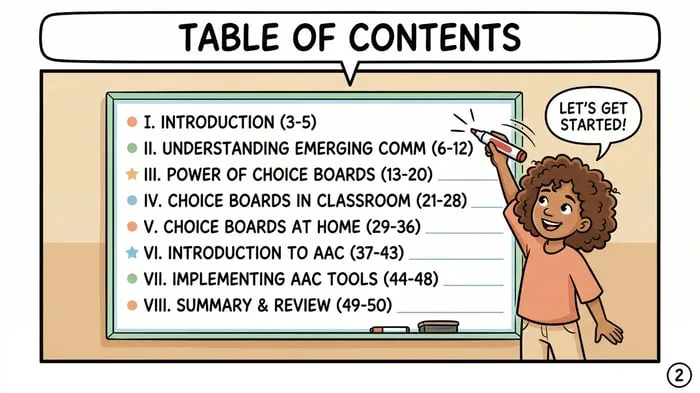
Empowering Nonverbal Communicators with AAC Tools: a 50-page visual guide covering emerging communicators, the power of choice boards, using choice boards in the classroom and at home, and an introduction to implementing AAC tools.
Sources and scope
- American Speech-Language-Hearing Association (ASHA): information on communication development and augmentative and alternative communication.
- IRIS Center, Vanderbilt University: free modules on evidence-based practices for students with disabilities.
- Individuals with Disabilities Education Act (IDEA): federal information on special education, including assistive technology considerations.
- Understood.org: family-friendly explanations of learning and thinking differences and school supports.
This guide covers getting started with picture choice boards at school and at home. It does not replace an AAC evaluation, speech-language therapy, or decisions made by the student’s IEP team.
Key takeaways
- Observe how the student already communicates, and build on those messages.
- Start choice boards for nonverbal students with two motivating, available options.
- Model the board during real routines instead of testing the student.
- Use the same symbols and words at school, in therapy, and at home.
- Track simple data and plan the next step toward AAC with the team.










Leave a Comment