

Echolalia in autism often shows up in the middle of an ordinary school day. Picture a second grader who answers “Do you want the blue one?” with “Do you want the blue one?”, then later shouts a line from a cartoon when the fire drill bell rings. Many adults were taught to stop this kind of echolalia in autism. Yet the child is very likely telling you something important.
This guide walks you through a five-step, neuroaffirming process: understand what echoed language is, find its function, respond as a skilled communication partner, honor scripts while gently expanding them, and share what you learn with the whole team. By the end, you will have a simple plan you can use tomorrow with one student.
Examples are fictional. Adapt to the student’s goals and agreed supports. This is guidance, not a diagnosis.
At a glance
- Repeated speech is communication. Treat it as a message, not a mistake.
- Look for the function: the same phrase can mean different things in different moments.
- Your response matters more than the child’s words. Calm, curious partners build trust.
- Honor familiar scripts first, then expand them in small, playful steps.
- Write down what scripts mean so every adult responds the same way.
1. Understand echolalia in autism as communication
First, it helps to name what you are hearing. Echolalia in autism is the repetition of words, phrases, or longer scripts that a person heard before. Some repetition happens right away, which many professionals call immediate echolalia. Other repetition happens hours, days, or even weeks later, which is often called delayed echolalia.
Next, consider how some children learn language. Many autistic children seem to learn language in whole chunks or “gestalts” before they break those chunks into single words. In that light, a long movie line is not empty noise. Instead, it can be a whole unit of meaning that the child has stored and reuses.
Also, notice how older approaches framed echolalia in autism. For years, repeated speech was often called “nonfunctional,” and the goal was to reduce it. A neuroaffirming approach starts from a different belief: the child is communicating in the way that works for them right now, and our job is to understand and connect.
Let’s meet the student who will appear throughout this guide. Leo is a fictional second grader. He speaks mostly in phrases from songs, cartoons, and things adults have said to him. When his teacher asks, “Are you ready for lunch?” he often answers, “Are you ready for lunch?” At first, staff assumed he did not understand. However, Leo walks straight to the door each time, which suggests he understood perfectly.
| Type | What it can look like | Possible message |
|---|---|---|
| Immediate | Repeats your question right away | “Yes,” or “I am thinking” |
| Delayed | Says a movie line hours later | “This feels like that scene” |
| Mitigated | Changes a few words of a script | Early steps toward new phrases |
Finally, remember that echolalia in autism can also be comforting. A familiar line can calm a child during noise or change. That is a valid use too, and it deserves respect.
2. Find the function behind each echo
Because the same words can carry different messages, understanding echolalia in autism takes some detective work. Ask yourself one question every time: what is this phrase doing for the child right now? Common functions include requesting, protesting, saying yes, starting a social exchange, labeling, preparing for a transition, and calming down.
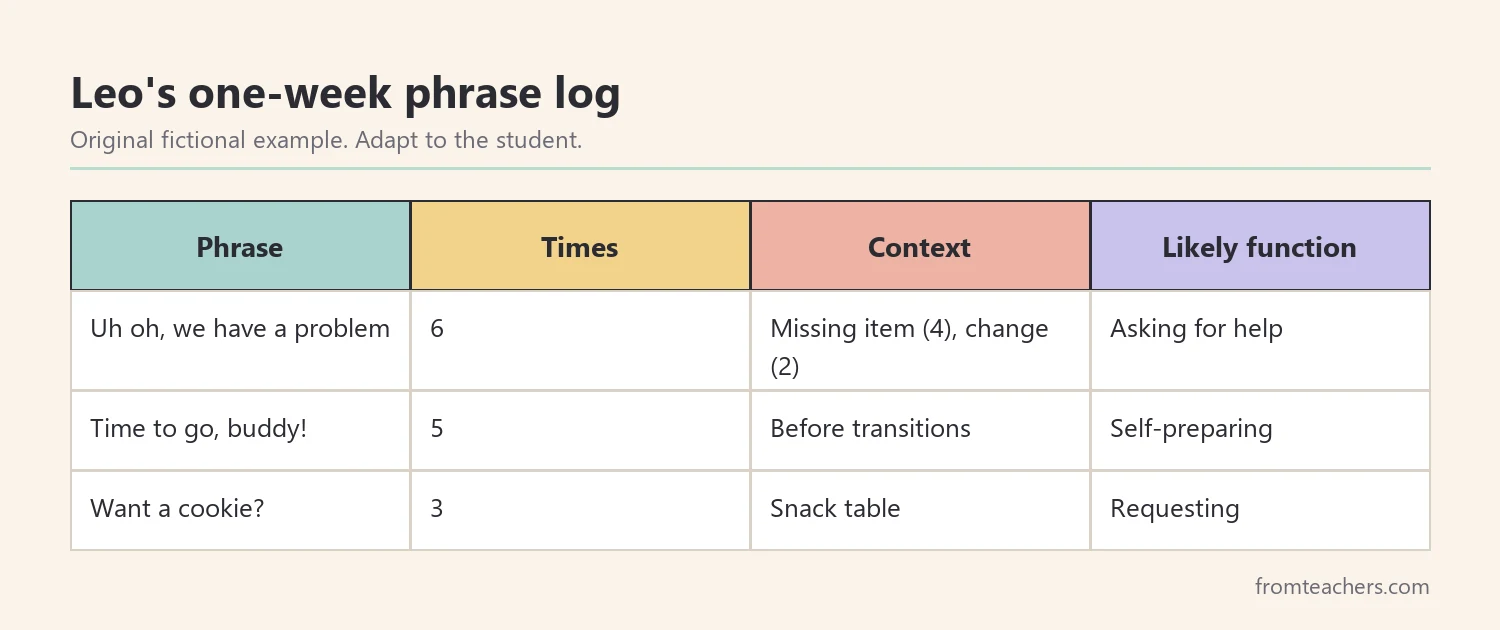
To find the pattern, keep a short log for about a week. Write the exact words, the moment they appeared, what happened right before, and what the child did next. Then look for repeats. Often, the context tells you far more than the words themselves.
For example, Leo’s teacher, Ms. Rivera, kept a log for five school days. Over that week, she recorded the phrase “Uh oh, we have a problem” 6 times. Four of those times came when a puzzle piece or pencil was missing, and the other 2 came when the class schedule changed. In both cases, the meaning looked like “Something is wrong and I need help.”
Meanwhile, she noticed a second pattern. Leo said “Time to go, buddy!” 5 times, always just before a transition. Rather than a random echo, it seemed to be his way of preparing himself to move. That one insight changed how the team planned transitions.
| Phrase | Times heard | Most common context | Likely function |
|---|---|---|---|
| “Uh oh, we have a problem” | 6 | Missing item or schedule change | Asking for help |
| “Time to go, buddy!” | 5 | Before transitions | Self-preparing |
| “Want a cookie?” | 3 | At snack table | Requesting |
Importantly, do not assume a single meaning forever, because echolalia in autism is flexible. Functions can shift as a child grows or as routines change. Therefore, revisit your log every few weeks. If you want a ready-made structure for this, the neuroaffirming echolalia toolkit with a functions and communication intent guide gives your team a shared way to interpret repeated speech.
3. Respond to echolalia in autism as a skilled partner
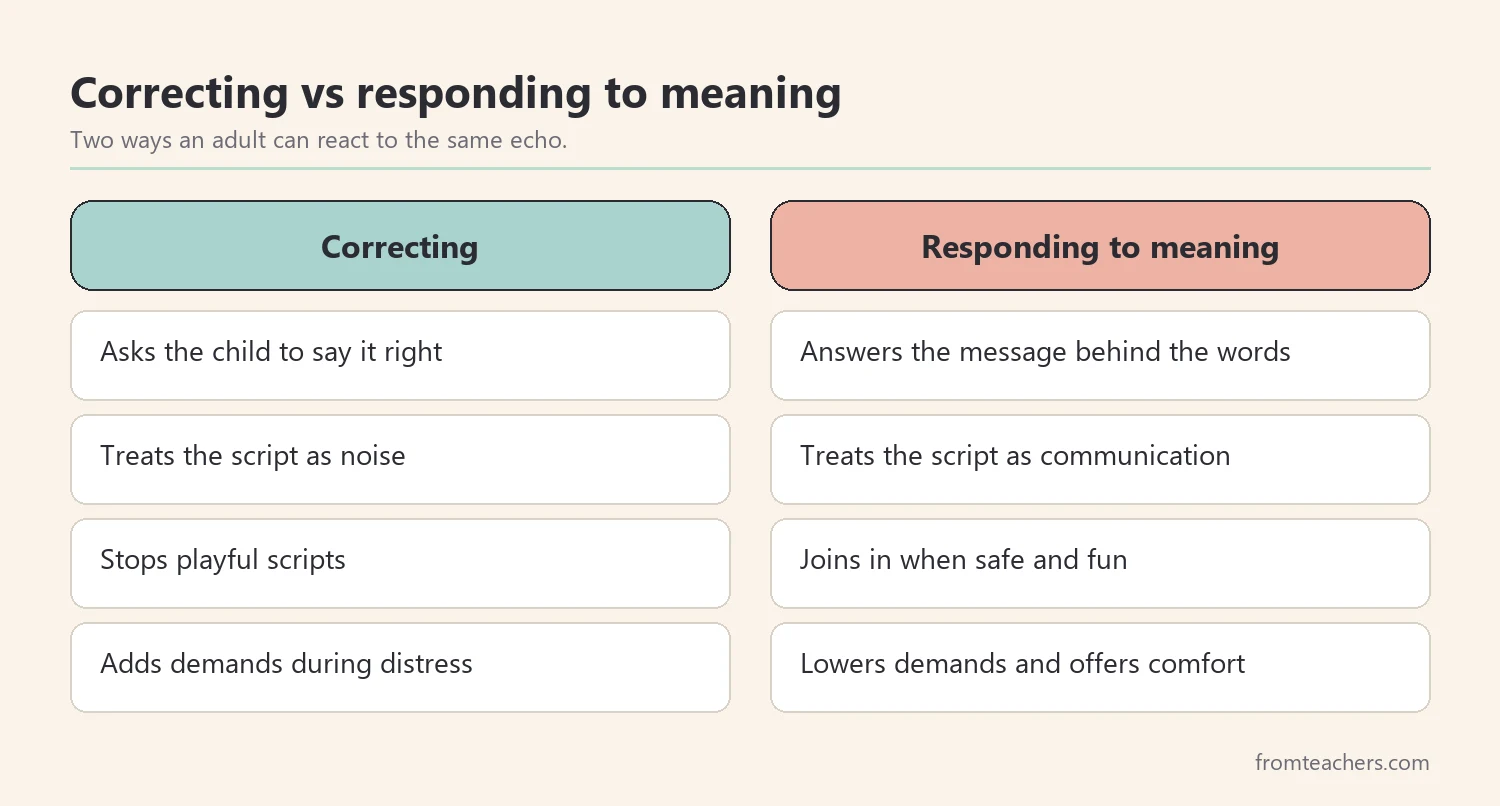
Once you have a guess about the function, your response becomes the most powerful tool you have. In many cases, the barrier is not the child’s language. Instead, it is the adult’s habit of correcting, rushing, or ignoring. Supporting echolalia in autism starts with changing what we do as communication partners.
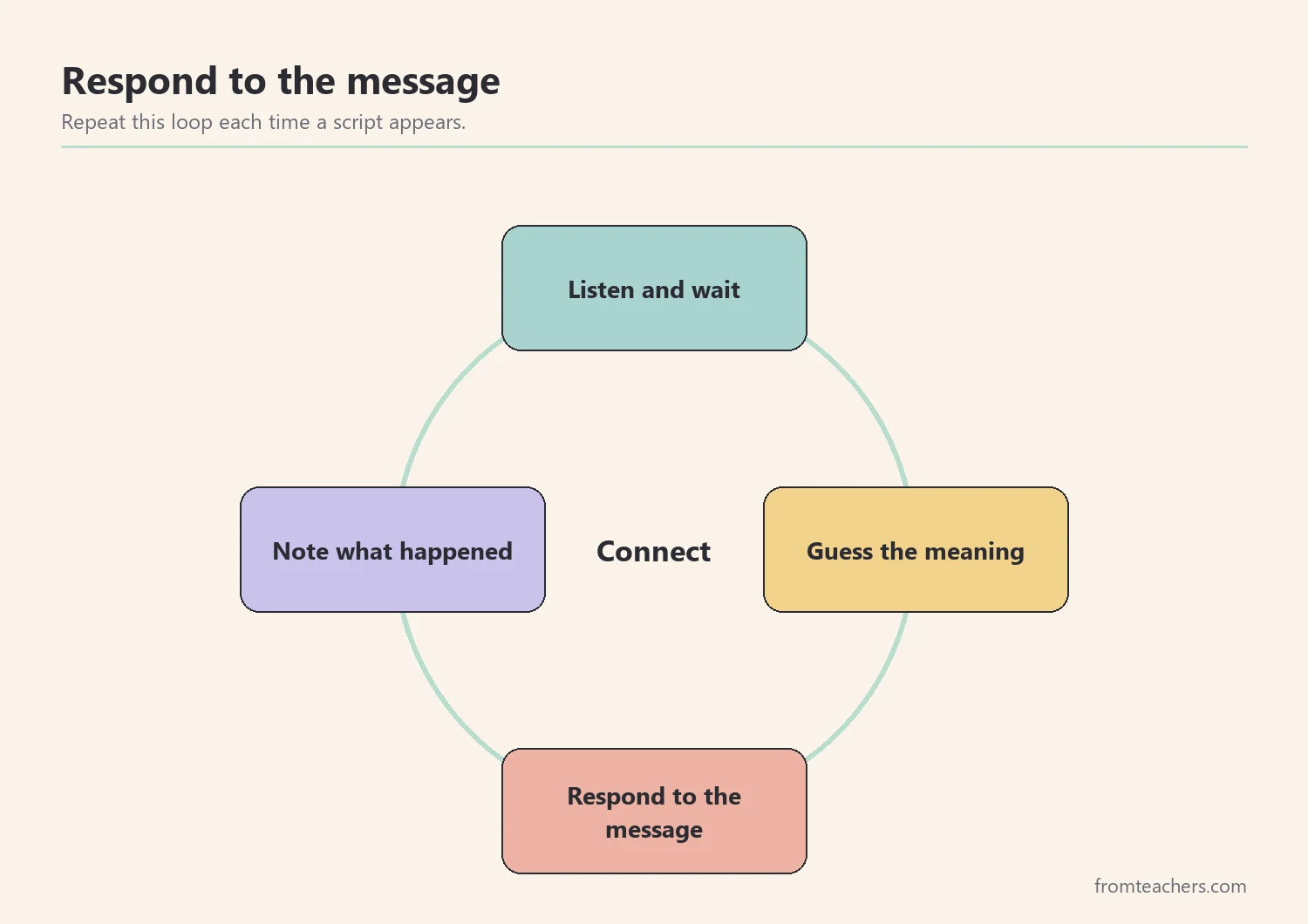
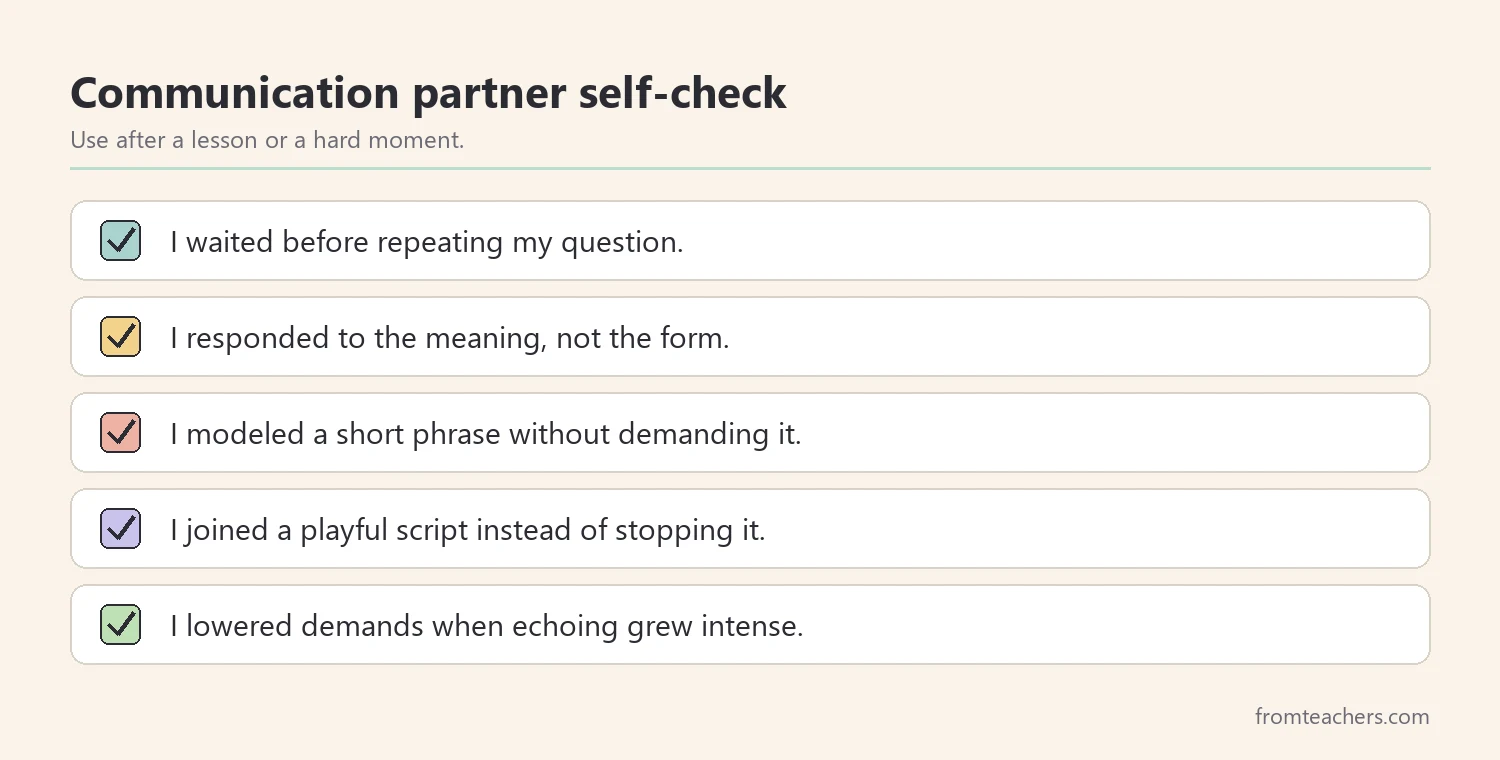
Begin by listening fully. Pause, look interested, and give the child time. Then respond to the meaning, not the form. If Leo says “Uh oh, we have a problem,” Ms. Rivera now says, “You need help. Let’s find the pencil,” and she helps right away. She does not ask him to “say it the right way.”
Next, model language the child could use. Keep it short and natural, often in the child’s own voice. For instance, she might say, “Help, please,” while handing him the pencil. That model is an offer, not a demand. Leo can take it or leave it.
Also, adjust the environment around common triggers. Since Leo uses a script before transitions, the team now gives a short warning and a visual cue first. As a result, his transition script sounds calmer and is often followed by him walking to the line on his own.
Here are simple partner moves that tend to help:
- Wait at least a few seconds before repeating a question.
- Say less. Use short, clear phrases the child can store and reuse.
- Join the script with a smile when it is playful, instead of stopping it.
- Avoid testing questions like “What color is this?” when the child is regulating.
- Name what you think the child means, then act on it.
Finally, watch your own stress level when echolalia in autism gets intense. Intense echoing during distress usually signals that the child needs regulation support, not more language input. In those moments, lower your voice, reduce demands, and offer comfort first.
4. Honor scripts, then expand them gently
Scripts and other forms of echolalia in autism are often a child’s first bridge into social connection. When Leo walks up to a classmate and says, “Hi friend, want to play?” in a cartoon voice, he is starting a conversation. Honoring that start is more important than how the words sound.
So, respond warmly and keep the exchange going. A peer or adult might answer, “Yes! Let’s play blocks.” That reply rewards the attempt and teaches that scripts can open doors. Over time, you can coach peers to answer this way too.
Then, look for small ways to expand. One gentle method is to keep most of the familiar script and change one word. If Leo often says “Want a cookie?”, an adult might model “Want a cracker?” when crackers are on the table. Because the frame is familiar, the new word is easier to take on.
Another method is to offer a new short phrase in context, many times, in a calm voice. For example, at the end of a game, an adult says “All done, high five!” Leo may later reuse that whole phrase at the end of other activities, which is a sign that it has become a new, flexible chunk.
However, keep expectations realistic. Expanding language takes time and usually works best with guidance from a speech-language pathologist. Moreover, avoid turning every script into a lesson. A child who is corrected constantly may begin to speak less, which is the opposite of what you want.
Echolalia in autism can also be a joyful, playful part of a child’s day. When a script is clearly for fun, it is fine to simply enjoy it together. Shared laughter builds the trust that all future learning depends on.
5. Share what echolalia in autism means with the whole team
Even the best plan fails if only one adult knows it. A substitute, a lunch supervisor, or a new paraprofessional may hear “Uh oh, we have a problem” and think Leo is being silly. Consequently, the team needs a simple way to share what each script means.
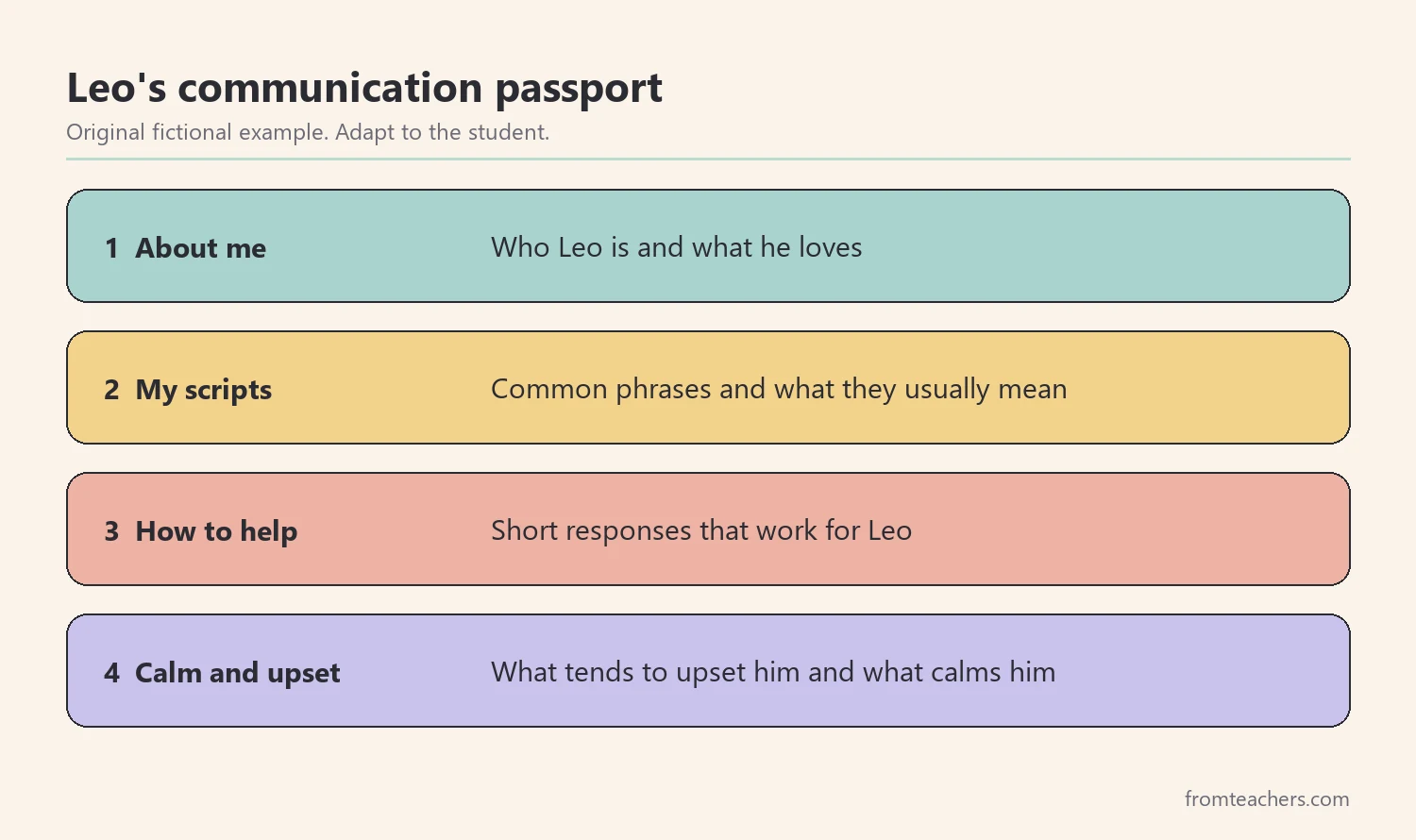
One practical tool for explaining echolalia in autism is a “Communication Passport.” It is a short, friendly document, often one or two pages, that introduces the child and explains their scripts and interests. Families usually know the most about where scripts come from, so invite them to help write it.
For Leo, the team built a passport with four sections. It starts with who he is and what he loves. Next, it lists his common scripts and what they usually mean. Then, it explains how adults can help. Finally, it notes what tends to upset him and what calms him.
| Leo says | It usually means | Helpful response |
|---|---|---|
| “Uh oh, we have a problem” | I need help | “You need help. Let’s fix it.” |
| “Time to go, buddy!” | I am getting ready to move | Show the next picture and wait |
| “Want a cookie?” | I want something to eat | Offer snack choices |
After that, review the passport every few months. Add new scripts, remove ones Leo no longer uses, and note any new meanings. Share the updated version with the family and every adult who works with him.
In addition, bring the passport to team meetings. It helps keep goals focused on connection and understanding rather than on reducing a natural way of speaking. That shift alone can change how adults see and support echolalia in autism across the school.
Common mistakes and how to avoid them
- Treating every echo as meaningless. Fix: assume there is a message, then look at the context to find it.
- Demanding the child “say it right.” Fix: respond to the meaning first, then model a short phrase without requiring it.
- Assuming one script always means one thing. Fix: keep a short log and review it every few weeks.
- Stopping playful scripts. Fix: join in when it is safe and fun, since shared joy builds connection.
- Keeping the knowledge in one person’s head. Fix: write a communication passport and share it with everyone.
Questions teachers and parents ask about echolalia in autism
Is echolalia in autism a bad sign?
No. Echolalia in autism is common, and many autistic children use repeated speech as part of how they learn and use language. It is a different path, not a broken one. If you have questions about a specific child’s development, talk with a speech-language pathologist.
Should I try to stop my child from repeating phrases?
In most cases, no. Stopping echolalia in autism can remove a main way the child communicates. Instead, try to understand what the phrase means and respond to that message.
How can I tell what a script means?
Look closely at when the script appears and what happens next. Keep a simple log for a week and look for patterns. Families often know where a script came from, which can offer useful clues.
Can echolalia turn into flexible speech?
For many children, familiar scripts gradually change and combine into new phrases. This often happens with patient modeling and support from an SLP. Every child moves at their own pace, so focus on connection rather than speed.
What should I do when echoing gets loud and intense?
Intense echoing can be a sign of stress or overload. First, reduce demands and noise, then offer comfort and a calm space. Language support can wait until the child feels safe again.
Related reading: Autism Spectrum Disorder: A Guide to Early Signs, Support, and Effective Strategies, Autism Social Skills Development: Practical Strategies for Growth, and Managing Sensory Overload: Practical Strategies for Autism and ADHD.
A companion resource for echolalia in autism:
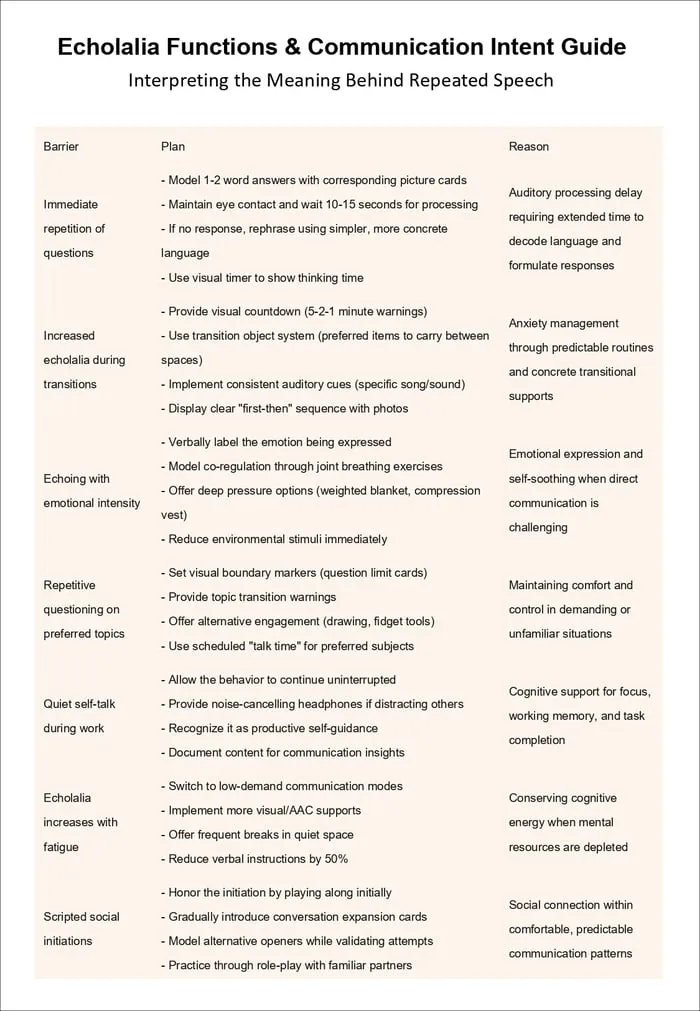
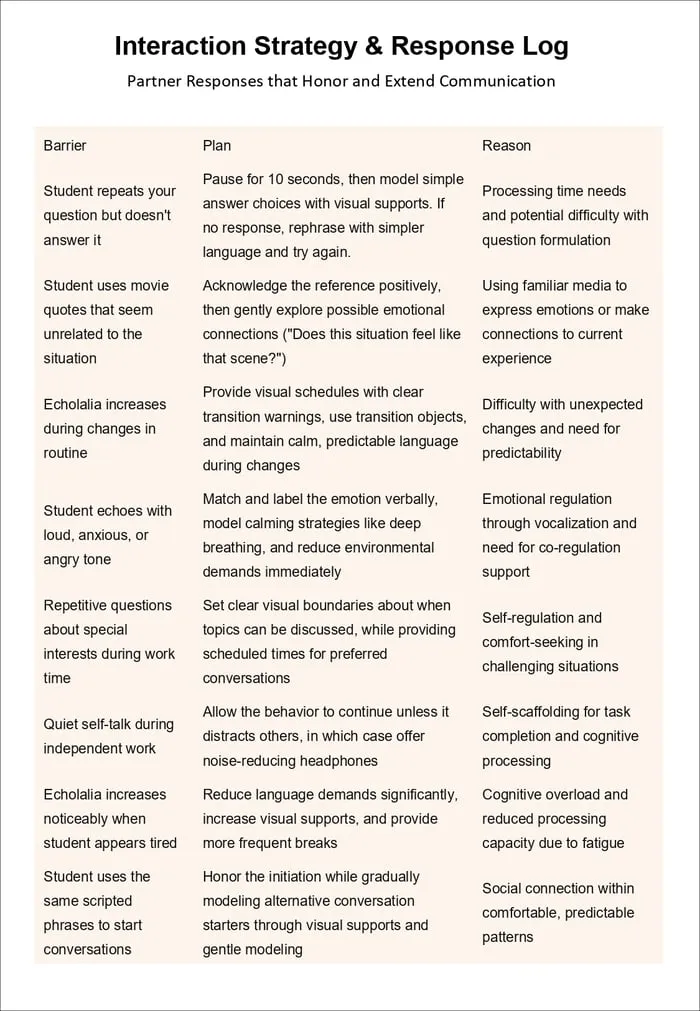
Echolalia: A Neuroaffirming Approach: a 12-page Barrier/Plan/Reason toolkit with an echolalia functions guide, a communication partner skills checklist, strategies for immediate, transition-related, and emotionally intense echoing, and guidance on creating a Communication Passport.
Sources and scope
- American Speech-Language-Hearing Association (ASHA): professional information on autism, language development, and the role of SLPs.
- IRIS Center, Vanderbilt University: free learning modules on autism and evidence-based classroom practices.
- CDC autism information: general background on autism in children.
- IDEA, U.S. Department of Education: the law behind special education services, IEPs, and related services such as speech-language therapy.
This guide covers everyday ways teachers and families can understand and respond to repeated speech. It does not cover diagnosis or individual therapy plans, which belong to qualified professionals and the student’s team.
Key takeaways
- Echolalia in autism is communication, so listen for the message first.
- Log phrases and contexts for a week to find each script’s function.
- Respond to meaning, model short phrases, and lower demands during distress.
- Honor scripts as communication, then expand them one small change at a time.
- Use a communication passport so every adult responds the same way.






Leave a Comment