
Special education classroom organization often decides whether a teacher spends Sunday evening planning lessons or hunting for an IEP progress report. Picture a case manager five minutes before a parent meeting, flipping through three binders and two email folders for last month’s data. The information exists. It simply has no single home.
This guide gives you a five-step system you can build over a few weeks: map what you manage, set up compliance paperwork, organize student data, prepare for substitutes and paraprofessionals, and keep the system running with small weekly habits. By the end, you will have a practical plan rather than a Pinterest board of ideas.
Examples are fictional. Adapt to your caseload, your school’s policies, and your students’ agreed supports. This is general guidance, not legal advice.
At a glance
- Start by listing everything you manage, then give each item one home.
- Keep compliance paperwork in one secure, consistent system with a deadline calendar.
- Collect data in the simplest format the whole team can use.
- Prepare a binder or folder so substitutes and paras can work without you.
- Protect the system with a short weekly reset rather than a big yearly cleanup.
1. Map what special education classroom organization must cover
First, take stock. Special education classroom organization covers far more than desks and bins. Most special educators juggle IEP paperwork, progress data, instructional materials, behavior and communication logs, therapy schedules, and staff instructions, often for many students at once.
Start with a quick audit. On one sheet, list every category of material you handle and where it lives right now. Be honest. “Some in a binder, some in email, some on my desk” is a useful finding, because it shows where time is being lost.
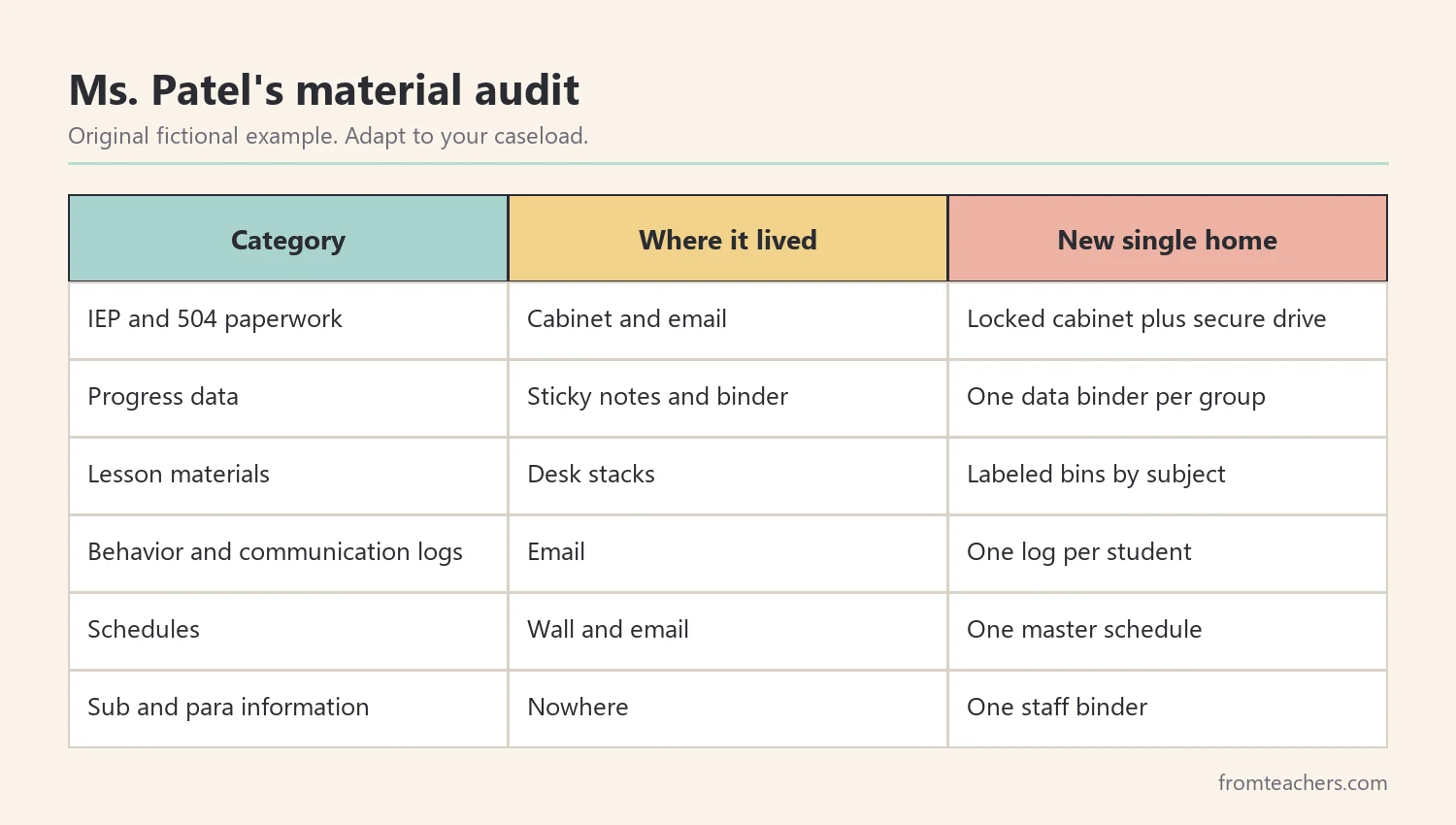
Let’s meet the teacher in this guide. Ms. Patel is a fictional resource room teacher with a caseload of 12 students across grades 3 to 5. When she did her audit, she found 6 categories of material scattered across a filing cabinet, her email, sticky notes, the wall, and stacks on her desk. One category had no home at all.
| Category | Where it lived | New single home |
|---|---|---|
| IEP and 504 paperwork | Cabinet and email | Locked cabinet plus secure drive folder |
| Progress data | Sticky notes and binder | One data binder per group |
| Lesson materials | Desk stacks | Labeled bins by subject |
| Behavior and communication logs | One log per student in the drive | |
| Schedules | Wall and email | One master schedule on the wall and drive |
| Sub and para information | Nowhere | One staff binder |
Then, apply one rule: every category gets one home. A paper home and a matching digital home are fine, as long as everyone knows which is which. Two random locations are not.
Also, involve your team in the audit. Paraprofessionals and related service providers often know exactly where things get lost, because they are the ones searching. A ten-minute conversation can reveal problems in your special education classroom organization that you would never notice alone.
Finally, start small. Choose the category causing the most stress and fix it first. For Ms. Patel, that was IEP paperwork, because annual review deadlines were coming up.
2. Organize IEP, 504, and compliance paperwork
Compliance paperwork is the area where special education classroom organization matters most. Missed deadlines and lost documents create real stress for families and staff. Therefore, build this part of your system carefully and follow your district’s rules on confidentiality and storage.
Begin with a deadline calendar. List each student’s annual review date, reevaluation date, and progress report dates. Then set reminders a few weeks ahead of each one. Ms. Patel color-codes her calendar by month so she can see busy periods at a glance.
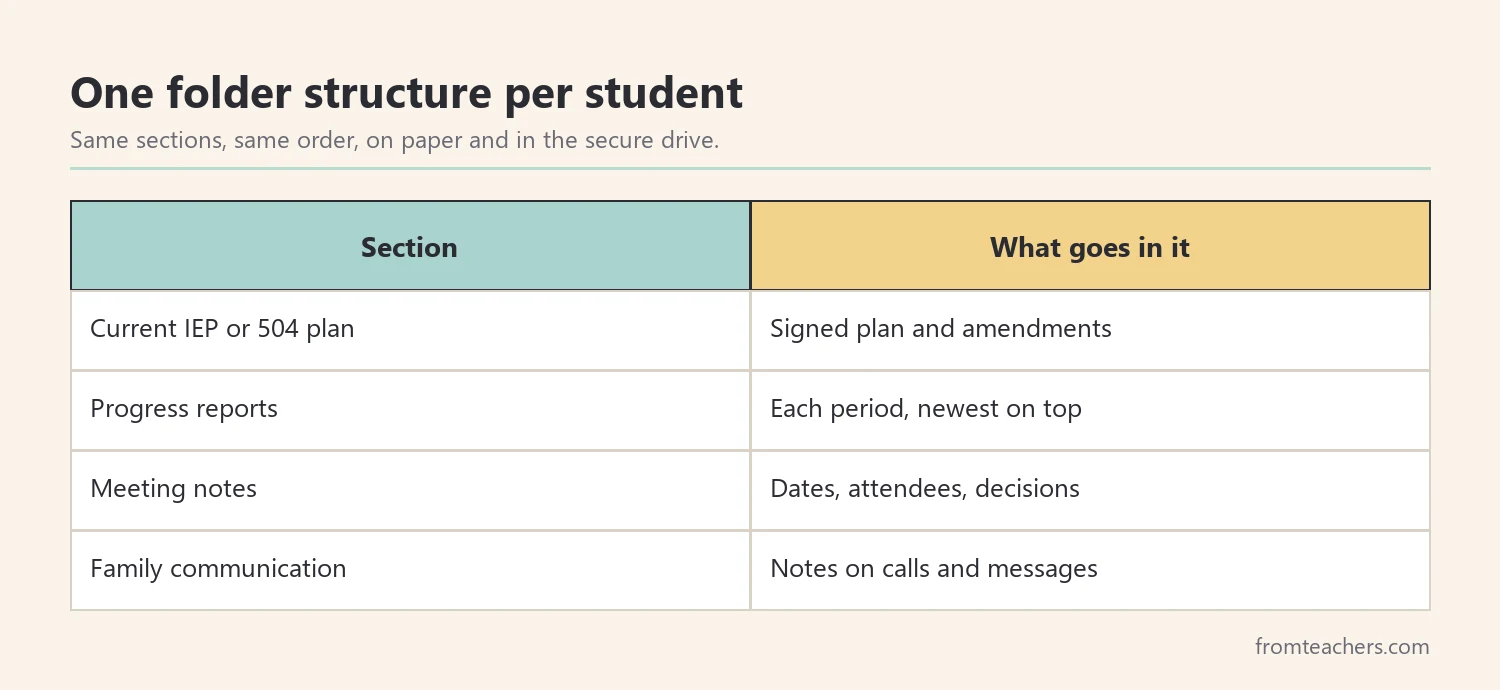
Next, set up a consistent folder structure. Each student gets the same set of folders, in the same order, both on paper and in the secure drive. A simple structure might include current IEP, progress reports, meeting notes, parent communication, and evaluations.
| Student folder section | What goes in it |
|---|---|
| Current IEP or 504 plan | Signed plan and amendments |
| Progress reports | Each reporting period, newest on top |
| Meeting notes | Dates, attendees, decisions |
| Family communication | Notes on calls and messages |
Also, keep a one-page snapshot for each student. It lists goals, accommodations, and key contacts in plain language. Staff who need quick information can use the snapshot instead of opening the full file, which also helps protect privacy.
In addition, think about email. Many important decisions about IEPs happen in messages that never reach the student file. A simple habit helps: once a week, save key family and team messages into the student’s communication section. That one step keeps special education classroom organization complete without extra meetings.
For a ready-made framework covering compliance files, digital folders, filing systems, and more, the Special Education Classroom Organization Handbook for Teachers walks through each area with step-by-step strategies.
3. Build a simple system for student data
Next, look at progress monitoring. Data is only useful if it is easy to collect and easy to find. Many special educators collect plenty of data but struggle to turn it into clear progress reports. Good special education classroom organization fixes that by making collection quick and storage predictable.
First, decide what you actually need. Each IEP goal should have one clear way to measure it, such as correct responses out of a set number of trials or the number of words read correctly in a minute. Write that method at the top of the data sheet so every adult measures the same way.
Then, keep data sheets where the teaching happens. Ms. Patel uses one clipboard per instructional group, with a data sheet for each student in that group. At the end of the day, sheets go into a single data binder, organized by student.
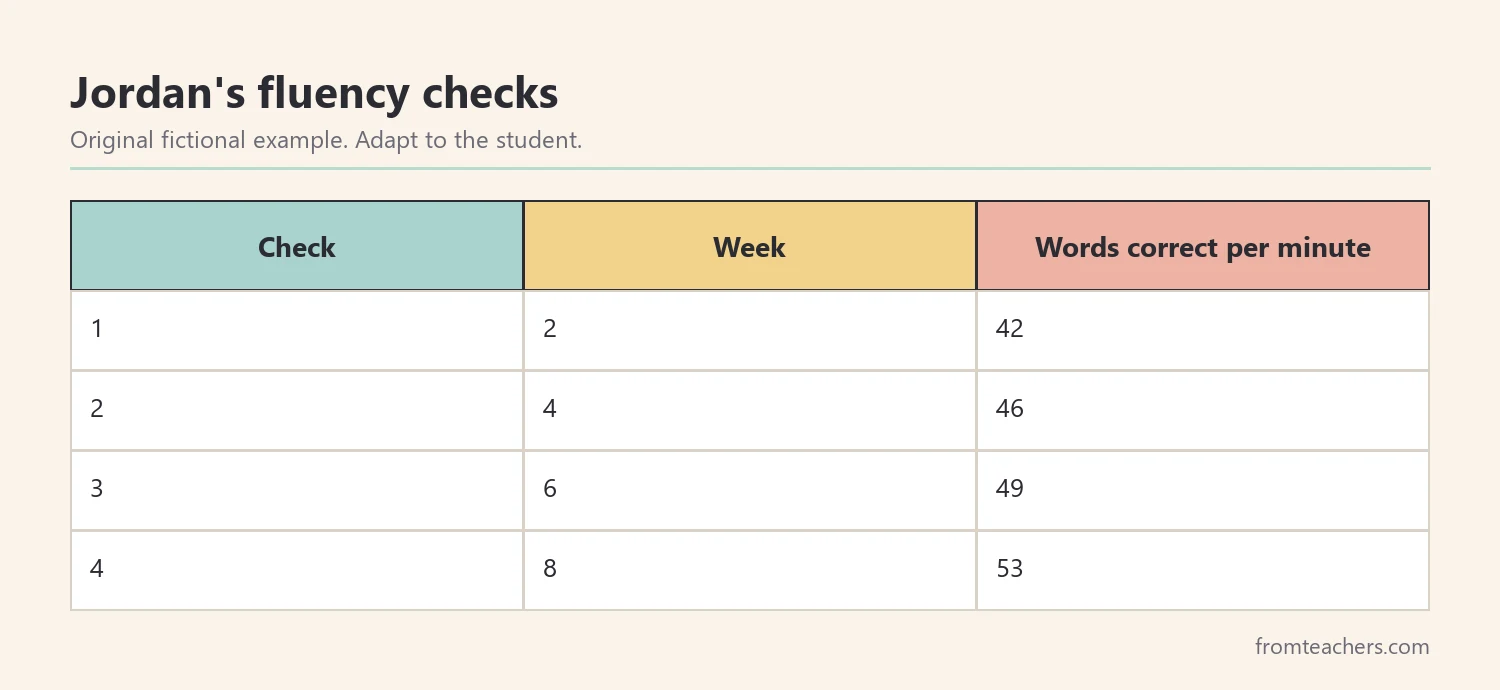
For example, one of her students, Jordan, has a reading fluency goal. Ms. Patel checks it every two weeks with a one-minute reading. Over 8 weeks, she recorded 4 checks: 42, 46, 49, and 53 words correct per minute. Because the data lives in one place, she can graph it in minutes before a meeting.
| Check | Week | Words correct per minute |
|---|---|---|
| 1 | 2 | 42 |
| 2 | 4 | 46 |
| 3 | 6 | 49 |
| 4 | 8 | 53 |
Moreover, store digital data with the same logic as paper. If the binder is organized by student, the drive should be too. When both systems mirror each other, anyone on the team can find information quickly, which is the whole point of special education classroom organization.
Finally, schedule a short data review. Every two weeks, Ms. Patel spends 20 minutes looking at each group’s sheets. If a student is not progressing, she notes it and plans a change. That habit makes progress reports far easier to write.
4. Prepare special education classroom organization for other adults
Special education classrooms often have several adults: paraprofessionals, therapists, co-teachers, and substitutes. Without clear information, each adult works a little differently, and students feel the inconsistency. So, plan your special education classroom organization for the people who are not you.
Start with a staff binder. Ms. Patel’s binder has five tabs: the daily schedule, student snapshots, behavior and communication plans, emergency procedures, and a short list of routines. A substitute can open it and run the day without guessing.
Next, post a master schedule. It should show where each adult is during each block and which students they support. When schedules change, update the master copy first, then tell the team in one consistent channel.
Also, give each adult clear jobs. Paraprofessionals often know exactly what to do with one student but are unsure about the rest of the class. A short role card for each adult, listing their groups, data tasks, and break times, prevents confusion.
In addition, keep behavior and communication logs in one shared place. When every adult records incidents and successes the same way, patterns are easier to spot. That shared record also helps at team and family meetings.
Likewise, organize therapy and sensory materials so specialists can find them. A labeled bin for each therapy area, kept in a consistent spot, means a speech-language pathologist or occupational therapist can grab what they need without interrupting instruction. Good special education classroom organization supports every adult who works in the room.
Finally, check in briefly with staff each week. A five-minute huddle on Monday morning to review schedule changes and student updates can save hours of miscommunication later.
5. Keep the system going with weekly habits
Even the best system falls apart without maintenance. Paper piles up, digital folders fill with duplicates, and bins slowly lose their labels. Therefore, sustainable special education classroom organization depends on small, regular habits rather than occasional big cleanups.
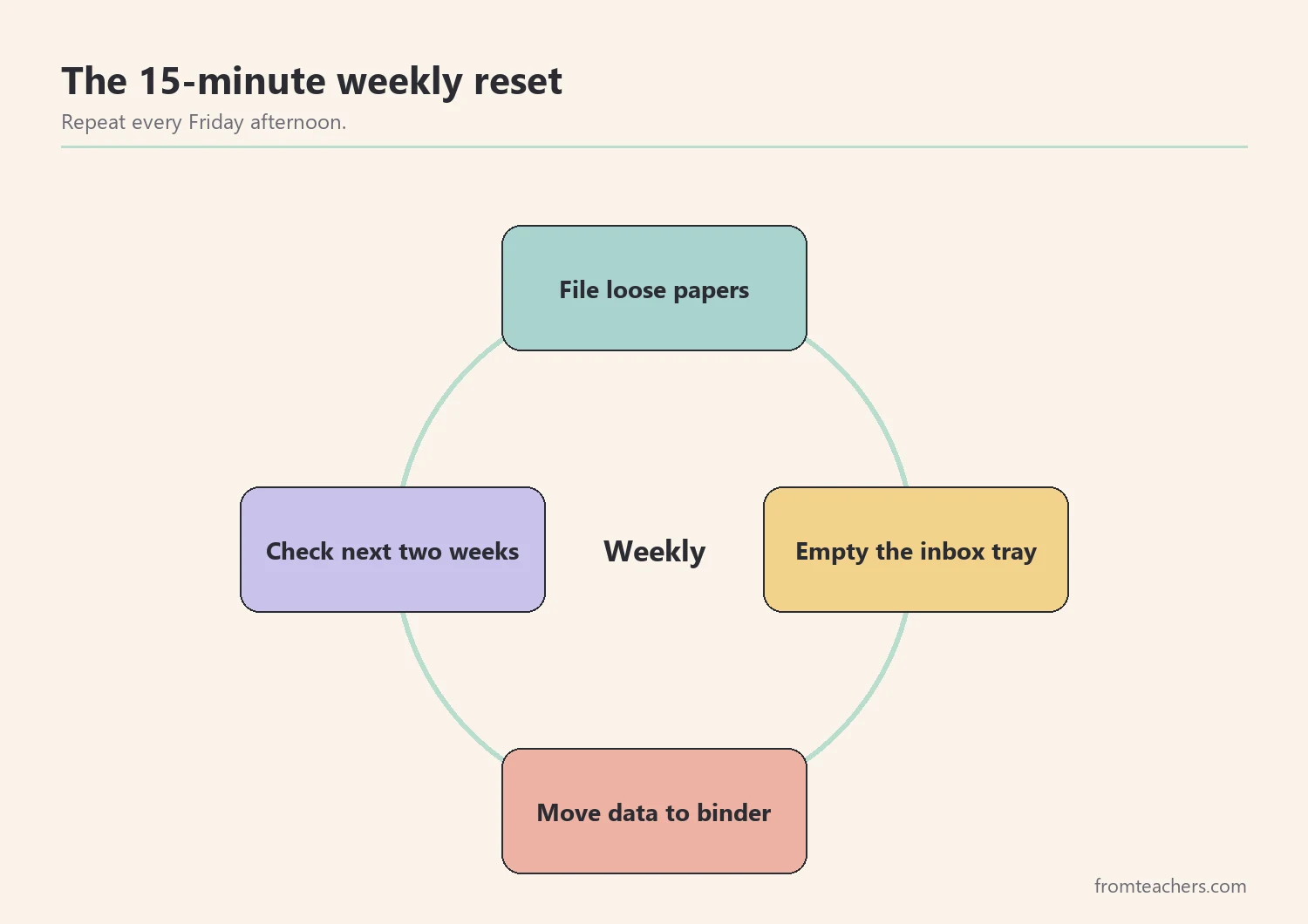
Try a 15-minute weekly reset. Ms. Patel does hers every Friday afternoon. She files loose papers, empties her inbox tray, moves the week’s data sheets into the binder, and checks the deadline calendar for the next two weeks.
Next, plan for the start and end of the year. In the last weeks of school, archive completed files according to district rules, clean out materials, and note what to change. At the start, set up new student folders, update snapshots, and refresh the staff binder.
Similarly, set up a simple routine for assessment season. Keep testing materials, protocols, and schedules in one locked location, and list which students need which accommodations during testing. Planning ahead turns a stressful window into a predictable part of your special education classroom organization.
Also, keep the system budget-friendly. Labeled bins, binders, and a consistent folder structure on a shared drive cost very little. The value comes from consistency, not expensive supplies.
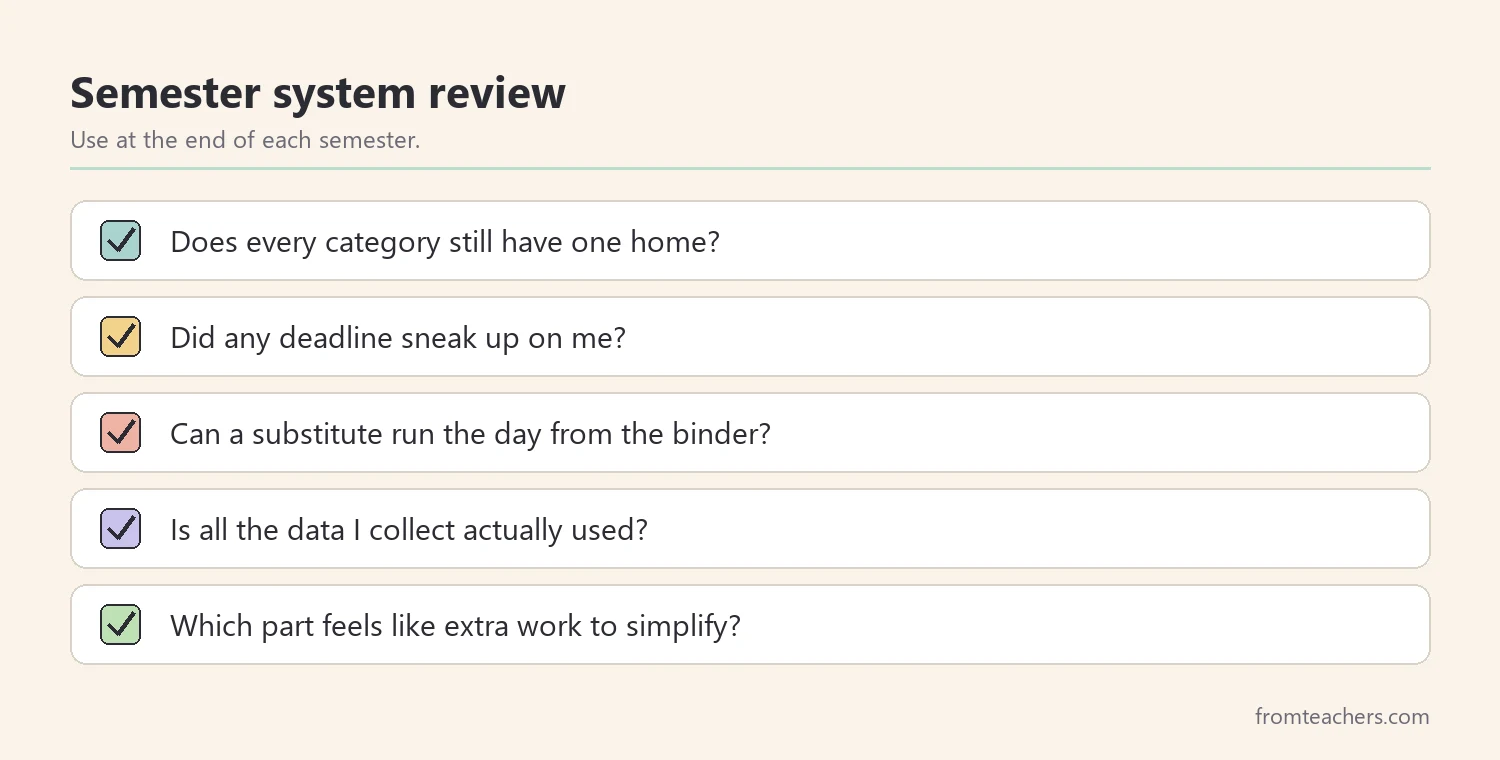
Lastly, review the whole system each semester. Ask which parts still save time and which feel like extra work. Then simplify. Special education classroom organization should make your job easier; if a part of it does not, change it.
Common mistakes and how to avoid them
- Trying to organize everything at once. Fix: start with the category causing the most stress.
- Keeping materials in several places. Fix: give each category one paper home and one digital home.
- Collecting data nobody uses. Fix: measure only what each goal needs and review it every two weeks.
- Leaving substitutes without information. Fix: build a staff binder with schedules and routines.
- Relying on yearly cleanups. Fix: protect a short weekly reset.
Questions teachers ask about special education classroom organization
Where should I start with special education classroom organization?
Start with a quick audit of everything you manage and where it lives. Then fix the category causing the most stress, often IEP paperwork. Small wins build momentum for the rest.
Should I go fully digital?
It depends on your district’s systems and privacy rules. Many teachers use a mix: signed documents in a locked cabinet and working files in a secure drive. The key is one consistent home for each type of material.
How do I keep IEP information private while staff still have access?
Follow your district’s confidentiality policies. One-page student snapshots can share the essentials staff need without exposing full files. Keep full records secured and limit access to authorized staff.
How much time does weekly maintenance take?
For many teachers, about 15 minutes a week is enough once the system is set up. The first few weeks take longer. After that, the weekly reset usually saves far more time than it costs.
Can the same system work for different grade levels?
Yes, the structure stays the same while the materials change. Younger students may need more visual supports and bins, while older students may manage some of their own folders. Adapt the details to your students.
Related reading: The Power of Data Tracking in Special Education, Special Education Accommodation and Modification Tracker, and How Teachers Communicate With Parents in Special Education: Building a Strong Partnership.
A companion resource for special education classroom organization:
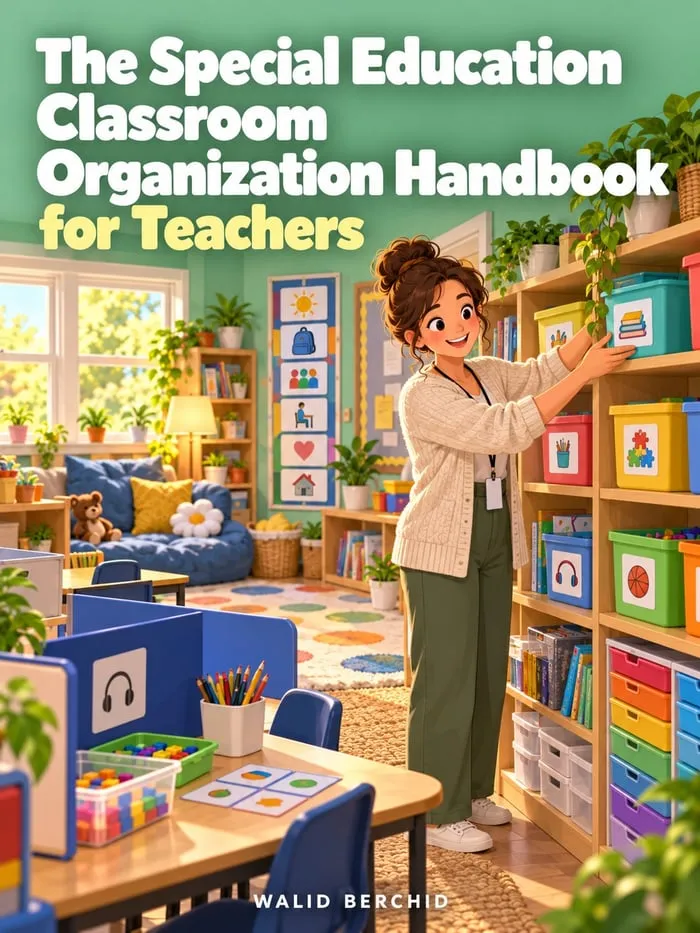
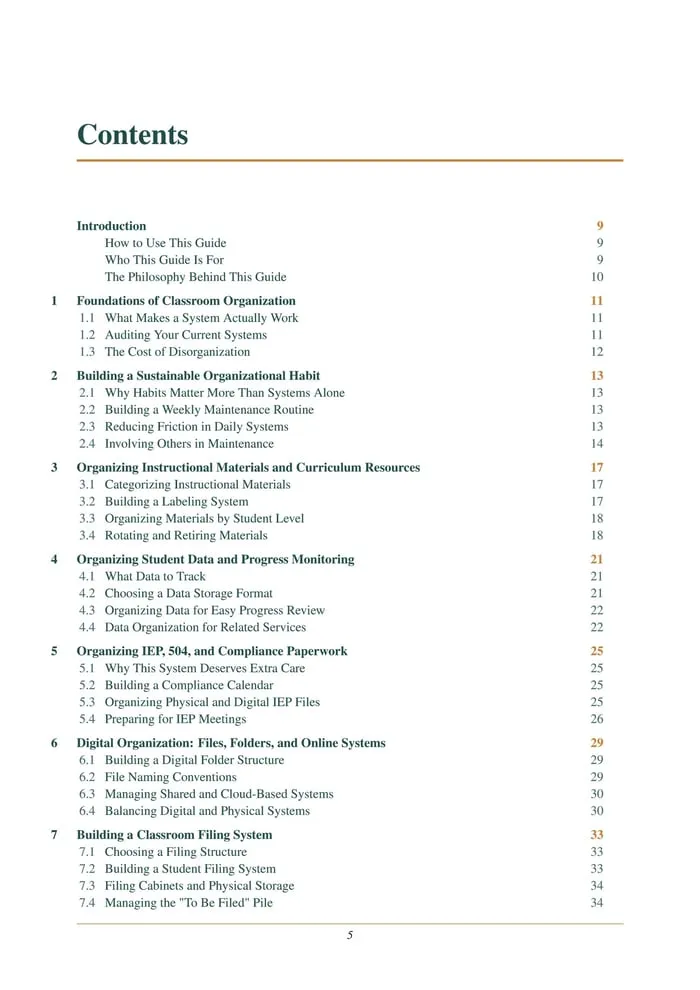
The Special Education Classroom Organization Handbook for Teachers: a 96-page PDF guide covering instructional materials, student data, IEP and 504 paperwork, digital files, filing systems, schedules, substitute and paraprofessional materials, behavior logs, and start and end of year routines.
Sources and scope
- IDEA, U.S. Department of Education: the law behind special education services, IEPs, and timelines.
- IRIS Center, Vanderbilt University: free modules on progress monitoring, classroom management, and working with paraprofessionals.
- Student Privacy Policy Office, U.S. Department of Education: information on protecting student records.
- Council for Exceptional Children: professional resources for special educators.
This guide covers practical organization systems for special education teachers and case managers. It does not replace your district’s policies on records, timelines, or confidentiality, which always take priority.
Key takeaways
- Special education classroom organization starts with an audit and one home per category.
- Use a deadline calendar and a consistent folder structure for compliance paperwork.
- Collect only the data each goal needs and review it every two weeks.
- Prepare a staff binder and master schedule for other adults.
- Keep it working with a 15-minute weekly reset.








Leave a Comment