

Receptive and expressive language skills shape almost every minute of a school day, yet gaps in them are easy to misread. Picture a third grader who sits still after you say, “Get your journal, write the date, and start on page twelve,” then gets up only after watching three classmates move. He may look unfocused, but he may simply not have understood the full direction.
After reading this guide, you will be able to tell the two skill areas apart, give directions that students can follow, build speaking and writing with sentence frames, track progress with simple data, and work with your speech-language pathologist and the family. Examples are fictional. Adapt to the student’s goals and agreed supports. This is guidance, not a diagnosis.
At a glance
- Receptive language is understanding; expressive language is putting ideas into words, signs, or symbols.
- Many “behavior” moments are really language moments, so observe before you correct.
- Short, visual directions help understanding; sentence frames help output.
- AAC is a language tool, and it supports speech rather than replacing it.
- Record a few simple numbers each week and share them with the SLP and family.
1. Define receptive and expressive language for your classroom
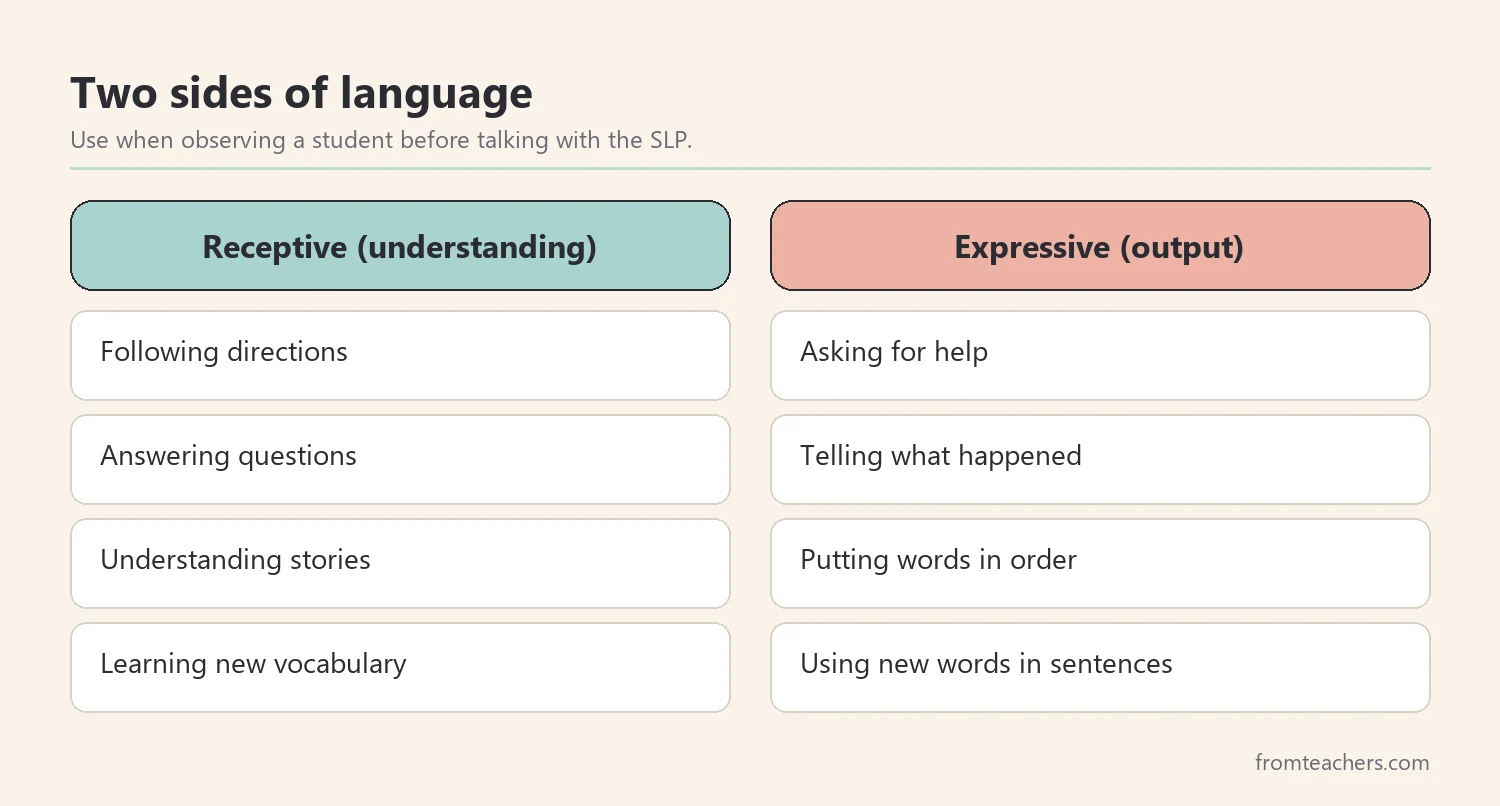
First, separate the two skill areas. Receptive language is understanding: following directions, answering questions, and making sense of stories and class talk. Expressive language is output: putting words in order, telling what happened, asking for help, and explaining ideas.
Also, separate language from speech. Speech is about producing sounds clearly. A child can have clear speech and still struggle to organize a sentence or understand a two-step direction. In contrast, a child with unclear speech may understand everything you say.
Consider Leo, a fictional student in grade 3. Leo talks easily with friends at recess, so adults assumed his language was fine. In class, however, he often started tasks late, and his written answers were one or two words long.
His teacher wrote down what she saw for one week, without judging it:
| What adults saw | Possible area | Question to explore |
|---|---|---|
| Watches peers before starting | Receptive | Did he understand the direction? |
| Answers “I don’t know” often | Receptive or expressive | Is it the question or the answer? |
| One-word written answers | Expressive | Can he say more than he writes? |
| Tells stories out of order | Expressive | Does a sequence frame help? |
Notice that the table uses questions, not labels. This keeps the team curious. Understanding receptive and expressive language needs starts with careful observation, and a speech-language pathologist can then help decide what is really going on.
In addition, observe across settings. A student may follow directions well in a quiet small group but miss them in a noisy whole-class lesson. Likewise, a student may speak in full sentences about a favorite topic but struggle to explain a math step. Noting where and when difficulties happen gives the team a much clearer picture of receptive and expressive language than any single moment can.
2. Give directions students can understand
Next, look at your own directions. Long, fast, spoken-only directions are hard for many students, not only those with identified language needs. Therefore, small changes help the whole class.
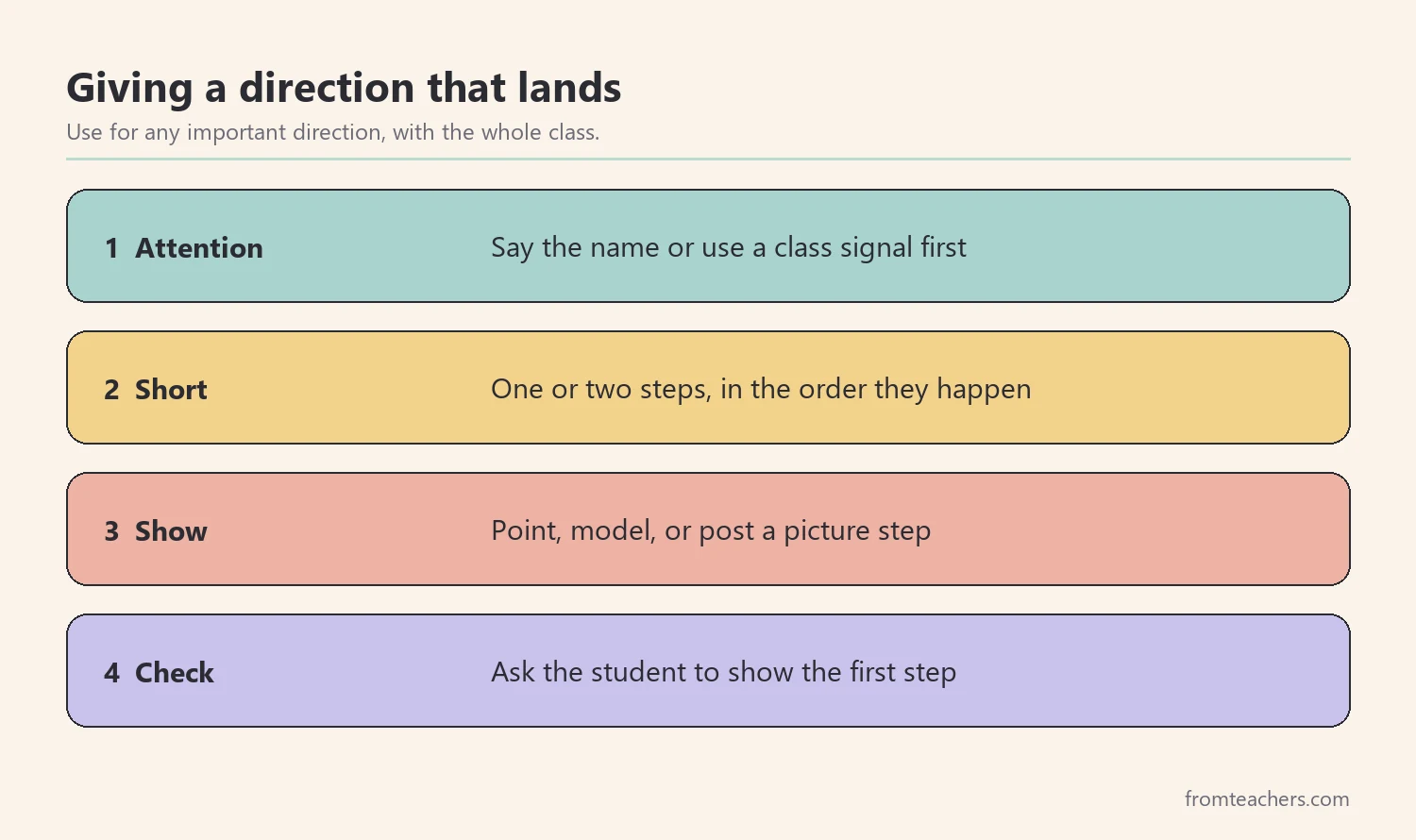
Use a simple routine every time you give an important direction:
- Get attention: Say the student’s name or use a class signal first.
- Keep it short: Give one or two steps at a time, in the order they happen.
- Show it: Point, model, or post a picture or written step.
- Check it: Ask the student to show or tell the first step, rather than asking “Do you understand?”
For Leo, his teacher changed “Get your journal, write the date, and start on page twelve” into two parts. First, she said, “Journals out,” and held up her own journal. Then, once journals were open, she said, “Date, then page twelve,” while pointing to the date on the board.
In addition, she added a small strip on Leo’s desk with three pictures: journal, date, page. As a result, Leo started on time on most days within two weeks. Several other students also started faster.
Receptive and expressive language needs often overlap. Consequently, when you make directions clearer, students also have more energy left to talk and write about the work.
3. Build expressive language with sentence frames
Once students understand the task, help them show what they know. Sentence frames give a starting structure, so the student can focus on ideas instead of building every sentence from scratch.
Begin with a few frames that match daily tasks:
- “I think ___ because ___.”
- “First ___, then ___, last ___.”
- “I need help with ___.”
- “I agree with ___ because ___.”
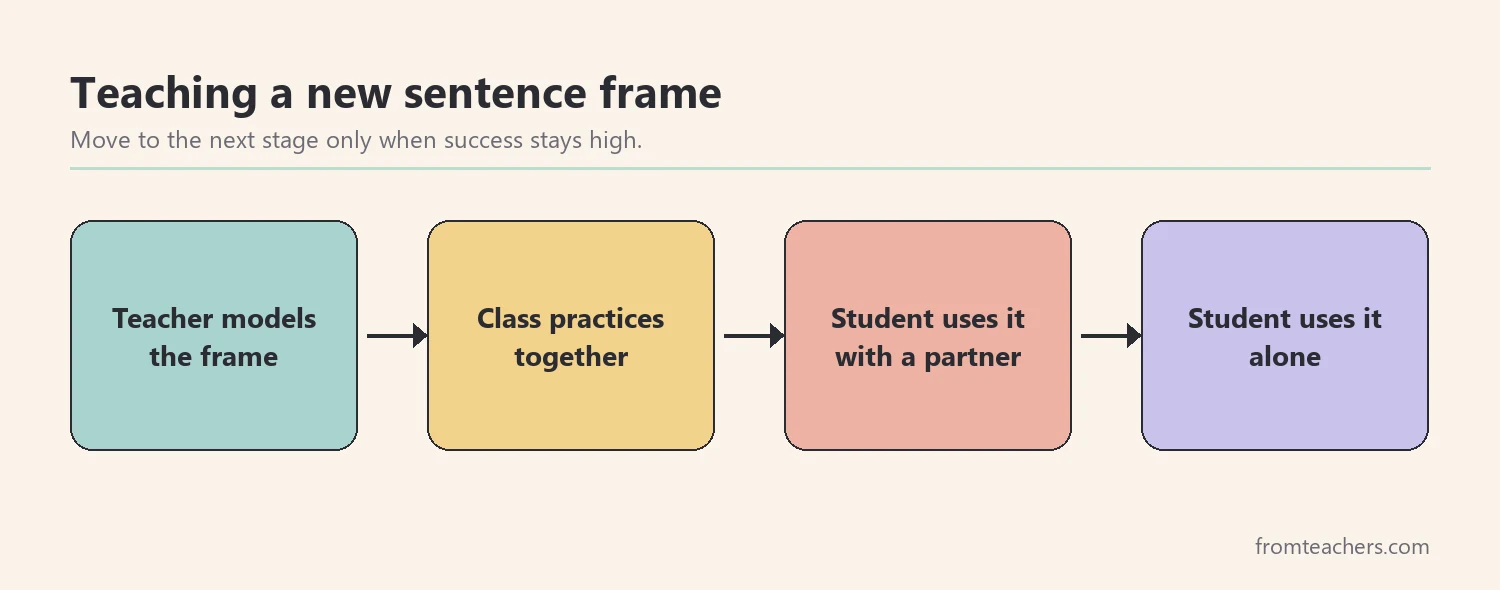
Then, teach each frame in a clear sequence. Model it yourself, practice it together, let students use it with a partner, and finally expect it in independent work. Moving through these stages slowly keeps success high.
For Leo, his teacher chose “First ___, then ___, last ___” for retelling stories. She modeled it with a short read-aloud, practiced it with Leo in a small group, and then had him retell to a partner. A week later, Leo wrote three-part retells instead of one-word answers.
If you want ready-made frames and routines, the speech and language toolkit for receptive and expressive language support includes separate sections on understanding and on using words, with sentence frames and vocabulary routines for K-8 classrooms.
Also, accept many ways of expressing ideas. Drawing, pointing, gesturing, or using a communication board all count as expressive language. Growth in receptive and expressive language often shows up in these forms before it shows up in full sentences.
4. Teach vocabulary and support AAC users
Vocabulary links receptive and expressive language. A student who understands a word is more likely to use it, and a student who uses a word tends to understand it more deeply.
Pick a small set of important words for each unit, perhaps five to eight. Then teach them in a routine: say the word, show a picture or object, give a student-friendly meaning, and use it in a sentence. Next, ask students to use the word themselves during the week.
For students who use augmentative and alternative communication (AAC), make sure the unit words are available on their device or board. Also, model by pointing to symbols yourself while you talk. This is often called aided language modeling, and it shows students how the system works in real conversations.
Then, give students many short chances to use new words. Quick partner talk, a word wall they can point to, and an exit ticket that asks for one unit word all add practice without adding long lessons. For students with receptive and expressive language needs, repeated, low-pressure practice like this often matters more than a single detailed lesson.
Remember that AAC supports language. It does not stop a child from talking, and it gives every student a way to take part now. Families sometimes worry about this, so share the purpose clearly.
In Leo’s class, one classmate used a picture communication board. During the plants unit, the teacher added “root,” “stem,” “leaf,” and “seed” to the board and pointed to them while teaching. Leo, meanwhile, used the same four words in his “First, then, last” retell of how a seed grows.
5. Record receptive and expressive language progress
Simple data shows whether supports are working. You do not need complex forms. Instead, choose one receptive skill and one expressive skill, and count a few tries each week.
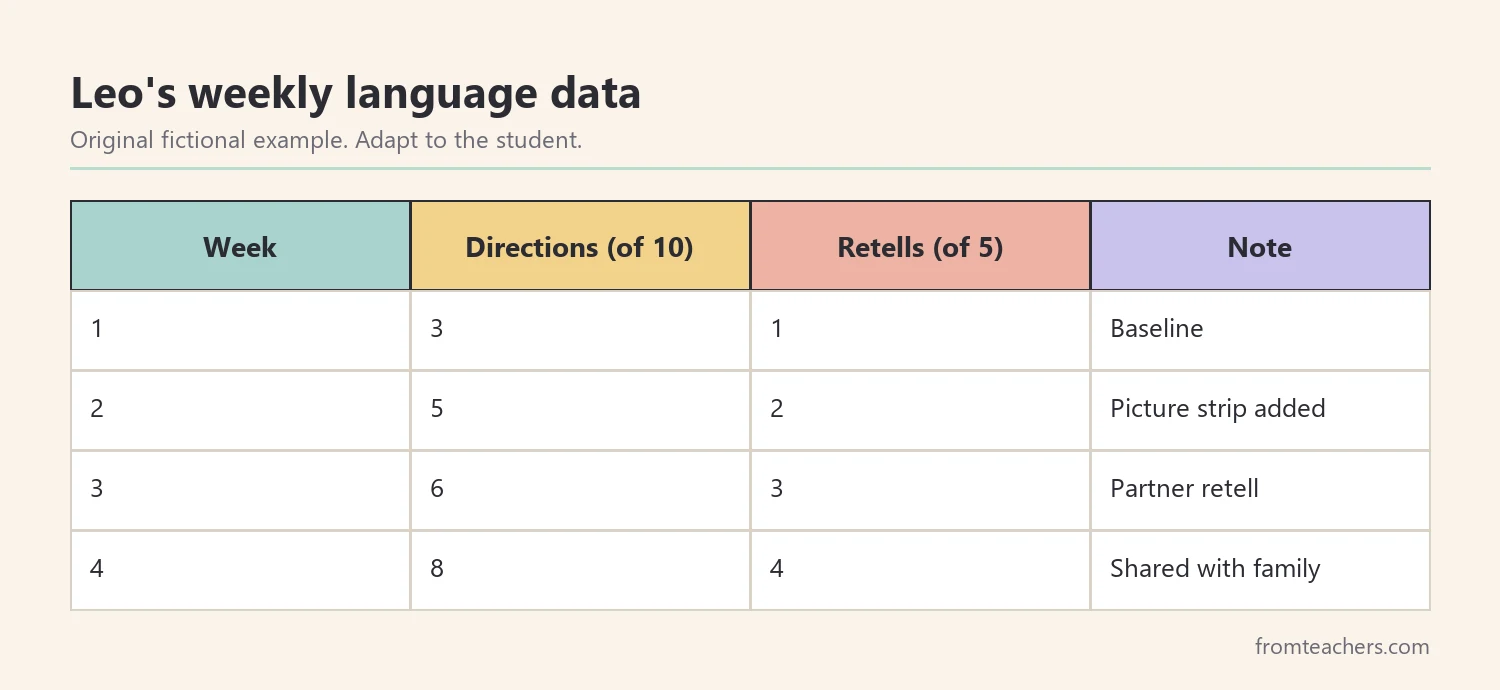
Leo’s teacher tracked two things. For receptive language, she counted how many of 10 two-step directions Leo followed without watching peers. For expressive language, she counted how many of 5 retells used a complete “First, then, last” sentence.
Over four weeks, Leo followed 3, then 5, then 6, then 8 of 10 directions. His complete retells went from 1 to 2, then 3, then 4 of 5. These numbers were easy to collect during normal lessons, and they gave the team a clear picture.
Also, write a short note next to each week. For example, “picture strip added” or “substitute on Friday.” These notes explain jumps and dips later. Furthermore, keep the same number of tries each week, so the numbers stay easy to compare. Tracking receptive and expressive language this way also makes conversations with the SLP faster and more specific.
6. Partner with the SLP and family on receptive and expressive language
Finally, connect the classroom with the rest of the team. The speech-language pathologist brings expertise in assessment and therapy, while teachers and families see the student in many real settings every day.
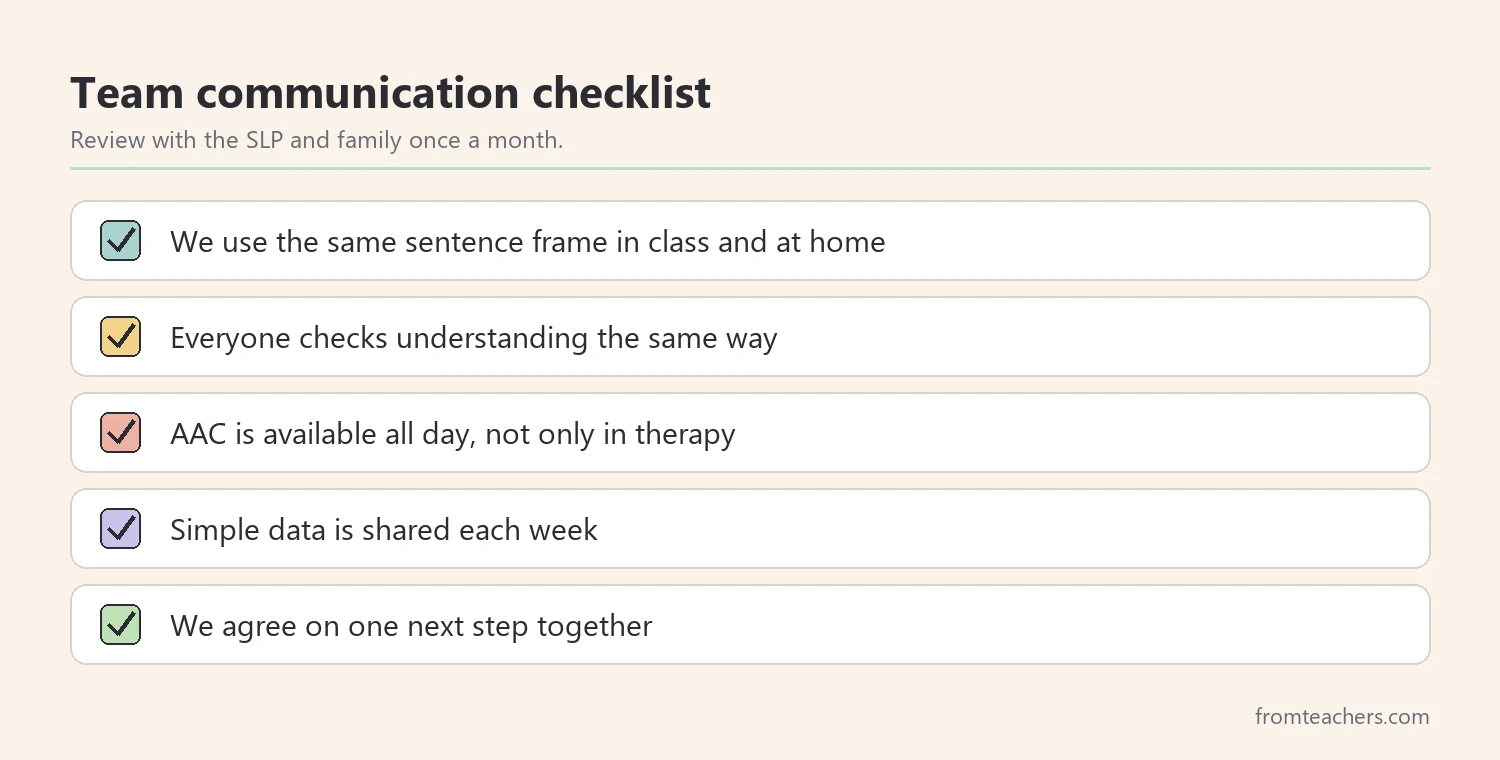
Agree on a few shared strategies so the student hears the same language everywhere. For example, everyone might use the same sentence frame, the same picture strip, or the same way of checking understanding.
Then, share data briefly and often. A two-line note each week works better than a long report once a term. Leo’s teacher sent home his retell frame and a short note: “This week Leo wrote 4 of 5 complete retells. Ask him to tell you about his day with first, then, last.”
In turn, his family shared that Leo had started using the frame at dinner to describe recess. Small connections like this help receptive and expressive language skills grow across settings, not only during lessons.
Also, keep the family’s home language in mind. Children who speak another language at home bring real strengths, and families can practice frames and vocabulary in the language they use most. Ask the SLP how best to support each child’s languages, so home practice feels natural rather than forced.
Common mistakes and how to avoid them
Even experienced teams fall into a few habits that slow down receptive and expressive language growth. Here are common ones, with a simple fix for each.
- Mistake: treating a language gap as defiance. Fix: check understanding before correcting behavior.
- Mistake: asking “Do you understand?” Fix: ask the student to show or tell the first step.
- Mistake: introducing many frames at once. Fix: teach one frame well, then add another.
- Mistake: keeping AAC for therapy only. Fix: make the device or board available all day and model on it.
- Mistake: working in separate silos. Fix: share one or two strategies and simple data with the SLP and family.
Questions teachers and parents ask about receptive and expressive language
Can a child be strong in one area and weak in the other?
Yes. Some children understand far more than they can say, while others talk easily but miss parts of what they hear. That is why it helps to look at receptive and expressive language separately.
Do I need speech therapy training to use these strategies?
No. Short directions, visual supports, sentence frames, and vocabulary routines are everyday teaching practices. However, assessment and therapy decisions belong to the speech-language pathologist.
Will AAC stop a child from learning to talk?
AAC is designed to support communication and language, and professional organizations describe it as a support rather than a barrier to speech. Talk with the student’s SLP about how AAC fits their goals.
How often should I collect data?
Once or twice a week is usually enough for classroom tracking. Choose a few tries during normal lessons, so data collection does not take over teaching time.
What should I do if I suspect a language need?
Write down specific observations, share them with the family, and talk with your school’s speech-language pathologist or student support team. They can decide whether an evaluation of receptive and expressive language is appropriate.
Related reading: Best Assistive Technology for Special Education Classrooms, How Teachers Communicate With Parents in Special Education: Building a Strong Partnership, and The Power of Data Tracking in Special Education.
A companion resource for receptive and expressive language:


Speech and Language Toolkit: AAC, Receptive and Expressive Support: a 49-page guide for K-8 teachers, paraprofessionals, and SLP partners, with sections on receptive and expressive language, sentence frames, vocabulary routines, social communication, AAC basics, SLP and parent partnerships, and print-and-go data trackers.
Sources and scope
- American Speech-Language-Hearing Association (ASHA): information on speech, language, and AAC for families and professionals.
- IRIS Center, Vanderbilt University: free modules on evidence-based classroom practices.
- Understood.org: practical articles for families and teachers on learning and thinking differences.
- IDEA, U.S. Department of Education: the law behind special education services, including speech and language services.
This guide covers everyday classroom strategies for supporting understanding and expression. It does not cover formal assessment, diagnosis, or therapy, which belong to speech-language pathologists and the student’s team.
Key takeaways
- Separate understanding from output, and both from speech sounds.
- Give short, visual directions and check the first step.
- Teach one sentence frame at a time: model, practice, partner, alone.
- Make AAC available all day and model on it.
- Track one receptive and one expressive skill weekly and share with the team.










Leave a Comment