

A vocabulary intervention plan starts with a familiar moment: a student reads a science passage aloud without a single error, then cannot tell you what “habitat” or “predict” means. The words were decoded, but they were never really learned. As a result, comprehension breaks down quietly, and the student falls further behind in every subject that depends on those words.
After reading this guide, you will be able to choose a small set of target words, teach them in a predictable routine, track how independently the student uses each word, and decide when to move on. The steps work for speech-language pathologists, special education teachers, reading interventionists, and families who want to support language at home.
Examples are fictional. Adapt to the student’s goals and agreed supports. This is guidance, not a diagnosis.
At a glance
- Pick 5 to 8 useful words per cycle, not a long list from the back of the book.
- Teach each word with a student-friendly definition, an example, a picture or gesture, and a chance to say it.
- Plan many short exposures across the week instead of one long lesson.
- Record the level of support the student needs, from full prompt to spontaneous use.
- Review every two to three weeks and check that words appear outside the therapy room.
1. Choose target words for the vocabulary intervention plan
Word choice decides most of the result. If the list is random, practice time is spread thin and the student meets each word too few times. Therefore, start with words the student will hear and need again and again.
Three groups usually give the best return:
- High-use academic words: words such as compare, describe, predict, and reason that appear across subjects.
- Current unit words: key terms from the science or social studies unit the class is studying now.
- Functional words: words for routines, feelings, and self-advocacy, such as “confused,” “repeat,” or “finished.”
Next, check what the student already knows. A quick receptive check (point to the picture) and an expressive check (tell me what it means) will show which words are new, partly known, or already secure. Only new and partly known words belong in the plan.
Finally, keep the set small. Five to eight words per two or three week cycle is enough for most students who need intervention. A shorter list allows more exposures, and more exposures matter more than more words.
Worked example: Leila, grade 3
Leila reads fluently but struggles to explain what she has read. Her class is starting a unit on animal habitats. Her SLP and classroom teacher chose six words for the first cycle:
| Word | Group | Starting level |
|---|---|---|
| habitat | Unit word | New |
| survive | Unit word | Partly known |
| predict | Academic | New |
| compare | Academic | Partly known |
| shelter | Unit word | Partly known |
| confused | Functional | New |
Notice that the list mixes groups. As a result, Leila practices words she needs in science, in reading, and in asking for help.
2. Write a clear goal and a simple measure
A plan without a measure turns into a list of activities. In contrast, a short written goal tells every adult what success looks like and when to check it.
Good vocabulary goals name three things: the words, the kind of use, and the level of independence. For example, “Given six unit words, the student will use each word correctly in a spoken sentence with no more than a verbal reminder, in two of three sessions.” That goal is specific, observable, and easy to record.
Then decide how you will describe support. A simple prompt ladder works well:
- Full model: the adult says the word and the sentence, and the student repeats it.
- Partial prompt: the adult gives the first sound or a sentence starter.
- Visual cue: the student uses a picture or word card to find the word.
- Independent on request: the student uses the word when asked, with no cue.
- Spontaneous: the student uses the word on their own in a new setting.
Moreover, agree on where the word should show up. A word that appears only in the therapy room is not yet learned. A good vocabulary intervention plan names at least one other setting, such as the classroom, a small reading group, or home.
Worked example: Leila’s goal
Leila’s team wrote: “Leila will use the six habitat words correctly in a spoken or written sentence at the independent level, in therapy and in class, by the end of the three-week cycle.” Her teacher agreed to listen for the words during science talk twice a week.
3. Teach each word with a predictable routine
Students who struggle with vocabulary benefit from explicit teaching. Instead of hoping the meaning comes from context, teach it directly and in the same order every time. A predictable routine also lowers anxiety, because the student knows what comes next.
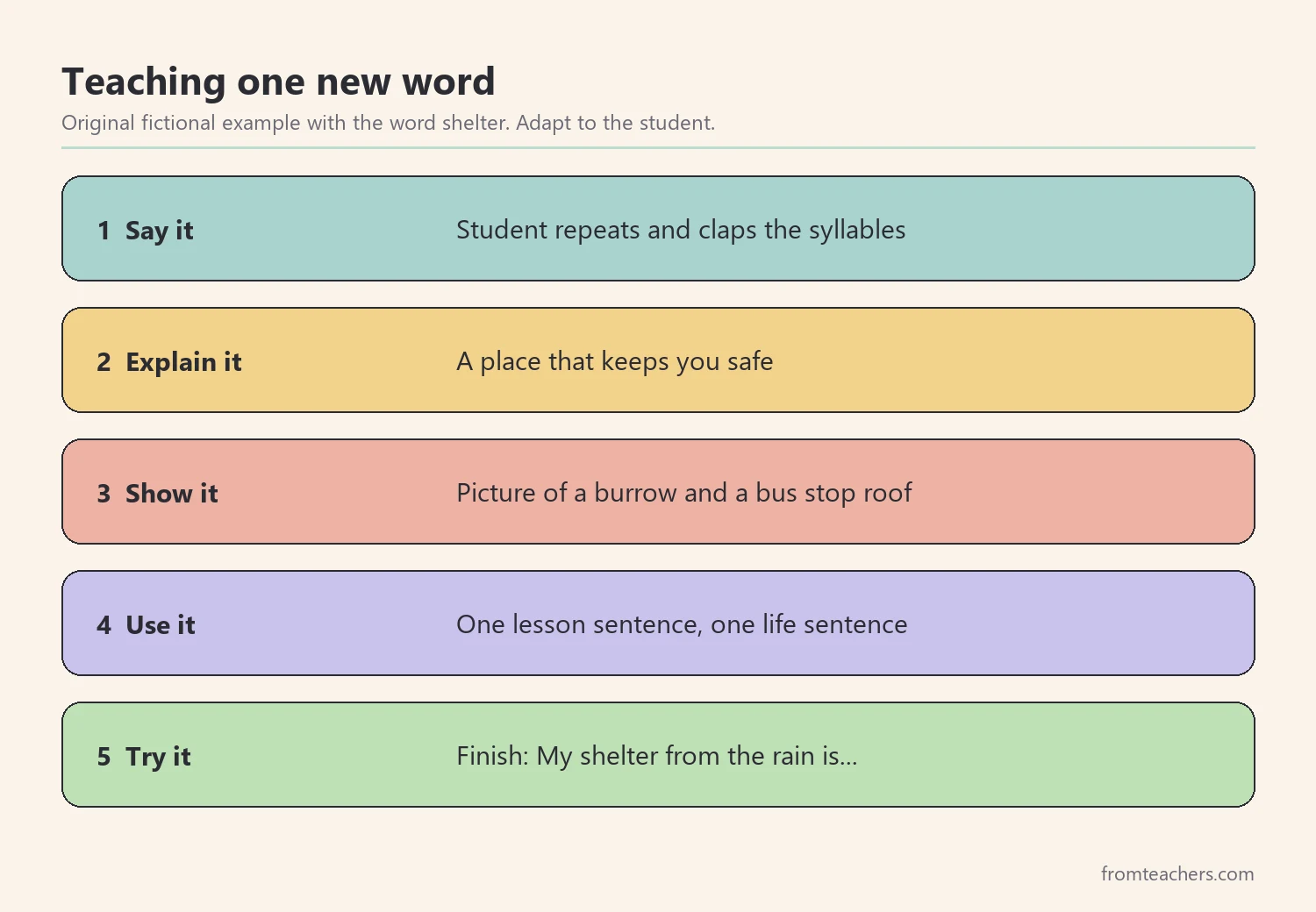
A short routine for each new word might look like this:
- Say it: the adult says the word clearly, and the student repeats it and claps the syllables.
- Explain it: give a student-friendly definition in everyday language.
- Show it: add a picture, gesture, or object.
- Use it: give two example sentences, one from the lesson and one from the student’s life.
- Try it: the student makes their own sentence with support.
For example, for “shelter,” the adult might say, “A shelter is a place that keeps you safe from weather or danger.” Then show a picture of a burrow and a bus stop roof. Afterward, the student finishes the starter “My shelter from the rain is…”
In addition, connect new words to known ones. Ask, “Is a habitat more like a home or more like a toy?” Questions like this build links in memory and help the student retrieve the word later.
4. Plan many short exposures across settings
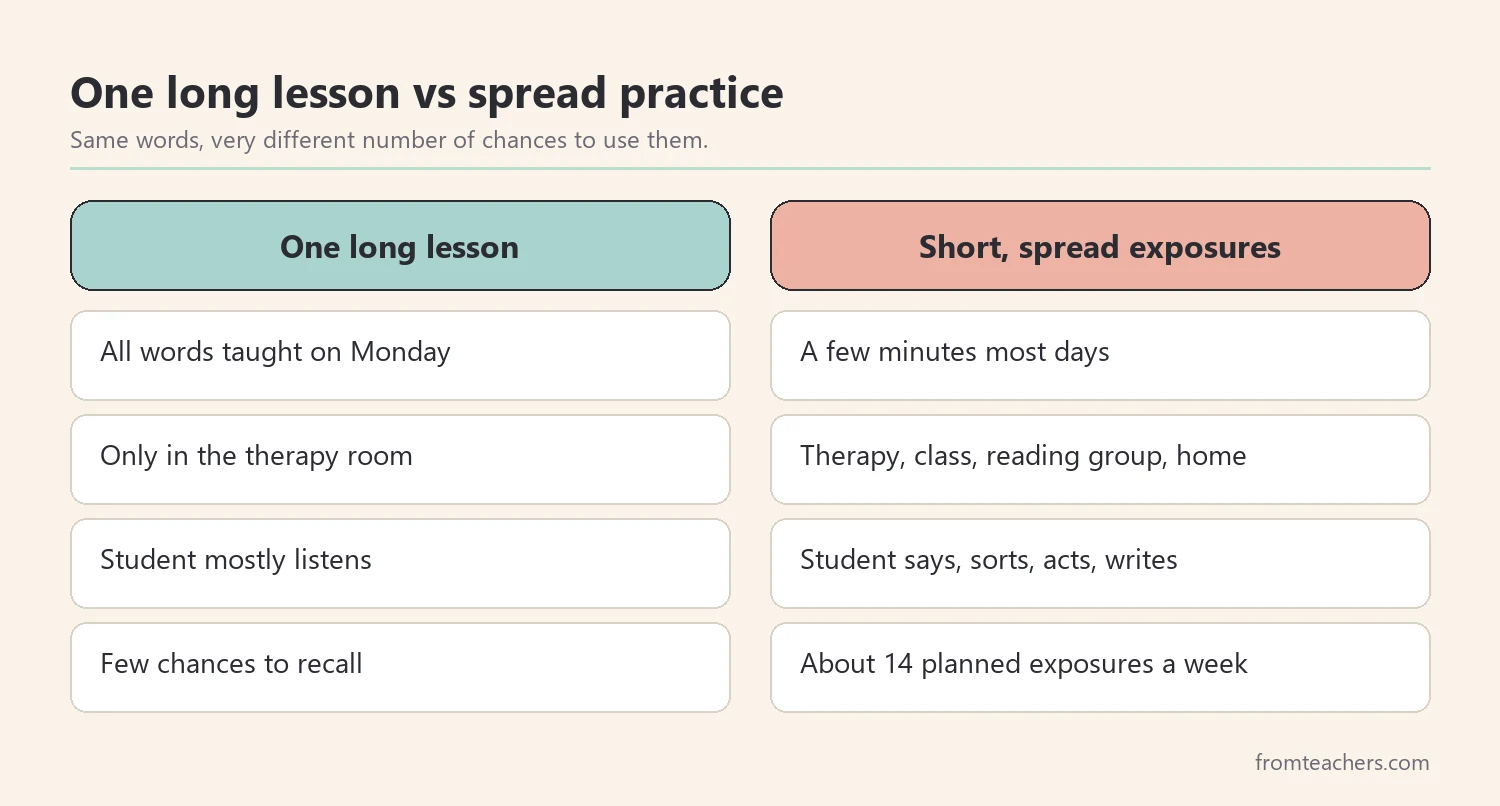
One strong lesson is rarely enough. Most students who need a vocabulary intervention plan need to hear, say, and use a word many times, in different places, before it sticks. Therefore, plan exposures on purpose rather than leaving them to chance.
Spread practice across the week in short bursts:
- Hear it: read a short text or story that uses the word.
- Say it: ask questions that require the word in the answer.
- Sort it: match words to pictures or sort them into “living thing” and “place” groups.
- Act it: role-play a scene, such as an animal looking for shelter.
- Write it: finish sentence starters or label a drawing.
Furthermore, share the word list with the classroom teacher and the family. A short note that lists the words, the definitions, and one example sentence is enough. When the same word comes up at home and in class, the student meets it in real life, not only in drills.
Worked example: Leila’s exposure week
| Setting | Activity | Exposures per week |
|---|---|---|
| Therapy (2 sessions) | Routine, sorting, role play | 6 |
| Science class | Discussion questions | 3 |
| Reading group | Short habitat text | 2 |
| Home | Word of the day at dinner | 3 |
| Total | 14 |
As a result, each word gets about 14 planned exposures in a week, far more than a single lesson could give.
5. Track progress in the vocabulary intervention plan
Tracking does not need to be complicated. However, it must be consistent. Use the same prompt ladder each time so you can compare one week to the next.
For each target word, record the highest level the student reached without help in that session. In addition, note the setting and any examples of spontaneous use. A short checklist with columns for the word, the support level, the setting, and a note is enough. For a ready-made option, the fillable vocabulary observation checklists include goal-setting, prompt-level, contextual word use, and multiple exposure pages.
Also, ask other adults to record too. A teacher who hears “Leila said ‘predict’ in science” gives evidence that a word is moving into real use. That single note may be worth more than a perfect score in a drill.
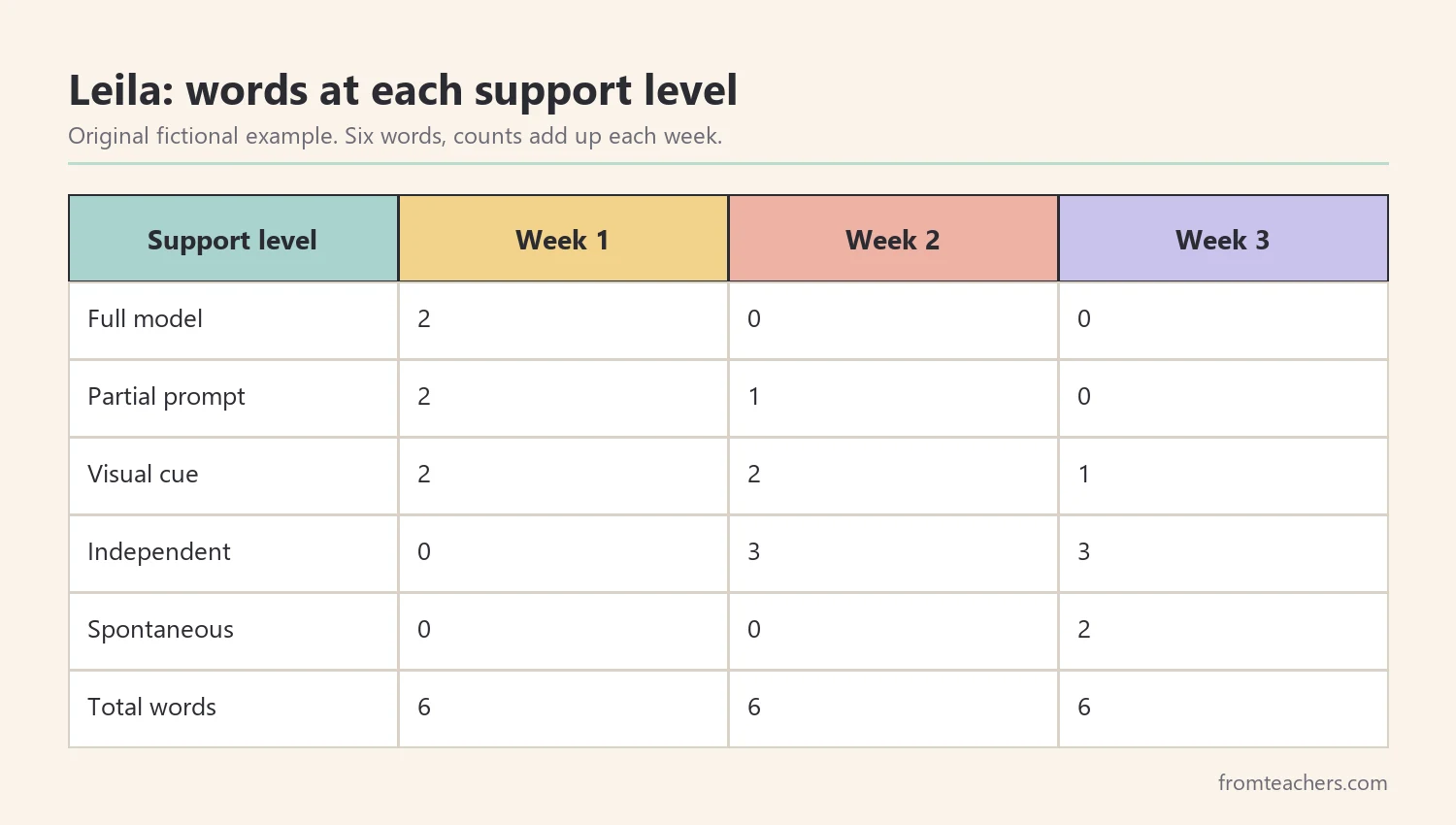
Worked example: Leila’s tracking after three weeks
| Word | Week 1 | Week 2 | Week 3 |
|---|---|---|---|
| habitat | Partial prompt | Visual cue | Independent |
| survive | Visual cue | Independent | Spontaneous |
| predict | Full model | Partial prompt | Visual cue |
| compare | Visual cue | Independent | Independent |
| shelter | Partial prompt | Independent | Spontaneous |
| confused | Full model | Visual cue | Independent |
By week 3, five of the six words reached the independent or spontaneous level. Only “predict” still needed a visual cue.
6. Review, adjust, and start the next cycle
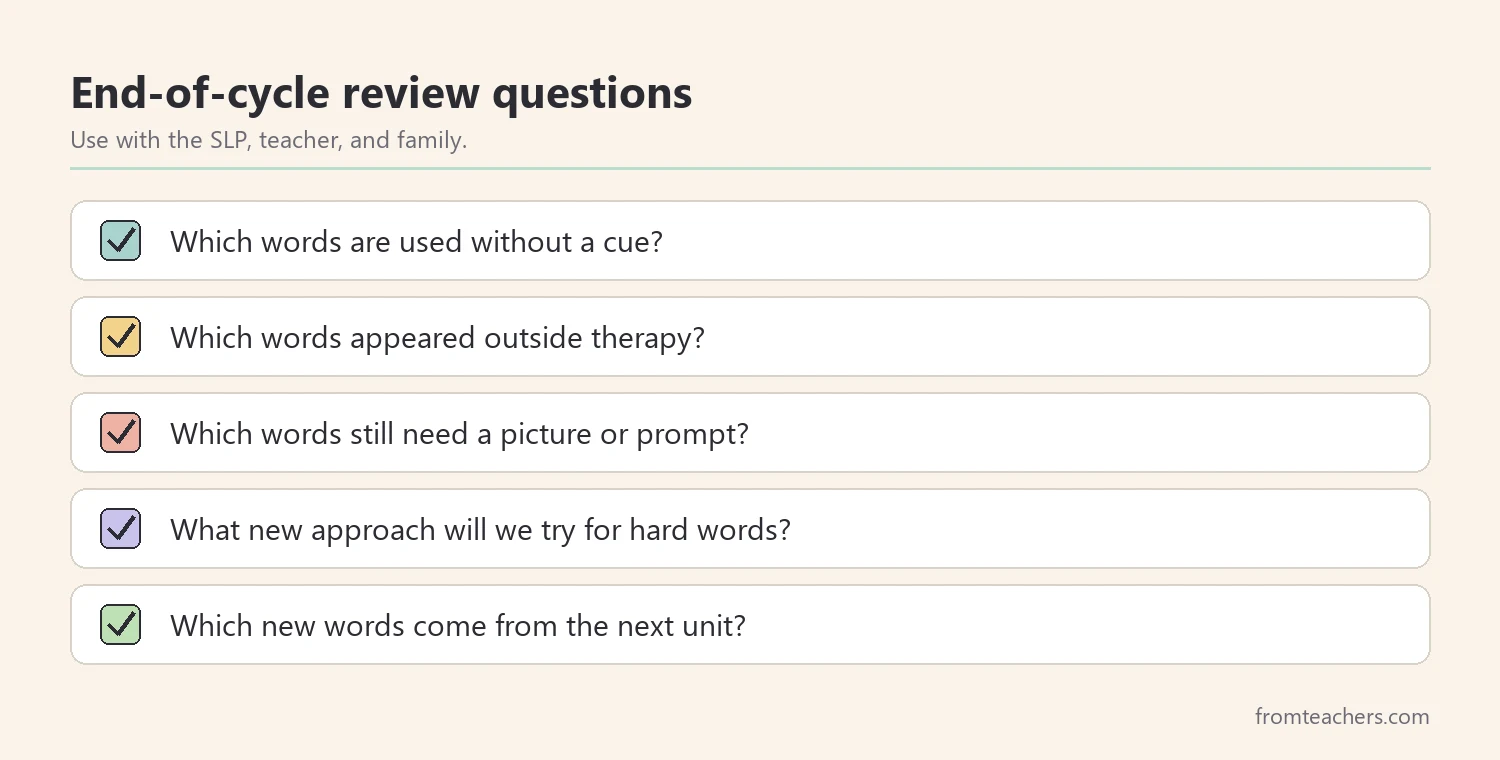
At the end of each cycle, meet briefly with the team. Look at the tracking data and decide what happens to each word. Words at the spontaneous level can move to a “review now and then” list. Words still at the prompt level stay in the next cycle, often with a new teaching approach.
For example, “predict” was hard for Leila because it is abstract. Her SLP added a short daily game: before turning a page, Leila guesses what will happen and starts with “I predict…” That small change gives the word a clear, repeated job.
In addition, involve the student in the review. Show Leila her own chart and ask which words feel easy and which still feel slippery. Students who see their progress often become more willing to try hard words, and some start to notice new words on their own. For older students, a simple self-rating of “I know it, I am learning it, or I need help” adds useful information to the adult data.
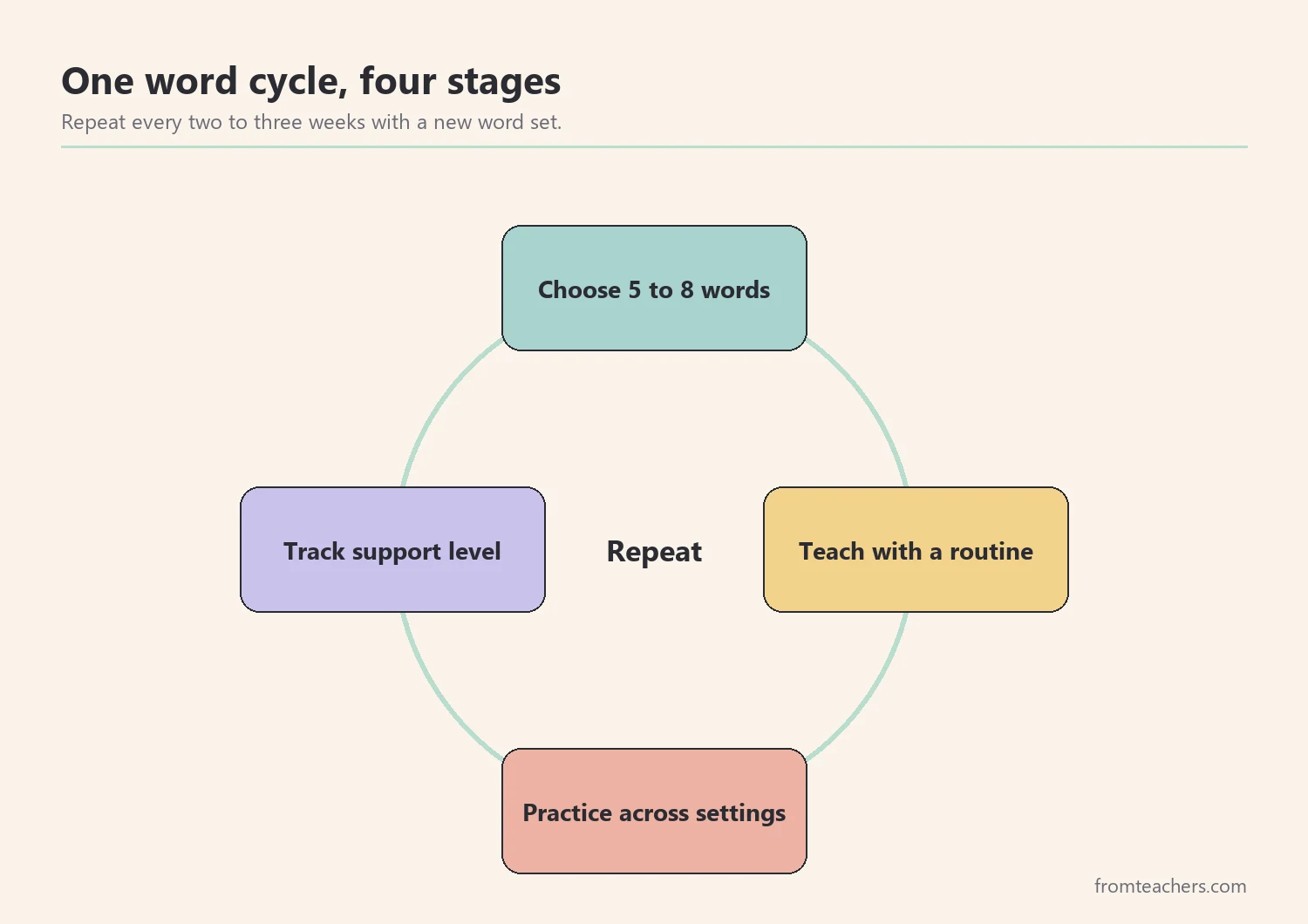
Then choose the next set of words. Keep the cycle the same: choose, teach, practice, track. Over a school year, a steady vocabulary intervention plan can cover many words that the student truly owns, rather than a long list that was only seen once.
Common mistakes and how to avoid them
- Too many words at once. Fix: limit the list to five to eight words per cycle so each word gets enough practice.
- Dictionary definitions. Fix: write short, everyday explanations and pair them with a picture or gesture.
- Practice only in therapy. Fix: share the list with the teacher and family and plan at least one other setting.
- Tracking only right or wrong. Fix: record the support level, so you can see growth before full independence.
- Dropping words too early. Fix: keep words in review until the student uses them without a cue in more than one setting.
Questions teachers and parents ask about a vocabulary intervention plan
How many words should a vocabulary intervention plan include?
Most students do well with five to eight words per cycle of two to three weeks. A smaller set allows more exposures for each word. You can add more words once the student moves through cycles quickly.
How do I know a word is really learned?
Look for independent use in a new setting. If the student uses the word correctly in class or at home without a cue, it is likely secure. Keep it on a light review list for a few weeks to be sure.
Can parents help with vocabulary at home?
Yes. A short list of words with simple definitions and example sentences is enough. Families can use one word of the day during meals, car rides, or bedtime stories, and note when the child uses it.
What if the student can say the word but not explain it?
That usually means the sound of the word is known but the meaning is still weak. Go back to the “explain it” and “show it” parts of the routine. Ask the student to sort, act out, or compare the word with a known word.
Does this work for older students?
Yes. The routine stays the same, but the words change. Older students may focus on academic and subject words, and they can help choose words and track their own progress.
Related reading: The Power of Data Tracking in Special Education, Dyslexia Solutions in the Classroom, and Special Education Tracking Tools.
A companion resource for your vocabulary intervention plan:
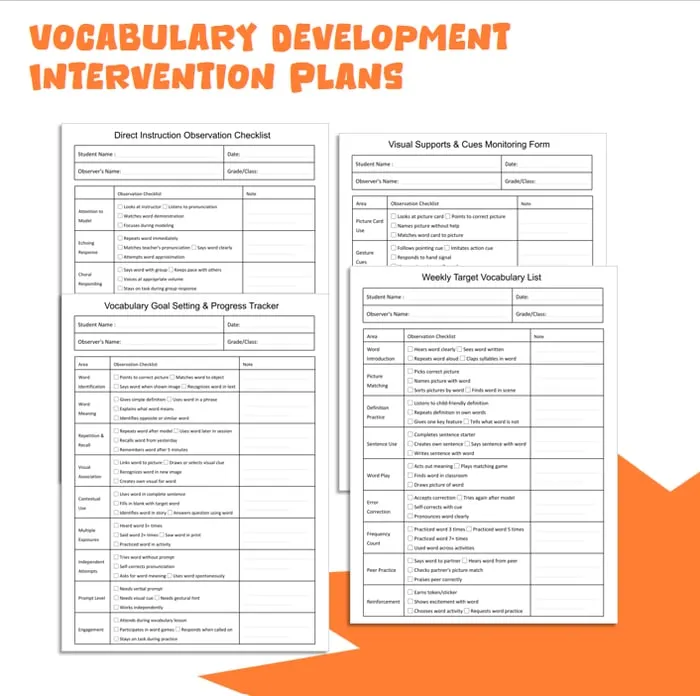
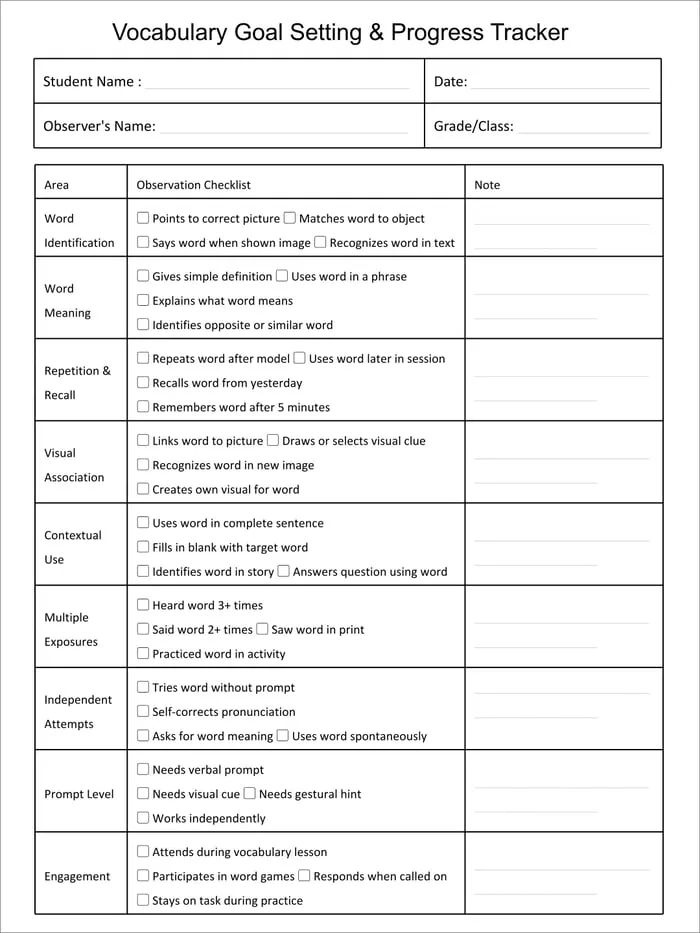
Vocabulary Development Intervention Plans: a 12-page printable collection of fillable observation checklists for tracking word recognition, prompt levels, exposures, contextual use, role play, and sentence completion across therapy, classroom, and home.
Sources and scope
- American Speech-Language-Hearing Association (ASHA): professional guidance on language development and intervention.
- IRIS Center, Vanderbilt University: free modules on evidence-based instruction and progress monitoring.
- What Works Clearinghouse: practice guides on literacy and language instruction.
- Individuals with Disabilities Education Act (IDEA): the federal framework for special education services and goals.
Scope: this guide covers planning, teaching, and tracking vocabulary for students who need extra support. It does not replace a speech-language evaluation or the student’s IEP team decisions.
Key takeaways
- A small, well-chosen word list beats a long one.
- Teach each word directly with a predictable routine and a picture or gesture.
- Plan many short exposures across therapy, class, and home.
- Track the level of support, not only right or wrong answers.
- Review each cycle and keep hard words with a fresh approach.




Leave a Comment