

Autism support strategies matter most in the small moments of a school day. Picture a second grader who covers his ears when the class lines up for lunch, then refuses to leave the carpet when the timer goes off. He is not being stubborn. The noise, the change, and the unclear next step all arrived at once.
This guide gives you a five-step process for choosing and using autism support strategies in a calm, organized way. You will learn how to name one clear challenge, match it to a strategy, add visual and sensory supports, teach the routine, and review what is working. By the end, you will have a simple plan you can share with your team and the family.
Examples are fictional. Adapt to the student’s goals and agreed supports. This is guidance, not a diagnosis.
At a glance
- Start with one specific challenge, written as what you see and hear.
- Match every challenge to one strategy and a few practical implementation tips.
- Use visual supports and sensory adjustments before asking the student to change.
- Teach routines and transitions directly, then practice them when things are calm.
- Record one simple measure and review it with the team every few weeks.
1. Name one clear challenge before choosing autism support strategies
Many plans fail because they try to fix everything at once. Instead, start with one challenge that affects the student’s day the most. Write it as what you can see and hear, not as a label or a guess about motives.
For example, “Leo does not like transitions” is too broad. A clearer version is “When the timer rings for lunch, Leo stays on the carpet and covers his ears for several minutes.” This description tells you when it happens, what it looks like, and what the environment is doing at that moment.
Next, look for patterns over a few days. Note the time, the activity, the noise level, and what happened right before. Patterns often point directly to the right autism support strategies. In other words, the observation does half of the planning for you.
| Day | Time | What happened before | What Leo did |
|---|---|---|---|
| Monday | 11:30 | Timer rang, class lined up | Covered ears, stayed on carpet |
| Tuesday | 11:30 | Timer rang, loud hallway | Covered ears, cried briefly |
| Wednesday | 11:30 | Warning given, quiet hallway | Joined line after a short wait |
Leo is a fictional grade 2 student. His teacher, Ms. Grant, notices that the hard moments happen at the same time each day, and that Wednesday went better when she gave a warning and the hallway was quiet. That small detail shapes her whole plan.
Above all, keep the family in the loop. Parents often know which sounds, changes, or routines are hardest, and they may already use supports at home that can carry over to school.
2. Match the challenge to a strategy
Once the challenge is clear, choose one strategy that fits it. A simple way to organize this is a four-part table: the challenge, the strategy, implementation tips, and notes. This format keeps autism support strategies practical, because every idea is tied to a real moment.
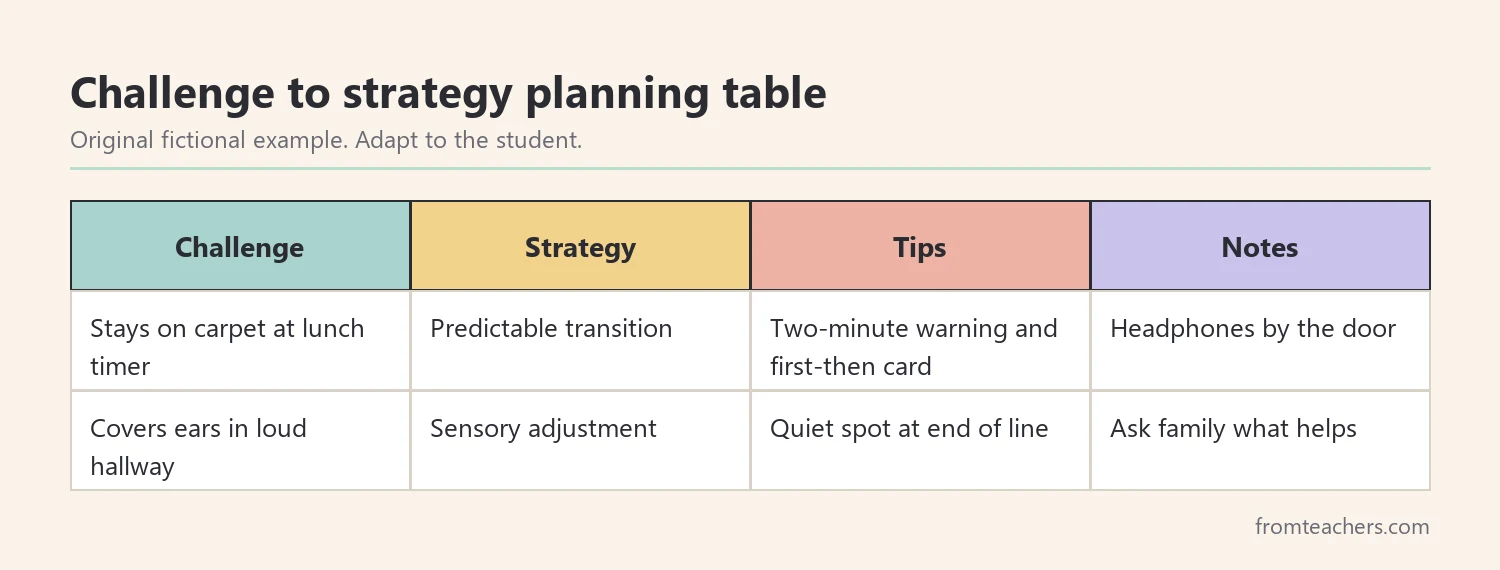
For Leo, the challenge is moving from the carpet to the lunch line. The strategy is a predictable transition with a warning and a visual cue. The implementation tips are a two-minute warning, a “first carpet, then lunch” card, and a quiet spot at the end of the line. The notes say that headphones are available for the hallway.
In addition, choose strategies from the right area. Autism support often covers several domains: social communication, sensory processing, transitions, emotional regulation, social skills, visual supports, and behavior. Picking the right domain keeps you from using a social skills strategy for what is really a sensory problem.
| Area | What you might see | Example strategy |
|---|---|---|
| Sensory | Covering ears, avoiding touch | Headphones, quieter seat |
| Transitions | Stuck at the end of an activity | Warning and first-then card |
| Communication | Hard to ask for help | “I need a minute” card |
| Regulation | Upset that builds quickly | Taught calm area routine |
Keep this kind of table close at hand when you plan. It reminds you that autism support strategies are not one size fits all, and that the same behavior can come from different needs in different students.
Put this step into practice
If you want a ready-made reference for this step, the Autism Support Strategies Toolkit with challenge and strategy tables organizes support ideas by area, with implementation tips and notes for each one.
Finally, start with one strategy, not five. If you change many things at once, you will not know which one helped. A single, well-chosen strategy is easier for every adult to use the same way.
3. Add visual and sensory autism support strategies
Many autistic students process visual information more easily than spoken directions. Therefore, visual supports are among the most useful autism support strategies you can add. A visual schedule, a “first, then” card, or a short picture sequence can make the day feel predictable.
In addition, start with the moment you named in step 1. For Leo, a small card on the carpet shows two pictures: “first carpet” and “then lunch.” When the warning comes, Ms. Grant points to the card instead of repeating directions. As a result, Leo hears fewer words and sees a clear next step.
Sensory adjustments work alongside visual supports. Think about sound, light, touch, and movement. Some students need noise-reducing headphones in the hallway. Others need a seat away from a buzzing light or a chance to move before sitting for a long lesson.
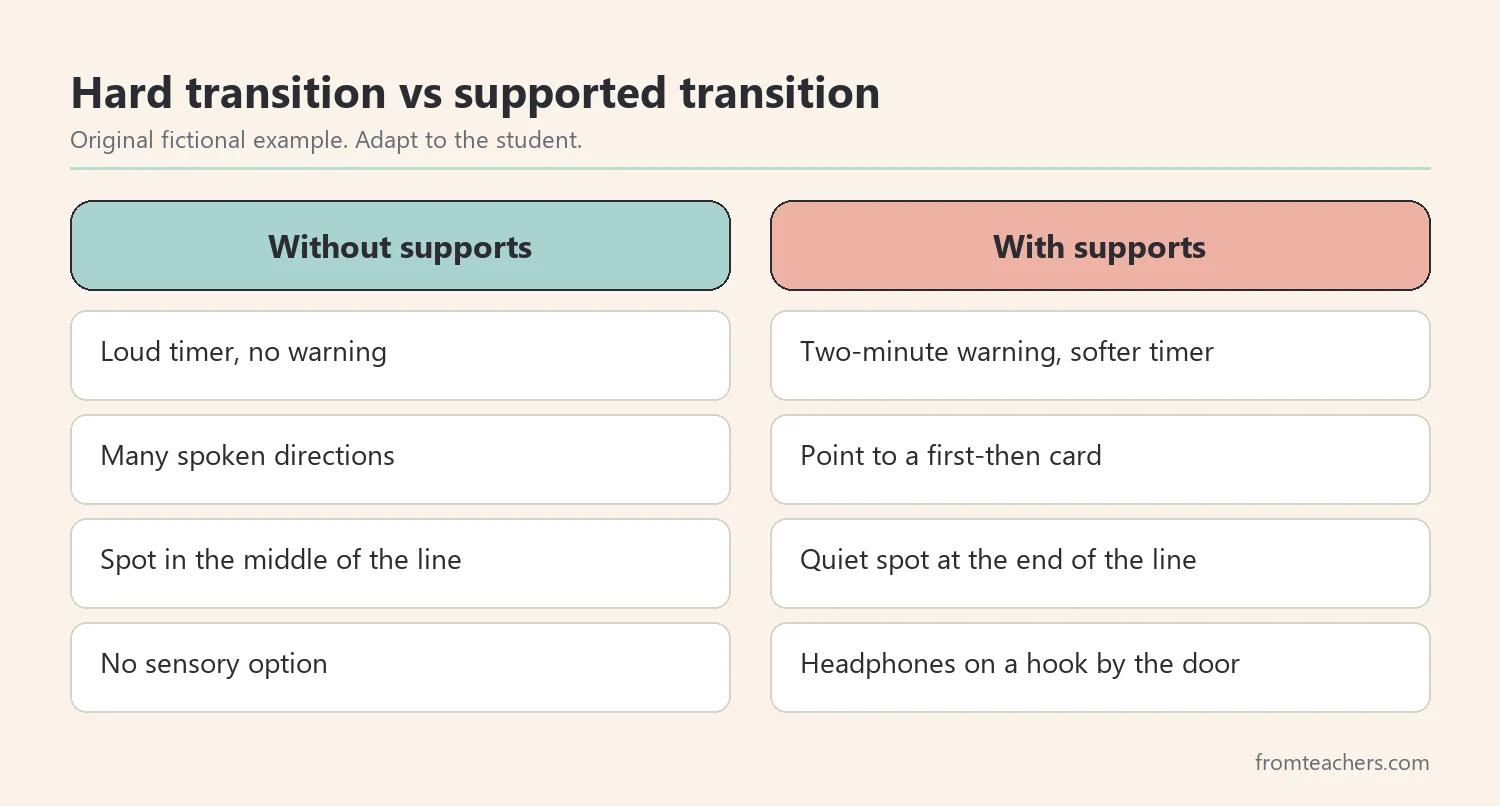
For example, Ms. Grant moves Leo’s line spot to the end, where it is quieter, and keeps headphones on a hook by the door. She also lowers the volume of the timer. None of these changes ask Leo to be different. Instead, they change the environment around him.
Moreover, a calm area in the classroom can help. Keep it simple: a soft seat, a few calming items, and a visual card for “I need a break.” Teach the student how and when to use it, so it becomes a tool rather than a reward or a punishment.
Meanwhile, check that every support is easy to use. If a card is lost every day or headphones are locked away, the support will not happen when it is needed.
4. Teach routines and transitions directly
Autism support strategies work best when students know exactly what to do. Routines that seem obvious to adults often need to be taught step by step. In particular, transitions benefit from a short, clear sequence that stays the same every day.
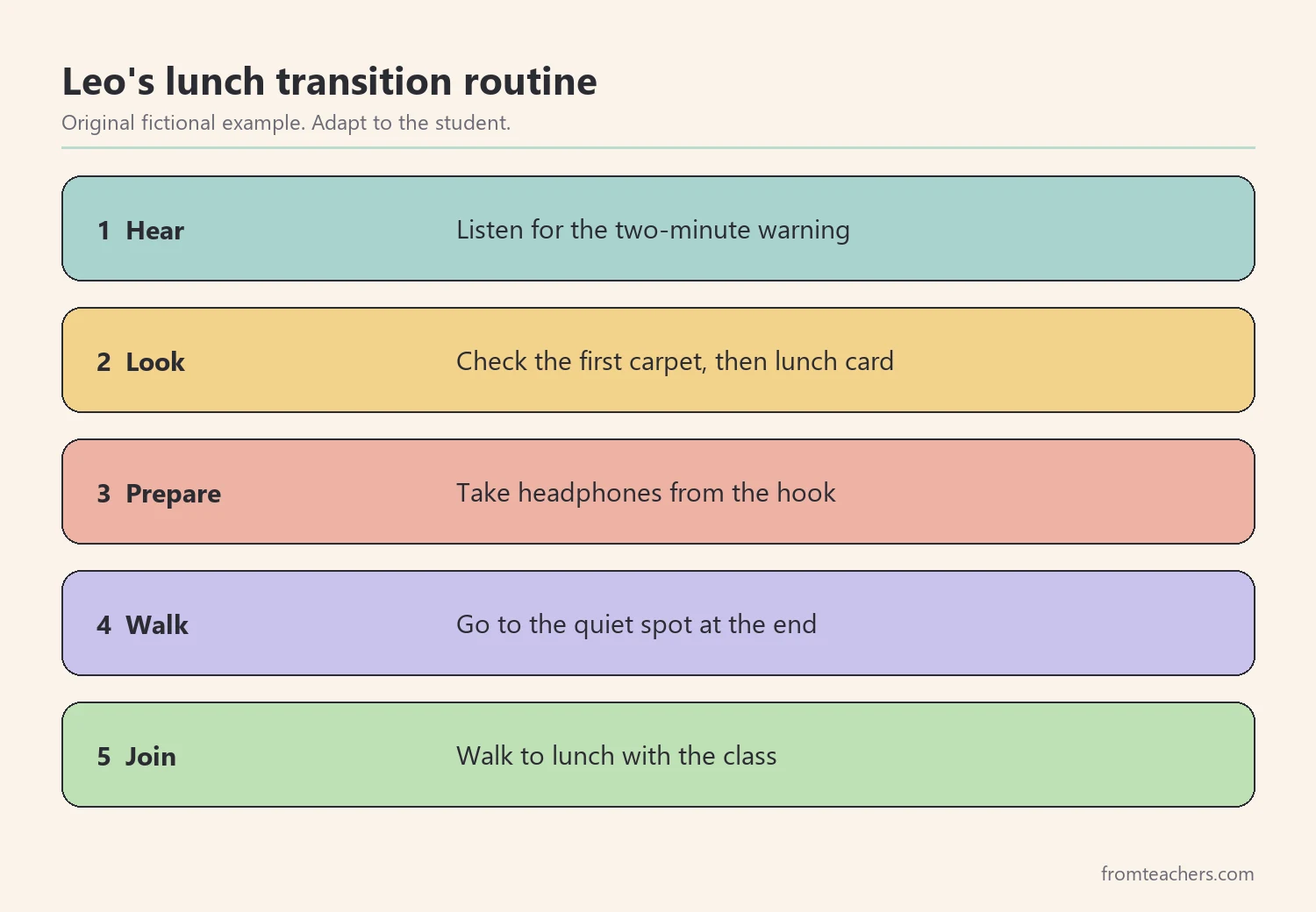
Teach the routine at a calm time, not during the hard moment. For instance, Ms. Grant practices the lunch transition at 10:00, when the hallway is empty. Leo hears the warning, looks at his card, puts on his headphones, and walks to the end of the line. Then she praises the specific step he did well.
For example, use the same words every time. If one adult says “line up” and another says “time to go,” the routine becomes less predictable. A short shared script for all adults keeps the support consistent.
Social communication can be built into routines as well. A simple phrase such as “I need a minute” or a card that says the same thing gives the student a way to ask for help without a meltdown. Practice it often so it becomes automatic.
A quick classroom example
In addition, plan for change. Fire drills, assemblies, and substitute days happen. Prepare the student with a short visual story or a quick preview: “Today is different. After math, we go to the gym.” Advance notice makes surprises feel smaller.
Also, think about peers. Classmates notice when a student leaves the line early or wears headphones. A short, respectful explanation, such as “Some of us use tools to help our bodies feel calm,” keeps the support normal. In many classes, other students start asking to use the same tools, which is a good sign that autism support strategies can benefit everyone.
Finally, write the routine down for every adult who works with the student. One page with the steps, the exact words, and where the supports are kept helps paraprofessionals, specialists, and substitutes respond the same way.
5. Record and review your autism support strategies
A support plan is only useful if you know whether it is working. Choose one simple measure that matches the challenge from step 1. For Leo, Ms. Grant records how many minutes it takes him to join the lunch line after the warning.
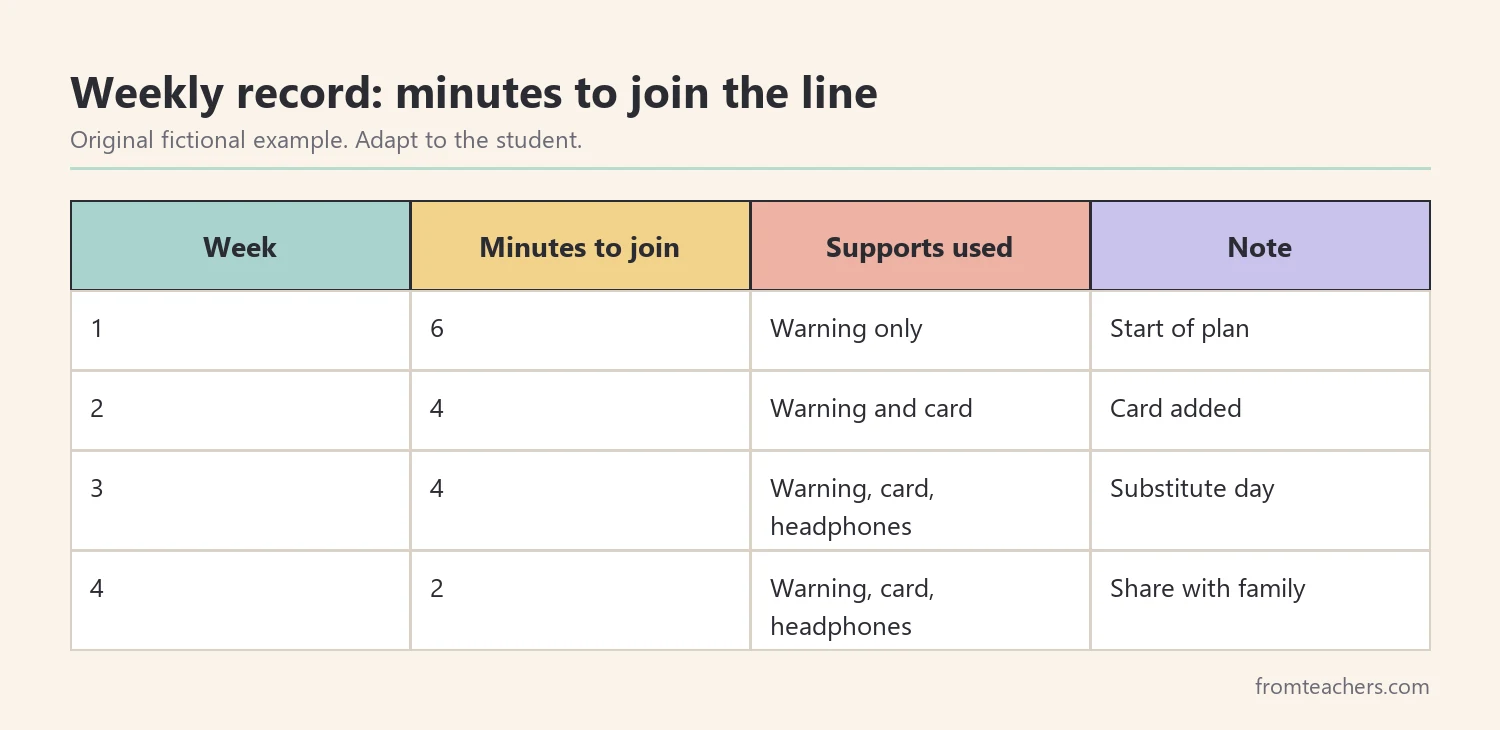
Over four weeks, the record shows a clear trend. In week 1, Leo takes about 6 minutes to join the line. By week 2, he takes 4 minutes. In week 3, he takes 4 minutes again because of a substitute day. By week 4, he takes 2 minutes. The numbers do not need to be perfect; they only need to show direction.
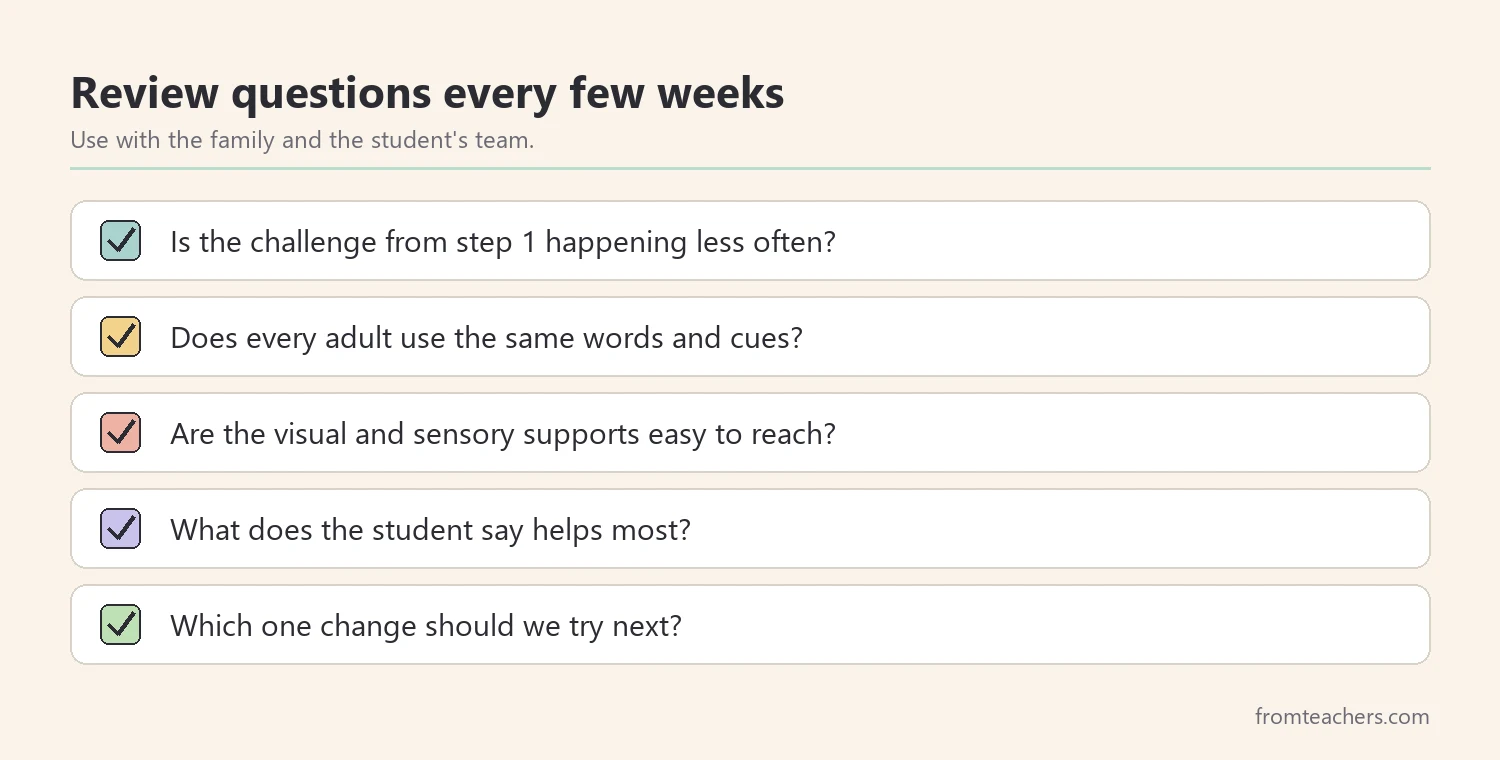
Next, review the data with the team and the family every three to four weeks. Ask what is working, what is not, and which one change to try next. If the plan is working, keep it and consider fading one support slowly. If it is not, adjust one part rather than starting over.
Finally, include the student when possible. Ask simple questions: “Do the headphones help?” “Is the card useful?” Students often give the clearest feedback about which autism support strategies feel helpful.
Common mistakes and how to avoid them
- Trying many strategies at once. Fix: choose one challenge and one strategy, then add more only after reviewing.
- Using a strategy from the wrong area. Fix: check whether the challenge is sensory, communication, transition, regulation, or social before choosing.
- Teaching routines only during hard moments. Fix: practice when the student is calm, and keep the same words every time.
- Treating a calm area as a reward or punishment. Fix: teach it as a tool the student can ask for.
- Not tracking anything. Fix: record one simple measure each week and review it with the team.
Questions teachers and parents ask about autism support strategies
Which autism support strategies should I try first?
Start with visual supports and predictable routines, because they help many students and are easy to add. Then, match additional strategies to the specific challenge you observed. Always check with the student’s team and IEP if one is in place.
How long should I try a strategy before changing it?
Give a new strategy about three to four weeks of consistent use. That is usually enough time to see a direction in your data. However, if a strategy clearly increases distress, stop and review it with the team sooner.
Do autism support strategies work for the whole class?
Many of them do. Visual schedules, transition warnings, and calm areas often help other students too. Using them class-wide also means the autistic student does not feel singled out.
How can parents use these strategies at home?
Parents can use the same “first, then” cards, the same transition words, and similar sensory supports. Sharing the school routine with families helps the student experience the same structure in both places.
What if the student refuses the support?
Refusal is information. The support may be too noticeable, too hard to use, or not matched to the real need. Talk with the student if possible, try a different format, and keep the focus on comfort rather than compliance.
Related reading: Managing Sensory Overload: Practical Strategies for Autism and ADHD, Autism Social Skills Development: Practical Strategies for Growth, and Understanding Autism ADHD Meltdowns: Signs and Support Strategies
A companion resource for autism support strategies:
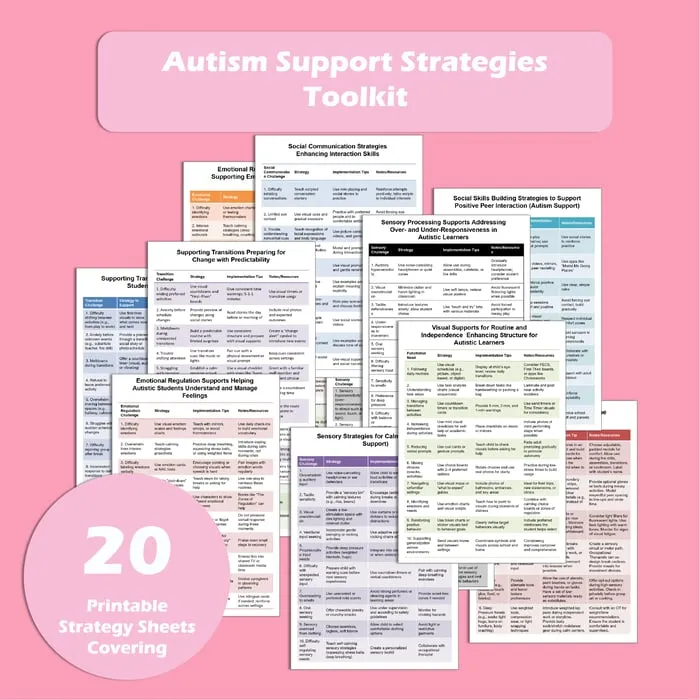
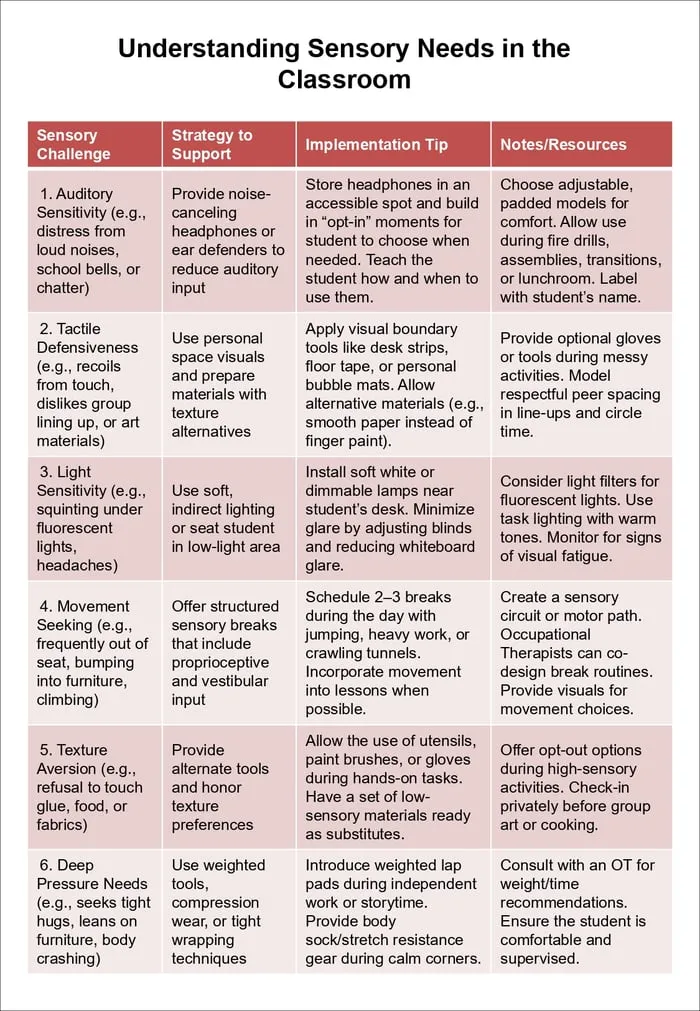
Autism Support Strategies Toolkit: a 20-page reference of Challenge, Strategy, Implementation Tips, and Notes tables covering social communication, sensory processing, transitions, emotional regulation, social skills, visual supports, behavior support, and classroom environment adaptations.
Sources and scope
- IRIS Center, Vanderbilt University: free modules on autism, evidence-based practices, and classroom supports.
- CDC autism information: general background on autism spectrum disorder in children.
- American Speech-Language-Hearing Association: information on communication and the role of speech-language pathologists.
- IDEA, U.S. Department of Education: the law behind special education services and IEPs.
This guide covers everyday classroom strategies for supporting autistic students. It does not cover diagnosis, therapy, or formal evaluation, which belong to qualified professionals and the student’s team.
Key takeaways
- Good autism support strategies start with one clear, observable challenge.
- Match each challenge to one strategy with practical implementation tips.
- Visual and sensory supports change the environment before asking the student to change.
- Teach routines and transitions when the student is calm, with the same words every time.
- Track one simple measure and review it with the team and family.










Leave a Comment