

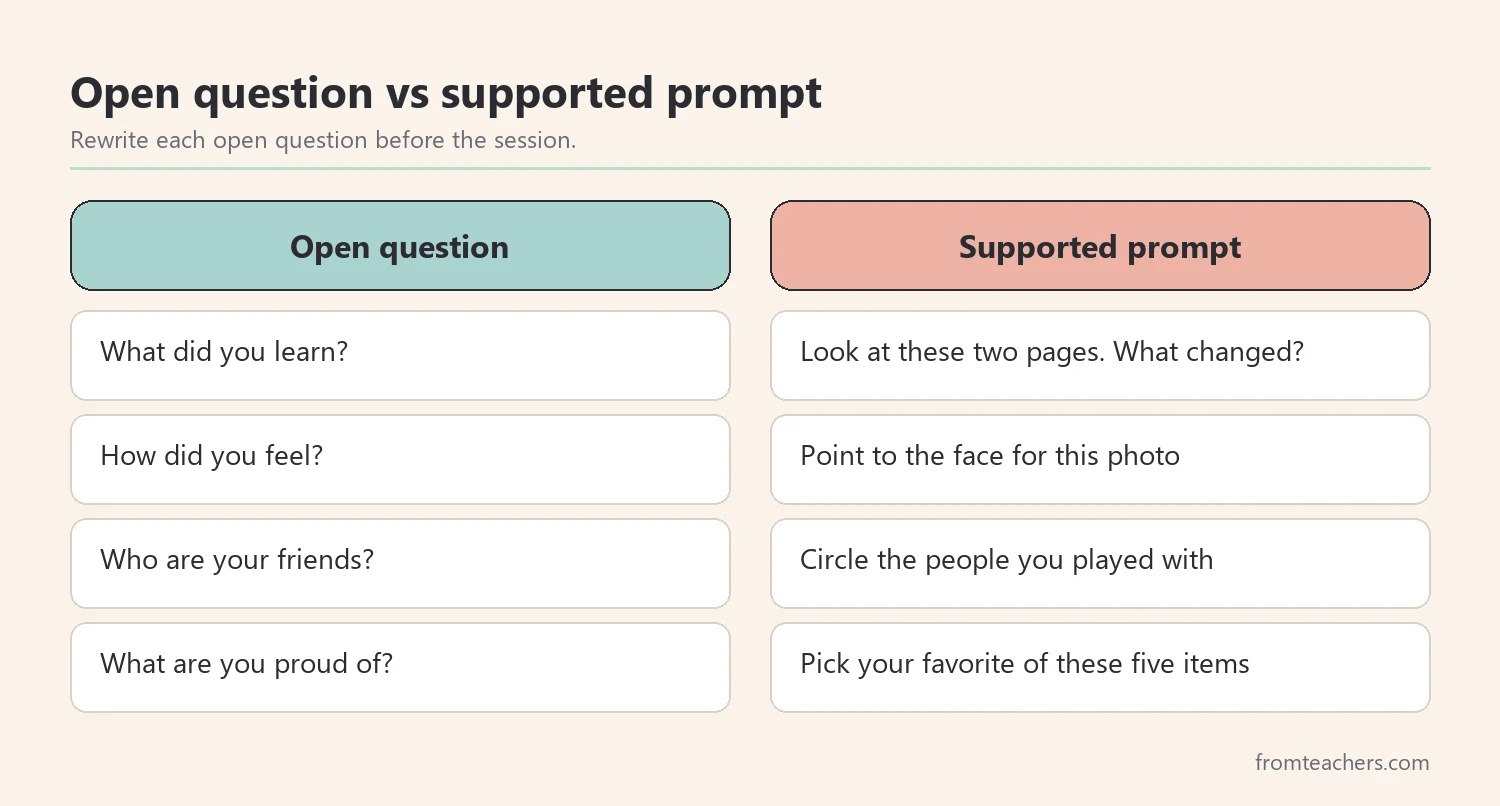
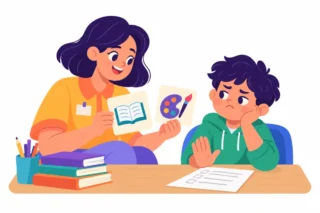
End of year reflection for students can be one of the most meaningful moments of the school year, or one of the most frustrating. Picture a fifth grader staring at a worksheet that asks, “What did you learn this year?” He shrugs, writes “nothing,” and puts his head down, even though he grew a great deal since September.
After reading this guide, you will be able to set up a safe space for reflection, gather memory anchors, offer several ways to respond, guide reflection by theme, help students set goals, and celebrate growth in a way every learner can join. Examples are fictional. Adapt to the student’s goals and agreed supports. This is guidance, not a diagnosis.
The six steps below follow the order of a real reflection unit, from preparing the room to sharing the finished work. You can run end of year reflection for students over one or two weeks, using short sessions that fit your schedule.
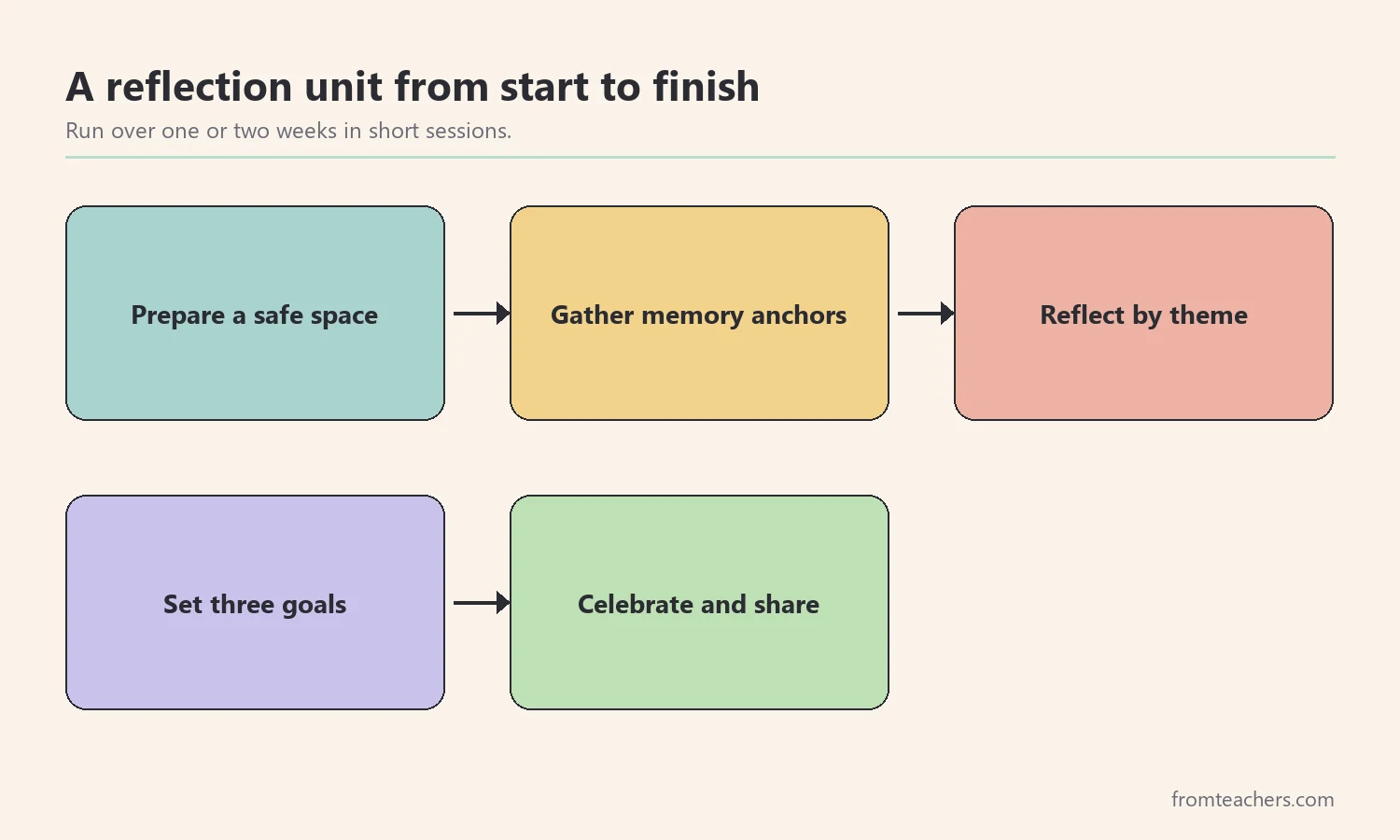
At a glance
- Open questions like “What did you learn?” are hard for many learners; concrete prompts work better.
- Photos and work samples act as memory anchors, so students do not have to recall a whole year.
- Writing, drawing, speaking, choosing, and AAC are all valid ways to reflect.
- Short sessions spread over a week or two are easier than one long block.
- End with goals and a celebration, and share the results with next year’s teacher.
1. Set up a safe space for end of year reflection for students
First, think about why reflection can feel hard. Many students who learn differently have heard more corrections than praise during the year. Consequently, a question about the year may bring up memories of struggle rather than pride.
Also, some students find it hard to recall the past or to describe feelings in words. Differences in working memory, interoception (noticing body signals like tiredness or tension), and self-concept can all play a part. None of this means the student cannot reflect; it means the activity needs more structure.
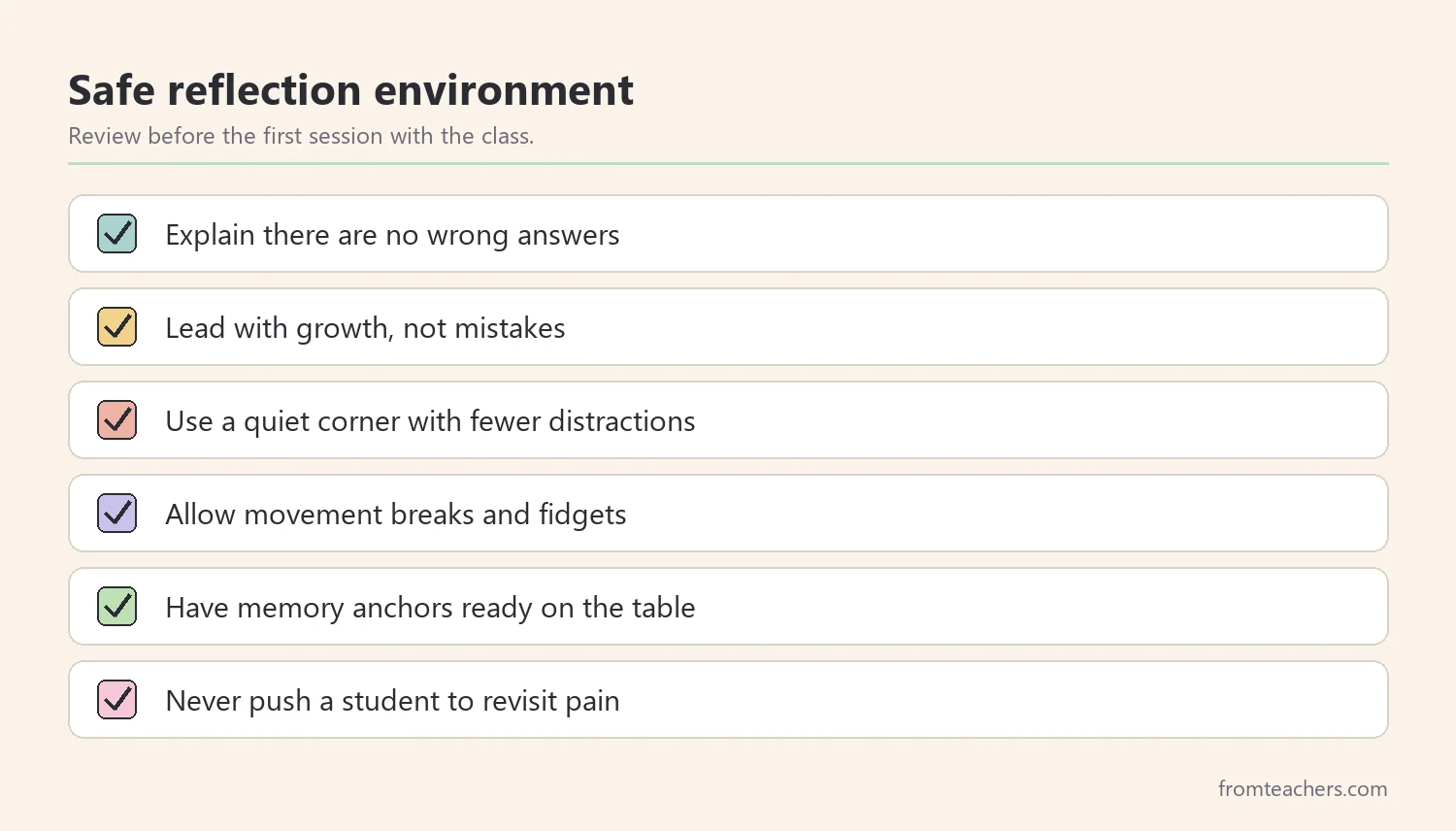
So, set clear, kind expectations. Explain that reflection is not a test and that there are no wrong answers. Make it clear that the goal is to notice growth, not to judge mistakes.
Consider Jonah, a fictional fifth grader with ADHD. At the start of a reflection activity in previous years, Jonah often said he did not remember anything. This year, his teacher told the class, “We are going to look for things you did well. I already have some ideas, and I will help you find them.”
Next, arrange the physical space. A quiet corner, low lighting, and fewer visual distractions help many learners focus. Similarly, allow movement breaks and fidgets. A safe space makes end of year reflection for students feel like a celebration rather than another assignment.
2. Gather memory anchors before you ask questions
Memory anchors are concrete reminders of the year: photos, work samples, class charts, and short notes from adults. They do the heavy lifting of recall, so the student can focus on thinking about what happened.
Start collecting early if you can, because end of year reflection for students is easier when anchors are ready. Even so, it is never too late; most classrooms already have folders, photos from events, and samples of writing from different months.
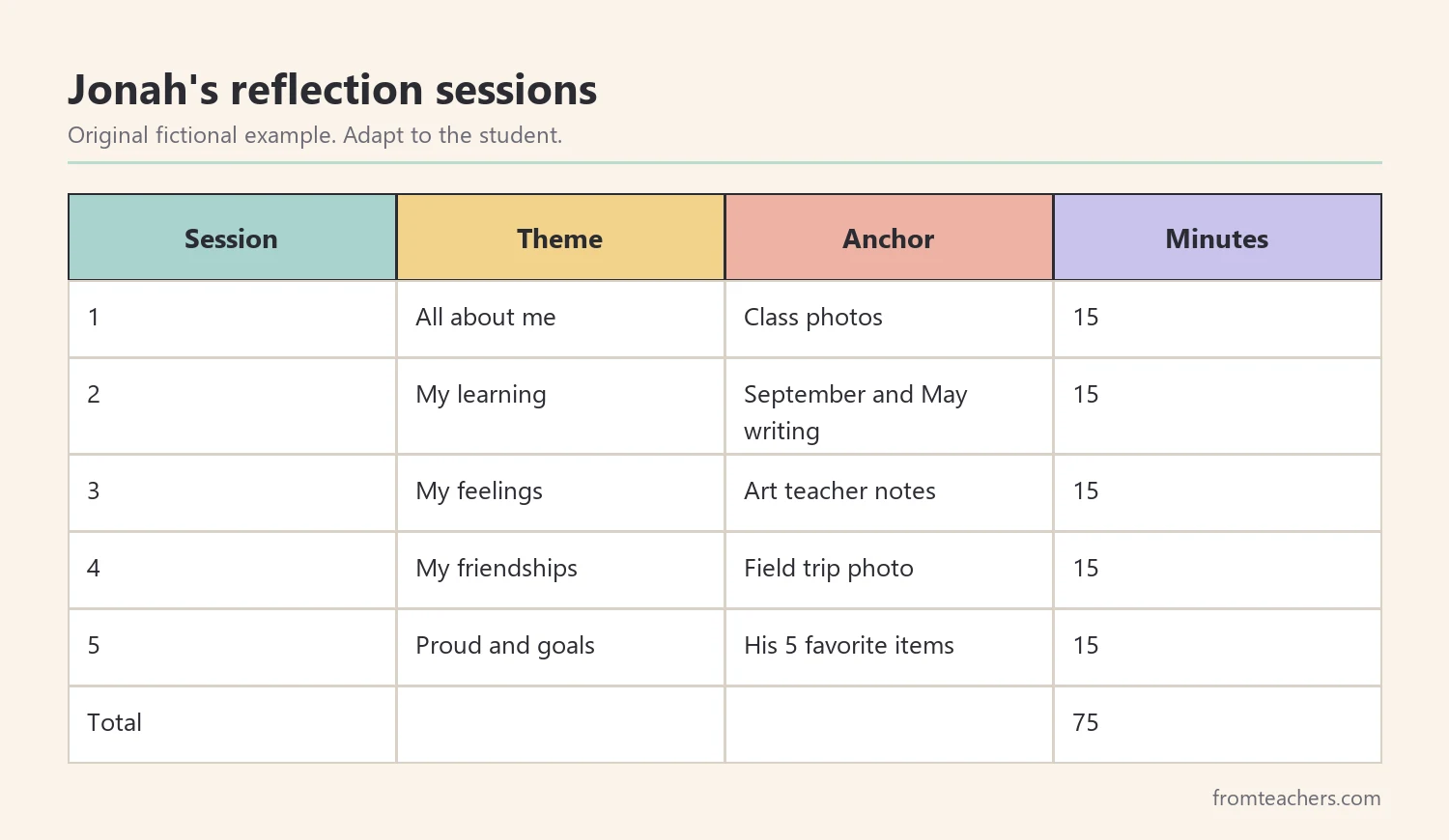
For Jonah, his teacher gathered 12 items: 4 photos from class events, 4 work samples from September to May, 2 notes from the art teacher, and 2 reading logs. Then, she asked Jonah to pick his 5 favorites. Choosing from real items was much easier for him than answering an open question.
Also, pair early and late samples. When Jonah saw his September writing next to his May writing, he noticed on his own that his sentences were longer. That single comparison gave him something real to be proud of.
Memory anchors also help students who find it hard to describe feelings. For instance, a photo of a field trip can prompt a student to point to a feelings chart instead of searching for words. In short, end of year reflection for students works best when students have something concrete in front of them. Anchors turn “I don’t remember” into “Oh, I did that.”
3. Offer more than one way to respond
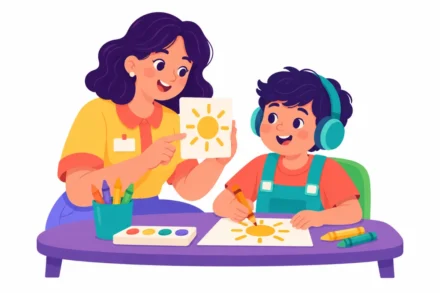
Next, plan for different ways of responding. Writing is only one option. Students can also draw, speak while an adult records, choose from picture options, sort cards, or use AAC.
Offering choices is not lowering the bar. Instead, it lets students show their real thinking without getting stuck on handwriting or spelling. Flexible responses are central to end of year reflection for students who learn differently. In many classrooms, this is the difference between a blank page and a full one.
| Response mode | Example | Helpful for |
|---|---|---|
| Writing | Sentence starters | Students who like to write |
| Drawing | Draw your proudest moment | Visual thinkers |
| Speaking | Adult records the answer | Students who say more than they write |
| Choosing | Circle one of four pictures | Students who need options |
| AAC | Unit words on the device | AAC users |
Jonah chose to speak his answers while his teacher typed them, and then he added a drawing. In contrast, a classmate who uses AAC selected from symbols the teacher added to her device, such as “proud,” “friends,” and “reading.”
If you want structured pages that already include these options, the end of year reflection journal for students with autism, ADHD, and special needs offers prompts that can be answered by writing, drawing, speaking, choosing from visual options, or using AAC tools.
4. Guide end of year reflection for students by theme
Instead of one big question, break reflection into themes. Each theme gets its own short session, with its own anchors and prompts. This keeps the load small and gives students several chances to succeed.
Useful themes include:
- All about me: how I changed this year.
- My learning: a skill I can do now that I could not do before.
- My feelings: a hard moment and a good moment.
- My friendships: people who mattered to me.
- Things I am proud of: a short achievement list.
Jonah’s teacher planned five sessions of 15 minutes each, for a total of 75 minutes across two weeks. Each session used one theme, one or two anchors, and Jonah’s preferred response mode. Shorter sessions fit his attention, and he finished each one feeling successful.
Also, handle challenges with care. When students reflect on hard moments, help them frame those moments as resilience: “This was hard, and I kept going.” Never push a student to revisit something painful if they do not want to.
Moreover, keep the same routine for every session: show the anchor, read the prompt, offer the response options, and close with one sentence of praise. A predictable routine makes end of year reflection for students easier for learners who find change stressful, and it helps you run sessions quickly.
Guided by theme, end of year reflection for students becomes a series of small wins rather than one overwhelming task.
5. Turn reflection into goals for next year
Reflection looks back, and goals look forward. Every end of year reflection for students should finish with this forward step. Together, they help students see that growth continues. Keep goals few and concrete; three is usually enough.
A simple structure helps: one learning goal, one feelings or self-care goal, and one friendship or community goal. For each, the student names the goal and one thing that will help.
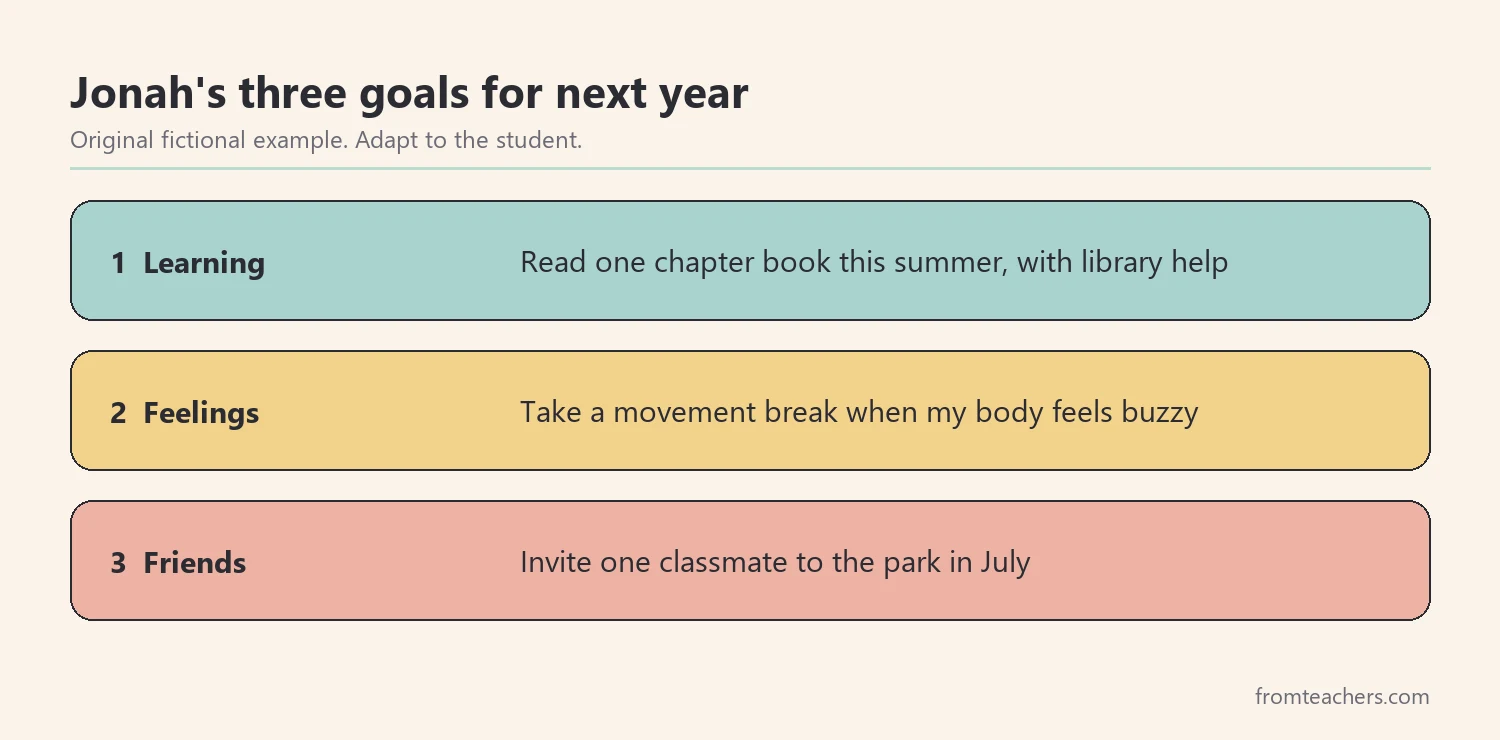
Jonah set these three goals:
- Learning: read one chapter book over the summer, with help choosing it at the library.
- Feelings: use a movement break when his body feels “buzzy,” instead of waiting until he is upset.
- Friends: invite one classmate to play at the park in July.
Notice that each goal connects to something Jonah found during reflection. For example, his reading goal came from seeing his longer sentences in May. That link makes goals feel earned rather than assigned.
Goals are the bridge between end of year reflection for students and the first weeks of the next school year. Therefore, keep a copy, so the student and next year’s teacher can revisit the goals in September.
Also, write goals in the student’s own words when possible. A goal the student can say out loud is a goal they are more likely to remember.
6. Celebrate and share end of year reflection for students
Finally, celebrate. A celebration does not have to be big. Students might share one page with a partner, hang their “My Year in Five Words” on a wall, or read a thank-you message to someone who helped them.
Offer choices here too. Some students love to present; others prefer to show one page to a single trusted adult. Both count as sharing. Choice keeps end of year reflection for students positive right up to the last page.
Then, pass the reflection forward. With the family’s permission, share a short summary with next year’s teacher: the student’s strengths, what helped this year, and their three goals. This gives the new teacher a positive first picture of the student.
Jonah chose to show his September and May writing side by side to the class, and his journal went home with a note for his family. His mother said it was the first time he had come home talking about what he did well. Moments like that are why end of year reflection for students is worth the time.
Common mistakes and how to avoid them
A few habits can make end of year reflection for students harder than it needs to be. Here are the most common, with a simple fix for each.
- Mistake: starting with open questions. Fix: start with photos and work samples, then ask about them.
- Mistake: requiring written answers only. Fix: offer drawing, speaking, choosing, and AAC.
- Mistake: doing it all in one long block. Fix: split it into short sessions by theme.
- Mistake: focusing on what went wrong. Fix: lead with growth and frame challenges as resilience.
- Mistake: letting the work stay in a drawer. Fix: share a short summary with the family and next year’s teacher.
Questions teachers and parents ask about end of year reflection for students
When should we start the reflection unit?
Two to three weeks before the last day usually works well. That leaves time for short sessions without crowding the final days, which are often busy and unpredictable.
What if a student says they did nothing well?
Bring out a memory anchor, such as an early and a late work sample, and ask what is different. Also, share one specific thing you noticed. Concrete evidence is more convincing than general praise.
Can families do this at home?
Yes. Families can look through photos from the year and ask about a favorite memory or a new skill. Even a short conversation at home supports the same goals, and it shows the child that end of year reflection for students is not only a school task.
How do I include students who use AAC?
Add reflection words to the device ahead of time, such as feelings, subjects, and names of friends. Then, model those words yourself during the sessions, and accept choosing and pointing as full answers.
Is end of year reflection for students useful in the upper grades?
Yes. Older students can reflect more independently and set more detailed goals, but anchors and choices still help. Many secondary students appreciate the chance to recognize their own progress.
Related reading: Reflect & Plan: A Teacher’s New Year Guide for 2025, ADHD in Children: A Guide to Effective Classroom and Home Support, and How Teachers Communicate With Parents in Special Education: Building a Strong Partnership.
A companion resource for end of year reflection for students:
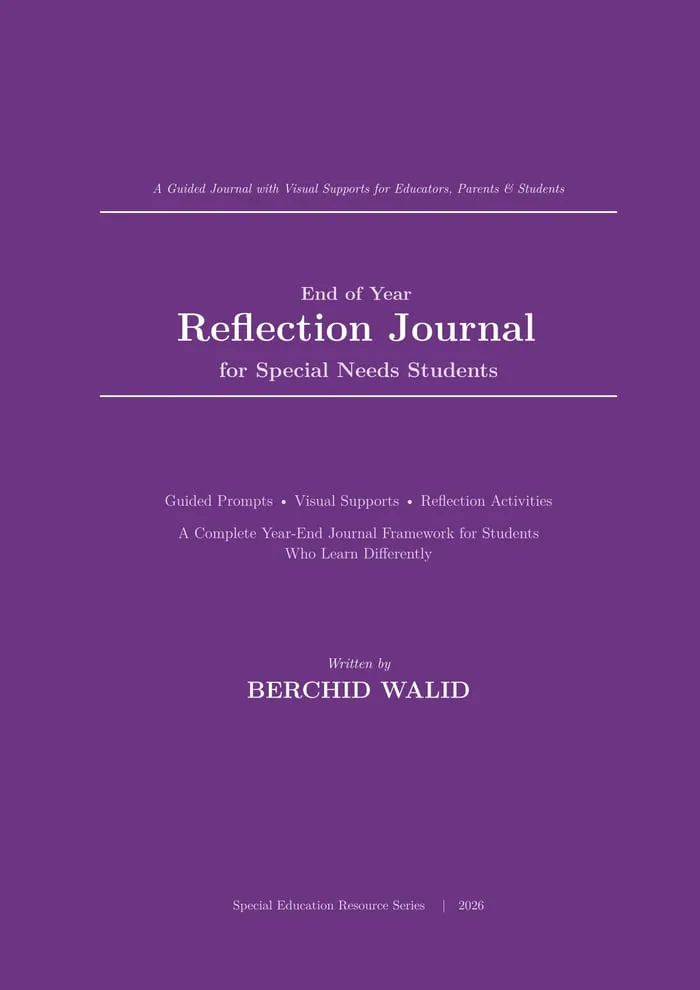
End of Year Reflection Journal for Students with Autism, ADHD and Special Needs: a 36-page guided journal with a guide to teaching reflection, a safe-environment checklist, the “I Am” Wheel, pages on learning, feelings, friendships, pride, challenges and resilience, a three-goal planning page, and celebration pages. Every prompt can be answered by writing, drawing, speaking, choosing, or AAC.
Sources and scope
- CAST UDL Guidelines: a framework for offering multiple means of engagement, representation, and expression.
- IRIS Center, Vanderbilt University: free modules on evidence-based classroom practices.
- Understood.org: practical articles for families and teachers on learning and thinking differences.
- American Speech-Language-Hearing Association (ASHA): information on communication and AAC.
This guide covers practical classroom and home approaches to end-of-year reflection and goal setting. It does not cover formal assessment, IEP goal writing, or mental health support, which belong to qualified professionals and the student’s team.
Key takeaways
- Create a calm, kind space and explain that there are no wrong answers.
- Use photos and early and late work samples as memory anchors.
- Offer writing, drawing, speaking, choosing, and AAC as equal options.
- Reflect by theme in short sessions, then set three concrete goals.
- Celebrate, and share a short summary with the family and next year’s teacher.


Leave a Comment