

Autism classroom strategies matter most in the moments nobody planned for. Picture a third grader who freezes at the gym door, covers his ears, and drops to the floor while the rest of the class lines up for relay races. The adult nearby wants to help, but in that moment there is no time to read a long article or call a meeting.
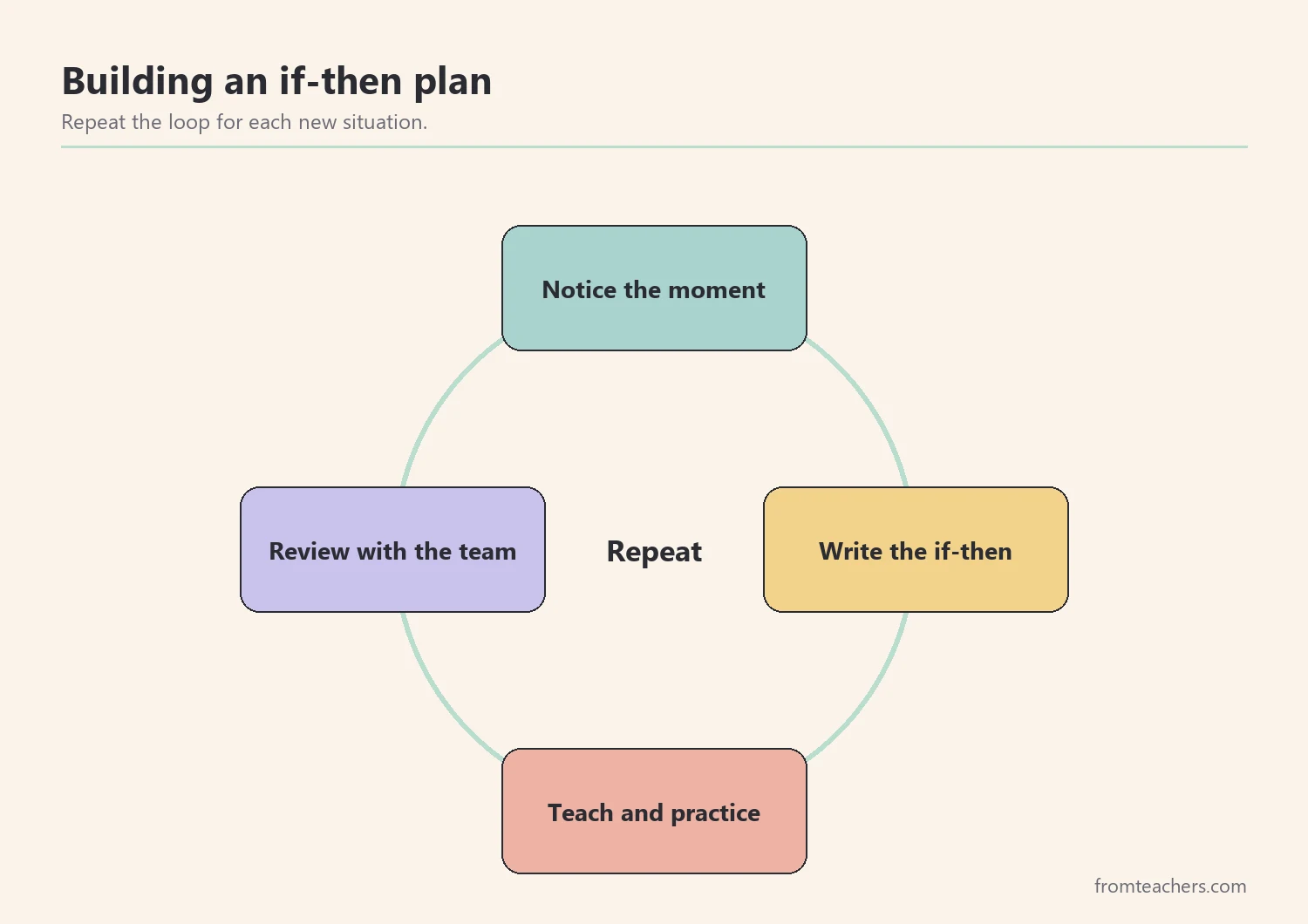
This guide shows you how to turn what you already know about a student into short if-then plans you can use on the spot. By the end, you will be able to spot a pattern, write a clear if-then response, teach the skill behind it, adapt it for different settings, and review whether it is working with the team and the family.
Examples are fictional. Adapt to the student’s goals and agreed supports. This is guidance, not a diagnosis.
At a glance
- Start with one specific situation, not a general label or worry.
- Write each plan as “If this happens, then try this,” in plain words any adult can follow.
- Teach the replacement skill during calm times, not only during hard moments.
- Adapt the same plan for PE, art, transitions, and group work.
- Record a few quick notes and review the plan with the team every few weeks.
1. Define the situation before choosing autism classroom strategies
Good support starts with a clear picture of the moment. Instead of writing “Leo has trouble in PE,” describe what you actually see: where it happens, what comes just before, what the student does, and what happens right after. As a result, everyone on the team is talking about the same event.
For example, take Leo, a fictional third grader who is autistic and uses short spoken phrases. His teacher notices that the hardest moments cluster around gym class. After three days of short notes, a pattern appears: the trouble starts when the whistle blows and the class moves into relay lines.
| Before | What Leo does | After |
|---|---|---|
| Whistle blows for relays | Covers ears, sits on floor | Aide sits with him by the door |
| Teacher calls “line up fast” | Walks to the wall, says “no” | Leo misses the first race |
| Quiet stretching warm-up | Joins and copies moves | Teacher praises him |
Notice what this small table shows. Leo can join PE when it is quiet and predictable. Meanwhile, loud sound and sudden group movement seem to be the triggers. That is a much more useful starting point than “Leo refuses PE.”
Next, pick only one situation to work on first. Choose the one that happens often, blocks learning, or causes the most stress for the student. In Leo’s case, the team chooses the relay transition, because it happens twice a week and he loses the whole lesson when it goes badly.
Finally, write the situation in one sentence that any adult could recognize: “When the whistle blows and the class lines up for relays, Leo covers his ears and sits down.” Autism classroom strategies work best when they answer a sentence like this, not a vague worry.
2. Write autism classroom strategies as if-then plans
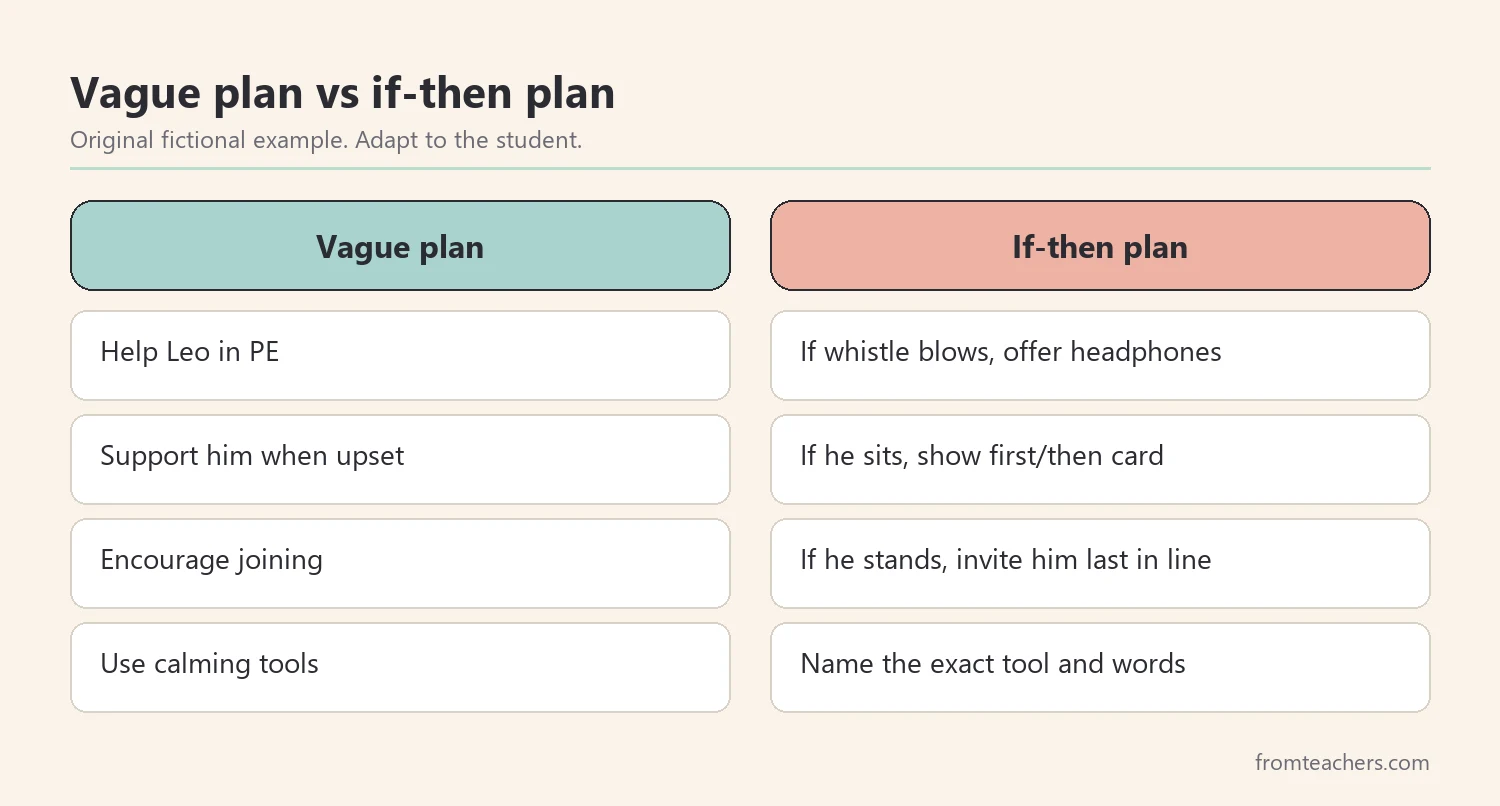
An if-then plan is a short rule that links a situation to a response. “If Leo covers his ears when the whistle blows, then offer his headphones and point to the quiet start spot.” It works because it removes guesswork in a stressful moment. In other words, it turns autism classroom strategies from ideas on paper into actions an adult can take in seconds.
To write a strong plan, keep three parts in every line. First, the “if” names something an adult can see or hear. Second, the “then” names one or two actions, not a list of ten. Third, the plan includes what to do once the student is calm, so the moment ends with success instead of escape.
Here is how Leo’s team writes his first three if-then lines:
| If… | Then… |
|---|---|
| Whistle blows and Leo covers his ears | Hand him his headphones, point to the quiet spot |
| Leo sits on the floor | Kneel, show the “first stretch, then race” card |
| Leo stands and looks at the group | Invite him to be last in line, praise quietly |
Notice how short these are. Short plans are easier to remember, easier to share with a substitute, and easier to follow when your heart rate is up. In contrast, a two-page behavior summary rarely gets read in the moment.
Also, use the student’s actual words and tools. If Leo uses a “break” card, write “break card” in the plan, not “a communication tool.” Specific wording keeps every adult consistent. Similarly, using the same symbols at home and at school helps autism classroom strategies carry over from one place to the next.
If you would rather start from tested examples than a blank page, a ready set of if-then strategy tables for students with ASD covers areas like adapting physical education, communication for non-verbal students, transitions, and self-regulation. You can copy the closest row, then edit it to fit your student.
3. Teach the skill behind each autism classroom strategy
An if-then plan tells adults how to respond. However, the student also needs to learn what to do instead. That replacement skill should be taught on calm days, in short practice sessions, long before the next hard moment.
For Leo, the team picks two skills: putting on his headphones on his own, and using a “quiet start” card to ask to join the line last. They practice both in the classroom first, when nothing is loud and nobody is rushing.
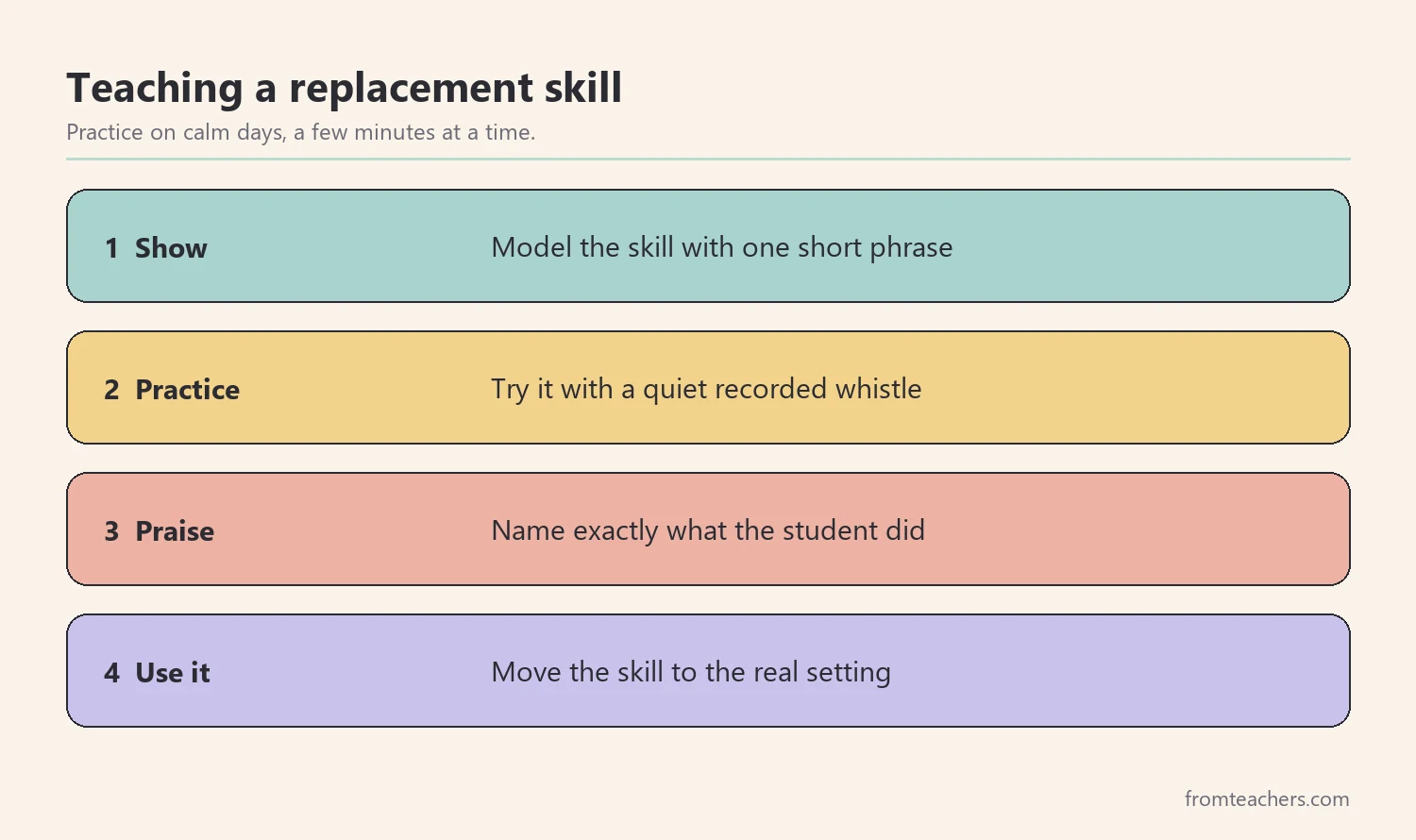
A simple teaching sequence looks like this:
- Show. The adult models the skill while saying one short phrase, such as “Too loud, headphones on.”
- Practice. Leo tries it with a recorded whistle at low volume, then a bit louder.
- Praise. The adult names what he did: “You put your headphones on by yourself.”
- Use it for real. The skill moves to the gym, with the same words and the same card.
Then, fade your help slowly. At first, the aide hands Leo the headphones. Later, she only points to them. Eventually, Leo reaches for them as soon as he hears the whistle. Each step is a small win worth recording.
Also, keep practice brief and positive. Two or three minutes a day is often enough. In fact, short, frequent practice is one of the simplest autism classroom strategies to fit into a busy schedule. Practice should feel like a game or a routine, not a punishment for what happened yesterday.
Finally, remember that communication is part of every skill. If a student does not yet use spoken words, teach the request with a card, a sign, or a device. Autism classroom strategies that include a clear way to say “too loud” or “I need a break” usually reduce the need for big reactions.
4. Adapt autism classroom strategies across PE, art, and transitions
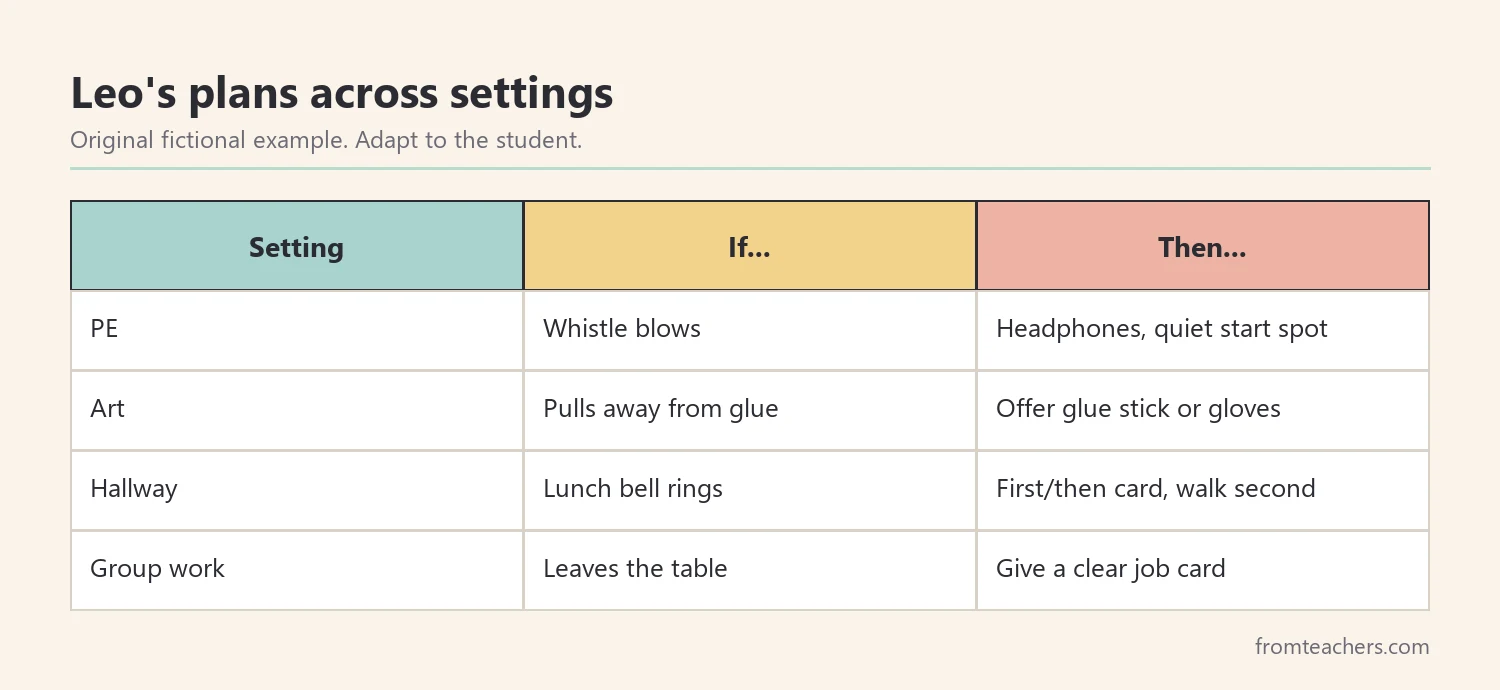
A plan that works in one room often needs small changes in another. Leo’s headphones help in PE, but in art the challenge is different: he avoids sticky materials like glue and paint. As a result, the team writes a second, short set of if-then lines for art.
| Setting | If… | Then… |
|---|---|---|
| PE | Whistle blows | Headphones, quiet start spot |
| Art | Leo pulls away from glue | Offer a glue stick or gloves |
| Hallway | Bell rings for lunch | Show first/then card, walk second |
| Group work | Leo leaves the table | Give him a clear job card |
Notice that the core ideas stay the same. Leo gets a warning, a tool, and a clear next step. Only the details change from room to room. That consistency is what makes autism classroom strategies feel predictable for the student.
Next, share each setting’s plan with the adult who runs that space. The PE teacher, the art teacher, and the lunch supervisor do not need the full file. Instead, they need the two or three lines that apply to their room, written in plain language.
Also, think about sensory needs in each space. Gyms are loud and echo. Art rooms have strong smells and messy textures. Cafeterias have crowds and noise. Autism classroom strategies that prepare for these differences ahead of time prevent many hard moments before they start.
Finally, plan for transitions, because they are often the hardest part of the day. Give a short warning, show what comes next, and keep the words the same each time. For older students, a written schedule or phone reminder can replace picture cards.
5. Record and review your autism classroom strategies
A plan is only useful if you know whether it works. Fortunately, the record for autism classroom strategies can be very simple. One line per lesson is enough: the date, whether the hard moment happened, and what helped.
For Leo, the aide uses a small card clipped to her lanyard. She marks how many PE lessons he joined from the start, and how many times he used his headphones without a prompt.
| Week | PE lessons | Joined from start | Headphones without prompt |
|---|---|---|---|
| 1 | 2 | 0 | 0 |
| 2 | 2 | 1 | 1 |
| 3 | 2 | 1 | 1 |
| 4 | 2 | 2 | 2 |
Over four weeks, Leo joined 4 of 8 PE lessons from the start, with the strongest week at the end. That is real progress, and it came from small, steady autism classroom strategies rather than one big change. It also shows the team that the plan is worth keeping, with small adjustments.
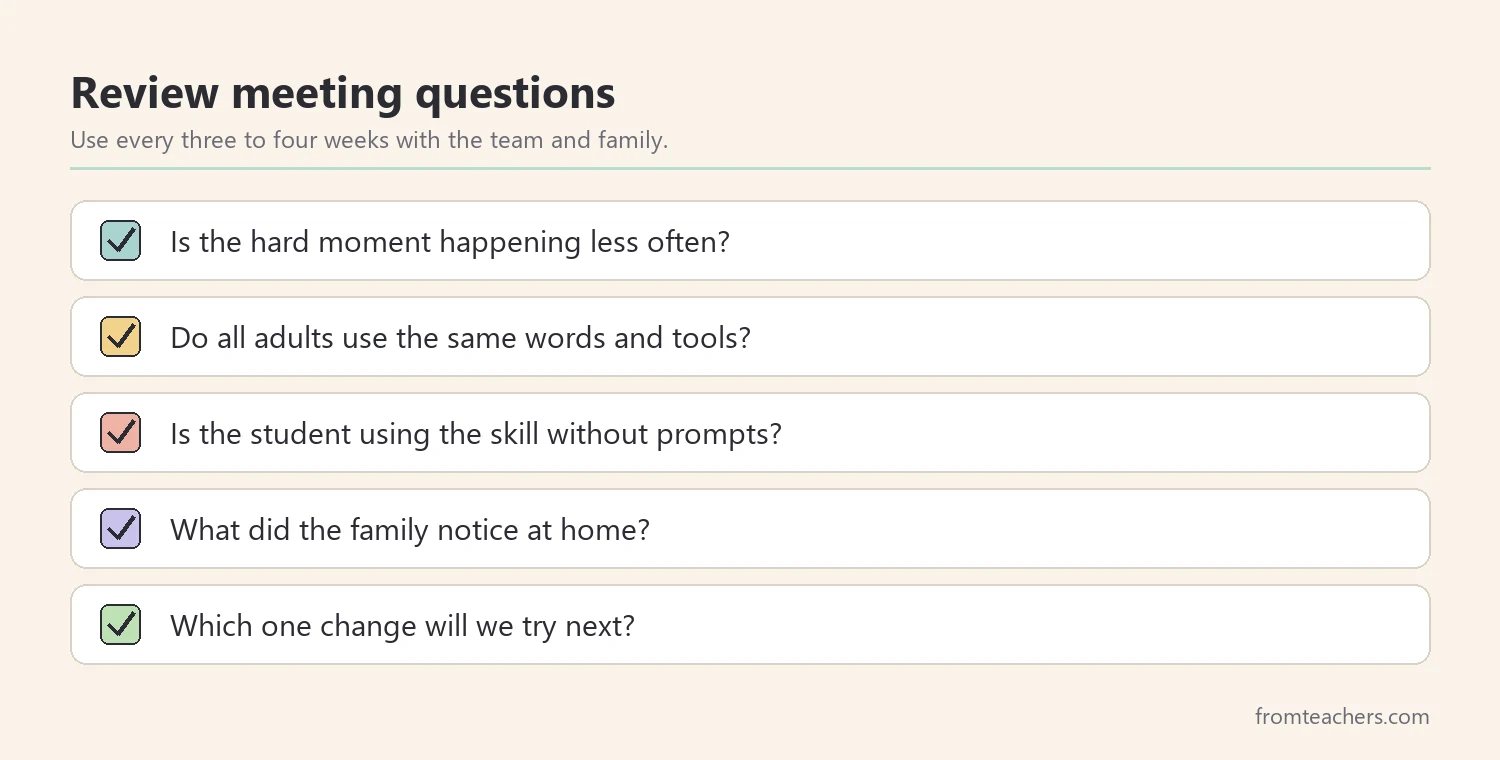
Then, set a short review every three to four weeks. Ask what is working, what is not, and which one change to try next. Bring the family into this conversation, because they often notice patterns at home that explain what happens at school.
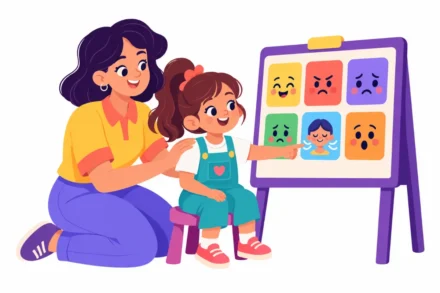
Moreover, invite the student’s view when possible. Leo can point to a smiley or a frown card to show how PE felt. Even a simple choice gives the team useful information and builds his self-awareness.
Finally, keep your autism classroom strategies in one shared place. A single page with the current if-then lines, the skill being taught, and the latest notes makes it easy for a substitute or new aide to step in without losing progress.
Common mistakes and how to avoid them
- Writing autism classroom strategies that are too long. Fix: keep each line to one situation and one or two actions.
- Only reacting, never teaching. Fix: practice the replacement skill during calm times, a few minutes a day.
- Different adults, different words. Fix: write the exact phrase and card in the plan and share it with everyone.
- Changing everything at once. Fix: adjust one part of the plan, then watch for two to three weeks.
- Leaving out the family and the student. Fix: include their observations and choices in every review.
Questions teachers and parents ask about autism classroom strategies
How many if-then plans should one student have?
Start with one to three. Overall, a few clear autism classroom strategies that everyone uses are better than a long list nobody remembers. Add new lines only when the first ones are working well.
Do these strategies work for non-verbal students?
Yes, as long as the plan includes a clear way to communicate. Use picture cards, signs, or a speech device for requests like “break” or “too loud.” Work with the speech-language pathologist so the tools match what the student already uses.
What if the plan stops working after a few weeks?
First, check whether every adult is still using it the same way. Next, look for changes in routine, health, sleep, or the setting. Then adjust one part at a time and keep notes.
Can parents use if-then plans at home?
Absolutely. The same format works for bedtime, meals, outings, and screen time. When home and school share a few matching phrases, the student often feels more secure in both places.
Are autism classroom strategies only for special education rooms?
No. General education teachers, PE and art teachers, and lunch staff can all use short if-then plans. In fact, the plans are most helpful in busy settings where adults have little time to think.
Related reading: Managing Sensory Overload: Practical Strategies for Autism and ADHD, Autism Social Skills Development: Practical Strategies for Growth, and Meltdowns vs Tantrums: A Guide to Understanding and Responding.
A companion resource for autism classroom strategies:
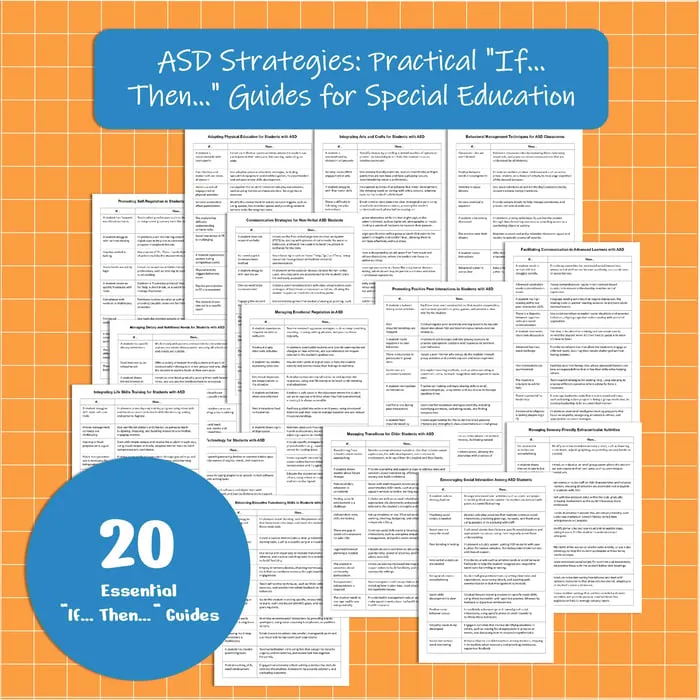
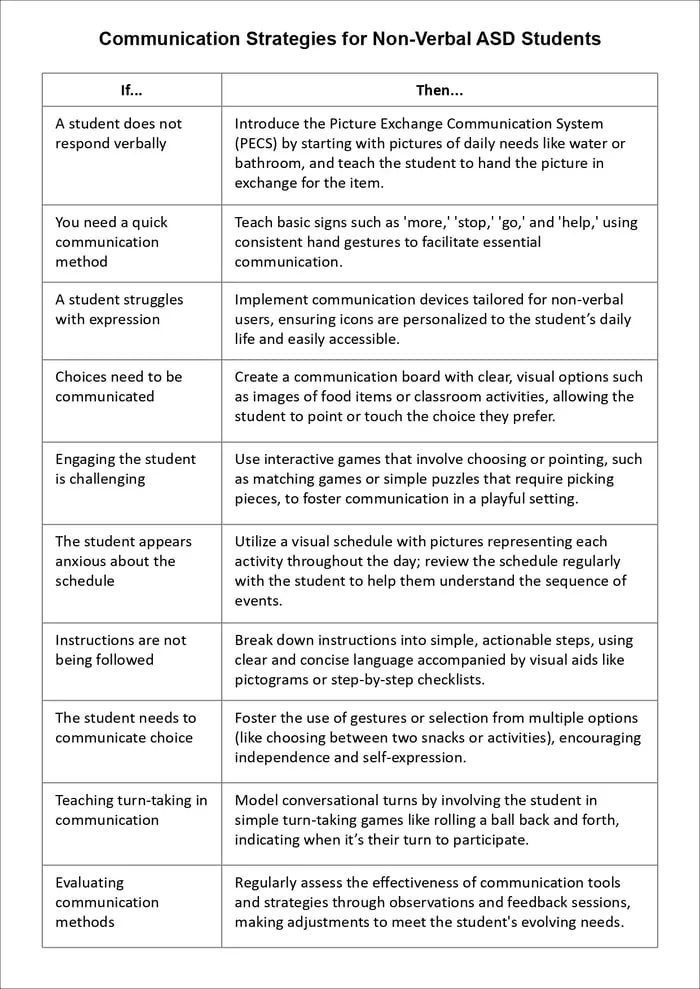
ASD Strategies: If-Then Guides for Special Education: a printable PDF with twenty if-then strategy tables covering PE, arts and crafts, behavior, communication for non-verbal and advanced learners, self-regulation, transitions, social interaction, technology, and executive functioning.
Sources and scope
- IRIS Center, Vanderbilt University: free modules on autism, classroom behavior, and evidence-based practices.
- CDC autism information: general background on autism spectrum disorder in children.
- American Speech-Language-Hearing Association (ASHA): information on communication support and AAC.
- IDEA, U.S. Department of Education: the law behind special education services and IEPs.
This guide covers practical classroom routines for writing, teaching, and reviewing if-then plans. It does not cover diagnosis, therapy, or formal behavior assessment, which belong to qualified professionals and the student’s team.
Key takeaways
- Autism classroom strategies start with one clearly described situation.
- Short if-then lines turn autism classroom strategies into actions every adult can take the same way.
- Teach the replacement skill on calm days, then fade your help.
- Adapt the same pattern for PE, art, hallways, and group work.
- Track a simple measure and review it with the family and student.








Leave a Comment