

Writing social stories is one of the most practical ways to teach skills like personal space and coping with change. Picture a fourth grader who stands too close in the lunch line, then gets upset when the schedule switches from art to an assembly. Meanwhile, classmates step away, and the morning gets harder for everyone.
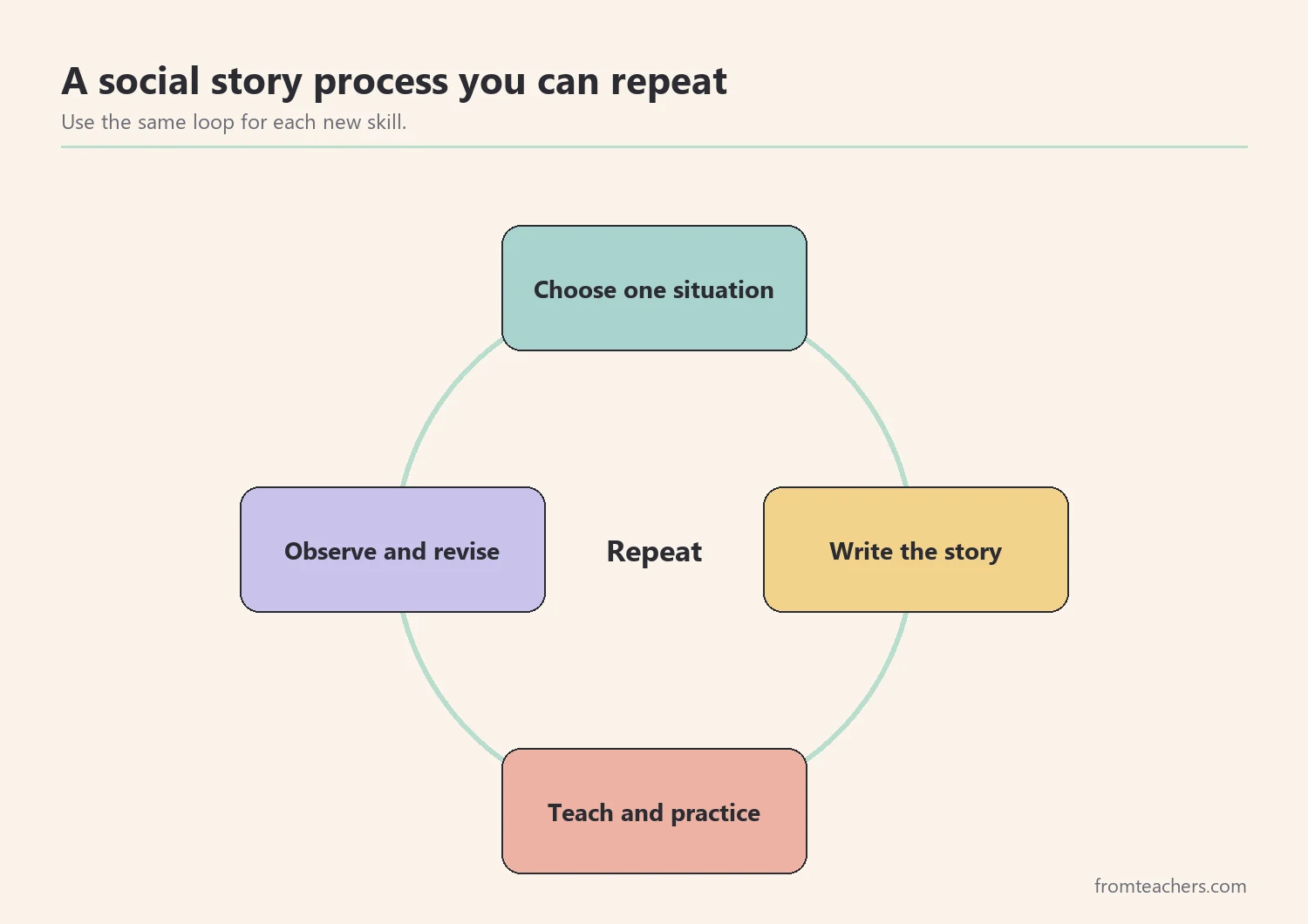
By the end of this guide, you will be able to pick the right target, write a clear story, teach it, observe the skill across the school day, and decide what to change. As a result, writing social stories becomes a repeatable process rather than a one-time handout.
Examples are fictional. Adapt to the student’s goals and agreed supports. This is guidance, not a diagnosis.
At a glance
- Choose one specific situation before writing anything.
- Write mostly descriptive sentences, with only a few gentle coaching lines.
- Read the story at calm times and practice the skill in real settings.
- Observe the skill with a simple checklist across different places.
- Review the data and revise the story, not the student.
1. Choose one situation and one target skill
A social story is a short, personalized text that describes a situation, what usually happens, and what the student can try. The approach was developed by Carol Gray, and it is widely used with autistic students and others who benefit from clear social information. Notably, the stories describe and explain; they do not lecture.
Before writing social stories, narrow the topic. “Behavior in the cafeteria” is too broad. “Standing an arm’s length away in the lunch line” is specific enough to teach and observe.
Our fictional student, Ethan, is in grade 4. His teacher, Ms. Carter, notices two patterns. First, Ethan stands very close to peers in lines and at group tables. Second, he becomes upset when the schedule changes without warning. Therefore, she decides to write two short stories, one for each skill, and teach them one at a time.
To choose a target, ask three questions:
- Where and when does the difficulty happen most often?
- What would the student do instead, in observable terms?
- How will we know the skill is improving?
For Ethan’s first story, the answers were: in lines and at group tables; stand or sit about an arm’s length away; and count how often he keeps that space during lines each week. Ms. Carter started with personal space because it happened every day.
In addition, collect a little baseline information before writing social stories. For example, watch the situation three or four times and note what the student does now. That baseline gives you something to compare against later, so you can see real change instead of guessing.
2. Plan the sentences before writing social stories
Good stories use a mix of sentence types. Mostly, they describe the situation and explain other people’s thoughts and feelings. Only a few sentences coach the student on what to try. This balance keeps the tone supportive rather than bossy.
| Sentence type | What it does | Example |
|---|---|---|
| Descriptive | States facts about the situation | “At lunch, my class lines up at the door.” |
| Perspective | Describes others’ thoughts or feelings | “Most kids feel comfortable with some space.” |
| Coaching | Gently suggests what to try | “I can try to stand an arm’s length away.” |
| Affirmative | Reassures or shares a common value | “That is a kind thing to do.” |
Additionally, follow a few simple guidelines:
- Write from the student’s point of view, in first person, for younger students.
- Use flexible words like “usually” and “sometimes” so the story stays true.
- Keep it short: often 6 to 10 sentences, one idea per page.
- Add a clear picture or photo for each page.
- Avoid negative language like “I must not.”
Many teachers find that writing social stories gets faster with a simple template: a title, a setting sentence, two or three perspective sentences, one or two coaching sentences, and a positive closing line. Then draft and read the story aloud. If any sentence sounds like a rule or a scolding, rewrite it as a description or a gentle suggestion.
3. Write the personal space story
Now you can start writing social stories for real. Here is Ethan’s personal space story, kept short and calm:
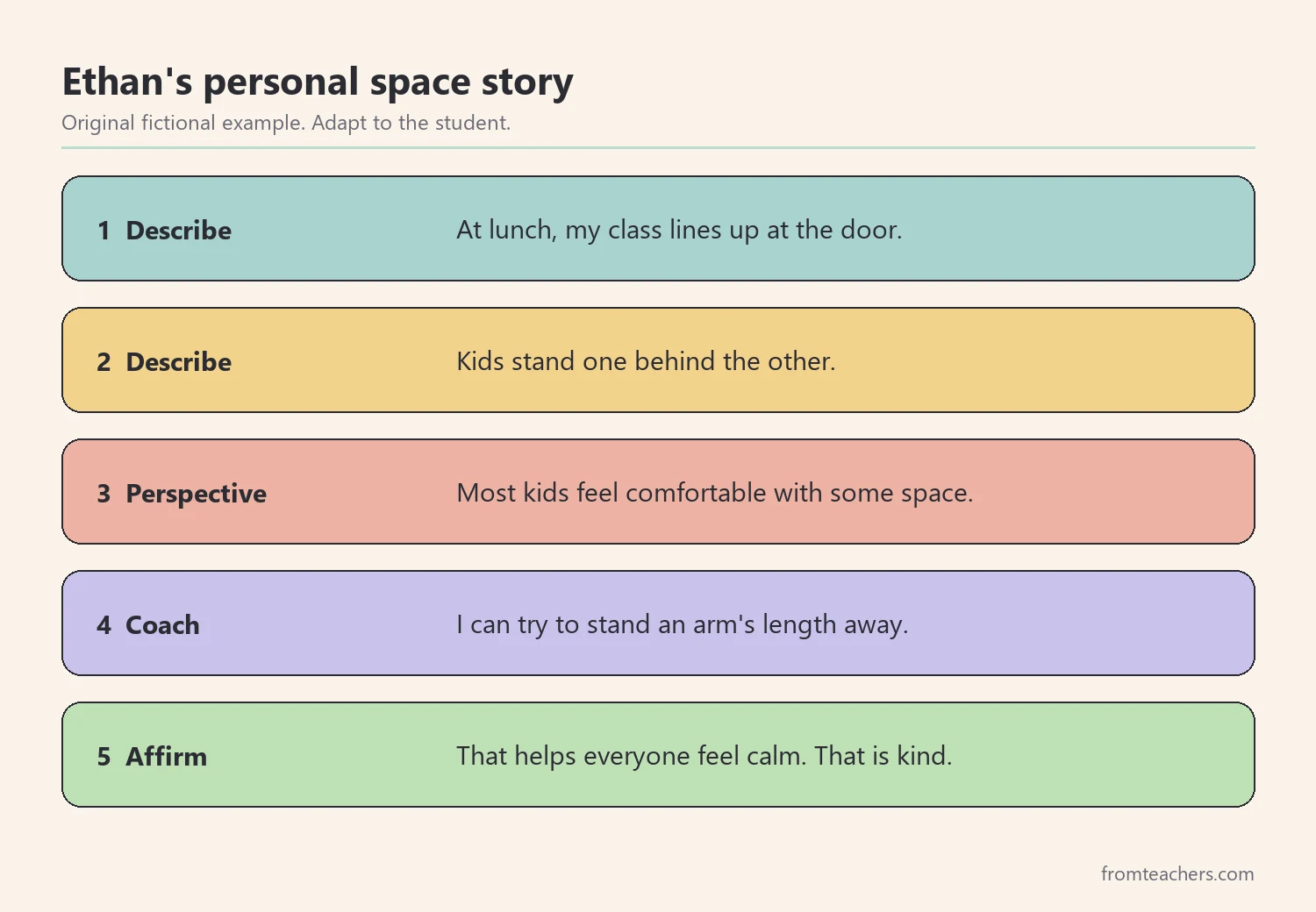
Notice the balance. Out of five sentences, three describe or explain, one coaches, and one affirms. Also, the story gives a concrete measure (“an arm’s length”) that Ethan can see and practice.
To make the measure real, Ms. Carter practiced with a hula hoop on the floor during a calm morning. Ethan stood inside the hoop while a classmate stood outside it. Then they tried the same distance in the actual lunch line. In this way, the story connects to something Ethan can feel, not only read.
Similarly, the flexibility story followed the same pattern: “Sometimes our schedule changes. My teacher will usually tell me what is different. Changes can feel surprising. I can take a breath and look at the new schedule. Then I know what comes next.”
When writing social stories about flexibility, it helps to include a calming step and a way to find information. Many students cope better with change when they know where to look for the new plan.
4. Teach and practice the story
A story alone rarely changes a skill. Therefore, plan how and when to read it, and how to practice in real settings. Generally, reading the story once a day at a calm time works well at the start.
A simple teaching plan looks like this:
- Read the story together at a calm time, often before the situation happens.
- Talk briefly about one or two pictures.
- Practice the skill in a role play or in the real place.
- Give specific praise when the student tries the skill.
- Reread the story just before the situation, if needed.
For example, Ms. Carter read Ethan’s story with him each morning before lunch. Then, as the class lined up, she gave a quiet cue from the story: “Arm’s length.” Later in the week, she added the flexibility story, read right after the morning schedule check.
Additionally, share the story with other adults who see the student. Lunch staff, specials teachers, and bus staff can use the same short cue. When every adult uses the same words, the student hears one clear message.
For students who read independently, consider giving them a copy to keep in a folder. Some students like to reread their stories on their own, which builds ownership. Writing social stories with a clean, simple layout also makes them easy to share with families.
Finally, keep the tone positive. The story is a support, not a consequence. Reading it right after a hard moment can feel like punishment, so save it for calm times when possible.
5. Observe the skill across settings
Writing social stories is only half the job. Once the student is practicing, observe whether the skill shows up in real life. A simple observation checklist makes this quick. For each setting, note whether the student showed the skill and add a short comment.
Useful settings to check include:
- The classroom, during group work and lining up.
- The lunchroom and the playground.
- Assemblies and other large group events.
- The school bus, if staff can share notes.
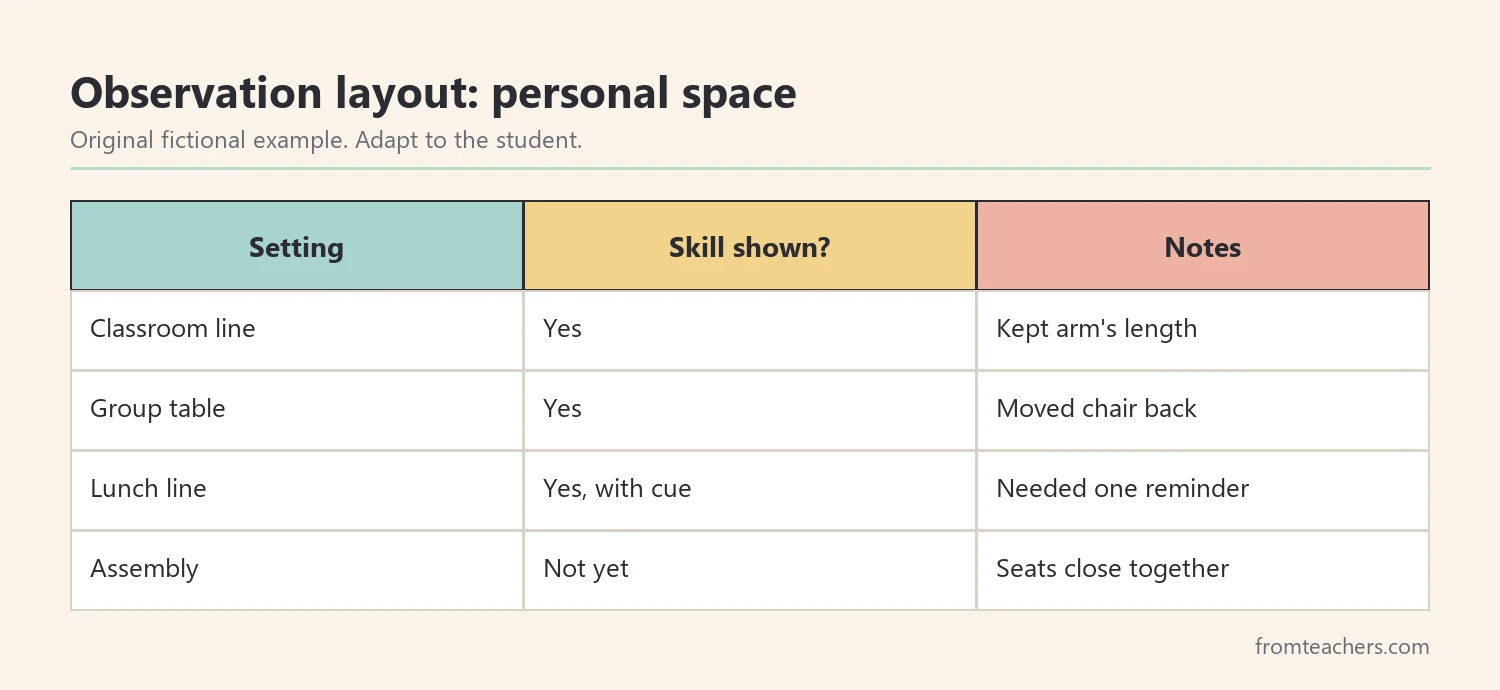
To save time on this step, a set of social stories observation checklists for personal space and flexibility provides fillable pages with student name, date, observer, and an area, checklist, and notes table for settings like the playground, lunch time, assemblies, and the school bus.
For Ethan, Ms. Carter and the lunch aide each filled in a short checklist on Tuesdays and Thursdays. They noticed that Ethan kept good space in the classroom line but crowded peers at assemblies, where the seating was tight. That told Ms. Carter where to focus next.
Also, observe flexibility separately. For schedule changes, check whether the student notices the change, how they react, and whether they use the calming step from the story. A post-change reflection, done later at a calm time, helps the student remember what worked.
6. Review data and revise when writing social stories
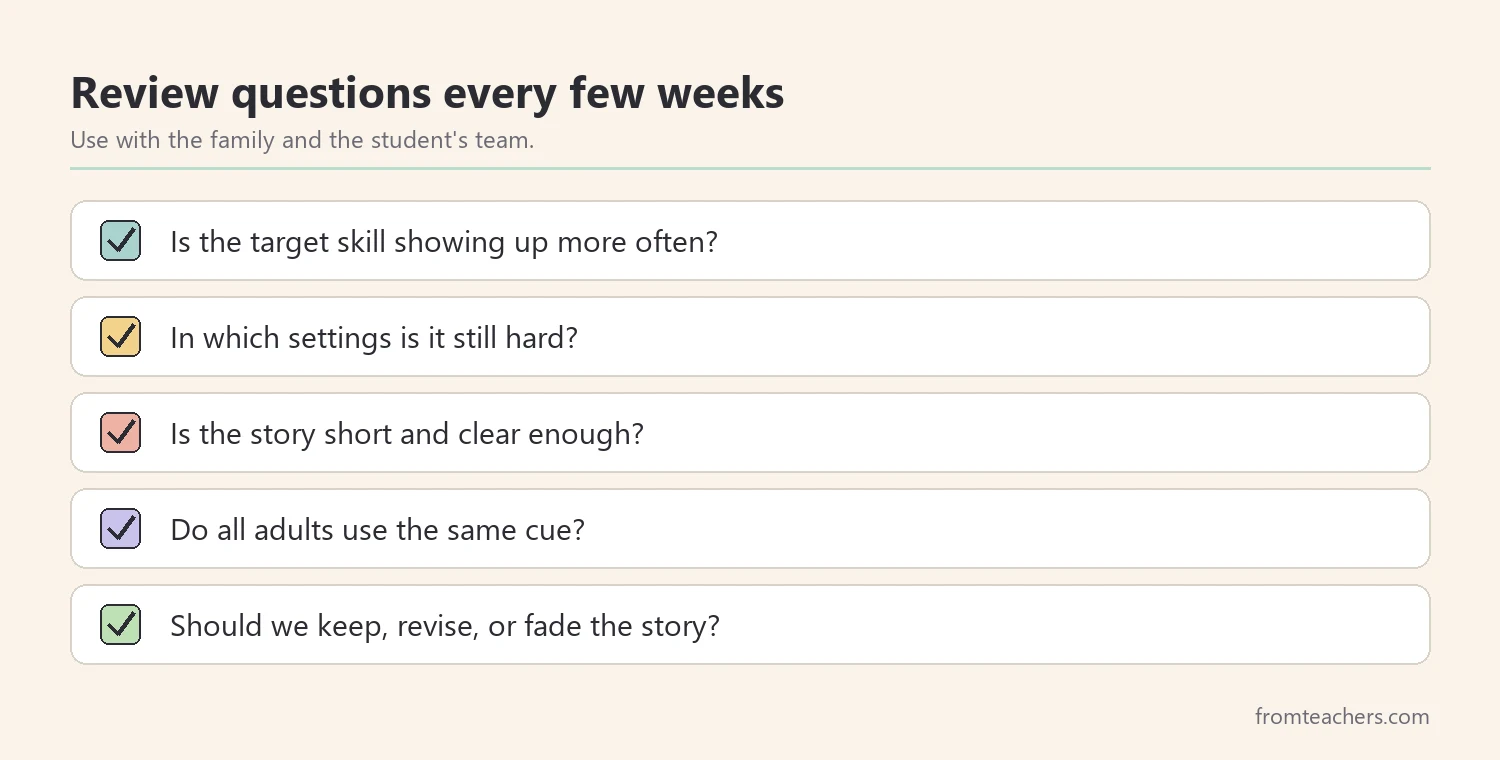
After a few weeks, look at your observations. Ask whether the skill is improving, where it is strongest, and where it still breaks down. Then decide whether to keep the story as is, revise it, or fade it.
Ms. Carter counted, for each week, the lines Ethan stood in and how many times he kept an arm’s length. She recorded both numbers so the percentages would be fair.
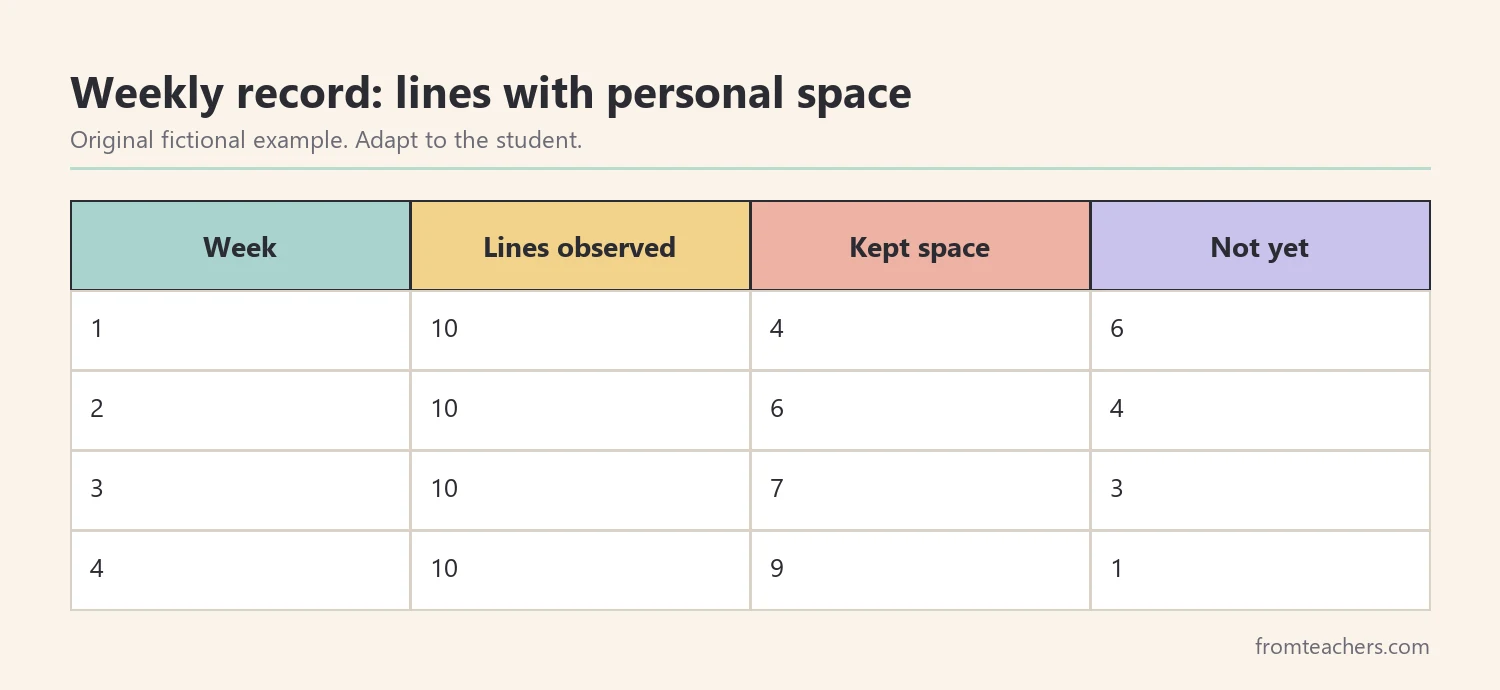
In this fictional record, Ethan kept his space in 4 of 10 lines in week 1 and 9 of 10 in week 4. Because the assembly problem continued, Ms. Carter added one page to the story: “At assemblies, the seats are close. I can keep my hands in my lap.” That small revision targeted the one setting where the skill still slipped.
Revising is a normal part of writing social stories, and it is a sign that the process is working as intended. If progress stalls, check whether the story is too long, the cue is unclear, or the student needs more practice in the hard setting. Change one thing at a time so you can see what helped.
When the skill is steady across settings, fade the story slowly. For instance, read it twice a week, then once a week, then keep it available for review before new situations, such as a field trip.
Common mistakes and how to avoid them
- Choosing a topic that is too broad. Fix: target one situation and one observable skill.
- Writing a list of rules. Fix: use mostly descriptive and perspective sentences, with only a few coaching lines.
- Reading the story only after problems. Fix: read it at calm times, before the situation.
- Skipping practice in real settings. Fix: role play, then practice in the actual place.
- Not checking whether the skill transfers. Fix: observe across settings with a simple checklist.
- Never revising the story. Fix: review data every few weeks and change one thing at a time.
Questions teachers and parents ask about writing social stories
How long should a social story be?
Usually, short is best: about 6 to 10 sentences with one idea per page. For older students, a single page with a few clear paragraphs may work better than a picture book format.
Who should be involved in writing social stories?
Writing social stories works best as a team effort. The teacher, the family, and, when appropriate, the student can all contribute. Families often know which words and pictures the student responds to. Speech-language pathologists and counselors can also help with wording.
Can social stories be used with older students?
Yes. For older students, use age-respectful language, real photos, or a simple written format. Some older students prefer to help write their own story.
How do I know if a story is working?
Observe the target skill in real settings over several weeks. If the skill appears more often and in more places, the story is likely helping. If not, revise one element and observe again.
Should I write one story for several skills?
Generally, no. When writing social stories, one story per situation or skill keeps the message clear. You can write a short series, as with Ethan’s personal space and flexibility stories, and teach them one at a time.
Related reading: Autism Social Skills Development: Practical Strategies for Growth, The Power of Data Tracking in Special Education, and Spectrum Voices: Essential Strategies for Navigating High-Functioning Autism.
A companion resource for writing social stories:
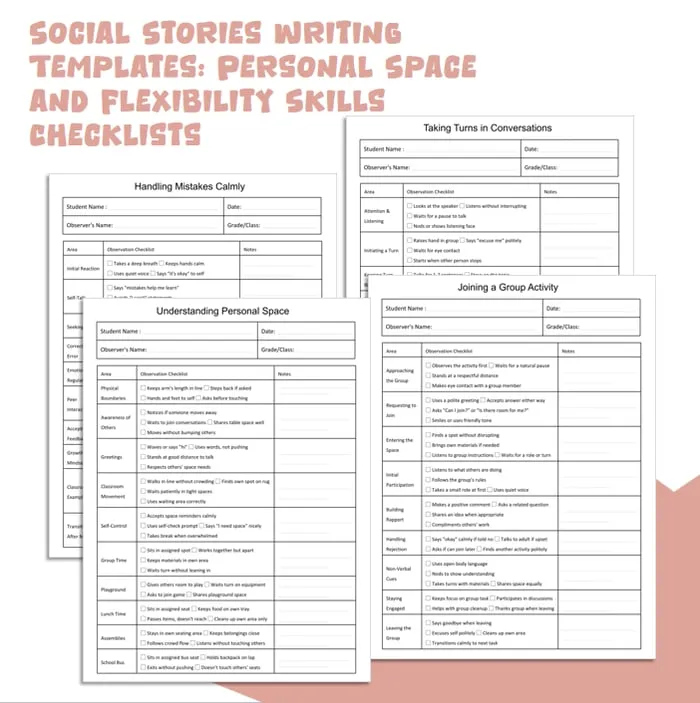
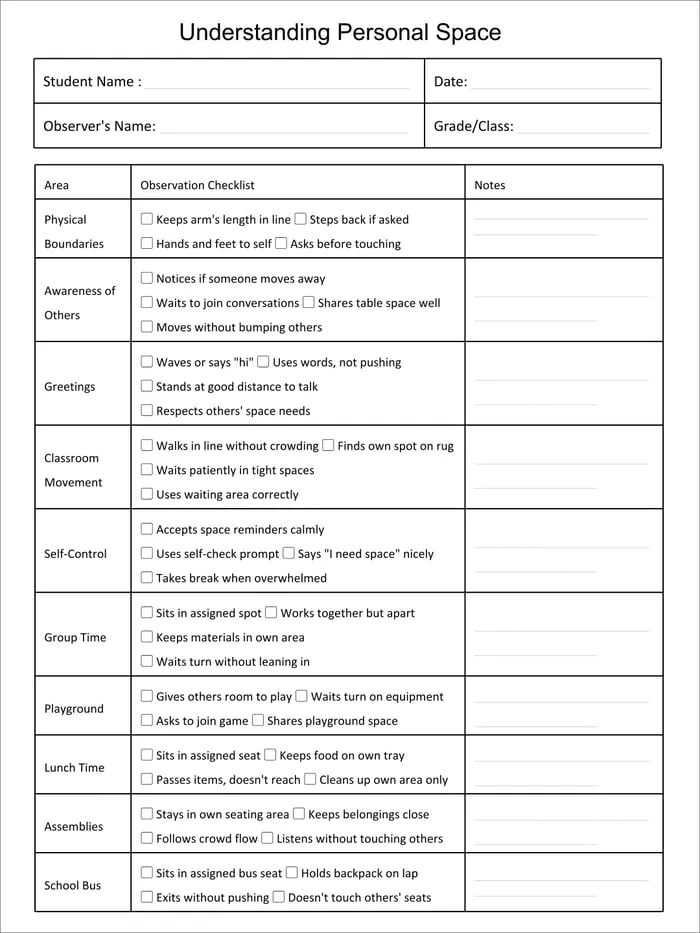
Social Stories Writing Templates: Personal Space and Flexibility Skills Checklists: a 12-page printable collection of blank, fillable observation checklists for tracking personal space, schedule changes, self-control, flexible thinking, and setting-specific skills on the playground, at lunch, at assemblies, and on the school bus.
Sources and scope
- IRIS Center, Vanderbilt University: free modules on autism, social skills instruction, and evidence-based practices.
- National Professional Development Center on Autism Spectrum Disorder: briefs and learning materials on evidence-based practices for autistic learners.
- American Speech-Language-Hearing Association (ASHA): information on social communication and how speech-language pathologists support it.
- IDEA, U.S. Department of Education: the law behind special education services and IEPs.
This guide covers practical steps for writing social stories, teaching them, and observing skills such as personal space and flexibility. It does not cover diagnosis, formal assessment, or therapy plans, which belong to qualified professionals and the student’s team.
Key takeaways
- Writing social stories starts with one specific situation and one observable skill.
- Use mostly descriptive and perspective sentences, with a few gentle coaching lines.
- Read the story at calm times and practice in the real setting.
- Observe the skill across settings with a simple checklist.
- Review the data and revise the story one change at a time.



Leave a Comment