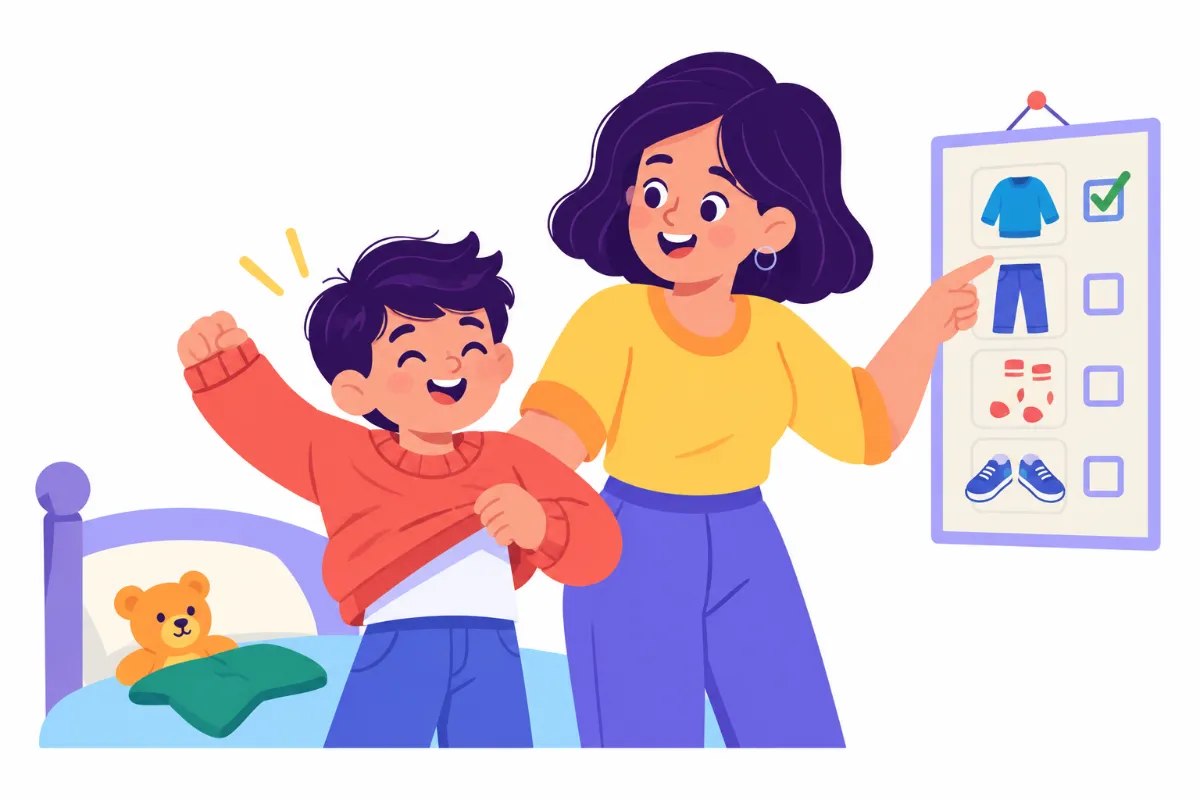

A getting dressed social story can turn a tense morning into a calmer, more predictable routine. Picture a six-year-old sitting on the bedroom floor with one sock on, a shirt inside out, and a parent watching the clock. Meanwhile, the bus is coming, and every reminder seems to make things slower.
By the end of this guide, you will be able to write or adapt a getting dressed social story, break dressing into teachable steps, plan around tricky textures, and track small gains week by week. As a result, both the child and the adults around them can expect the same steps every day.
Examples are fictional. Adapt to the student’s goals and agreed supports. This is guidance, not a diagnosis.
At a glance
- Start by watching one real dressing moment and noting where it breaks down.
- Write a short story in the child’s voice, with calm, positive sentences.
- Teach one piece of clothing at a time, often starting with the last step.
- Plan for textures, buttons, and backward clothes before they cause stress.
- Record a simple measure weekly and fade adult help slowly.
1. Observe the dressing routine before you write
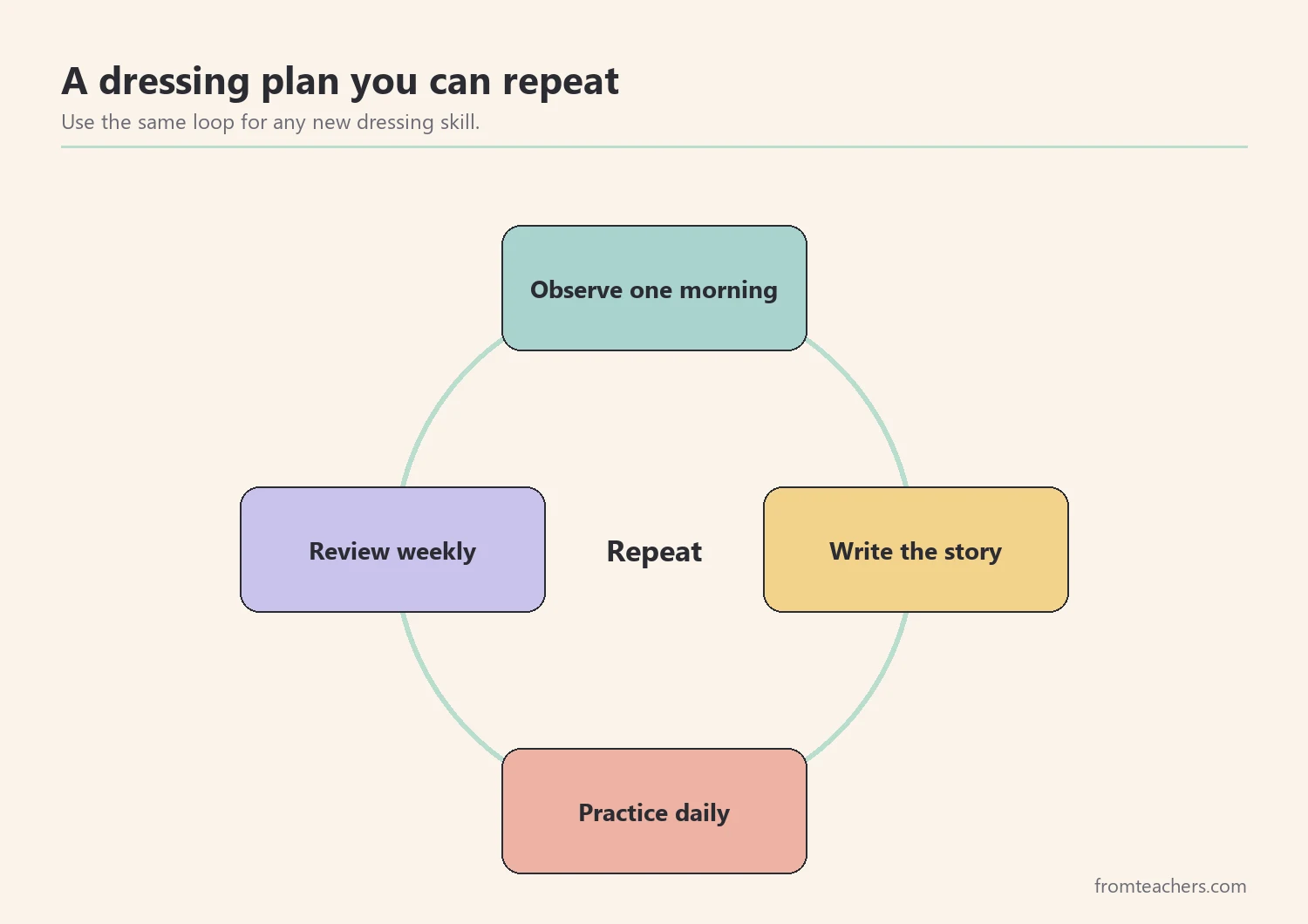
Before writing a single sentence, watch the routine as it happens now. In fact, a story works best when it matches the real problem, not the problem adults assume. So spend two or three mornings simply noting what the child does, where they stop, and what the adults say.
For example, our fictional student, Leo, is six and in kindergarten. His mother notices that Leo can pull on pants and socks, but he freezes at his shirt. He also refuses a sweater with a scratchy label. On most days, she ends up dressing him from the shirt onward.
Next, write down three things for each morning:
- Which items the child put on alone.
- Where the child stopped or asked for help.
- What happened just before the stop (a tag, a button, a tight neck hole, a distraction).
After a few days, a pattern usually appears. In Leo’s case, the hard moments are the shirt over his head and any clothing with a label at the neck. That gives you two clear targets instead of “he will not get dressed.”
| Item | Leo alone? | Notes |
|---|---|---|
| Underwear and pants | Yes | Elastic waist works well |
| Socks | Yes, slowly | Heel sometimes on top |
| Shirt | No | Stops when head is inside |
| Sweater | No | Pulls at the label |
Finally, share the notes with anyone else who helps in the morning. Similarly, if the child changes clothes at school for gym or after an accident, ask the teacher what they see. The goal is one shared picture of where support is needed.
2. Write a getting dressed social story in the child’s voice
Now you can write. A getting dressed social story is a short, illustrated text that describes what happens, why it matters, and what the child can try. Generally, it uses the first person (“I”), present tense, and calm, positive language. It describes rather than scolds.
Keep these guidelines in mind:
- Use one idea per page, with a clear picture or photo.
- Describe the situation first, then what the child can do.
- Include reassuring lines, such as “Many kids learn buttons later. That is okay.”
- Use flexible words like “usually” and “sometimes” so the story stays true on hard days.
- End with a proud, realistic closing line.
For Leo, a short version might read like this:
- “In the morning, I get dressed for school.”
- “My clothes are laid out on my chair in order.”
- “I put on my pants and socks. I am good at that.”
- “Next, I find the tag on my shirt. The tag goes in the back.”
- “I put my head through the big hole, then one arm, then the other arm.”
- “Sometimes my shirt is backward. That is okay. I can turn it around or ask for help.”
- “When I am dressed, I feel proud. Then I eat breakfast.”
Notice that this getting dressed social story names the exact step that is hard and gives a simple way through it. Also, it gives permission to make mistakes, which lowers pressure. If writing from scratch feels like a lot, a ready-made illustrated option such as the Getting Dressed by Myself social story for kids already walks children through dressing one step at a time and normalizes backward clothes.
Finally, read the getting dressed social story at a calm time first, such as bedtime, not in the middle of a rushed morning. That way, the child meets the ideas before they need them.
3. Break dressing into small, teachable steps
Even a well-written getting dressed social story will not do all the teaching. Therefore, pair it with a task analysis: a list of the small steps inside one dressing task. Each step should be something the child can see and do.
For Leo’s shirt, the steps look like this:
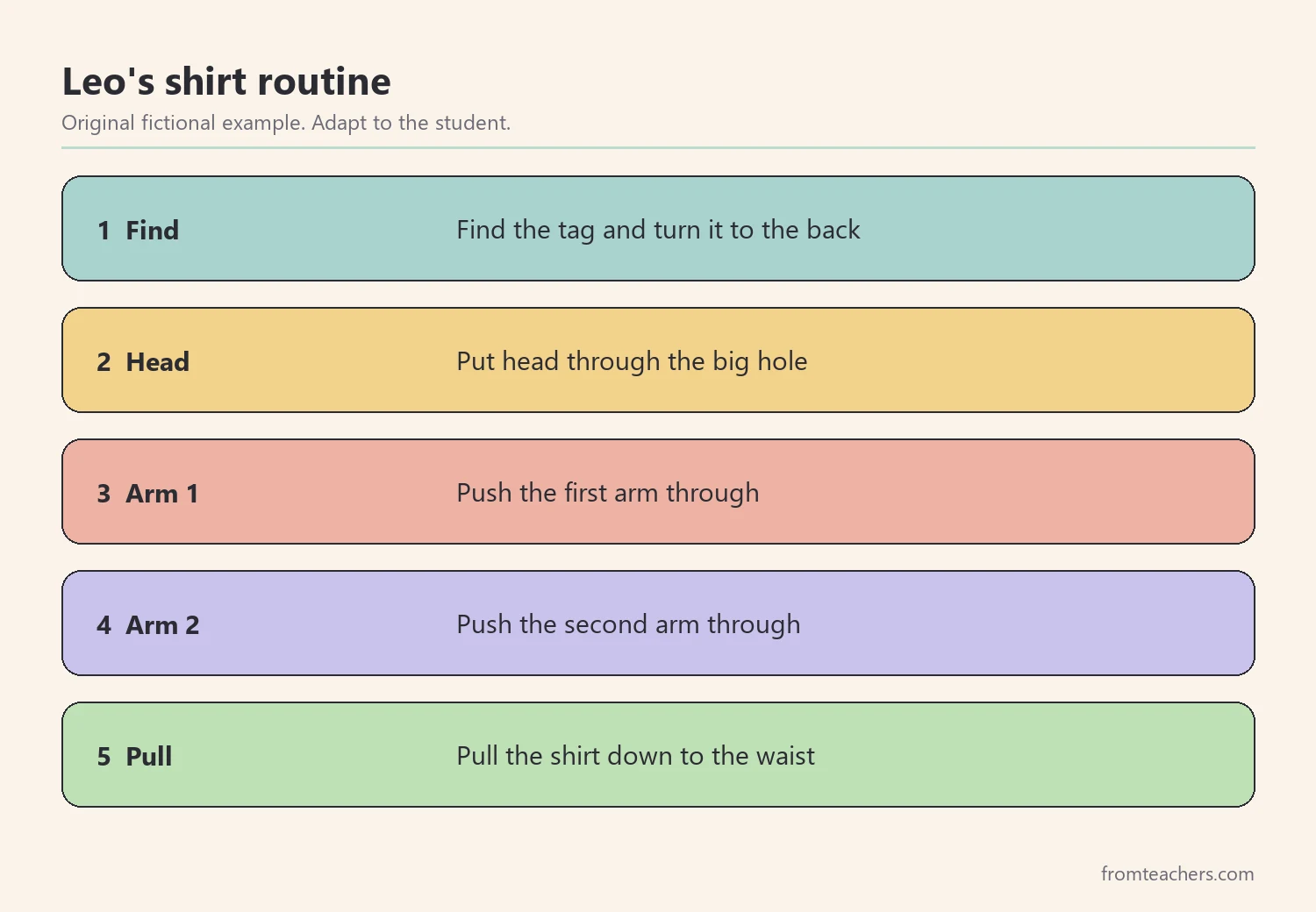
Many occupational therapists suggest teaching the last step first, often called backward chaining. In practice, the adult does steps 1 to 4, and the child finishes step 5, pulling the shirt down. Because the child completes the task every time, they get the satisfying feeling of “done.” Then, once step 5 is steady, the child also does step 4, and so on.
Here is how that looked over Leo’s first weeks:
- Week 1: Leo pulls the shirt down (step 5).
- Week 2: Leo pushes his second arm through and pulls down (steps 4 and 5).
- Week 3: Leo does both arms and pulls down (steps 3 to 5).
Also, choose simple clothes for practice. For instance, elastic waistbands, wide neck holes, and loose sleeves make early success more likely. Save buttons, snaps, and zippers for later, and practice them separately at a table, perhaps on a shirt laid flat.
Additionally, a picture strip on the wall or the back of the door helps the child see what comes next. Matching the strip to the pictures in the getting dressed social story keeps the language the same.
4. Plan for textures, tags, and tricky fasteners
For many children, the hardest part of dressing is not the sequence. Instead, it is how clothes feel. Tags, seams, tight cuffs, and stiff fabrics can make a child pull away or refuse. A getting dressed social story can name these feelings and offer a plan, but the environment matters too.
First, look at the clothes themselves. Then make small changes:
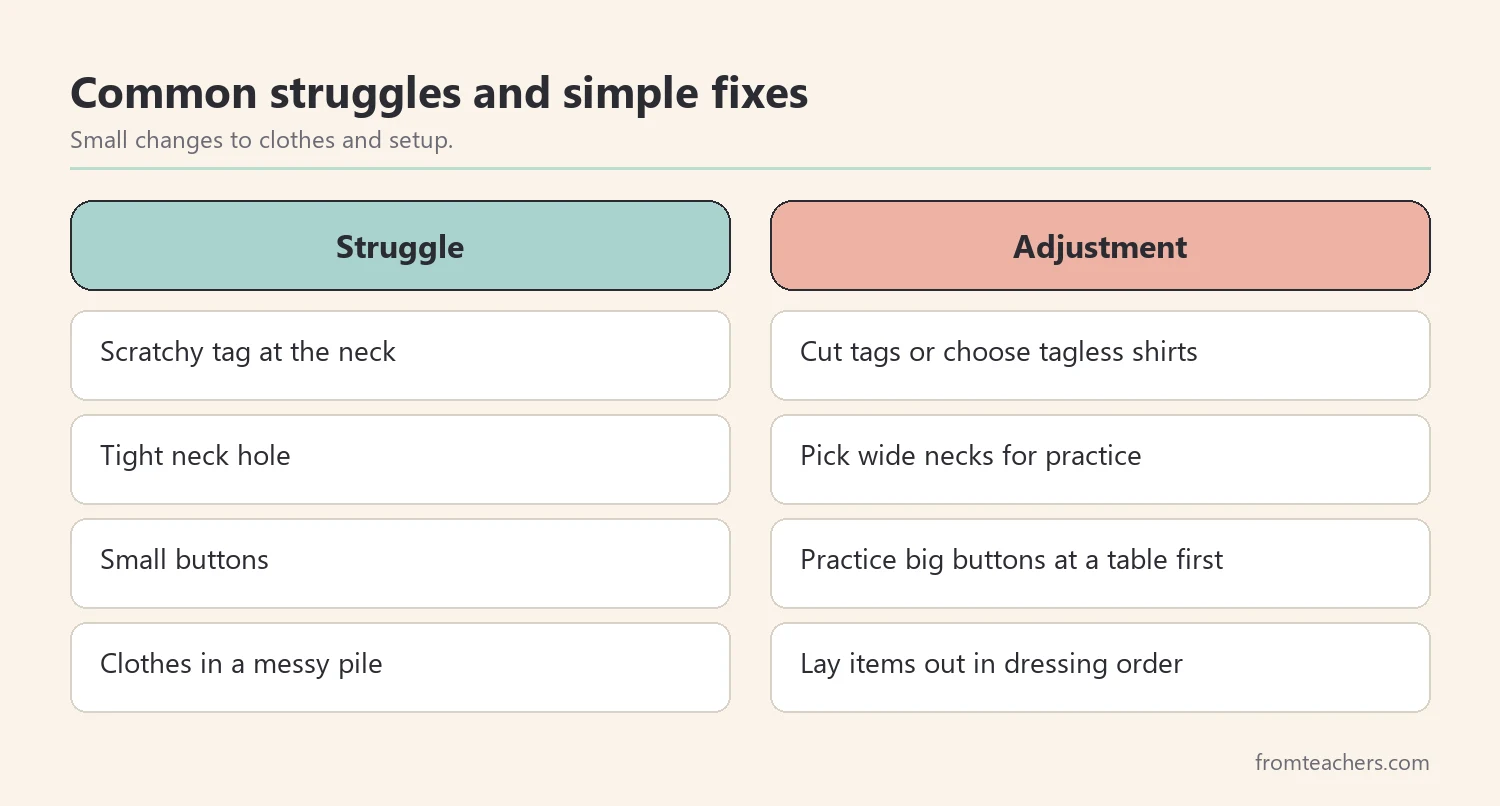
In Leo’s case, his mother cut the labels out of his three school shirts and moved his sweater to the “weekend” pile. Next, she added a page to his getting dressed social story: “Some clothes feel itchy. I can tell Mom, and we can find a softer shirt.” As a result, Leo now had words to use instead of pulling at his collar.
If sensory reactions are strong, frequent, or affect many parts of the day, talk with the child’s pediatrician or school occupational therapist. They can look at the bigger picture. Meanwhile, this guide stays with everyday home and classroom changes.
For fasteners, keep practice short and playful. For example, practice big buttons on a cardigan laid on the table, then smaller ones later. Some children learn zippers before buttons, and others the reverse. That is normal, and the story can say so.
5. Practice the getting dressed social story every day
Consistency is where progress happens. Usually, reading the getting dressed social story once a day for the first few weeks works well. A calm time, like bedtime, is better than the rushed minutes before school. Then, during dressing, adults can quote short lines from the story instead of giving new directions.
Here is a simple plan:
- Read the story at bedtime, pointing at pictures.
- Lay clothes out the night before, in dressing order.
- In the morning, use one or two story lines as prompts, such as “Tag in the back.”
- Praise specific effort: “You did both arms yourself.”
- Keep the routine the same on school days and weekends when possible.
Also, use the least help needed. For instance, start with a gesture toward the picture strip, then a short spoken cue, and only then a light physical prompt. Over time, the adult steps further back.
Teachers can support the same goals at school. During gym changes, after recess, or when putting on coats, the class can use the same words. Indeed, when home and school share the language, children learn faster and feel less confused.
Finally, plan for setbacks. Illness, holidays, and new clothes can bring old struggles back. When that happens, return to the story for a few days and add help back briefly before fading it again.
6. Track progress and fade adult help
To know whether the plan is working, record one simple measure. For dressing, a good one is the number of items the child put on alone, out of the items laid out. Keep the total the same each day so the numbers compare fairly.
Leo’s mother laid out five items each school day: underwear, pants, socks, shirt, and shoes with hook-and-loop straps. Then she wrote down, on Friday, the most typical count for that week.
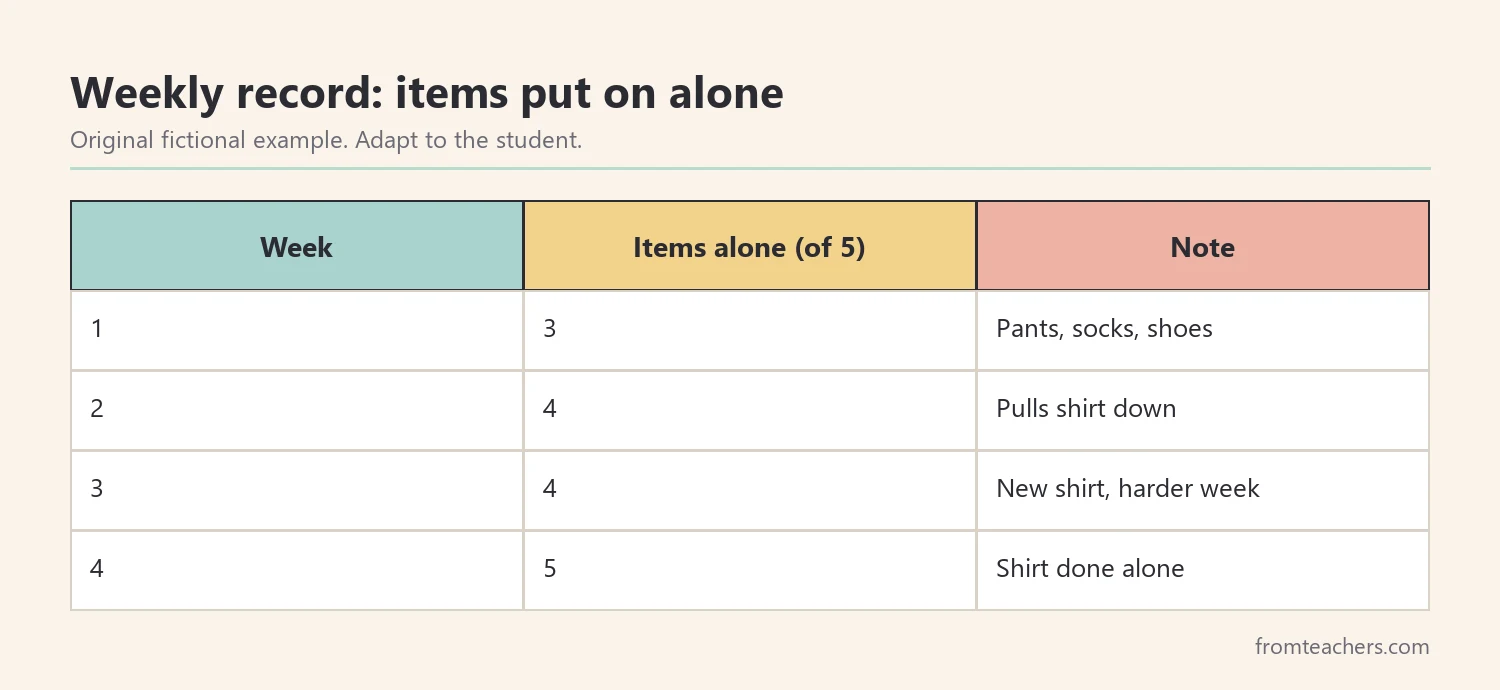
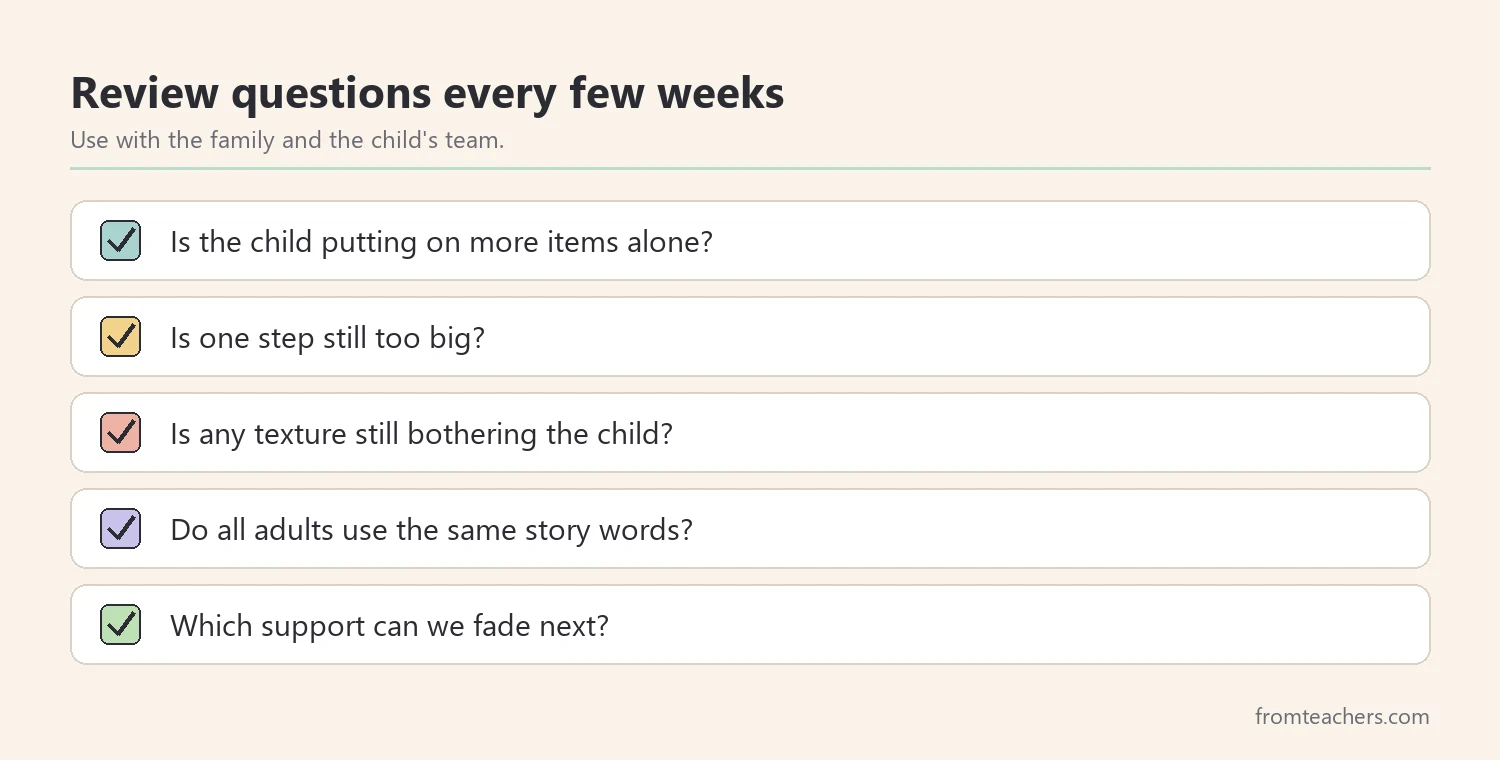
In this fictional record, Leo moved from three of five items in week 1 to five of five in week 4. Of course, progress is rarely this smooth, and a flat week is information, not failure. Consequently, if the count does not change for two or three weeks, review the steps: is one step too big, or is a texture still bothering the child?
When the child is steady, fade supports slowly. For example, move from reading the getting dressed social story daily to a few times a week. Later, take the picture strip down for one item the child has mastered. Eventually, the getting dressed social story becomes something the child returns to only when a new challenge appears, such as winter clothes.
Common mistakes and how to avoid them
- Writing the story as a list of rules. Fix: describe the situation and offer choices, using calm, positive sentences.
- Teaching every item at once. Fix: choose one item, usually the hardest, and teach it in small steps.
- Reading the story only during the struggle. Fix: read it at a calm time first, then quote short lines during dressing.
- Ignoring how clothes feel. Fix: remove tags, choose soft fabrics, and add a page about asking for a different shirt.
- Fading help too quickly. Fix: wait until a step is steady for a week or more before removing support.
- Using different words at home and school. Fix: share the story and the step list with every adult who helps.
Questions teachers and parents ask about getting dressed social story use
What age is a getting dressed social story for?
Most often, these stories are used with young children, from preschool through the early grades. However, older children who are still building dressing skills can also benefit if the pictures and language feel respectful of their age.
How long should the story be?
Short is better. Usually, a getting dressed social story of 6 to 10 pages with one idea each is enough. If the child loses interest, cut pages rather than adding more.
Should I use photos or drawings?
Either can work in a getting dressed social story. Some children connect best with photos of their own room and clothes, while others prefer clear drawings. Try one and watch how the child responds.
What if my child refuses to listen to the story?
First, try reading it at a different time or letting the child turn the pages. Also, keep the tone light and avoid reading it right after a hard morning. If refusal continues, shorten the story to two or three pages.
Can teachers use the same story at school?
Yes. In fact, it helps when teachers use the same words during gym changes or coat time. Ask the family for a copy of their getting dressed social story or share the one you use in class so the language stays consistent.
Related reading: Navigating the Path to Adulthood: Building Essential Life Skills, Managing Sensory Overload: Practical Strategies for Autism and ADHD, and Autism Social Skills Development: Practical Strategies for Growth.
A companion resource for a getting dressed social story:
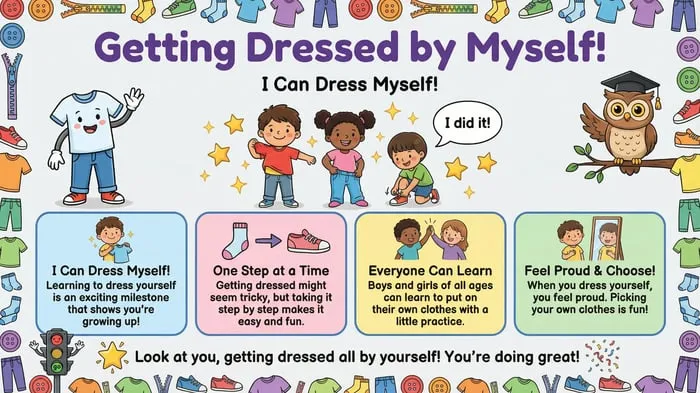
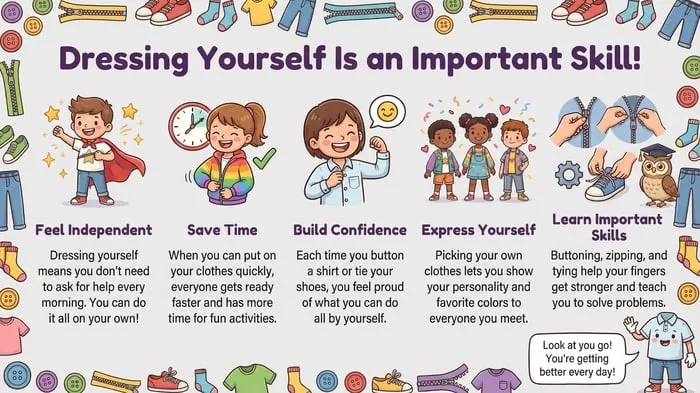
Getting Dressed by Myself: Social Story for Kids: an encouraging, illustrated story that walks children through dressing one step at a time, suggests starting with simple clothes, treats backward clothes as part of learning, and celebrates small wins. It works as a morning or bedtime read-along, an occupational therapy companion, or a classroom self-help tool.
Sources and scope
- American Occupational Therapy Association (AOTA): information on how occupational therapists support daily living skills such as dressing.
- CDC Learn the Signs. Act Early.: general information on child development and milestones for families.
- IRIS Center, Vanderbilt University: free modules on evidence-based practices, including teaching skills in small steps.
- Understood.org: practical articles for families on learning and thinking differences and daily routines.
This guide covers everyday strategies for teaching dressing with a social story at home and school. It does not cover diagnosis, therapy plans, or medical concerns, which belong to qualified professionals and the child’s team.
Key takeaways
- A getting dressed social story works best when it matches a real, observed problem.
- Write in the child’s voice, with calm, flexible, positive sentences.
- Teach one item at a time, often finishing with the last step first.
- Adjust clothes and setup to remove texture struggles.
- Track one simple measure each week and fade help slowly.





Leave a Comment