

Emotional exhaustion in teachers often shows up quietly at 3:30 on a Tuesday. The students have gone home, the room is finally still, and you sit in the car for ten minutes before you can turn the key. Nothing dramatic happened today. Still, you replay one hard moment from the morning, and a familiar wave of guilt follows you home.
This guide turns that feeling into a plan you can actually use. After reading, you will be able to spot early warning signs, debrief a difficult moment in five minutes, separate real responsibility from unearned guilt, set two or three kind boundaries, and check in with yourself every few weeks. The focus is on teachers in autism and special education classrooms, but the steps work in any school.
Examples are fictional. Adapt to the student’s goals and agreed supports. This is guidance, not a diagnosis.
At a glance
- Emotional exhaustion builds slowly, so early signs matter more than big moments.
- A short written debrief helps you process a hard event instead of carrying it home.
- Guilt is useful only when it points to something you can change.
- Boundaries work best when they are small, specific, and shared with your team.
- A simple self-check every few weeks shows whether your plan is helping.
1. Recognize the early signs of emotional exhaustion in teachers
First, it helps to name what you are looking at. Emotional exhaustion in teachers is the feeling of being drained by the emotional demands of the job, not only by the workload. In autism classrooms, those demands are constant: reading body language, staying calm during dysregulation, and caring deeply about students whose progress can be slow.
Many educators also use the term compassion fatigue. It describes the cost of caring for people who are struggling, day after day. You do not need to choose the perfect label. What matters is noticing emotional exhaustion in teachers early, while small changes can still help.
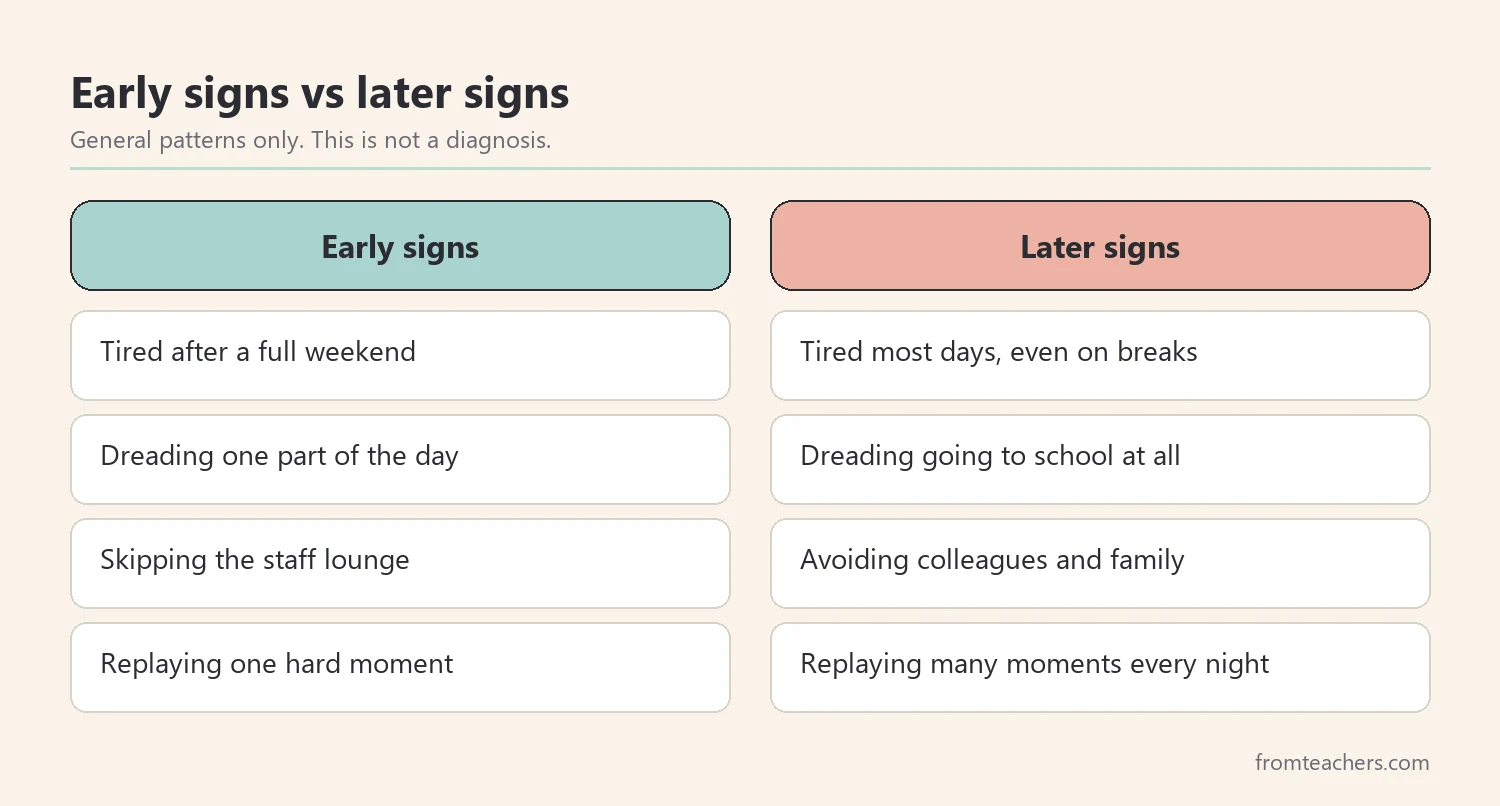
Next, look at signs in three areas: your body, your feelings, and your behavior. Early signs are often easy to dismiss as “just a busy week.” However, when several of them appear together for more than two or three weeks, they deserve attention. Emotional exhaustion in teachers rarely announces itself with one big event.
| Area | Early sign | What it might sound like |
|---|---|---|
| Body | Tired even after a weekend | “I slept, but I still feel flat.” |
| Feelings | Dreading specific moments | “I hope arrival goes okay today.” |
| Behavior | Pulling back from colleagues | “I eat lunch alone to get a break.” |
| Thinking | Replaying events at night | “I should have seen that coming.” |
For example, meet Dana, a fictional teacher in a K-2 autism classroom. In October, Dana notices she is snapping at her own family, skipping the staff lounge, and replaying one student’s meltdown every evening. None of this means something is wrong with Dana. Instead, it tells her that her current way of coping is not keeping up with the emotional load of the job.
Finally, remember that these are signals, not a diagnosis. If you notice signs of depression, anxiety, or thoughts of self-harm, reach out to a doctor or a mental health professional right away. This guide is about daily habits, not clinical care.
2. Debrief difficult moments so they do not follow you home
A hard moment in the classroom does not end when the bell rings. Without a way to close it, your mind keeps the file open. That is one reason emotional exhaustion in teachers builds up: dozens of small, unprocessed events pile on top of each other.
A debrief is a short, structured look back at one event. It is not a report for the office. Instead, it is a private tool that helps you understand what happened, notice what you did well, and decide what, if anything, to change. Five minutes is enough, and it is one of the simplest tools against emotional exhaustion in teachers.
Use the same four questions every time, so the habit becomes automatic:
- What happened? Write two or three plain sentences, like a news report.
- What did I feel? Name one or two emotions, such as worried, embarrassed, or sad.
- What went right? List at least one thing you or the team did well.
- What will I keep or try? Choose one small action, or decide that nothing needs to change.
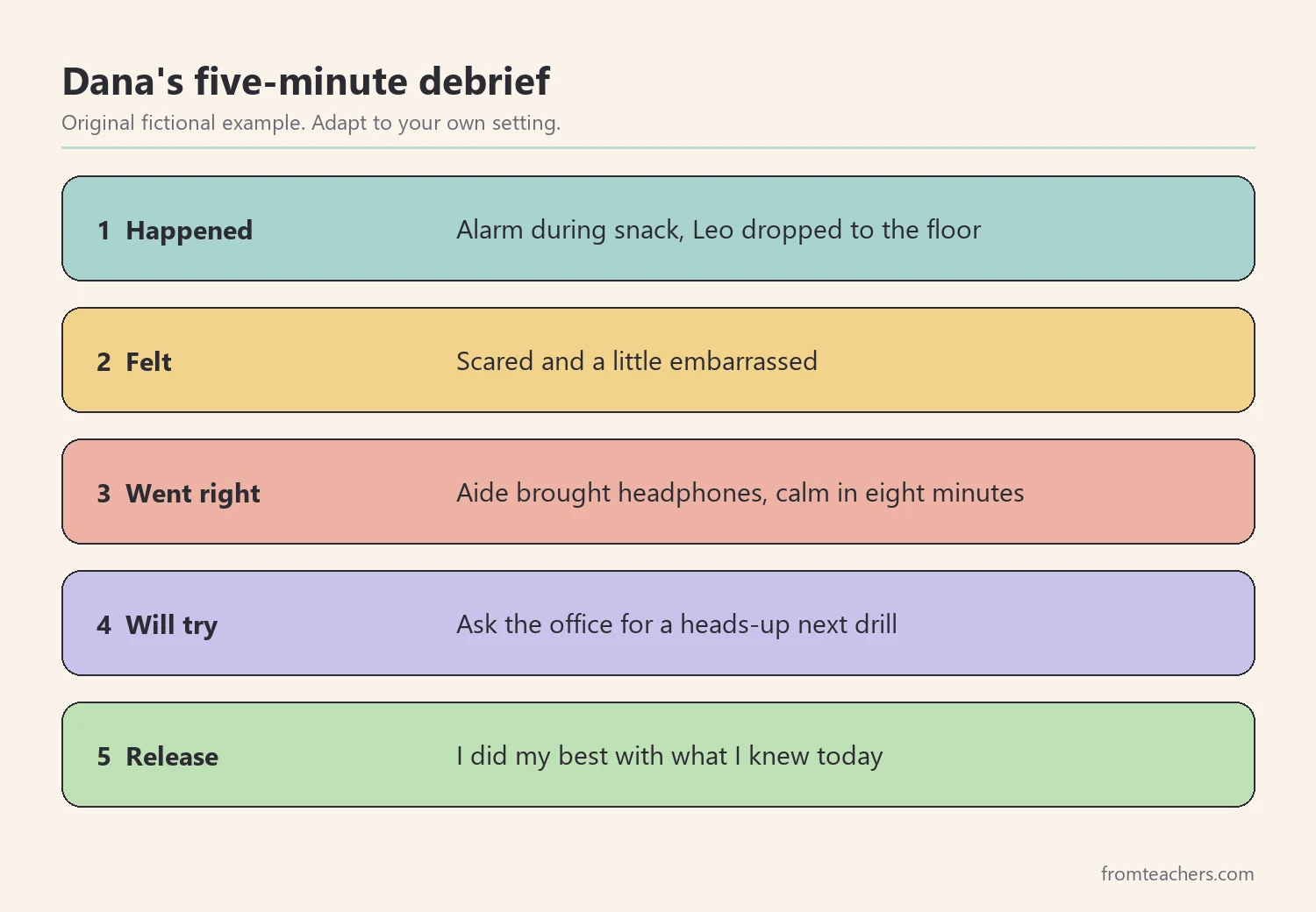
For example, Dana’s student Leo had a meltdown during a fire drill. Dana’s debrief reads: “The alarm went off during snack. Leo dropped to the floor and covered his ears. I felt scared and a little embarrassed in the hallway. The aide brought his headphones fast, and Leo was calm in eight minutes. Next drill, I will ask the office for a heads-up and keep headphones by the door.”
If you like a printed format, the difficult moment debrief and release journal for autism classroom teachers gives you ready pages for this routine.
Then, Dana closes the notebook and adds a short release line: “I did my best with what I knew today.” This small ritual signals to her brain that the event is finished. As a result, she spends less time replaying it at night.
3. Release guilt that does not belong to you
Guilt is one of the heaviest parts of emotional exhaustion in teachers. Many special educators feel guilty when a student has a hard day, when a parent is upset, or when they leave on time. Some of that guilt is helpful. Much of it is not, and unearned guilt quietly feeds emotional exhaustion in teachers.
A simple test can help. Ask yourself two questions. First, did I act against my own values or a clear agreement? Second, is there something I can realistically change next time? If the answer to both is no, the guilt is probably unearned, and you can practice letting it go.
| Thought | Useful or unearned? | Next step |
|---|---|---|
| “I forgot to send the visual schedule home.” | Useful | Send it tomorrow and set a reminder. |
| “Leo melted down, so I failed him.” | Unearned | Review the debrief and note what helped. |
| “I left at 3:45 instead of 5:00.” | Unearned | Remind yourself rest is part of the job. |
For instance, Dana writes down three guilty thoughts from one week. Only one, the forgotten schedule, points to a real action. She fixes it the next morning. For the other two, she writes a short counter-statement: “Meltdowns are a response to overload, not proof that I failed.” Over time, this practice makes guilt feel smaller and more manageable.
In addition, notice where guilt comes from. Sometimes it comes from comparing yourself to colleagues on social media or to an imagined perfect teacher. Real classrooms are messy. Students who need a lot of support will have hard days, even with excellent teaching.
4. Set kind boundaries that protect your energy
Boundaries are not walls. In a school, they are simple agreements about what you can do well and what you cannot do every day. Without them, emotional exhaustion in teachers tends to grow, because the job always has more needs than one person can meet.
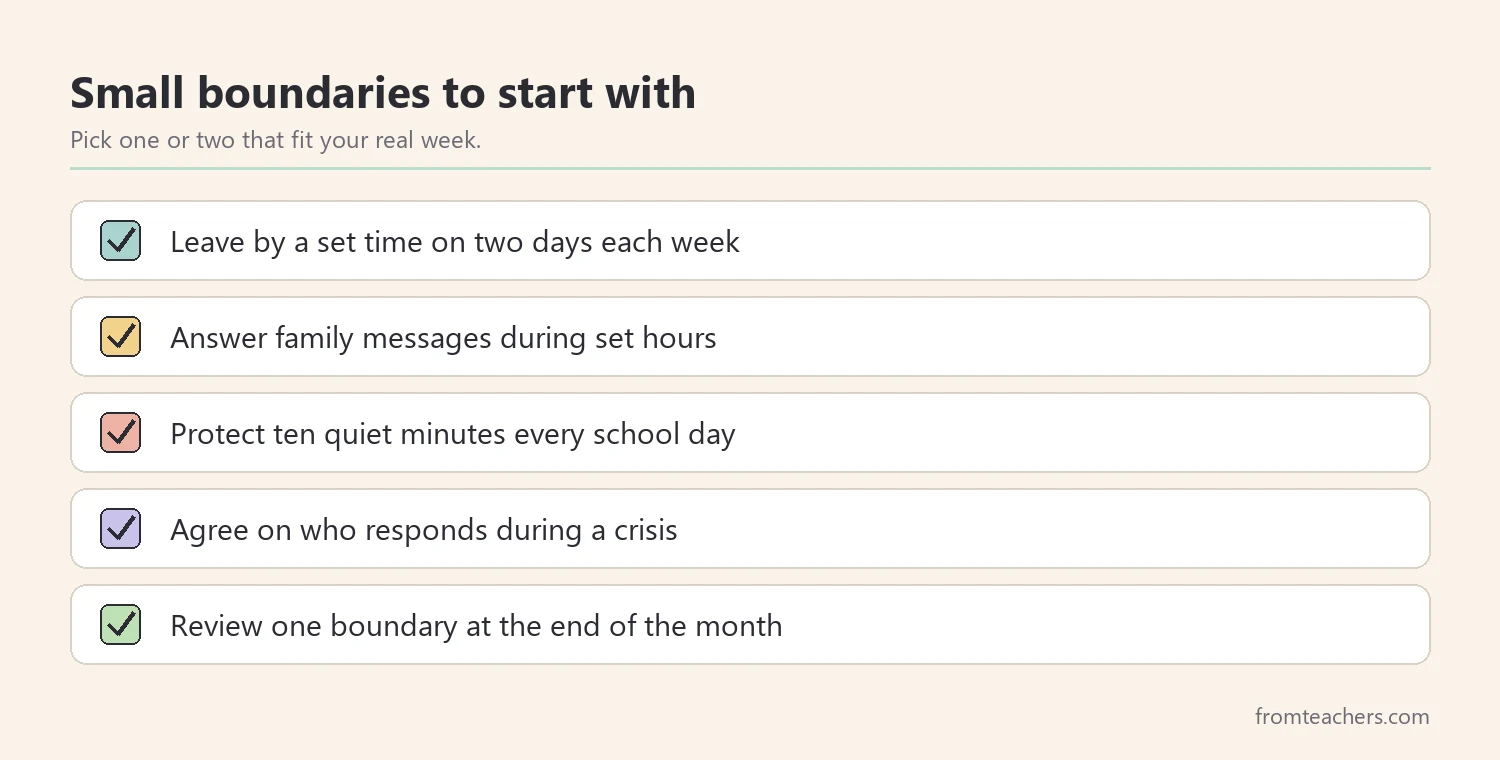
Start with small, specific boundaries. Vague promises like “I will take better care of myself” rarely last. Specific ones, like “I leave by 4:15 on Tuesdays and Thursdays,” are easier to keep and easier to explain to others. They also make emotional exhaustion in teachers easier to prevent, because you protect energy before it runs out.
- Time: Pick two days a week with a firm leaving time.
- Communication: Answer family messages during set hours, and say so in your welcome letter.
- Breaks: Protect at least ten quiet minutes in your day, even if lunch is short.
- Roles: Ask your team who handles which task during a crisis, so you are not the only responder.
Next, share your boundaries with your team in a calm, positive way. For example, Dana says to her aides: “I want to be fully present for the kids. To do that, I am leaving at 4:15 on Tuesdays and Thursdays. If something urgent comes up, text me before 4:00.” Her aides respond well, and one of them sets a similar boundary.
Finally, expect some boundaries to slip at first. That is normal. When one breaks, treat it as information, not failure. Ask what got in the way and adjust the boundary so it fits your real week. A boundary you keep 80 percent of the time is far better than a perfect one you never start.
5. Track your energy and review emotional exhaustion in teachers over time
Feelings change from day to day, so it is easy to lose track of your own pattern. A simple weekly check gives you real information instead of guesses. It also shows whether your debriefs and boundaries are making a difference to your emotional exhaustion as a teacher.
Use three quick ratings each Friday, on a scale from 1 (very low) to 5 (very good): energy, mood, and sleep. Add the three numbers for a weekly total out of 15. Then write one sentence about what helped or hurt that week.
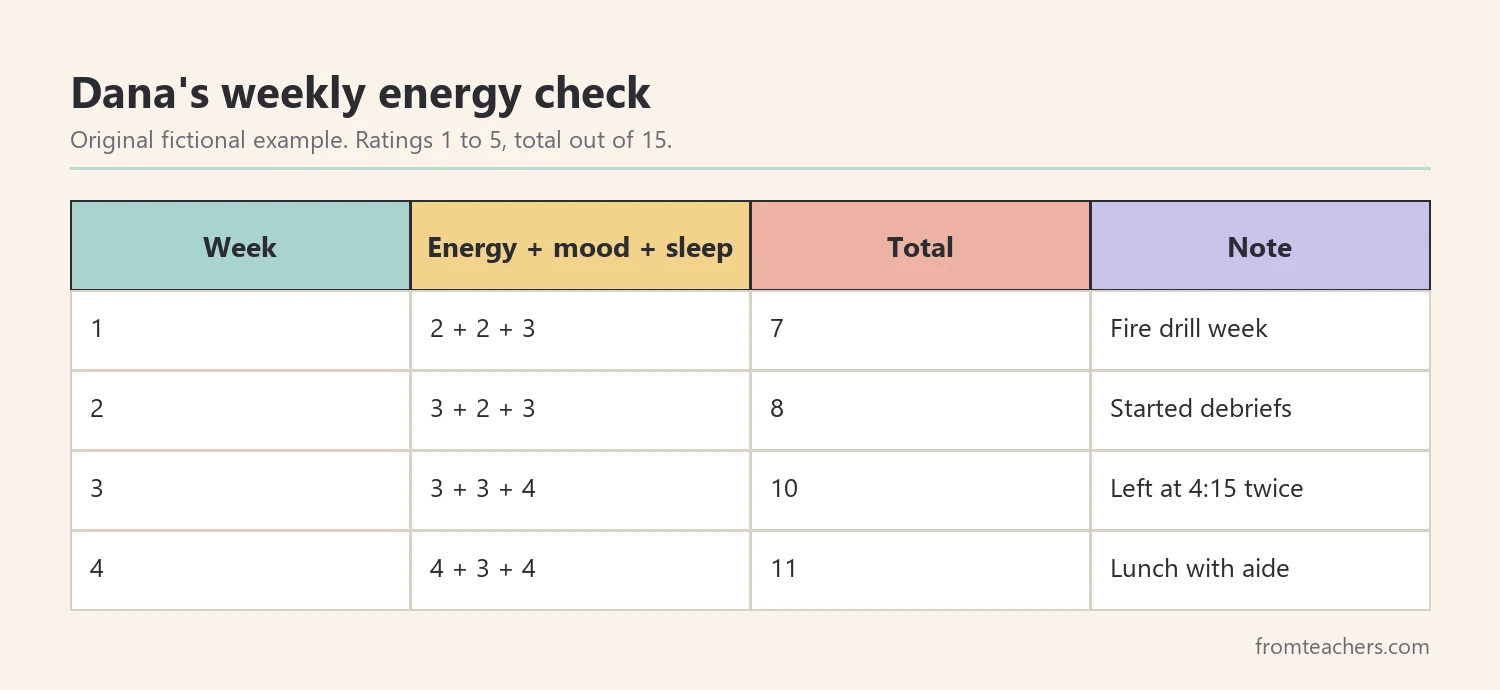
For example, here is Dana’s record for four weeks in November:
| Week | Energy + mood + sleep | Total (of 15) | Note |
|---|---|---|---|
| 1 | 2 + 2 + 3 | 7 | Fire drill week |
| 2 | 3 + 2 + 3 | 8 | Started debriefs |
| 3 | 3 + 3 + 4 | 10 | Left at 4:15 twice |
| 4 | 4 + 3 + 4 | 11 | Lunch with aide |
As a result, Dana can see a clear upward trend from 7 to 11. The numbers are personal and not scientific, but they help her notice which habits seem to help. They also give her something concrete to share if she decides to talk with a counselor or her school’s employee assistance program.
Moreover, review your ratings every four weeks. If your totals stay low or drop, that is a sign to ask for more support, from your administrator, a mentor, or a health professional. Emotional exhaustion in teachers is not a personal weakness. It is a normal response to demanding work, and it deserves real support.
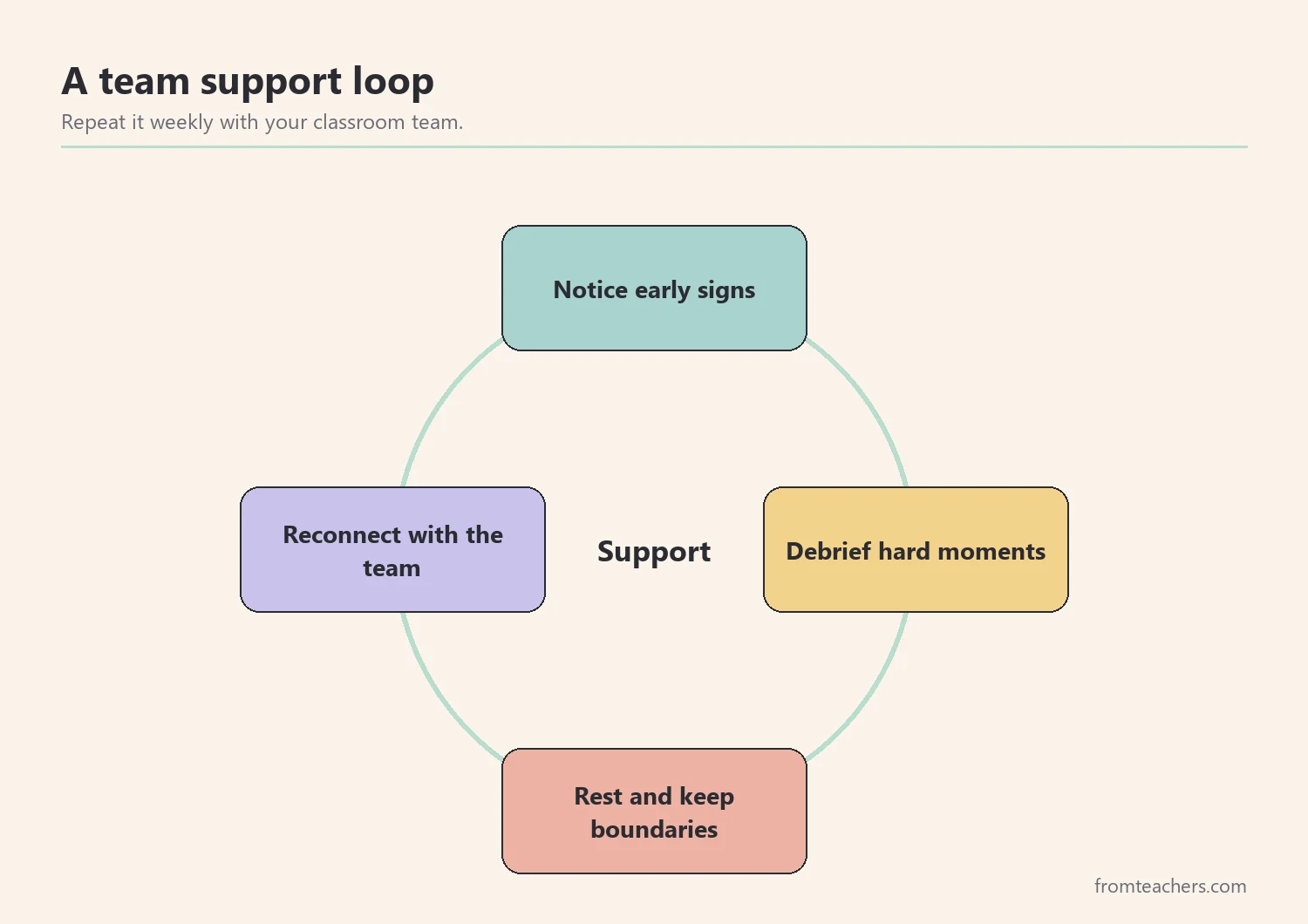
6. Build a support loop with your team
Individual habits help, but they work much better inside a supportive team. In many autism classrooms, teachers, aides, and therapists share the same hard moments. When they also share a way to recover, the whole room feels calmer, and emotional exhaustion in teachers becomes a shared concern rather than a private struggle.
One simple idea is a weekly five-minute team check-in. Each person names one hard moment and one good moment from the week. There is no fixing and no judging. The goal is to remind everyone that they are not alone in the work.
Another idea is a “tap-out” agreement. If an adult feels overwhelmed during a difficult moment, they can quietly signal a colleague to step in for a few minutes. This protects both the adult and the student. However, it only works if the team agrees on the signal in advance.
For example, Dana’s team chooses a simple phrase: “Can you check the reading corner?” It sounds ordinary to students but tells another adult that Dana needs a short break. In the first month, the team uses it four times, and each time the adult returns calmer.
Common mistakes and how to avoid them
- Waiting for a breaking point. Instead, act on early signs like constant tiredness or dread.
- Debriefing only in your head. Writing it down helps close the event and shows patterns over time.
- Treating all guilt as a signal to work harder. First, check whether there is a real action to take.
- Setting huge boundaries. Start with one or two small ones that fit your actual schedule.
- Keeping it private from your team. A short, honest conversation often makes boundaries easier for everyone.
- Using self-care as one more task to perfect. Keep it simple and flexible. Easing emotional exhaustion in teachers is about steady habits, not perfect ones.
Questions teachers and parents ask about emotional exhaustion in teachers
Is emotional exhaustion in teachers the same as burnout?
Emotional exhaustion is often described as one part of burnout. Burnout can also include feeling detached from work or feeling less effective. If you are unsure what you are experiencing, a health professional can help you sort it out.
How long does it take to feel better?
It varies a lot from person to person. Some teachers notice small changes within a few weeks of new habits, while others need more time and more support. Tracking your energy helps you see real progress instead of guessing.
What if my school does not support boundaries?
Start with boundaries that are within your control, like how you spend your lunch or when you check messages. Then, bring a specific, positive request to your administrator. Framing it as better care for students often helps.
Can parents help prevent emotional exhaustion in teachers?
Yes, in small ways. Respecting communication hours, sharing positive notes, and working as a team on goals all reduce stress. A simple thank-you can matter more than parents expect when emotional exhaustion in teachers is building.
When should I seek professional help?
Seek help if low mood, poor sleep, or anxiety lasts for weeks or affects your daily life. Also seek help right away if you have thoughts of harming yourself. Your doctor, a counselor, or your school’s employee assistance program are good places to start.
Related reading: Understanding Autistic Burnout and School Exhaustion, Special Education Challenges and Strategies, and Teacher-Parent Communication in Special Education.
A companion resource for emotional exhaustion in teachers:
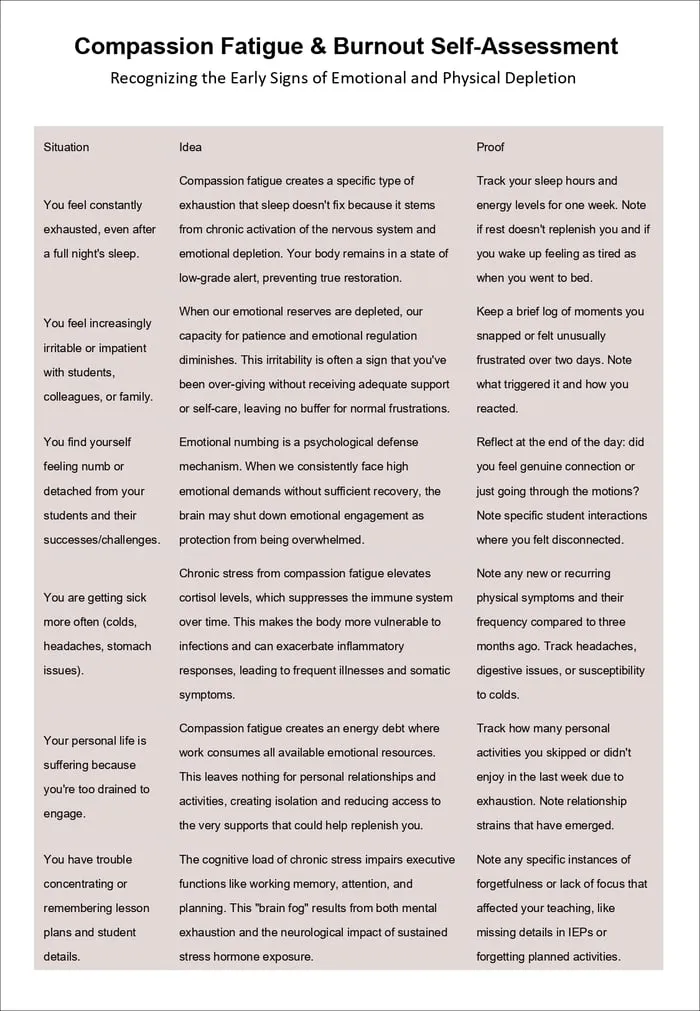
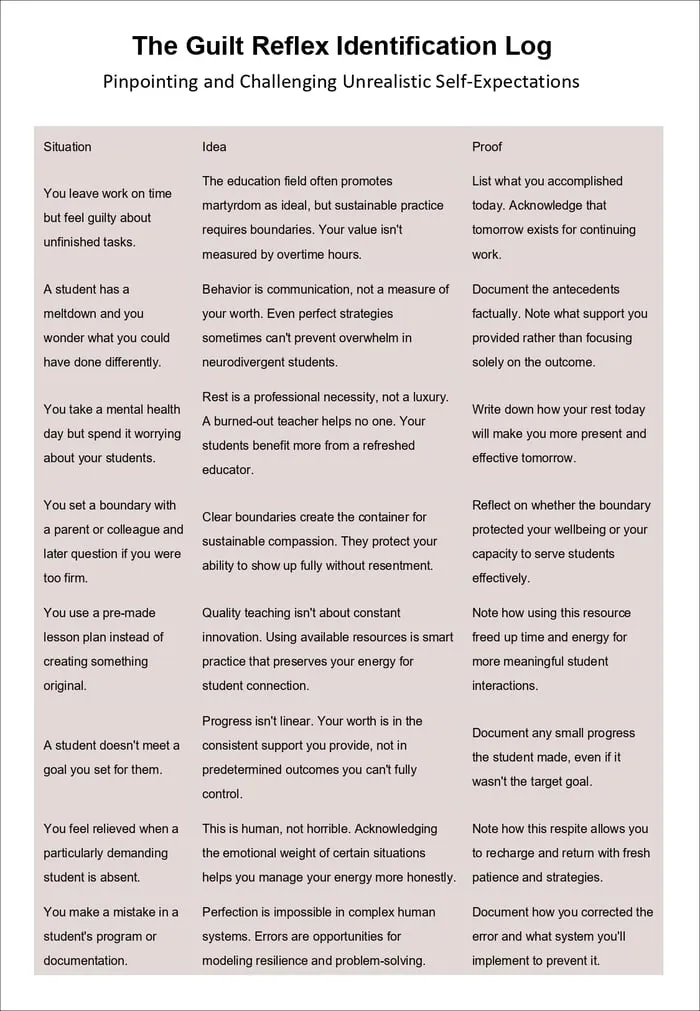
You Matter Too: Compassion Fatigue, Guilt, and Boundaries in Autism Classrooms: a 12-page printable toolkit with a compassion fatigue and burnout self-assessment, a difficult moment debrief and release journal, and pages that pair common warning signs with a concrete way to track them.
Sources and scope
- World Health Organization: general information on burnout as an occupational phenomenon and on mental health at work.
- CDC National Institute for Occupational Safety and Health (NIOSH): resources on workplace stress and worker wellbeing.
- American Psychological Association: articles on stress, coping, and when to seek help.
- 988 Suicide and Crisis Lifeline: free, confidential support in the United States, available by call or text at 988.
This guide covers everyday habits for noticing and easing emotional exhaustion in teachers, especially in autism and special education settings. It does not diagnose or treat burnout, depression, or anxiety, which belong to qualified health professionals.
Key takeaways
- Emotional exhaustion in teachers builds slowly, so watch for early signs in body, feelings, and behavior.
- A four-question debrief helps you close hard moments instead of carrying them home.
- Keep guilt that points to a real action and practice releasing the rest.
- Set small, specific boundaries and share them with your team.
- Track energy, mood, and sleep weekly, and ask for help if totals stay low.




Leave a Comment