

Task initiation strategies matter most in one quiet classroom moment: everyone else is writing, and one bright student is still staring at a blank page ten minutes later. She understands the assignment. She wants to do well. Yet she cannot make the first move, and the adults around her start to read it as defiance or laziness.
By the end of this guide, you will be able to name what is getting in the way, shrink the first step until it feels possible, build a short start routine, record progress in a simple way, and review the plan with the student. Examples are fictional. Adapt to the student’s goals and agreed supports. This is guidance, not a diagnosis.
At a glance
- Getting started is an executive function skill, not a measure of effort or intelligence.
- Good task initiation strategies make the first step tiny, visible, and concrete.
- A short, repeated start routine works better than reminders and warnings.
- Track minutes to start, not only work completed.
- Fade adult prompts slowly so the student owns the routine.
Good task initiation strategies start with understanding, not pressure. Throughout the guide, we will follow one fictional student. Maya is in grade 6. She reads above grade level, talks easily about books, and loses most of her writing time before she writes a single sentence.
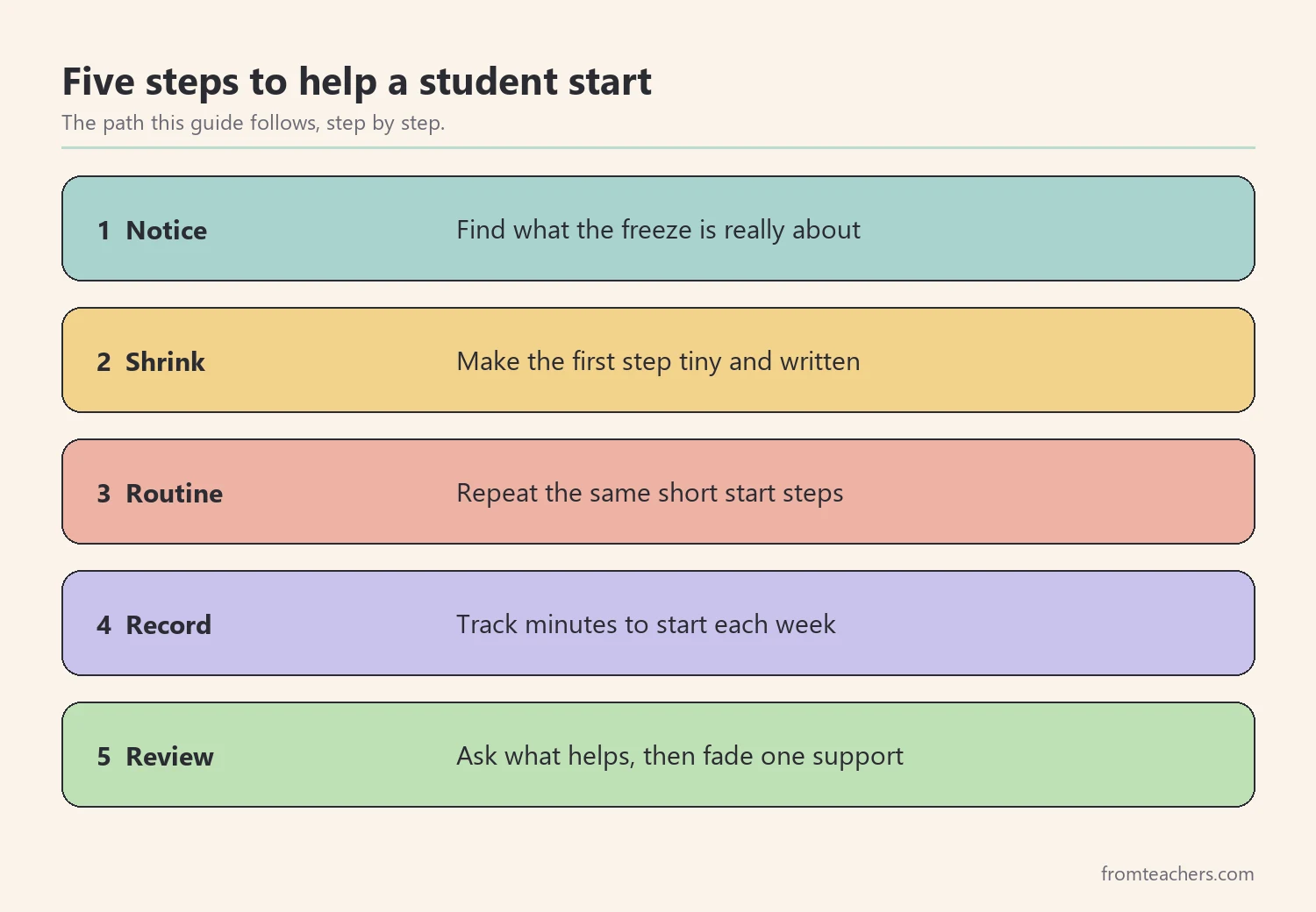
1. Notice what the freeze is really about before choosing task initiation strategies
First, look closely before you change anything. Task initiation is the ability to begin a task without long delay. It sits alongside planning, working memory, organization, and self-monitoring in the group of skills often called executive function. Because these skills are separate from intelligence, a capable student can still get stuck at the starting line.
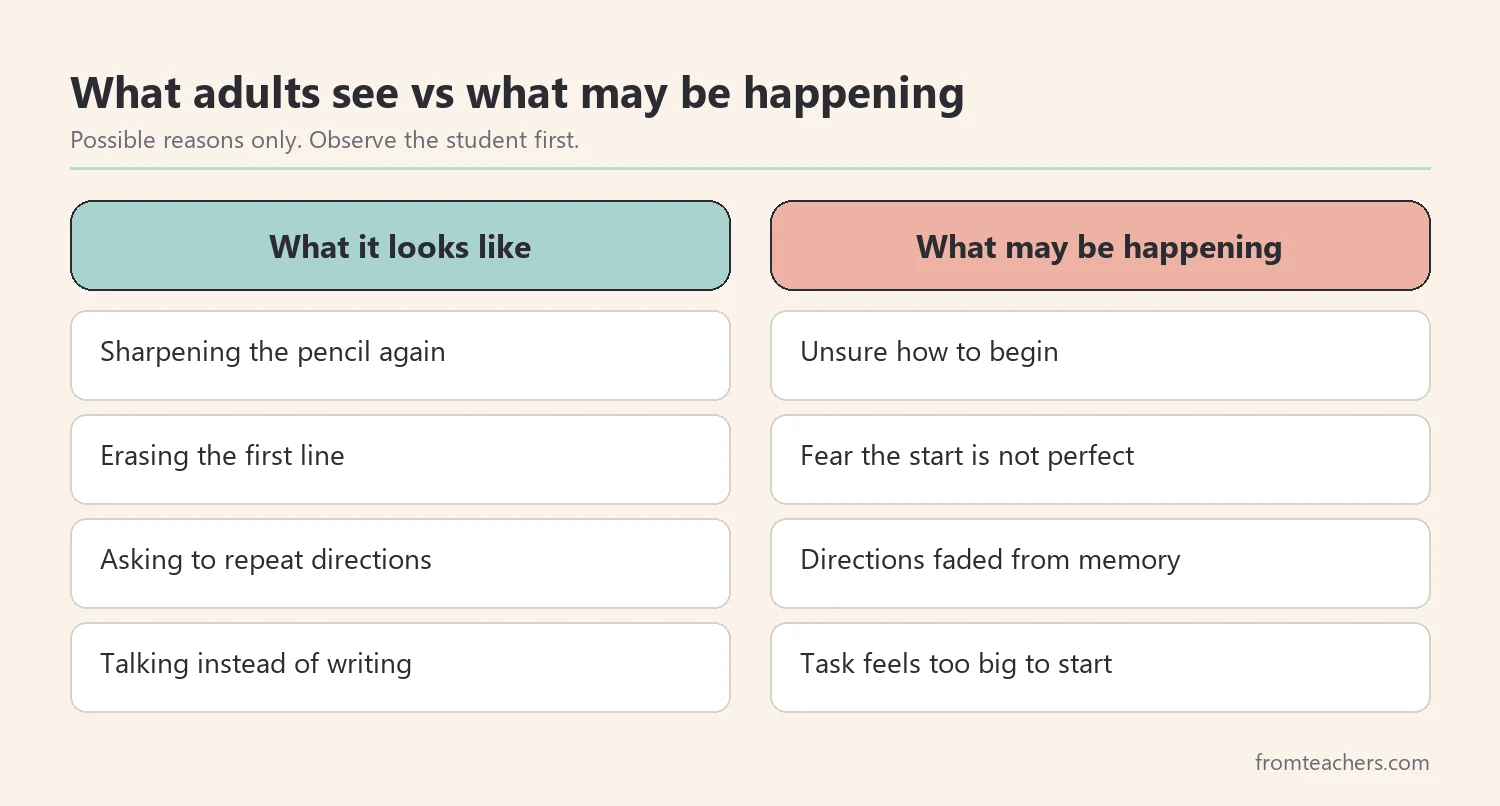
Next, watch for patterns. A freeze usually has a reason, even when the student cannot explain it. Common drivers include:
- Overwhelm: the task looks too big or the end point is unclear.
- Perfectionism: the first sentence has to be perfect, so no sentence gets written.
- Working memory gaps: the directions faded before the student began.
- Low interest: dull tasks need more effort to start.
- Worry: avoiding the task feels safer than trying and failing.
Also, notice when the freeze does not happen. That contrast is useful data, and it will shape which task initiation strategies you try first. If a student starts math quickly but stalls on open writing, the problem is probably not general motivation.
Worked example. Over one week, Maya’s teacher, Ms. Ortiz, jots a few notes during independent work. Maya starts math worksheets within two minutes. However, on open writing prompts she sharpens her pencil, rereads the prompt, and erases her name. When asked, Maya says, “I don’t know how it should start.” Ms. Ortiz writes down her best guess: the blank page and the need for a perfect opening are the main barriers.
Finally, keep this step short. One week of light notes is enough to choose a starting point for task initiation strategies. You can always adjust later.
2. Shrink the first step with task initiation strategies
Once you have a guess about the barrier, make the first step smaller than seems necessary. The goal is a step so small that saying no to it feels silly. Of all task initiation strategies, this is the one teachers tend to underuse. For many students, that is the single most powerful change.
Here are practical task initiation strategies for shrinking the start:
- Name the first action: “Write your name and the date” or “Copy the first question.”
- Give a sentence starter: a few words that remove the blank page problem.
- Show the finish line: a model or a simple checklist of parts.
- Cover the rest: fold the page or use a sticky note so only the first part shows.
- Offer a choice: two possible first steps, picked by the student.
In addition, write the first step down. Spoken directions disappear. A sticky note on the desk stays there and does not need the teacher to repeat it.
| Task | Too big | Small first step |
|---|---|---|
| Paragraph | “Write about your weekend.” | “Write one thing you did on Saturday.” |
| Worksheet | “Finish the page.” | “Do problem one.” |
| Project | “Start your research.” | “Open the folder and read the first source title.” |
Worked example. For writing time, Ms. Ortiz gives Maya a sticky note with two options: “Start with: One reason I…” or “Start with: The first thing I noticed was…” Maya picks one, copies it, and finishes the sentence. Because the opening is no longer her job alone, the perfect first sentence problem fades. On the first day, she writes three sentences. Not a full paragraph, but a real start.
As a result, the adult role changes. Instead of urging the student to try harder, you are designing the start so effort can begin.
3. Build a short start routine around your task initiation strategies
A small first step works best inside a routine the student repeats every time. Routines reduce the number of decisions at the hardest moment. In fact, a routine is where separate task initiation strategies come together into one habit. When the steps are the same each day, the brain does not have to plan how to begin.
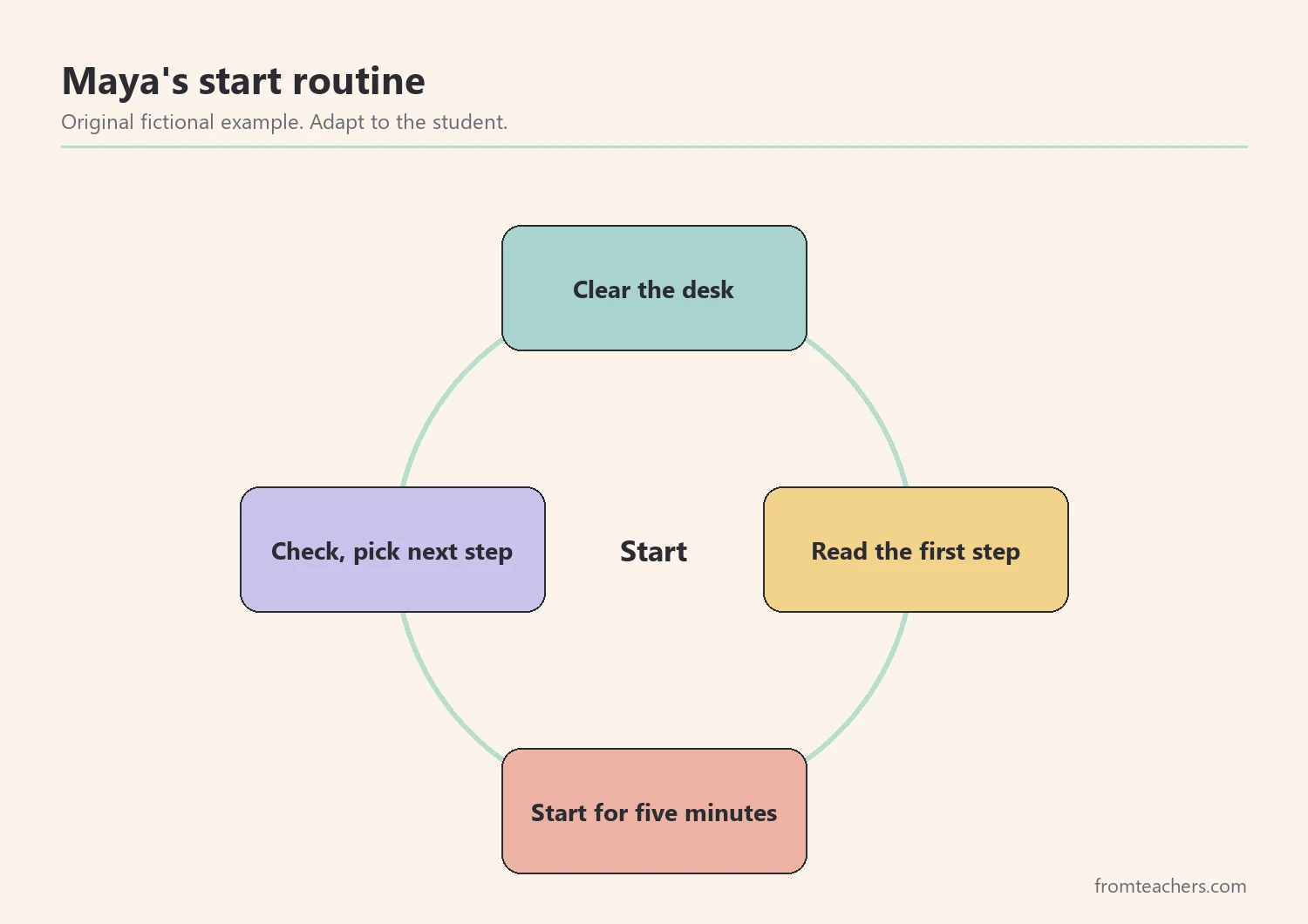
Keep the routine to four or five steps. For instance:
- Clear: put away everything except what the task needs.
- Read: read the first step on the sticky note.
- Start: do that one step.
- Time: work until a short timer ends, often five minutes.
- Check: look at what is done, then choose the next small step.
Moreover, teach the routine directly. Model it, practice it with an easy task, and then use it with real work. A short timer helps because the student only has to commit to a few minutes, not to the whole assignment.
If you would like a ready-made explanation to share with colleagues and families, the Executive Function Guide on why smart students get stuck covers the freeze in comic style, along with strategies and ideas for a classroom that supports these skills.
Worked example. Ms. Ortiz teaches Maya a routine called “Clear, Read, Start, Check.” She practices it twice with a fun prompt about a favorite animal. Because the steps are short, Maya learns them quickly. Then she tapes a small card with the four words to the corner of Maya’s desk. During writing time, Ms. Ortiz no longer repeats directions. Instead, she points to the card and waits quietly. That small silence matters, because it gives Maya the chance to start on her own. Maya follows it and sets a five minute timer on her own.
4. Record how long it takes to start
Without a record, it is hard to know whether task initiation strategies are working or simply feel helpful on a good day.
Next, collect a little data. Many teachers track only finished work. However, task initiation strategies target the start, so the most useful measure is the delay before the first real action.
Keep it simple. A quick note of “minutes to start” for one task type, three or four times a week, is plenty. Add one column for what support was used and one for anything unusual, such as a substitute or a fire drill.
Also, involve the student when possible. Older students can record their own start time. Seeing the number drop can feel motivating, and it builds self-awareness. Over time, students begin to notice which task initiation strategies help them most.
Worked example. Ms. Ortiz tracks Maya’s writing starts for four weeks. In week one, Maya’s average delay is 9 minutes. By week two, after the sticky note starters, it falls to 6. In week three, with the routine card, it falls to 4. Finally, in week four, it is 3 minutes, even though one day had a substitute. Over the same weeks, the number of sentences Maya writes rises from 3 to 5, then 7, then 8. That is a total change of 6 minutes saved at the start and 5 more sentences written.
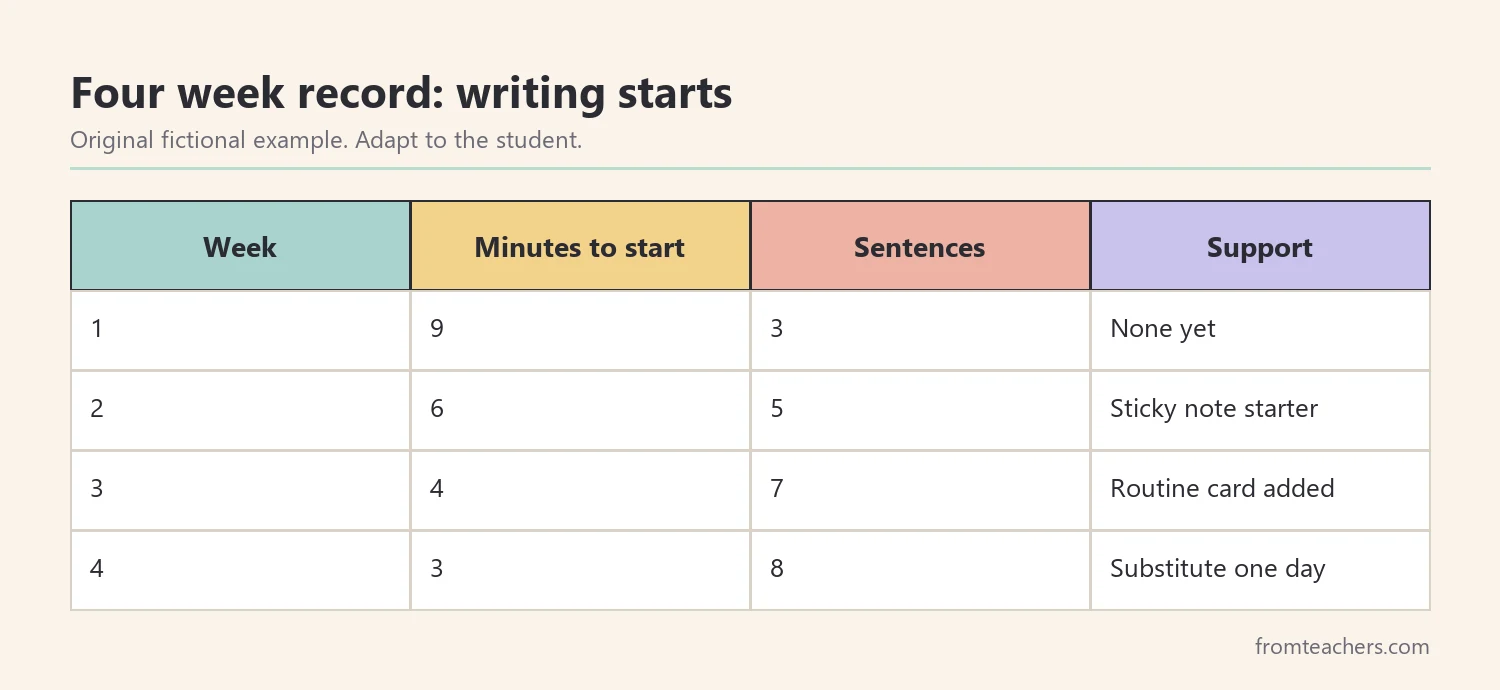
In short, a small record turns a vague feeling (“she is getting better, I think”) into something you can share with the student, the family, and the team.
5. Review and fade the task initiation strategies
Finally, plan a short review every few weeks. Look at the record, ask the student what helps, and choose one change. The long term goal is independence, so the review should also ask which supports can be faded.
Fade one support at a time. For example, move from a written sentence starter to a choice of two starters, then to “write your own first step.” Not all task initiation strategies need to fade at the same speed. Keep the routine card longer than the other supports, since it costs little and keeps the start predictable.
Furthermore, share the plan with families in plain language. Homework often shows the same freeze. If parents use the same routine words at home, the student practices the skill in two places. Consistent task initiation strategies across school and home also send one clear message: starting is a skill we practice together.
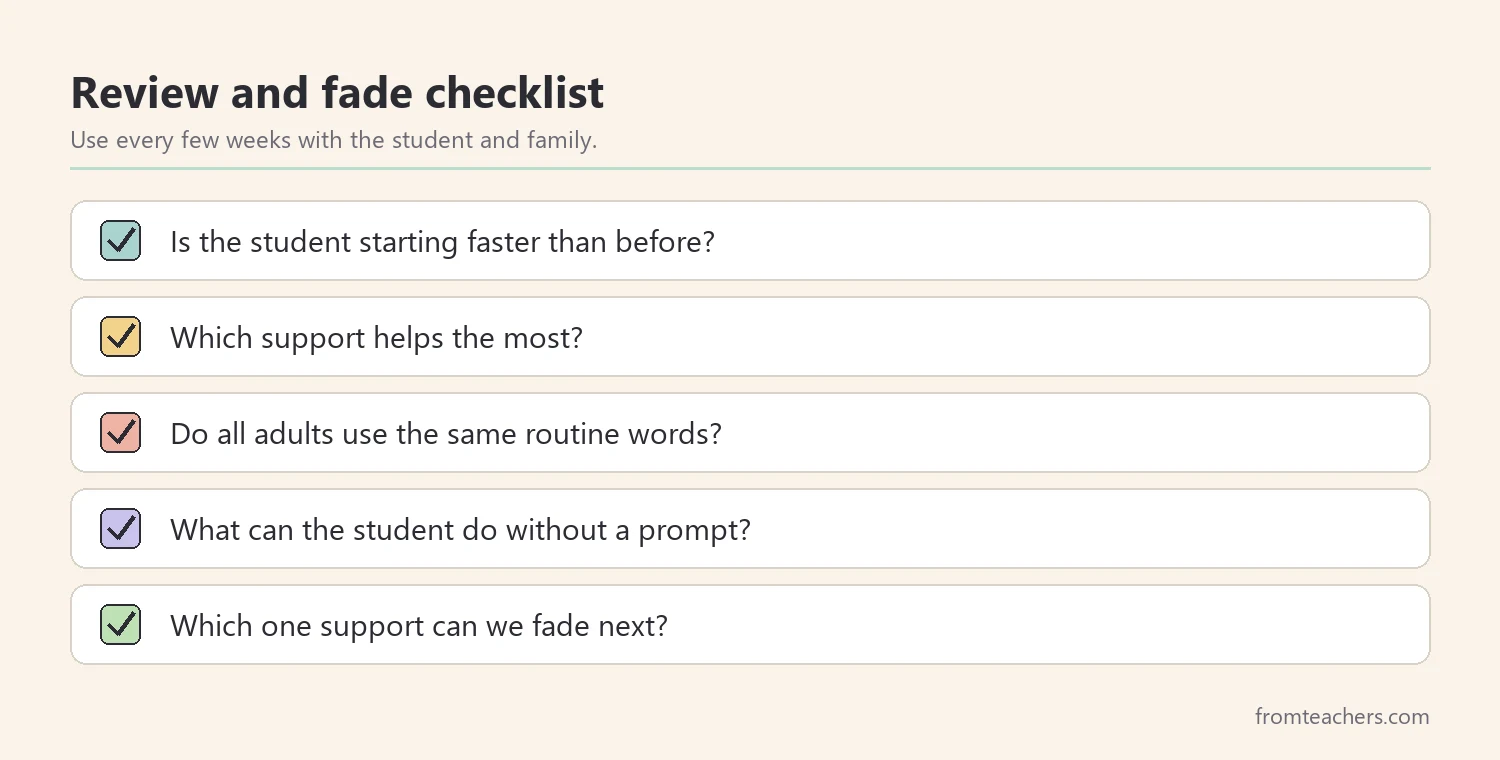
Use these review questions:
- Is the student starting faster than before?
- Which support seems to help the most?
- Does every adult use the same routine words?
- What can the student now do without a prompt?
- Which one support could we fade next?
Worked example. After four weeks, Ms. Ortiz meets with Maya for ten minutes. Maya says the timer helps most and the sticky note starters now feel “a little babyish.” Together they agree that Maya will write her own first step on the sticky note, and Ms. Ortiz will check it at the start of class. Maya’s parents get a short note with the routine card so homework can follow the same steps.
Common mistakes and how to avoid them
- Treating the freeze as a choice. Fix: assume a skill gap first and look for the barrier.
- Repeating directions louder. Fix: write the first step down and point to it.
- Making the first step too big. Fix: shrink it until starting feels almost too easy.
- Changing supports every day. Fix: keep one routine for at least two or three weeks.
- Tracking only finished work. Fix: record minutes to start as well.
- Removing every support at once. Fix: fade one support at a time and watch the record.
Questions teachers and parents ask about task initiation strategies
Is trouble starting tasks a sign of ADHD?
Difficulty starting work is common in students with ADHD, but it also appears with anxiety, learning differences, and in many students with no diagnosis. Only a qualified professional can evaluate a student. In the meantime, the strategies in this guide can help any student who freezes.
How small should the first step be?
Small enough that the student can do it right now without asking a question. Often that means one action, such as writing a name, copying a heading, or answering the first item. If the student still freezes, make it smaller.
Do timers really help as task initiation strategies?
For many students, yes. A short timer turns a huge task into a few minutes of work, which feels more doable. Watch the student, though, because some find a visible countdown stressful and do better with a quiet timer.
How can parents use task initiation strategies at home?
Parents can use the same routine words as school, put the first homework step on a sticky note, and set a short timer. Also, a calm start time and a cleared table reduce decisions. Praise the start, not only the finished work. Even a single sentence written without a reminder is worth noticing out loud.
How long before we see a change?
It varies by student, and by how consistently adults use the task initiation strategies. Some show faster starts within a week or two, while others need longer. That is why a simple record helps: it shows small changes you might miss day to day.
Related reading: Effective ADHD classroom strategies to support student success, 5 practical teaching tips to boost classroom focus, and the power of data tracking in special education.
A companion resource for students who can’t start:
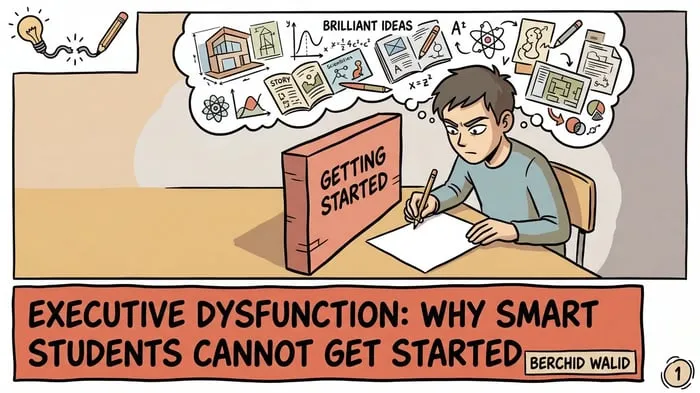
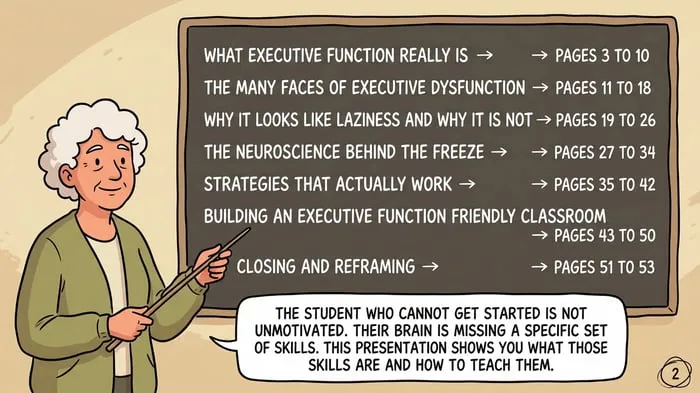
Executive Function Guide: Why Smart Students Get Stuck: a 53 page comic style guide that explains executive dysfunction, why it can look like laziness, and the strategies that help, so you can respond to the freeze with understanding.
Sources and scope
For further reading, these organizations offer reliable background on executive function and learning:
- Center on the Developing Child at Harvard University, which explains executive function and self-regulation for educators and families.
- Understood.org, with practical articles on executive function, ADHD, and learning differences.
- CDC ADHD information, for general facts about ADHD in children.
- The IRIS Center, offering free learning modules on classroom behavior and instruction.
Scope: this guide offers classroom and home strategies for getting started on tasks. It does not diagnose ADHD or any other condition and does not replace an evaluation, an IEP, or advice from a qualified professional.
Key takeaways
- A freeze at the start is often a skill gap, not a lack of effort.
- Strong task initiation strategies shrink the first step and write it down.
- A short routine with a timer reduces decisions at the hardest moment.
- Record minutes to start so progress is visible.
- Review task initiation strategies every few weeks and fade one support at a time.



Leave a Comment