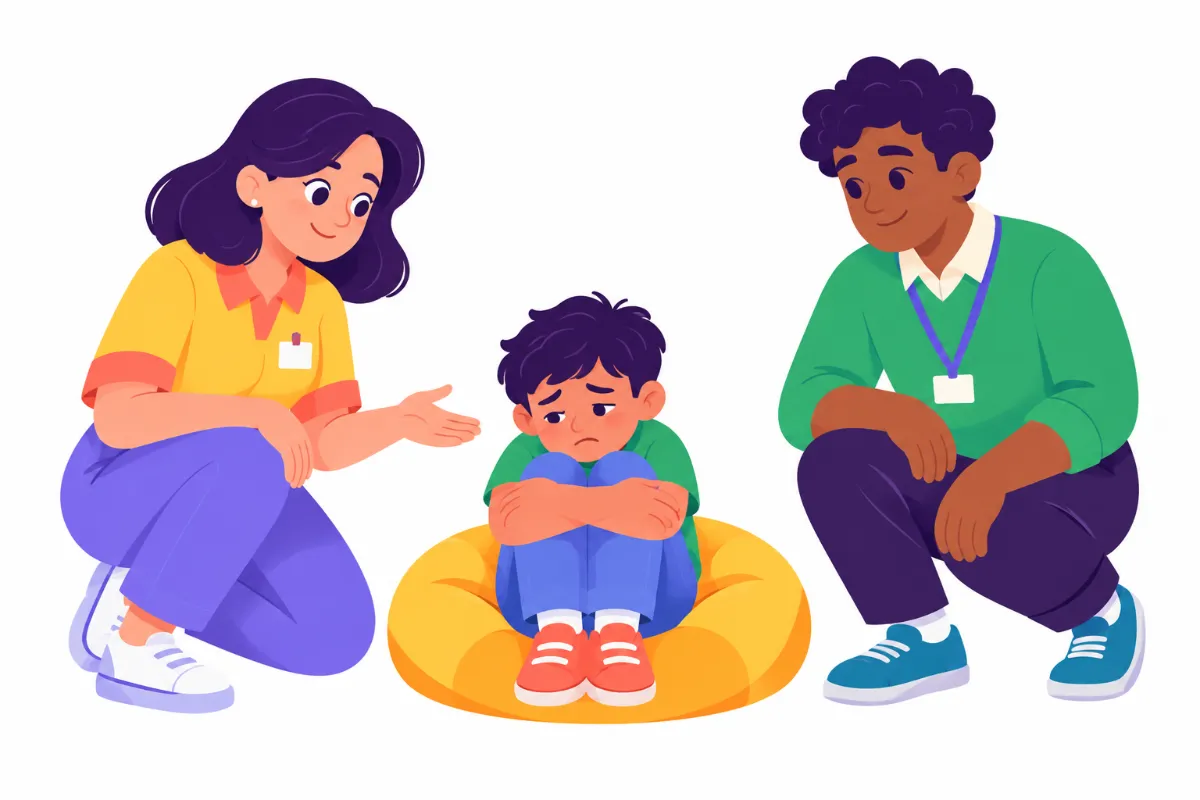

Unsafe behavior in school can turn an ordinary morning upside down in seconds. A chair goes over, a student bolts for the door, or a classmate gets hit, and every adult in the room feels the same rush of fear and pressure to act fast.
After reading this guide, you will be able to describe unsafe behavior in school in clear, observable terms, find the unmet need behind it, plan a calm response, and know when the student needs more than one classroom can offer. In short, you will have a team process instead of a series of emergencies.
Examples are fictional. Adapt to the student’s goals and agreed supports. This is guidance, not a diagnosis.
At a glance
- Unsafe behavior in school is usually a signal of overwhelm or an unmet need, not a choice to cause harm.
- Safety comes first in the moment; understanding and planning come after.
- Rewards and harsher consequences rarely work for a student whose body is not regulated.
- Patterns across days tell you more than any single bad day.
- Some needs go beyond classroom capacity, and naming that honestly is part of a safe plan.
1. Define unsafe behavior in school in observable terms
First, the team needs a shared definition of unsafe behavior in school. Words like “aggressive,” “violent,” or “out of control” mean different things to different adults. As a result, one teacher calls for help early while another waits until someone is hurt.
Instead, describe what the behavior looks like and sounds like. A good definition passes the stranger test: a substitute who has never met the student could read it and recognize the behavior. In addition, separate unsafe actions from behavior that is simply disruptive or annoying.
For example, meet Jonah, a fictional grade 3 student. His team first wrote “Jonah becomes aggressive.” After one meeting, they replaced it with three clear definitions.
| Vague label | Observable definition | Unsafe? |
|---|---|---|
| Aggressive | Hits or kicks a peer or adult with hand or foot | Yes |
| Runs off | Leaves the classroom or playground without an adult | Yes |
| Destructive | Throws chairs or hard objects toward people | Yes |
| Defiant | Says “no” and puts head on desk | No |
Notice the last row. Refusal can be frustrating, yet it is not unsafe. Therefore, the team agreed not to treat Jonah’s head-down refusal as a crisis. That decision alone lowered the number of tense moments, because adults stopped pushing on a behavior that posed no danger.
Finally, keep the list short. Most students show two to four unsafe behaviors that matter. Focusing on those helps the team track progress honestly and avoid labeling the whole child.
2. Read unsafe behavior in school as a signal of unmet needs
Next, shift the question from “How do we stop this?” to “What is this telling us?” No student wakes up planning to hurt a classmate. Usually, unsafe behavior in school appears when stress outruns the coping skills the child has right now.
In other words, the behavior is often the loudest message a student can send. A child who bolts may be escaping noise, failure, or fear. Similarly, a child who hits may not have a faster way to say “Stop, I am overwhelmed.”
Common needs behind unsafe behavior in school include:
- Sensory overload: crowded halls, loud rooms, bright lights, or strong smells.
- Demands beyond current skills: work that feels impossible or arrives without warning.
- Communication gaps: no reliable way to ask for a break, help, or a stop.
- Unexpected change: a missing adult, a schedule shift, or a fire drill.
- Body signals: hunger, poor sleep, pain, or a need to move.
For Jonah, the team noticed that most hitting happened during whole-group reading on the carpet. Kids sat close together, the room got loud, and Jonah had no easy way out. Consequently, the message seemed to be “I need space and a way to leave safely,” not “I want to hurt people.”
Of course, a hypothesis is only a starting point. The team will test it with data in step 4. Even so, naming a likely need changes how adults talk about the student, and that change in tone matters.
3. Respond calmly in the moment and avoid common escalators
During a moment of unsafe behavior in school, the goal is simple: keep everyone safe and help the student’s body settle. Teaching, lecturing, and consequences can wait. In fact, the brain of a dysregulated student is not ready to learn a lesson in that moment.
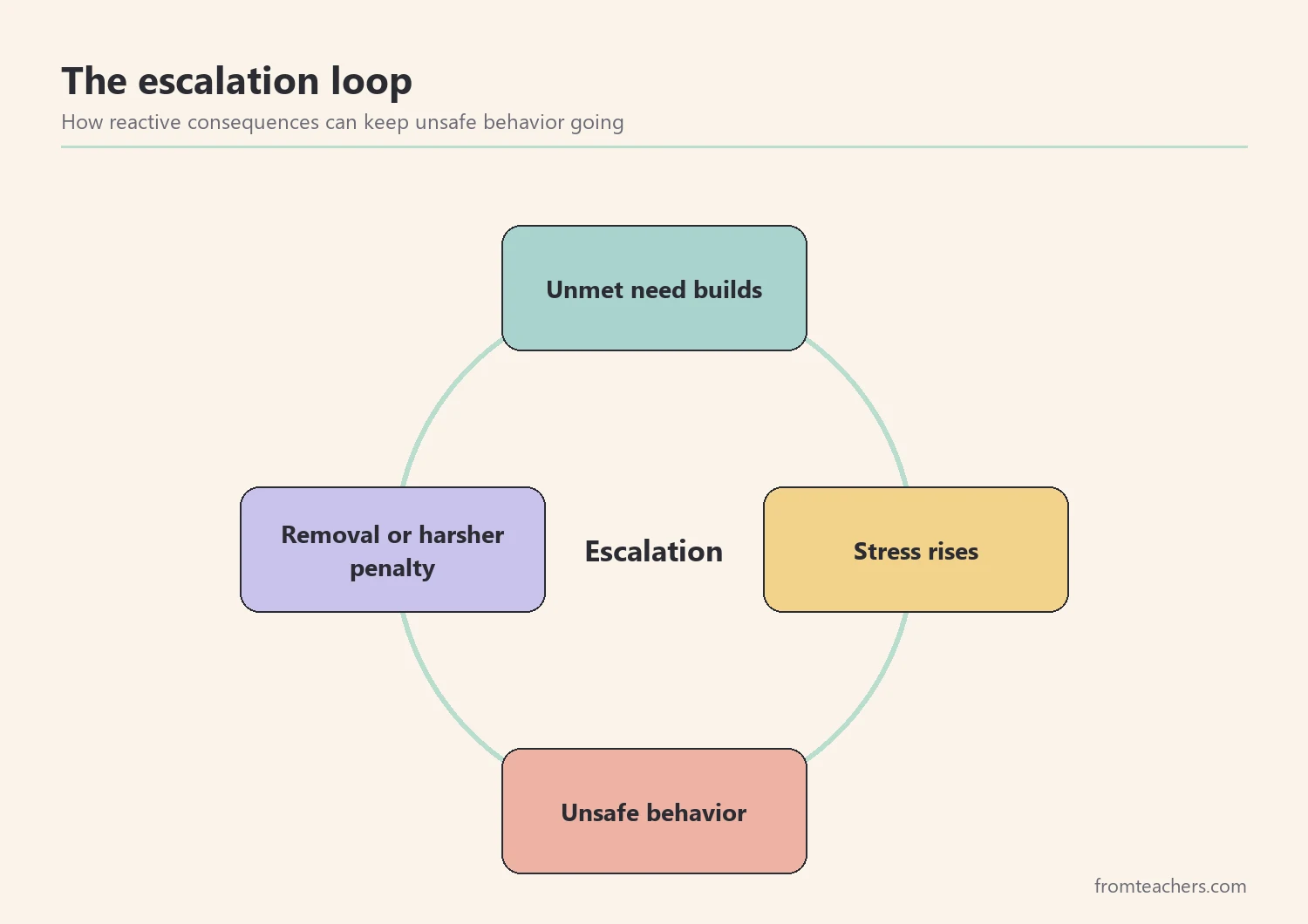
Several common responses to unsafe behavior in school tend to make things worse. For instance, offering a reward mid-crisis assumes the student can choose to calm down for a prize. However, a student whose body is not regulated may not have that choice available yet. This is the core of what some trainers call the myth of motivation.
Likewise, physical prompting carries real risk. Hands-on guidance, pulling an arm, or blocking a doorway can feel threatening, especially for students with trauma histories. As a result, touch can turn a tense moment into a dangerous one. Always follow your district’s policy and your student’s written plan on physical contact.
Instead, use calm, low-demand moves:
- Lower your voice and use few words.
- Give space and stand at an angle, not face to face.
- Move other students away rather than moving the upset student.
- Offer one simple choice, such as “Cushion or hallway with me?”
- Remove objects that could be thrown if you can do it safely.
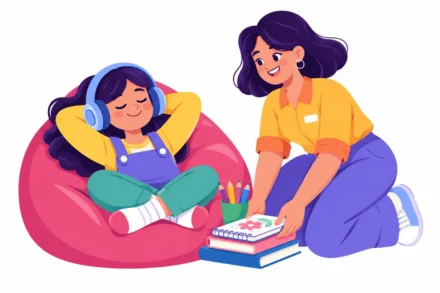
For Jonah, staff practiced a short routine. One adult quietly led the class to the reading table while a second adult stayed near Jonah, sat down, and said only, “You are safe. I will wait.” Within a few minutes, he usually moved to the beanbag on his own.
4. Track patterns of unsafe behavior in school, not single bad days
After the moment passes, it is tempting to judge the whole week by the worst incident. Still, one hard day tells you very little. Patterns across several days are what reveal triggers, times, and settings worth changing.
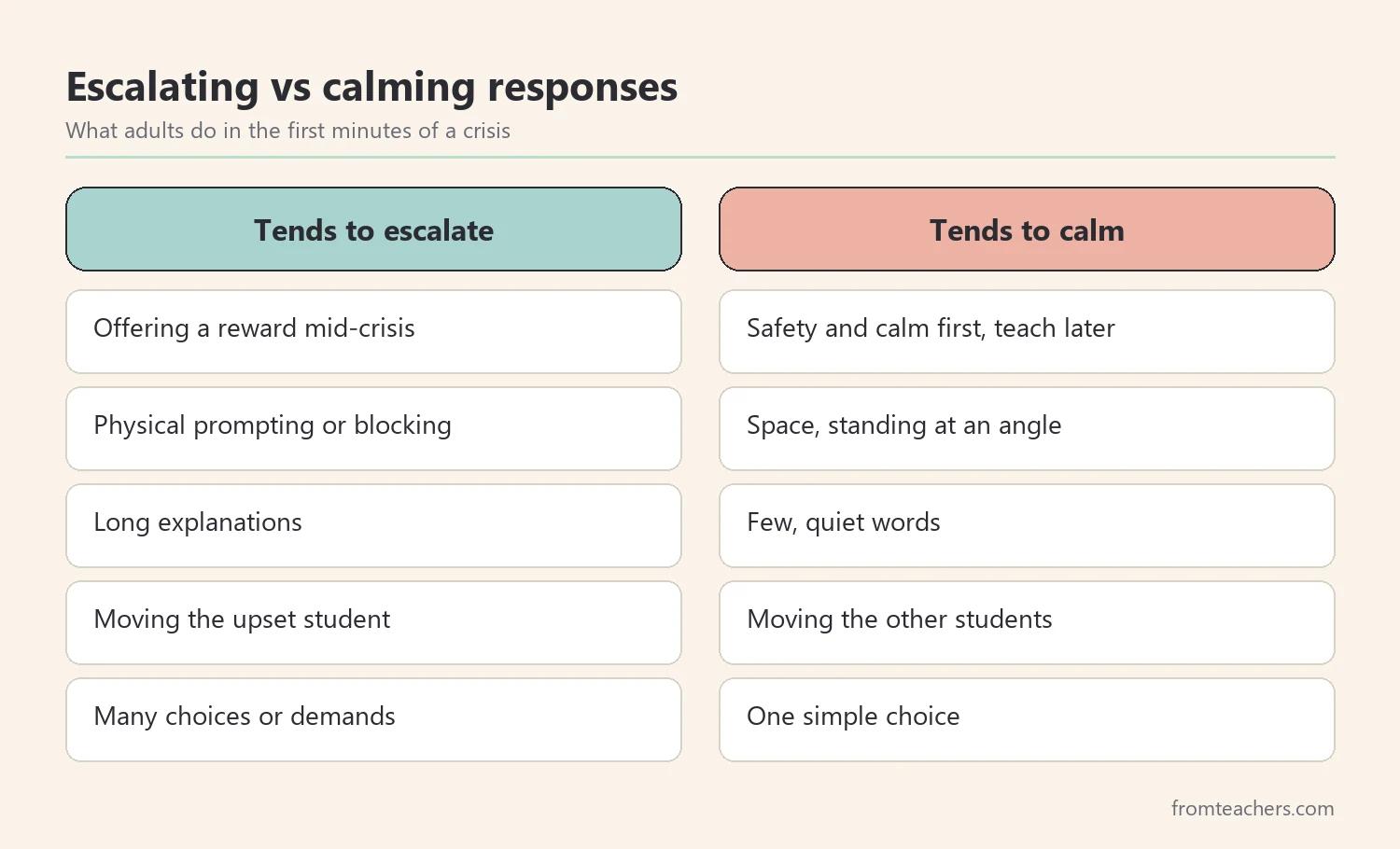
Therefore, keep a short log after each incident of unsafe behavior in school. Five fields are enough: date and time, setting, what happened just before, what the behavior looked like, and what happened right after. In addition, note how long it lasted and what helped the student return to calm.
Here is a fictional two-week summary for Jonah’s 10 logged incidents:
| Setting | Incidents | Common trigger |
|---|---|---|
| Carpet reading | 6 | Close seating, loud room |
| Hallway transition | 3 | Crowding at the door |
| Lunch | 1 | Schedule change |
| Total | 10 |
The numbers made the pattern hard to ignore. Six of ten incidents happened on the carpet, and nine of ten involved crowding or noise. Consequently, the team decided to test a change before adding any new consequence.
Also, look at what adults did after each incident. If the student is regularly removed from the hardest task, the behavior may be working as an escape route. That is not a reason to blame anyone. Rather, it is useful information for designing a better way to get the same need met.
For a structured tool to organize this kind of team review, the When Behavior Is Unsafe guide for SPED teams walks through patterns, escalation, and capacity with built-in reflection questions.
5. Build a safety plan that meets the need
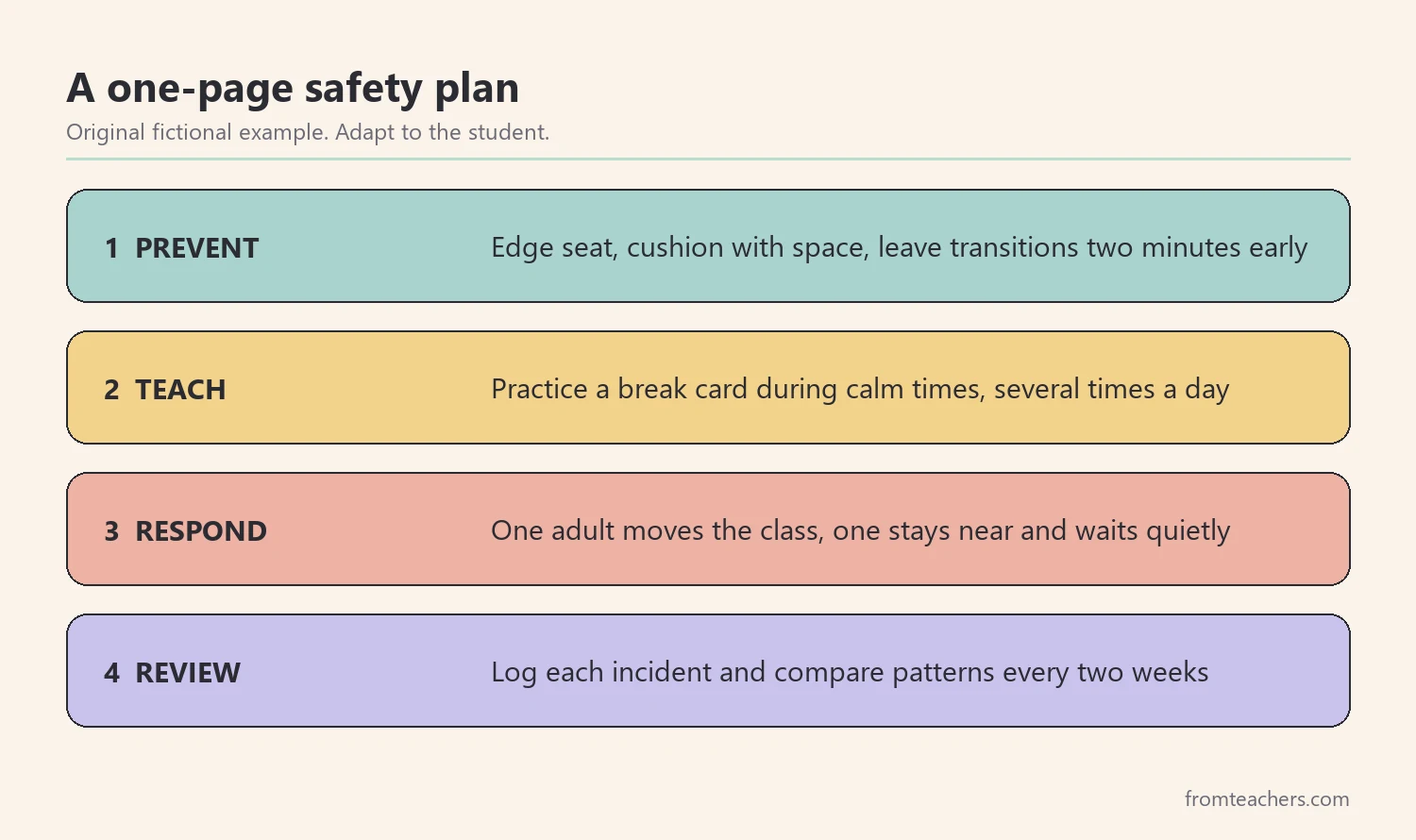
With a pattern in hand, the team can build a plan. A strong plan for unsafe behavior in school has three parts: prevent the predictable triggers, teach a safer way to meet the need, and agree on a calm crisis response. Each part should fit on one page so every adult can use it.
First, prevention. Change the setting before you try to change the child. For Jonah, that meant a seat at the edge of the carpet, a cushion with clear space around it, and leaving for transitions two minutes before the class.
Second, teach a replacement skill. Jonah needed a fast, reliable way to say “I need space.” So his teacher introduced a break card and practiced it during calm times, several times a day, with praise each time he used it.
Third, write the crisis response in plain steps: who moves the class, who stays near the student, where the calm space is, and who to call. Afterward, the adult who stayed checks in briefly and writes the log entry.
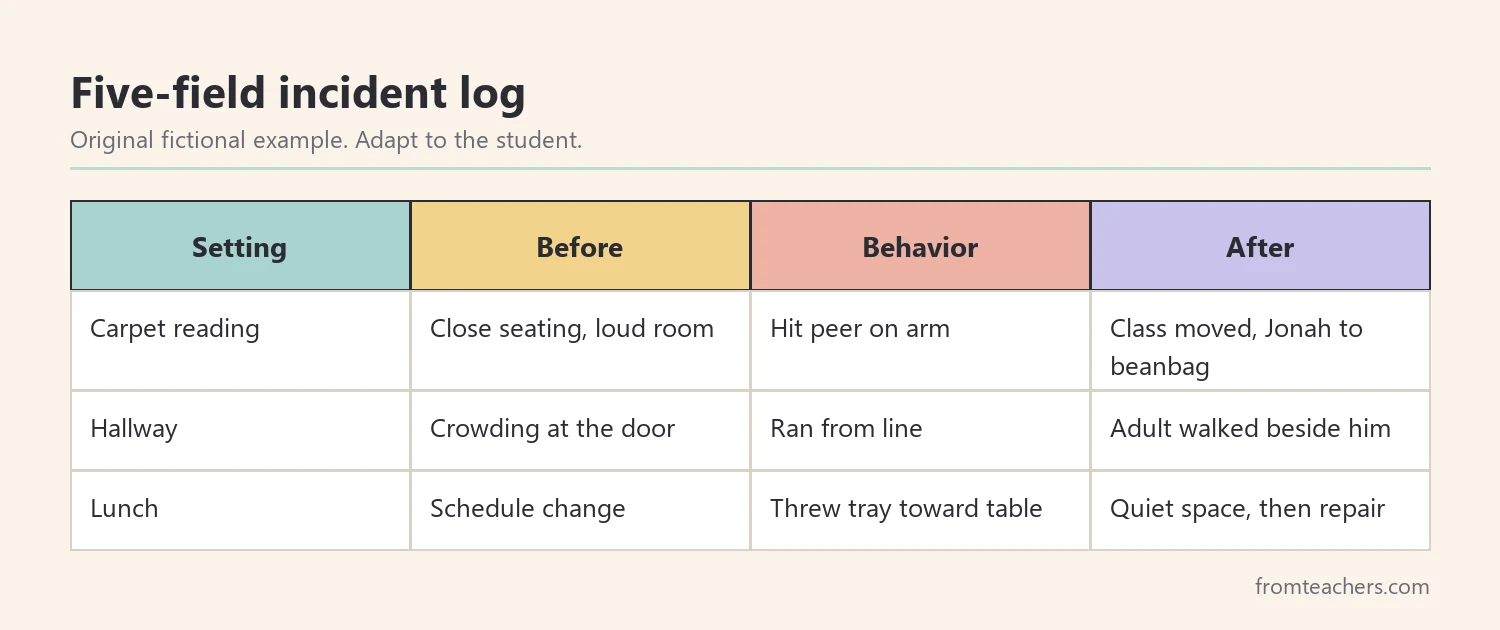
Equally important, avoid escalating consequences. When each incident of unsafe behavior in school brings a harsher penalty, stress goes up, which makes the next incident more likely. Natural repairs, such as helping pick up chairs once calm, work better than stacking punishments. Moreover, they protect the relationship the student will need in order to feel safe enough to try new skills.
6. Recognize when needs go beyond classroom capacity
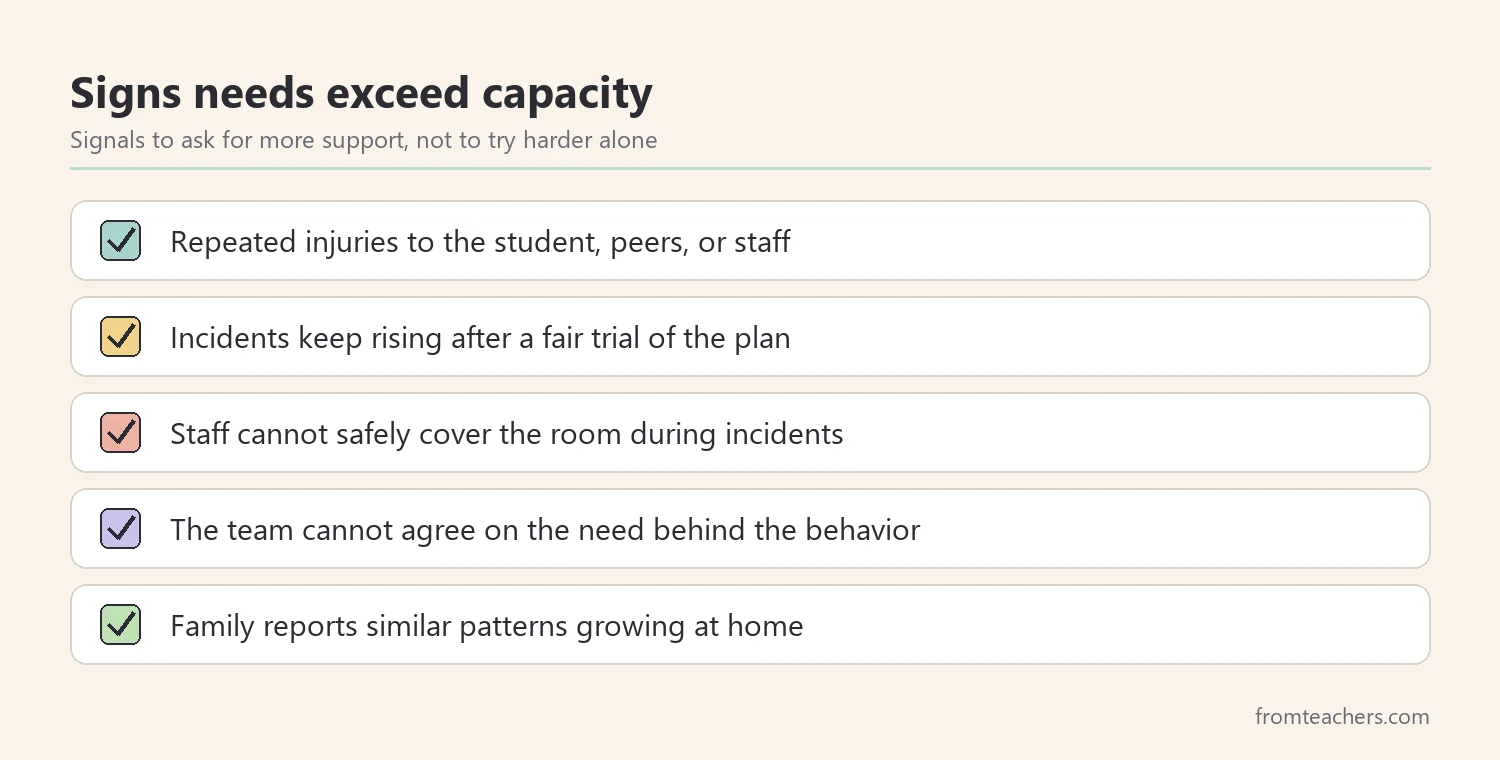
Sometimes a well-run plan for unsafe behavior in school is still not enough. That is not a failure of the teacher or the student. Rather, it can mean the student’s needs exceed the supports currently available in that setting.
Signs that a team should ask for more include repeated injuries, incidents that keep rising after a fair trial of the plan, or staff who cannot safely cover the room. In those cases, the team may need to revisit the IEP, request a functional behavior assessment, add trained staff, or consider a different level of support.
For Jonah, incidents dropped after the carpet and transition changes. Even so, the team scheduled a review date in case they rose again. Planning for capacity ahead of time, before unsafe behavior in school spikes again, keeps the conversation calm and focused on the child.
Above all, involve families early. Parents often know the triggers and calming strategies that work at home. As a result, home and school can use the same words and the same break signal.
Common mistakes and how to avoid them
- Mistake: Treating every refusal as unsafe. Fix: Define unsafe actions clearly and respond calmly to the rest.
- Mistake: Offering rewards during the crisis. Fix: Focus on safety and calm first; teach skills later when the student is regulated.
- Mistake: Judging progress by one bad day. Fix: Compare patterns over two weeks or more.
- Mistake: Stacking harsher consequences. Fix: Change triggers and teach a replacement skill instead.
- Mistake: Waiting too long to ask for help. Fix: Agree on review dates and clear signals for more support.
Questions teachers and parents ask about unsafe behavior in school
Is unsafe behavior in school always linked to a disability?
No. Any student can show unsafe behavior in school under enough stress. However, students with communication, sensory, or regulation differences may reach that point sooner, so teams should look closely at those needs.
Should we use a reward chart for unsafe behavior?
Reward charts can help with skills a student is able to choose, such as finishing work. Still, they rarely help a student whose body is in fight or flight. Teaching regulation and changing triggers usually comes first.
What if other students are scared?
Their feelings are valid and deserve attention. Practice a calm room-clear routine so they know what to do, and keep the explanation simple and private. Afterward, reassure them that adults are keeping everyone safe.
How long before we see change?
It depends on the student and the plan. Many teams review data after two to four weeks of consistent use. If nothing improves, revisit the hypothesis rather than simply adding consequences.
When should we request a functional behavior assessment?
Consider one when unsafe behavior in school continues despite a fair trial of supports, or when the team cannot agree on the need behind it. Your district’s special education staff can explain the process.
Related reading: Meltdowns vs tantrums: understanding and responding, trauma-informed teaching strategies, and positive alternatives to shame and behavior charts.
A companion resource for safer school teams:
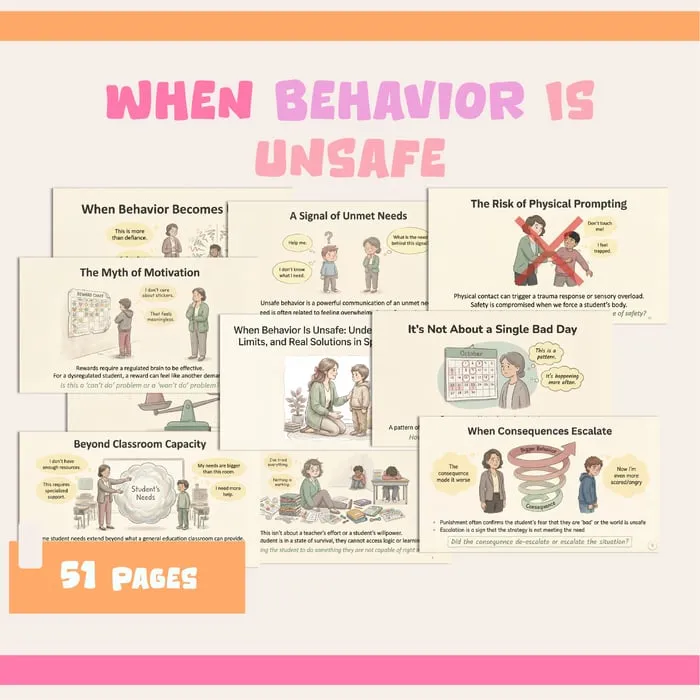
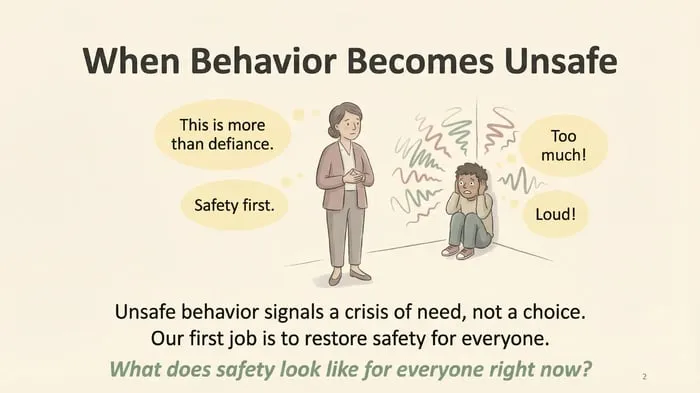
When Behavior Is Unsafe: Understanding Needs, Limits, and Real Solutions: a discussion-ready guide that helps SPED teams reframe unsafe behavior as unmet needs, spot responses that escalate, and recognize when needs exceed classroom capacity, with reflection questions on every slide.
Sources and scope
- Individuals with Disabilities Education Act (IDEA), U.S. Department of Education: the federal framework for IEPs and behavior supports.
- IRIS Center at Vanderbilt University: free modules on behavior, classroom management, and functional assessment.
- Center on PBIS: resources on positive behavioral interventions and supports.
- Understood.org: plain-language guidance for families and educators on learning and thinking differences.
This guide covers everyday team planning for unsafe behavior; it does not replace crisis training, district restraint and seclusion policy, medical advice, or a formal functional behavior assessment.
Key takeaways
- Define unsafe behavior in school in observable terms everyone shares.
- Treat the behavior as a signal and form a hypothesis about the need.
- In the moment, choose space, few words, and safety over rewards or touch.
- Use simple logs to find patterns, then change triggers and teach a replacement skill.
- Plan review dates and ask for more support when needs exceed capacity.





Leave a Comment