

Autistic burnout recovery often begins after a moment that adults misread. A student who held it together all semester suddenly stops handing in work, sleeps through first period, or freezes when asked a simple question. To staff, it can look like a sudden drop in effort. To the student, it is the end of months of hiding how hard each day has been.
This guide shows how to notice masking, spot early signs of burnout, reduce demands without lowering respect, and build a slow, steady return. After reading, you will have a practical plan you can share with the student, the family, and the school team.
Examples are fictional. Adapt to the student’s goals and agreed supports. This is guidance, not a diagnosis.
At a glance
- Masking means hiding or copying behavior to fit in, and it costs a lot of energy.
- Burnout usually builds slowly, so early signs matter more than the final crash.
- Recovery starts with fewer demands and more rest, not with more pressure.
- Accommodations are tools for access, not rewards to be earned.
- Plan a gradual return with the student, and track energy as well as work.
1. Understand masking and why it drains energy
Masking, sometimes called camouflaging, is when an autistic person hides natural responses to appear like peers. For example, a student might force eye contact, copy classmates’ jokes, hold back the urge to move, or rehearse every sentence before speaking. Many autistic people describe it as a skill they learned to stay safe or to avoid teasing.
However, masking has a cost. Every hour of monitoring one’s own face, voice, and body uses energy that other students can spend on learning. Over weeks and months, that cost adds up. As a result, a student who looks calm and compliant may be running on empty.
Adults can learn to notice possible masking without labeling the student. Look for patterns such as:
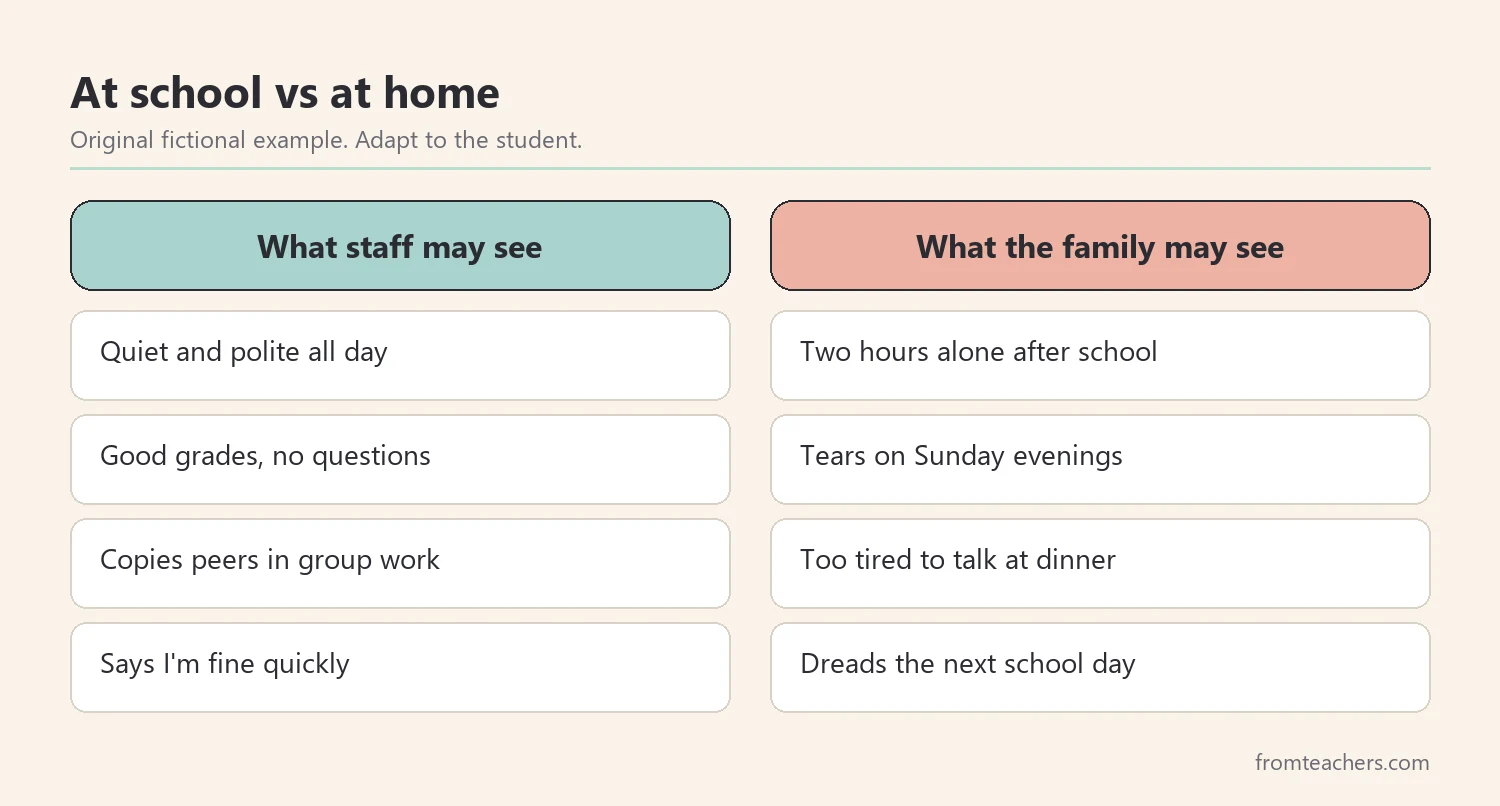
- Very different behavior at school and at home, with long shutdowns after school.
- Copying peers’ phrases or gestures closely, then appearing lost when the script runs out.
- Rarely asking for help, even when work is clearly hard.
- Saying “I’m fine” quickly, then avoiding the next task.
Worked example: Maya, grade 8
Maya earns good grades and is described as “quiet and polite.” At home, she spends two hours alone in her room after school and often cries on Sunday evenings. Her parent mentions this at a meeting. Until then, staff had no idea school was so draining for her.
That gap between school and home is the first clue. In fact, many families notice burnout before teachers do, because the student saves the release for a safe place.
2. Spot early signs before autistic burnout recovery is needed
The best autistic burnout recovery is the one that starts early. When adults wait for a full crash, the student may need weeks or months to return. In contrast, small changes made at the first signs can prevent a deep slump.
Early signs are often quiet. Watch for:
- Energy changes: more tiredness, slower starts, longer recovery after social events.
- Skill changes: skills that were steady, such as organizing, speaking, or eating lunch with peers, become harder.
- Sensory changes: lights, noise, or textures that were bearable now feel overwhelming.
- Attendance and work: more late arrivals, missed homework, or requests to stay home.
- Mood: more irritability, withdrawal, or statements like “I can’t do this anymore.”
None of these signs proves burnout on its own. However, a cluster of changes over a few weeks deserves attention. Bring the observations to the team, and ask the student and family what they notice.
Worked example: Maya’s warning signs
| Area | Before | Now (over 4 weeks) |
|---|---|---|
| Arrival | On time | Late 2 to 3 days a week |
| Lunch | Cafeteria with peers | Asks to eat in library |
| Homework | Complete | Missing in 3 subjects |
| Speech in class | Answers when called | Shrugs or whispers |
Taken together, these changes suggest Maya’s energy is running out, not that she has stopped caring.
Next, the team asked Maya privately how school felt lately. She wrote, “Everything takes more effort than before.” That one sentence, in her own words, became the starting point for the plan. Asking in writing, rather than face to face, made it easier for her to answer honestly.
3. Reduce demands and protect rest
Once burnout is likely, the first goal is to lower the total load. This can feel uncomfortable for schools, because the instinct is to push harder or add incentives. Yet adding pressure usually deepens burnout.
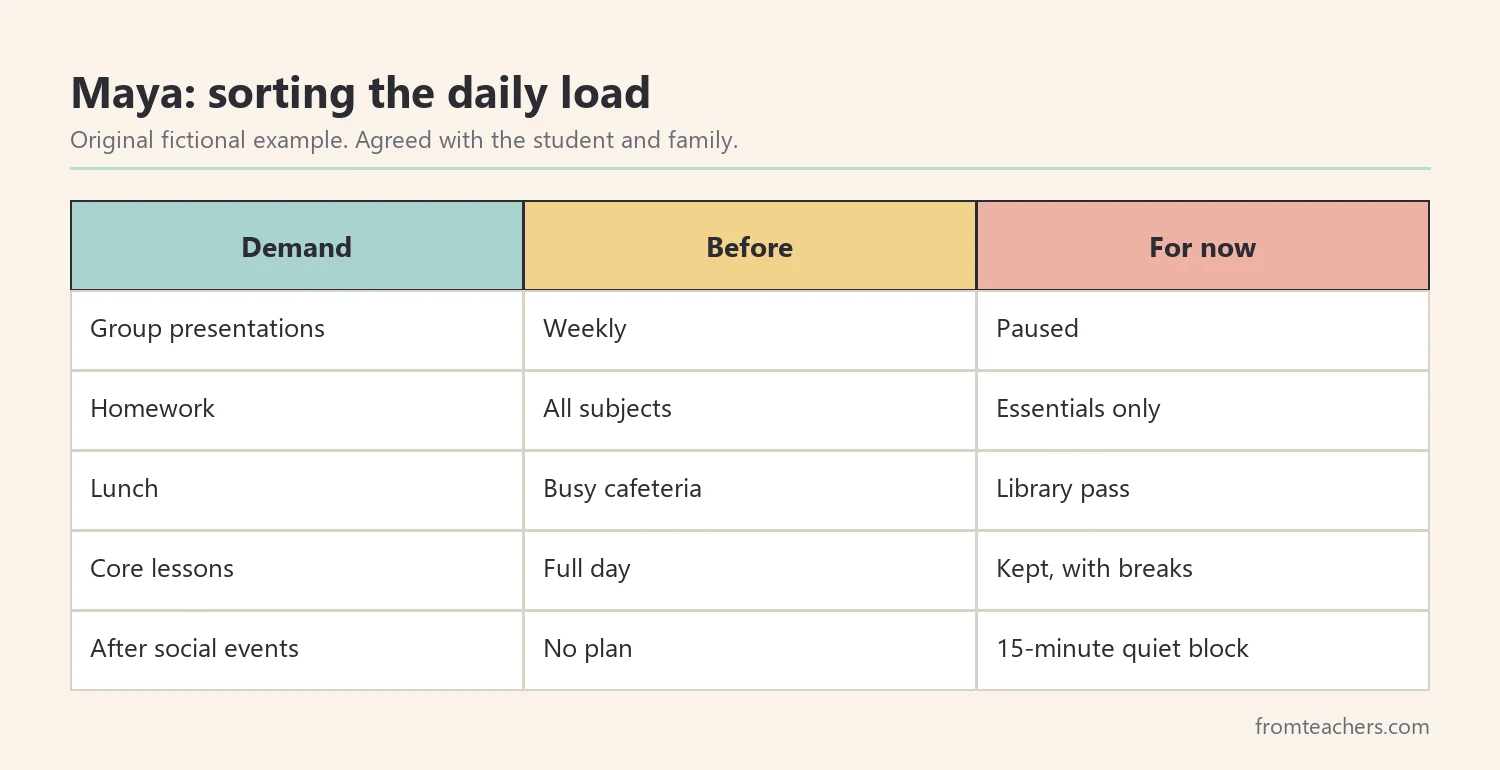
Start by listing every demand in the student’s day: academic, social, sensory, and organizational. Then decide with the student which demands can pause, shrink, or change for a few weeks. For example:
- Pause optional group presentations and allow written or recorded answers.
- Shorten homework to the essential practice only.
- Offer a quiet place to eat lunch or a short break before afternoon classes.
- Reduce sensory load with headphones, seat changes, or dimmer lighting where possible.
- Allow a later start or a lighter day if the team and family agree.
When you talk with the student about these changes, keep the message simple and kind. For example: “School has been using up a lot of your energy. For the next few weeks, we are making the day lighter so you can recover.” Avoid framing the changes as a punishment or a special favor. Instead, present them as a normal, temporary adjustment that many people need at times.
Moreover, protect rest at home. Families may need permission from school to let the evening be calm instead of full of catch-up work. A short note from the teacher saying “Rest is part of the plan” can lift a lot of guilt.
For staff who want ready language, the masking and burnout support tables for autistic students pair real classroom moments with a helpful response and the meaning behind it.
4. Support recovery after hard social days
Even during recovery, some days will be harder than others. Field trips, assemblies, group projects, and unexpected changes can leave a student exhausted. Therefore, plan for the hours after these events, not only the events themselves.
Helpful recovery supports include:
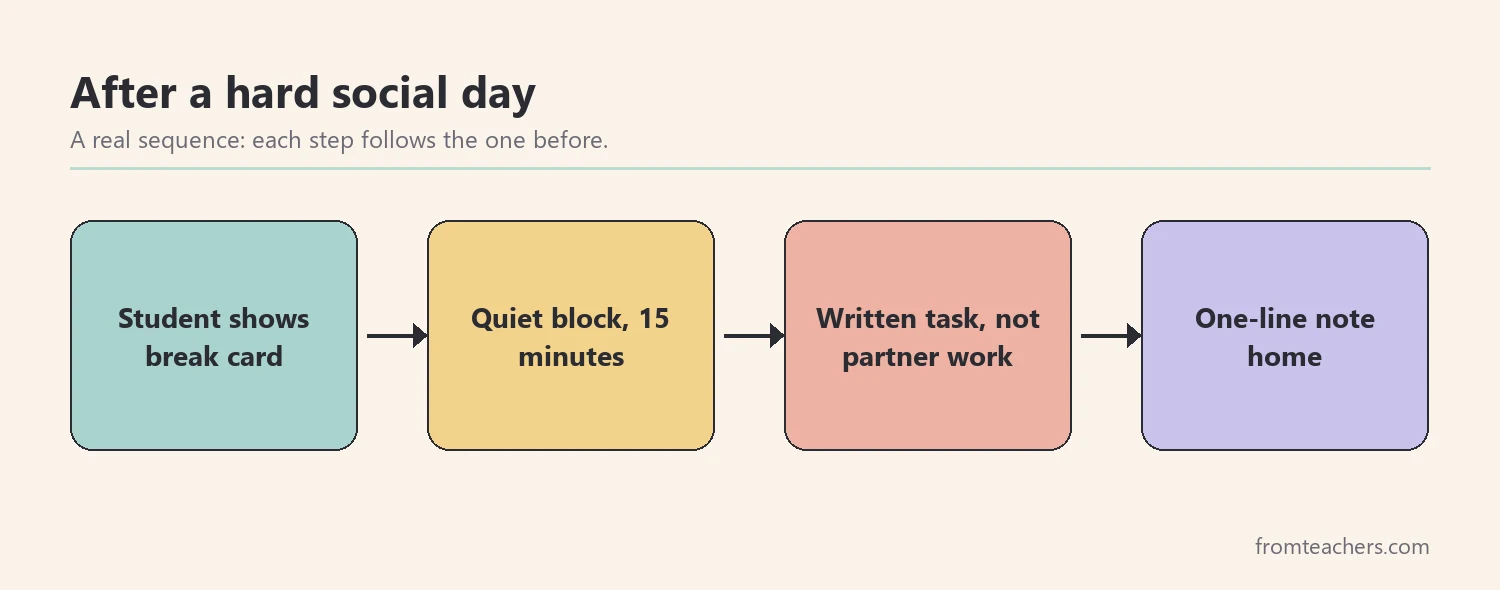
- A planned quiet block: a calm task after a social event, such as reading or drawing alone.
- Low-talk check-ins: a card, a thumbs signal, or a written note instead of a conversation.
- Predictable next steps: a short written schedule for the rest of the day.
- Home communication: a quick message so the family knows the day was heavy.
Language matters here too. Instead of “You seemed fine at lunch,” try “Lunch was busy today. It makes sense to feel tired now.” That kind of response treats exhaustion as real information, not as an excuse.
Worked example: Maya after an assembly
After a loud assembly, Maya slides a yellow card onto her teacher’s desk. The teacher nods and points to the reading corner. Maya reads with headphones for 15 minutes, then joins the next lesson with a written task instead of partner work. Later, the teacher sends a one-line note home: “Big assembly today. Maya used her quiet break well.”
5. Build an autistic burnout recovery plan with the student
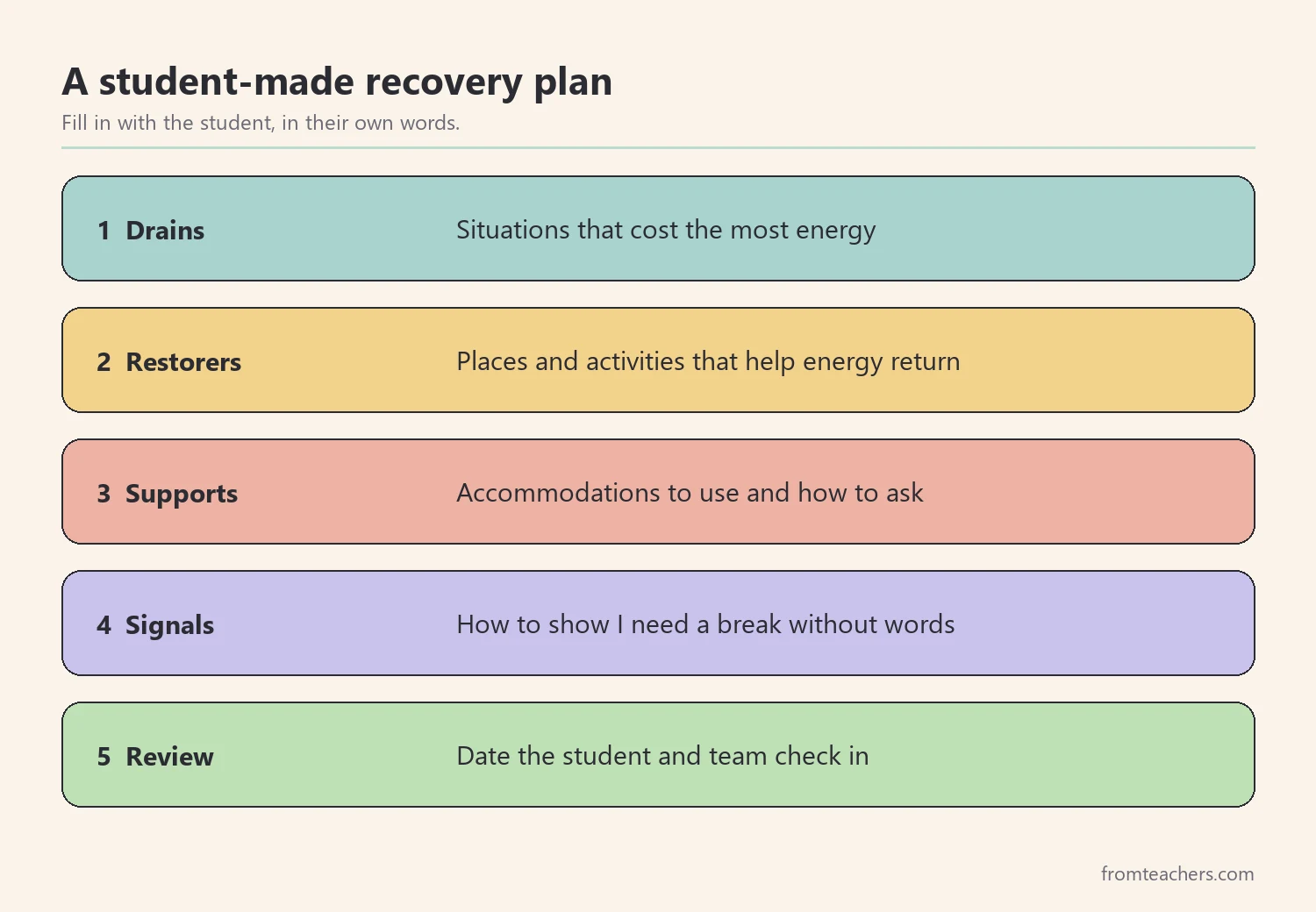
A written autistic burnout recovery plan keeps everyone consistent. More importantly, it gives the student a voice. Older students in particular can help name what drains them, what restores them, and which accommodations feel useful.
A simple plan includes:
- Drains: the situations that cost the most energy.
- Restorers: activities and places that help energy return.
- Accommodations: the supports the student will use, and how to ask for them.
- Signals: how the student will show “I need a break” without speaking.
- Review date: when the team and student will check in.
Some students resist accommodations because they do not want to look different. That reaction is understandable after years of masking. One gentle approach is to try one accommodation for a week and notice what changes. For instance, Maya agreed to try a lunch pass to the library for five days. By Friday she said the afternoons felt “less heavy,” and she decided to keep it.
In addition, share the plan with every adult who works with the student, including substitutes and specialists. A plan that only one teacher knows will break down on the first busy day.
6. Plan a gradual return and track energy
Recovery is rarely a straight line. Therefore, add demands back slowly, one at a time, and watch how the student responds. If energy drops again, step back to the last level that worked.
Track more than grades. A simple weekly scale from 1 (empty) to 5 (full), rated by the student, gives useful information. Combine it with attendance and work completion to see the full picture.
Worked example: Maya’s six-week return
| Week | Change added | Energy (1 to 5) | Days on time (of 5) |
|---|---|---|---|
| 1 | Reduced load begins | 1 | 2 |
| 2 | None, rest focus | 2 | 3 |
| 3 | Full homework in one subject | 2 | 3 |
| 4 | None, holding steady | 3 | 4 |
| 5 | One partner task per day | 3 | 4 |
| 6 | Review meeting | 4 | 5 |
Setbacks are normal. A family event, a schedule change, or exam season can pull energy down again. When that happens, return to the last week that felt manageable and hold there until the rating rises. In addition, tell the student plainly that stepping back is part of the plan. That message prevents the student from reading a setback as failure.
Finally, set a review meeting every four to six weeks. Bring the energy ratings, attendance, and the student’s own comments. Then decide together which supports stay, which can fade, and which new skills the student wants to work on, such as asking for a break in a new class.
Notice that the team left some weeks with no new demand. Holding steady is part of recovery, not a delay.
Common mistakes and how to avoid them
- Treating burnout as laziness. Fix: look at the pattern of changes and ask what has drained the student.
- Adding rewards to push through. Fix: lower demands first, then rebuild slowly.
- Removing all supports once the student looks better. Fix: keep the accommodations that helped, and review before removing any.
- Planning without the student. Fix: ask what drains and restores them, and use their words in the plan.
- Ignoring home. Fix: share a short weekly update and ask the family what they see after school.
Questions teachers and parents ask about autistic burnout recovery
How long does autistic burnout recovery take?
It varies from person to person. Some students recover in a few weeks with reduced demands, while others need much longer. Starting early and keeping the load low usually helps.
Is burnout the same as depression?
They can look similar, and they can happen together. If you are worried about a student’s mood or safety, involve the school counselor or psychologist and encourage the family to speak with a health professional.
Should we stop masking completely?
The goal is not to force a student to stop. Instead, aim for environments where the student feels safe enough to mask less. Reducing the need to mask is more respectful than demanding a change.
What if the student refuses accommodations?
Offer a short, low-pressure trial of one support and review it together. Make the support as private as possible, such as a card signal instead of a public break.
How can parents help at home?
Protect calm time after school, reduce extra activities for a while, and share what you notice with the school. Your observations often show the early signs that staff cannot see.
Related reading: Understanding Autistic Burnout and School Exhaustion, Managing Sensory Overload in Autism and ADHD, and Demand Avoidance and School Refusal.
A companion resource for autistic burnout recovery:
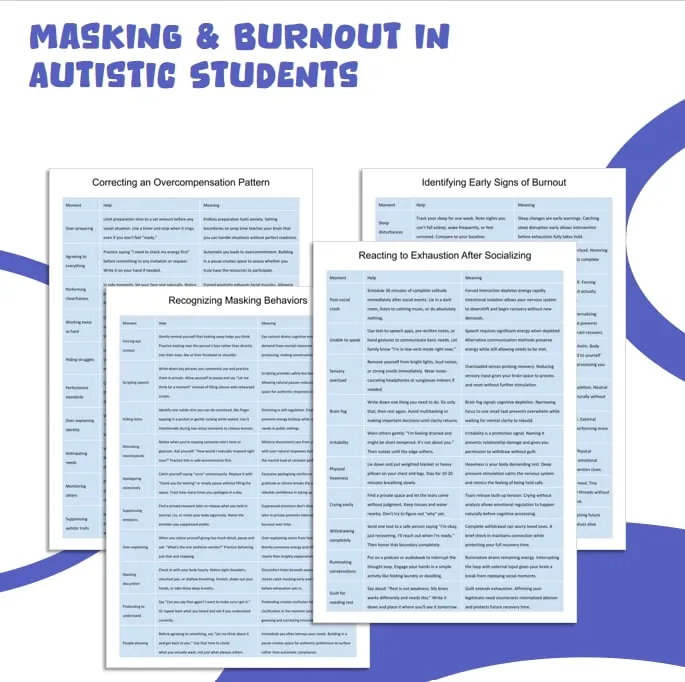
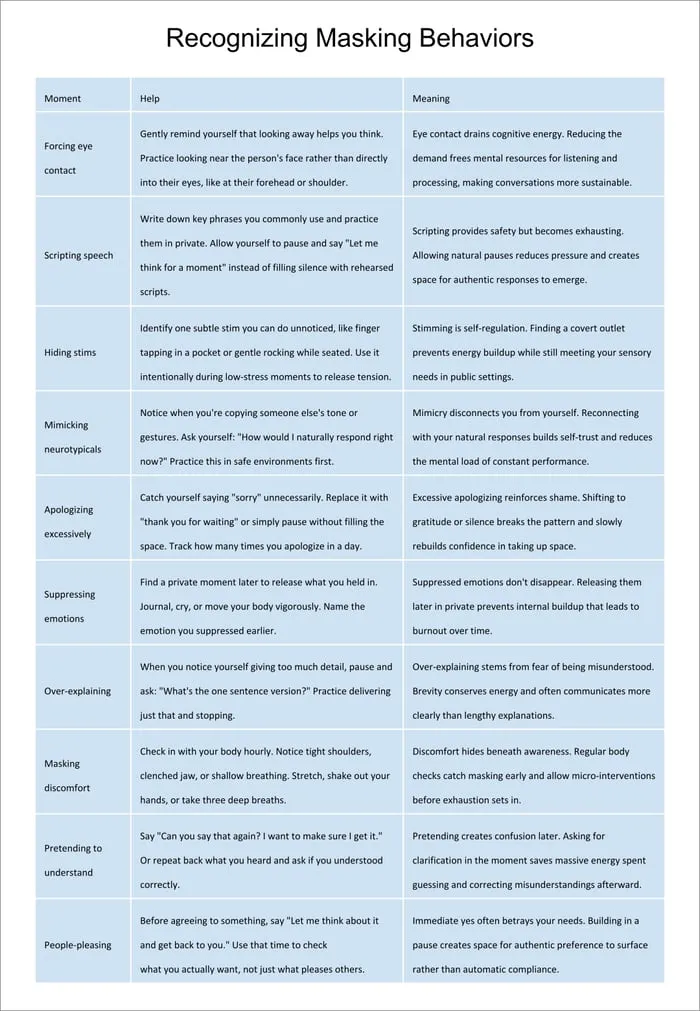
Masking and Burnout in Autistic Students: 12 pages of Moment, Help, and Meaning tables on recognizing masking, early signs of burnout, exhaustion after socializing, and accepting accommodations, for teachers, counselors, and older autistic students.
Sources and scope
- Centers for Disease Control and Prevention: Autism: general information about autism.
- IRIS Center, Vanderbilt University: free modules on autism and classroom supports.
- Understood.org: family and teacher resources on learning and thinking differences.
- Individuals with Disabilities Education Act (IDEA): the federal framework for accommodations and services.
Scope: this guide offers classroom and home strategies for students who may be experiencing masking and burnout. It does not diagnose or treat any condition, and concerns about mental health should go to qualified professionals.
Key takeaways
- Masking uses energy that other students can spend on learning.
- Watch for clusters of quiet changes, and listen to families.
- Lower demands and protect rest before rebuilding.
- Write the recovery plan with the student, using their words.
- Return slowly, track energy, and keep supports that work.










Leave a Comment