

An end of year journal gives students a calm, structured way to look back before the school year closes. The last weeks of school can feel chaotic: routines change, classrooms are packed up, and goodbyes come quickly. For many students in special education, that mix of change and emotion is hard to process. A guided journal turns those weeks into a chance to notice growth, name feelings, and say goodbye with confidence.
This guide shows how to plan and run reflection sessions that work for every learner, including students who do not write easily. After reading, you will be able to prepare the journal, make every prompt accessible, run short sessions, guide reflection on strengths and hard times, and share the finished journal with families and next year’s teacher.
Examples are fictional. Adapt to the student’s goals and agreed supports. This is guidance, not a diagnosis.
At a glance
- Reflection helps students make sense of the year and prepares them for change.
- Every prompt should allow writing, drawing, speaking, or choosing symbols.
- Students can always pass on a question without explaining why.
- Short, regular sessions work better than one long reflection day.
- The finished journal can support transition to next year’s class.
1. Understand why end of year reflection matters
Reflection is a skill. When students look back on what they learned, how they felt, and what helped them, they build self-awareness and self-advocacy. These skills matter for every student, but especially for students who will need to explain their needs to new teachers in the future.
In addition, reflection supports transitions. The end of the year brings many changes: a new teacher, a new classroom, maybe a new school. Looking back on the year helps students close one chapter before starting another. Moreover, it lets them see evidence of their own progress, which can ease worry about what comes next.
Finally, reflection gives adults valuable information. Students often share what helped them most, what was hard, and what they want next year. That information is useful for the next teacher and for the student’s team.
Worked example: Kai, grade 5
Kai is autistic and moving to middle school next year. He communicates well in short spoken sentences and sometimes uses picture symbols when he is stressed. Writing long answers tires him quickly. His teacher wants him to reflect on his year without turning the activity into a writing test.
For families, reflection at home can continue the conversation. A short note explaining the journal invites parents to ask about it and to share their own memories of the child’s year.
2. Prepare the end of year journal
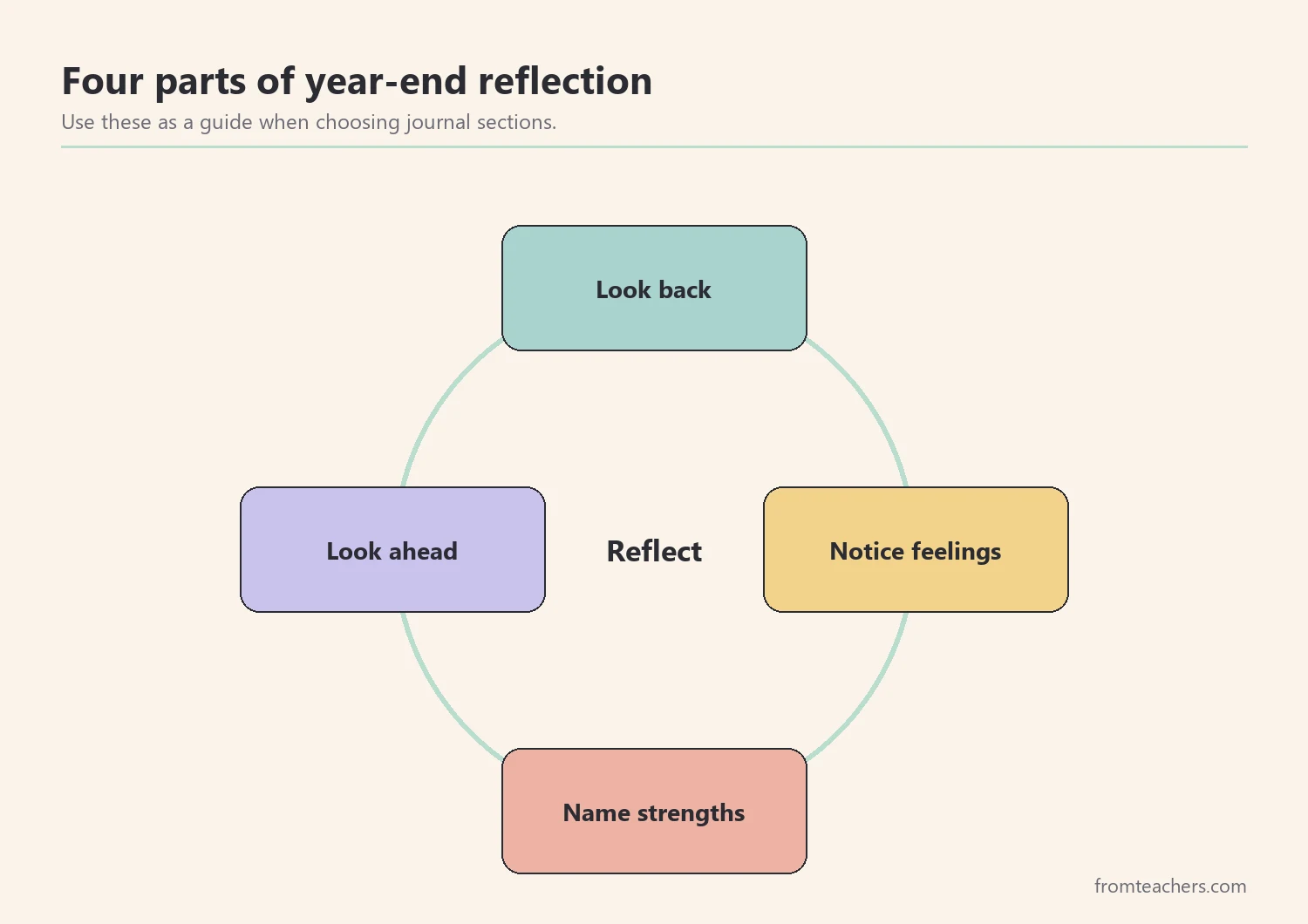
Preparation makes the sessions smoother. First, choose the sections you want to cover. A balanced journal includes looking back, learning, feelings, strengths, relationships, challenges, pride, goals, and a goodbye. You do not need to use every section with every student.
Next, gather materials: printed journal pages, pencils and markers, picture symbols, photos from the year, and examples of student work. Photos are especially helpful because they jog memory and give students something concrete to talk about.
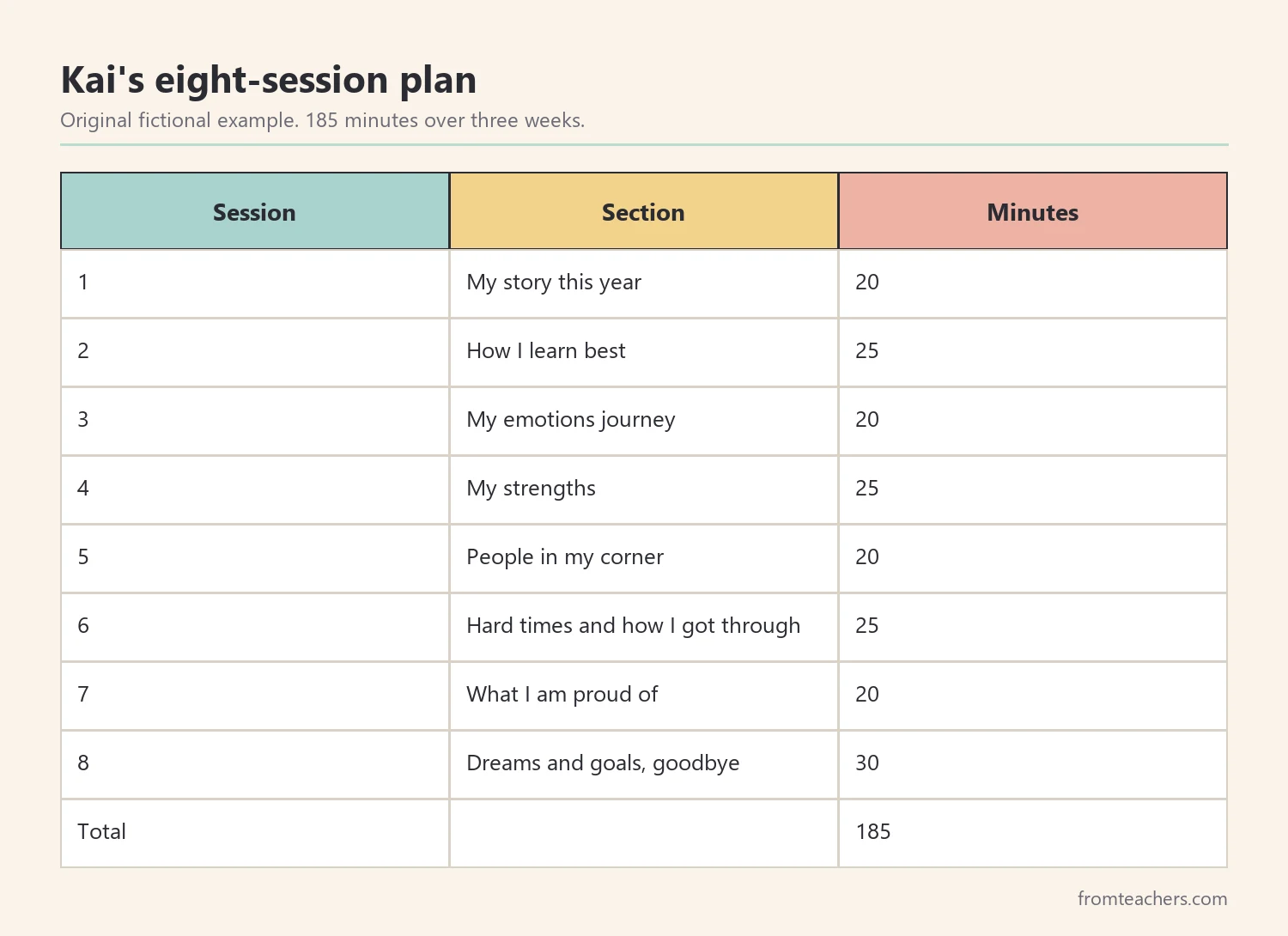
Then plan the schedule. Eight or nine short sessions spread over the last few weeks are often more manageable than one long block. Each session can cover one section.
A ready-made option can save a lot of planning time. The end of year reflection journal for special education students includes 37 pages of guided prompts and visual supports, designed to run as 8 to 9 guided sessions of 20 to 40 minutes.
Worked example: Kai’s session plan
| Session | Section | Minutes |
|---|---|---|
| 1 | My story this year | 20 |
| 2 | How I learn best | 25 |
| 3 | My emotions journey | 20 |
| 4 | My strengths | 25 |
| 5 | People in my corner | 20 |
| 6 | Hard times and how I got through | 25 |
| 7 | What I am proud of | 20 |
| 8 | Dreams and goals, goodbye | 30 |
| Total | 185 |
Spread over three weeks, that is about one hour per week, which fits into Kai’s existing schedule.
3. Make every prompt accessible
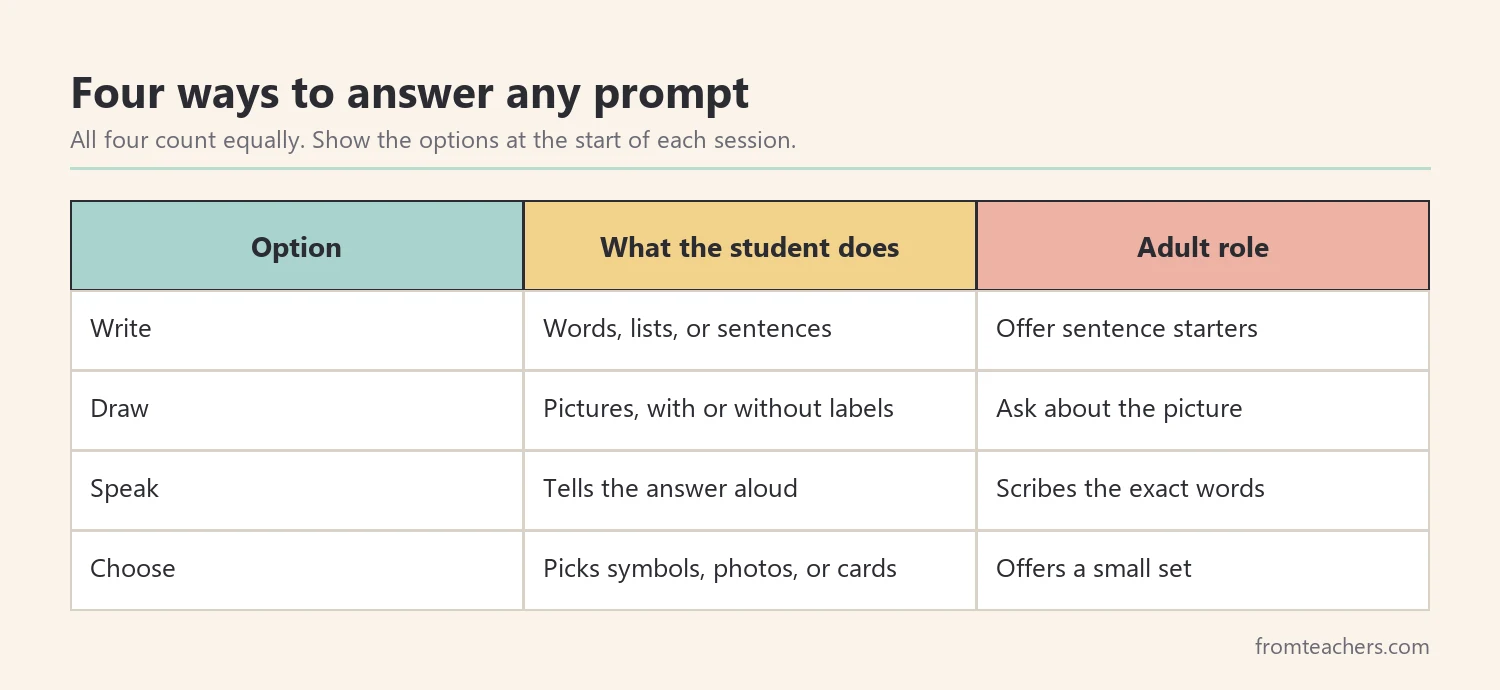
Reflection should never depend on writing ability. Therefore, offer several ways to respond to each prompt:
- Writing: full sentences, lists, or single words.
- Drawing: pictures with or without labels.
- Speaking: the student talks and an adult scribes the words exactly.
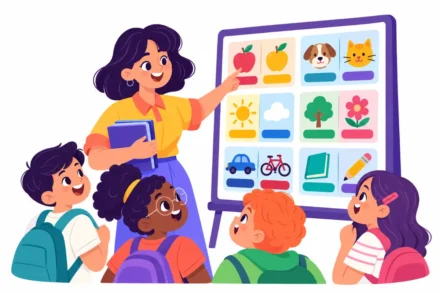
- Choosing: the student picks from symbols, photos, or word cards.
Make the options visible at the start of each session, so the student knows they can choose. In addition, use sentence starters for students who want to write but find a blank page hard: “This year I learned ___.” or “I felt proud when ___.”
Just as important, allow students to pass. Some questions touch on hard memories or feelings. A clear rule, such as “You can skip any question, and you do not have to say why,” makes the activity safer. Students who feel safe often return to a skipped question later on their own.
Furthermore, prepare symbols ahead of time for each section. A small set of six to eight choices per prompt is usually enough. Too many options can overwhelm a student, while too few can limit what they are able to say. Include a “something else” card so the student can always add an idea of their own.
Worked example: Kai’s response choices
For “How did your year begin?”, Kai chose three picture symbols: a school bus, a worried face, and a new classroom. His teacher asked, “Can you tell me about the worried face?” Kai said, “New teacher. Didn’t know the rules.” His teacher wrote his words exactly under the symbols.
4. Run short, predictable end of year journal sessions
A predictable session structure helps students relax and focus. Use the same order every time, so students know what to expect.
- Warm-up: look at a photo or object from the year.
- Introduce the section: read the title and one prompt aloud.
- Choose how to respond: point to the options.
- Work time: the student responds while the adult supports as needed.
- Share (optional): the student shows one page if they want to.
- Close: name one thing the student did well today.
Keep sessions short, usually 20 to 40 minutes, and stop before the student is exhausted. For students who tire quickly, split a section across two sessions.
Moreover, think about the setting. Some students reflect better one-to-one in a quiet space. Others enjoy a small group where they can hear peers’ ideas. Choose what fits the student.
Worked example: one of Kai’s sessions
For the “How I learn best” section, Kai’s teacher started with a photo of Kai using a picture schedule. She read the prompt “What helped you learn this year?” and pointed to the four response options. Kai chose symbols for “pictures,” “headphones,” and “quiet corner,” then said, “Headphones help in the loud room.” At the close, his teacher said, “You knew exactly what helps you. That is a big skill.”
Notice that the session took about 25 minutes and stayed in the same order as every other session. Because Kai knew what was coming, he spent his energy on reflecting rather than on figuring out the task.
5. Guide reflection on strengths and hard times
Two parts of an end of year journal need special care: strengths and hard times.
Strengths. Many students in special education hear more about their difficulties than their strengths. Help them reframe differences as strengths. For example, “You notice details others miss” or “You keep trying even when it is hard.” Use real examples from the year as evidence. If a student cannot think of a strength, offer two or three choices and let them pick.
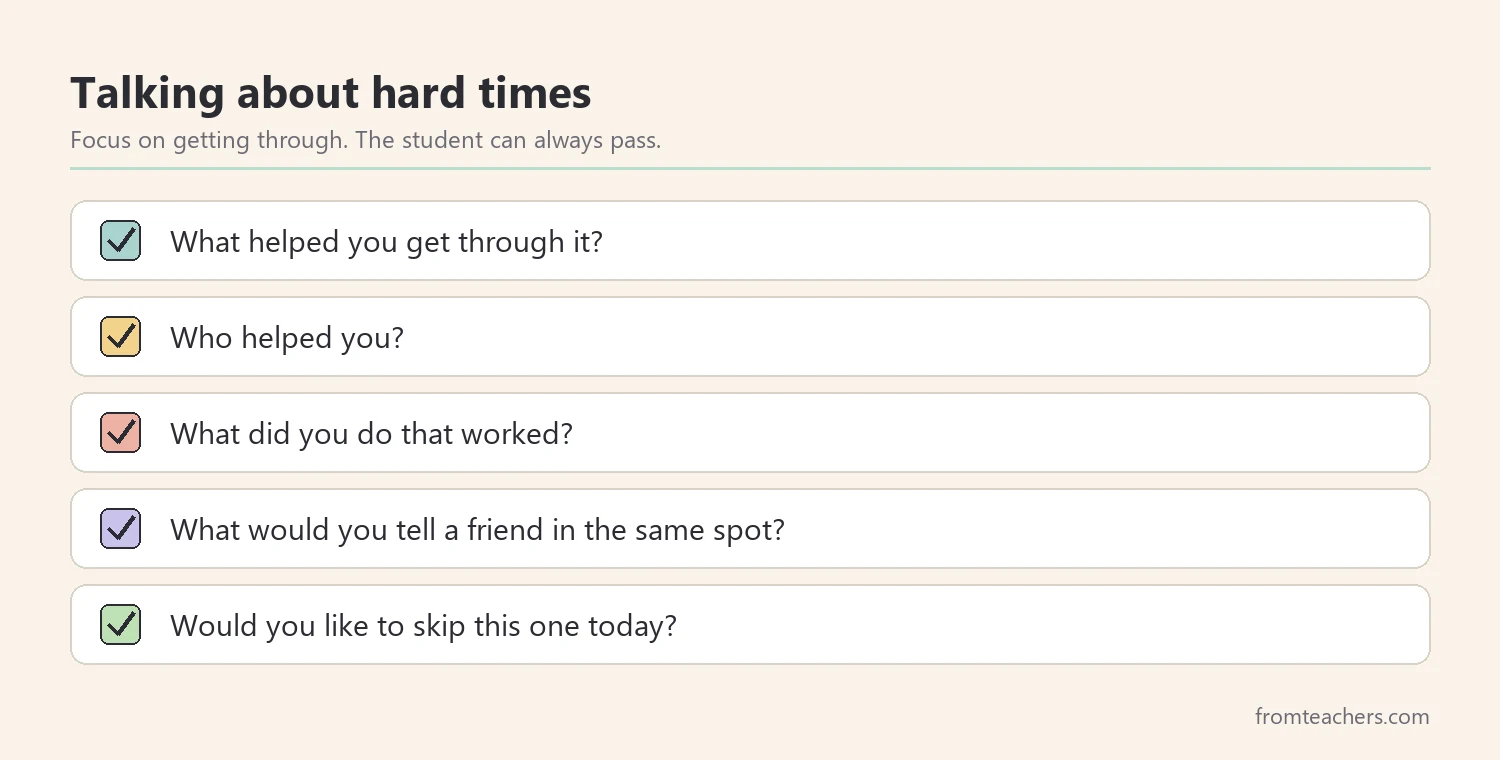
Hard times. Reflecting on challenges can build resilience when it focuses on how the student got through. Ask, “What helped you?” and “Who helped you?” rather than dwelling on what went wrong. Keep the tone calm and validating. If a student becomes upset, pause, offer comfort, and allow them to skip the section.
In addition, include a section on achievements nobody noticed. Students are often proud of things adults overlook, such as making a new friend or trying a new food in the cafeteria.
Worked example: Kai’s strengths page
Kai first said, “I don’t have strengths.” His teacher showed him three photos: Kai building a model, Kai helping a classmate find a book, and Kai’s perfect attendance certificate. Kai chose “I am good at building” and “I help people.” He drew his model next to the words.
Equally, be careful with comparisons. Reflection is about the student’s own journey, so avoid comparing one student’s journal with another’s. Praise honest answers, including short ones. A single word or one small drawing can be a meaningful reflection for a student who finds this kind of thinking hard.
6. Share the journal and use it for transition
A finished journal is a powerful document. With the student’s permission, share it with the family, and consider sending a summary to next year’s teacher.
The “How I learn best” and “Dreams and goals” sections are especially useful for the next teacher. They describe, in the student’s own words, what helps and what the student hopes for. Some teams turn these pages into a one-page student profile for the new school year.
Also, plan a goodbye. A final page such as “My goodbye to this year” or a “Letter to next year’s me” gives a sense of closure. Some students enjoy reading their letter aloud, while others prefer to seal it in an envelope to open next year.
Before sharing, always ask the student. Some pages may feel private, and students should decide which parts leave the classroom. Respecting that choice builds trust and teaches students that their reflections belong to them.
Worked example: Kai’s transition profile
From Kai’s journal, his teacher created a one-page profile for his middle school team. It included his words “I learn best with pictures and quiet,” his strengths of building and helping, and his goal to “find the library on the first day.” Kai checked the profile and added a drawing of himself.
Common mistakes and how to avoid them
- Making it a writing task. Fix: offer drawing, speaking, and symbols as equal options.
- One long session. Fix: spread reflection across several short sessions.
- Pushing on painful topics. Fix: let students pass on any question, without explanation.
- Adults rewording answers. Fix: scribe the student’s words exactly.
- Leaving the journal in a drawer. Fix: share it with families and use it for transition planning.
Questions teachers and parents ask about an end of year journal
What age is an end of year journal suitable for?
Reflection journals can work from early elementary through high school. Adjust the prompts, response options, and session length to the student’s age and needs.
What if a student does not want to take part?
Offer choices about how and when to respond, start with an easy, positive section, and let the student pass on questions. Some students warm up after seeing peers enjoy the activity.
Can parents use the journal at home?
Yes. Families can run sessions at home, especially over the summer, using the same response options and the right to pass.
How long does the full journal take?
Many teachers spread it across eight or nine sessions of 20 to 40 minutes. You can shorten it by choosing only a few sections.
Should the journal be graded?
No. Reflection is personal, and grading can make students cautious. Celebrate participation and effort instead, and thank the student for sharing their year with you.
Related reading: Year-End Reflections and New Year Planning, Parent-Teacher Collaboration in Special Education, and Special Education Strategies.
A companion resource for your end of year journal:
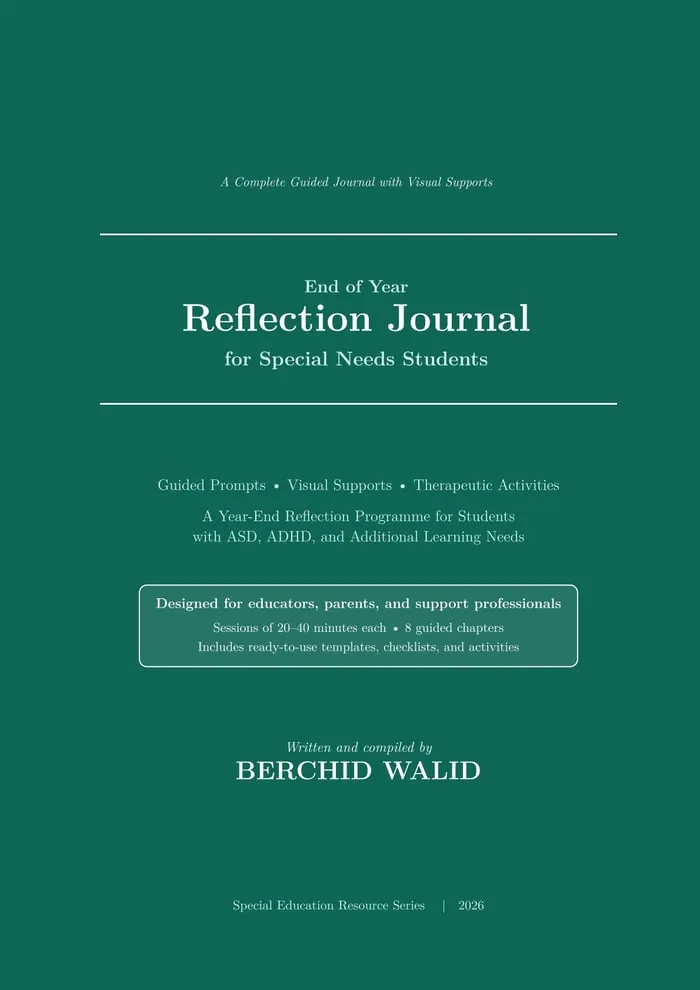
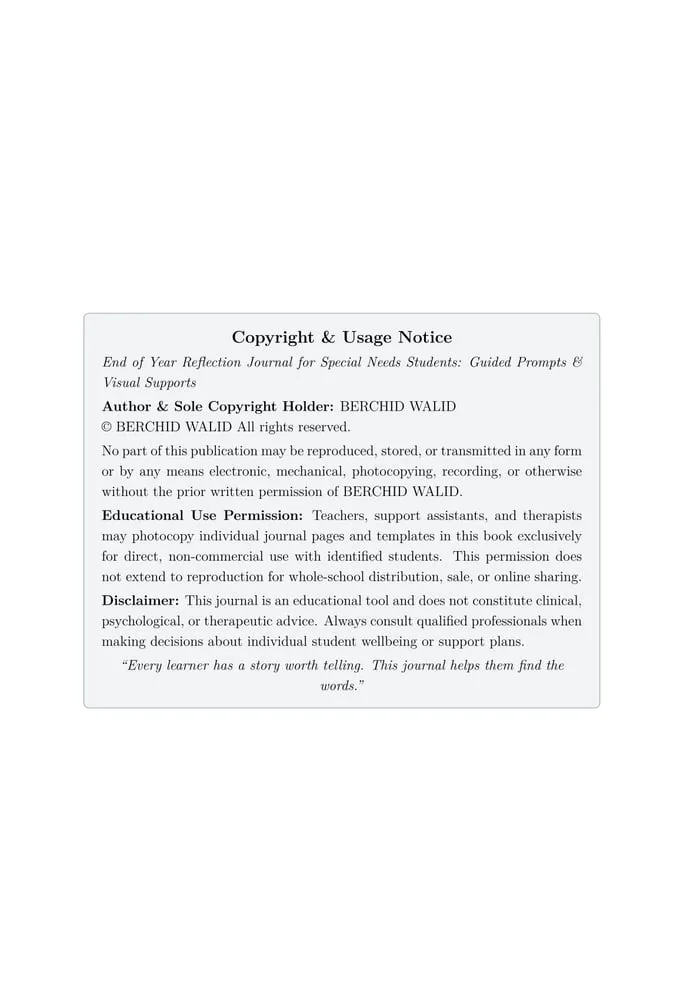
End of Year Reflection Journal for Special Education Students: a 37-page guided journal with prompts and visual supports covering my story this year, how I learn best, emotions, strengths, the people in my corner, hard times, achievements, goals, and a goodbye to the year, run as 8 to 9 sessions.
Sources and scope
- Individuals with Disabilities Education Act (IDEA): the federal framework for student involvement in planning and transition.
- IRIS Center, Vanderbilt University: modules on student-centered planning and self-determination.
- CAST UDL Guidelines: guidance on offering multiple means of expression.
- Understood.org: resources on self-advocacy and transitions for families and teachers.
Scope: this guide covers planning and running year-end reflection with students in special education. It is not a therapeutic program, and concerns about a student’s emotional well-being should go to qualified school staff.
Key takeaways
- Year-end reflection builds self-awareness and eases transitions.
- Offer writing, drawing, speaking, and symbols for every prompt.
- Let students pass on any question without explanation.
- Run short, predictable sessions over several weeks.
- Share the finished journal and use it to plan next year.



Leave a Comment