

Fear of making mistakes can look like a crumpled worksheet, a pencil thrown across the desk, or a student who simply refuses to start. For many autistic students, one wrong letter or one red mark can feel overwhelming, and what follows may be tears, a shutdown, or a meltdown that has little to do with the actual task.
This guide offers a calm, step-by-step approach for teachers and parents. By the end, you will be able to spot the patterns behind a student’s fear of making mistakes, respond in the moment with clear words, model mistakes on purpose, teach helpful self-talk, and track whether things are getting easier.
Examples are fictional. Adapt to the student’s goals and agreed supports. This is guidance, not a diagnosis.
At a glance
- Strong reactions to errors are often anxiety, not defiance.
- Log the moments first, so you know what triggers the fear.
- Use short, calm, predictable words in the moment.
- Let students see adults make and fix mistakes on purpose.
- Teach a few self-talk lines and track small changes over weeks.
1. Understand the fear of making mistakes
Before you change anything, it helps to understand what is happening. For many autistic students, a mistake is not just a wrong answer. It can feel like a broken rule, an unexpected change, or a loss of control. Some students also hold very high, very fixed standards for their own work. When reality does not match the picture in their mind, distress can rise quickly.
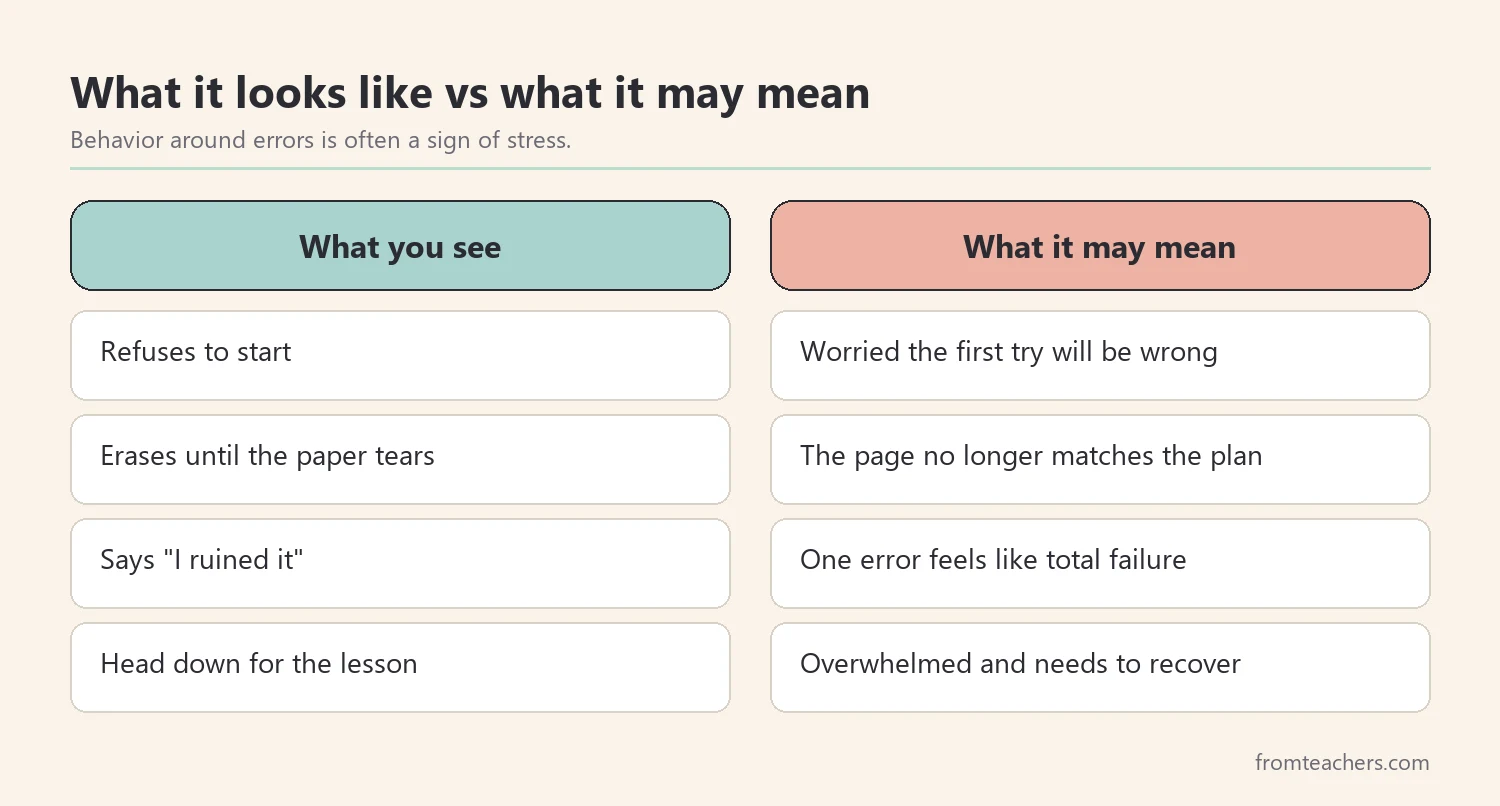
Because of this, the fear of making mistakes often shows up as behavior. A student may avoid starting, erase until the paper tears, insist on redoing an entire page, or shut down completely. These are signs of stress. Responding with consequences alone usually adds more stress, not less.
Instead, take a curious stance. Ask: what kind of task was it? What happened right before? How did the student show distress? What helped them recover? Your answers will guide every step that follows.
It also helps to remember that the fear of making mistakes is not a lack of effort. Often, the students who react most strongly are the ones who care most about getting things right.
Here is our fictional student. Eli is in grade 4 and is autistic. He reads well and loves facts about trains. His teacher, Ms. Brooks, notices that he becomes very upset during handwriting and spelling. When he makes an error, he erases hard, says “I ruined it,” and sometimes puts his head down for the rest of the lesson.
In other words, Eli is not refusing to work. His fear of making mistakes is getting in the way of work he is fully capable of doing.
2. Log the moments behind the fear of making mistakes
Patterns are hard to see from memory. A simple log, kept for two weeks, turns scattered incidents into useful information. It does not need to be long: date, task, trigger, reaction, and what helped.
First, write entries soon after each incident, while details are fresh. Second, describe what you saw, not your interpretation: “erased the same word five times” rather than “was being difficult.” Third, note what helped, even if it only helped a little. Over time, you will see which tasks, times, and situations are hardest.
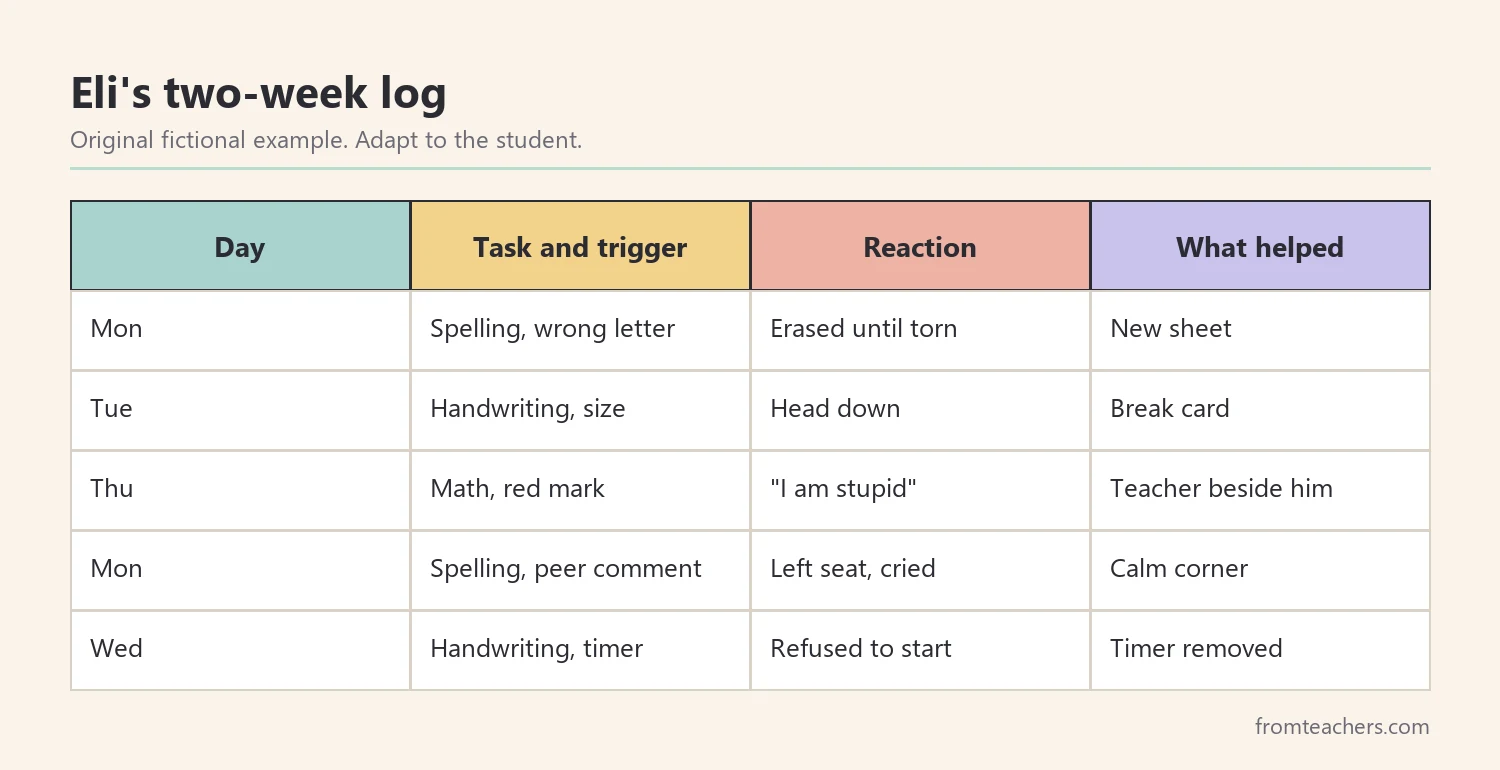
Here are five entries from Eli’s two-week log.
| Day | Task and trigger | Reaction | What helped |
|---|---|---|---|
| Mon | Spelling, one wrong letter | Erased until paper tore | New sheet, quiet voice |
| Tue | Handwriting, letter too big | Head down, 10 minutes | Break card, then retry |
| Thu | Math, red mark returned | Said “I am stupid” | Teacher sat beside him |
| Mon | Spelling, peer pointed out error | Left seat, cried | Calm corner, 5 minutes |
| Wed | Handwriting, timed task | Refused to start | Timer removed |
As a result, Ms. Brooks sees a clear pattern: four of five incidents involved writing tasks, and visible marks or timers made things worse. A quiet presence and a fresh start helped most.
Keep the log private and use it only for planning support. When the team reviews it together, the fear of making mistakes becomes something everyone understands, rather than a label attached to the student.
A structured page makes this easier to keep up. The It Is Safe to Be Wrong toolkit for autistic students who fear mistakes includes a Mistake Response and De-escalation Log for recording triggers, reactions, and calming strategies, along with scripted responses for moments like handwriting and spelling errors.
3. Respond in the moment with calm, predictable words
When a student is in distress, long explanations rarely help. The brain is focused on the threat, not on reasoning. Short, calm, predictable words work better, and they work best when the student has heard them before in calm moments.
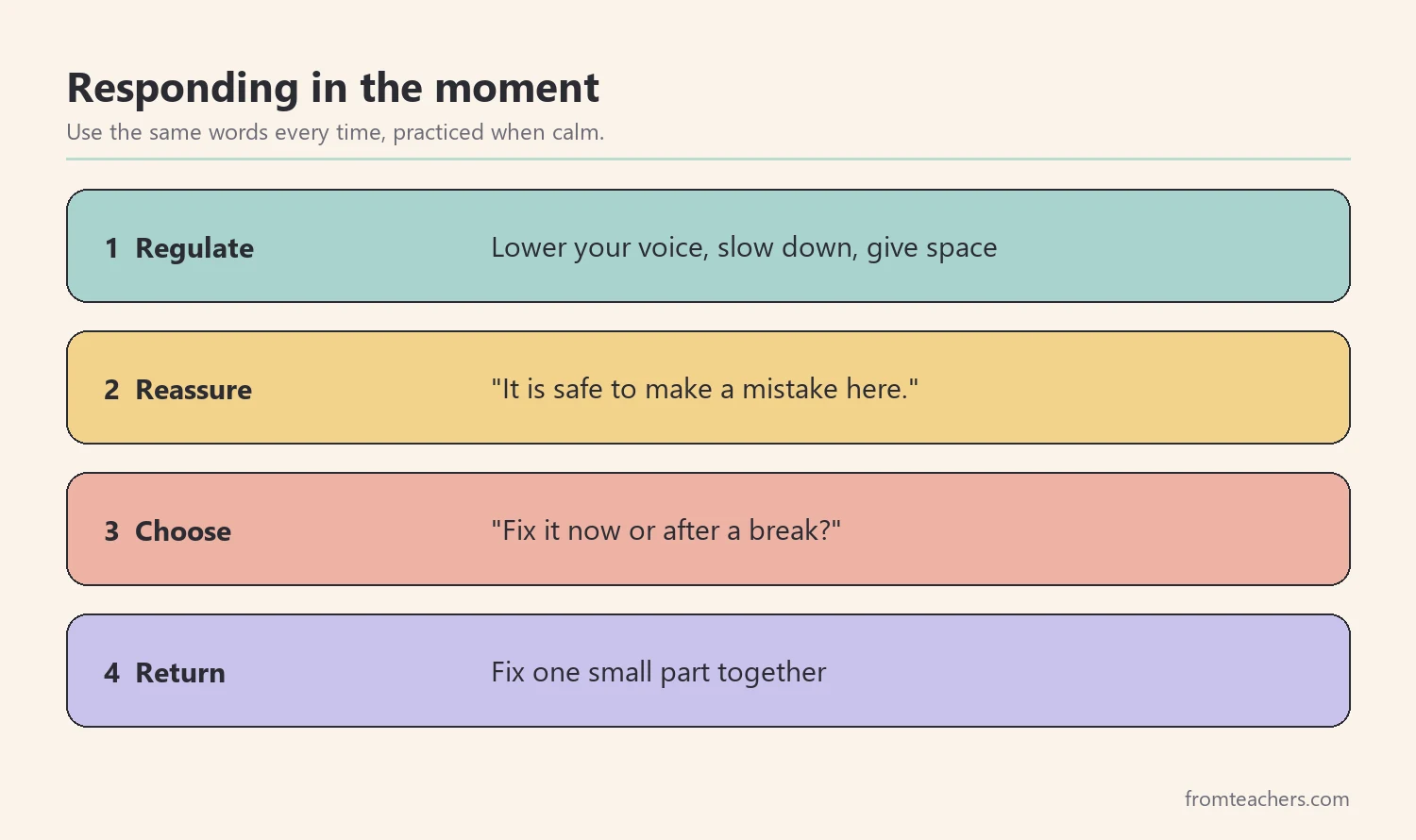
A useful pattern has four parts. First, regulate: lower your voice, slow down, and give space. Second, reassure with one short line: “It is safe to make a mistake here.” Third, offer a simple choice: “Do you want to fix it now or after a break?” Then, once the student is calm, return to the task with a small, clear next step.
In addition, change the environment where you can. Offer a fresh sheet instead of insisting on erasing. Use pencil instead of pen. Hold off on red marks, and give feedback privately rather than in front of peers.
| Moment | Helpful words |
|---|---|
| Student erases hard | “You can start fresh on a new line.” |
| Student says “I ruined it” | “It is one letter. The rest is still yours.” |
| Student shuts down | “I will wait here. Take your time.” |
| Student is calm again | “Let us fix just the first word together.” |
For Eli, Ms. Brooks practices these lines during calm times so they become familiar. The next time he misspells a word, she quietly slides a fresh strip of paper over and says, “You can start fresh on a new line.” He pauses, then rewrites the word. The episode lasts less than a minute.
Afterward, once the student is fully calm, a brief and gentle debrief can help. Ask what felt hard and what helped. Keep it short, and never use it to lecture.
Supporting a student with fear of making mistakes is mostly about consistency. When every adult uses the same words, the student learns what to expect.
4. Model mistakes to ease the fear of making mistakes
Students learn a lot from watching how adults handle errors. If the adults around them never seem to make mistakes, a student may believe mistakes are rare and terrible. So, make mistakes visible, ordinary, and fixable.
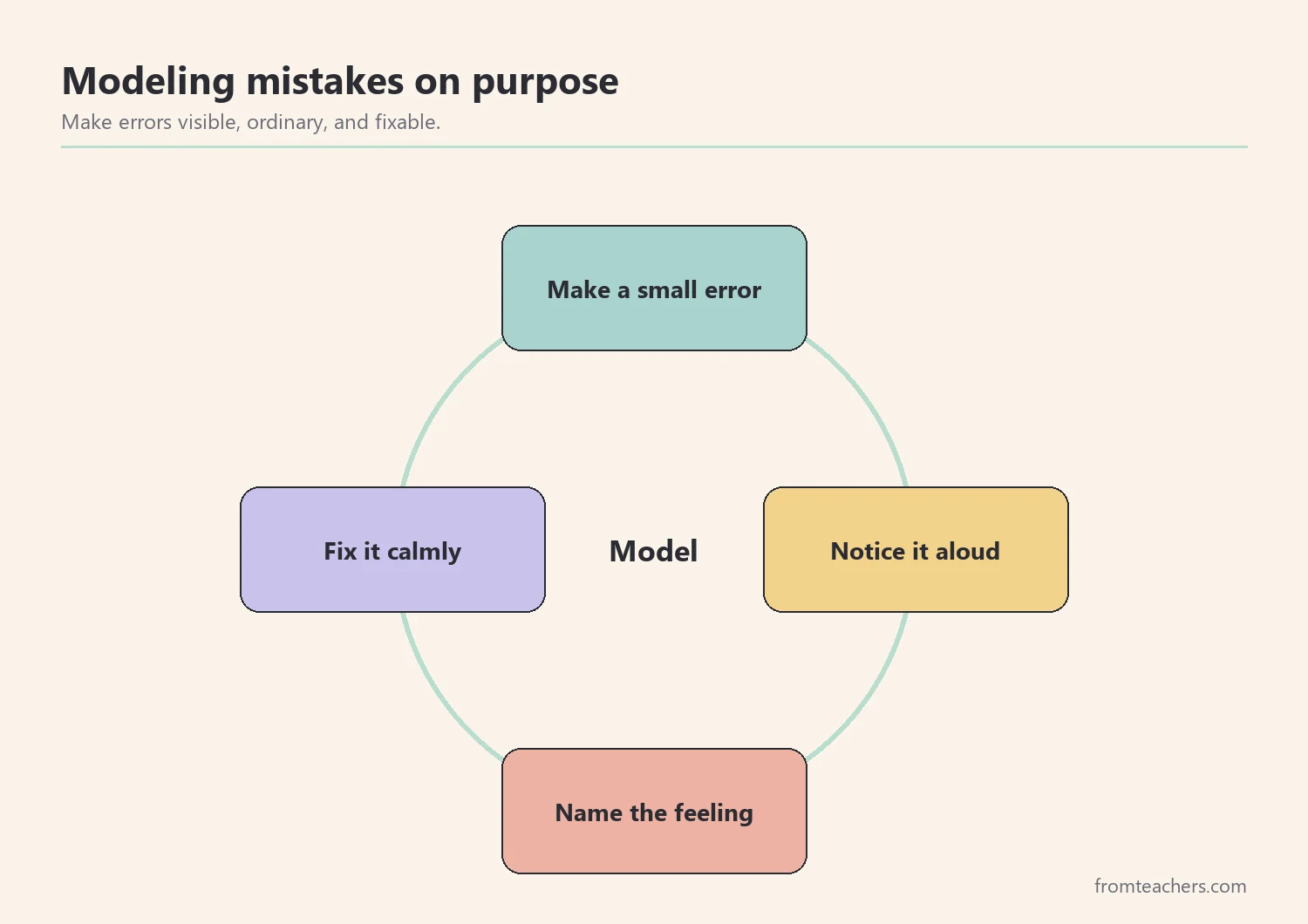
First, plan a few small errors during whole-class teaching. Misspell a word on the board, or write a number in the wrong place. Next, notice it aloud in a relaxed tone: “Oops, I wrote that backward. Let me fix it.” Then, fix it calmly and keep going. Over time, you can invite students to catch your mistakes, which turns errors into a shared, low-stakes game.
Also, share how you feel and what you do: “I felt a bit annoyed when I made that mistake. I took a breath and fixed it.” That gives students a model for both the feeling and the response.
For a student like Eli, start small and predictable. Ms. Brooks tells him privately, “Today I will make one mistake on the board. See if you can spot it.” He finds it and grins. A week later, she makes a mistake without warning, and Eli calls out, “You can start fresh on a new line.” He has learned the script by hearing it used kindly.
Peers benefit too. When a whole class sees mistakes treated calmly, the fear of making mistakes eases for many students, not only those with the strongest reactions. Some teachers keep a “favorite mistake of the week” moment to celebrate learning from errors.
Gradually, the fear of making mistakes loses some of its power when errors are part of everyday classroom life.
5. Teach self-talk and track progress with fear of making mistakes
Adult support is the starting point. The longer-term goal is for the student to have their own calming words. Self-talk lines give the student something to say inside their head when the panic starts.
First, choose two or three short lines with the student. Keep them honest and specific, not overly cheerful. Examples include “Mistakes help me learn,” “I can fix one part,” and “Everyone gets things wrong sometimes.” Next, practice them during calm times, perhaps at the start of a writing lesson. Then, prompt them in hard moments with a gesture or a small card on the desk.
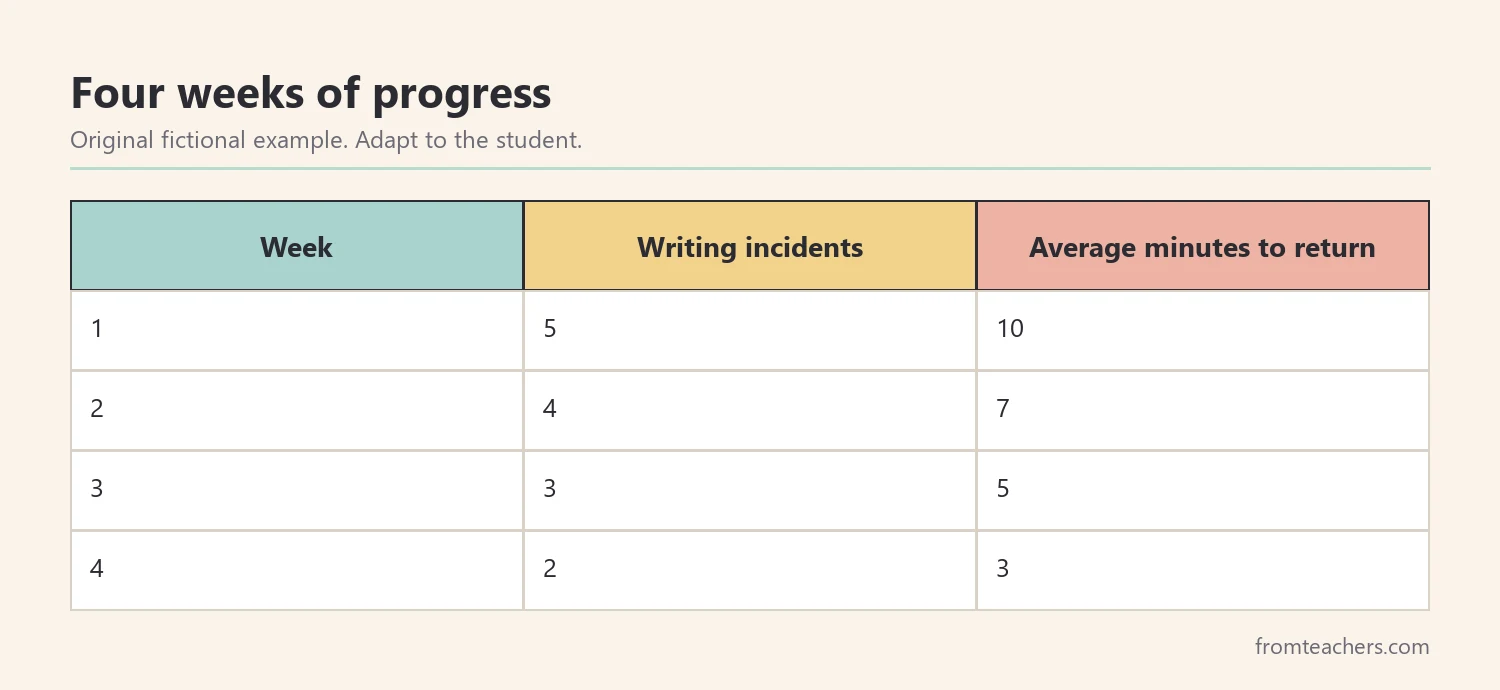
At the same time, track one simple measure each week. For Eli, Ms. Brooks counts writing incidents and the average minutes he needs to return to work.
| Week | Writing incidents | Average minutes to return |
|---|---|---|
| 1 | 5 | 10 |
| 2 | 4 | 7 |
| 3 | 3 | 5 |
| 4 | 2 | 3 |
Expect ups and downs. A hard day after a good week does not mean the plan failed. Changes in routine, sleep, or a substitute teacher can bring the fear of making mistakes back for a while, so look at the trend over several weeks.
Share the progress with Eli in plain terms: “Four weeks ago, it took about ten minutes to get back to work. This week it took about three.” Seeing the numbers helps him believe he can handle mistakes.
Finally, share the log and the self-talk lines with the family and the student’s team. When the same words are used at home and at school, the fear of making mistakes has fewer places to grow.
Common mistakes and how to avoid them
- Treating distress as defiance. Fix: look for the trigger and respond to the anxiety first.
- Explaining too much in the moment. Fix: use one short, calm line and give space.
- Insisting on erasing. Fix: offer a fresh sheet or line so the student can start again.
- Correcting in front of peers. Fix: give feedback privately and quietly.
- Changing words every time. Fix: agree on the same phrases across all adults.
- Expecting quick results. Fix: track small changes over several weeks.
Questions teachers and parents ask about fear of making mistakes
Is fear of making mistakes common in autistic students?
Many families and teachers notice strong reactions to errors in autistic children, but every student is different. Some react strongly, others not at all. Focus on the individual student’s patterns rather than general assumptions.
Should I stop correcting errors?
No. Students still need feedback to learn. Change how you correct: privately, briefly, with a clear way to fix it, and without red marks if those trigger distress.
How is this different from perfectionism?
The two often overlap. Perfectionism is about very high standards, while the fear of making mistakes is about the distress when those standards are not met. The strategies in this guide help with both.
What if the student has a meltdown?
Prioritize safety and calm. Reduce demands, lower your voice, and give space. Talk about the mistake later, once the student is regulated, and follow the support plan agreed with the student’s team.
When should we ask for extra help?
If distress is frequent, intense, or affecting learning or wellbeing, talk with the family and the student’s team. A school psychologist, counselor, or other qualified professional can help assess what is happening.
Related reading: Meltdowns vs Tantrums: A Guide to Understanding and Responding, Understanding Autistic Burnout and School Exhaustion, and Moving Beyond Shame and Behavior Charts.
A companion resource for fear of making mistakes:
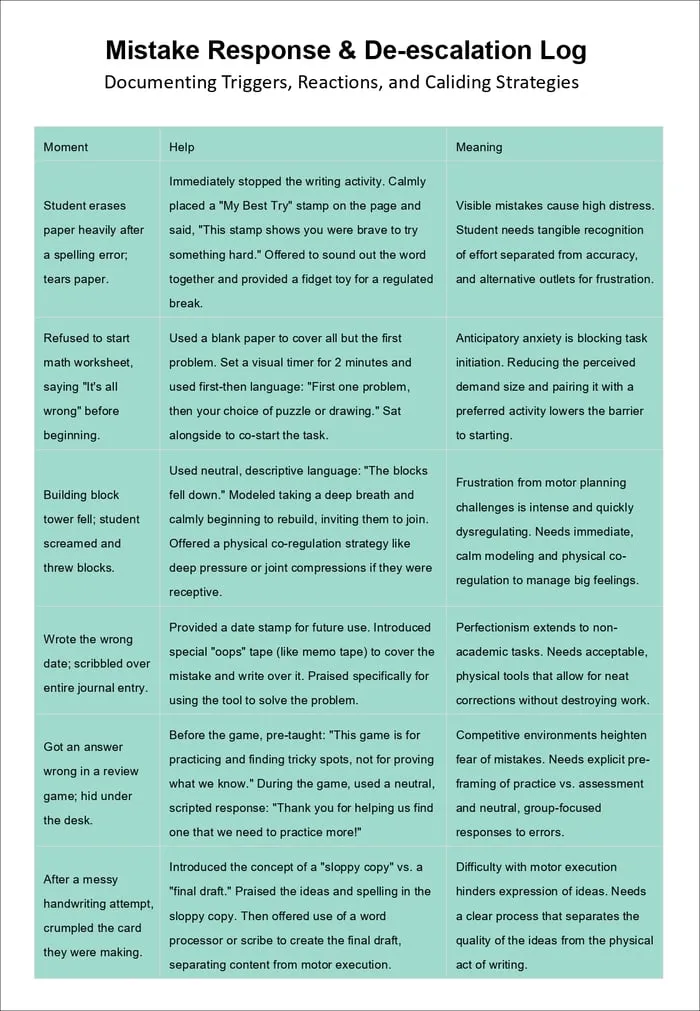
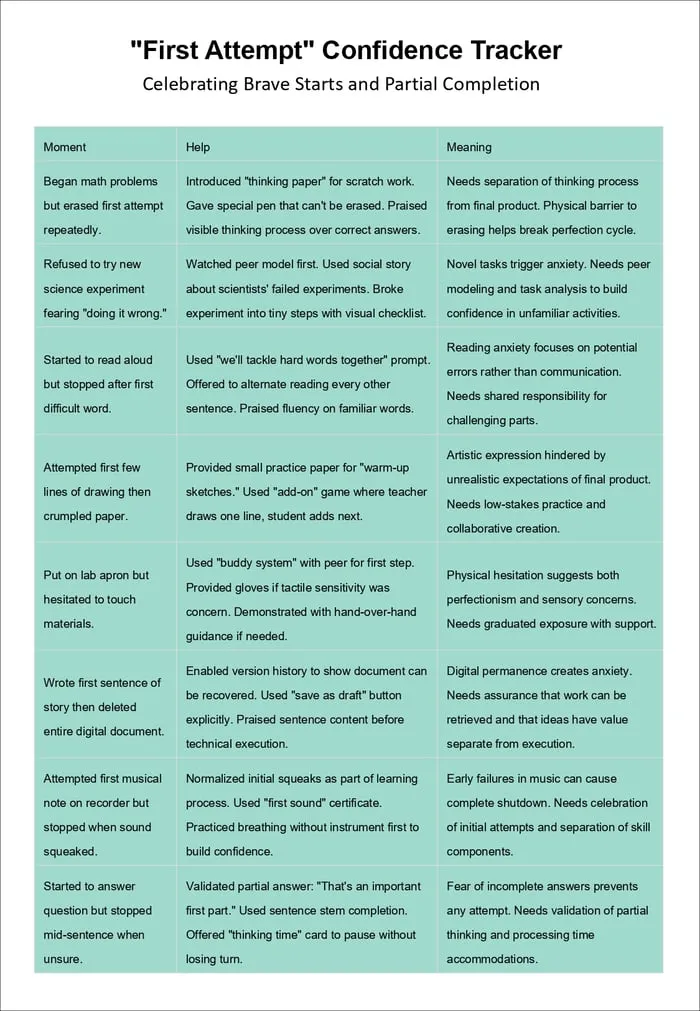
It Is Safe to Be Wrong: Supporting Autistic Students Who Fear Mistakes: a 12-page printable toolkit with Moment, Help, and Meaning pages, a Mistake Response and De-escalation Log, growth mindset and self-talk prompts, and scripted responses for handwriting, spelling, and more.
Sources and scope
- IRIS Center, Vanderbilt University: free modules on autism, behavior, and evidence-based classroom practices.
- CDC autism information: general background on autism spectrum disorder for families and educators.
- Understood.org: practical articles for families and teachers on anxiety and learning differences.
- IDEA, U.S. Department of Education: the law behind special education services and IEPs.
This guide covers everyday classroom and home strategies for students who are distressed by mistakes. It does not cover diagnosis, treatment of anxiety disorders, or crisis procedures, which belong to qualified professionals and the student’s team.
Key takeaways
- The fear of making mistakes often looks like refusal but is usually anxiety.
- Log incidents for two weeks to find the real triggers.
- Respond with short, calm, consistent words and a fresh start.
- Model mistakes on purpose so errors feel ordinary.
- Teach self-talk and track recovery time week by week.










Leave a Comment