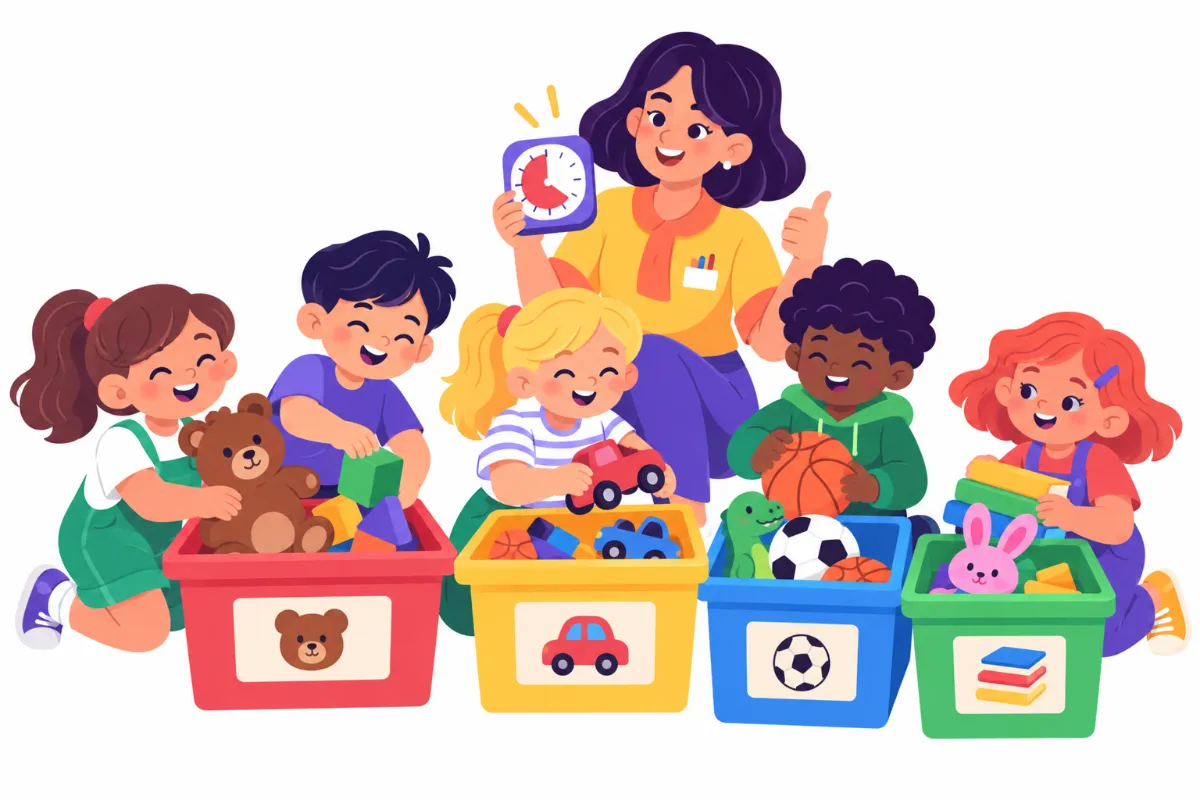

Teaching kids to clean up can feel like the longest five minutes of the day. Picture a kindergarten classroom after free play: blocks under the rug, crayons on three tables, and one child happily building while everyone else is lining up. Saying “Clean up, please!” louder does not help, because the child does not yet know what cleaning up actually looks like.
This guide gives you five steps to turn cleanup into a calm routine at school or at home: show what “clean” means, give everything a home, use a short time frame, make it a team game, and finish with handwashing and praise. By the end, you will have a simple plan you can start with one child or a whole class.
Examples are fictional. Adapt to the child’s age, needs, and agreed supports. This is guidance, not a diagnosis.
At a glance
- Children cannot clean up until they know what “clean” looks like, so show them.
- Give every item a labeled home with a picture.
- Keep cleanup short, predictable, and the same every day.
- Turn tidying into a team game rather than a punishment.
- End with handwashing and specific praise to build the habit.
1. Show what clean looks like when teaching kids to clean up
First, make the goal visible. When adults say “clean up,” they picture a finished room. Young children often picture nothing at all. Teaching kids to clean up starts with showing them a clear picture of the end point.
Take a photo of each play area when it is tidy. Post it at child eye level near that area. Then, during cleanup, point to the photo and say, “Make it look like this.” That one picture replaces a long list of directions.
Let’s meet the child in this guide. Sam is a fictional five-year-old in kindergarten. At the start of the year, Sam often kept playing during cleanup or moved toys from one spot to another without putting them away. His teacher, Ms. Lopez, realized Sam did not know when the job was finished.
So, she broke cleanup into small, visible steps. Next to the block area, she posted three pictures: blocks in the bin, the bin on the shelf, and an empty rug. Sam could now check his own work against each picture.
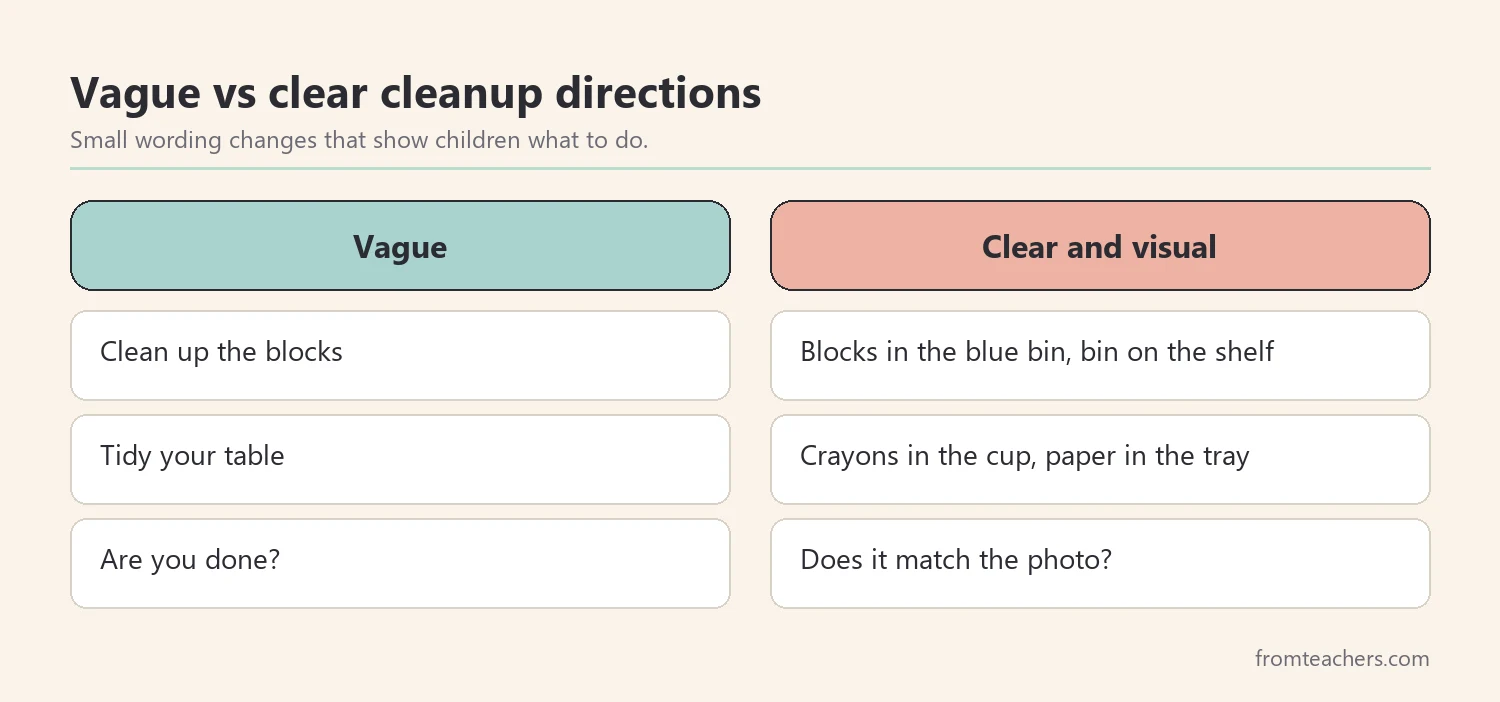
| Vague direction | Clear, visual direction |
|---|---|
| “Clean up the blocks.” | “Blocks go in the blue bin. Bin on the shelf.” |
| “Tidy your table.” | “Crayons in the cup. Paper in the tray.” |
| “Are you done?” | “Does it match the photo?” |
In addition, use the same words every time. If one adult says “put away” and another says “tidy up” or “clear it,” some children will not connect them. Consistent language is a quiet but important part of teaching kids to clean up, especially for children who are still learning English or who process language more slowly.
Also, model it. Show the steps slowly while the children watch, then do it together. Teaching kids to clean up works much better with a demonstration than with reminders alone.
2. Give everything a home
Next, make sure every item has one place to go. Children cannot put things away if “away” keeps changing. Clear homes are the foundation of teaching kids to clean up in any setting.
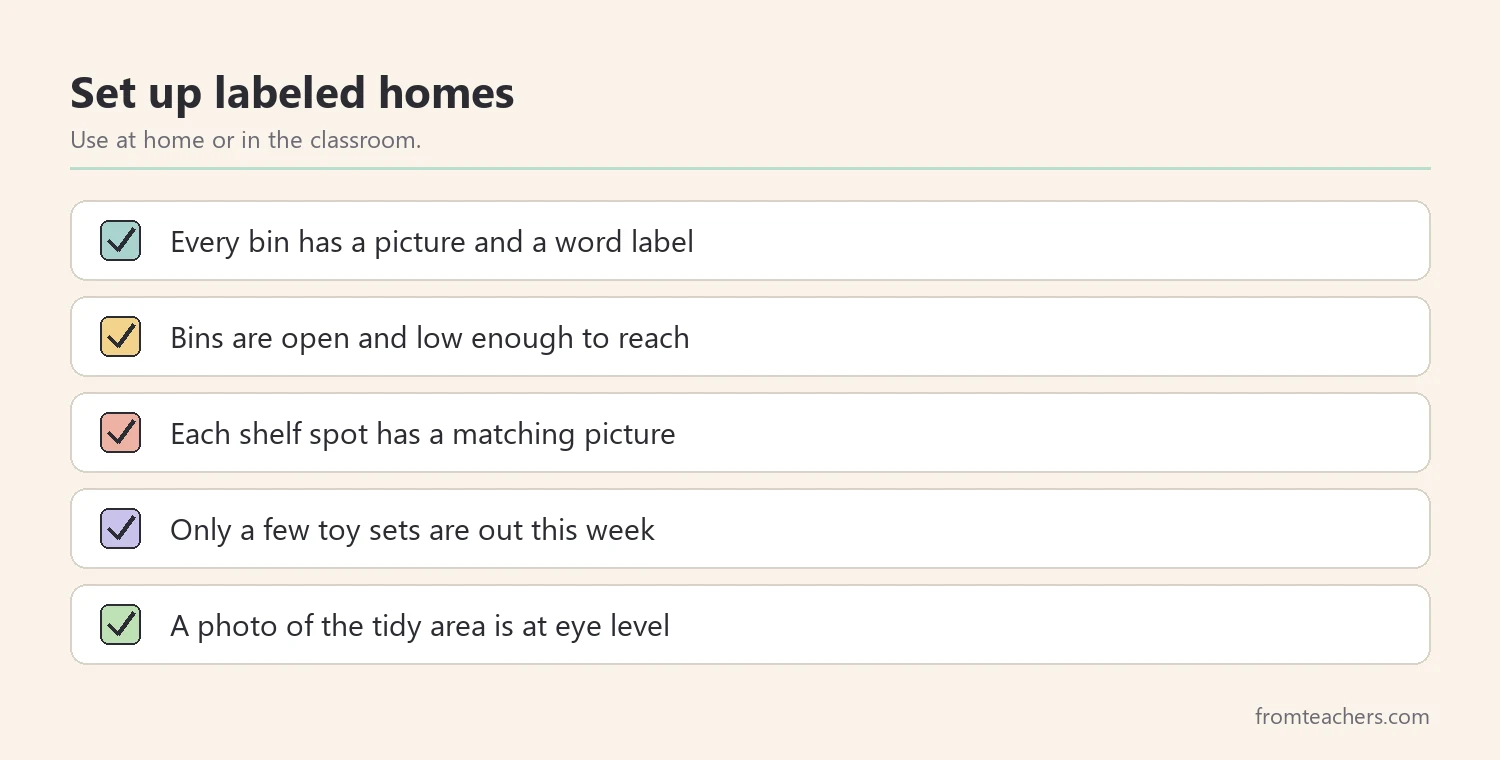
Use bins, baskets, or shelves with picture and word labels. For example, a bin with a photo of toy cars and the word “cars” tells a child exactly what belongs inside. Keep bins open and low so children can reach them without help.
Then, reduce clutter. Too many toys out at once make cleanup feel endless. Many teachers and parents rotate toys, keeping only a few sets out each week and storing the rest. Fewer items mean a shorter, more successful cleanup.
For Sam’s classroom, Ms. Lopez labeled 8 bins in the play area: blocks, cars, animals, puppets, puzzles, dress-up, kitchen, and books. She also put a matching picture on each shelf spot. Within two weeks, Sam was returning bins to the right shelf most of the time, because he could match the pictures.
Moreover, involve children in choosing homes. When kids help decide that the puppets live in the basket by the window, they remember it better. That sense of ownership makes teaching kids to clean up feel like a shared project rather than an adult rule.
In addition, teach where shared supplies go at home and at school. Art supplies, books, and outdoor toys each need a clear home too. A child who learns “everything has a home” in one place can apply the idea in another.
If you want a ready-made story to introduce this idea, a cleanup social story for kids walks children through putting toys, books, and art supplies back where they belong, in simple illustrated steps.
3. Use a short, predictable time frame
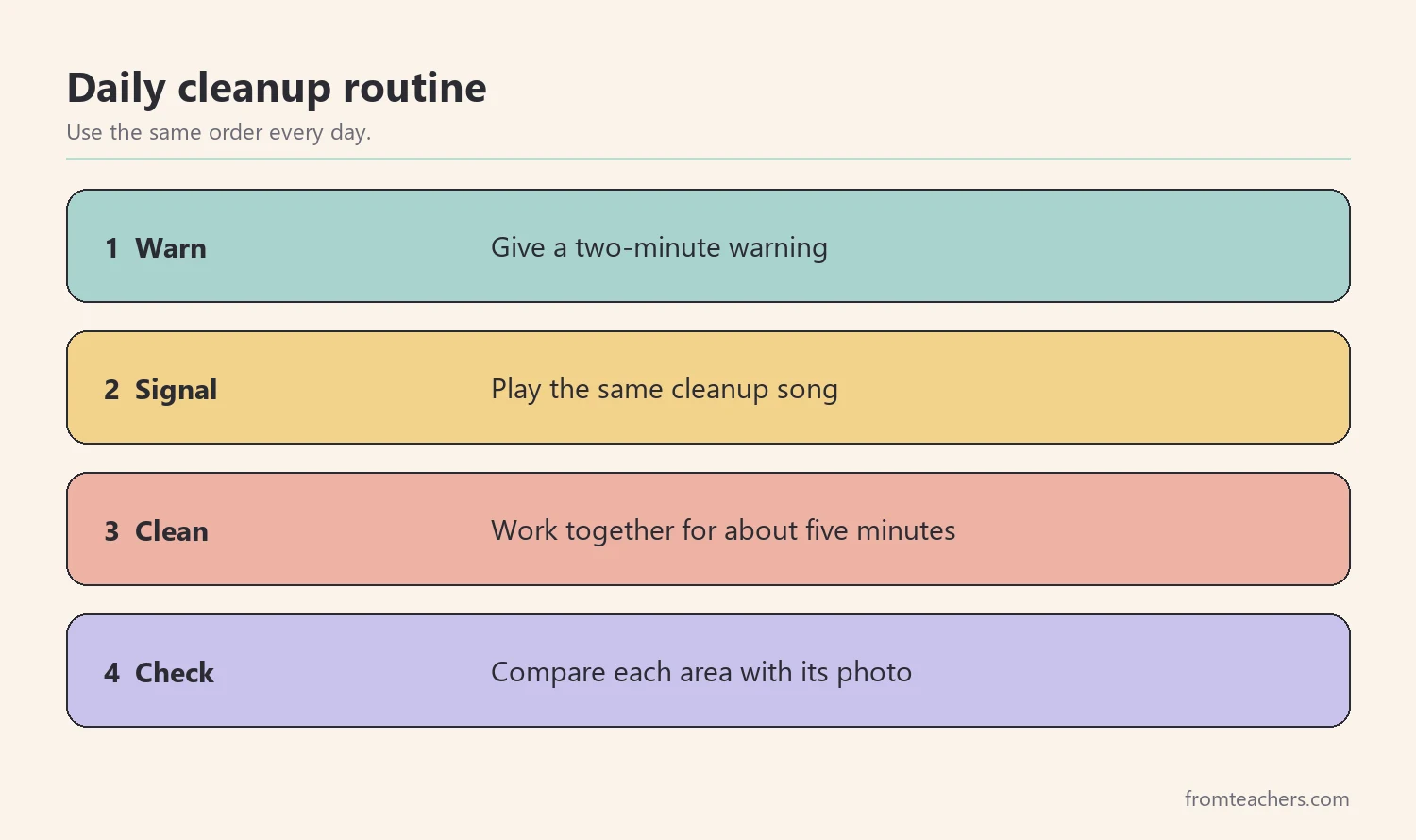
Many children resist cleanup because it feels like it will never end. A short, clear time frame helps. One simple idea is a five-minute rule: cleanup lasts about five minutes, and everyone works together during that time.
First, give a warning before cleanup starts. A two-minute warning, a song, or a visual timer helps children finish what they are doing. Sudden transitions often lead to protests, especially for children who find change hard.
Then, use the same signal every day. Ms. Lopez plays the same short cleanup song each time. When Sam hears it, he knows exactly what comes next. Predictable routines reduce arguments, which makes teaching kids to clean up far easier.
For children who need more support, a visual timer can make time concrete. Seeing the colored section shrink helps a child understand that cleanup has an end. This small tool is often one of the most effective supports for teaching kids to clean up when transitions are hard.
Also, keep the time frame realistic. If cleanup routinely takes much longer than five minutes, there may be too many toys out or the homes may be unclear. Adjust the setup before blaming the children.
For example, during the first week, Ms. Lopez timed cleanup each day. It took 12, 11, 9, 8, and 7 minutes from Monday to Friday. After she removed two crowded bins from the play area, cleanup dropped to about 5 minutes the next week. Those simple numbers helped her see what was working.
| Day | Week 1 cleanup time |
|---|---|
| Monday | 12 minutes |
| Tuesday | 11 minutes |
| Wednesday | 9 minutes |
| Thursday | 8 minutes |
| Friday | 7 minutes |
4. Make teaching kids to clean up a team game
Next, add some fun. Cleanup does not need to feel like a chore. When it becomes a game, many children join in eagerly. Teaching kids to clean up through play builds the habit without daily battles.
Try simple games. Children can race the song, pick up everything of one color, or be “toy rescuers” bringing toys home. Another favorite is “I spy something that needs a home.” These games take no preparation and keep the tone light.
Also, emphasize teamwork. Cleanup is everyone’s job, not just the job of the child who made the biggest mess. Assign small team roles, such as block helpers or book helpers, and rotate them each week.
For Sam, a special role made a big difference. Ms. Lopez named one child each day as the “Cleanup Captain.” The captain checks each area against the photos and gives a thumbs up. When it was Sam’s turn, he took the job very seriously and reminded friends where the cars belonged.
Similarly, mix in calm options for children who dislike noisy games. Some kids prefer a quiet job, such as stacking books or matching puzzle pieces into boxes. Offering both active and quiet roles keeps teaching kids to clean up inclusive for every child in the room.
However, avoid using cleanup as punishment. When tidying is linked to being in trouble, children learn to dislike it. Keep cleanup positive, and handle behavior issues separately.
In addition, extend teamwork beyond the classroom. At home, families can clean up together after dinner or play. When visiting a friend’s house, a quick “Let’s help put things back” teaches that cleanup is part of being a good guest.
5. Finish with handwashing and praise
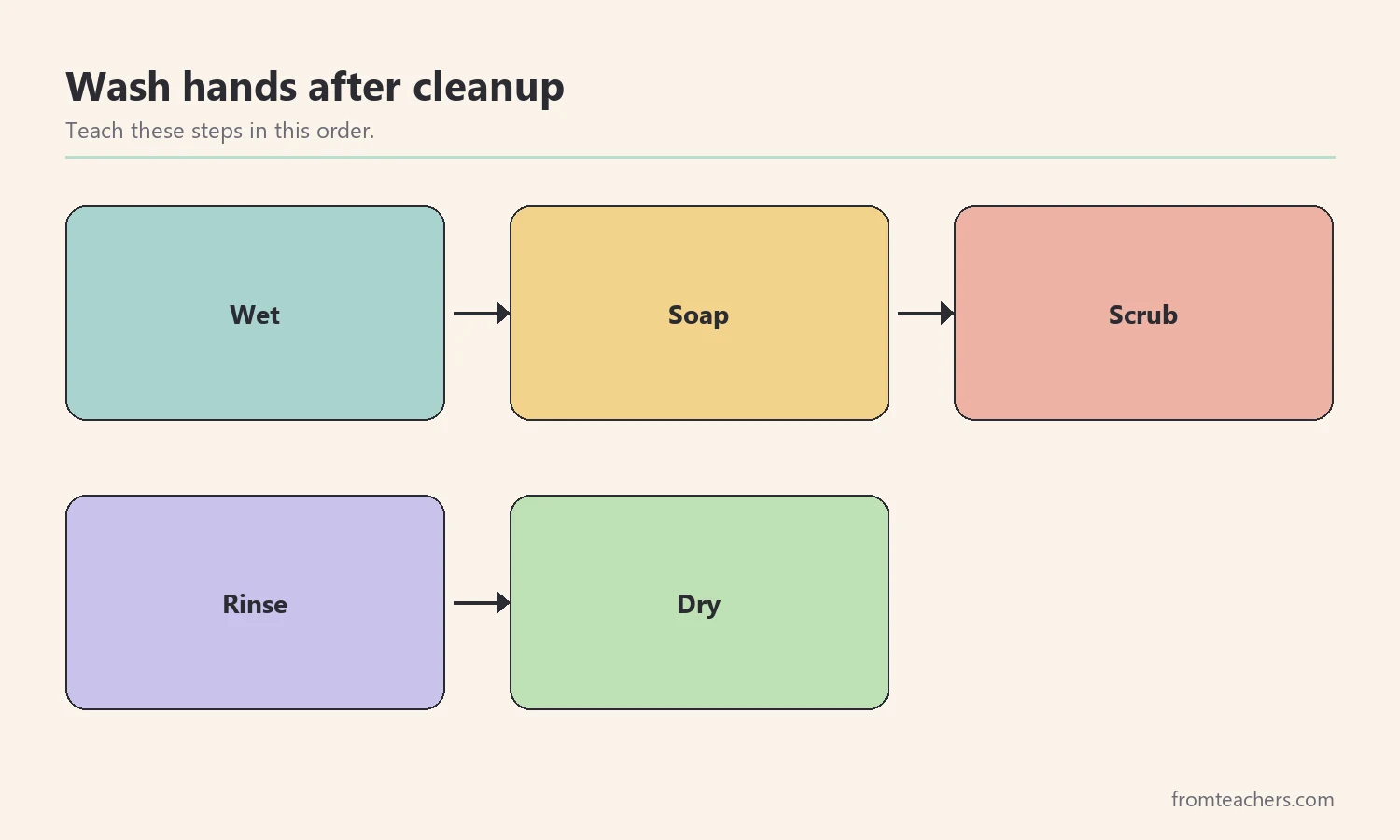
Finally, close the routine the same way every time. Many cleanup tasks, especially after art, snack, or outdoor play, should end with washing hands. Teach the steps clearly: wet, soap, scrub, rinse, and dry.
Then, give specific praise. Instead of “Good job,” say exactly what the child did: “You put all the cars in the bin and checked the photo.” Specific praise tells children which actions to repeat, which is the heart of teaching kids to clean up.
Also, notice effort, not perfection. A five-year-old’s clean table will not look like an adult’s. Celebrate progress and keep expectations matched to the child’s age and skills.
After about a month, Ms. Lopez noticed that Sam started cleaning up when the song began, without extra reminders, on most days. He also began reminding his younger brother at home, according to his family. Small, consistent steps had turned cleanup into a habit.
Families can support the same habit at home with the same steps. For example, a photo of a tidy bedroom shelf and a short cleanup song before bath time mirror the classroom routine. When home and school use matching cues, teaching kids to clean up becomes consistent across a child’s whole day.
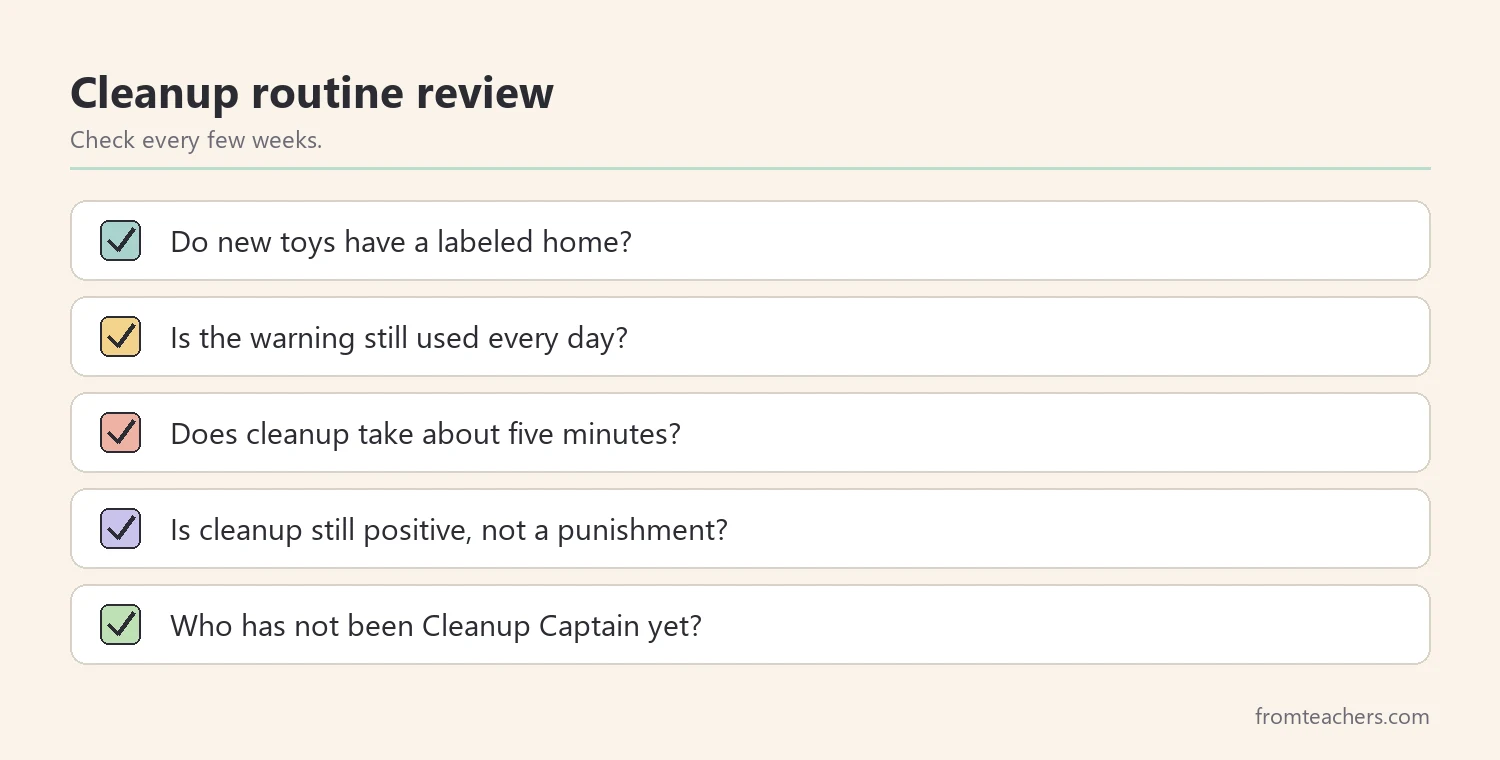
Lastly, review the routine every few weeks. If cleanup becomes hard again, check whether new toys lack homes, whether the warning is still used, or whether the time frame has drifted. Small adjustments keep the routine working all year.
Common mistakes and how to avoid them
- Giving vague directions. Fix: show a photo of the finished area and name each step.
- Too many toys out at once. Fix: rotate toys and keep fewer sets available.
- Starting cleanup without warning. Fix: use a warning and the same signal every day.
- Using cleanup as punishment. Fix: keep it positive and handle behavior separately.
- Changing the routine every day. Fix: keep teaching kids to clean up predictable with the same signal, order, and words.
- Expecting adult-level results. Fix: praise effort and match expectations to age.
Questions teachers and parents ask about teaching kids to clean up
At what age should I start teaching kids to clean up?
Many toddlers can start with simple tasks like putting a toy in a basket with help. As children grow, they can handle more steps on their own. Start small and add steps gradually.
What if my child refuses to clean up?
First, check whether the task is clear and short enough. Then, try a game, a song, or cleaning up together. Avoid power struggles and praise any effort to join in.
Do rewards help with cleanup?
Small, short-term rewards can help while a new routine is forming. However, specific praise and the satisfaction of a tidy space often work well on their own. Over time, aim for cleanup to become a normal part of the day.
How can I help a child who finds transitions hard?
Give a clear warning, use a visual timer, and keep the routine the same each day. A social story read before cleanup can help the child know what to expect. Some children also benefit from a first-then card.
Should siblings or classmates clean up each other’s messes?
Treat cleanup as a shared job. Everyone helps the space get back to “clean,” regardless of who made the mess. That teamwork approach reduces arguments about fairness.
Related reading: Navigating the Path to Adulthood: Building Essential Life Skills, Moving Beyond Shame and Behavior Charts: Positive Alternatives for Effective Classroom Management, and 5 Practical Teaching Tips to Boost Classroom Focus and Learning.
A companion resource for teaching kids to clean up:
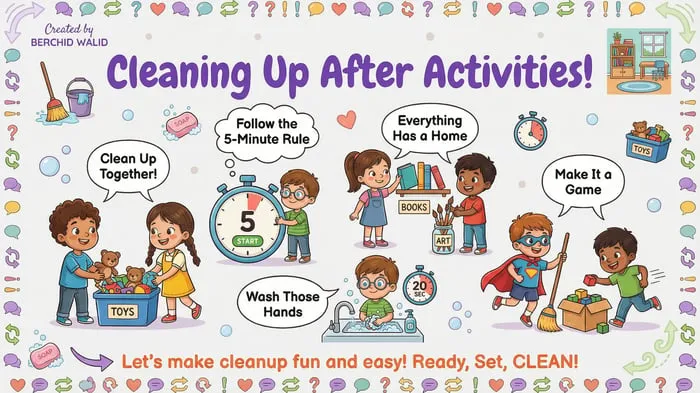
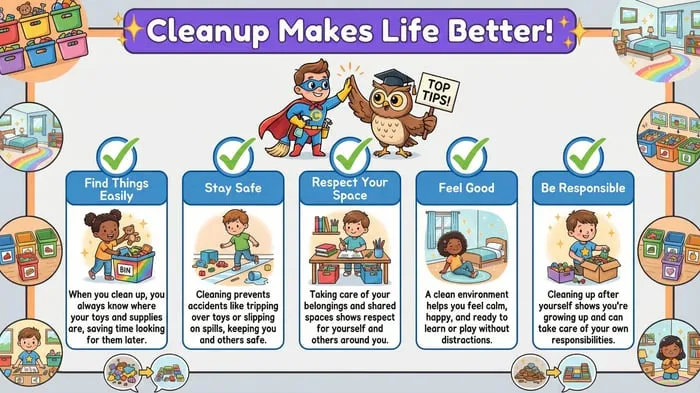
Cleaning Up After Activities: Social Story Kids: an illustrated social story covering the 5-minute rule, giving everything a home, making cleanup a game, teamwork, cleaning up at home, school, and friends’ houses, handwashing, and a Cleanup Captain wrap-up.
Sources and scope
- National Association for the Education of Young Children (NAEYC): resources on early childhood routines and classroom practice.
- ZERO TO THREE: information for families on young children’s development and daily routines.
- HealthyChildren.org, American Academy of Pediatrics: parenting information on child development and healthy habits.
- Centers for Disease Control and Prevention (CDC): public health guidance, including handwashing.
This guide covers everyday routines for building cleanup habits in young children at home and school. It does not cover behavior evaluations or individual therapy plans, which belong to qualified professionals and the child’s team.
Key takeaways
- Teaching kids to clean up starts with showing a clear picture of “clean.”
- Give every item a labeled home and keep fewer toys out.
- Use a warning, a short time frame, and the same signal every day.
- Make cleanup a team game and never a punishment.
- Finish with handwashing and specific praise.






Leave a Comment