

The PDA need for control often shows up in the smallest requests. Picture a fourth grader who loves drawing, yet refuses to draw the moment a teacher says, “Please draw your character now.” He crosses his arms, makes a joke, then hides under the table. The task was easy. The demand was what felt impossible.
This guide explains the PDA need for control: why autonomy can feel like safety for students with a pathological demand avoidance (PDA) profile, and what teachers can do about it. You will learn how to reframe refusal, spot hidden demands, lower demand pressure, share control through collaboration, and notice the cost of compliance. By the end, you will have a calmer, autonomy-supportive plan for your classroom.
Examples are fictional. Adapt to the student’s goals and agreed supports. This is guidance, not a diagnosis.
At a glance
- For PDA learners, refusal is often anxiety-driven self-protection, not defiance.
- Any demand, even a pleasant one, can raise anxiety automatically.
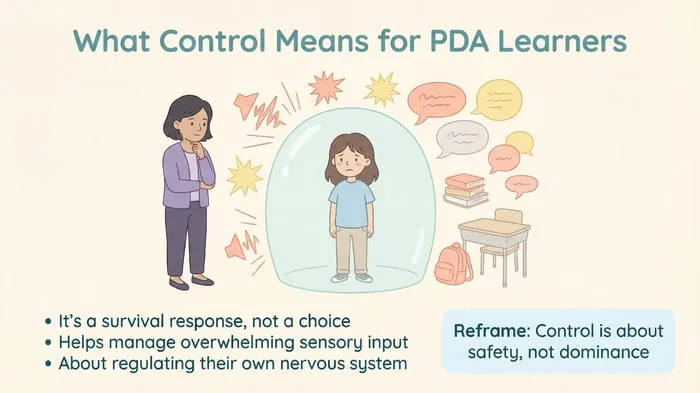
- The PDA need for control is a safety need, so sharing control lowers the threat.
- Indirect language, negotiation, and role-play create distance from direct demands.
- A student who looks fine at school may be exhausted at home, so watch the cost of compliance.
1. Reframe refusal and the PDA need for control
PDA is a term used to describe a profile, often discussed alongside autism, in which everyday demands trigger strong anxiety and avoidance. It is not currently listed as a separate diagnosis in the DSM-5, and professionals continue to discuss how best to describe it. However, many families and teachers find the profile helpful for understanding what they see.
At the center of the profile is the PDA need for control. When a student feels in control, anxiety stays lower. When control is taken away, even by a kind request, the nervous system can react as if something is wrong. As a result, refusal becomes a way to feel safe again.
In addition, this reframe changes your first question. Instead of “How do I make him comply?” you ask, “What made this feel unsafe?” That question leads to very different responses.
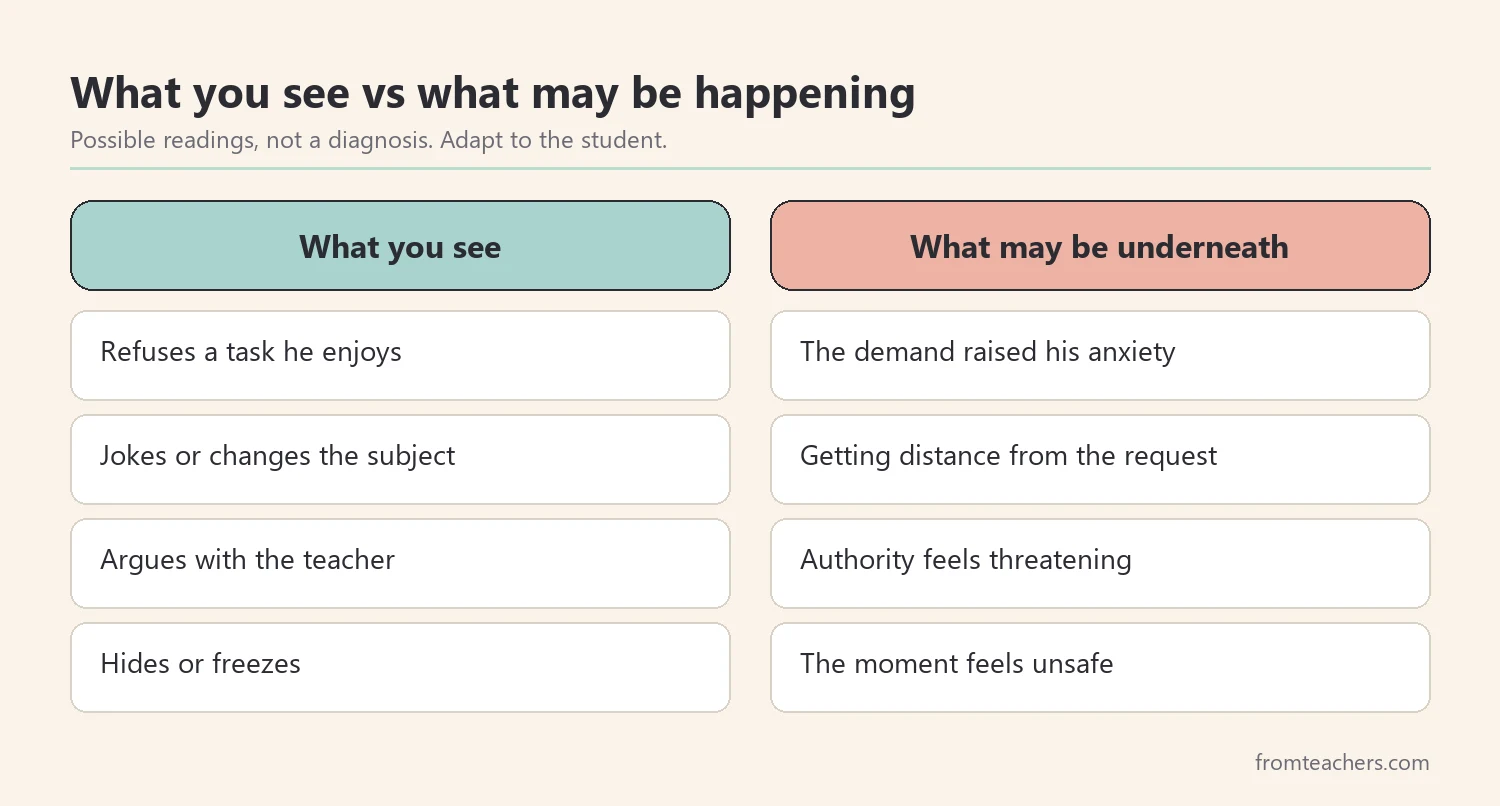
Sam is a fictional grade 4 student with a PDA profile. His teacher, Ms. Reyes, notices that he refuses tasks he enjoys as soon as they are framed as instructions. When she treats this as a sign of anxiety rather than a challenge to her authority, the classroom feels calmer for both of them.
Put this step into practice
In addition, avoidance can take many forms. Some students argue, some distract with jokes or questions, some suddenly need the bathroom, and some freeze. These strategies may look different, but they often serve the same purpose: getting distance from a demand that feels threatening.
Also, keep in mind that the PDA need for control is not a choice the student makes in the moment. It is better understood as an automatic response to perceived threat. That is why logic, warnings, or rewards rarely help during a refusal: the student’s anxiety is already high, and thinking clearly is hard.
2. Spot the hidden demands in the school day
Schools are full of demands that adults rarely notice. Schedules, bells, transitions, group work, questions, praise, and even “good morning” can all carry expectations. For a student with the PDA need for control, these small demands add up across the day.
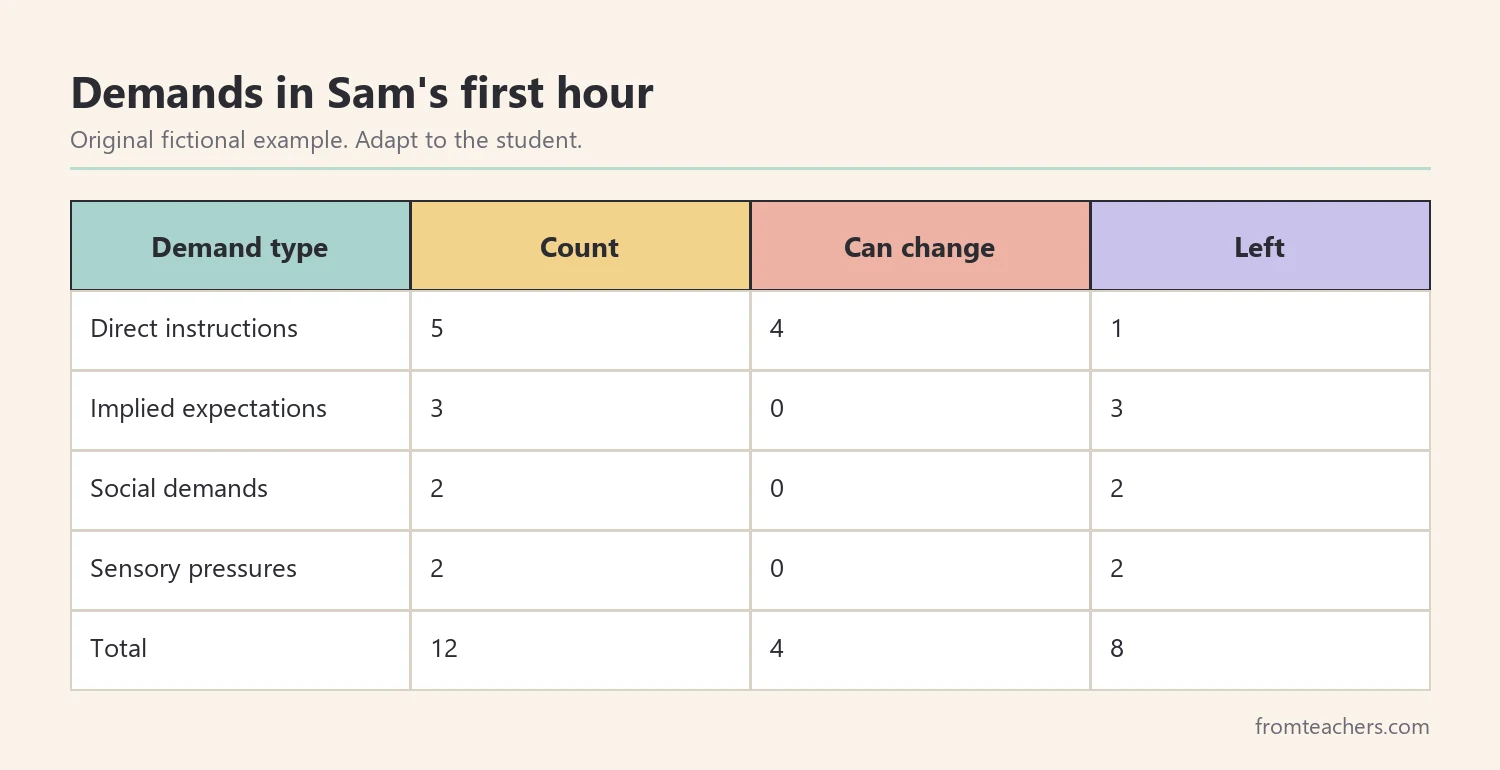
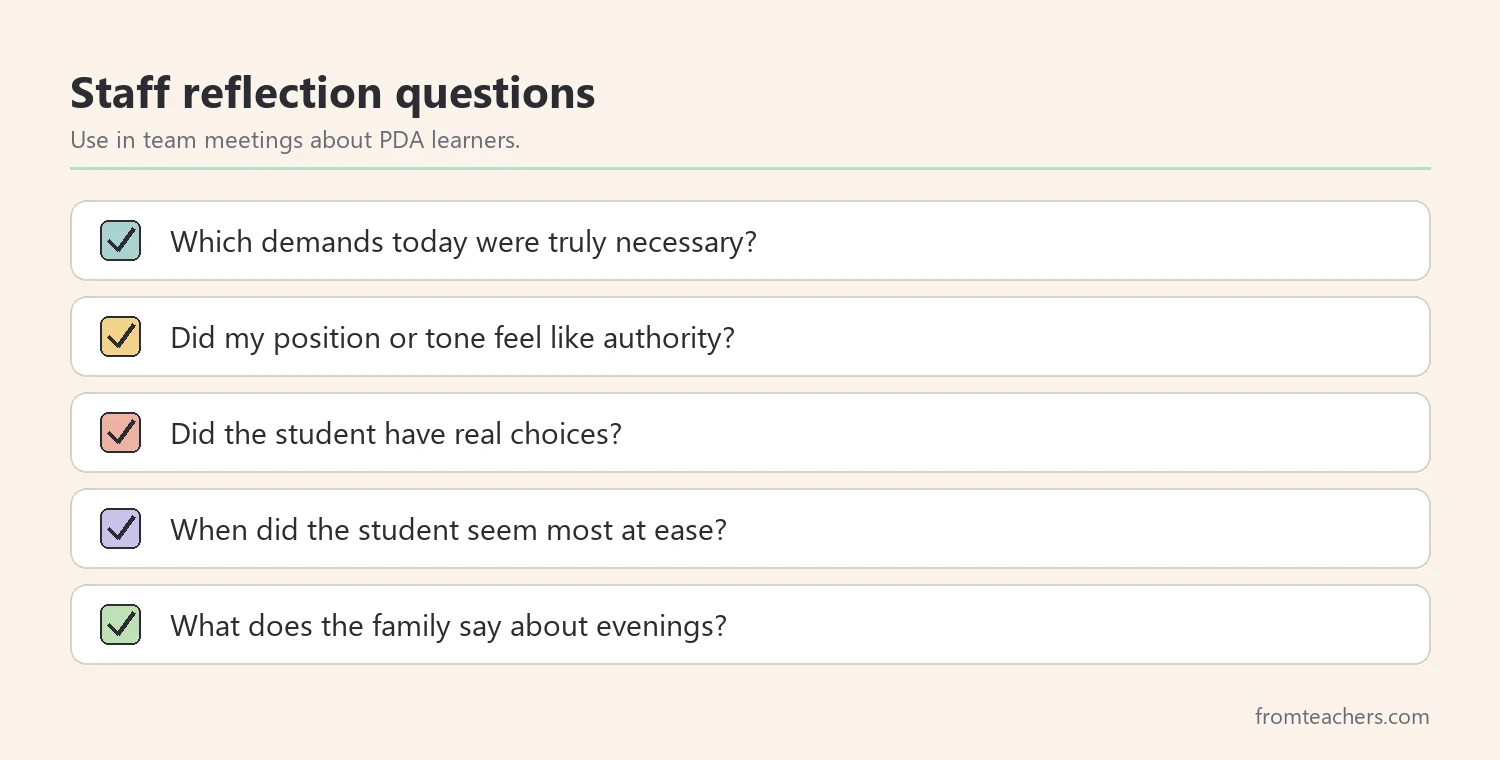
For example, start by listing the demands in one part of the day. Include direct instructions, implied expectations, and sensory pressures such as noise or crowded spaces. Then look at which ones are truly necessary.
| Demand type | Example | Possible change |
|---|---|---|
| Direct | “Sit down and start now.” | Indirect wording |
| Implied | Everyone else is already writing | Flexible start time |
| Social | Answer in front of the class | Written or private answer |
| Sensory | Loud, crowded transition | Leave early or later |
For example, Ms. Reyes lists the demands in Sam’s first hour. She counts 12 in total: 5 direct instructions, 3 implied expectations, 2 social demands, and 2 sensory pressures. She decides that 4 of the direct instructions can be rephrased or removed. That leaves 8 demands, which is a more manageable starting point.
A quick classroom example
Next, notice which demands cluster together. Transitions, for example, often combine a direct instruction, a sensory pressure, and a change of routine all at once. Reducing even one part of that cluster can make the PDA need for control easier to manage, because the total load drops.
Above all, remember that authority itself can feel like a demand. Many PDA learners find hierarchies threatening, so a teacher who stands over them and gives orders may raise anxiety before a single word is said. Sitting beside the student and using a more equal tone can help.
3. Respect the PDA need for control with indirect language
Once you know where demands come from, you can soften how they arrive. Indirect language keeps the expectation but removes some of the pressure. In many cases, the PDA need for control is respected when a student feels invited rather than told.
Next, try these shifts. Replace “Write your name” with “I wonder where the name goes on this one.” Replace “Clean up now” with “The tables need to be clear before lunch.” Replace “Answer the question” with “I’m curious what you think.” These statements describe the situation and leave room for the student to decide.
For instance, Ms. Reyes stops saying “Draw your character now.” Instead, she places paper and markers on the table and says, “I’ve been trying to imagine what your character’s hat looks like.” A few minutes later, Sam starts sketching. He did the same task, but the path felt like his own.
Make it stick
If you want a deeper training tool for this step, the PDA and the Need for Control and Autonomy professional development slides explain the demand and anxiety connection and include reflection prompts for staff discussion.
In addition, reduce the number of questions. Questions can feel like demands, too. Comments and observations often work better than direct prompts. Similarly, praise may feel like pressure for some students, so keep it low-key and specific.
Moreover, think about your body language. A relaxed posture, sitting at the student’s level, and a lighter tone all reduce the sense of a demand. Humor can help too, as long as it is warm and never at the student’s expense. Small adjustments like these show respect for the PDA need for control without lowering your expectations for learning.
4. Share control through choice, negotiation, and role-play
Lowering pressure is only half of the work when you support the PDA need for control. The other half is giving real control back in safe, structured ways. Because autonomy is a safety need for many PDA learners, shared control can reduce anxiety and open the door to learning.
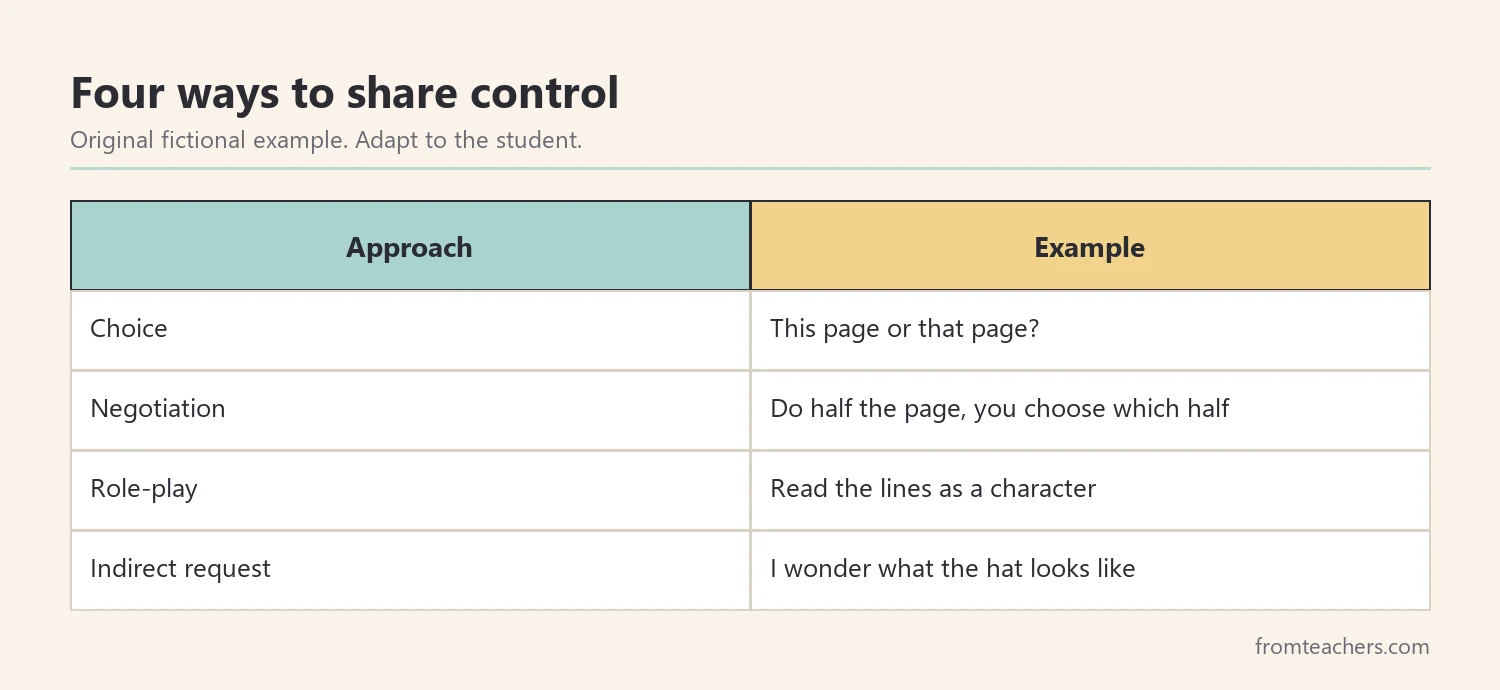
Choice is the simplest tool. Offer two or three options that all lead to the same goal: “This page or that page?” “Pencil or marker?” “Here or at the side table?” Make sure every option is truly acceptable.
Negotiation builds on choice. Sit together, describe the goal, and ask the student how they would like to get there. For example, Sam and Ms. Reyes agree that he will complete half of a math page, and he chooses which half. This collaboration respects the PDA need for control while keeping learning on track.
What this looks like day to day
Role-play and play-based approaches create even more distance from direct demands. A student who refuses to read aloud may happily read lines as a character. Similarly, a student who will not explain an answer may explain it to a puppet or “teach” it to the teacher.
Meanwhile, stay flexible about timing. A task refused at 9:00 may be completed at 9:20 once anxiety drops. Leaving the door open, rather than insisting on now, often leads to more work being done overall.
Finally, build trust before you build expectations. Students with the PDA need for control often respond best to adults they feel safe with. Time spent on shared interests, low-pressure conversation, and keeping promises is not time lost. It is the foundation that makes later collaboration possible.
5. Watch the cost of compliance and the PDA need for control
Some PDA learners hold it together at school and fall apart at home. They may look calm and compliant all day, then have meltdowns, exhaustion, or refusal in the evening. This pattern is sometimes called masking, and it has a real emotional cost.
Therefore, do not judge success by compliance alone. A quiet student who follows every instruction may be working very hard to suppress anxiety. Ask the family how evenings are going, and take their answer seriously.
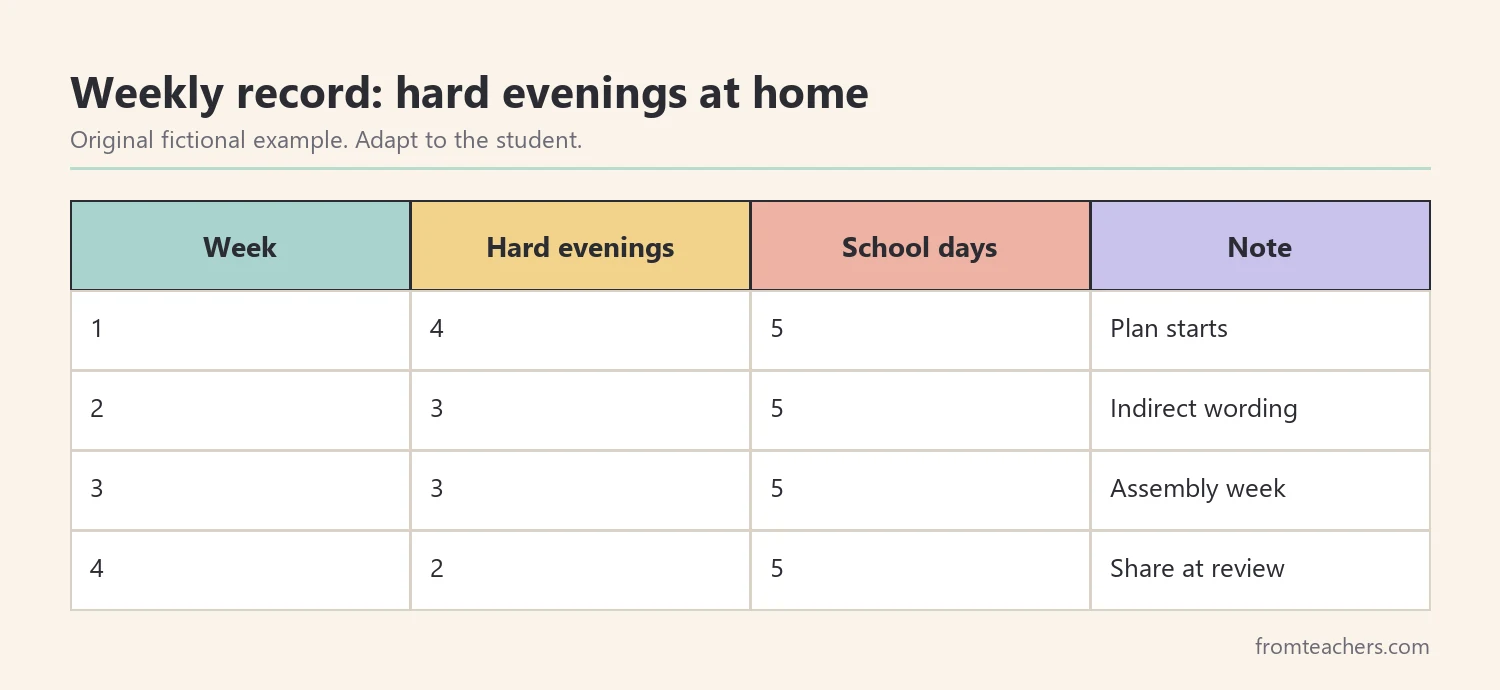
Track a few simple signs over time. Ms. Reyes and Sam’s family agree to note, each week, how many school days end with a hard evening at home. In week 1, it is 4 out of 5 days. By week 2, it is 3. In week 3, it is 3 again. Finally, in week 4, it is 2. Fewer hard evenings suggest that school demands are becoming more manageable.
In addition, give the student recovery time during the school day. A quiet break after a demanding lesson, a low-pressure activity before going home, or a reduced workload on hard days can lower the build-up of stress. These supports respect the PDA need for control and may reduce how much the student carries home.
Finally, review the plan with the team and the family every few weeks. Ask what feels easier, which demands still cause stress, and what one change could help next. Include the student when possible, using low-pressure questions and plenty of time.
Common mistakes and how to avoid them
- Treating the PDA need for control as defiance. Fix: see refusal as anxiety and ask what made the moment feel unsafe.
- Increasing pressure when a student refuses. Fix: lower demands, use indirect language, and allow more time.
- Using rewards and consequences as the main tool. Fix: focus on shared control, choice, and collaboration.
- Offering fake choices. Fix: give only options you are truly happy with.
- Judging success by compliance. Fix: ask how the student is doing at home, not only at school.
Questions teachers and parents ask about the PDA need for control
What does the PDA need for control mean?
It describes how many students with a PDA profile feel safer when they have control over what happens. When control is taken away, anxiety rises quickly. Avoidance is often the student’s way to restore a sense of safety.
Is PDA an official diagnosis?
PDA is not listed as a separate diagnosis in the DSM-5. Some professionals describe it as a profile within autism, and discussion is ongoing. Teachers do not need a formal label to use autonomy-supportive strategies.
Won’t giving choices let the student avoid everything?
Not when choices lead to the same goal. You still decide what learning needs to happen. The student decides some of the how, which lowers anxiety and often increases the amount of work completed.
How can parents support the PDA need for control at home?
Parents can use indirect language, offer real choices, and reduce unnecessary demands during hard periods. Sharing what works at home and at school helps adults stay consistent.
Why does the student seem fine at school but not at home?
Some students mask their anxiety at school and release it at home, where they feel safe. Therefore, a calm school day can still be very costly. Listening to families is essential.
Related reading: Understanding Demand Avoidance and School Refusal: Strategies for PDA-Style Profiles, Understanding Autistic Burnout and School Exhaustion: Prevention and Support Strategies, and Meltdowns vs Tantrums: A Guide to Understanding and Responding
A companion resource for the PDA need for control:
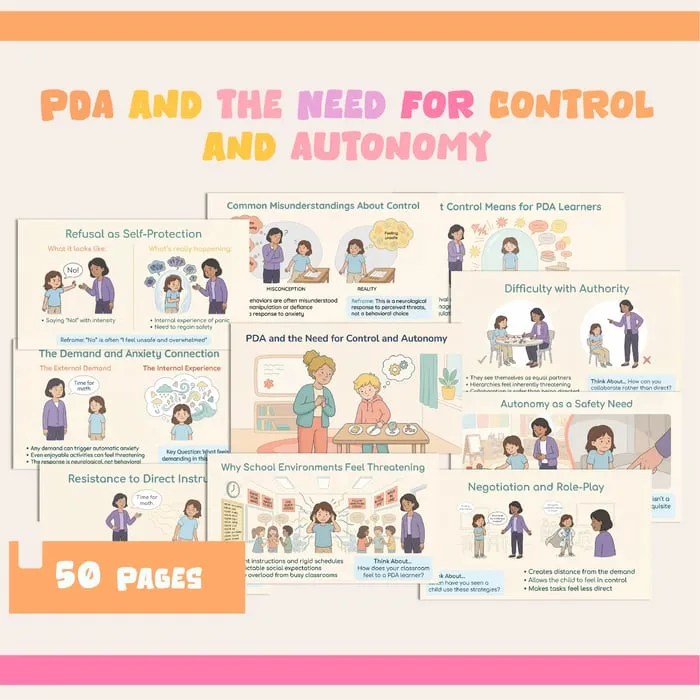
PDA and the Need for Control and Autonomy: a 50-slide professional development resource on refusal as self-protection, the demand and anxiety connection, difficulty with authority, why school environments can feel threatening, autonomy as a safety need, the emotional cost of compliance, and negotiation and role-play, with reflection prompts for staff.
Sources and scope
- PDA Society: information and resources about the PDA profile for families and professionals.
- National Autistic Society: general information about autism, including demand avoidance.
- IRIS Center, Vanderbilt University: free modules on autism, behavior, and evidence-based classroom practices.
- Understood.org: practical articles for families and teachers on anxiety and learning differences.
This guide covers classroom understanding and everyday responses for students with a PDA profile. It does not cover diagnosis, therapy, or formal evaluation, which belong to qualified professionals and the student’s team.
Key takeaways
- The PDA need for control is about safety, not defiance.
- Hidden demands add up across the school day, so count and reduce them.
- Indirect language lowers pressure while keeping expectations.
- Choice, negotiation, and role-play share control in safe ways.
- Watch the cost of compliance by asking how evenings at home are going.









Leave a Comment