

Reactive attachment disorder can make ordinary classroom moments feel like a power struggle. Picture a fifth grader who is told to put away her book and start math. She pushes the worksheet away, says “You can’t make me,” and turns her back. A firm reply feels natural, but it often makes the next ten minutes harder for everyone.
This guide gives you a five-step approach for supporting a student with reactive attachment disorder at school. You will learn how to spot the need for control early, offer real choices, respond to withdrawal without pushing, check your own triggers, and repair after hard moments. By the end, you will have a calm, relationship-first plan you can share with your team.
Examples are fictional. Adapt to the student’s goals and agreed supports. This is guidance, not a diagnosis.
At a glance
- For many students with attachment difficulties, control and predictability feel like safety.
- Notice early signs of the need for control before they turn into a power struggle.
- Offer real choices and lower demands without giving up structure.
- Respond to withdrawal with patience and space, not pressure.
- Own your part in hard moments and repair quickly to protect trust.
1. Recognize the need for control in reactive attachment disorder
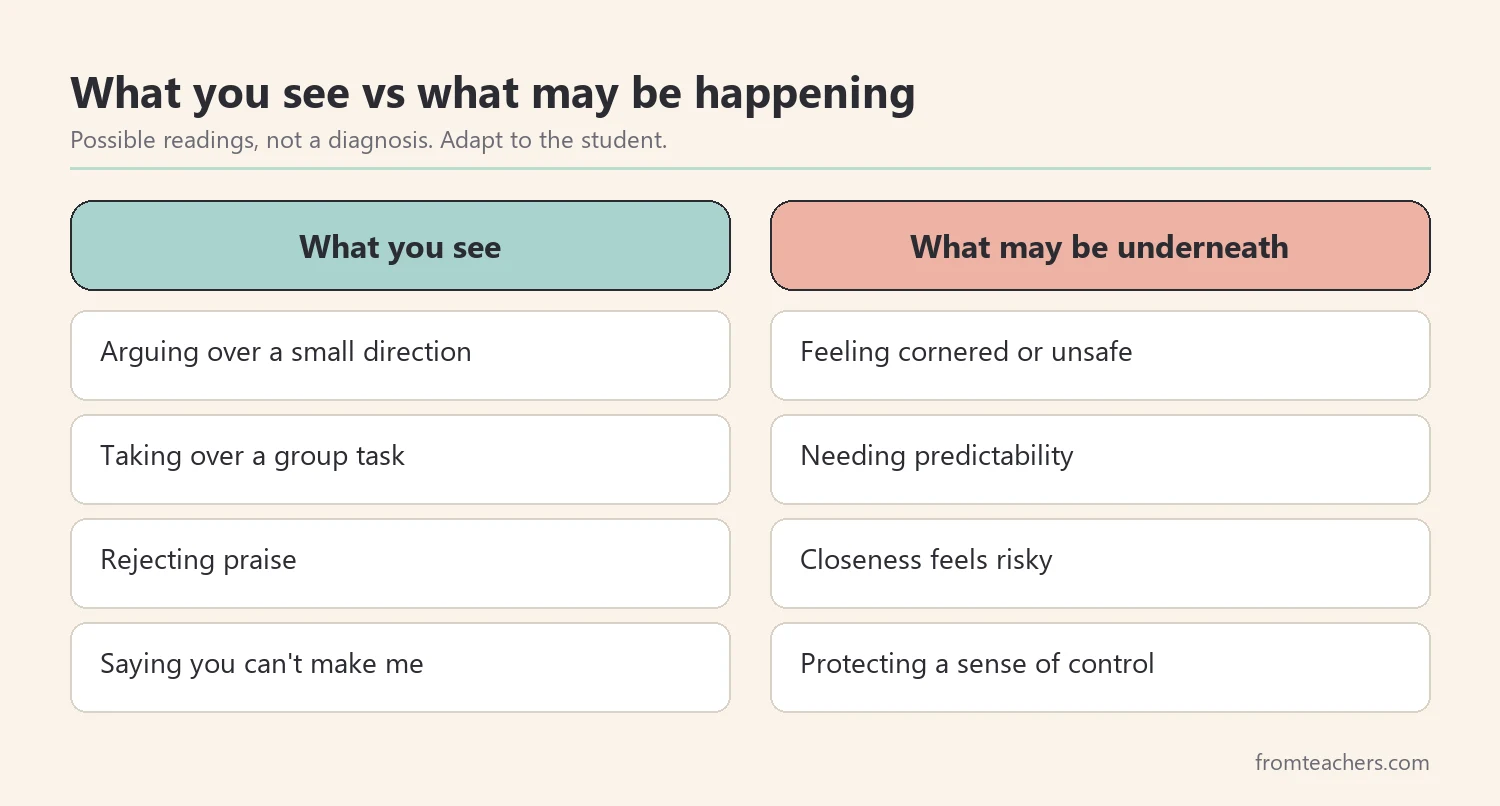
Reactive attachment disorder is a diagnosis made by qualified clinicians, not by teachers. However, teachers often work with students who have this diagnosis or who have complex attachment histories. In the classroom, what you see most is a strong need to stay in control.
In addition, that need can look like arguing over small directions, refusing help, taking over group tasks, or rejecting praise. It helps to see these behaviors as protection rather than defiance. For a child who has learned that adults are not always safe or predictable, control can feel like the only way to stay safe.
For example, start by watching for early signs. Note when the student tenses up, changes tone, or starts to bargain. These moments come before the larger refusal, and they are the best time to adjust.
| Early sign | What it may mean | First response |
|---|---|---|
| Arguing about a small step | Feeling cornered | Offer a choice |
| Ignoring a direction | Testing safety | Restate calmly once |
| Taking over a group | Needing predictability | Give a defined role |
Maya is a fictional grade 5 student with a reactive attachment disorder diagnosis. Her teacher, Mr. Hale, notices that her refusals often start right after a direct command in front of the class. That pattern becomes the starting point for his plan.
Put this step into practice
In addition, keep a short log for one or two weeks. Write down the time, the activity, the words you used, and how the student responded. You do not need a complex system. A few lines a day are enough to show which moments are hardest for a student with reactive attachment disorder, and which ones already go well.
Also, remember that the same student can look very different on different days. Sleep, changes at home, visits, or a new adult in the room can all raise the need for control. Noticing these outside factors helps you respond with patience instead of taking a hard day personally.
2. Offer real choices and shared control
Since control feels like safety, sharing it on purpose can lower tension. Real choices give the student a sense of power without removing classroom structure. The key word is “real”: both options must be acceptable to you.
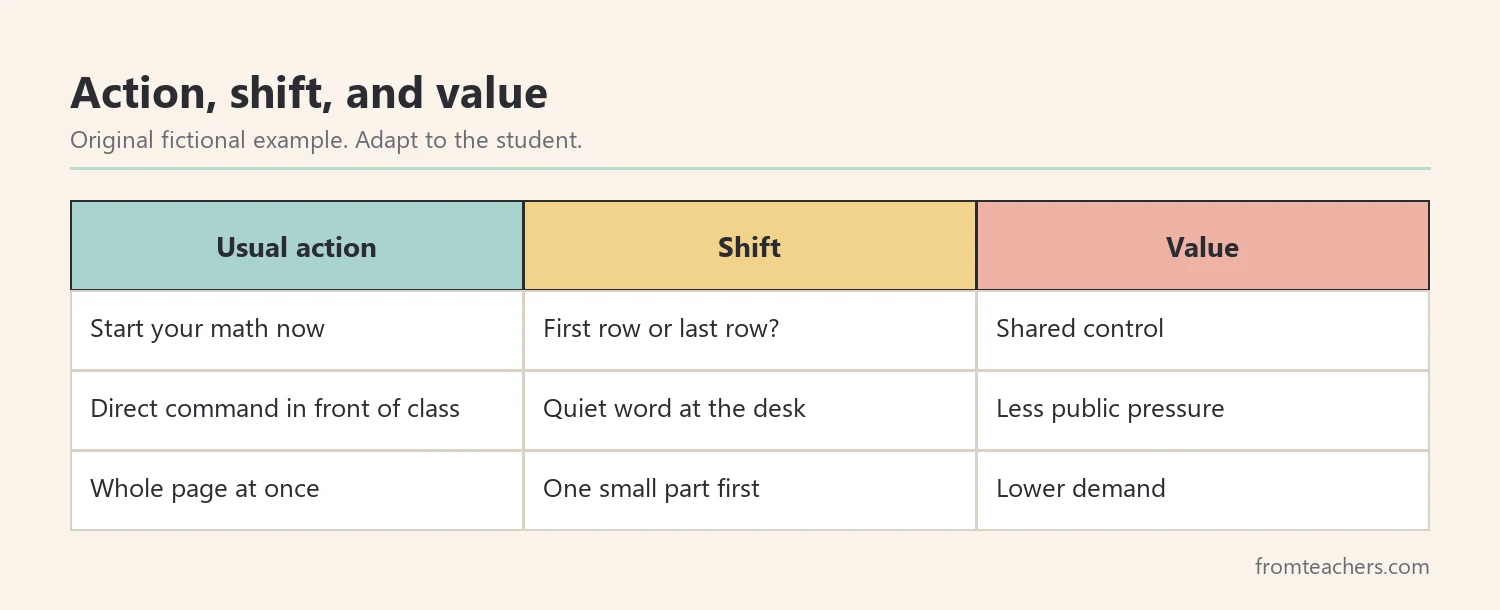
For example, instead of “Start your math now,” Mr. Hale says, “Do you want to start with the first row or the last row?” Maya still does math, but she decides how to begin. Similarly, he might offer a choice of pencil or marker, desk or side table, or now or in two minutes.
Lowering demands can also help. That does not mean lowering expectations forever. It means reducing the number of direct commands in a hard moment, giving more time, or breaking a task into smaller parts. In many cases, a student with reactive attachment disorder can complete the work once the pressure feels lower.
A quick classroom example
Next, a simple Action, Shift, and Value table helps adults plan these moves ahead of time. The action is what you usually do, the shift is what you try instead, and the value is why the shift matters. If you want a ready-made set of these tables, the Reactive Attachment Disorder in the Classroom strategy tables for teachers organize trauma-informed shifts by common classroom situations.
Above all, keep the tone neutral. A choice delivered with frustration still feels like a command. A calm, matter-of-fact voice tells the student that the choice is genuine.
Moreover, plan choices before you need them. In the middle of a tense moment, it is hard to think of two fair options. A short list of ready-made choices for common tasks, such as starting work, cleaning up, and lining up, makes it easier to stay calm and consistent with a student who has reactive attachment disorder.
3. Respond to withdrawal without pushing
Not every student with reactive attachment disorder argues. Some withdraw instead. They put their head down, stop talking, or move away from the group. Pushing for an answer in those moments often deepens the withdrawal.
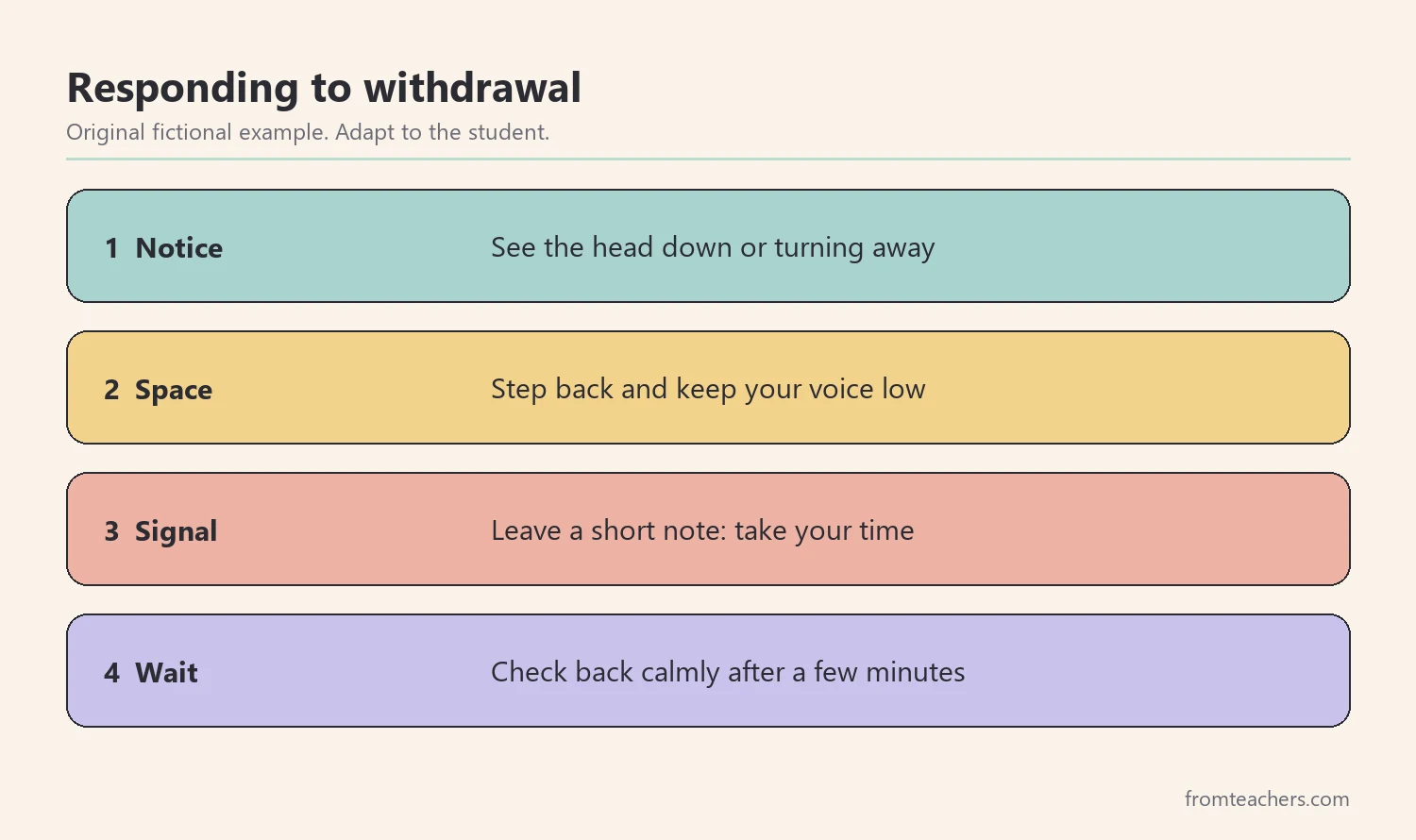
Instead, give space while staying present. Sit at a distance, keep your voice low, and let the student know you are nearby. A short phrase such as “I’m here when you’re ready” signals safety without adding a demand.
For instance, after a hard morning, Maya puts her head down during reading. Mr. Hale places a sticky note on her desk that says “Take your time. Page 12 when you’re ready.” Then he moves on to other students. After about five minutes, Maya opens her book.
In addition, honor the student’s need for space when it is safe to do so. A quiet corner, a short walk with an adult, or permission to work alone for a while can help. Make sure these options are taught in advance, so they feel like tools rather than escapes.
Make it stick
Meanwhile, watch your own urge to fix the moment quickly. Withdrawal can feel uncomfortable for adults. However, waiting calmly often works better than coaxing, and it shows the student that you can be trusted to stay steady.
For example, Mr. Hale and Maya agree on a small signal during a calm moment: if she turns her paper over, it means she needs a few minutes. He agrees not to ask questions until she turns it back. This shared signal gives her control over when to return.
Similarly, plan what you will do if withdrawal lasts longer than usual. Agree with the team on a simple next step, such as a counselor check-in or a quiet walk with a trusted adult. Having a plan keeps you from escalating out of worry.
4. Check your own triggers and correct misreadings
Adults bring their own patterns into every interaction. A sharp tone, a raised eyebrow, or a sigh can feel threatening to a student who is always scanning for danger. Therefore, part of supporting reactive attachment disorder is noticing what you bring to the moment.
Also, start with honest self-reflection. Which behaviors frustrate you most? When do you raise your voice? What helps you stay calm? Write the answers down. Knowing your own triggers makes it easier to pause before reacting.
Next, check whether you have misread a behavior. For example, Mr. Hale assumes Maya ignores him on purpose when she does not answer. Later, he notices she often does not answer when the room is loud. That small correction changes his response from a warning to a quiet check-in at her desk.
| First reading | Possible correction | New response |
|---|---|---|
| She is ignoring me | She may not have processed it | Repeat quietly at her desk |
| She is rude to peers | She may feel left out | Give a clear group role |
| She rejects praise | Praise may feel unsafe | Use short, specific feedback |
As a result, adults can respond to the need behind the behavior rather than to the surface. That shift protects the relationship, which is the foundation of everything else.
Finally, share your reflections with a colleague you trust. Supporting reactive attachment disorder in the classroom can be tiring, and adults need support too. A short weekly conversation with a counselor or coworker can help you stay steady and notice patterns you might miss on your own.
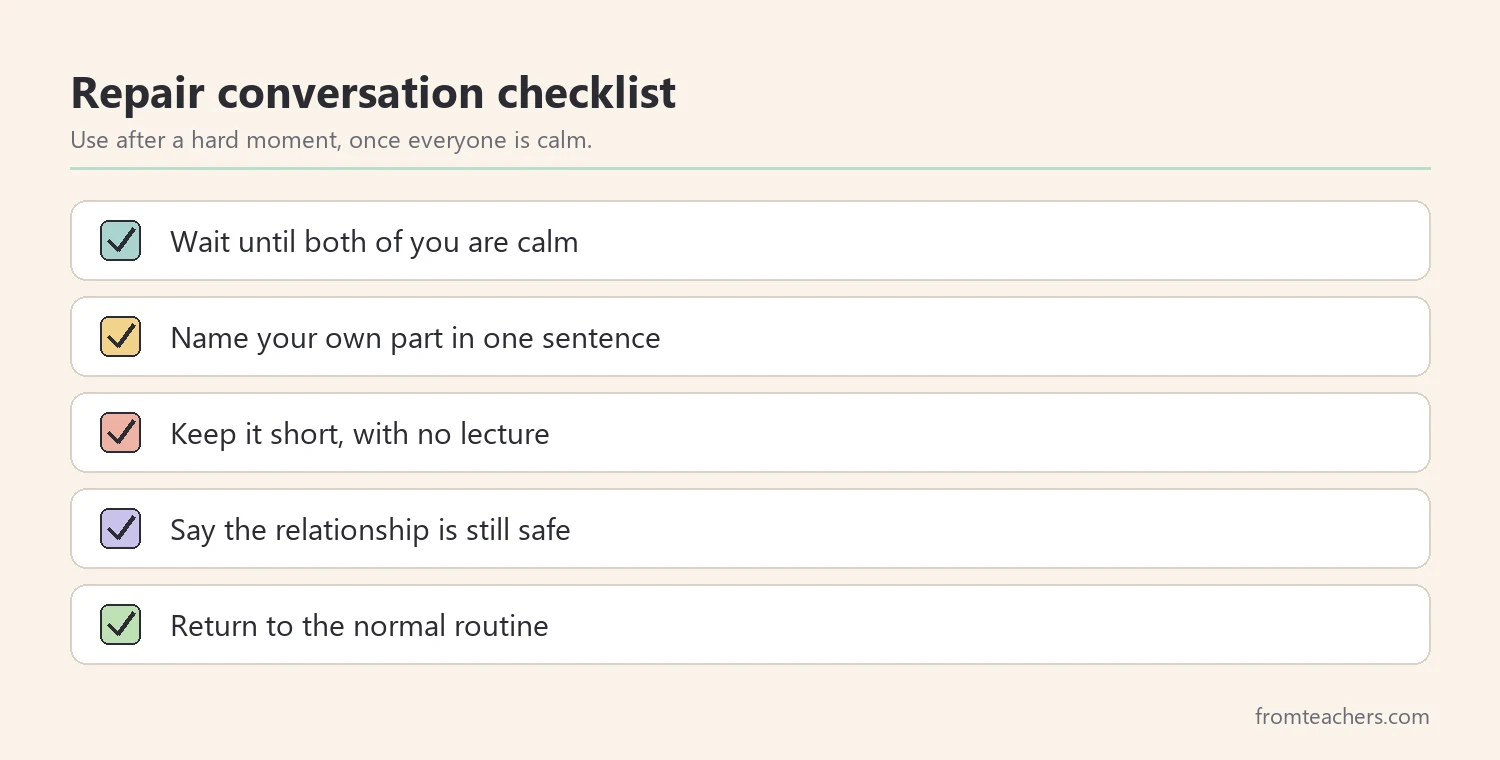
5. Repair quickly after reactive attachment disorder moments
Hard moments will still happen. What matters is what comes next. A quick, honest repair tells the student that the relationship survives conflict, which is something many children with reactive attachment disorder have not experienced.
As a result, keep repair short and specific. For example, “Earlier I used a sharp voice. That wasn’t fair. I’m still glad you’re in my class.” Avoid long lectures or asking the student to explain themselves. Then return to normal routines as soon as possible.
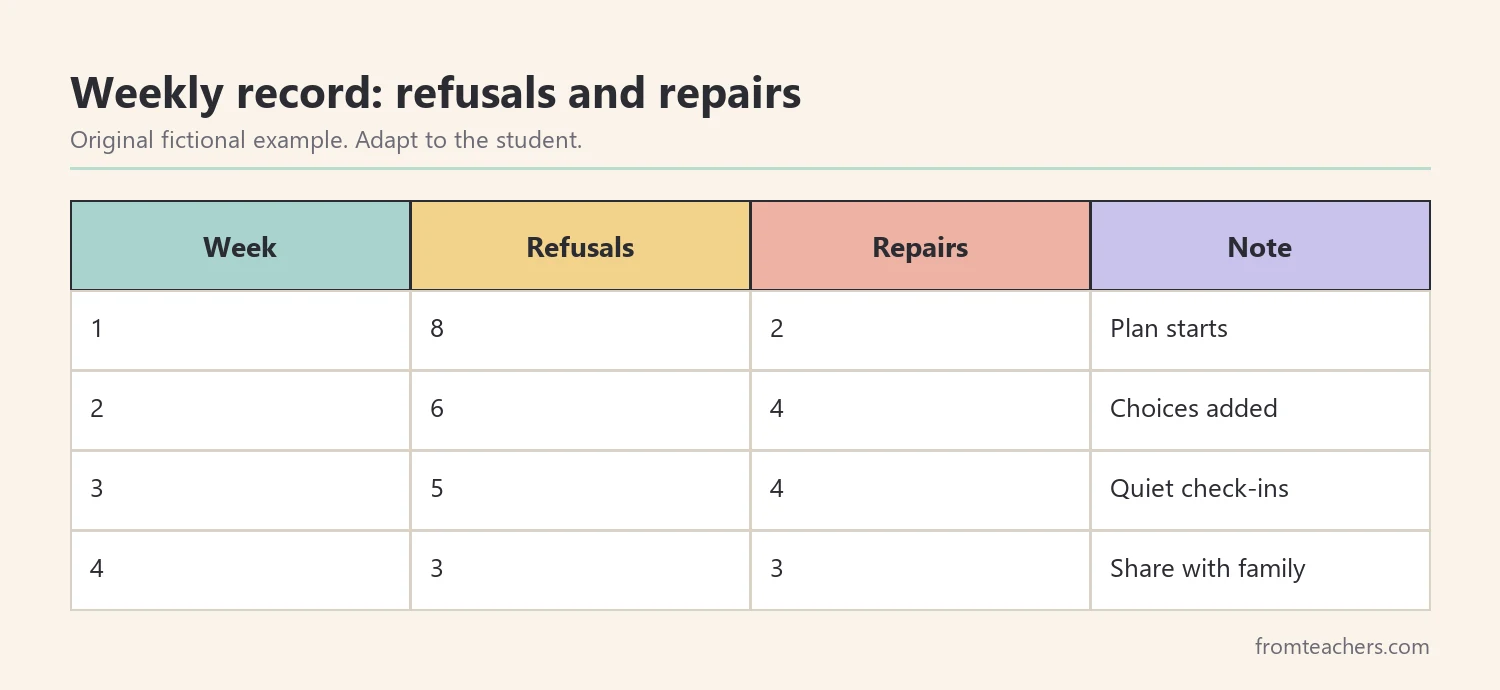
Track a few simple measures over time. Mr. Hale records how many refusals happen each week and how many end with a repair conversation. In week 1, there are 8 refusals and 2 repairs. By week 2, there are 6 refusals and 4 repairs. In week 3, there are 5 refusals and 4 repairs. Finally, in week 4, there are 3 refusals and 3 repairs. In total, 22 refusals happened over four weeks, and the trend is moving in the right direction.
Remember that progress is rarely a straight line. A good week can be followed by a hard one, especially after holidays, schedule changes, or events at home. When that happens, return to the basics: predictable routines, real choices, calm presence, and quick repair. These are the core of supporting reactive attachment disorder at school, and they work best when adults use them consistently over time.
Finally, share the plan with the team and the family. Counselors, support staff, and caregivers can use the same language and the same choices. Consistency across adults builds the predictability the student needs.
Common mistakes and how to avoid them
- Treating every refusal as defiance. Fix: look for the need for safety or control behind it.
- Giving fake choices. Fix: offer only options you are truly happy with.
- Pushing a withdrawn student to talk. Fix: give space, stay nearby, and wait calmly.
- Ignoring your own triggers. Fix: reflect on your patterns and pause before reacting.
- Skipping repair. Fix: keep repair short, honest, and quick, then return to routine.
Questions teachers and parents ask about reactive attachment disorder
What is reactive attachment disorder?
It is a diagnosis made by qualified mental health professionals, usually linked to early experiences of care. Teachers do not diagnose it. Instead, they support students by building safety, predictability, and trust in the classroom.
Why does a student with reactive attachment disorder resist adult directions?
For some children, adults have not always been safe or predictable. As a result, giving up control can feel risky. Shared control and real choices often lower that sense of threat.
Does offering choices mean the student is in charge?
No. You still set the structure and the goal. Choices only shape how the student reaches it, which keeps the classroom running while lowering tension.
How can parents support this at home?
Parents can use the same calm language, offer similar real choices, and practice short repairs after conflict. Sharing what works at school and at home helps the student experience consistent adults.
Who should be on the support team?
Usually the classroom teacher, a school counselor or psychologist, support staff, and the family. Outside therapists may also be involved. Regular, short check-ins keep everyone aligned.
Related reading: Essential Trauma-Informed Teaching Strategies for Modern Classrooms, Moving Beyond Shame and Behavior Charts: Positive Alternatives for Effective Classroom Management, and How Parents and Teachers Can Team Up for Special Education Success
A companion resource for reactive attachment disorder:
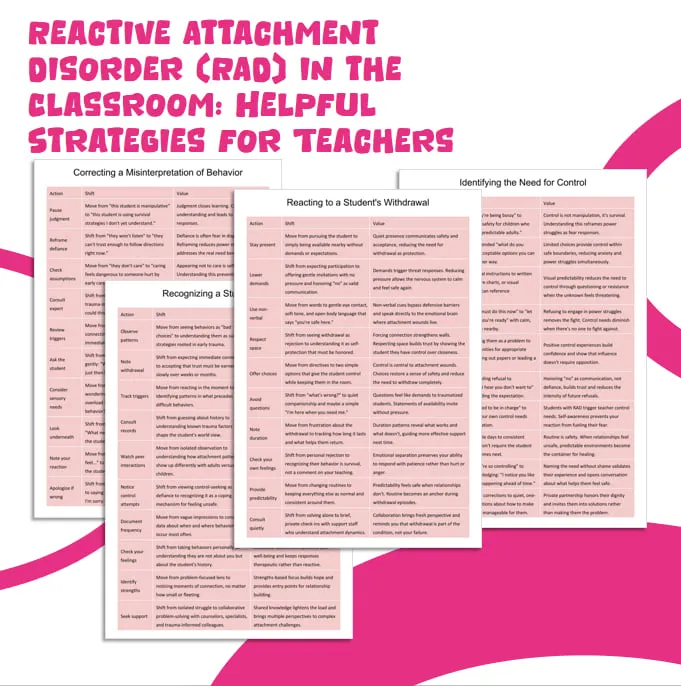
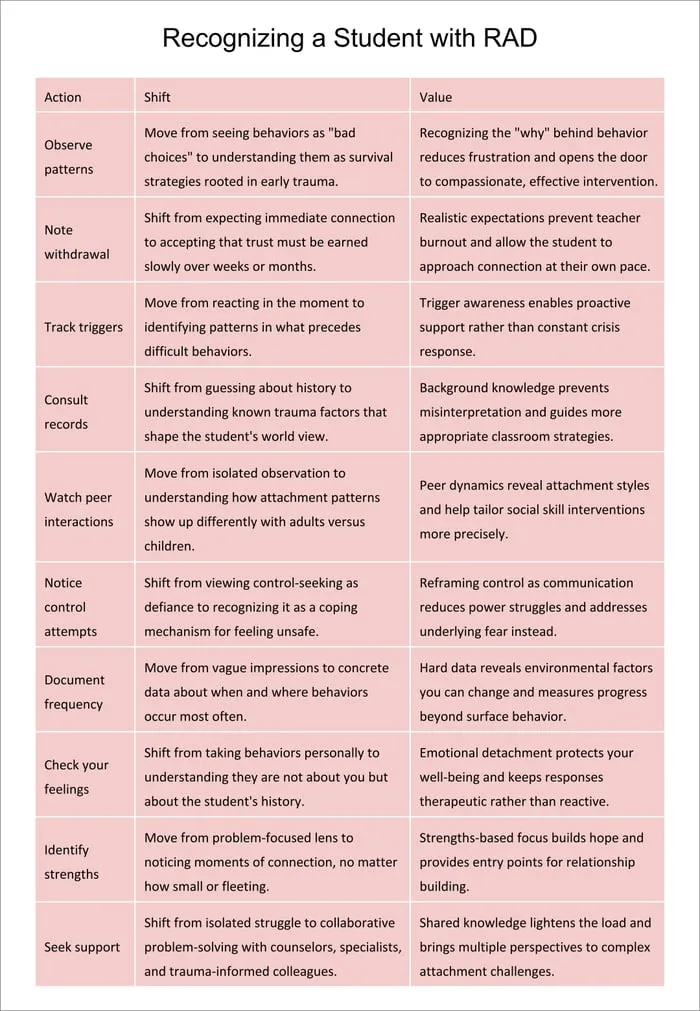
Reactive Attachment Disorder (RAD) in the Classroom: Helpful Strategies for Teachers: 12 pages of Action, Shift, and Value tables covering the need for control, responding to withdrawal, correcting misinterpretations of behavior, and accepting responsibility for triggers, with relationship-first language for repair.
Sources and scope
- National Child Traumatic Stress Network: information and resources for educators on trauma and children.
- American Academy of Child and Adolescent Psychiatry: family-friendly information on childhood mental health conditions.
- IRIS Center, Vanderbilt University: free modules on classroom behavior and evidence-based practices.
- IDEA, U.S. Department of Education: the law behind special education services and IEPs.
This guide covers everyday classroom responses for students with attachment difficulties. It does not cover diagnosis, therapy, or treatment, which belong to qualified professionals working with the family.
Key takeaways
- With reactive attachment disorder, control often feels like safety.
- Real choices and fewer direct commands lower tension without removing structure.
- Withdrawal calls for space and calm presence, not pressure.
- Reflecting on your own triggers helps you respond to the need behind the behavior.
- Quick, honest repair after conflict protects trust.










Leave a Comment