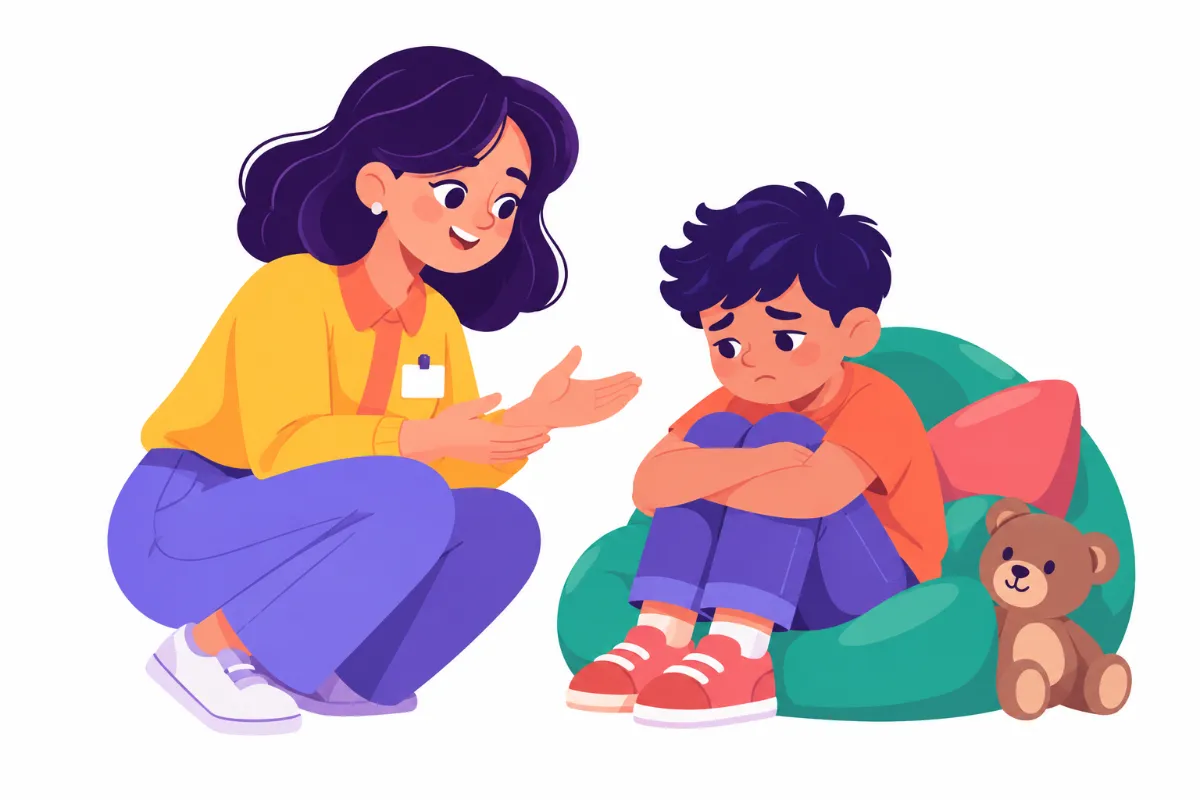

De-escalation strategies for teachers matter most in the few seconds when a student’s voice rises, a chair scrapes back, and the whole room turns to watch. In that moment, it is natural to want to take control fast. Yet a quick, firm demand often adds fuel, and a small conflict becomes a big one.
This guide gives you a five-step process you can practice before you need it: notice early signs, regulate yourself, use fewer words and calm body language, offer safe choices and space, and repair the relationship afterward. By the end, you will have a short plan you can rehearse with your team and use the next time a student starts to escalate.
Examples are fictional. Adapt to the student’s goals and agreed supports. This is guidance, not a diagnosis.
At a glance
- Catch the early signs, because small responses work best early.
- Calm yourself first: your voice and body set the tone.
- Use fewer words, a softer voice, and a side-on stance.
- Offer two safe choices and give time and space.
- Repair and reflect afterward so the next moment goes better.
1. Notice early signs before you need de-escalation strategies for teachers
First, learn what escalation looks like for each student. Many students show early signs well before an outburst: a clenched jaw, a tapping foot, short answers, pulling a hood up, or pushing materials away. De-escalation strategies for teachers work best at this early stage, when a small adjustment can still change the direction.
Next, think about common triggers, since de-escalation strategies for teachers are easier to use when you can predict the hard moments. Transitions, unexpected changes, public correction, difficult tasks, and conflict with peers often come right before escalation. Keep a short log for a week or two with the time, the activity, the early signs, and what happened next.
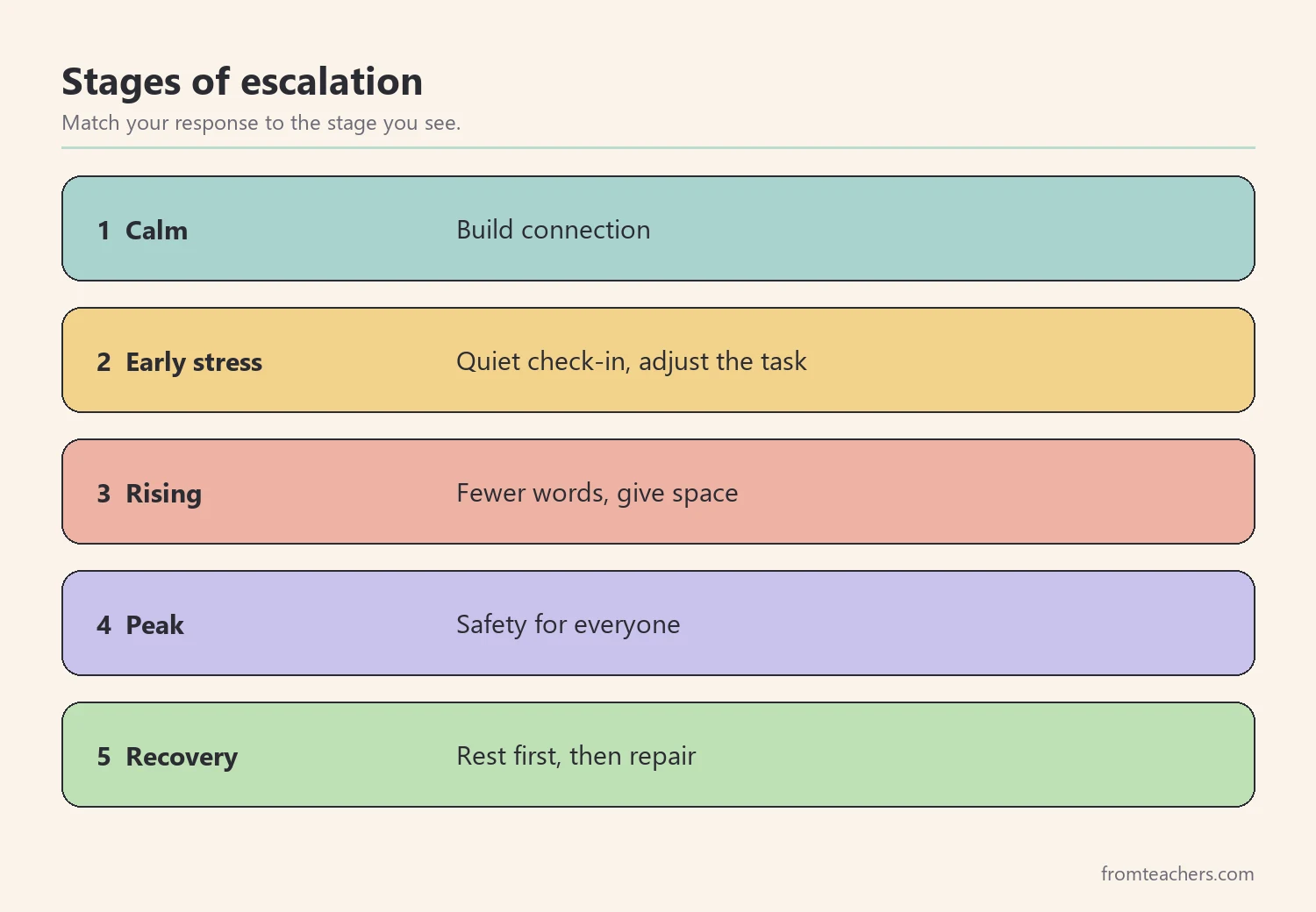
Then, match your response to the stage. Early on, a quiet check-in or a change of task may be enough. As stress rises, you need fewer words and more space. At the peak, the priority is safety, not teaching.
| Stage | What you might see | Teacher focus |
|---|---|---|
| Calm | Working, relaxed body | Build connection |
| Early stress | Fidgeting, short answers | Quiet check-in, adjust task |
| Rising | Raised voice, arguing | Fewer words, give space |
| Peak | Shouting, throwing, leaving | Safety for everyone |
| Recovery | Tired, quiet, withdrawn | Rest, then repair |
Worked example. Eli is a fictional student in grade 6. His teacher notices that before he shouts, he usually pulls his hood up and stops answering. This often happens when a test is handed out without warning. Now, she watches for the hood as her early signal.
In short, knowing the early signs gives you time. As a result, you can respond calmly instead of reacting at the peak.
2. Regulate yourself first: the core of de-escalation strategies for teachers
Students borrow calm from the adults around them. So, the second step in any set of de-escalation strategies for teachers is managing your own reaction. That does not mean feeling nothing. It means noticing your stress and choosing your response.
Start with your breath. One slow breath in through the nose and a longer breath out gives you a moment to think. Next, check your face and shoulders. Relax your jaw and lower your shoulders. Then, remind yourself that this is a stressed student, not a personal attack.
Also, plan your own exit if you need it. In many schools, a colleague can step in for a few minutes. Agree on a simple signal with your team, such as a phrase or a card, so you can hand off before your own stress leaks into the moment.
Self-regulation checklist
- One slow breath before you speak.
- Relaxed face, lowered shoulders, open hands.
- A private reminder: “This is stress, not a challenge to me.”
- A team signal to call for support or a handoff.
- A short break for yourself after a hard moment.
Worked example. When Eli raises his voice, his teacher feels her heart rate jump. She takes one slow breath, unclenches her hands, and decides not to answer his comment right away. That pause keeps her own voice steady when she does speak.
Clearly, self-regulation is not a soft extra. Among all de-escalation strategies for teachers, it is the one that makes every other step possible.
3. Use fewer words and calm body language
When a student is stressed, they process less language. Long explanations, lectures, and repeated warnings can feel like pressure. Therefore, de-escalation strategies for teachers focus on fewer words, a lower voice, and steady body language.
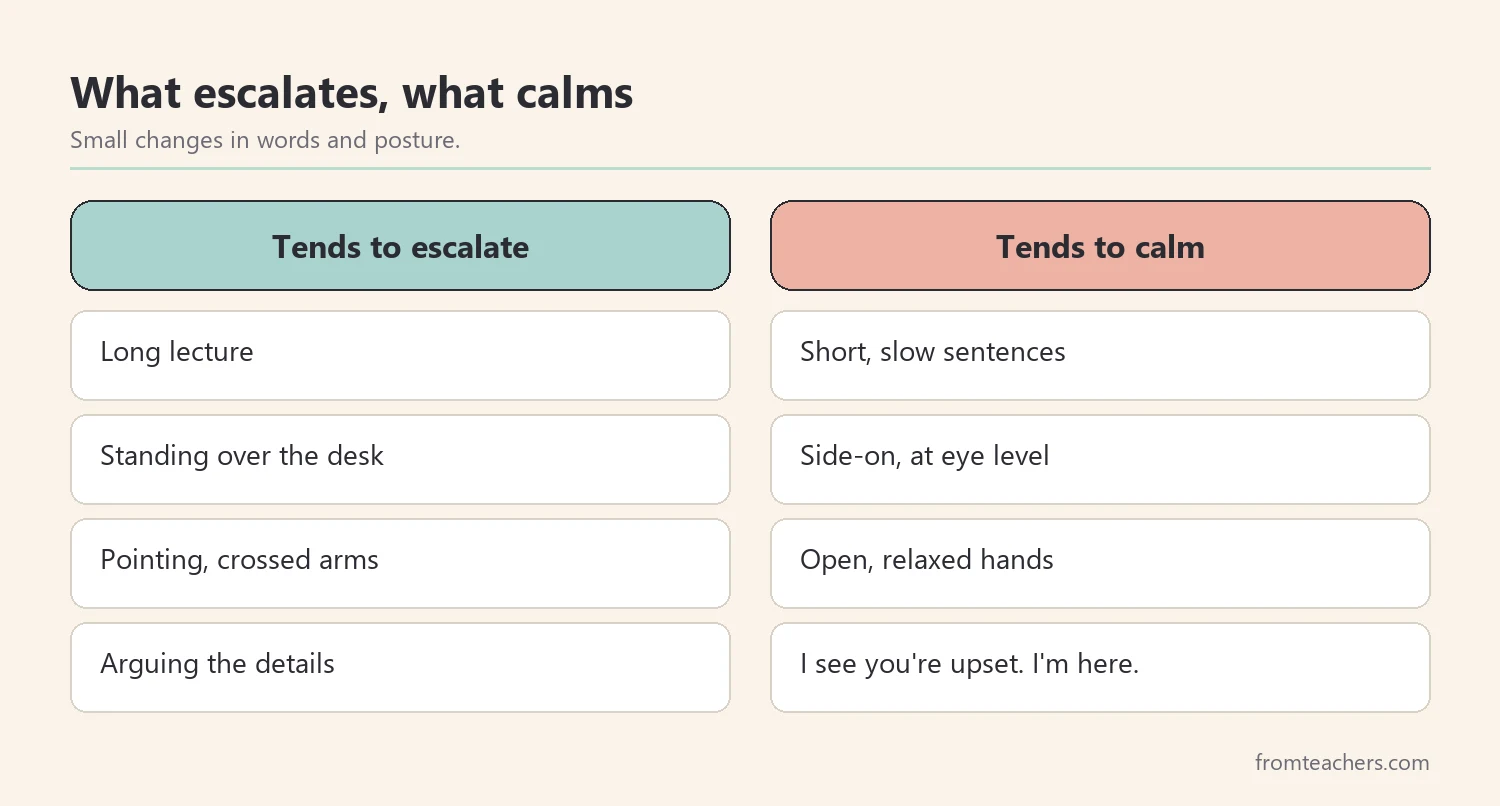
Speak slowly and softly, using short sentences. For example, “I see you’re upset. I’m here.” Avoid arguing about details, and do not try to win the point in the moment. In addition, use the student’s name in a calm tone, and leave pauses so they have time to respond.
Body language says as much as words, which is why de-escalation strategies for teachers always include posture. Stand slightly to the side rather than face to face, keep a respectful distance, and lower yourself to eye level if it is safe. Keep your hands visible and relaxed. Avoid pointing, crossing your arms, or standing over the student.
Short phrases that help
It helps to prepare a few phrases in advance, because finding calm words under pressure is hard. Good de-escalation strategies for teachers rely on short, neutral lines that acknowledge feelings without judging. For example, “That sounds really frustrating,” “Let’s take a minute,” or “We can sort this out later.”
Similarly, plan what you will not say. Sarcasm, ultimatums, and “Why did you do that?” usually raise stress. Practice your phrases with colleagues so they come out naturally when you need them.
If you would like a quick reference for these moments, the De-escalation Techniques strategy tables cover active listening, non-verbal communication, managing personal emotions, and more, each in a Strategy, Tip, and Why It Works format.
Worked example. Eli’s teacher walks over slowly and stands beside his desk, not in front of it. She crouches slightly and says quietly, “Eli, I can see this test is a lot right now.” Then she waits. Eli does not answer, but his voice drops when he speaks to his neighbor.
4. Offer safe choices and give space
A stressed student often feels trapped, and de-escalation strategies for teachers try to open a way out. Offering a sense of control can lower that feeling. So, the fourth step is to offer two simple, safe choices and to give physical and emotional space.
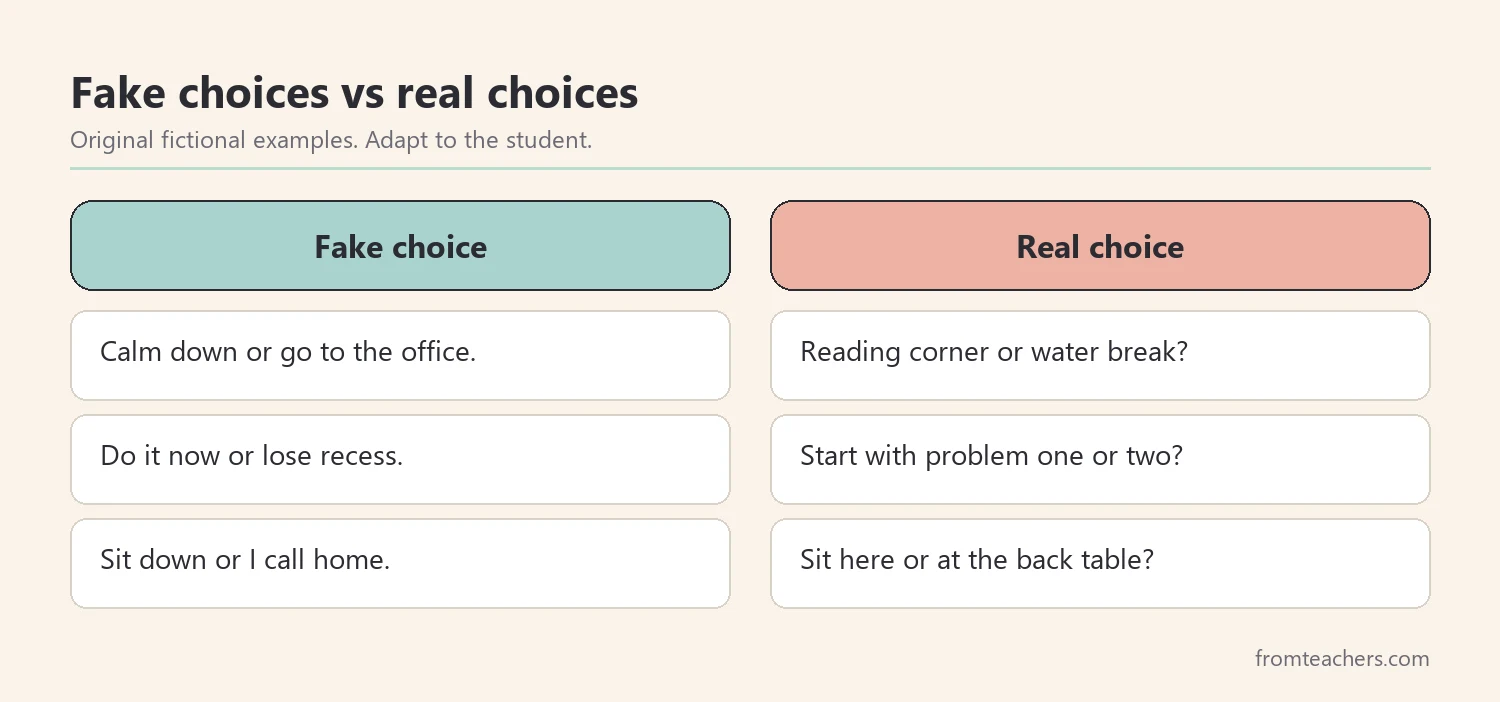
Keep choices small and real. For example, “Do you want to take a break at the back table or get some water and come back?” Both options should be acceptable to you and safe for everyone. Avoid threats disguised as choices, such as “Calm down or go to the office,” which tend to raise stress.
Next, give time. Silence can feel uncomfortable, but a student often needs a minute or more to settle. Meanwhile, quietly reduce the audience by giving the rest of the class a task or moving them gently. In addition, remove objects that could be thrown, if you can do so calmly.
However, safety comes first. If a student or others are at risk, follow your school’s safety and crisis procedures and call for support. De-escalation strategies for teachers aim to prevent that point, but they do not replace a school’s emergency plan.
Worked example. Eli’s teacher says, “You can take five minutes in the reading corner or get water and come back. Your choice.” Meanwhile, she tells the class to start the first two problems. Eli picks up his water bottle and leaves for a few minutes, then returns and sits down quietly.
5. Repair, reflect, and plan ahead
After a hard moment, the relationship needs attention. Repair helps the student feel safe returning to class and makes the next conflict less likely. Therefore, the last step of de-escalation strategies for teachers happens when everyone is calm again.
Wait until the student is fully settled, often later the same day or the next morning. Then, have a short private conversation. Name what happened without blame, listen to the student’s view, and agree on one thing to try next time. Keep it brief and warm. A student who feels welcomed back is far more likely to accept help the next time stress begins to rise.
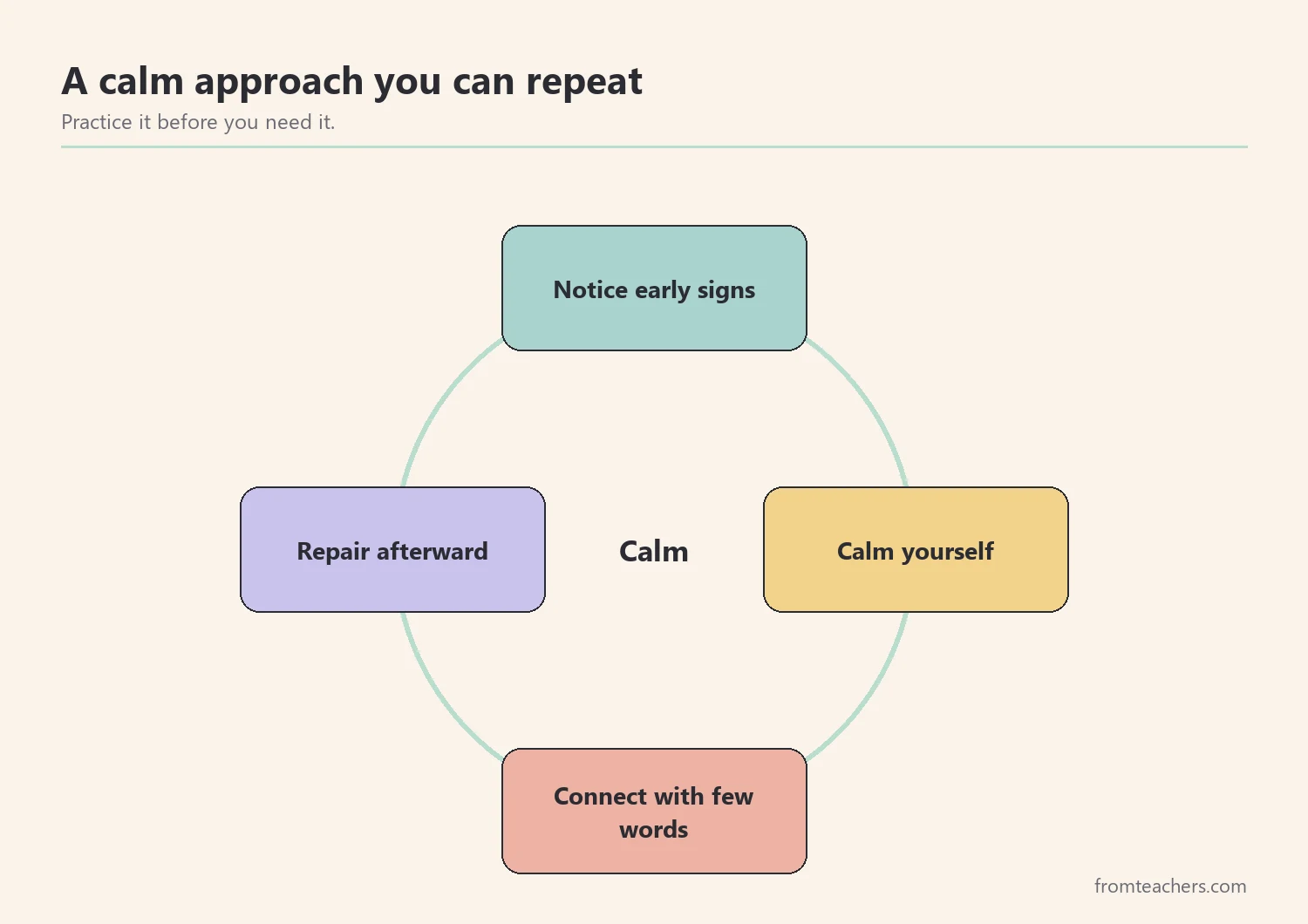
Next, reflect as a team on which de-escalation strategies for teachers worked. What were the early signs? What helped, and what did not? Was the trigger something you can change, such as warning before tests? Write down one or two adjustments and share them with other adults who work with the student and, where appropriate, the family.
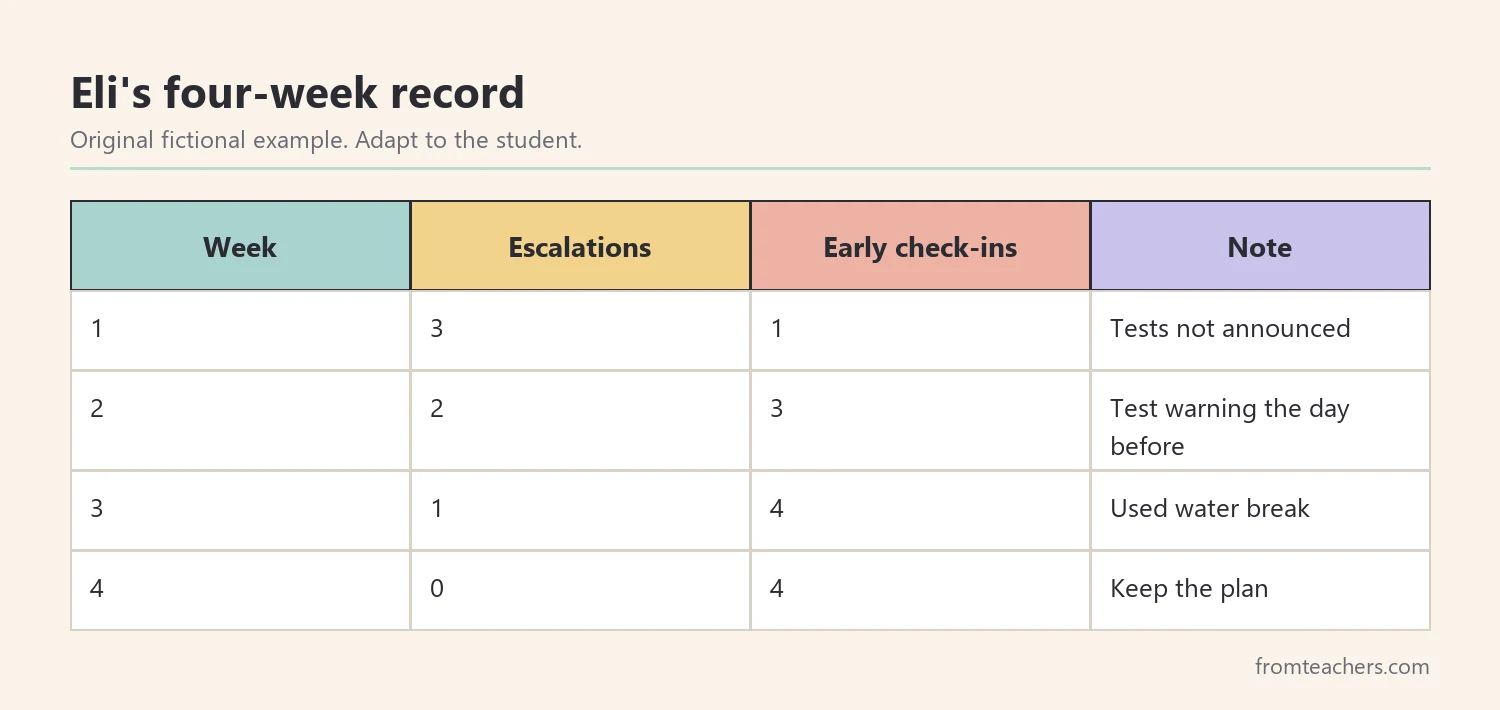
Worked example. The next morning, Eli’s teacher meets him at the door. “Yesterday was hard. What would help before a test?” Eli says he hates surprises. They agree she will tell him the day before. Over the next four weeks, his teacher tracks escalations: 3 in week 1, 2 in week 2, 1 in week 3, and none in week 4.
Planning ahead as a team
Finally, turn what you learned into a short written plan. List the student’s early signs, known triggers, the phrases and choices that help, and who to call for support. When every adult uses the same de-escalation strategies for teachers, the student meets a predictable response wherever they are in the building.
Also, review the plan every few weeks. Triggers change as students grow, and a plan that worked in September may need updates by spring.
Common mistakes and how to avoid them
- Arguing in the moment. Debating details keeps stress high. Fix: acknowledge feelings and save the discussion for later.
- Too many words. Long explanations overwhelm a stressed student. Fix: use short sentences and leave pauses.
- Public consequences. An audience raises the stakes. Fix: keep responses private and reduce the audience.
- Fake choices. Threats framed as options add pressure. Fix: offer two safe options you are happy with.
- Skipping repair. The student may return feeling ashamed or anxious. Fix: have a short, calm conversation once everyone is settled.
- Handling it alone. Your own stress can rise. Fix: agree on a team signal and use it early.
Questions teachers and parents ask about de-escalation strategies for teachers
Do de-escalation strategies for teachers mean letting behavior go?
No. The goal is to lower stress first so learning and problem-solving can happen later. Expectations and follow-up still matter, but they work better once the student is calm.
What should I say when a student is shouting?
Say very little. Use a calm voice, the student’s name, and a short line such as “I’m here” or “You’re safe.” Then wait and give space.
How do I handle the rest of the class?
Give the class a simple task, such as reading or starting problems, and keep your own voice calm. If needed, move the class or call for support so the student has less of an audience.
When should I call for help?
Call for help whenever safety is at risk or you feel your own stress rising too much. Follow your school’s crisis plan and use your team signal early rather than late.
Can families use the same approach at home?
Yes. Fewer words, a calm voice, two safe choices, and repair afterward work in many settings. Sharing the same language at home and school can help the child feel more secure.
Related reading: Meltdowns vs Tantrums: A Guide to Understanding and Responding, Moving Beyond Shame and Behavior Charts, and Essential Trauma-Informed Teaching Strategies for Modern Classrooms.
A companion resource for de-escalation strategies for teachers:
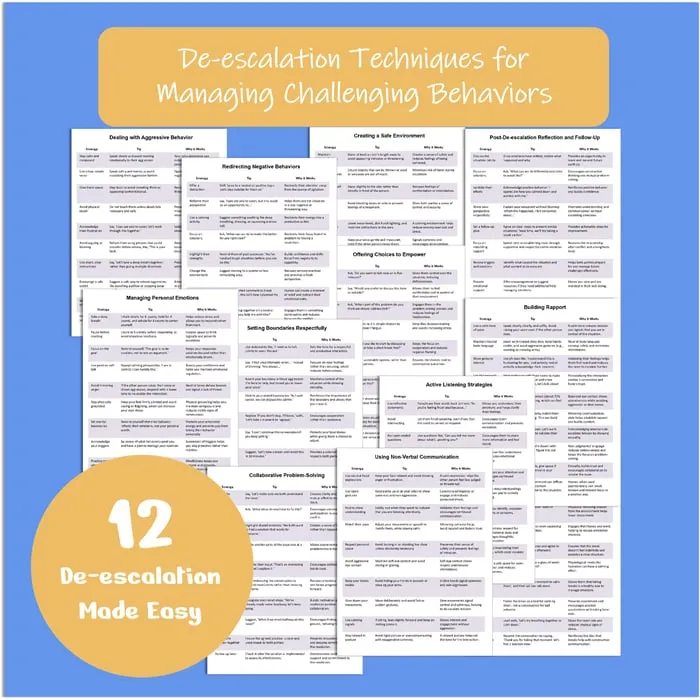
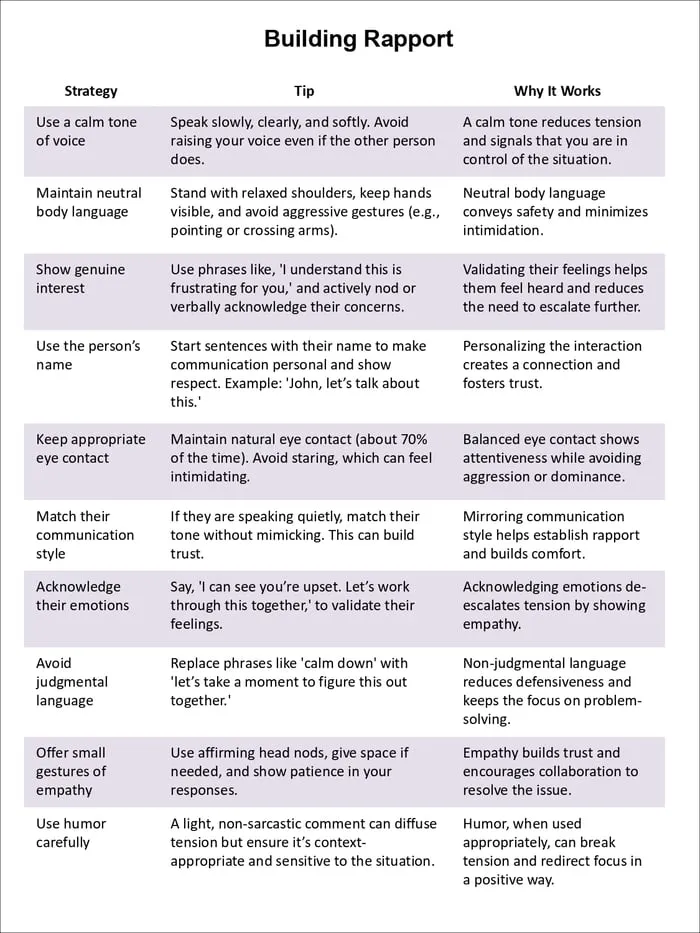
De-escalation Techniques for Managing Challenging Behaviors: twelve strategy tables, from managing personal emotions and active listening to offering choices and post-de-escalation follow-up, each in a Strategy, Tip, and Why It Works format.
Sources and scope
- Center on PBIS: guidance on positive behavior support and preventing challenging behavior in schools.
- Crisis Prevention Institute: training and resources on de-escalation in schools and other settings.
- CASEL: resources on social and emotional learning, including self-management and relationship skills.
- IRIS Center, Vanderbilt University: free modules on classroom behavior and acting-out cycles.
This guide covers everyday classroom responses to rising stress. It does not cover physical restraint, crisis intervention training, or legal requirements, which follow your school’s policies and qualified trainers. If your school offers formal training, the steps here can sit alongside it as a simple daily routine.
Key takeaways
- De-escalation strategies for teachers work best when you catch early signs.
- Calm yourself first, then use fewer words and steady body language.
- Offer two safe, real choices and give time and space.
- Put safety first and follow your school’s plan when risk is high.
- Repair the relationship and adjust the plan as a team.







Leave a Comment