

Evidence-based teaching strategies sound like something from a research journal, yet they show up in ordinary moments. Picture a fourth-grade math lesson where you explain a new skill, hand out practice, and then discover that half the class copied the wrong method. The lesson was not careless. It simply skipped a few steps that research and experience say matter.
This guide turns those steps into a five-part routine you can use tomorrow: choose one strategy, model it clearly, guide practice with feedback, add visual supports and spaced review, and check whether it worked. By the end, you will have a small, repeatable plan instead of a long list of buzzwords.
Examples are fictional. Adapt to the student’s goals and agreed supports. This is guidance, not a diagnosis.
At a glance
- Pick one strategy for one clear goal rather than many at once.
- Model the thinking out loud, then share the work, then hand it over.
- Give feedback that is specific, quick, and tied to the goal.
- Use visuals and spaced review so learning sticks.
- Check results with simple exit tickets and adjust.
1. Choose evidence-based teaching strategies for one clear goal
First, start with the goal, not the strategy. Evidence-based teaching strategies work best when they match a specific learning target. “Get better at math” is too broad. “Subtract three-digit numbers with regrouping” gives you something you can teach, practice, and measure.
Next, look at where students are now. A short pre-check of four or five problems shows who already has the skill, who is close, and who is missing an earlier step. That information tells you how much modeling and practice the group will need.
Then, choose one strategy to focus on. Many well-known approaches, such as explicit instruction, guided practice with feedback, visual supports, and spaced review, have strong support across research summaries from organizations like the What Works Clearinghouse. However, using one well beats using five halfway.
| If students need… | Strategy to try first |
|---|---|
| A brand-new skill | Explicit modeling |
| Practice with support | Guided practice and feedback |
| Help seeing structure | Visual supports |
| To keep what they learned | Spaced review |
Three questions before you choose
Before you commit, ask three short questions. Does the strategy fit the goal? Can you use it every day without extra materials? Will you be able to see whether it helps? If the answer to any of these is no, pick a simpler option from your list of evidence-based teaching strategies.
Also, think about the whole group as well as one student. Many evidence-based teaching strategies, such as clear modeling and quick checks, help everyone in the room. Consequently, a support you plan for one learner often lifts the class.
Worked example. Priya is a fictional student in grade 4 who receives support in math. On a pre-check of 5 subtraction problems with regrouping, she gets 1 correct. Her errors show that she subtracts the smaller digit from the larger one in each column. Her teacher chooses explicit modeling as the first strategy, because Priya needs a clear picture of the method.
In short, a narrow goal and a clear starting point make every later step easier. As a result, you can tell whether the strategy, not luck, made the difference.
2. Model the skill with explicit instruction
Explicit instruction is one of the most widely recommended evidence-based teaching strategies, especially for students who struggle. The idea is simple: show exactly how to do the skill, think aloud while you do it, and gradually hand over responsibility.
Begin with “I do.” Solve one or two problems while saying every decision out loud. For example, “I look at the ones column. The top number is smaller, so I need to regroup.” Keep your language short and consistent, and use the same words every time.
Next, move to “We do.” Solve the next problems together. Ask students to tell you each step, and write what they say. Then, finish with “You do,” where students try one or two problems on their own while you watch closely.
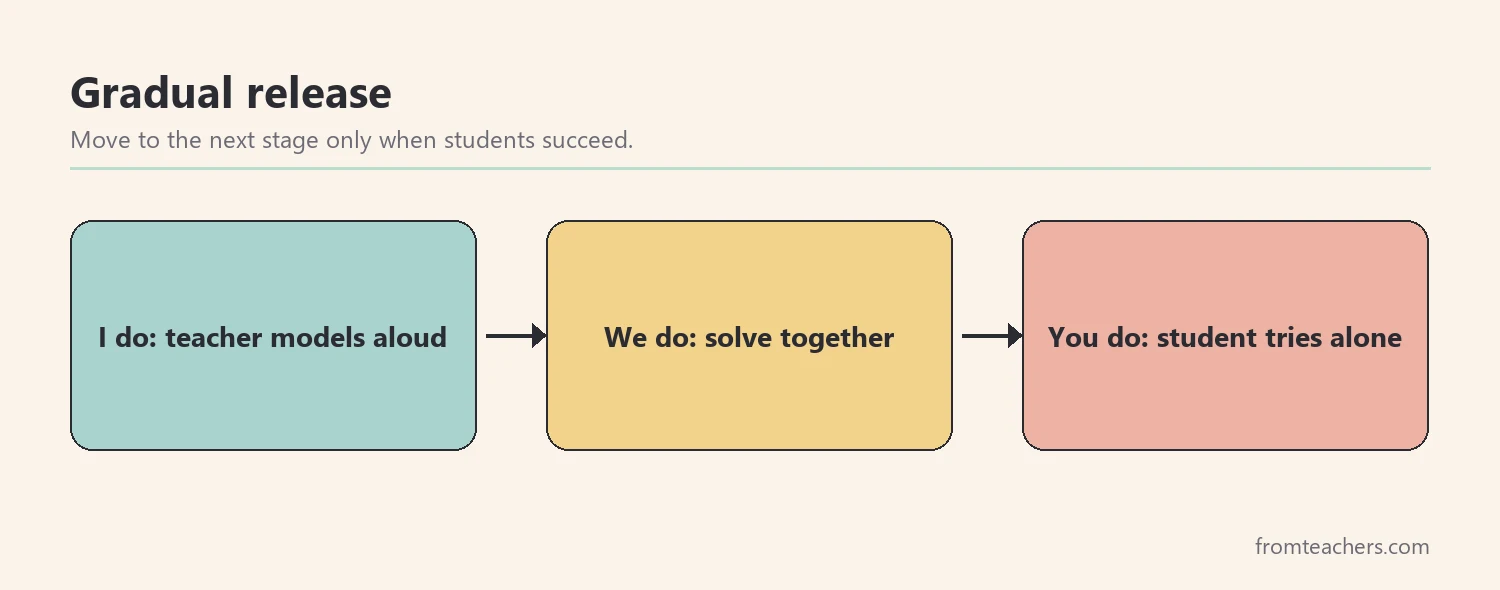
Also, keep examples clean at first. Use problems where only the new step is hard, and add complexity later. Non-examples help too. Showing a common error and explaining why it is wrong can prevent the same mistake in practice.
Finally, check for understanding before releasing students. Ask every student to show an answer at once, with fingers, cards, or whiteboards, rather than calling on one volunteer. If several students miss the same step, return to “we do” for one more problem. This small pause keeps the gradual release honest and prevents a whole set of practice built on the wrong method.
Worked example. Priya’s teacher models 2 problems, thinking aloud about each column. Next, the group solves 3 problems together, with Priya saying the regrouping step. Then, Priya tries 2 problems alone. She gets both right, so her teacher moves to guided practice.
3. Guide practice and give useful feedback
Practice turns a demonstration into a skill, and evidence-based teaching strategies treat it as a planned step rather than busywork. Yet practice without feedback can lock in errors. Therefore, the third step pairs short practice sets with quick, specific feedback, a combination found in many lists of evidence-based teaching strategies.
Keep practice sets small, such as four to six problems, and check early. Walk the room, look at the first one or two answers, and correct errors before they repeat. Mini whiteboards make this easier, because you can see every answer at once.
Then, make feedback specific. “Good job” says little. “You regrouped in the tens column, which is exactly the step we practiced” tells the student what to repeat. When there is an error, name the step and model it again briefly instead of just marking it wrong.
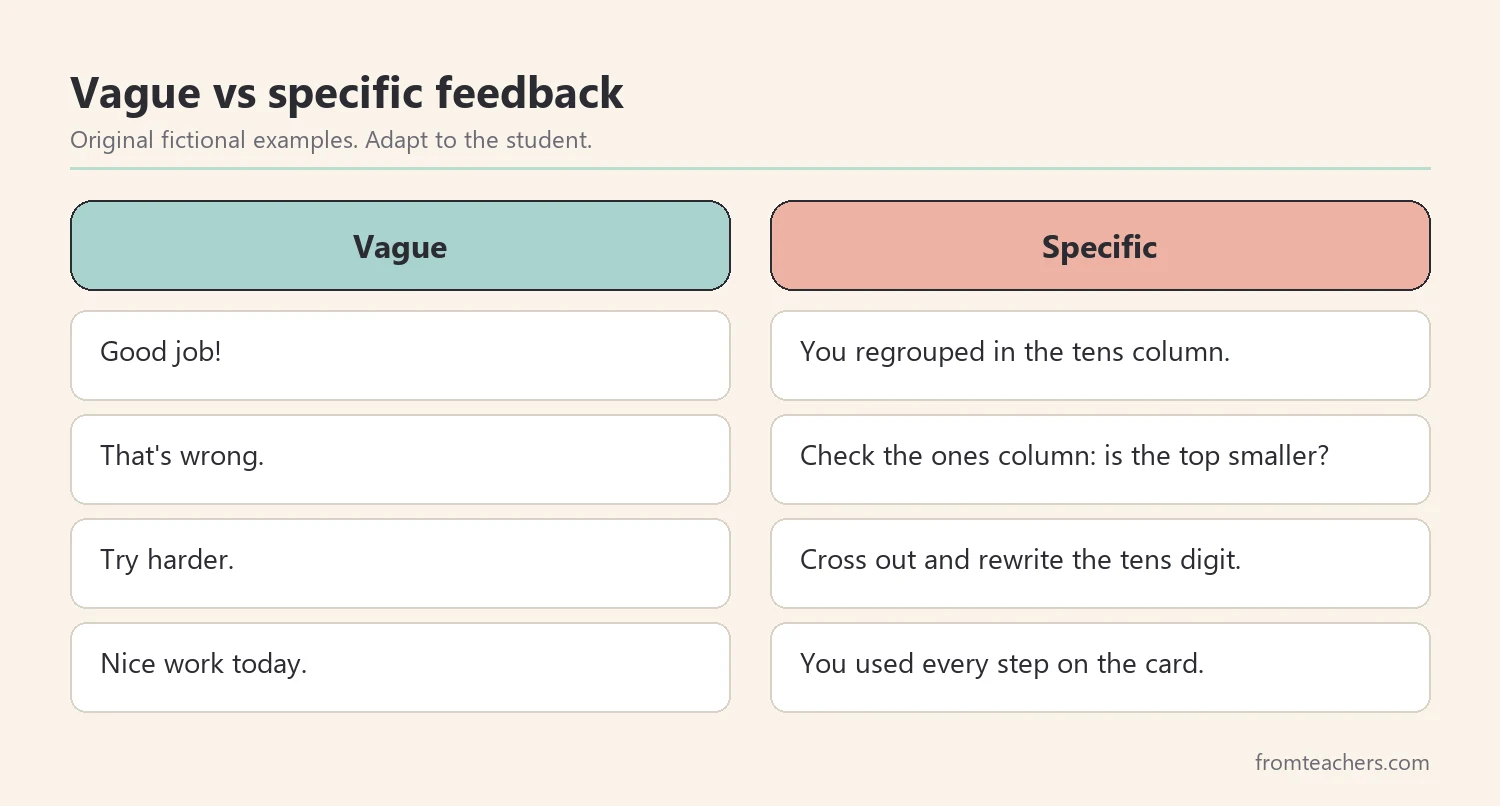
If you want ready-made references for planning, the Strategy Tables Bundle collects six strategy table resources in one place, so you can find an approach and its steps quickly.
Worked example. Priya completes a set of 6 problems on a whiteboard. After the first 2, her teacher notices that she forgot to cross out the regrouped digit once and reminds her of the step. Priya finishes with 5 of 6 correct. Her teacher says, “You regrouped every time the top digit was smaller. Next, let’s check that you crossed out and rewrote the number.”
4. Add visual supports and spaced review to evidence-based teaching strategies
Visual supports make structure visible, and they pair well with other evidence-based teaching strategies. For many learners, including students with disabilities and English learners, a well-designed visual reduces how much they must hold in memory at once. As a result, they can focus on the skill itself.
Useful visuals include step cards, worked examples on the wall, color-coded columns, and graphic organizers. Keep them simple and consistent with the words you used during modeling. Too many colors or icons can distract more than they help. In addition, fade them slowly, for example by covering one step at a time, so students learn to work without them.
Next, plan spaced review, one of the most practical evidence-based teaching strategies for busy classrooms. Learning that is revisited over days and weeks tends to last longer than learning crammed into one lesson. So, add two or three review problems to warm-ups for the next few weeks. Mix in older skills too, so students practice choosing the right method.
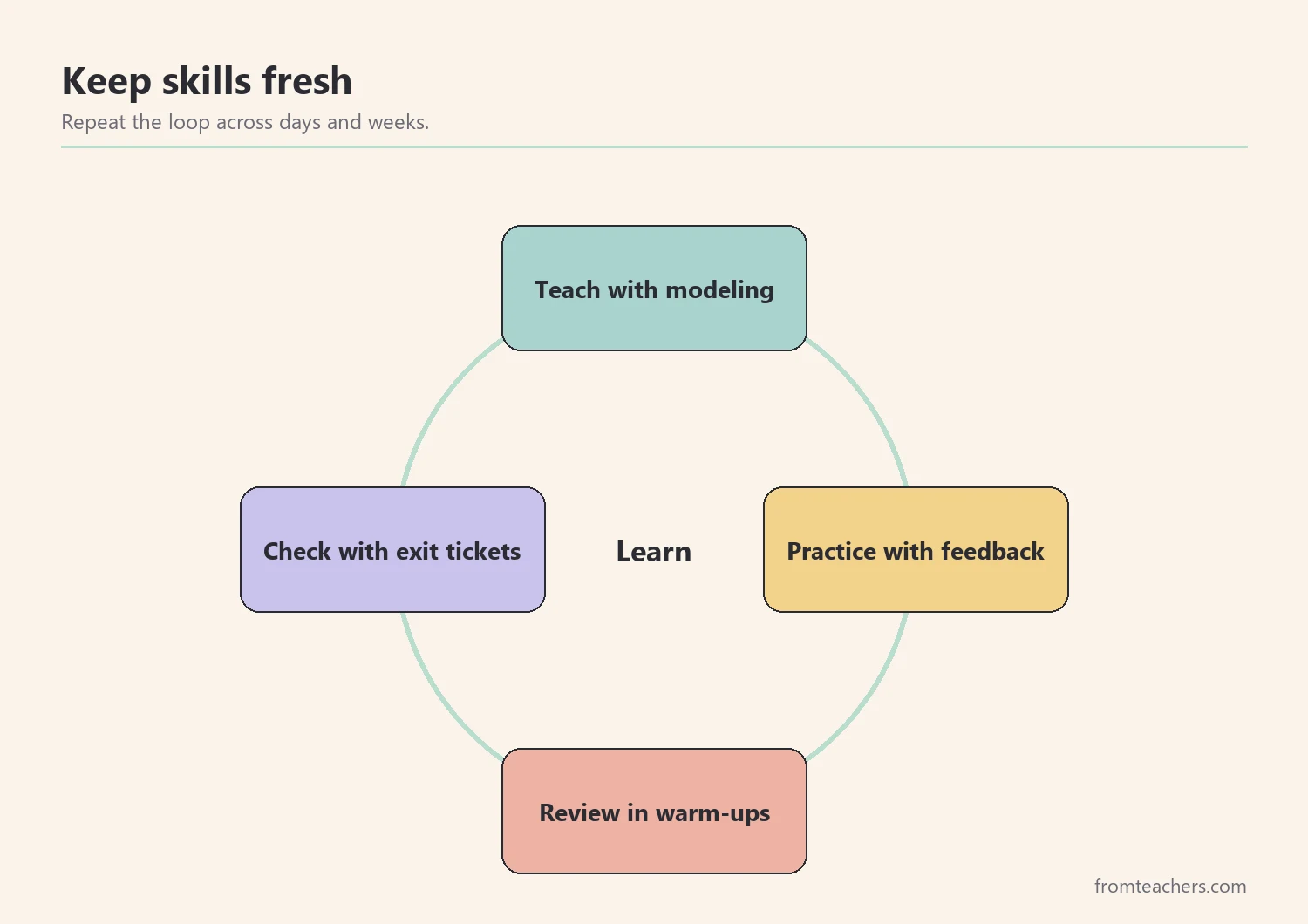
Visual support checklist
- Step card uses the same words as your modeling.
- One worked example is visible during practice.
- Columns or parts are clearly marked.
- Visual is faded over time, not removed suddenly.
- Review problems appear in warm-ups for several weeks.
Worked example. Priya gets a small step card with four steps for regrouping, taped inside her math folder. Her teacher adds 2 regrouping problems to the warm-up on Monday, Wednesday, and Friday for the next three weeks. In the third week, she covers step one on the card, and Priya still gets the problems right.
5. Check whether evidence-based teaching strategies are working
Research can tell you which approaches tend to help. Only your own data can tell you whether they help your students. Therefore, the last step is a quick, regular check of evidence-based teaching strategies in your classroom.
Exit tickets are the simplest tool. At the end of a lesson, give three to five problems on the target skill and record the number correct. Over a few weeks, you will see whether the trend is rising. In addition, note which errors still appear, because they tell you what to reteach.
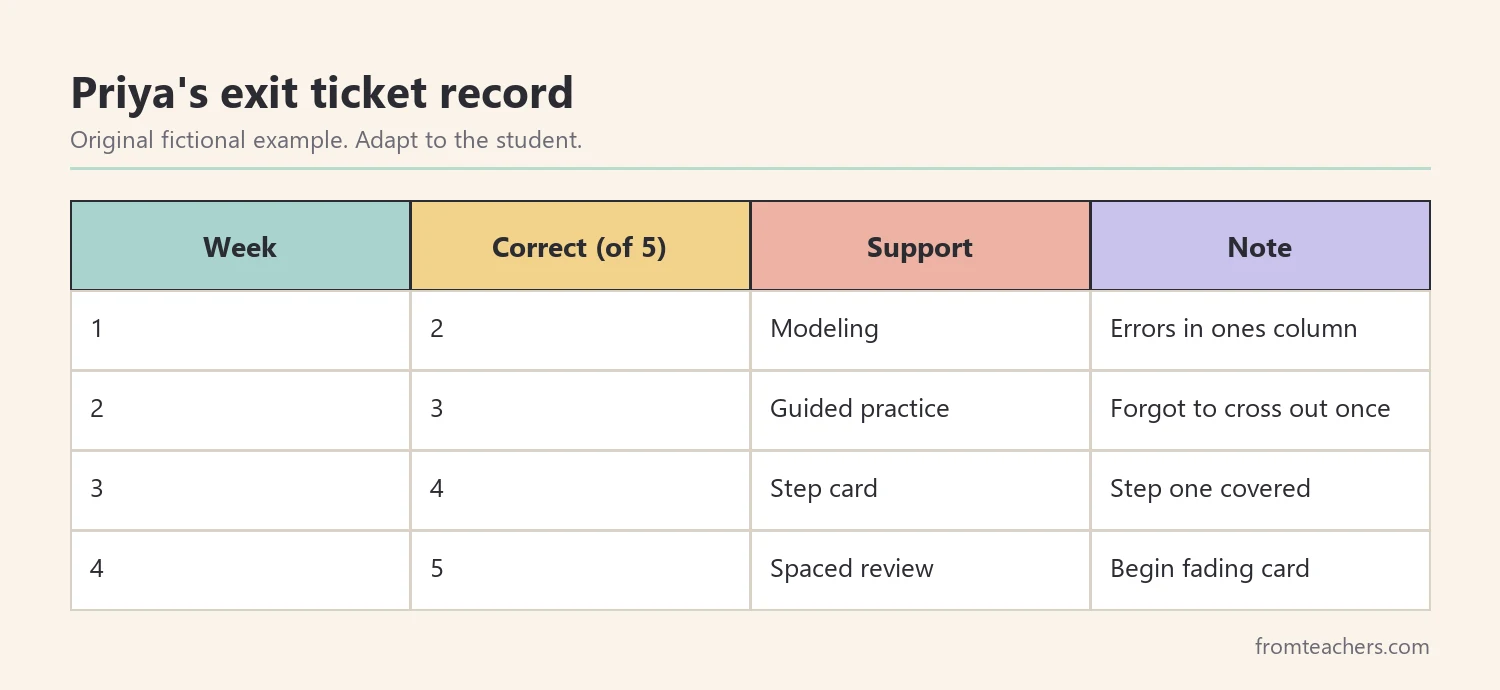
Then, decide what to change. If scores rise, keep the strategy and start fading support. If scores stay flat after a fair trial, change one thing, such as more modeling, smaller practice sets, or a clearer visual. Also, share progress with families and, where relevant, the IEP team.
Worked example. Priya’s teacher gives a 5-problem exit ticket every Friday. In week 1, Priya scores 2 out of 5. In week 2, she scores 3. In week 3, she scores 4, and in week 4, she scores 5 out of 5. Her teacher shares the trend with Priya’s family and begins fading the step card.
Fading support without losing progress
Once a student succeeds, the goal is independence. So, fade one support at a time and watch the next few exit tickets. For example, cover one line of the step card, then shorten the worked example, then remove the visual from the desk while keeping it on the wall.
However, if scores drop after a change, bring the support back for a week and try a smaller step. Fading is part of evidence-based teaching strategies too, because the aim is a skill the student can use without you.
Common mistakes and how to avoid them
- Trying many strategies at once. You cannot tell what helped. Fix: choose one strategy per goal and track it.
- Skipping the “we do” stage. Students move to independent work too soon. Fix: solve several problems together before handing over.
- Vague feedback. Praise without detail does not guide the next attempt. Fix: name the step the student did well or needs to fix.
- Visuals that never fade. Students may depend on them. Fix: remove one part at a time while checking results.
- Teaching once and moving on. Skills fade without review. Fix: add short spaced review to warm-ups.
- Never checking results. A strategy can look good and still not work for a student. Fix: use short exit tickets and review the trend.
Questions teachers and parents ask about evidence-based teaching strategies
What makes a strategy evidence-based?
Generally, a strategy is called evidence-based when well-designed studies show it helps students learn. Organizations such as the What Works Clearinghouse review that research. In the classroom, you still need your own data to confirm that evidence-based teaching strategies work for your students.
Do these strategies only work in special education?
No. Explicit modeling, feedback, visuals, and spaced review help many learners in general education too. Students with disabilities may need more modeling, more practice, and slower fading.
How long should I try a strategy before changing it?
Give it a fair trial, often a few weeks, and look at the trend in your data. If there is no change, adjust one part rather than dropping everything.
Can parents use these strategies at home?
Yes. Parents can model a step, practice together, and praise specific effort. Sharing the same step card or words used at school helps keep things consistent.
Where can I find reliable lists of evidence-based teaching strategies?
Start with trusted organizations such as the What Works Clearinghouse, the IRIS Center, and the Education Endowment Foundation. They summarize research in plain language for teachers.
Related reading: Special Education Strategies: 10 Powerful Ways Teachers Can Succeed, accommodations vs modifications, and 5 Practical Teaching Tips to Boost Classroom Focus and Learning.
A companion resource for evidence-based teaching strategies:


Strategy Tables Bundle (6): a bundle of six strategy table resources that organize teaching approaches into short, clear tables for quick planning.
Sources and scope
- What Works Clearinghouse: reviews of education research and practice guides from the Institute of Education Sciences.
- IRIS Center, Vanderbilt University: free modules on evidence-based practices and instruction.
- Education Endowment Foundation: plain-language research summaries for teachers and school leaders.
- CAST: the organization behind the Universal Design for Learning framework.
This guide covers practical classroom routines for using research-supported strategies. It does not review specific studies, curricula, or programs, and it does not replace the judgment of the student’s team. For deeper reading, the organizations above offer free guides written for teachers.
Key takeaways
- Evidence-based teaching strategies work best when tied to one narrow goal.
- Model clearly, practice together, then hand over.
- Give quick, specific feedback during practice.
- Use visuals and spaced review, and fade supports slowly.
- Check results with exit tickets and change one thing at a time.







Leave a Comment