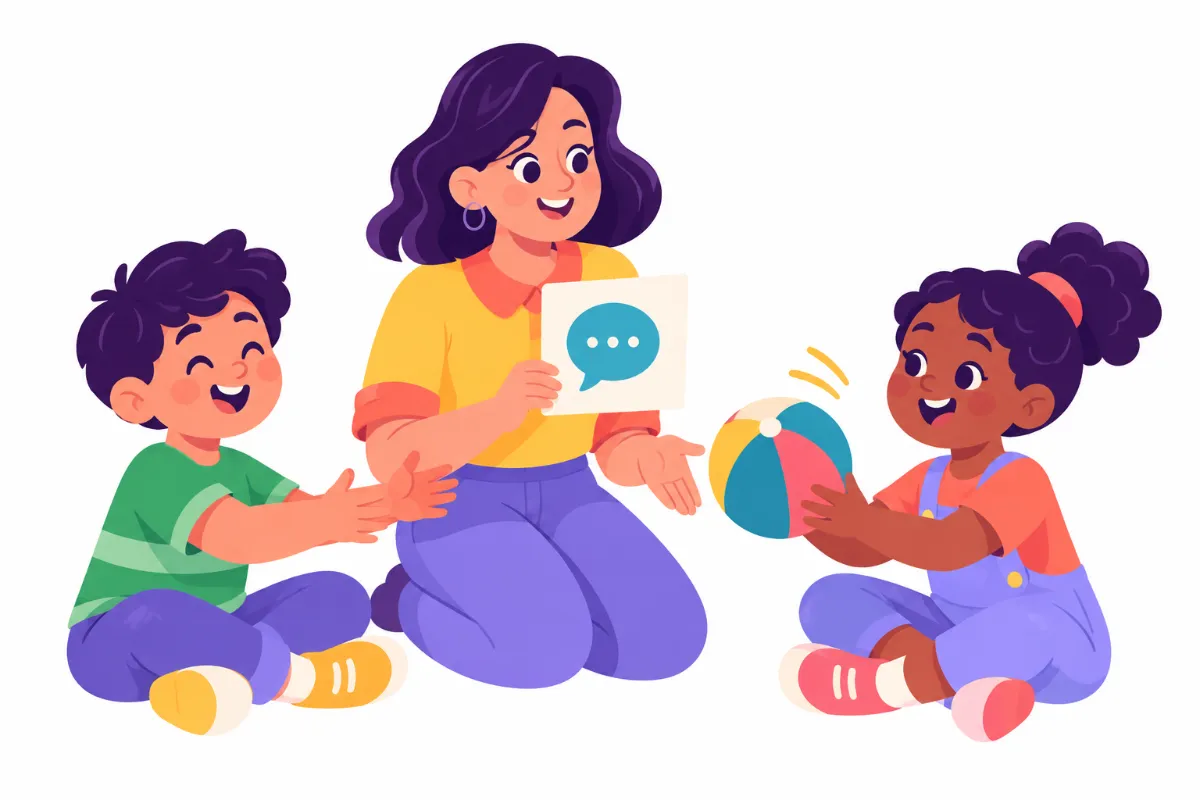

Conversation turn taking is the back-and-forth that keeps talk fair and friendly. Picture a lunch table: one child tells a long story about her weekend, her friend tries to jump in three times, and finally gives up and turns away. Neither child meant to be rude. They simply have not learned how to share the talking.
After reading this guide, you will be able to teach the parts of a conversation step by step, use simple visual cues, practice through games, and track progress at school and home. The steps fit a classroom lesson, a social skills group, or family time.
Examples are fictional. Adapt to the student’s goals and agreed supports. This is guidance, not a diagnosis.
At a glance
- Compare conversation to playing catch: each person holds the ball, then passes it.
- Teach when to talk, when to listen, and how long a turn should be.
- Use a concrete object or picture card to make turns visible.
- Practice with short games before real conversations.
- Track one clear behavior, such as asking a follow-up question.
1. Explain conversation turn taking with a simple picture
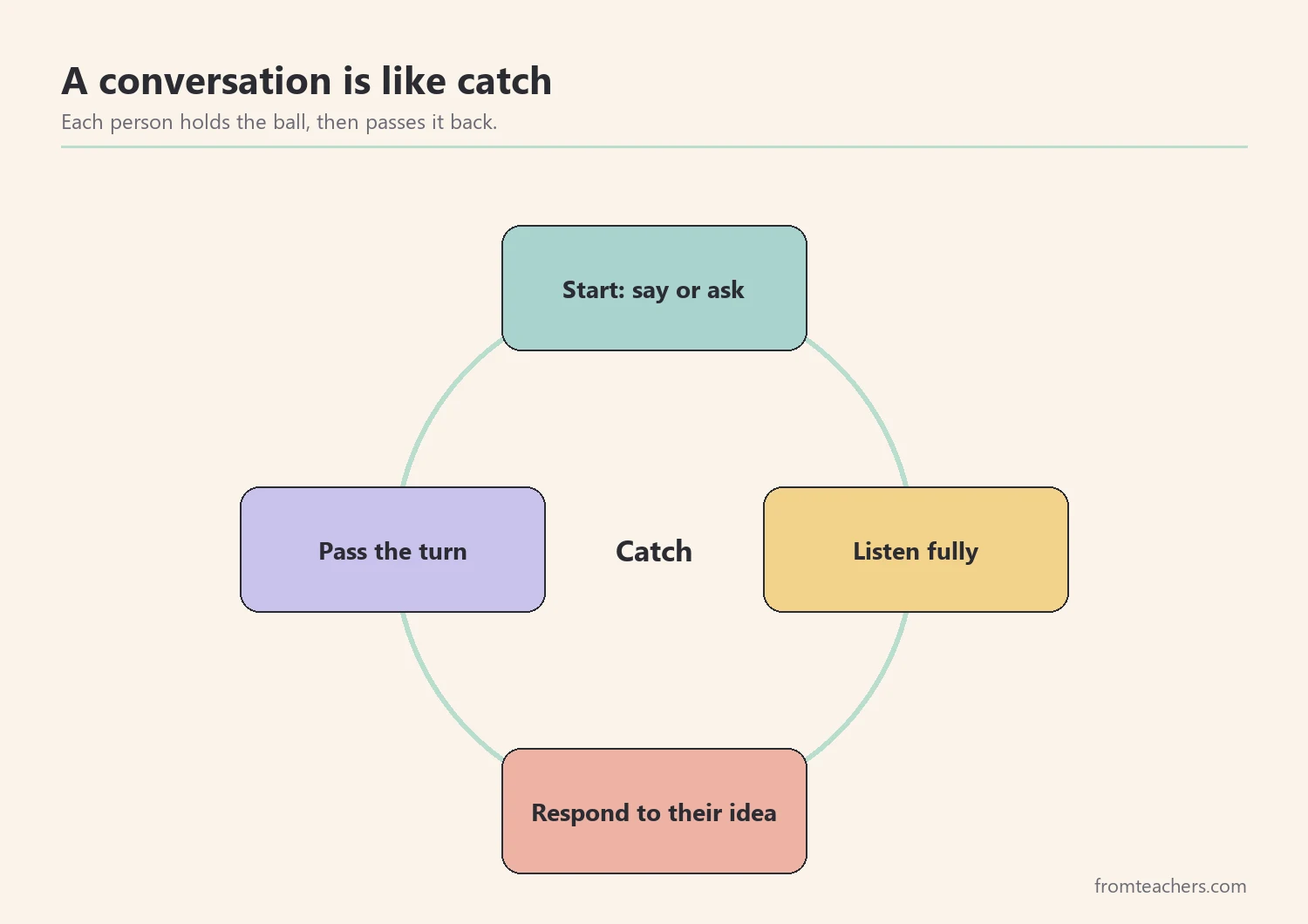
Many children understand games better than abstract rules. So, start by comparing conversation turn taking to playing catch. One person holds the ball and talks. Then, they pass the ball so the other person can talk. If one person keeps the ball the whole time, the game stops being fun.
This picture works because it is concrete. Children can hold the ball, feel the pause, and see the pass. Later, the word “catch” becomes a quick reminder during real conversations.
Use this comparison with a real ball. Toss it back and forth while saying short sentences. Then, hold the ball for a long time while talking and ask, “How does my partner feel now?” Children quickly see the problem.
Next, name the parts of a turn:
- Start: say something or ask a question.
- Listen: let the other person answer fully.
- Respond: add a comment linked to what they said.
- Pass: ask a question or pause so they can talk again.
Here is a fictional example. Maya is in grade 2. She loves talking about horses and often talks for several minutes without stopping. Her speech-language pathologist and teacher write a clear goal: “During a five-minute chat with a peer, Maya takes a turn, then passes the turn with a question, at least three times.”
Notice that the goal names a real situation, a clear behavior, and a number. In addition, it builds on Maya’s strength, which is her eagerness to talk. Conversation turn taking is not about talking less. Instead, it is about sharing the space.
2. Teach when to talk and when to listen
Next, help children notice the signals that tell them whose turn it is. For many kids, this is the hardest part of conversation turn taking. They may not notice a pause, or they may jump in before the speaker finishes.
It helps to start with very clear, exaggerated signals. Over time, make them more natural, the way they happen in everyday talk.
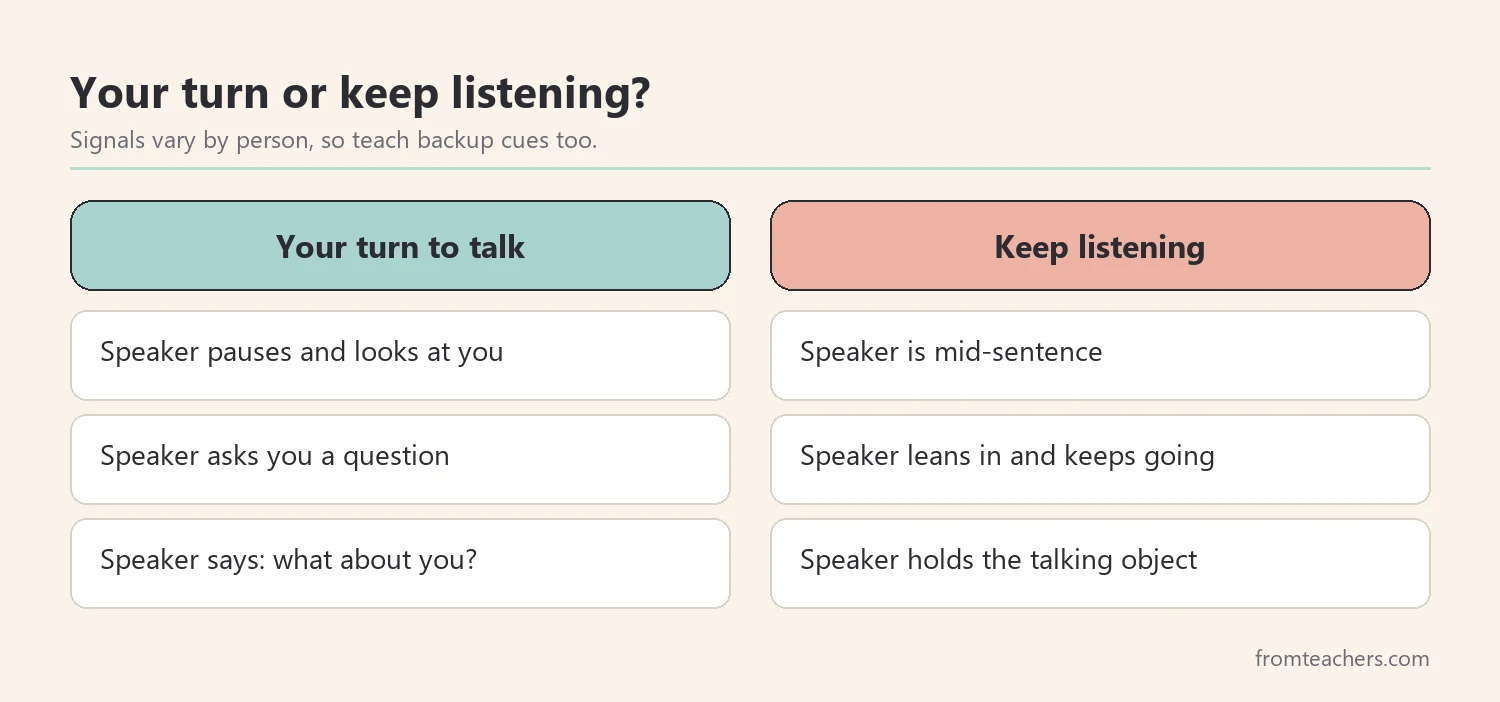
Teach these signals directly:
| Signal | What it usually means |
|---|---|
| Speaker pauses and looks at you | Your turn to talk |
| Speaker asks a question | Your turn to answer |
| Speaker is mid-sentence | Keep listening |
| Speaker leans in or keeps going | Keep listening |
Model each signal with another adult or a puppet. Then, pause a video or role-play and ask, “Is it my turn or your turn?” Children can answer with a thumbs-up for “my turn” and an open hand for “your turn.”
Keep in mind that signals vary from person to person. Some people pause briefly, and some children find faces hard to read. Therefore, teach clear backup cues too, such as a question at the end of a turn.
For Maya, the team practiced spotting questions. Each time her partner asked a question, she said, “My turn,” and answered. Then she practiced listening until the partner stopped. Because the rule was concrete, she could follow it even when she felt excited.
If you want a ready-made lesson, the Taking Turns in Conversation social story covers knowing when to talk and when to listen, reading signals from others, and sharing the spotlight.
3. Practice turn length and sharing the spotlight
Once children know when to talk, they need to learn how long to talk. A good turn is long enough to share an idea, but short enough to leave room for others. This balance is a core part of conversation turn taking.
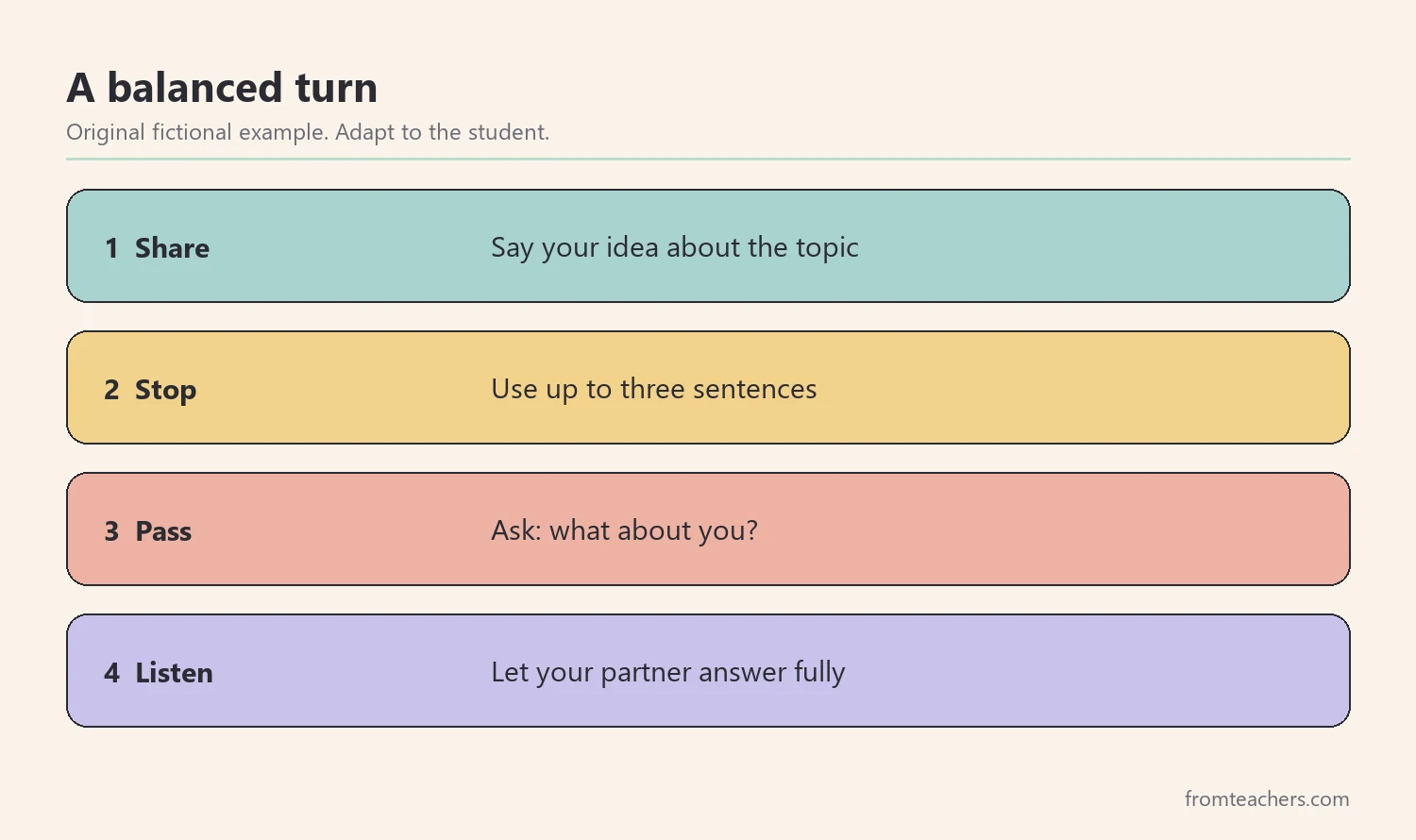
Make turn length visible. For example, use a “three sentence rule”: say up to three sentences, then pass the turn. Children can count sentences on their fingers. Alternatively, use a small sand timer for practice, but remove it once the habit grows.
Also, teach ways to pass the turn:
- Ask a question: “What do you like to do on weekends?”
- Invite a comment: “Have you ever seen a horse?”
- Pause and look at the partner.
Before you move on, check that turn length makes sense for the setting. A quick answer at lunch is shorter than a turn during show and tell. So, practice conversation turn taking in a few different situations, and talk about how turn length changes.
Sharing the spotlight also means showing interest in the other person’s topic. Teach simple follow-up comments, such as “That sounds fun” or “What happened next?” These keep the conversation going and show the partner they were heard.
Maya practiced the three sentence rule with a peer. At first, she needed a finger reminder from the adult. After a week, she started counting on her own. She also learned to add “What about you?” after talking about horses. As a result, her partner stayed in the conversation longer.
4. Use games to build conversation turn taking
Next, make practice playful. Games give children many turns in a short time, and they lower the pressure of a real conversation. In fact, conversation turn taking often grows fastest through short, repeated play.
Try these games:
| Game | How it works | Skill |
|---|---|---|
| Pass the ball | Talk only when holding the ball | Whose turn it is |
| Question chain | Answer, then ask the next person a question | Passing the turn |
| Topic train | Each person adds one linked sentence | Staying on topic |
| Interview partner | Ask three questions, then switch roles | Showing interest |
Keep games short, about five minutes, and end on a success. In addition, rotate partners so children practice with talkative and quiet peers alike. Also, praise specific actions: “You asked Sam a question about his dog. That passed the turn.”
Maya’s group played “Question chain” twice a week. Her teacher noticed that Maya, who used to talk only about horses, began asking classmates about their pets. That was a small but clear sign of progress.
At home, families can play the same games at dinner or in the car. For example, a parent might pass a spoon as the “talking object.” Using the same games in both places helps conversation turn taking carry over from practice to daily life.
5. Track conversation turn taking in real talks
Then, check whether the skill is showing up in real conversations, not just games. Tracking conversation turn taking can be simple. Pick one clear behavior and count it during a short, regular conversation.
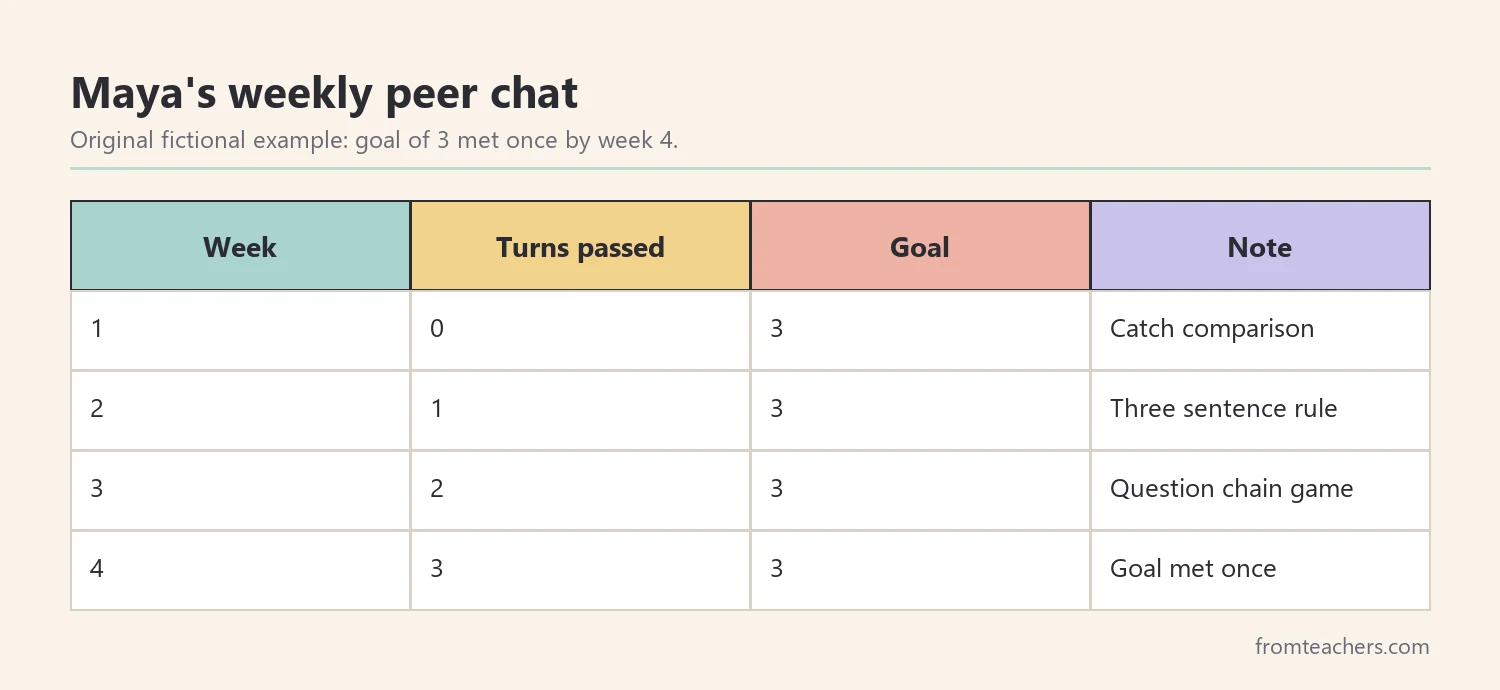
For Maya, the team counted how many times she passed the turn with a question during a five-minute chat with a peer, once a week.
| Week | Turns passed with a question | Goal | Note |
|---|---|---|---|
| 1 | 0 | 3 | Catch comparison taught |
| 2 | 1 | 3 | Three sentence rule |
| 3 | 2 | 3 | Question chain game |
| 4 | 3 | 3 | Goal met once |
By week 4, Maya met her goal of three for the first time. One week is a start, so the team will keep the same goal until she meets it in at least two more chats. Also, the notes column shows which teaching step came before each change.
Share the record with the child in simple terms. For example, “Last week you passed the turn two times. Today it was three.” Seeing progress can motivate children to keep practicing.
If progress stalls, look at the setting. Is the partner shy, or is the topic hard? A different partner or topic can change results a lot. In addition, ask the child what feels hard, because their answer often points to the next step.
6. Support turn taking at home and in groups
Finally, help children use conversation turn taking across the day. Skills last longer when adults use the same words and cues in many settings.
Share a simple plan with families. Include the playing catch comparison, the three sentence rule, and one game. Also, suggest natural practice times, such as dinner, car rides, or bedtime.
In group settings, add structure:
- Use a talking object so only one person speaks at a time.
- Give each child a set number of turns, such as three tokens.
- Have the adult model passing turns to quieter children.
- Celebrate when a child invites a friend into the talk.
Also, adults can model conversation turn taking during everyday talk with each other. Children notice when teachers or parents ask follow-up questions and wait for answers, and they copy what they see.
Remember that some children need extra time to answer. Waiting a few seconds before moving on gives them a fair turn. Likewise, children who talk a lot may need gentle help to notice when others want a turn.
Maya’s family began using a “talking spoon” at dinner. Within a few weeks, her younger brother got more turns, and Maya started asking him about his day. These everyday moments are where conversation turn taking becomes a real habit.
Common mistakes and how to avoid them
- Telling children to “talk less.” Fix: teach how to share and pass the turn instead.
- Assuming children can read signals. Fix: teach signals directly and add clear backup cues, like questions.
- Practicing only in structured games. Fix: plan short real conversations to check carryover.
- Using a timer forever. Fix: fade timers and counting once the habit grows.
- Not giving quieter children time. Fix: wait a few seconds and invite them by name.
Questions teachers and parents ask about conversation turn taking
At what age do children learn conversation turn taking?
Children build turn taking skills gradually, starting with early back-and-forth play. Many still need reminders through the early school years. If you have concerns, a speech-language pathologist can help.
Why does my child interrupt so much?
Often, children interrupt because they are excited or worried they will forget their idea. Teaching a “hold your idea” strategy, like a finger on the nose or a quick drawing, can help. Also, praise waiting when you see it.
Is conversation turn taking different for autistic children?
Some autistic children prefer different conversation styles, such as sharing information on a favorite topic. Respect those styles while teaching skills that help in shared settings. Work with the child, family, and team to set goals that feel meaningful.
How can I help a quiet child take turns?
Give a clear invitation and extra wait time. Also, offer sentence starters, such as “I like…” or “One time I…”, to make starting easier. Celebrate any turn, even a short one.
How do social stories help with conversation turn taking?
Social stories show the skill in a familiar setting before the child needs it. They give clear words and pictures that adults can repeat later. As a result, the skill feels more predictable and less stressful.
Related reading: Autism Social Skills Development: Practical Strategies for Growth, Spectrum Voices: Essential Strategies for Navigating High-Functioning Autism, and How Parents and Teachers Can Team Up for Special Education Success.
A companion resource for conversation turn taking:
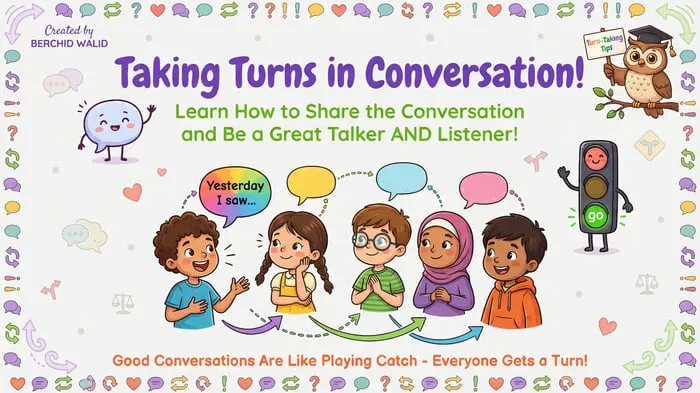
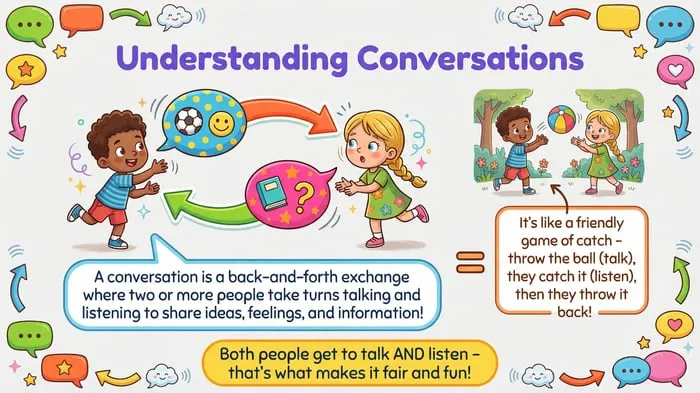
Taking Turns in Conversation: Social Story: a guide that explains turn-taking through a playing catch comparison, covering when to talk and when to listen, how long to talk, reading signals from others, and sharing the spotlight.
Sources and scope
- American Speech-Language-Hearing Association (ASHA): information on social communication and language development.
- IRIS Center, Vanderbilt University: free modules on evidence-based practices for students with disabilities.
- CASEL: a widely used framework for social and emotional learning, including relationship skills.
- Understood.org: practical articles for families and teachers on social skills and learning differences.
This guide covers everyday teaching of conversation skills at school and home. It does not cover speech or language evaluation or diagnosis, which belong to qualified professionals and the child’s team.
Key takeaways
- Conversation turn taking is easier to learn when compared to playing catch.
- Teach the signals for talking and listening, plus clear backup cues.
- Make turn length visible with a simple rule and fade it over time.
- Use short games, then check skills in real conversations.
- Track one behavior and share the same cues with families.

Leave a Comment