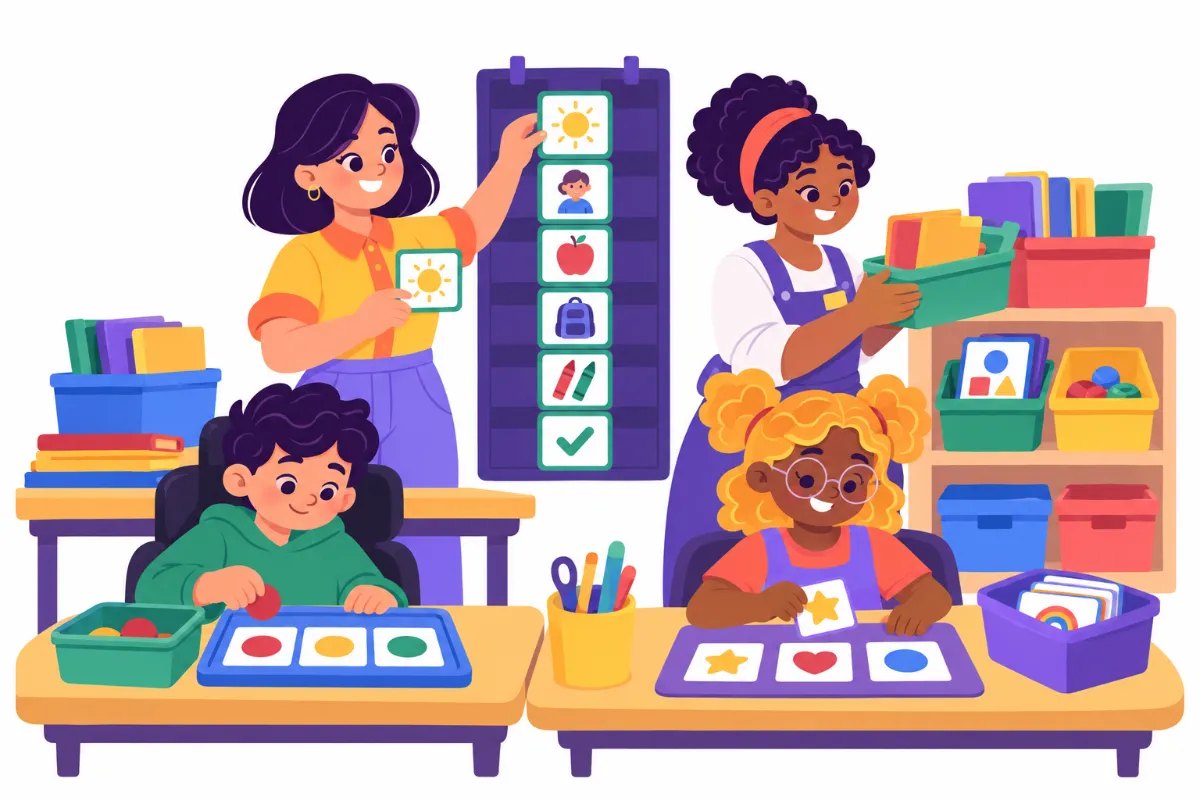

Self-contained classroom tips matter most in the first weeks, when a teacher walks into a room with eight students, three adults, and a stack of IEPs nobody has had time to read. By ten o’clock, one student is under a table, a paraprofessional is unsure whether to step in, and the visual schedule still shows yesterday. Nobody is doing anything wrong. The room simply has no shared structure yet.
This guide gives you five steps to build that structure: know every plan, set up the room, plan proactive supports and a calm de-escalation response, define staff roles, and collect data on a schedule. By the end, you will have a practical start-up plan for an intensive setting, whether you are new to it or resetting mid-year.
Examples are fictional. Adapt to the student’s goals and agreed supports. This is guidance, not a diagnosis.
At a glance
- Read every IEP and 504 plan in the first week and turn them into a one-page summary.
- Organize the room into clear areas with visual schedules and routines.
- Plan supports before problems start, and agree on one de-escalation response.
- Give every adult a defined role and a simple way to communicate.
- Collect a small amount of data on a fixed schedule and review it weekly.
1. Self-contained classroom tips for knowing every IEP
In an intensive setting, fidelity to each student’s plan is both a legal duty and the foundation of good teaching. Yet many teachers start the year with only a vague idea of what each IEP says. So your first job is to read every plan carefully, ideally before students arrive.
As you read, pull out four things for each student: annual goals, accommodations, related services with times, and any behavior plan. Then build a one-page “at a glance” summary that every adult in the room can use. Keep the full IEPs confidential and secure, and share the summary only with staff who work with the student.
Consider Theo, a fictional nine-year-old in Ms. Bennett’s class. His summary row looked like this.
| Area | Theo’s plan (summary) |
|---|---|
| Goals | Request a break; complete 3-step tasks |
| Accommodations | Visual schedule; first-then board; breaks |
| Services | Speech 2 times a week, 30 minutes |
| Behavior plan | Yes: teach break card, reduce wait time |
Next, check the plan against the daily schedule. If Theo’s speech sessions are on Tuesday and Thursday, mark them on the classroom calendar. If his plan lists a first-then board, make sure one exists and is at his work station by the first day.
A simple checklist makes this faster. For each accommodation, ask: is it in place, who provides it, and how will we know it happened? These self-contained classroom tips may feel slow at first, but they prevent the most common early problem, which is supports written on paper that never reach the student.
In addition, plan how you will check fidelity after the first month. Pick one day to walk through each summary and confirm that every accommodation is still happening. Students change, schedules shift, and supports can quietly drop away. A short monthly check, one of the simplest self-contained classroom tips, keeps the plan honest.
Finally, list questions for the case manager or previous teacher. For example, ask what has worked before, what signs come before a hard moment, and what the family wants you to know.
2. Self-contained classroom tips for room setup and visual systems
Some of the most practical self-contained classroom tips are about space. A well-organized room does a lot of teaching for you. When students know where to go, what comes next, and where to find materials, there are fewer reasons for confusion and fewer moments of stress.
Divide the space into clear areas, each with one main purpose: a group area, independent work stations, a teacher table for small groups, and a calm-down space. Use furniture, rugs, or tape to show boundaries. Label materials with words and pictures, and keep the most-used items within reach.
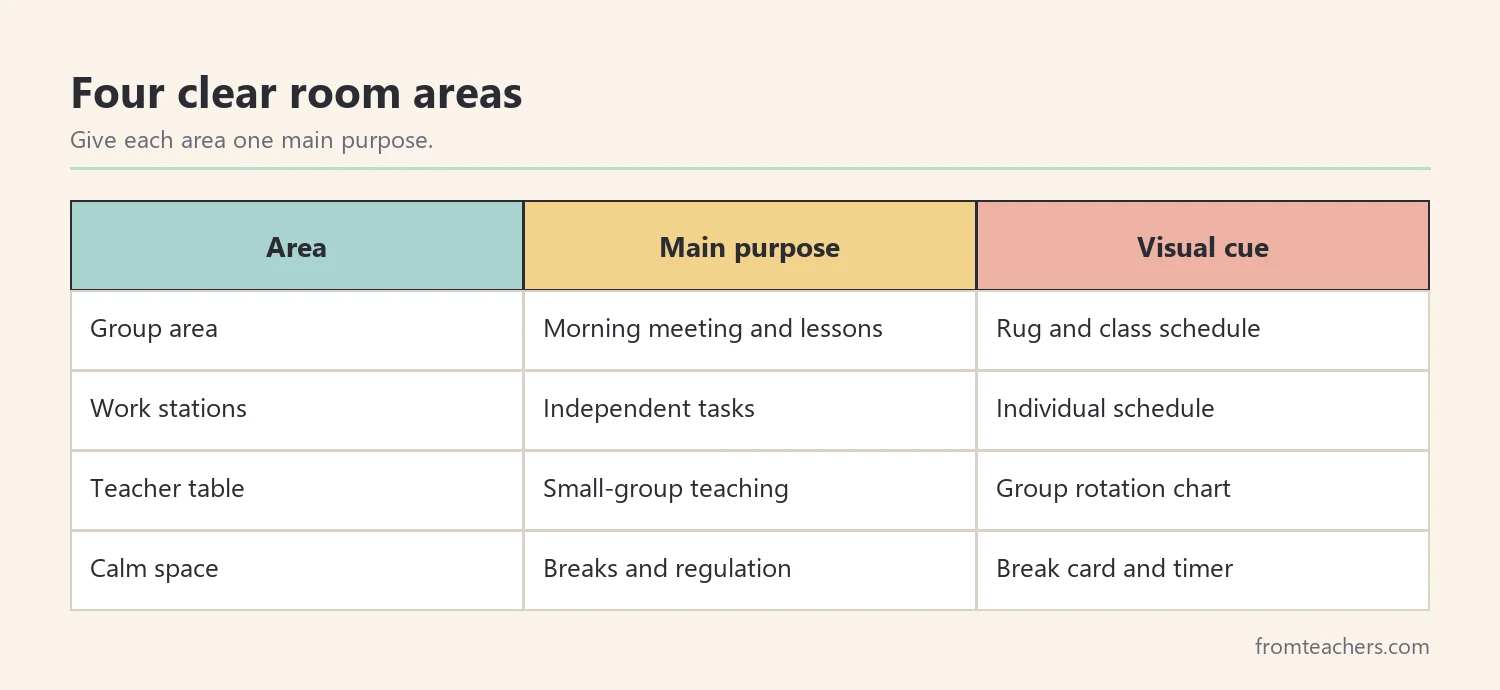
Then add visual systems, which appear in almost every list of self-contained classroom tips for good reason. A whole-class schedule shows the day, and individual schedules show each student’s next step. First-then boards help students who need a short, concrete sequence. Timers and transition warnings help students prepare for change.
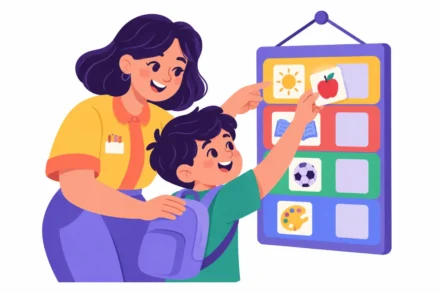
In Ms. Bennett’s room, Theo has a vertical picture schedule at his work station. Each time he finishes an activity, he moves the picture to the “done” pocket. As a result, he can see his day shrink, which makes transitions easier for him.
Teach routines directly. Do not assume students will learn them by watching. Model the routine, practice it, and give feedback. For example, practice arriving, unpacking, and checking the schedule every morning for the first two weeks.
Also, keep the room calm. Reduce visual clutter on walls near work areas, think about lighting and noise, and make the calm-down space inviting rather than a punishment area. Among all self-contained classroom tips, this one is easy to overlook and makes a large difference over time.
3. Plan proactive supports and a calm de-escalation response
Good self-contained classroom tips always put prevention first. Most hard moments can be made less frequent with support that starts early. So plan for prevention first, and response second. Proactive supports include clear routines, choices, planned breaks, and teaching the skills students need, such as asking for help or a break.
Start with what you learned from the IEPs and the previous teacher. For each student, list known triggers, early signs of stress, and supports that help. Then decide which supports every student gets (Tier 1) and which some students get more intensively (Tier 2).
Next, agree as a team on how to respond when a student begins to escalate. The goal is a calm, consistent, predictable response from every adult. A simple sequence helps everyone act the same way.
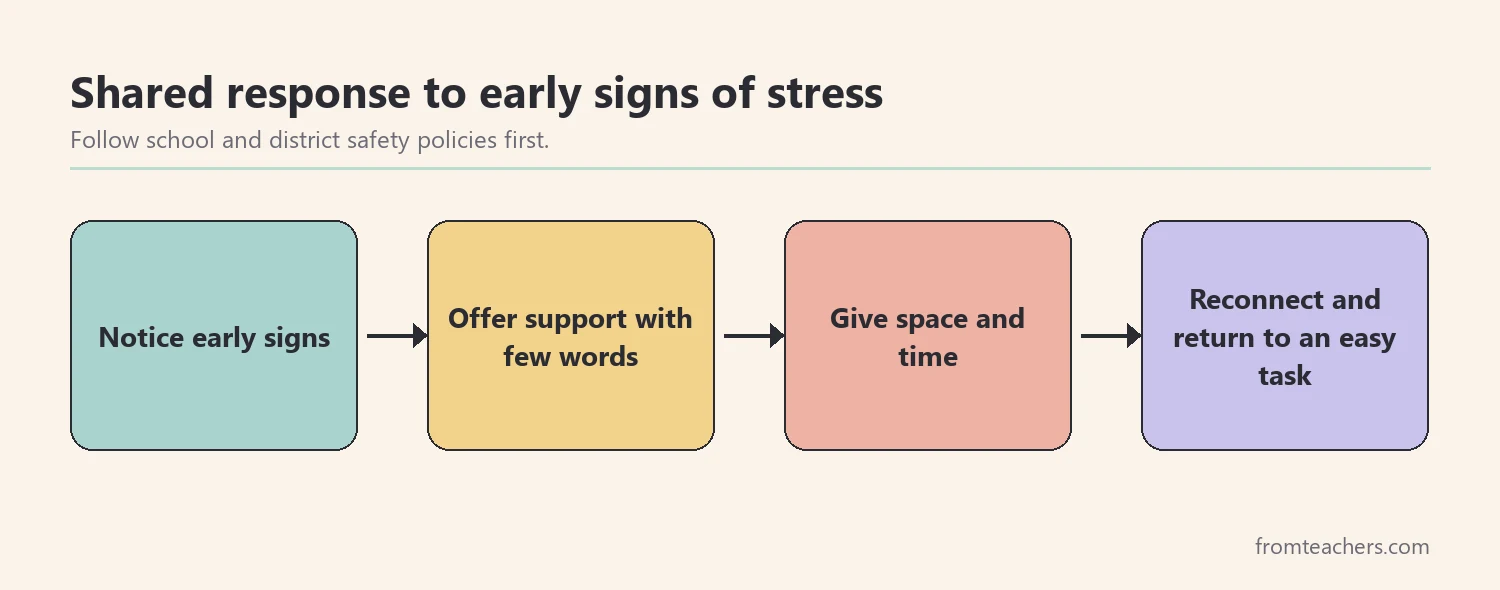
For Theo, early signs include humming loudly and pushing materials away. When adults see these signs, they offer his break card with few words. If he takes a break, they give him space and a timer. Afterward, an adult reconnects calmly and helps him return to an easier task first.
No list of self-contained classroom tips replaces policy. Follow your school and district policies for any serious safety situations, and make sure staff know who to call. Those policies come first, before any classroom routine.
After each significant incident, write a short log entry: time, what happened before, what the student did, how adults responded, and what helped. Over a few weeks, these entries reveal patterns. To save time, the toolkit for transitioning to a more intensive classroom includes a behavior escalation and de-escalation protocol log and a proactive support planner.
4. Self-contained classroom tips for staff teamwork
An intensive classroom often has several adults, so self-contained classroom tips about teamwork matter. That is a strength, but only when everyone knows their role. Without clear roles, two adults may respond to the same student while another student waits without help.
Write a simple roles plan. For each part of the day, show who leads instruction, who supports which students, and who takes data. Rotate some responsibilities, so students do not depend on one adult and staff do not burn out.
| Time | Ms. Bennett | Para 1 | Para 2 |
|---|---|---|---|
| 8:30 Arrival | Greets, checks schedules | Supports Theo | Supports bus group |
| 9:00 Reading | Leads small group | Work stations | Takes data |
| 10:00 Break | Plans next block | Calm space | Snack routine |
Then build a communication system. A five-minute huddle before students arrive works well. Review the day, any changes, and one focus. In addition, keep a shared notebook or board for quick notes during the day.
Also plan for absences. When a paraprofessional is out, who covers each role? Write a short backup version of the plan so a substitute can step in. Teams that follow these self-contained classroom tips find that a missing adult causes much less disruption, because the plan is on paper rather than in one person’s head.
Respect paraprofessionals as essential team members. Explain the reason behind each strategy, invite their observations, and thank them often. They often notice early signs and small wins that a lead teacher misses.
In Ms. Bennett’s class, the huddle revealed that Theo’s loud humming almost always came before the noisy snack routine. Consequently, the team moved his snack to a quieter corner, and his breaks during that time dropped.
The same ideas also apply to related service providers. Invite the speech therapist or occupational therapist to share one strategy staff can use between sessions.
5. Self-contained classroom tips for data and weekly review
The last of these self-contained classroom tips is about evidence. Data tells you whether supports are working and helps you report progress on IEP goals. However, trying to collect everything leads to collecting nothing well. Instead, choose a few measures and a fixed schedule.
For each student, pick one or two measures tied to IEP goals. Decide who collects the data, when, and where it is stored. A simple weekly schedule keeps it manageable.
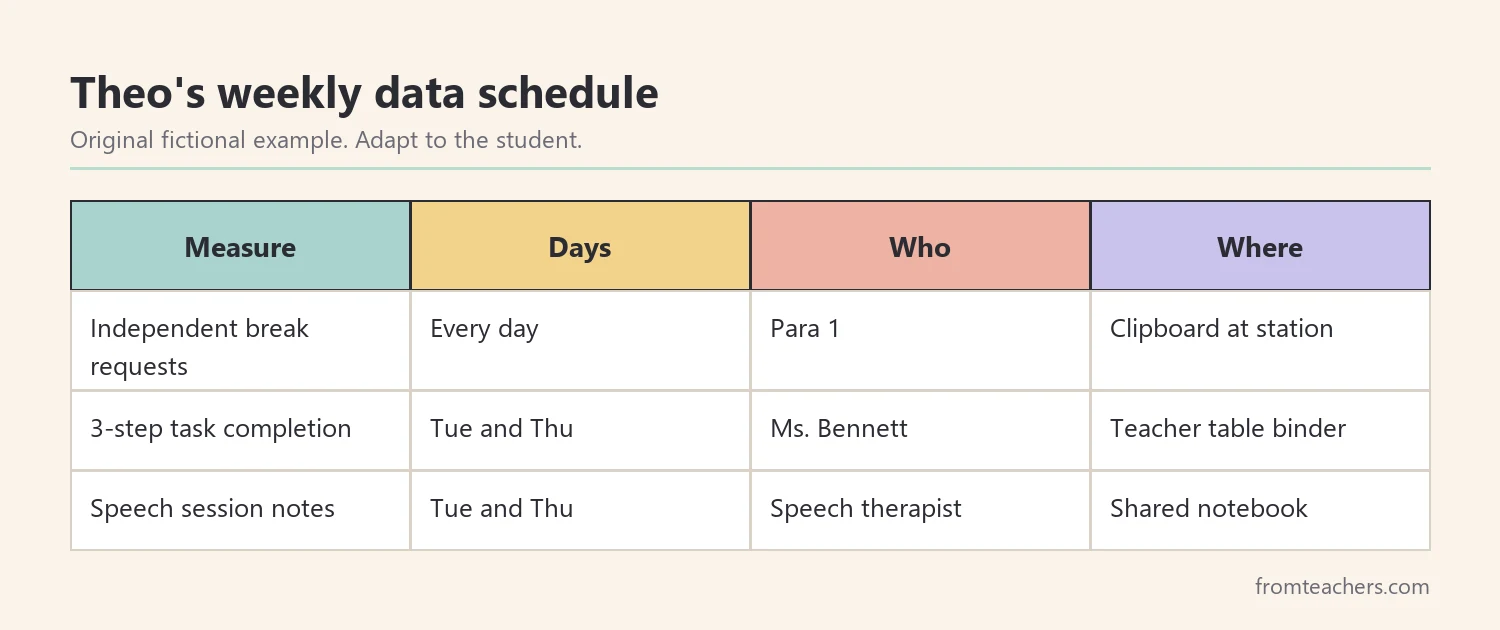
For Theo, staff counted independent break requests each day and recorded 3-step task completion twice a week. In week 1, he asked for 2 breaks on his own across five days. By week 4, the team recorded 9 independent requests across the week. That growth suggests the break card routine is working.
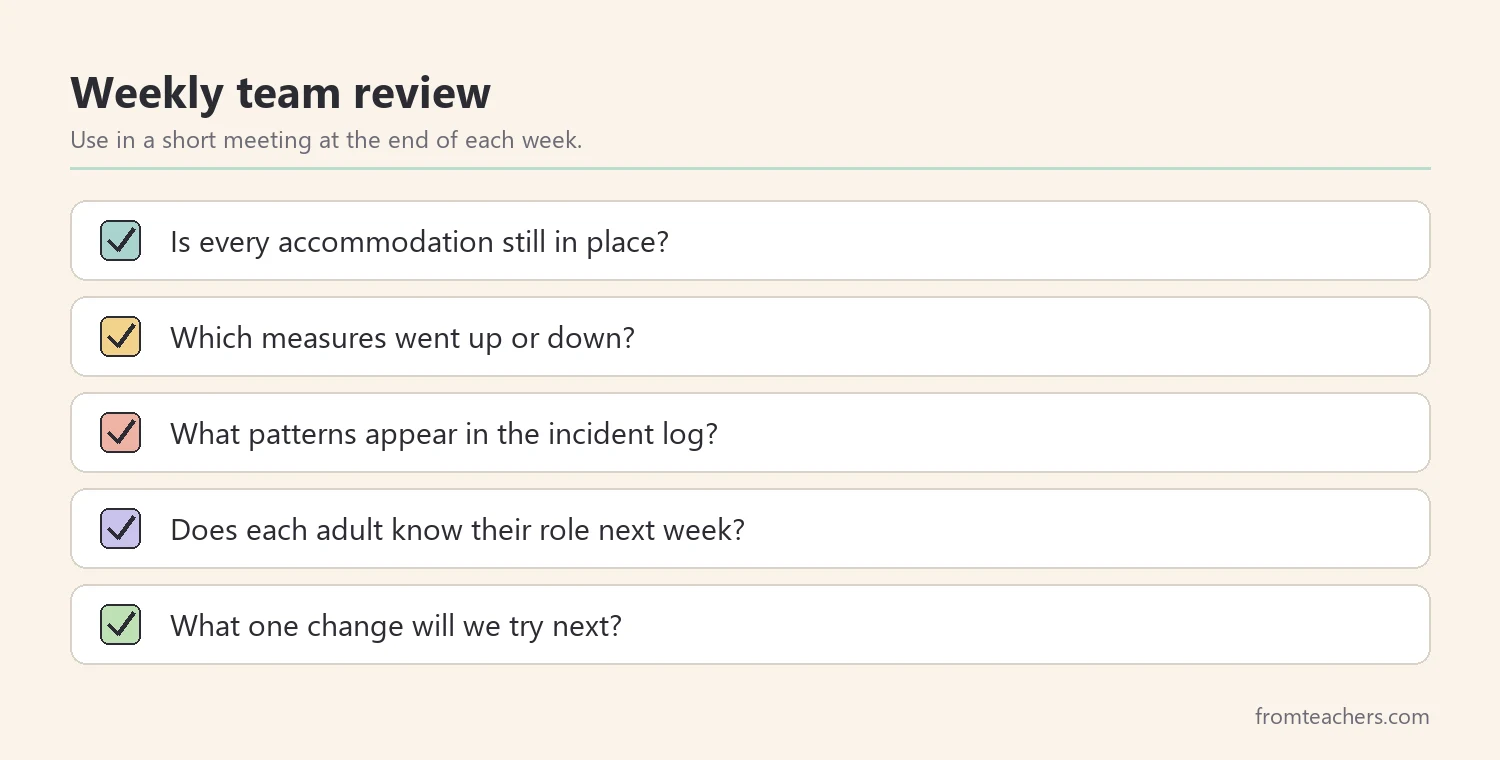
Keep data sheets where staff work, such as a clipboard at each station, so recording takes seconds. Among self-contained classroom tips, this small habit does a lot to make data collection actually happen. Review data weekly as a team. Ask: what is improving, what is not, and what one change will we try? Write the decision down. Every few weeks, share a short update with families, including a positive note.
Finally, be patient with yourself. A new intensive setting takes time to settle. With clear plans, a structured room, shared responses, defined roles, and simple data, most classrooms become calmer within the first months. These self-contained classroom tips are a starting point, so adapt them to your students and your school’s policies.
If you are joining mid-year, the same steps still apply. Start with the IEP summaries, then fix the one routine that causes the most stress, and add the others over the following weeks. Self-contained classroom tips work best one step at a time, rather than all at once on a Monday morning.
Common mistakes and how to avoid them
- Skimming IEPs. Supports on paper never reach students. Fix: build a one-page summary and check each accommodation is in place.
- A cluttered or unclear room. Students cannot tell where to go. Fix: create clear areas and teach routines directly.
- Responding only after a crisis. Fix: plan proactive supports and agree on one calm response sequence.
- Unclear adult roles. Fix: write a roles plan for each part of the day and hold a short daily huddle.
- Collecting too much data. Fix: choose one or two measures per student and a fixed schedule.
Questions teachers and parents ask about self-contained classroom tips
What should I do in my first week?
Read every IEP, build a one-page summary, set up clear areas, and teach arrival routines. Meet your staff and agree on roles before students arrive, if possible.
How many visual supports are too many?
Use the supports students actually need. Start with a class schedule and individual schedules, then add first-then boards or timers for students who benefit. Remove anything nobody uses.
How do I support paraprofessionals who are new?
Give them the student summaries, explain the reasons behind strategies, and model routines. A short daily huddle keeps everyone on the same page.
Where should the calm-down space be?
Place it in a quieter part of the room with soft seating or a few calming tools. Teach students to use it as a support, not a punishment.
How should I communicate with families?
Share a short, regular update with at least one positive note. Ask families what works at home, since that can help at school too.
Related reading: Accommodations vs Modifications in Special Education: The Difference Explained, Moving Beyond Shame and Behavior Charts: Positive Alternatives for Effective Classroom Management, and The Power of Data Tracking in Special Education.
A companion resource for self-contained classroom tips:
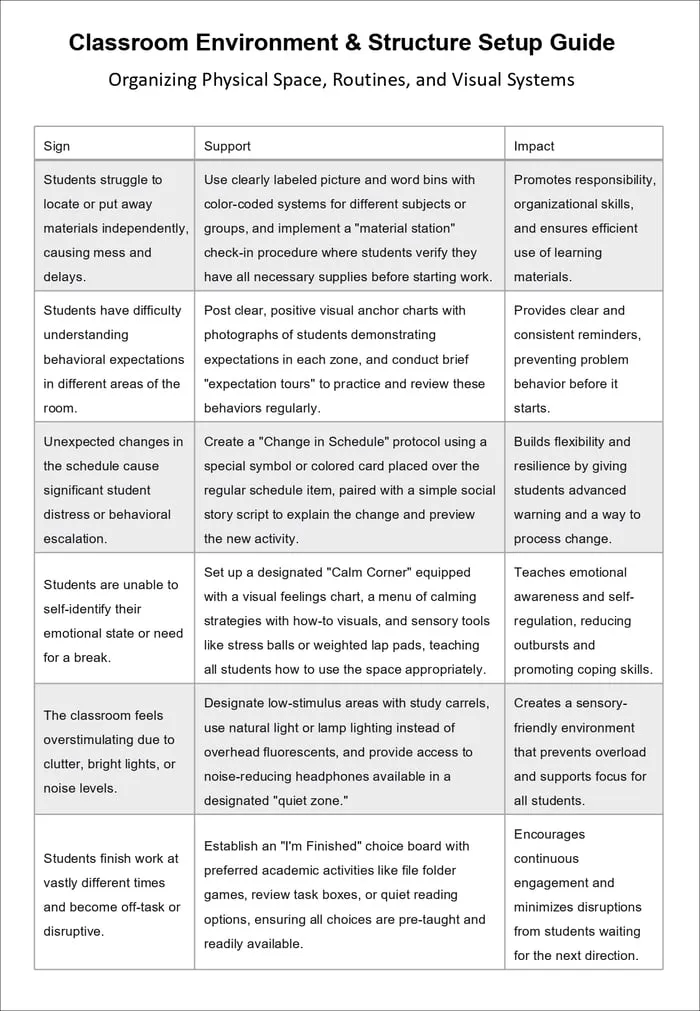
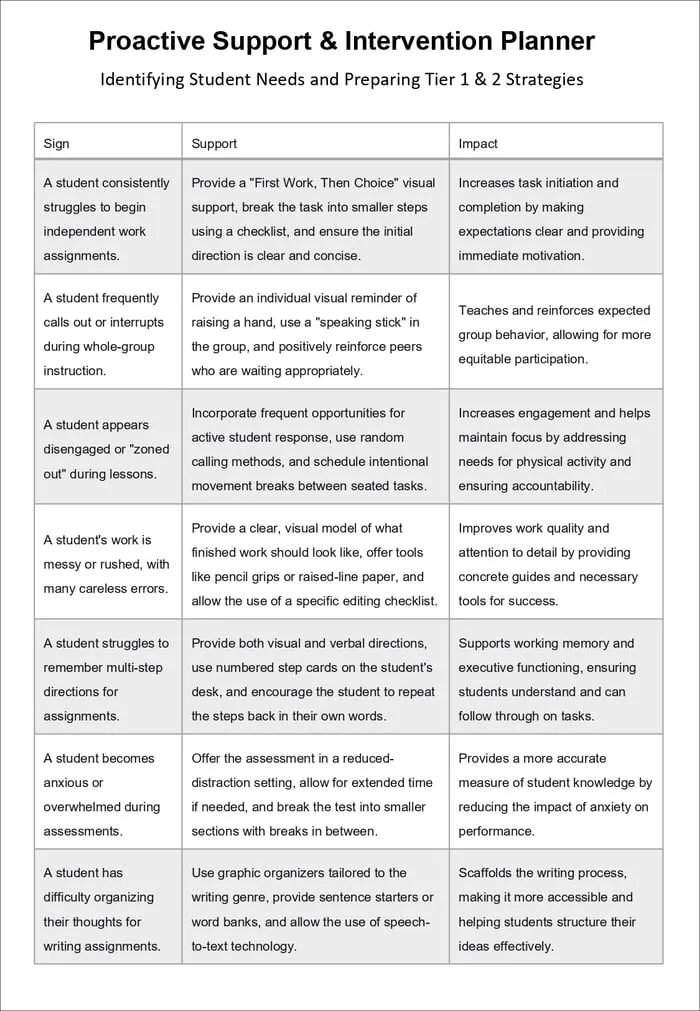
Transitioning to a More Intensive Classroom Toolkit: a 12-page printable toolkit using a Sign/Support/Impact format, with an IEP and 504 implementation checklist, proactive support planner, environment setup guide, de-escalation protocol log, paraprofessional collaboration plan, and data collection schedule.
Sources and scope
- Individuals with Disabilities Education Act (IDEA): the U.S. Department of Education’s site on the law and its regulations.
- IRIS Center (Vanderbilt University): free modules on classroom behavior, structure, and working with paraprofessionals.
- Center on PBIS: resources on positive behavioral interventions and supports across tiers.
- National Center on Intensive Intervention: guidance on intensive intervention and data-based decisions.
Scope: this guide covers practical start-up steps for teachers moving into self-contained or intensive-needs classrooms. It does not replace your district’s policies, legal guidance, or crisis and safety training.
Key takeaways
- Read every IEP early and turn it into a one-page summary staff can use.
- Create clear areas and visual systems, and teach routines directly.
- Plan prevention first, then one calm, shared response to stress.
- Define adult roles for each part of the day and hold a short huddle.
- Collect a little data on a fixed schedule and review it weekly.







Leave a Comment