
Tennessee facts for kids stick best when they connect to a place, a sound, or a story. Picture a third grade class opening a state study packet: the capital, the state tree, a list of cities. By Friday, most students remember the word “Nashville” and little else, because the facts were never tied to anything they could picture.
This guide shows you how to teach a Tennessee unit in five steps, built around the state’s three regions, its music, its mountains, and the Mississippi River. By the end, you will have a simple lesson sequence, a few hands-on activities, and a quick way to check what students really remember.
Examples are fictional classroom scenarios. Adapt them to your students, your grade level, and your local standards.
At a glance
- Start with a map so every fact has a place to live.
- Group facts by Tennessee’s three regions: East, Middle, and West.
- Use music and landmarks as memory hooks, not extras.
- Let students sort, compare, and explain facts in their own words.
- Check memory with a short, low-stress review at the end of the week.
1. Start Tennessee Facts for Kids With the Map
Tennessee facts for kids are easier to remember when students know where they belong. So, begin the unit with a large outline map of Tennessee before you share any list.
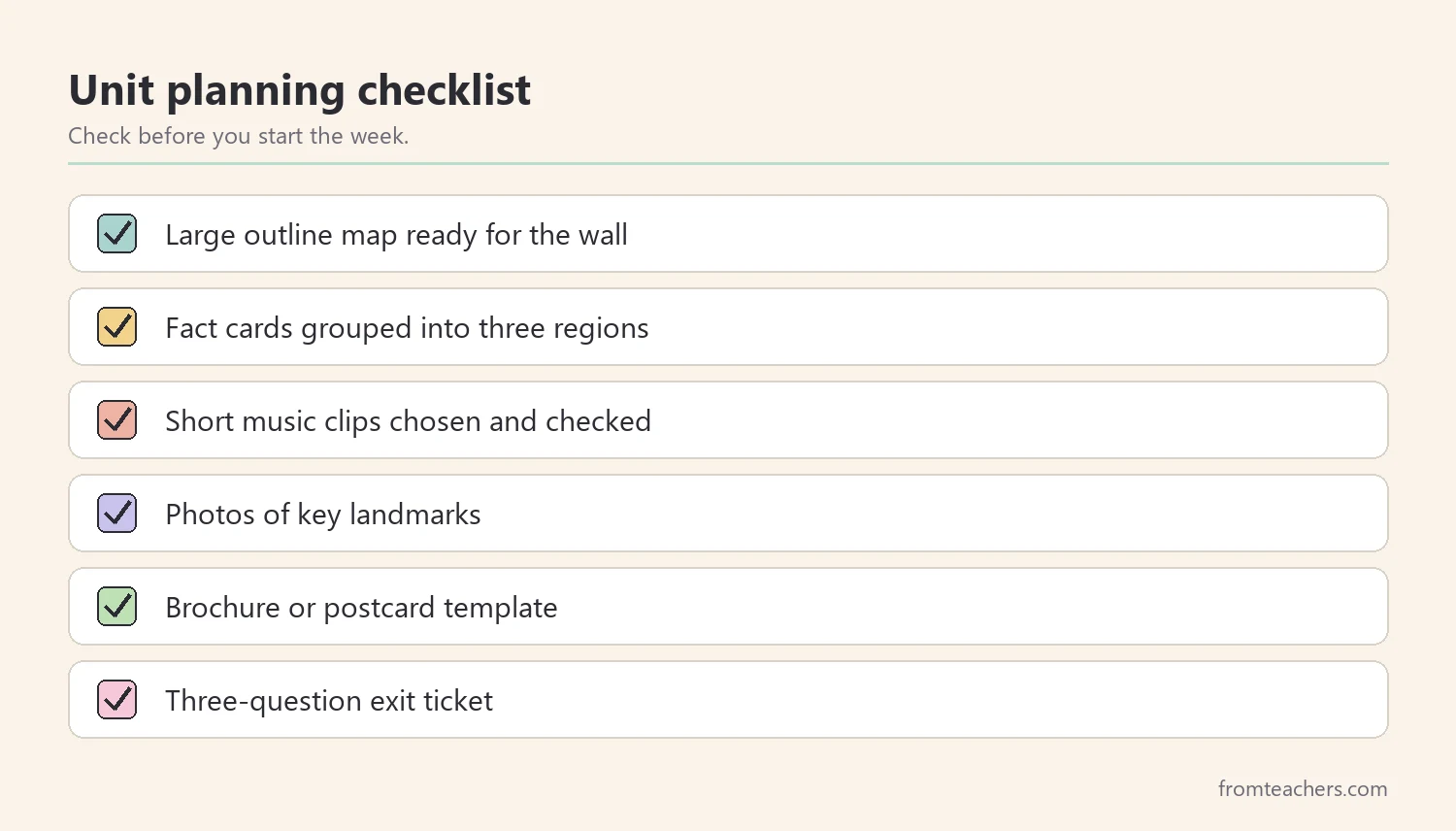
First, point out the state’s long, narrow shape. Then, trace its borders with students. Tennessee touches eight other states: Kentucky, Virginia, North Carolina, Georgia, Alabama, Mississippi, Arkansas, and Missouri. Students can count them on the map and color each neighbor a different shade.
Next, mark three anchor points. Put a star on Nashville, the capital, in the middle of the state. Then, draw the Mississippi River along the western edge and shade the mountains along the eastern edge. These three marks give students a frame for every fact that follows.
For example, in Ms. Rivera’s fictional third grade class, students drew the map on chart paper in small groups. Each group added one sticky note per border state. As a result, the class had a shared reference map on the wall for the rest of the unit.
| Map feature | Where it is | Why it matters |
|---|---|---|
| Nashville | Middle Tennessee | State capital |
| Mississippi River | Western border | Shipping and trade |
| Great Smoky Mountains | Eastern border | National park and forests |
| Eight border states | All around | Shows Tennessee’s central location |
Add a few statewide basics
Once the map is ready, share a short list of statewide Tennessee facts for kids. Tennessee became the 16th state in 1796. Its nickname is the Volunteer State, a name often linked to the many Tennesseans who volunteered to serve in the War of 1812. Keep this list short, because the regions in step 2 will carry most of the details.
Also, invite questions. Students may wonder why the capital is in the middle or why the state is so long and thin. Write their questions on a “wonder wall” beside the map, and return to them during the week.
Finally, keep the map visible all week. Every time you share new Tennessee facts for kids, ask a student to point to where that fact belongs.
2. Organize Tennessee Facts for Kids by Region
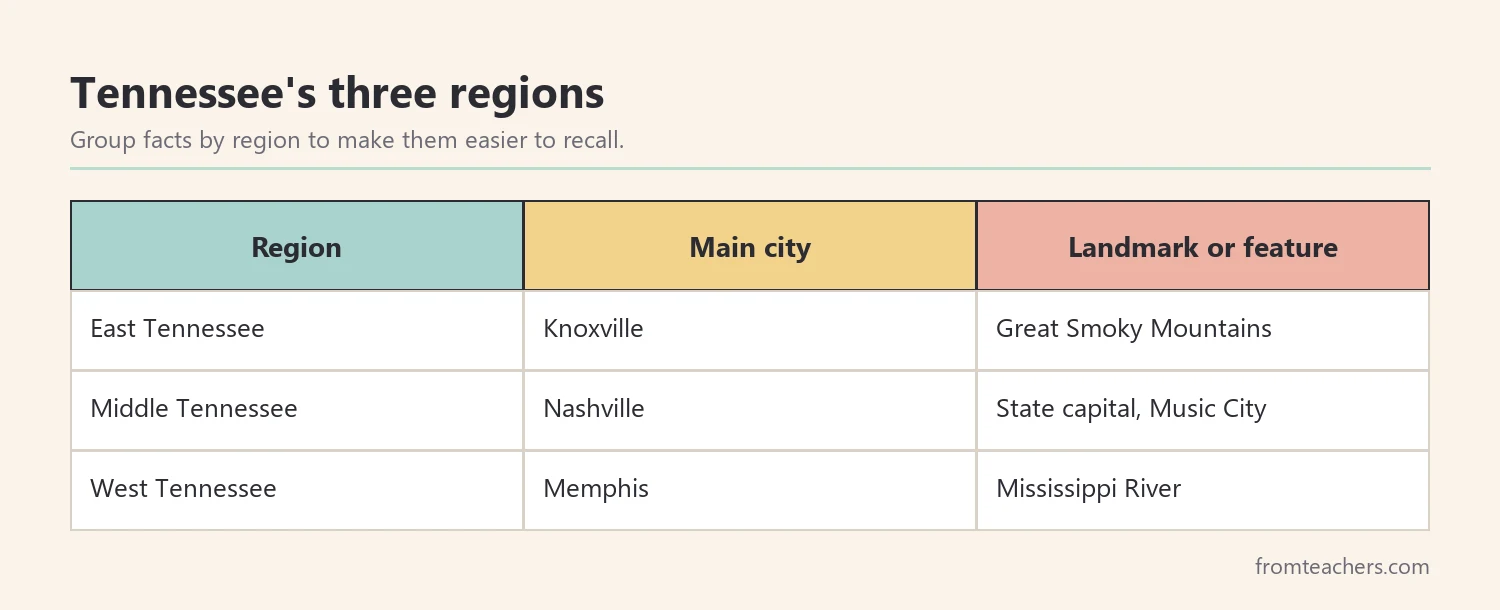
A long list of Tennessee facts for kids is hard for young learners to hold. However, sorting facts into groups makes them easier to remember. Tennessee offers a natural way to do this, because the state is commonly described as three Grand Divisions: East, Middle, and West Tennessee. The three stars on the state flag are often explained as standing for these regions.
East Tennessee
This region includes the Great Smoky Mountains and the city of Knoxville. Chattanooga sits in the southeast near the Georgia border. Mountains, forests, and rivers make this region a good place to talk about landforms.
Middle Tennessee
Here, students find Nashville, the capital, often called Music City. This region is a natural place to discuss state government and the music industry.
West Tennessee
Then, move west to Memphis on the Mississippi River. This region connects to river trade and to music history, including blues and the home of Elvis Presley, Graceland.
Keep each region to a few Tennessee facts for kids at first. Three or four facts per region are enough for most elementary students. You can always add more once the core facts are secure.
For practice, Ms. Rivera gave each group 12 fact cards and asked them to sort the cards into three columns. Each region had 4 cards, so 4 plus 4 plus 4 made 12. Afterward, groups explained one card they had sorted and why it belonged there.
3. Use Music and Landmarks as Memory Hooks
Students remember stories and sounds better than dates, and Tennessee facts for kids are full of both. Therefore, make music and landmarks the center of your Tennessee lessons rather than a fun extra at the end.
First, play a short, classroom-appropriate clip of country music and a short clip of blues. Ask students which city each style is often linked with: Nashville for country and Memphis for blues. Then, have them mark each city on the map with a small music note.
Next, introduce one landmark from each region. For instance, students can look at photos of the Great Smoky Mountains National Park, which Tennessee shares with North Carolina. They can also look at a photo of the Mississippi River at Memphis. Ask: “What would you see, hear, or do here?”
When you want a ready set of visuals, the All About Tennessee state study slideshow covers major cities such as Memphis, Knoxville, and Chattanooga, the state tree, the economy, and a closing review of key symbols and landmarks. It works as a whole-class slideshow or as an independent research companion.
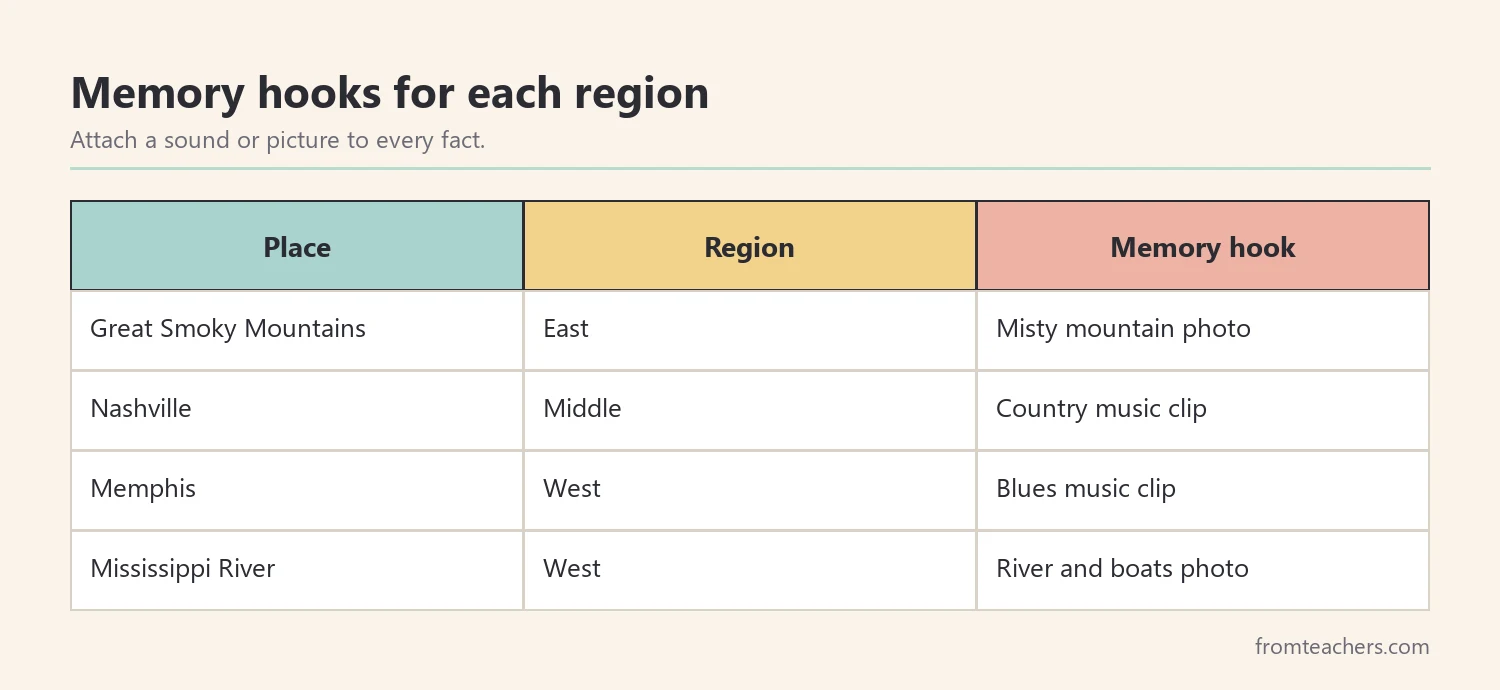
Also, connect symbols to things students can touch or picture. The state tree is the tulip poplar, which can grow very tall. Students might measure a long piece of string in the hallway to imagine its height. In the same way, the state bird, the mockingbird, can lead to a short listening activity about birds that copy sounds.
These hooks make Tennessee facts for kids easier to recall, because each fact now has a sound, a picture, or an action attached.
4. Let Students Work With the Facts
Listening alone rarely makes Tennessee facts for kids last. Instead, students need to do something with what they learned. As a result, plan at least two hands-on activities during the unit.
Fact sort and match
Give pairs a set of picture cards and fact cards, then ask them to match each picture to its fact and its region. For example, a picture of a guitar matches “Nashville is often called Music City” and Middle Tennessee.
Travel brochure
Next, have each student design a one-page brochure inviting visitors to one region. They should include the region’s name, one city, one landmark, and one reason to visit. Brochures give students a reason to use Tennessee facts for kids in their own words.
Postcard writing
Alternatively, students can write a short postcard “from” a Tennessee landmark. A postcard from the Smokies might describe misty mountains, while one from Memphis might mention the river.
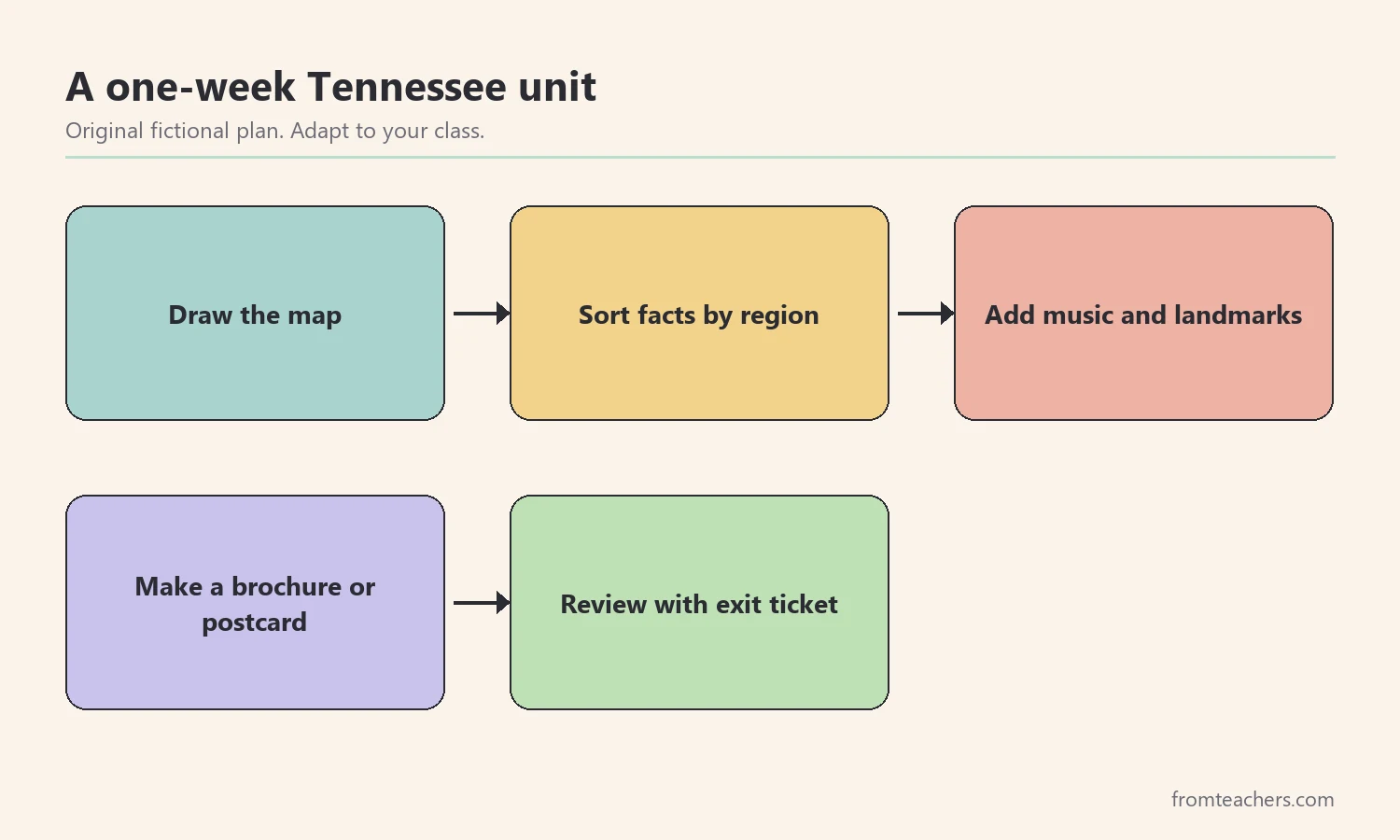
In Ms. Rivera’s class, students chose between the brochure and the postcard. Choice kept energy high, and both options asked students to explain facts rather than copy them.
In addition, a simple class game can turn Tennessee facts for kids into quick review. Read a clue, such as “I am a river on the western border,” and let teams hold up the matching card. Short games like this keep practice active without adding new content.
Also, support every learner. Provide sentence starters such as “In East Tennessee, you can see…” for students who need them. Picture-supported fact cards help English learners and early readers join in.
5. Review Tennessee Facts for Kids and Check Memory
A short review of Tennessee facts for kids at the end of the week shows what stuck. However, it does not need to be a stressful test. A friendly check is often more useful for planning.
First, try a quick map challenge. Point to a place on the class map and ask students to name it and share one fact about it. Next, use a three-question exit ticket: name the capital, name one landmark, and name one thing Tennessee is known for.
Then, look at the results to plan what to revisit. Here is a fictional example from Ms. Rivera’s class of 24 students.
| Exit ticket question | Correct | Not yet | Total |
|---|---|---|---|
| Name the capital | 22 | 2 | 24 |
| Name one landmark | 19 | 5 | 24 |
| Name one thing Tennessee is known for | 21 | 3 | 24 |
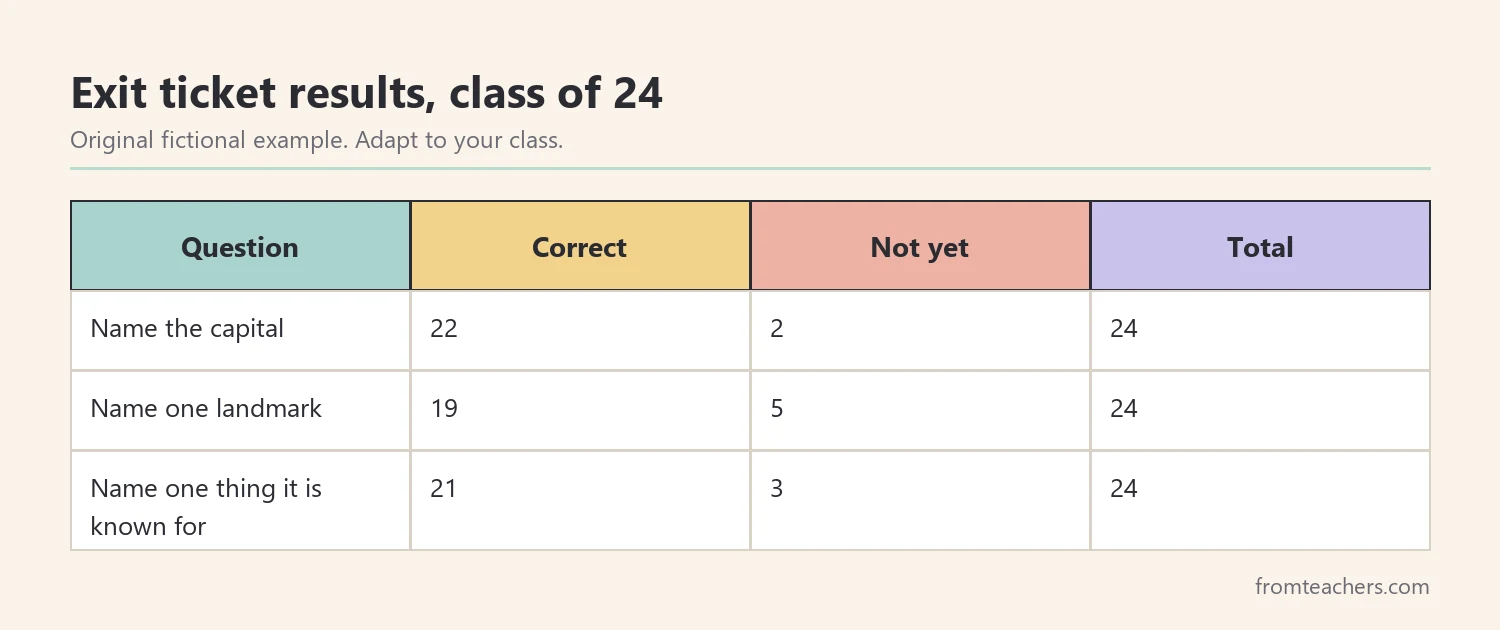
Because landmarks had the most “not yet” answers, Ms. Rivera added a five-minute photo review the next Monday. Students looked at the Smokies, the Mississippi River, and Graceland again, then pointed to each on the map.
Students who still mix up regions can use a three-color map at home with family members. Short, repeated practice usually helps more than one long review session, and it lets families see the Tennessee facts for kids their children are learning.
Finally, celebrate the unit. Display brochures and postcards in the hallway, or invite another class for a short “Tennessee tour.” Sharing work gives students one more chance to repeat what they learned.
After the unit, save the class map, the fact cards, and a few student samples. Next year, you can reuse them as models, and students in later grades can revisit the same map when they study U.S. regions or history. In this way, one week of Tennessee facts for kids becomes a foundation for later social studies learning rather than a list that fades by the next unit.
Common mistakes and how to avoid them
- Starting with a long fact list. Fix: start with the map and add facts to places.
- Treating music as an extra. Fix: use Nashville and Memphis music as memory hooks.
- Too many facts at once. Fix: group facts into three regions with a few facts each.
- Only teacher talk. Fix: plan sorting, brochures, or postcards so students use the facts.
- Testing without planning. Fix: use exit ticket results to decide what to review next.
Questions teachers and parents ask about Tennessee facts for kids
What are the most important Tennessee facts for kids to learn first?
Start with the capital, Nashville, the nickname “the Volunteer State,” and the three regions. Then, add the Mississippi River and the Great Smoky Mountains. These give students a clear frame for other facts.
How long should a Tennessee unit take?
Many teachers spend about one week on a single state in a 50-states study. A longer unit may suit a state research project. Adjust to your schedule and standards.
How can parents help at home?
Parents can practice Tennessee facts for kids by looking at a map together, listen to a song linked with Nashville or Memphis, or look up photos of the Smokies. Simple talk at home helps facts stick.
How do I adapt the unit for younger students?
Use fewer facts, more pictures, and more movement. For example, younger students can stand in three corners of the room for East, Middle, and West.
Where can I find reliable Tennessee information?
Use official and educational sources, such as the National Park Service for the Smokies and the Tennessee State Library and Archives for state history. Always check facts before sharing them with students.
Related reading: 5 Practical Teaching Tips to Boost Classroom Focus and Learning, Learning Styles Student Success Guide, and Homeschooling vs. Public Schooling: Which Educational Path Is Right for Your Child?
A companion resource for Tennessee facts for kids:
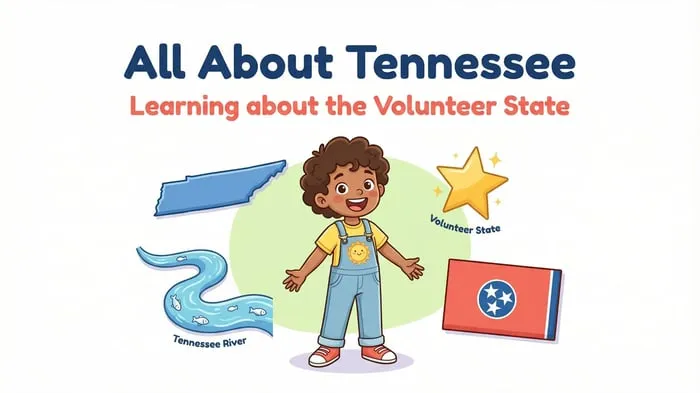
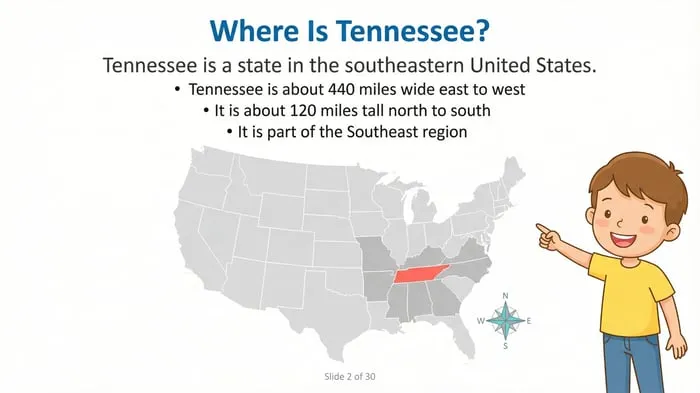
Tennessee State Study: Facts, Symbols, and Famous Landmarks: an “All About Tennessee” slideshow for elementary students with slides on the Volunteer State, major cities, the state tree, the economy, a fun fact, and a closing review of key symbols and landmarks.
Sources and scope
- Great Smoky Mountains National Park, National Park Service: official park information, maps, and photos.
- Tennessee State Library and Archives: state history collections and educational materials.
- Library of Congress: primary sources, maps, and music collections for classroom use.
- National Council for the Social Studies: guidance and resources for teaching social studies.
This guide covers a one-week elementary unit on Tennessee geography, symbols, and culture. It does not replace your state or district standards, and facts should be checked against current official sources before teaching.
Key takeaways
- Teach Tennessee facts for kids from a map so every fact has a place.
- Group facts by East, Middle, and West Tennessee.
- Use music and landmarks as memory hooks.
- Give students hands-on ways to sort and explain facts.
- Use a short exit ticket to decide what to review next.

Leave a Comment