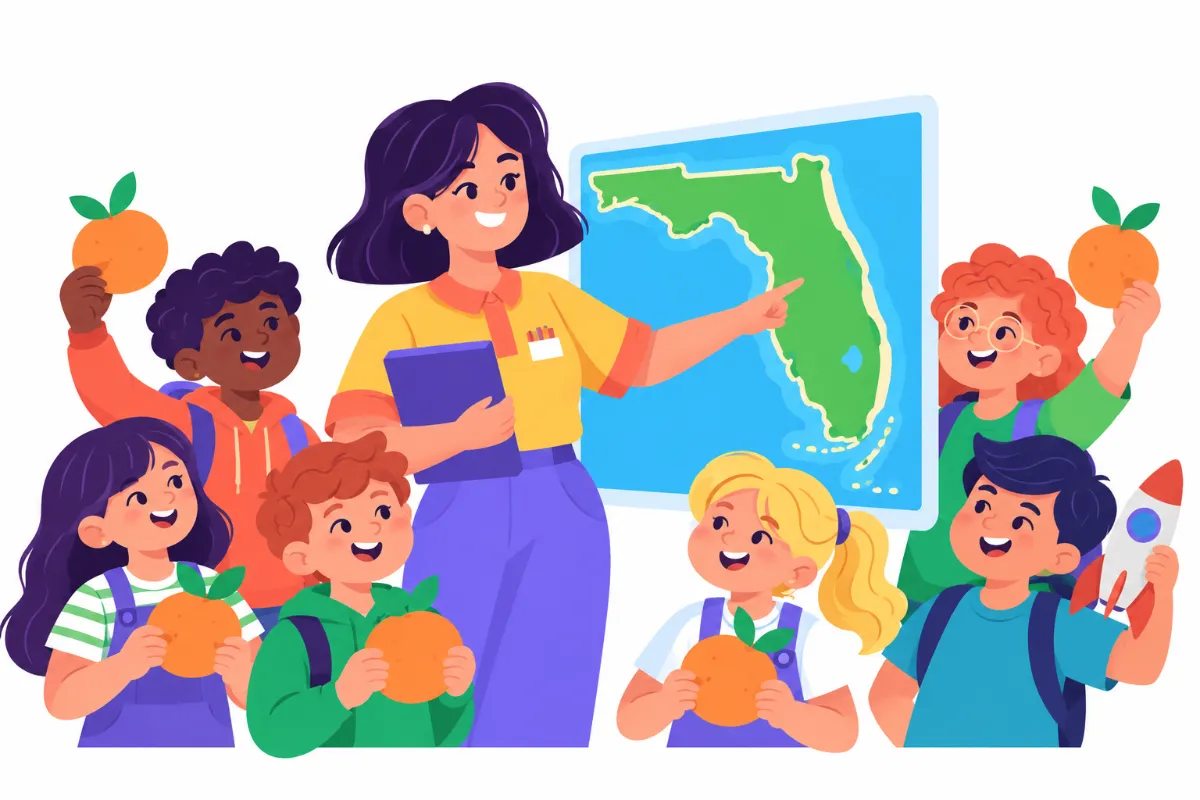

Florida facts for kids open the door to geography, science, and history in a single state study. Picture a fourth grade class looking at a photo of a rocket lifting off from the Florida coast: hands shoot up, and students want to know where it is going, who built it, and why it launches from Florida.
This guide shows you how to turn that excitement into a clear, five-day unit built around Florida facts for kids. By the end, you will be able to introduce the capital and nickname, teach state symbols, explore the Everglades and Kennedy Space Center, add hands-on research, and check what students remember. Examples are fictional. Adapt them to your students and your curriculum.
At a glance
- Start with the map, the capital, and the nickname before adding details.
- Teach state symbols with short memory hooks so they stick.
- Use the Everglades and Kennedy Space Center to connect nature and science.
- Add a short research task, such as manatee fact cards.
- Finish with a review that asks students to explain and compare.
1. Start With the Map: Florida Facts for Kids
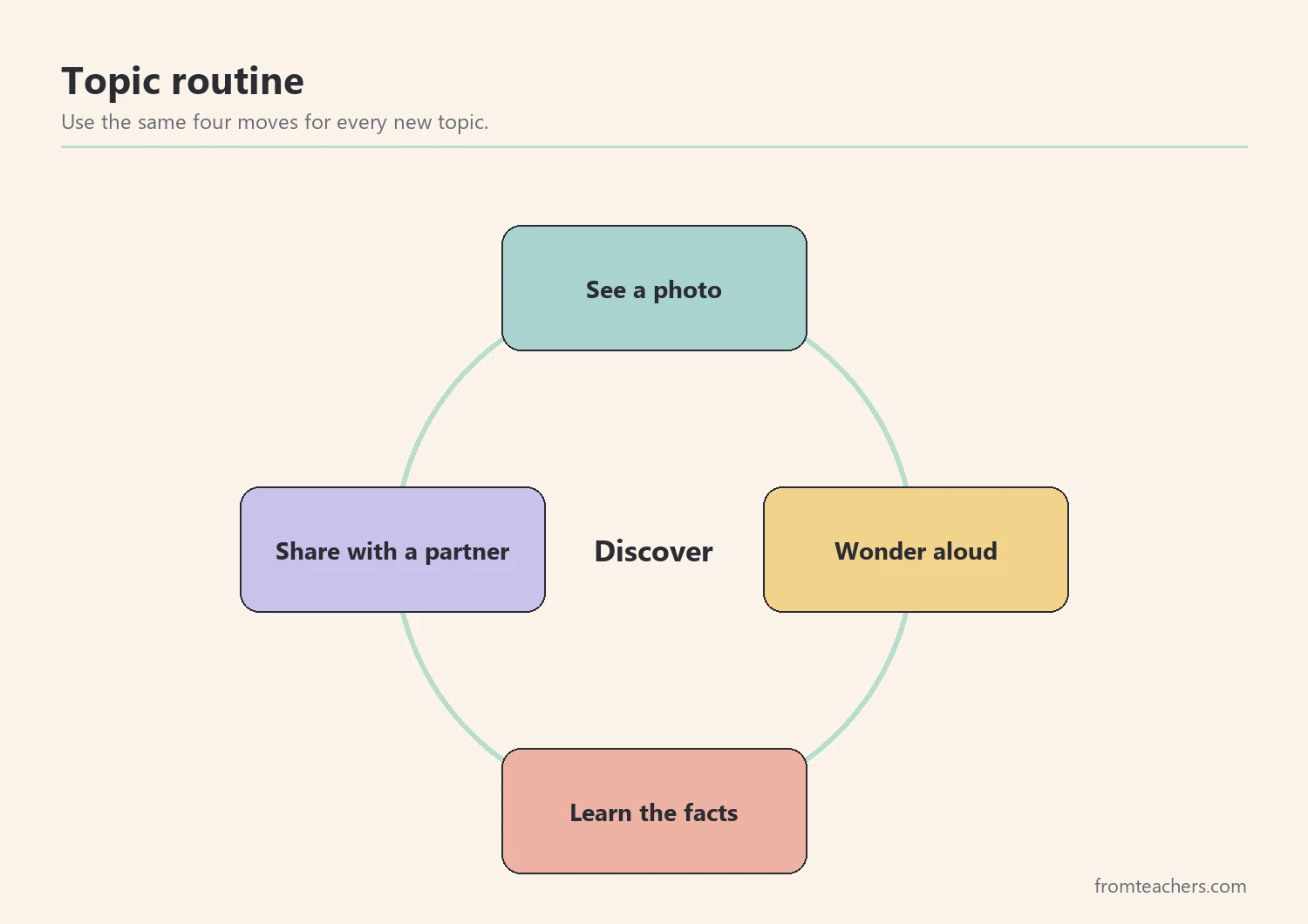
Students remember details better when they know where a place is. Therefore, start with a map of the United States and then zoom in on the Southeast. Ask students to find Florida and describe its shape.
Most students notice right away that Florida sticks out into the water. It is a peninsula, with the Atlantic Ocean on the east and the Gulf on the west. In addition, it shares land borders with only two states, Georgia and Alabama.
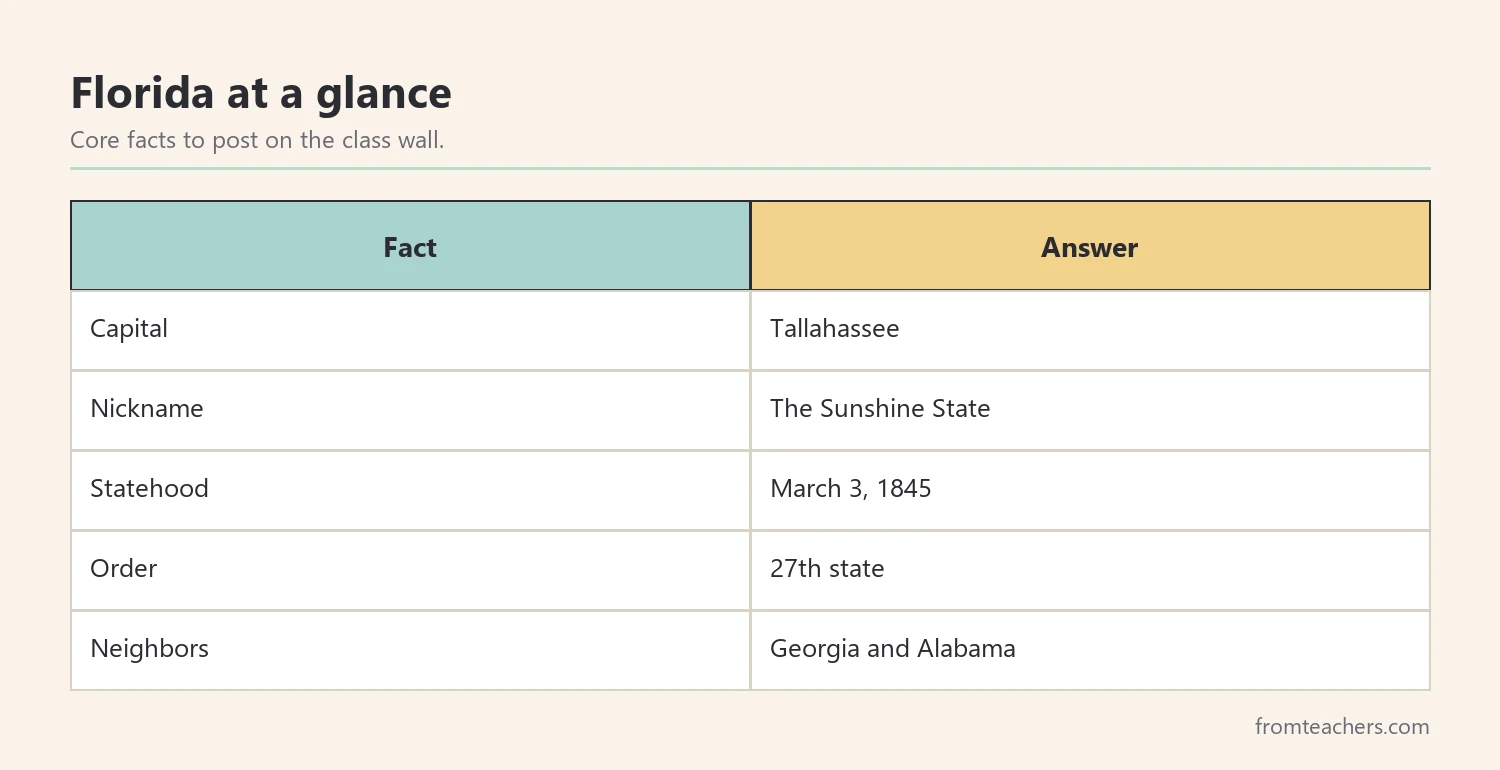
Next, add three anchor facts. Tallahassee is the capital. Florida’s nickname is “The Sunshine State.” Florida became the 27th state on March 3, 1845. Post these facts on the wall, because every later lesson will connect back to them.
For example, in Mr. Grant’s fictional fourth grade class, students color Florida on an outline map, draw a star for Tallahassee in the north, and label the Atlantic Ocean and the Gulf. Then they mark Georgia and Alabama along the northern border.
Also, many students expect the capital to be a big, famous city such as Miami or Orlando. This surprise is a great teaching moment. Ask, “Why might a state choose a capital that is not its biggest city?” and collect ideas. In fact, Tallahassee was chosen as the capital in 1824, and its location between the older settlements of Pensacola and St. Augustine is part of the story.
Finally, write a big question for the unit: “What makes Florida different from where we live?” As a result, you will have a simple way to show how student thinking grows over five days. Many teachers find that this first map lesson sets the tone for all the Florida facts for kids that follow.
2. Teach Florida State Symbols With Memory Hooks
State symbols are often the Florida facts for kids that students remember longest. However, a long list blurs quickly. A short memory hook for each symbol helps students recall it days later.
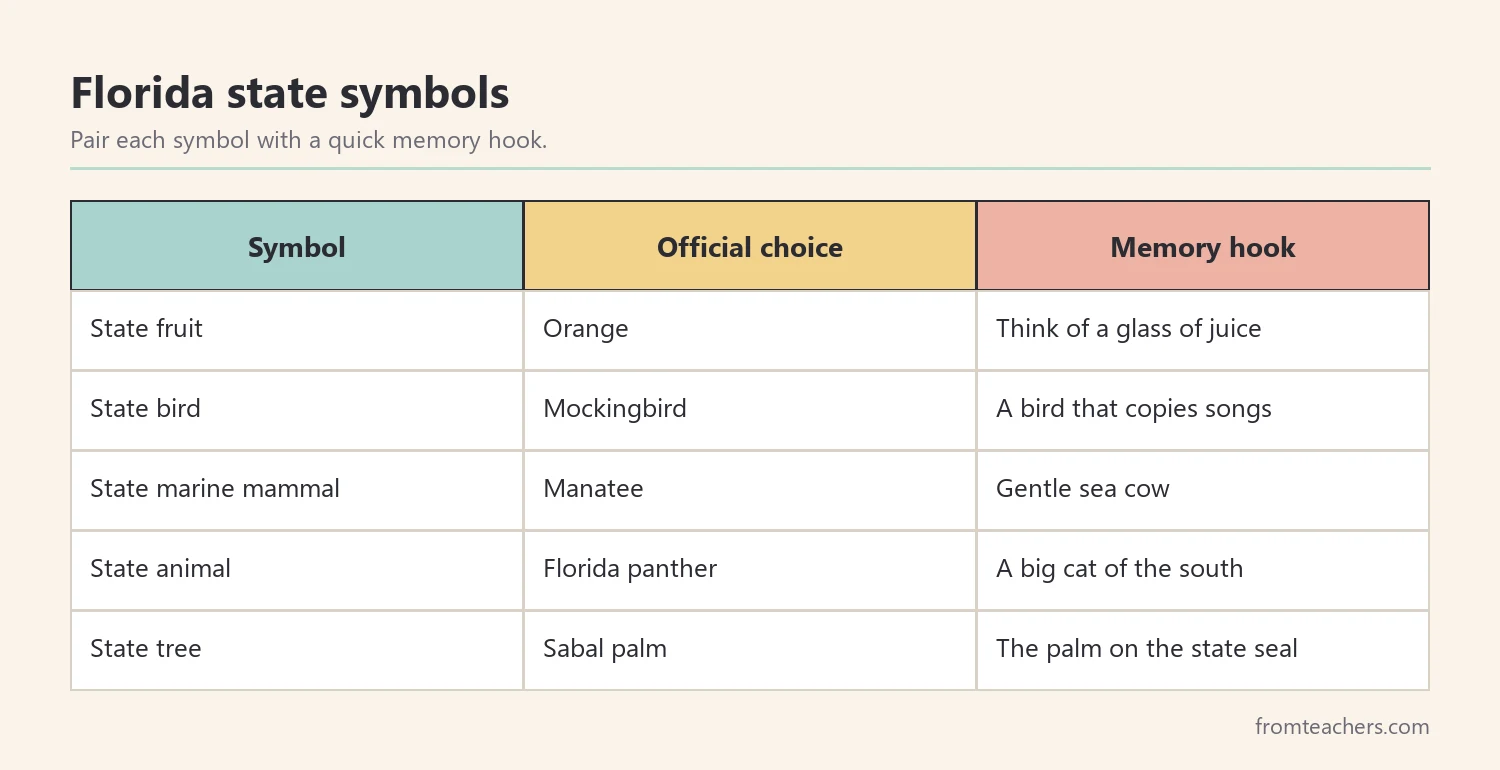
First, start with the orange, the state fruit. Florida is well known for growing citrus, and oranges appear on many Florida images and license plates. Next, introduce the mockingbird, the state bird, which is famous for copying the songs of other birds.
Then, add the manatee, the state marine mammal. Manatees are large, slow, gentle animals that eat plants, which is why many people call them sea cows. After that, introduce the Florida panther, the state animal, and the sabal palm, the state tree.
For example, Mr. Grant’s 28 students work in seven groups of four. Five groups each take one symbol and make a poster with a drawing and a memory hook. The other two groups make posters for the capital and the nickname. Then the class walks the gallery and reads all seven posters.
Moreover, connect symbols to real places. Oranges link to farms in the middle of the state, and manatees link to rivers, springs, and coastal waters. If you want ready-made slides for this step, the Florida state study slides on facts, symbols, and landmarks include a capital slide, a state fruit slide about the citrus industry, and a Kennedy Space Center spotlight. Because symbols are such memorable Florida facts for kids, it is worth giving them a full lesson.
3. Explore Florida Landmarks: Nature and Space
Landmarks turn Florida facts for kids into places students can picture. Two stand out because they show very different sides of the state: the Everglades and Kennedy Space Center.
First, the Everglades. This huge wetland in southern Florida is often described as a slow-moving river of grass. Everglades National Park protects part of it. It is home to alligators, wading birds, and many other animals. In fact, the park is known as a place where both alligators and crocodiles live.
Next, Kennedy Space Center. Located on Florida’s east coast, it is NASA’s well-known launch site. Rockets and spacecraft have launched from this area for many missions, including the Apollo missions to the Moon.
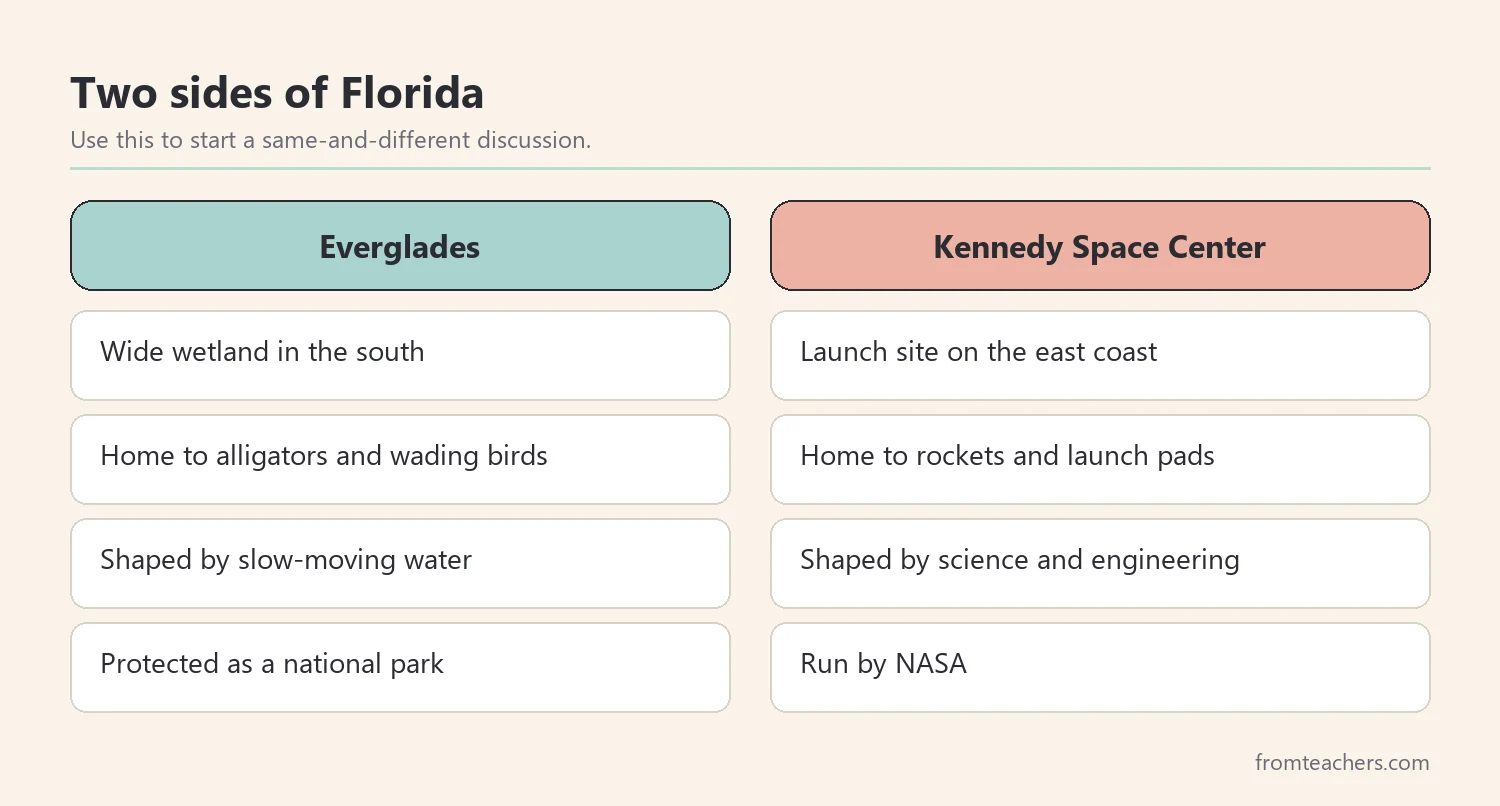
For example, Mr. Grant shows one photo of each place side by side. Students list what they see in a two-column chart. Then they talk with a partner about what is the same and what is different. Many notice that both places are near water, which leads to a short talk about Florida’s long coastline.
In addition, ask students why a launch site might be built on the coast. Accept all reasonable ideas, then explain simply that launching over the ocean keeps rockets away from crowded areas. Keep explanations short and accurate, and use official sources for any details.
| Place | What to notice | Big idea |
|---|---|---|
| Everglades | Wetland, grasses, wildlife | Water shapes habitats |
| Kennedy Space Center | Launch pads, rockets | Science and engineering |
Finally, keep each landmark lesson short: one photo, one question, and one big idea. Florida facts for kids stick best when students can explain why a place matters, not just name it.
4. Add Hands-On Research: Florida Facts for Kids in Action
Students learn more when they find facts themselves. Therefore, add a short research task built around one Florida animal. Manatees work well because they are gentle, easy to picture, and closely tied to Florida waters.
Start with photos. Ask students what they notice and what they wonder. Then give each group one short, trusted article or video. Students write three facts in their own words, draw where manatees live, and add one way people help protect them.
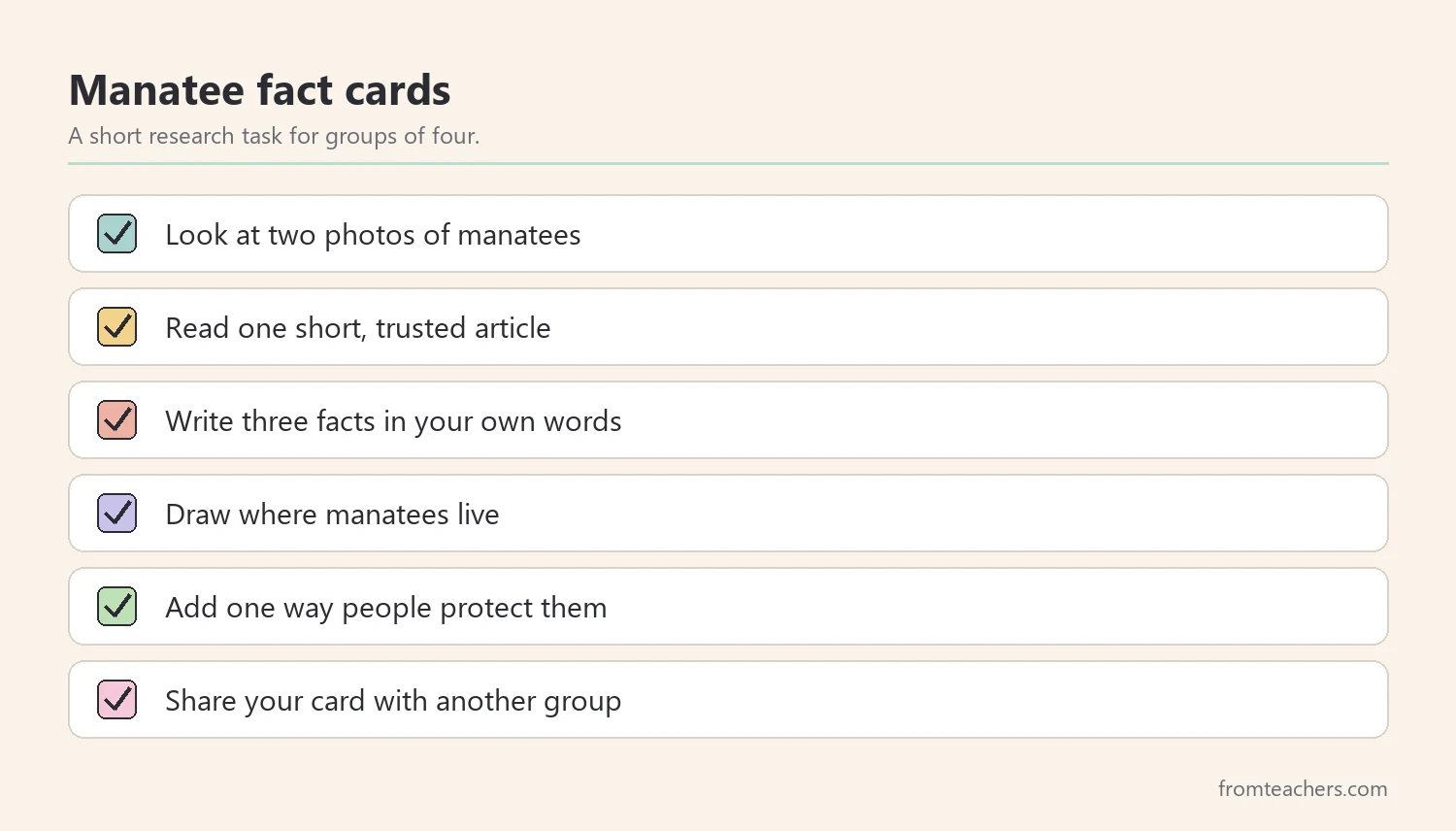
For example, Mr. Grant’s seven groups each make one manatee fact card. With three facts per card, the class collects 21 facts in total. Next, the groups compare cards and circle any facts that appear on more than one. These repeated facts become the class’s “big facts” about manatees.
Moreover, research tasks teach an important skill: checking sources. Remind students to use trusted sites, such as government, park, or museum pages, and to write facts in their own words. In addition, model how to say “I am not sure yet” when a fact needs checking.
- Use photos first, so students observe before reading.
- Keep each research task short and focused.
- Ask for facts in students’ own words.
Finally, link the research back to the map. Students can mark where manatees are often seen and connect this to Florida’s rivers, springs, and coastline. These active steps make Florida facts for kids feel like discoveries, not a list.
5. Connect Florida to Daily Life
Students often ask, “What is it like to live there?” A short look at daily life helps the state feel real. Florida has large cities, small towns, farms, beaches, and wetlands, and people there go to school and work just like your students.
First, explore the role of oranges and farming. Many students are surprised that the juice in their fridge may have started on a Florida farm. Next, talk about weather. The nickname “The Sunshine State” fits Florida’s warm climate, but the state also gets storms, including hurricanes, which is why communities plan ahead.
Next, look at how people spend time outdoors, from beaches and springs to state parks. Simple comparisons like these turn Florida facts for kids into conversations about real life, and they give quieter students an easy way to join in.
For example, Mr. Grant’s class makes a “Same as us, different from us” chart. Students compare weather, food, landscapes, and outdoor activities. By the end of the lesson, both columns are full, and the chart becomes part of the final review.
In addition, invite families to share. A parent who has visited Florida might send a photo or a short story. These personal links help students remember Florida facts for kids because the facts now connect to real people.
6. Review and Check What Students Remember
A strong review asks students to explain, not just repeat. Therefore, plan the last day around sharing and a short check. Students should be able to name the capital and nickname, describe two symbols, and explain one landmark.
First, return to the big question: “What makes Florida different from where we live?” Compare new answers with the first ideas from day one. Next, use a five-question check: the capital, the nickname, the state fruit, one landmark, and one fact about manatees.
For example, in Mr. Grant’s fictional class, 21 of 28 students answer all five questions correctly, and the other 7 miss one question each. As a result, he reteaches the two most-missed items in a short small group. A week later, he repeats the check to see which Florida facts for kids students still remember.
Finally, celebrate with a gallery walk of symbol posters and manatee cards. In addition, a “postcard from Florida” writing task lets each student choose one favorite fact and explain why it matters to them.
Common mistakes and how to avoid them
- Starting with a long fact list: begin with the map, the capital, and the nickname.
- Assuming the capital is the biggest city: use the surprise to start a discussion.
- Teaching symbols without hooks: add a short memory hook for each one.
- Using landmarks only as pictures: connect each place to a science or history idea.
- Letting research become copying: ask for facts in students’ own words.
Questions teachers and parents ask about Florida facts for kids
What are the most important Florida facts for kids to learn first?
Start with the capital, Tallahassee, the nickname, “The Sunshine State,” and Florida’s shape on the map. Then add the year it became a state, 1845. These anchor facts make later details easier to remember.
Why is Tallahassee the capital instead of Miami?
Tallahassee was chosen as the capital in 1824, long before Miami grew into a large city. Its location between older settlements made it a practical choice. This is a good example of how history shapes geography.
How can I make Florida facts for kids hands-on?
Try a symbol gallery, a manatee fact card task, or a same-and-different chart for the Everglades and Kennedy Space Center. Each activity works well in small groups and takes 15 to 30 minutes.
What grade level fits a Florida state study?
Elementary grades are a common fit, especially during state studies or geography units. Younger students can focus on symbols and pictures, while older students can research and write.
Can parents use these ideas at home?
Yes. A map, a few photos, and a short research task are enough. Families can also compare Florida with places they have visited or would like to visit.
Related reading: Learning Styles Student Success Guide and 5 Practical Teaching Tips to Boost Classroom Focus and Learning.
A companion resource for Florida facts for kids
Ready-to-use resource:
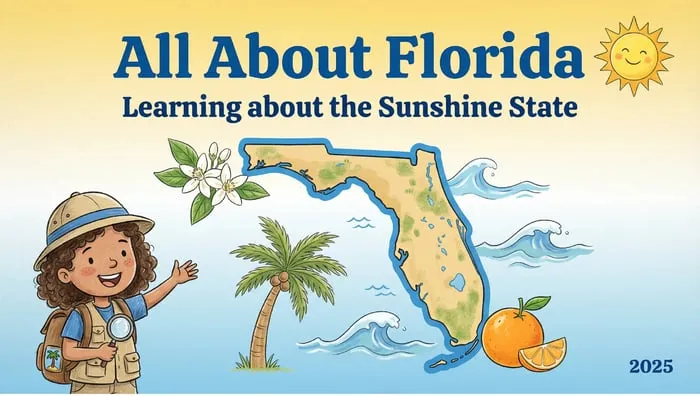
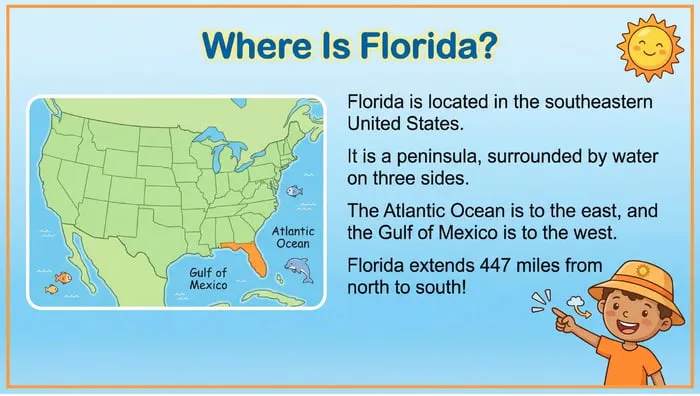
Florida State Study: Facts, Symbols, and Famous Landmarks: a 30-slide, kid-friendly introduction to Florida covering the capital, the state fruit, Kennedy Space Center, fun fact callouts, and a closing review.
Sources and scope
- Everglades National Park (National Park Service): the official park site with information on the wetland, its wildlife, and its history.
- NASA Kennedy Space Center: NASA’s page for its Florida launch site and missions.
- MyFlorida.com: the official portal of the State of Florida.
- U.S. Fish and Wildlife Service: the federal agency that works to conserve wildlife, including manatees.
Scope: this guide offers teaching ideas for an elementary Florida state study. It does not replace your state standards or a full history curriculum.
Key takeaways
- Open Florida facts for kids with the map, the capital, and the nickname.
- Teach symbols with short memory hooks.
- Use the Everglades and Kennedy Space Center to compare nature and science.
- Add short research tasks that ask for facts in students’ own words.
- Review by asking students to explain and compare.

Leave a Comment