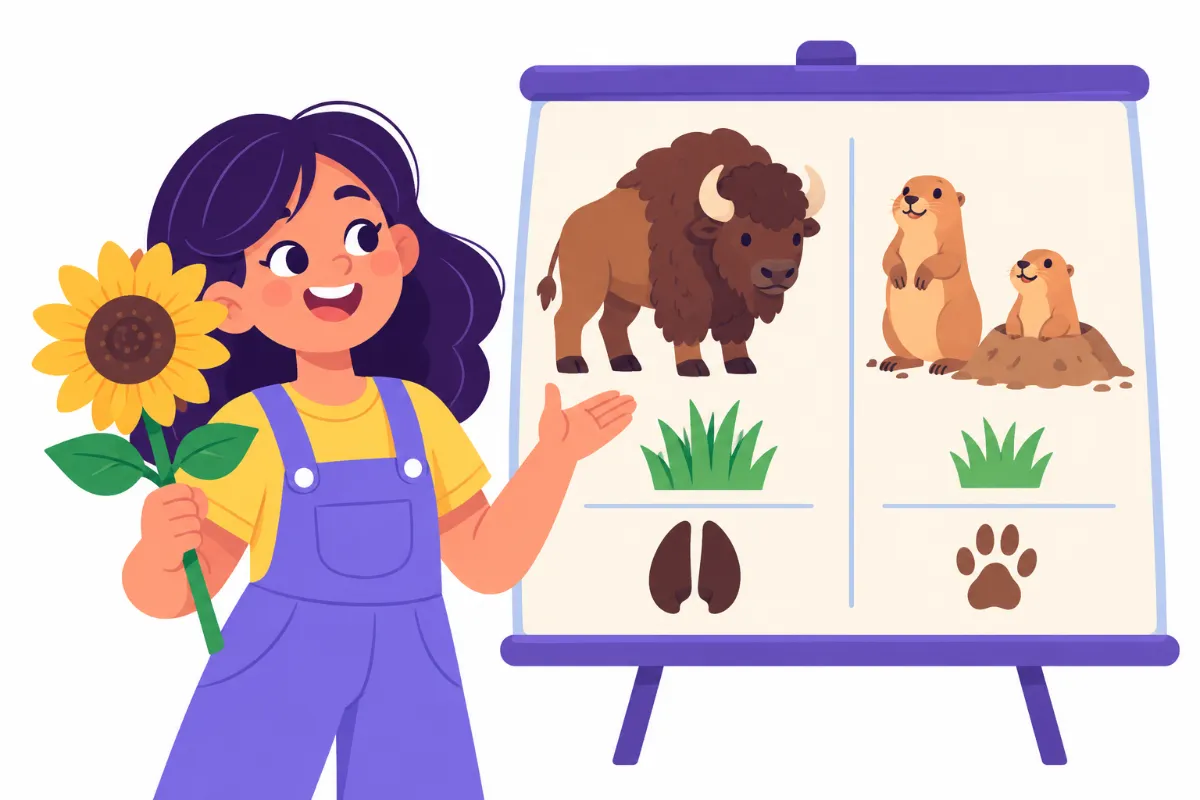

Kansas facts for kids can feel like a long list of names and numbers until students have a way to organize them. Picture Maya, a fourth grader, staring at a blank state report page and asking, “Where do I even start?” With a clear plan, that blank page becomes a map, a set of symbols, a few cities and rivers, and a story about the animals of the prairie.
By the end of this guide, you will be able to teach Kansas in short, connected lessons: locate the state, learn its symbols, explore cities and rivers, compare wildlife past and present, and help students build a fact project they can explain. In addition, you will have a simple way to check what students remember.
Examples are fictional. Adapt to the student’s goals and agreed supports. This is guidance, not a diagnosis.
At a glance
- Start every state study with a map, so facts have a place to live.
- Teach symbols as a story: why a sunflower, why a bison.
- Connect cities and rivers to the shape of the land.
- Compare wildlife of the past and present to build thinking skills.
- Finish with a short fact project and a quick review quiz.
1. Locate Kansas on the map before other Kansas facts for kids
First, give students a mental picture of where Kansas sits. Without that picture, all the later Kansas facts for kids float free. So, open a U.S. map and find the middle of the country together.
Kansas sits in the center of the contiguous United States. In fact, the geographic center of the lower 48 states is located near the town of Lebanon, Kansas, which is a memorable hook for kids. Next, point out the neighbors: Nebraska to the north, Missouri to the east, Oklahoma to the south, and Colorado to the west.
Then, look at the shape. Kansas is close to a rectangle, with one small notch in the northeast corner where the Missouri River forms part of the border. Ask students to trace the outline with a finger and describe it in their own words.
| Direction | Neighbor state |
|---|---|
| North | Nebraska |
| East | Missouri |
| South | Oklahoma |
| West | Colorado |
Also, talk about the land. Much of Kansas is part of the Great Plains, with wide, open land that is mostly flat or gently rolling. As a result, it is a good place for farming, which leads naturally to the next lesson.
Worked example: Ms. Patel gives Maya a blank outline map of the United States. Maya colors Kansas, labels the four neighbors, and draws a small star near the center of the country. Then she writes one sentence: “Kansas is in the middle of the United States.”
2. Learn the symbols behind Kansas facts for kids
Next, teach the symbols, the most familiar Kansas facts for kids, as a set of small stories. Students remember a reason better than a label. For instance, instead of only saying “the state flower is the sunflower,” ask, “Why might a prairie state choose a flower that follows the sun?”
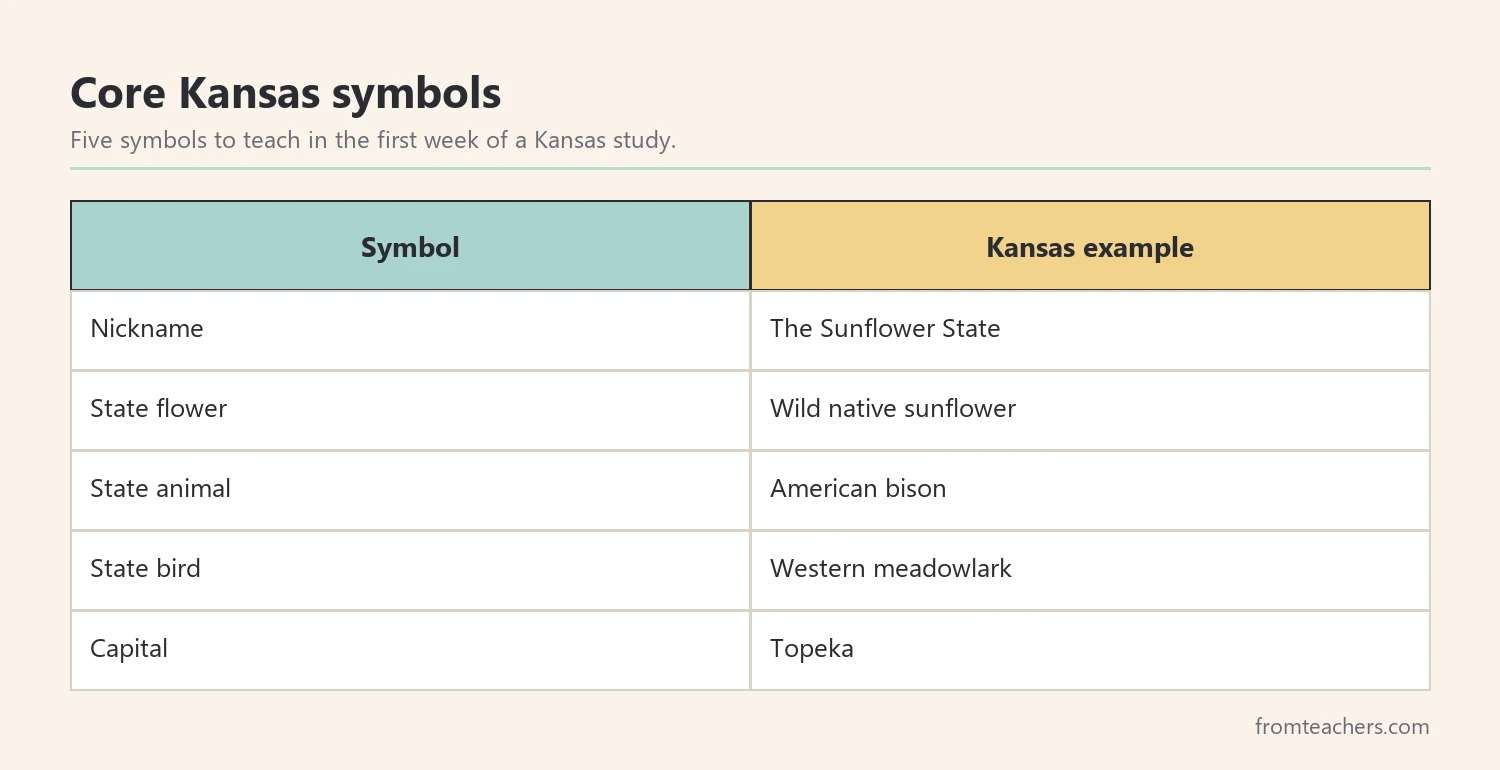
Here are the core symbols most state studies include:
- Nickname: the Sunflower State.
- State flower: the wild native sunflower.
- State animal: the American bison.
- State bird: the western meadowlark.
- Capital: Topeka.
- Statehood: January 29, 1861, as the 34th state.
Similarly, wheat belongs among the core Kansas facts for kids, since it is closely tied to Kansas identity. Kansas is one of the top wheat-growing states in the country, and golden wheat fields appear often in pictures of the state. Therefore, many teachers pair the sunflower and wheat as the two “images” of Kansas.
To make symbols stick, try a quick matching game. Write each symbol on one card and its picture on another, then let students match them in pairs. Afterward, students explain one match out loud.
Worked example: Maya matches six symbol cards with her partner. She gets five right on the first try and mixes up the state bird with a picture of a robin. Ms. Patel shows a photo of a western meadowlark with its yellow chest, and Maya fixes the match.
3. Explore cities and rivers
After symbols, move to people and places. Cities and rivers turn Kansas facts for kids into real places. They show students how land and water shape where people live. In addition, they give students real names to use in their projects.
In addition, start with a few major cities:
- Wichita: the largest city in Kansas.
- Overland Park: a large city in the Kansas City area.
- Kansas City, Kansas: on the eastern edge of the state, next to Kansas City, Missouri.
- Topeka: the state capital.
Then, add the rivers. The Kansas River, often called the Kaw, flows east across northeastern Kansas, and it is about 148 miles long. Meanwhile, the Arkansas River crosses the southern and central part of the state. Ask students to add these Kansas facts for kids to their maps: find each river and name a city near it, such as Wichita on the Arkansas River.
For example, a quick tip: a Kansas state study slideshow covering cities, rivers, and wildlife walks students through these places one fact at a time, which works well as a whole-class introduction before independent research.
Worked example: Maya adds four city dots and two blue river lines to her map. Next to Wichita, she writes “largest city.” Next to the Kansas River, she writes “about 148 miles long.” Her map now holds 6 new facts, plus the 4 neighbor states from step 1, for a total of 10 labeled facts.
4. Compare wildlife in Kansas facts for kids, past and present
Wildlife is often the favorite part of Kansas facts for kids. Moreover, it invites real thinking, because students can compare how the prairie has changed over time.
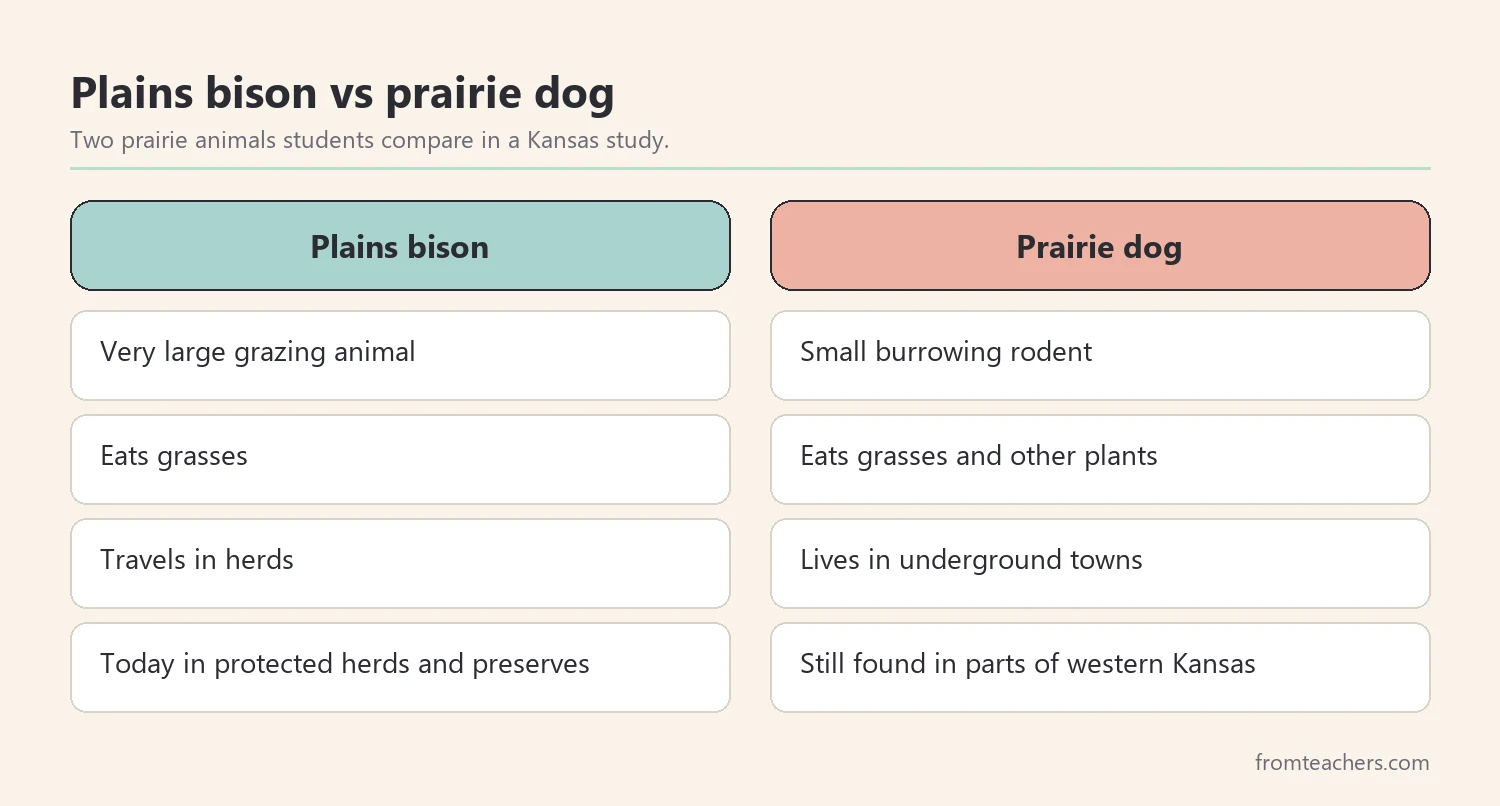
Long ago, huge herds of plains bison roamed the grasslands of Kansas. Over the 1800s, hunting and settlement reduced their numbers sharply. Today, bison live in protected herds and preserves rather than roaming freely across the whole state. In contrast, smaller prairie animals such as black-tailed prairie dogs still live in parts of western Kansas.
Also, introduce the tallgrass prairie. Kansas is home to the Tallgrass Prairie National Preserve in the Flint Hills, managed with The Nature Conservancy and the National Park Service. Students can look at photos and describe how tall grass, wide sky, and open land fit the animals they have learned about.
Put this step into practice
In addition, this is a natural place to talk about change over time. Ask students, “Why do you think the bison herds got smaller?” and “What helps animals come back?” Then, guide them toward simple, accurate ideas such as hunting, farming, and protected land. As a result, Kansas facts for kids become a starting point for thinking about people and nature, not just a list to memorize.
Next, a Venn diagram or comparison chart works well here. For example, students list “big, eats grass, lives in herds” for bison and “small, digs burrows, lives in towns” for prairie dogs. Then, in the middle, they write what both share: “lives on the prairie, eats plants.”
Worked example: Maya completes a comparison chart with four rows. She writes that bison are huge and travel in herds, while prairie dogs are small and live in underground towns. Finally, she writes one sentence: “Both animals need the prairie grass to survive.”
5. Build a Kansas facts for kids project
Now, students pull all their Kansas facts for kids together. A short project helps them choose, organize, and explain facts instead of copying a list. Keep it focused so the work stays manageable.
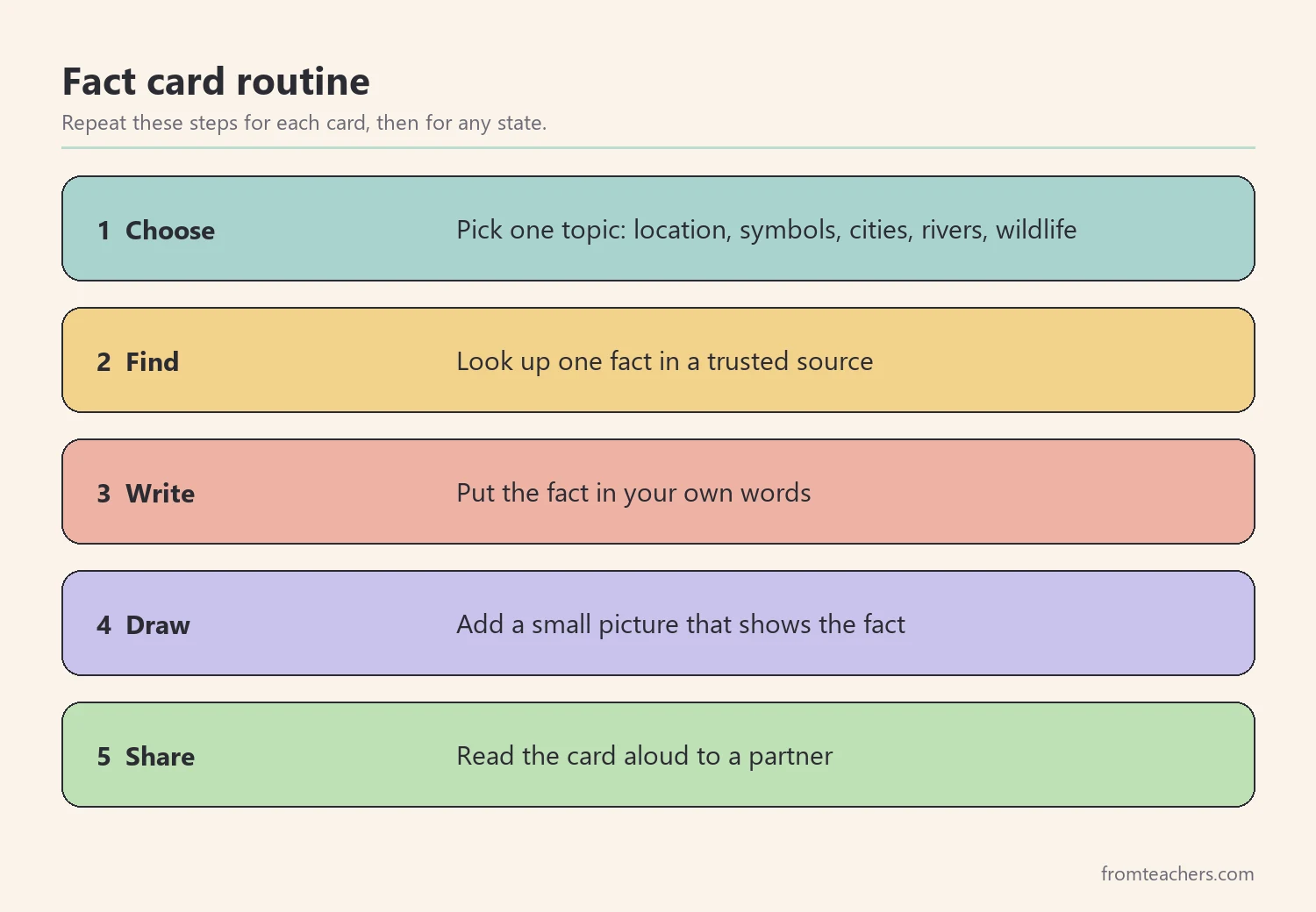
One simple format is a set of fact cards. Each card has a title, one fact in the student’s own words, a small drawing, and a source. For example:
- Card 1, Location: center of the country, four neighbor states.
- Card 2, Symbols: sunflower, bison, western meadowlark.
- Card 3, Capital and cities: Topeka, Wichita, Overland Park.
- Card 4, Rivers: Kansas River and Arkansas River.
- Card 5, Wildlife: bison then and now, prairie dogs today.
Before writing, model one card yourself. Think aloud as you choose a fact, check it in a trusted source, and rewrite it in simple words. Then, let students write their first card with a partner before working alone. Because the routine is the same for every card, students gain speed and confidence with each one, and their Kansas facts for kids cards look more polished by the end.
Furthermore, ask students to present one card aloud. Speaking about a fact in their own words is a strong check of understanding. Similarly, a gallery walk lets classmates read each other’s cards and spot new facts.
A quick classroom example
For students who need more support, give a sentence frame on each card, such as “Kansas is known for ___ because ___.” On the other hand, for students who are ready for more, add a “Did you know?” card with one extra fact they found in a trusted source.
Worked example: Maya finishes five fact cards in two class periods. She chooses the bison card to present and explains that bison once roamed Kansas in large herds and now live in protected areas. Her classmates add two questions to the class wonder wall.
6. Review and check what students remember
Finally, check learning with a short, low-pressure review. A quick quiz on Kansas facts for kids, a matching game, or an exit ticket shows which Kansas facts for kids have stuck and which need another pass.
Also, keep the review short, around ten questions. Mix question types: a map question, a few symbols, one city, one river, and one wildlife comparison. Then, revisit any facts that many students missed in a two-minute warm-up the next day.
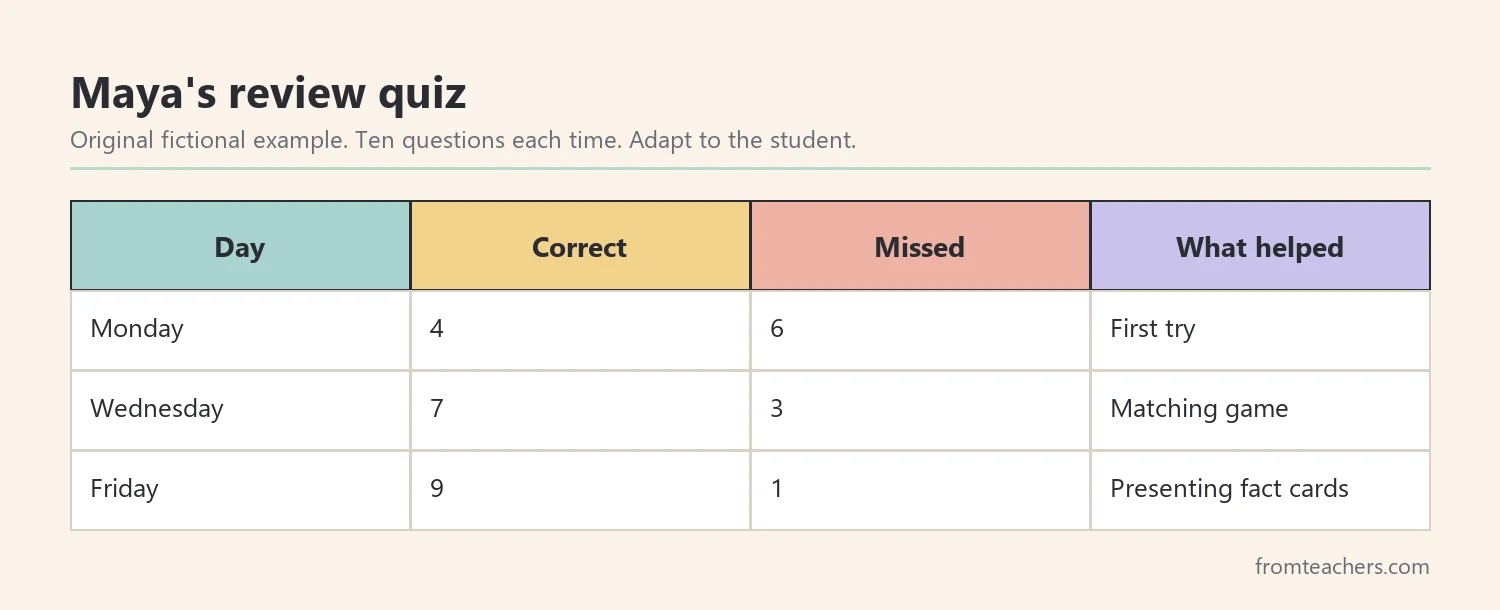
Worked example: Maya takes the same ten-question review three times in one week. On Monday, she scores 4 out of 10. On Wednesday, after a matching game, she scores 7 out of 10. On Friday, after presenting her fact cards, she scores 9 out of 10. The only item she still misses is the year of statehood, so Ms. Patel adds it to Monday’s warm-up.
In addition, use the review to plan the next state. If your class is studying all 50 states, the same map, symbols, cities, wildlife, and project routine works for each one. As a result, students learn the routine once and apply it again and again.
Common mistakes and how to avoid them
- Starting with a long list of facts. Fix: begin with the map so facts have a place.
- Teaching symbols as labels only. Fix: give each symbol a short “why” story.
- Skipping the land and water. Fix: connect cities to rivers and the plains.
- Copying facts word for word. Fix: require one fact per card in the student’s own words.
- Using untrusted sources. Fix: point students to official state, park, and library websites.
- No review. Fix: give a short quiz and reteach the most missed item.
Questions teachers and parents ask about Kansas facts for kids
What are the most important Kansas facts for kids to learn?
Start with location, the capital Topeka, the nickname Sunflower State, the state animal (American bison), and the largest city, Wichita. Then add rivers, wildlife, and statehood as students are ready.
Why is Kansas called the Sunflower State?
The wild native sunflower is the state flower, and it grows widely across Kansas. Because of that, the nickname became a natural fit for the state.
What grade level fits a Kansas state study?
State studies often appear in upper elementary social studies, around grades 3 to 5. However, younger students can enjoy the symbols and animals, while older students can go deeper into history and geography.
How can parents teach Kansas facts for kids at home?
Look at a map together, read about the sunflower and the bison, and make a few fact cards at the kitchen table. Also, try a quick quiz in the car, such as “Name a Kansas neighbor state.”
Where can students find reliable Kansas facts?
Point them to official and well-known sources, such as the Kansas Historical Society, the National Park Service, and the Library of Congress. Then, ask them to note the source on each fact card.
Related reading: Learning Styles Student Success Guide, 5 Practical Teaching Tips to Boost Classroom Focus and Learning, and Homeschooling vs. Public Schooling: Which Educational Path Is Right for Your Child?.
A companion resource for Kansas facts for kids:
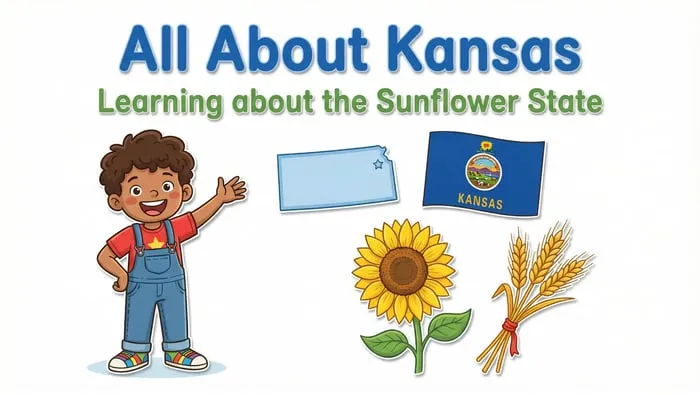
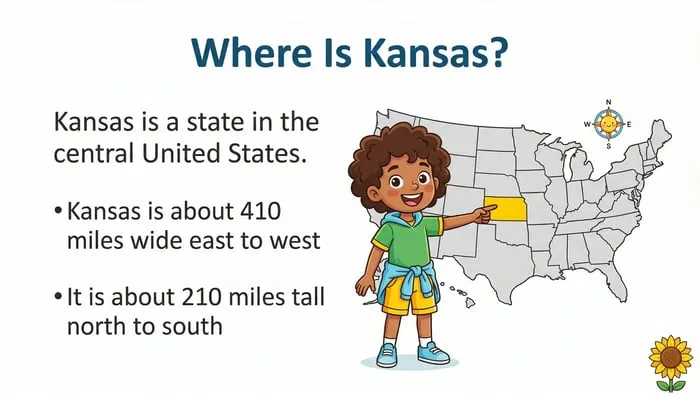
Kansas State Study: Facts, Symbols, and Wildlife: a 30-slide, kid-friendly introduction to the Sunflower State covering major cities, the Kansas and Arkansas Rivers, historic and current wildlife, and a review of key facts.
Sources and scope
- Kansas Historical Society: the state agency for Kansas history, with information on state symbols and history.
- National Park Service: information on national park sites, including the Tallgrass Prairie National Preserve in Kansas.
- U.S. Geological Survey: maps and information about rivers, land, and geography in the United States.
- Library of Congress: primary sources and teacher resources on U.S. states and history.
- National Council for the Social Studies: a professional organization supporting social studies teaching.
This guide gives an elementary-level introduction to Kansas geography, symbols, and wildlife; it does not cover Kansas history in depth, and facts should be checked against current official sources.
Key takeaways
- Begin Kansas facts for kids with the map: location, neighbors, and shape.
- Teach symbols with a short reason behind each one.
- Link cities to rivers and the land of the Great Plains.
- Compare bison and prairie dogs to build thinking skills.
- Close with Kansas facts for kids cards and a short review quiz.





Leave a Comment