
Learning guides for kids can make a big topic feel small enough to start, but only if they are used well. Picture a child at the kitchen table with a guide about the water cycle: one parent reads every word aloud, the child drifts off by page three, and nothing sticks. Another family uses the same guide in short, playful sessions, and the child explains evaporation at dinner.
This guide works like a short course. By the end, you will be able to choose the right guide, preview it with a child, read in short chunks, connect it to hands-on activities, check understanding, and build a simple weekly routine at home or in class. Examples are fictional. Adapt to the student’s goals and agreed supports. This is guidance, not a diagnosis.
At a glance
- Learning guides for kids work best as a short, regular routine, not a one-time read.
- Choose a guide by the child’s interest, reading level, and your goal for the session.
- Preview the guide together before reading, so the child knows what to look for.
- Pair every guide with a quick hands-on activity or conversation.
- Check understanding with simple “tell me” questions, not tests.
1. Choose learning guides for kids that fit the child
First, think about the child in front of you. A good guide matches three things: what the child cares about, what they can read or follow with help, and what you want from the session.
Interest comes first, because curiosity keeps a child turning pages. Next, check the reading load. If most pages need heavy help, plan to read together. If the child can read most of it alone, the guide can become an independent activity.
Then, decide on your goal. Do you want a calm independent activity, a new topic to explore together, or practice on something already started in class? The same guide can serve different goals, but knowing yours helps you plan the session.
| Your goal | Best choice | How to use it |
|---|---|---|
| Calm independent time | Familiar topic | Child reads alone, shares one fact |
| Explore something new | Fresh topic | Read together, talk often |
| Practice class learning | Topic from school | Short review, then an activity |
Meet our fictional learner, Maya, grade 2. Maya loves animals but avoids long texts. Her dad picks a guide about animal habitats, a topic she already enjoys, and plans to read it together in short sessions. Because the topic is familiar and exciting, Maya starts with energy instead of resistance.
Also, keep a few options on hand. Letting a child choose between two learning guides for kids gives them ownership without leaving the choice wide open.
Finally, think about the child’s attention and energy. A tired child at the end of a long school day may need a shorter, more visual guide. On a relaxed weekend morning, the same child might enjoy a longer topic. Matching learning guides for kids to the moment, not only to the child, makes a real difference.
2. Preview the guide together
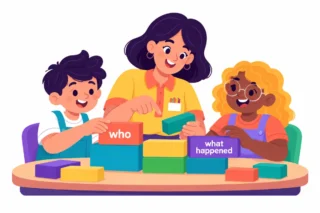
Before reading, spend two or three minutes previewing. A preview gives the child a map, so the content feels less like a wall of new information.
Start with the title and the cover. Ask, “What do you think this guide is about?” Then flip through the pages and look only at headings, pictures, and labels. Point out how the guide is organized: sections, numbered steps, or labeled diagrams.
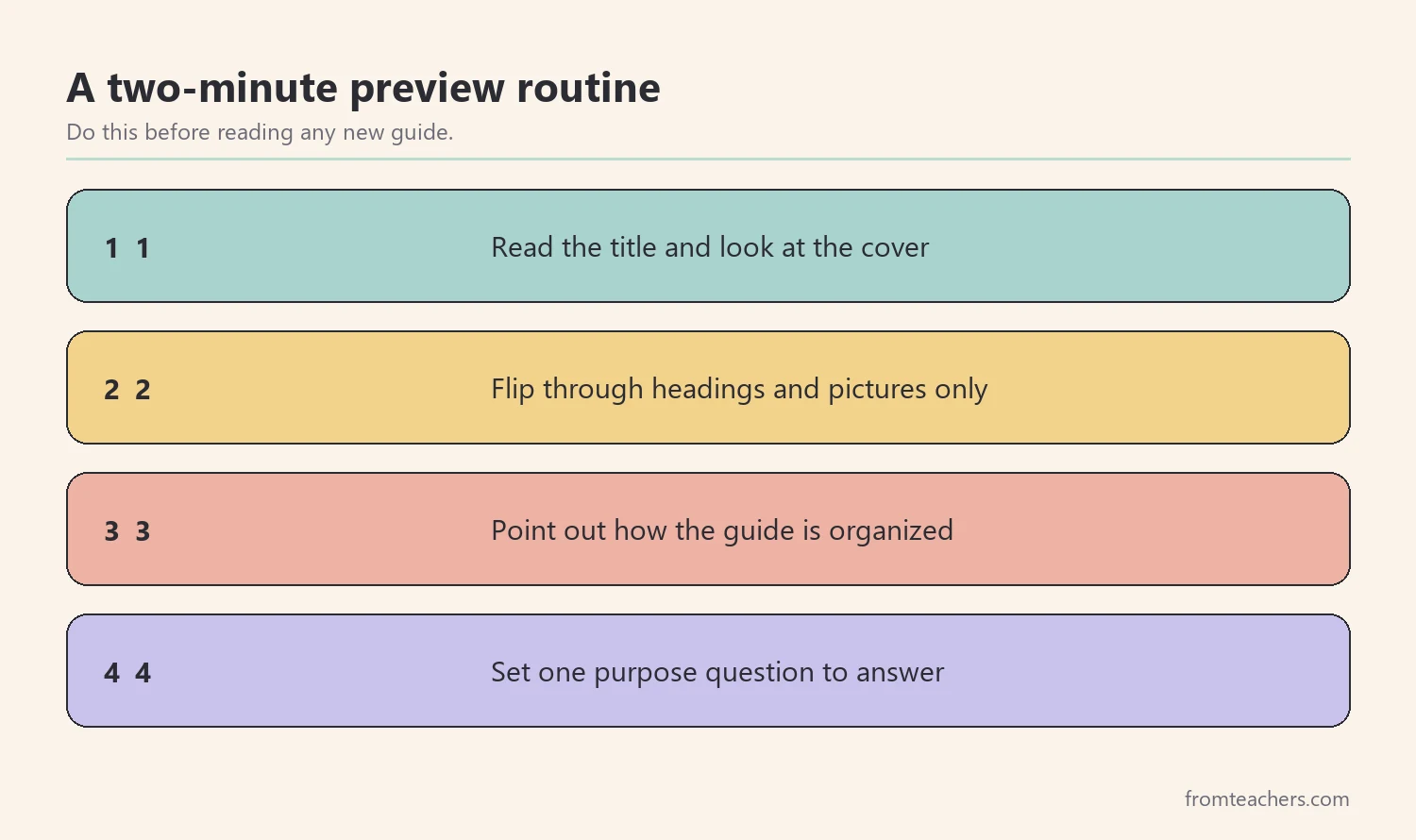
Next, set one purpose question. For example: “Let’s find out where polar bears live and how they stay warm.” A purpose question gives the child something to look for, which helps attention and memory.
For Maya, the preview became a small game. Her dad asked her to find three animal pictures and guess their homes before reading. By the time they started, she already had questions she wanted answered.
In addition, previewing helps children who find reading hard. Knowing the headings and pictures ahead of time reduces surprises. That makes learning guides for kids more accessible for struggling readers and for children learning English.
If you are looking for a ready set to preview and explore together, the Learning Guides for Kids Bundle gives you a collection of guides to rotate through at home or in class.
3. Read learning guides for kids in short chunks
Long reading sessions tire young readers. Therefore, plan short chunks: one section or two pages at a time, followed by a quick pause to talk.
A simple pattern works well. Read a short section. Then stop and ask, “What did we just learn?” Next, look at a picture or diagram together and connect it to the text. Finally, decide whether to continue or stop for the day.
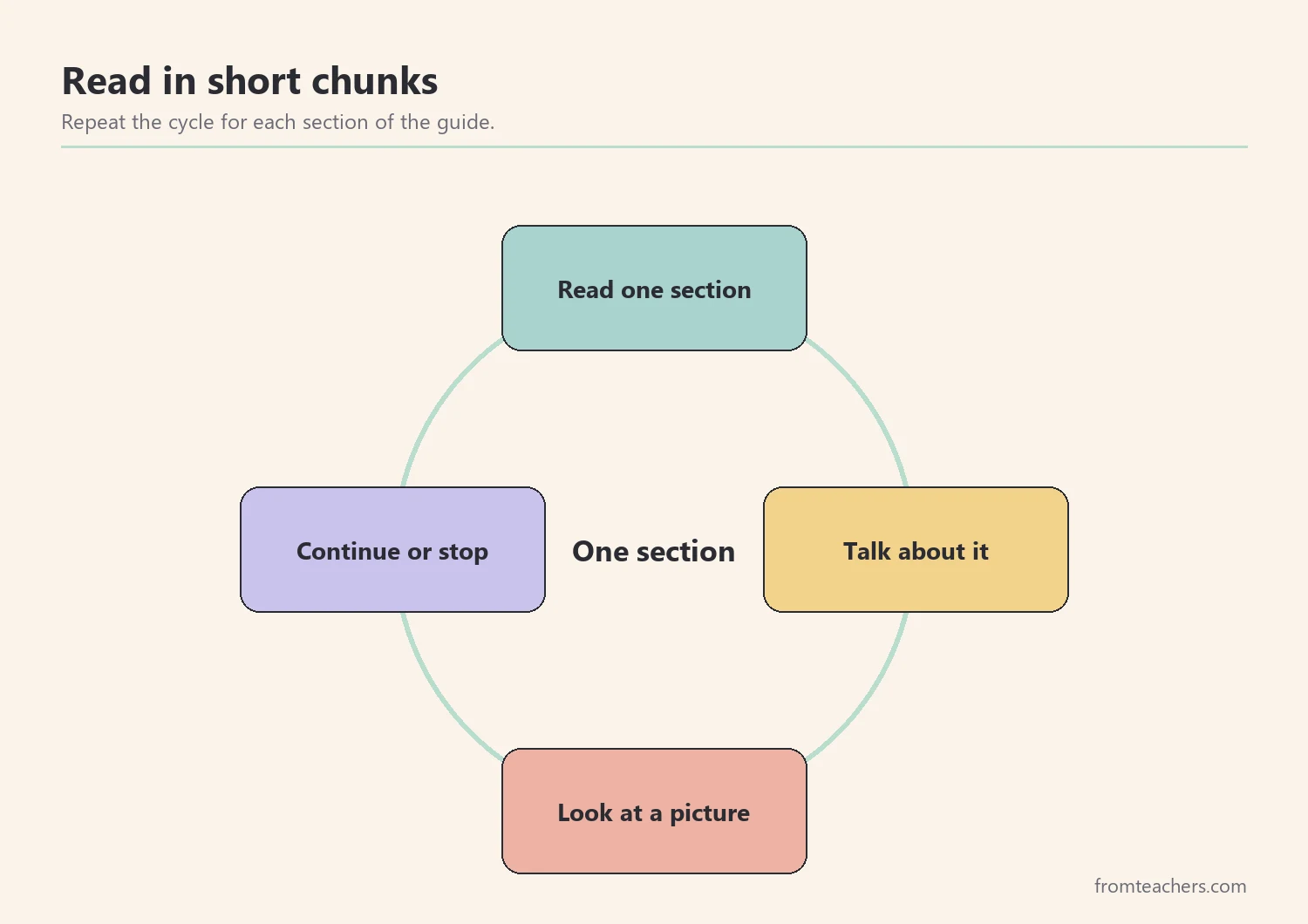
Also, stop while the child is still interested. Ending on a high point makes the next session easier to start. For many young children, ten to fifteen minutes is plenty, though you will learn what works for your child.
For Maya, each session covered one habitat. On Monday it was the Arctic, on Wednesday the rainforest, and on Friday the desert. Each session took about twelve minutes, and Maya asked to keep going more than once.
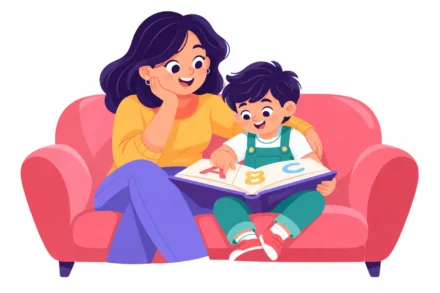
Furthermore, share the reading. You can read one paragraph and the child reads the next, or the child reads the labels while you read the main text. Shared reading keeps learning guides for kids active rather than passive.
4. Pair each guide with a hands-on activity
Children remember more when they do something with what they read. After each section, add a short activity that uses the new idea.
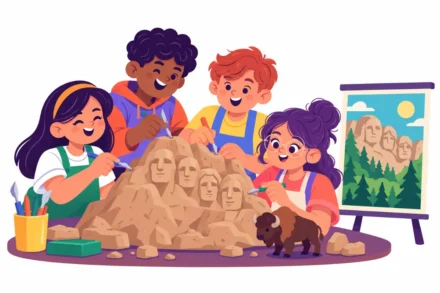
Keep activities simple and quick. Draw and label one thing from the guide. Build a model with blocks or clay. Act out a process. Sort picture cards into groups. Or explain the idea to a sibling, a stuffed animal, or a grandparent on the phone.
| Topic | Hands-on activity | Time |
|---|---|---|
| Animal habitats | Sort animal cards by habitat | 10 min |
| Water cycle | Draw and label the cycle | 10 min |
| Plants | Plant a seed and keep a log | 15 min |
| Weather | Record the weather each day | 5 min a day |
For Maya, the activity after each habitat was a drawing. She drew the animal, its home, and one way it stays safe. By Friday, she had three drawings, which her dad taped to the fridge. Those drawings became a natural reason to talk about what she learned.
Moreover, hands-on activities help children who learn best by moving and making. They also give quieter children another way to show what they know. In classrooms, these activities fit well into centers or partner work alongside learning guides for kids.
Also, keep supplies ready so activities start quickly. A small box with paper, crayons, glue, scissors, and a few blocks means you can move from reading to doing in under a minute. When setup is slow, the energy from the reading often fades before the activity begins.
For example, a classroom teacher might set up a habitat center with a guide, a sorting mat, and a set of animal cards. Students read one section with a partner, sort the cards, and then write one sentence about what they noticed. The same structure works at home with a parent instead of a partner.
5. Check understanding with simple questions
Next, check what the child understood, gently. The goal is conversation, not a quiz. Simple “tell me” questions work well and keep the mood positive.
Try questions like these: “Tell me one thing you learned.” “What surprised you?” “How is this like something you already know?” “What question do you still have?” Each question invites the child to think and talk in their own words.
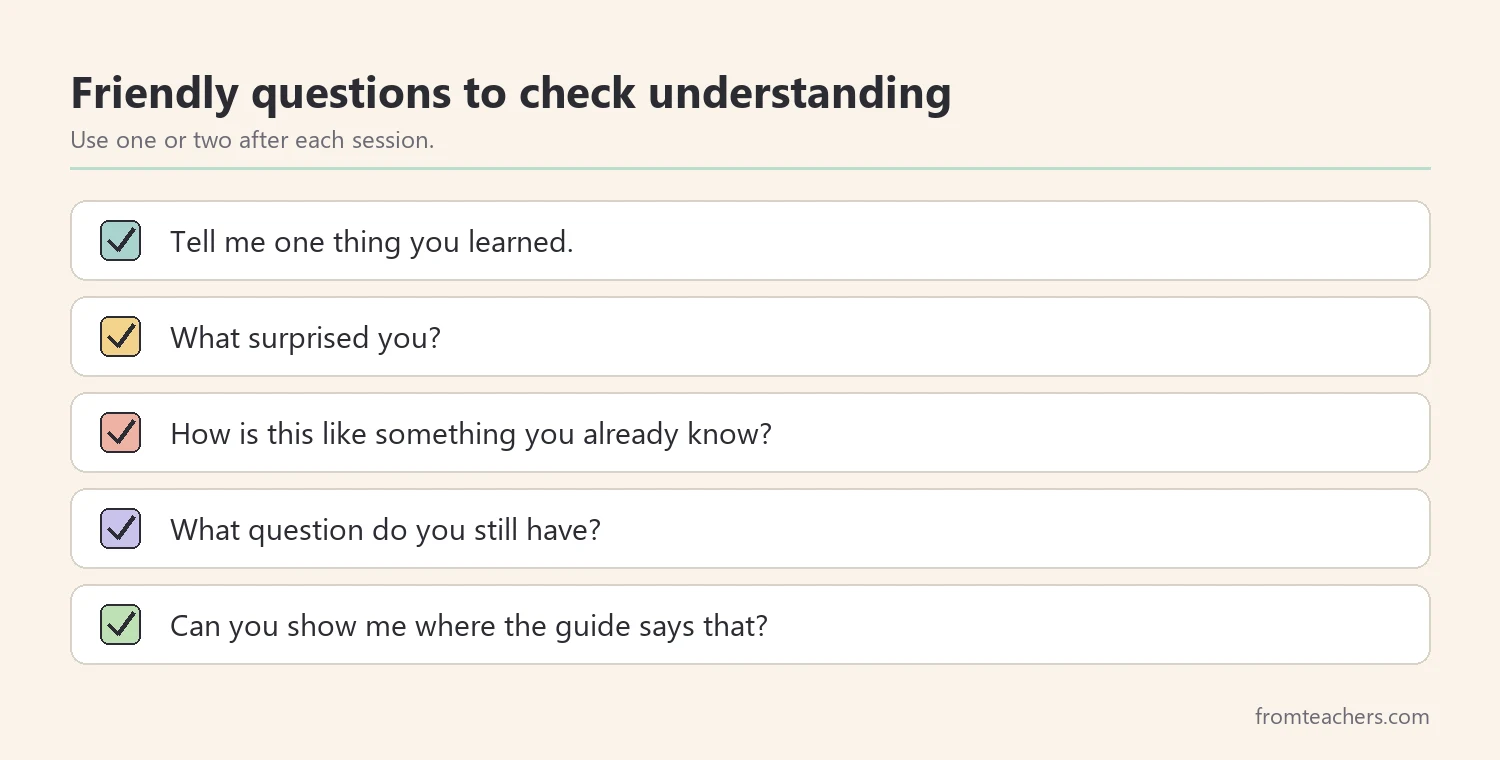
Also, listen for mix-ups and correct them kindly. If Maya says camels store water in their humps, her dad does not need to say “wrong.” Instead, he can say, “Let’s check the guide together,” and they look for the answer. Going back to the text teaches a lasting habit of checking facts.
In addition, notice which kind of question is hardest. Some children recall facts easily but struggle to explain why. Others make great connections but forget details. That information tells you what to focus on next time you use learning guides for kids.
For teachers, a short exit card with one “tell me” question can work well in class. For students with IEPs, these quick checks can also give the team simple evidence of progress on reading or comprehension goals.
6. Build a weekly routine with learning guides for kids
Finally, turn good sessions into a routine. Consistency matters more than length, and a predictable plan helps children know what to expect.
A simple weekly routine might be three short sessions. Each session includes a preview or recap, reading one section, an activity, and one or two questions. At the end of the week, the child shares what they learned with someone else.
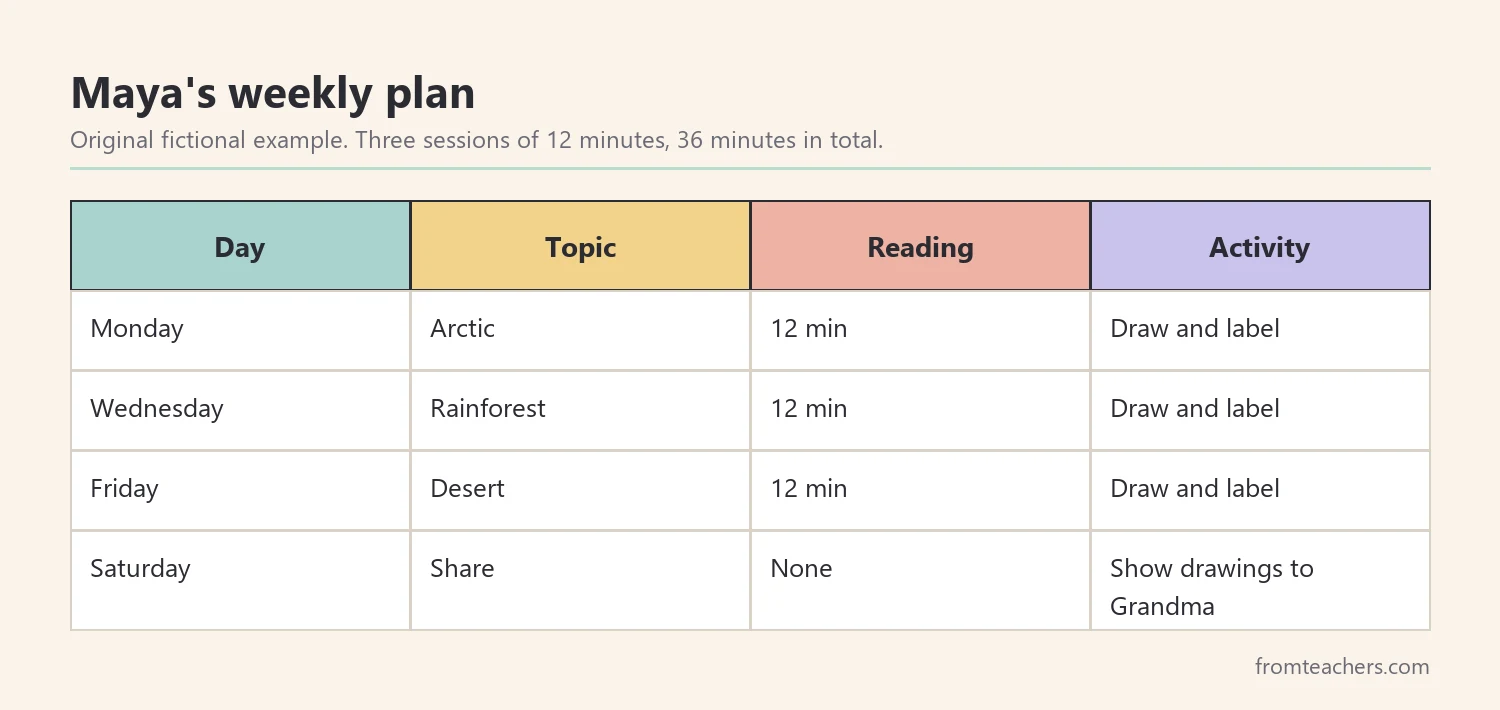
For Maya, the routine was Monday, Wednesday, and Friday after snack, about twelve minutes each, followed by a short drawing. On Saturday, she showed her three drawings to her grandmother on a video call. That is three sessions of about twelve minutes, roughly 36 minutes of reading in a week, plus a fun moment to share.
Then, review the routine every few weeks. Is the child still interested? Is the reading level right? Is it time for a new topic? Swapping guides keeps things fresh. Keeping a short list of favorite learning guides for kids also helps you find similar ones later.
Also, connect home and school when you can. Parents can ask teachers which topics are coming up, and teachers can suggest guides for home. When both settings use similar materials, children make stronger connections.
Moreover, track the routine lightly. A simple list on the fridge or in a notebook, with the date, the guide, and one thing the child learned, is enough. Over a month, that list shows how much ground the child has covered, which can be very motivating for both of you. It also helps you notice which learning guides for kids held attention best, so you can choose similar ones next.
Common mistakes and how to avoid them
- Mistake: Reading the whole guide in one sitting. Fix: read one section at a time and stop while interest is high.
- Mistake: Skipping the preview. Fix: spend two minutes on title, headings, and pictures, then set one purpose question.
- Mistake: Using guides only as quiet reading. Fix: add a quick hands-on activity after each section.
- Mistake: Turning questions into a test. Fix: use friendly “tell me” questions and check the guide together.
- Mistake: Choosing only for reading level. Fix: match interest and your goal too, and offer two choices.
Questions teachers and parents ask about learning guides for kids
What age are learning guides for kids best for?
Many guides suit elementary-aged children, but the right fit depends on the guide’s reading level and the child’s interests. Older students who are building reading skills can also enjoy them, especially with a partner.
Can learning guides replace a curriculum?
No. Guides are a supplement. They add clarity and interest, while a full curriculum covers skills in a planned sequence over time.
How often should children use them?
A few short sessions each week work well for many families and classrooms. Consistency matters more than long sessions.
How can I use guides with a child who struggles to read?
Read together, preview the pictures and headings first, and let the child read labels or short parts. Hands-on activities also let them show understanding without heavy reading.
Can teachers use learning guides for kids in centers?
Yes. A guide, a short activity card, and one “tell me” question make a simple, independent center. Rotating topics keeps the center fresh.
Related reading: Learning Styles Student Success Guide, Homeschooling vs. Public Schooling: Which Educational Path Is Right for Your Child?, and 5 Practical Teaching Tips to Boost Classroom Focus and Learning.
A companion resource for learning guides for kids:
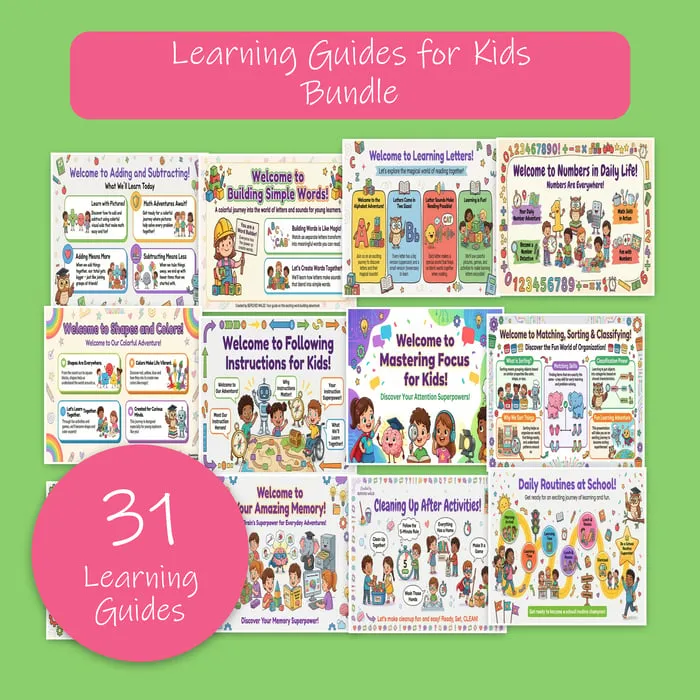
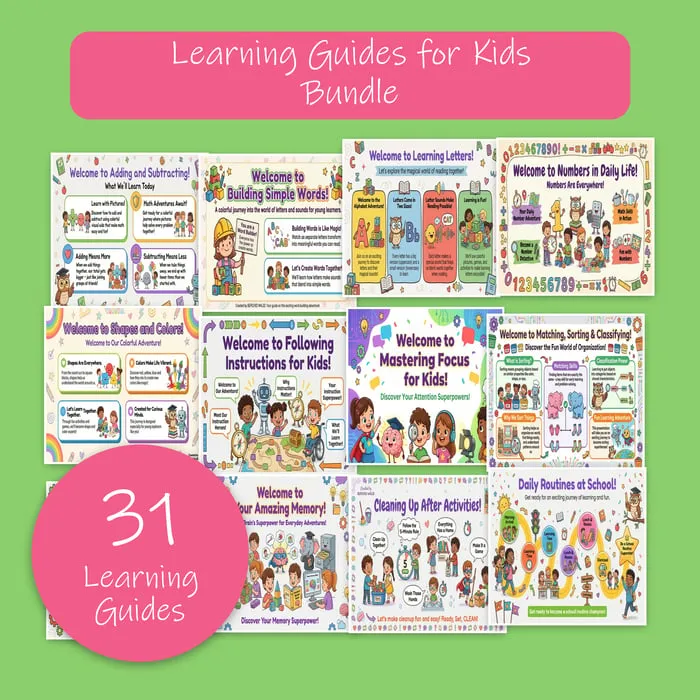
Learning Guides for Kids Bundle: a full bundle of learning guides for children, ready to use at home or in the classroom.
Sources and scope
- Reading Rockets: research-based information for parents and teachers on helping children learn to read and understand texts.
- National Association for the Education of Young Children: resources on early learning for families and educators.
- CAST: information on Universal Design for Learning and flexible ways to present content.
- U.S. Department of Education: general information and resources for families and schools.
This guide covers practical ways to choose and use learning guides at home and in class. It does not cover full curriculum planning, reading assessment, or diagnosis of learning differences, which belong to teachers and qualified specialists.
Key takeaways
- Learning guides for kids work best in short, regular sessions.
- Choose by interest, reading level, and your goal, and offer two options.
- Preview first, then read one section at a time with short talk breaks.
- Pair every section with a quick hands-on activity.
- Check understanding with friendly questions and build a simple weekly routine.
Leave a Comment