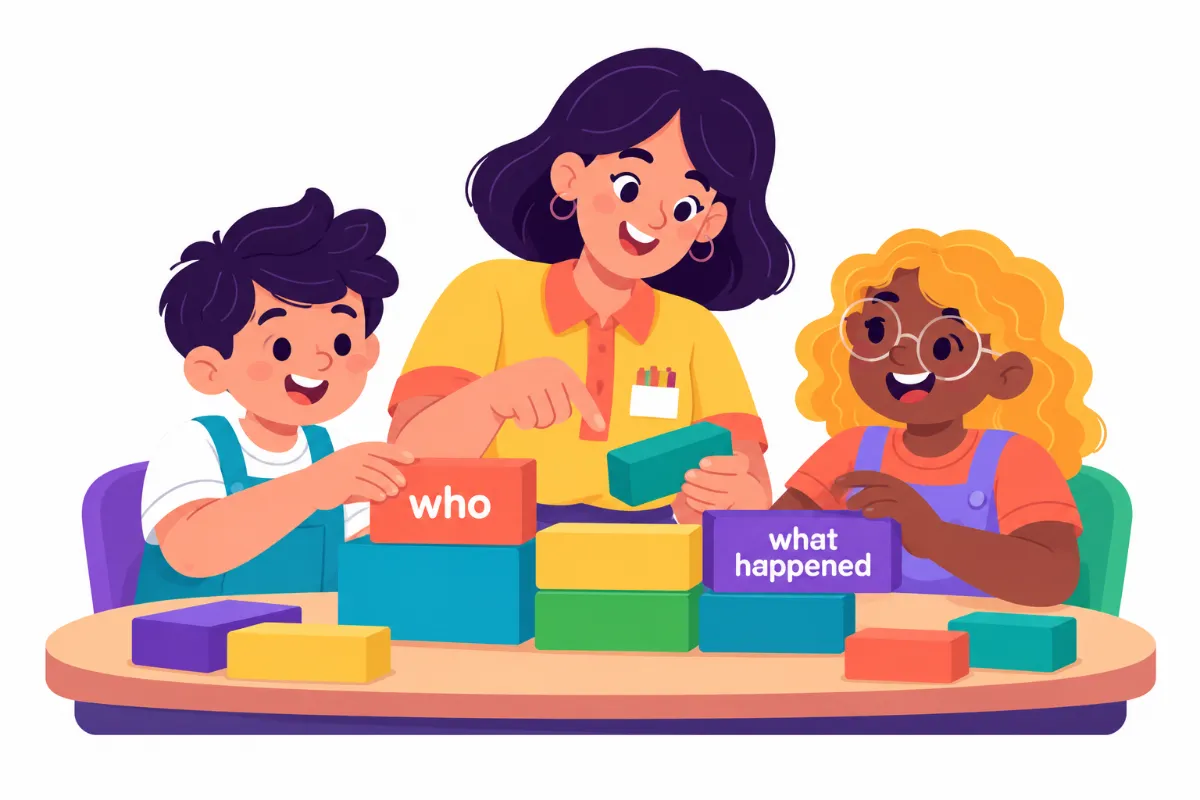

Teaching complete sentences for kids often starts with a page like this: “My dog. Went to the park. Because it was fun.” Every idea is there, but the sentences fall apart. The child knows what they want to say, yet the writing does not hold together, and red pen corrections rarely fix it.
This guide gives you a clear, step-by-step way to teach complete sentences for kids at home or in the classroom. By the end, you will be able to explain what a sentence needs, model building one, run quick practice games, fix fragments without frustration, and track progress over a few weeks.
Examples are fictional. Adapt to the student’s goals and agreed supports. This is guidance, not a diagnosis.
At a glance
- A complete sentence answers two questions: who or what, and what happened.
- Kids learn sentences faster when they can build them with their hands first.
- Short, daily games beat long grammar worksheets.
- Fix fragments by asking the missing question, not by rewriting for the child.
- Track one simple number each week, such as complete sentences out of five.
1. Explain what complete sentences for kids need
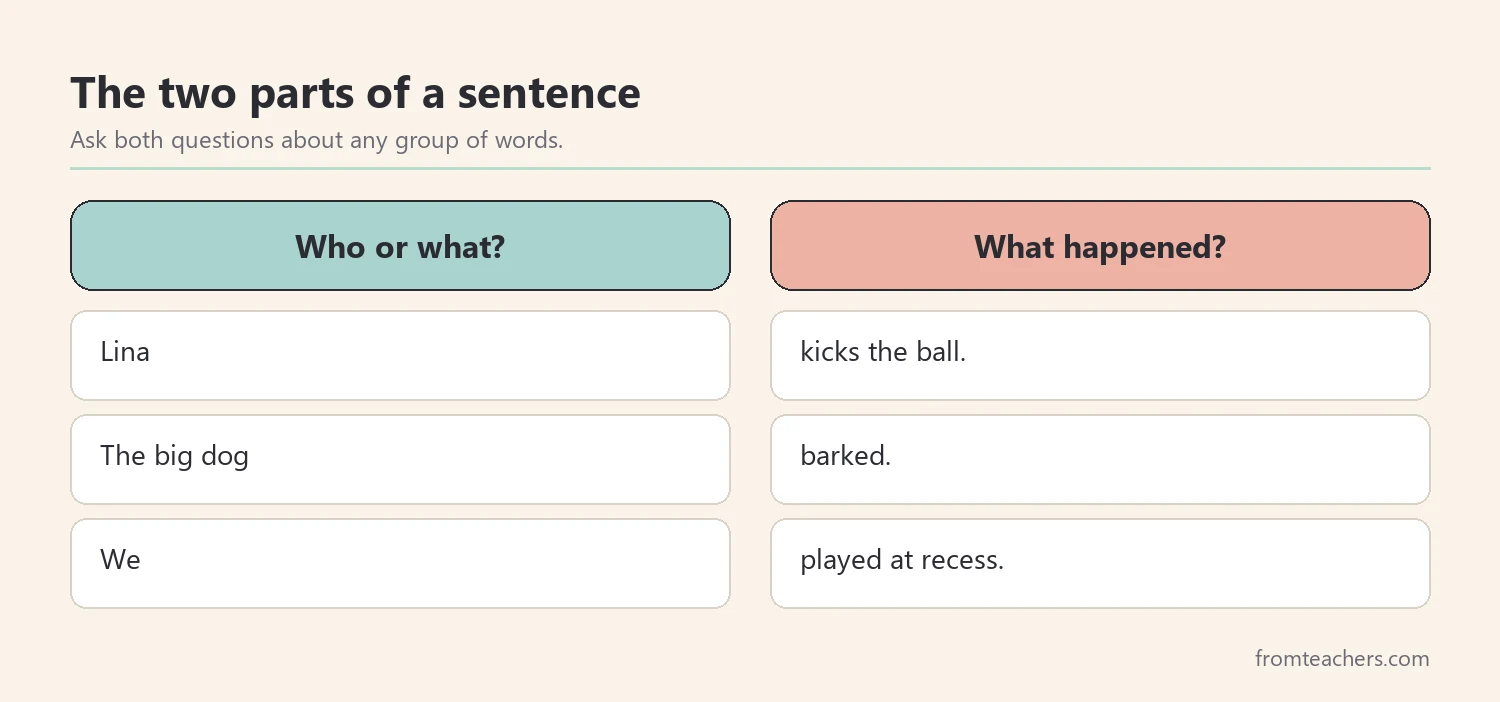
Children cannot build what they cannot picture. So, before any practice, give them one simple rule they can remember. A sentence needs a “who or what” part and a “what happened” part. In grammar terms, that is a subject and a predicate, but younger children do better with the plain questions first.
In addition, start by saying a complete sentence aloud: “The cat sleeps.” Ask, “Who is this about?” The cat. Then ask, “What happened?” Sleeps. Next, say a fragment: “The cat.” Ask the same two questions. The child will notice that “what happened” has no answer. That small moment of discovery is the heart of teaching complete sentences for kids.
In addition, add two finishing rules: a sentence starts with a capital letter and ends with a punctuation mark. Keep these separate from the main idea at first, so children do not confuse “has a period” with “is complete.”
Put this step into practice
Here is our fictional student. Lina is in grade 2. Her teacher, Mr. Owens, notices that about half of her written sentences are fragments. On the first day, he teaches only the two questions, using her favorite topic, soccer.
| Words | Who or what? | What happened? | Complete? |
|---|---|---|---|
| Lina kicks the ball. | Lina | kicks the ball | Yes |
| The goalie. | The goalie | missing | No |
| Ran down the field. | missing | ran down the field | No |
Keep this first lesson short, around ten minutes. When teaching complete sentences for kids, one clear rule practiced well is worth more than five rules introduced at once. You can return to capital letters and punctuation the next day.
As a result, Lina has a tool she can use on her own: two questions she can ask about any group of words.
2. Model complete sentences for kids with building blocks
Once the rule is clear, show it with something children can touch. A building metaphor works well because sentences, like towers, need a base before you add more. Write “who or what” words on one color of card and “what happened” words on another, or simply use two labeled piles of sticky notes.
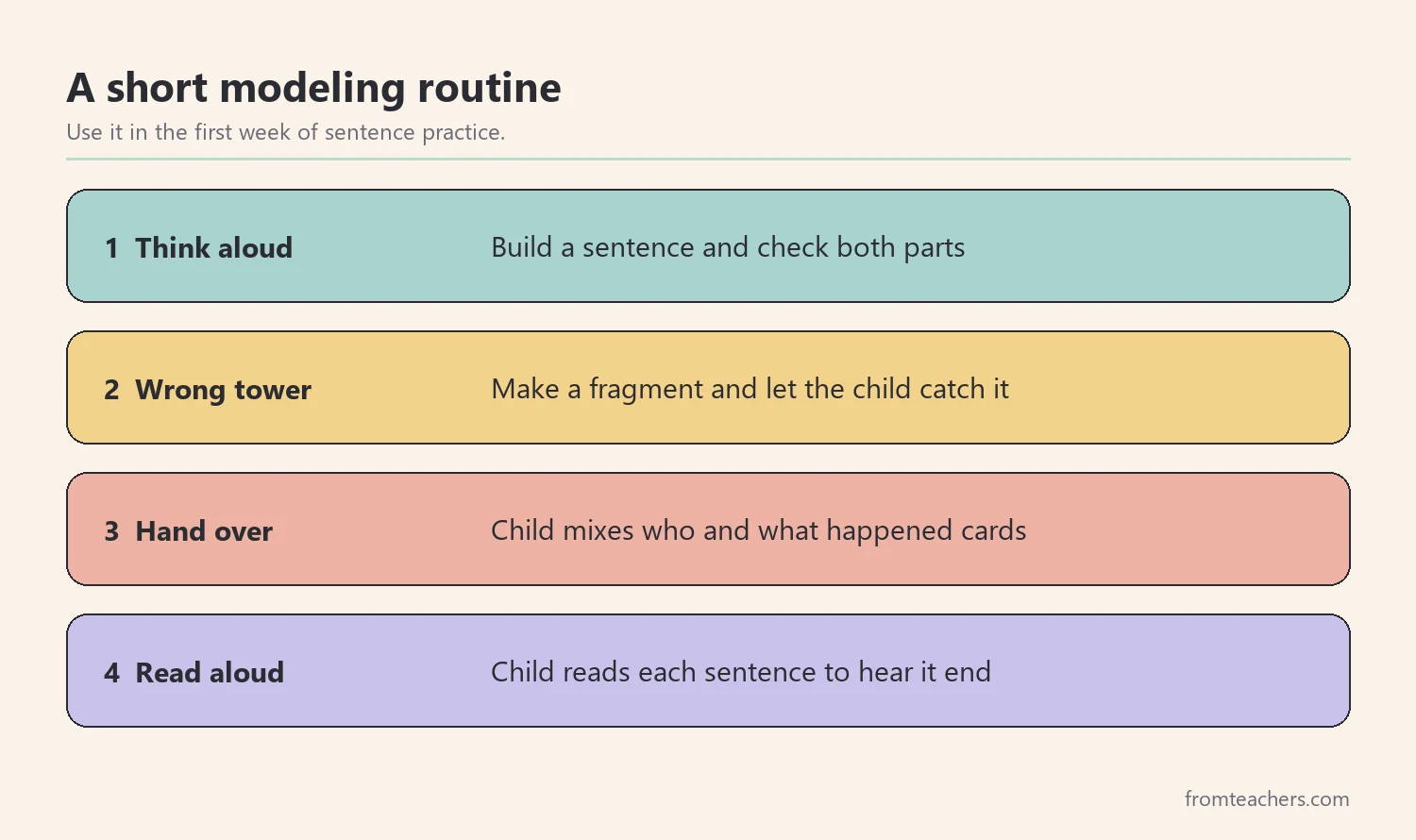
First, think aloud as you build. “I need a who. I will pick ‘My brother.’ Now I need what happened. Let me pick ‘laughs.’ My brother laughs. Does it answer both questions? Yes.” Next, build a wrong tower on purpose and let the child catch it. Children enjoy correcting the adult, and it makes the rule stick.
Then, hand over the cards. Let the child mix and match to make silly sentences, such as “The teacher swims” or “A dinosaur eats pizza.” Silly is fine. What matters is that each sentence has both parts. Finally, have the child read each sentence aloud. Hearing a sentence often helps children feel when it is finished.
For complete sentences for kids, hands-on building matters most in the first week. After that, move from cards to whiteboard, then to paper.
A quick classroom example
If you want a ready-made visual explanation, the Complete Sentences for Kids sentence building guide walks children through subjects, verbs, nouns, and adjectives using a block-stacking idea they can picture and remember.
For children who find writing tiring, building with cards also removes the load of handwriting. They can focus fully on the structure of the sentence, and the writing comes later once the idea is secure.
Back with Lina, Mr. Owens prepares eight “who” cards and eight “what happened” cards about soccer and school. In ten minutes, Lina builds six sentences and reads each one aloud. She catches a fragment Mr. Owens made on purpose, “The coach,” and adds “blows the whistle.”
3. Practice complete sentences for kids with short daily games
Practice works best in small, frequent doses. Five to ten minutes a day is usually enough, and games keep energy high. Rotate between a few simple formats so the routine feels fresh while the skill stays the same.
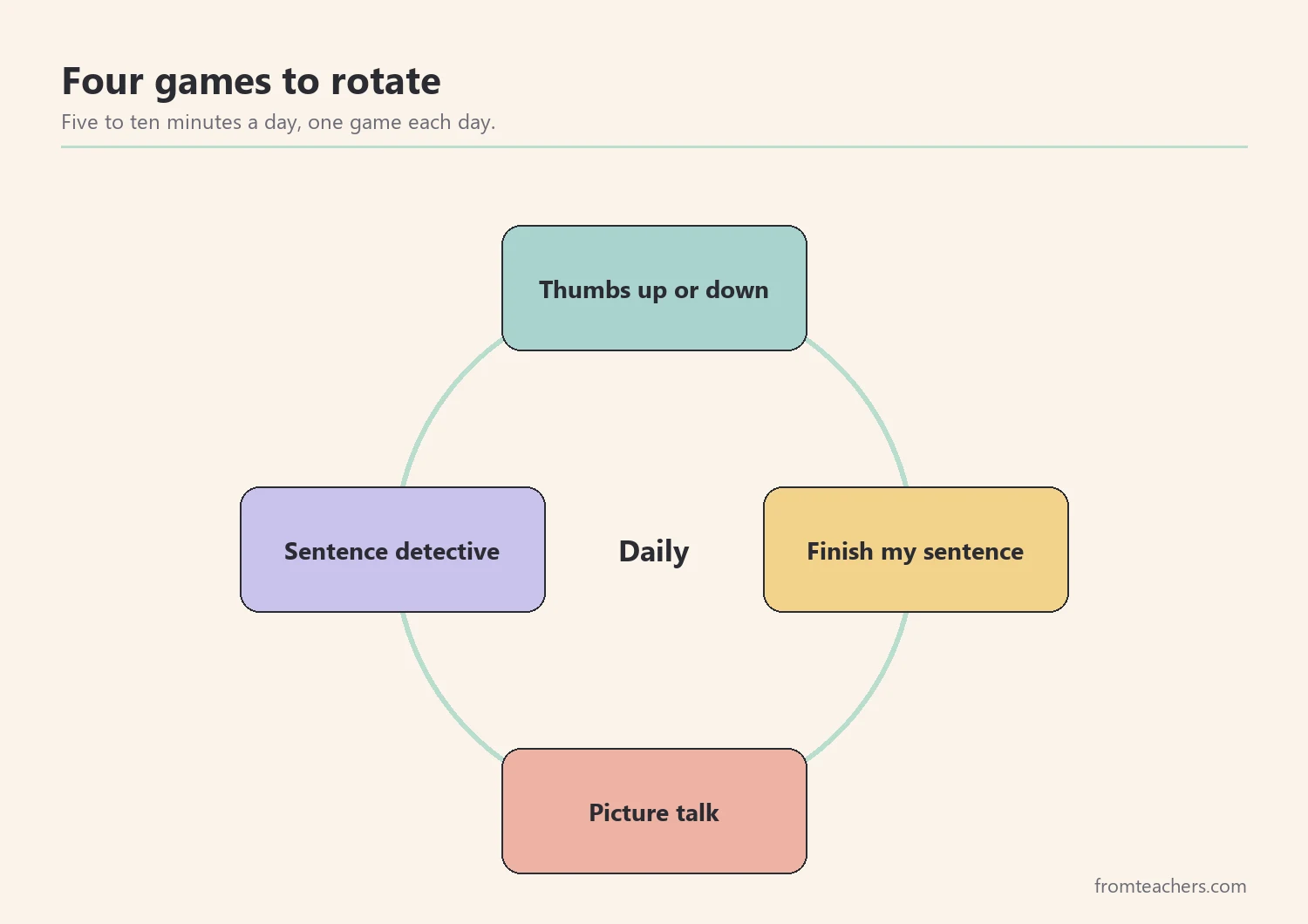
- Thumbs up, thumbs down: say a group of words; the child shows thumbs up for a complete sentence and thumbs down for a fragment.
- Finish my sentence: give a “who” and ask the child to add “what happened,” or the other way around.
- Picture talk: show a photo and ask for one complete sentence about it.
- Sentence detective: hide two fragments in a short paragraph and ask the child to find them.
In each game, keep the language consistent. Always use the same two questions. Over time, the child will start asking them silently. Moreover, praise the thinking, not just the answer: “You checked for what happened. That is exactly what writers do.”
For complete sentences for kids at home, parents can play these games at dinner or in the car. No paper is needed for the first three.
Lina’s week looks like this. Mr. Owens chooses one game per day and records how many of ten items she gets right.
| Day | Game | Correct (of 10) |
|---|---|---|
| Monday | Thumbs up, thumbs down | 6 |
| Tuesday | Finish my sentence | 7 |
| Wednesday | Picture talk | 7 |
| Thursday | Sentence detective | 8 |
One more tip: say each item clearly and at a natural pace. Complete sentences for kids are easier to judge by ear when the adult reads with normal expression, because a fragment often sounds unfinished.
Make it stick
Notice that the scores move gradually. That is normal and healthy. Steady small gains matter more than one perfect day.
4. Fix fragments without frustration
Sooner or later, fragments will appear in real writing. How you respond matters. If you rewrite the sentence for the child, they learn that someone else fixes their work. If you ask the missing question, they learn to fix it themselves.
First, point to the fragment and read it aloud in a neutral voice. Second, ask the two questions. Third, let the child add the missing part. Then, have them read the new sentence aloud. Keep the tone light, because mistakes are part of learning to write.
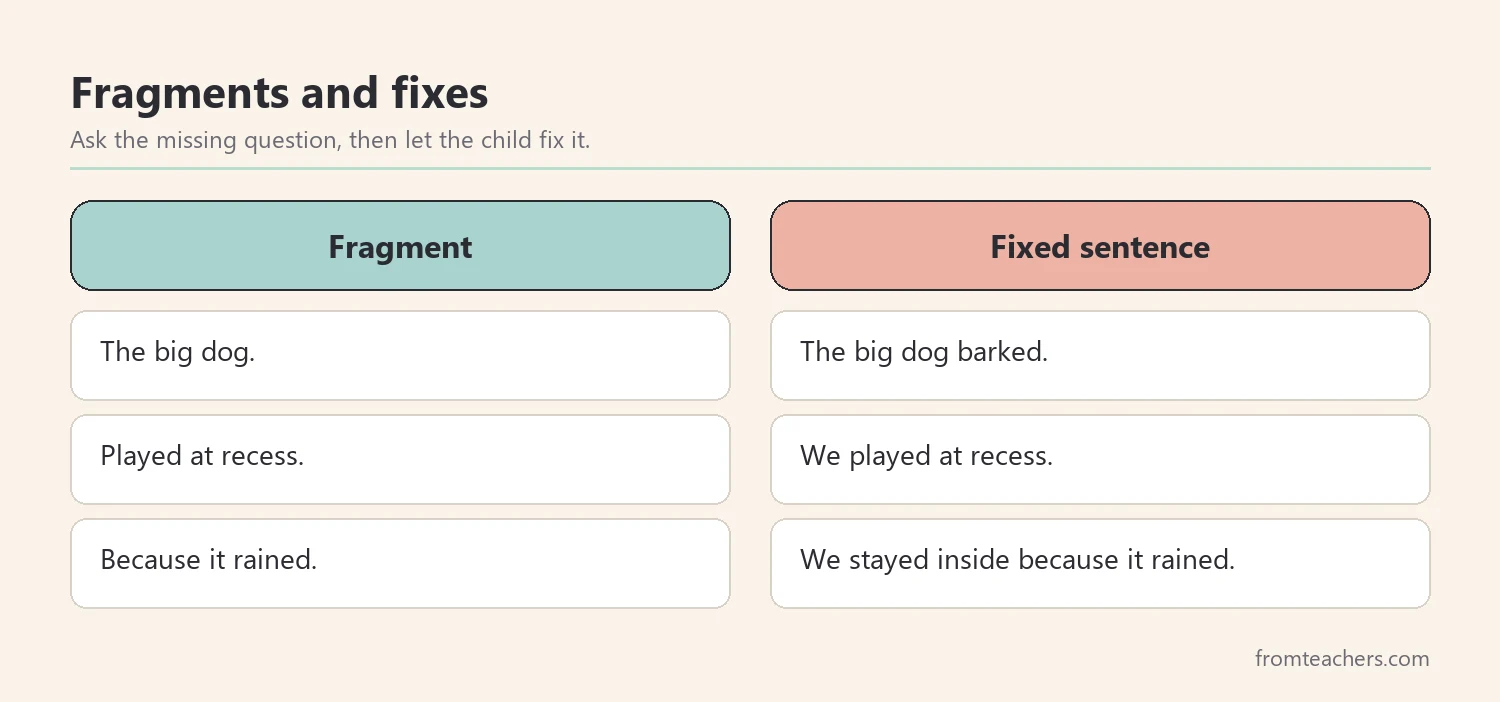
There are three common fragment types in young writers’ work, and each has a simple fix.
| Fragment | What is missing | Fixed sentence |
|---|---|---|
| The big dog. | What happened | The big dog barked. |
| Played at recess. | Who | We played at recess. |
| Because it rained. | The main idea | We stayed inside because it rained. |
The “because” fragment is the trickiest. Explain that “because” starts a reason, and a reason needs something to explain. A handy question is, “What happened because it rained?”
Also, avoid marking every fragment on a long piece. Choose one or two to fix together, and leave the rest for another day. Children improve faster when they do not feel that the whole page is wrong.
In Lina’s journal, Mr. Owens finds “After the game. We got ice cream.” He reads it aloud and asks, “After the game, what happened?” Lina joins the two parts: “After the game, we got ice cream.” She smiles because she fixed it herself.
5. Grow and track complete sentences for kids
Once a child writes complete sentences most of the time, help them make sentences richer. Add a “where” or “when,” an adjective, or a reason. “The dog barked” becomes “The big dog barked at the mail carrier this morning.” Each detail still sits on top of the same base: who and what happened.
At the same time, keep tracking simple. Once a week, ask the child to write five sentences about a topic they like. Count how many are complete. Write the number in a small log with a short note. After four weeks, you will see a clear picture, and the child can see it too.
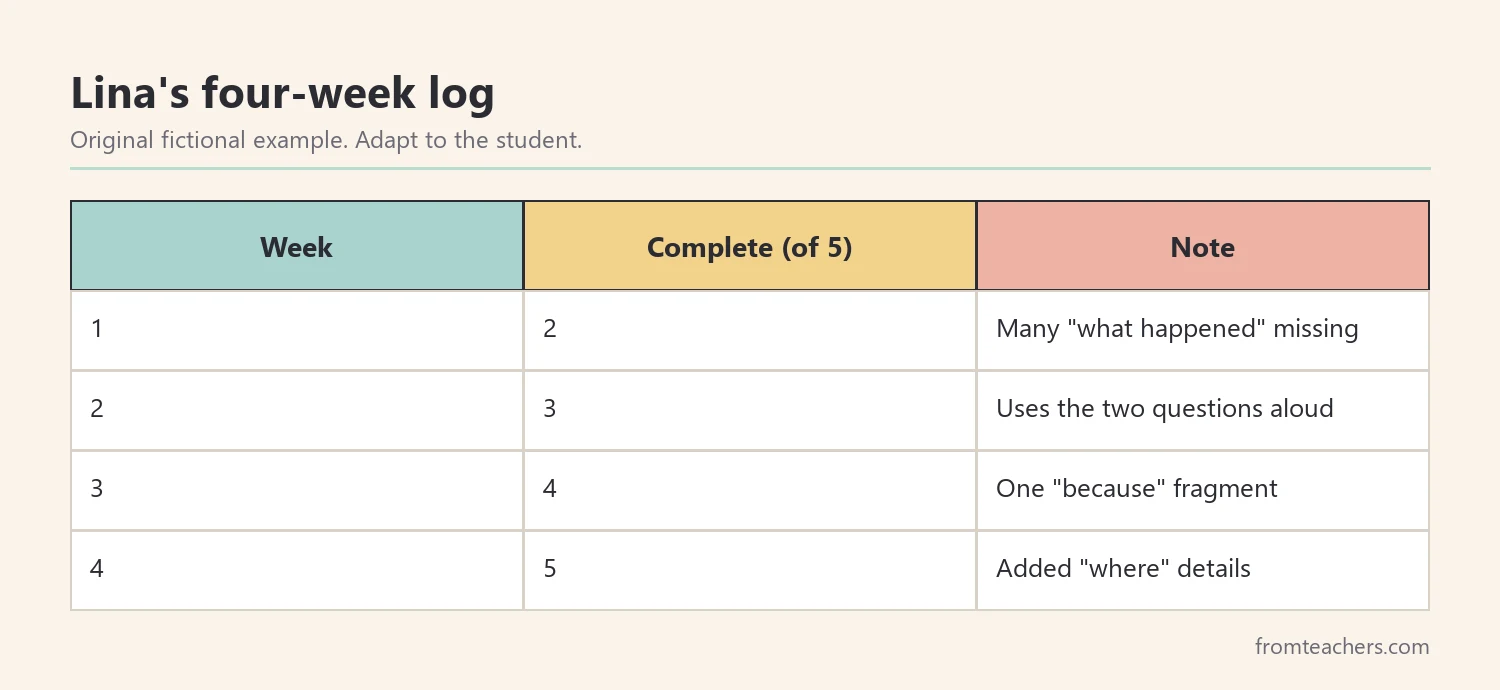
Here is Lina’s four-week log.
| Week | Complete (of 5) | Note |
|---|---|---|
| 1 | 2 | Many “what happened” missing |
| 2 | 3 | Uses the two questions aloud |
| 3 | 4 | One “because” fragment |
| 4 | 5 | Added “where” details |
Share progress with the child in plain words: “Four weeks ago, you wrote two complete sentences out of five. Today you wrote five.” That kind of evidence builds writing confidence far better than general praise.
What this looks like day to day
When a child reaches five out of five for two weeks in a row, raise the challenge a little. Ask for sentences with one added detail, or for two sentences that connect with “and” or “but.” The same two questions still apply to each part.
Finally, keep connecting complete sentences for kids to real purposes: a note to a friend, a caption for a drawing, a list of weekend plans. When sentences have a reader, children care more about making them clear.
For classrooms, the same routine works with small groups. Each child keeps their own small log, and the teacher checks it during a quick conference once a week. This keeps complete sentences for kids visible without adding a big grading load.
Common mistakes and how to avoid them
- Starting with grammar terms. Fix: begin with “who or what” and “what happened,” then add subject and predicate later.
- Equating a period with a complete sentence. Fix: teach that punctuation finishes a sentence but does not make it complete.
- Rewriting the child’s fragments. Fix: ask the missing question and let the child add the part.
- Long worksheets. Fix: use five to ten minutes of games daily.
- Pushing long sentences too early. Fix: secure the base first, then add one detail at a time.
Questions teachers and parents ask about complete sentences for kids
At what age do children learn complete sentences?
Many children begin writing simple sentences in kindergarten and first grade, and keep refining them for years. Every child moves at a different pace. Focus on steady progress from where the child is now.
How do I explain subject and predicate simply?
Use two questions. The subject answers “who or what is this about?” and the predicate answers “what happened?” Once the questions are easy, attach the grammar names.
How can parents help with complete sentences for kids at home?
Play short oral games during everyday moments, like asking for one complete sentence about dinner or a car ride. Read together and point out sentences you enjoy. Keep it light and brief.
How long does it take to learn complete sentences for kids?
It varies widely from child to child. Many children show clear progress within a few weeks of short daily practice, while others need more time and support. Keep tracking and celebrate small steps.
What if my child’s sentences run on and on?
Run-on sentences are the opposite problem. Read the sentence aloud together and listen for places where one idea ends. Then ask, “Who did what here?” to find where to add a period.
Related reading: Learning Styles Student Success Guide, 5 Practical Teaching Tips to Boost Classroom Focus and Learning, and Dyslexia Solutions in the Classroom.
A companion resource for complete sentences for kids:
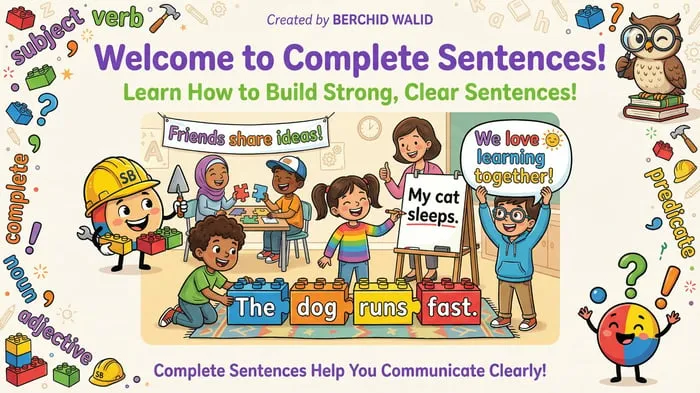
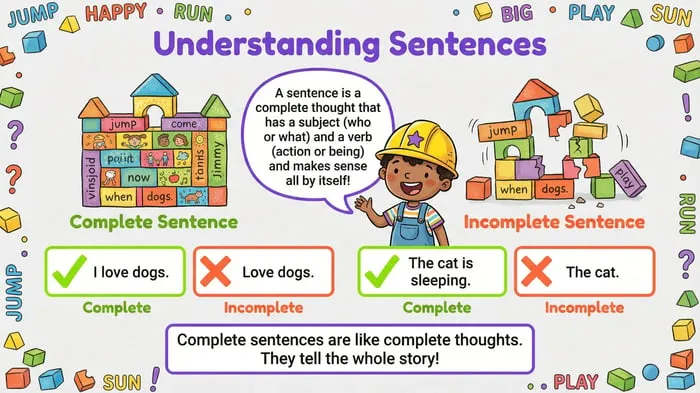
Complete Sentences for Kids: Sentence Building: a colorful guide that uses a building metaphor to explain why complete sentences matter, the parts of a sentence, step-by-step sentence building, adding details, and fixing incomplete sentences with before-and-after examples.
Sources and scope
- Reading Rockets: a national literacy initiative with articles for teachers and families on reading and writing.
- National Council of Teachers of English (NCTE): a professional organization for English language arts educators.
- What Works Clearinghouse: reviews of education research, including practice guides on writing instruction.
- International Literacy Association: a global organization supporting literacy educators.
This guide covers everyday teaching of basic sentence structure for young writers. It does not cover assessment of language disorders, which belongs to qualified professionals such as speech-language pathologists.
Key takeaways
- Teach complete sentences for kids with two questions: who or what, and what happened.
- Model with hands-on building before moving to paper.
- Keep practice short, daily, and game-based.
- Fix fragments by asking the missing question.
- Track a weekly count and add details once the base is secure.


Leave a Comment