

Coping with uncertainty is a skill, and like any skill, it can be practiced. Picture a high school senior who has just learned that her part-time job is changing shifts, her college plan is still unclear, and her family might move next year. She lies awake making lists of everything that could go wrong. Nothing is wrong yet, but her mind is already living in the worst version of the future.
This guide gives teens, adults, and the counselors and coaches who support them a five-step process: name the feeling, reframe the fear, sort what you can and cannot control, prepare for the new situation, and build steady resilience over time. By the end, you will have a small set of tools you can return to whenever change shows up.
Examples are fictional. Adapt to the person’s goals and situation. This is guidance, not a diagnosis or a substitute for professional mental health care.
At a glance
- Naming a feeling clearly is often the first step toward managing it.
- Anxious thoughts can be questioned and rewritten, not just endured.
- Put your energy into what you can control and loosen your grip on the rest.
- Prepare for a new setting with a short, practical checklist.
- Track small habits that build resilience and review them weekly.
1. Name the feeling when coping with uncertainty
First, slow down long enough to notice what you feel. Uncertainty often shows up as a mix: worry, frustration, sadness, and sometimes excitement, all at once. When everything blends together, it feels bigger than it is. Coping with uncertainty starts with pulling those strands apart.
Next, use specific words. “I feel bad” is hard to work with. “I feel nervous about the new schedule and sad about leaving my coworkers” gives you two clear things to address. Many people find it helps to rate each feeling from 1 to 5, so they can see changes over the week.
Then, use a simple Trigger, Action, Reason pattern. Write what set off the feeling, one small action you can take, and why that action helps. This turns a vague feeling into a concrete next step.
For example, Jordan is a fictional 18-year-old finishing high school and working part time at a grocery store. When the manager announced new shifts, Jordan felt a wave of panic. Her counselor, Ms. Hale, suggested she fill in a short Trigger, Action, Reason log each evening for a week.
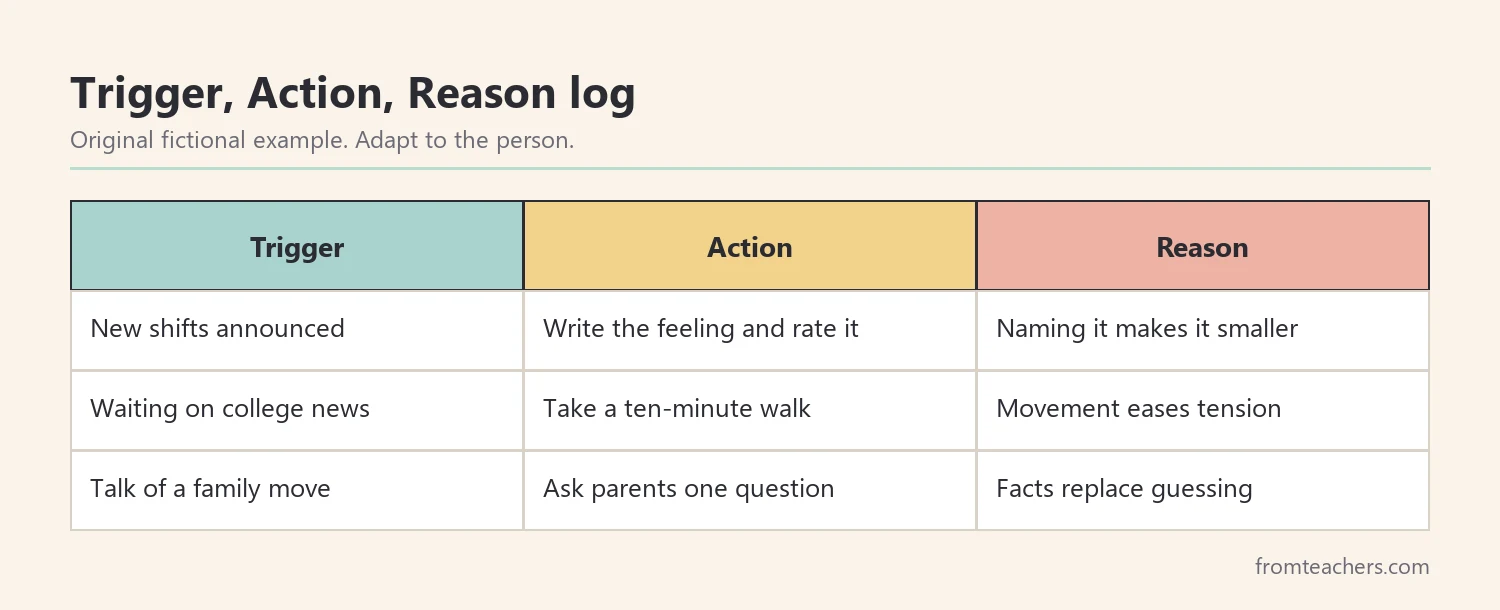
Meanwhile, keep the log short. Two or three lines per day is enough. Coping with uncertainty does not require a long journal; it requires a regular habit of noticing and choosing one response.
Finally, accept that the feeling makes sense. Change is hard for most people. Noticing and naming the feeling does not make it disappear, but it gives you room to choose what to do next instead of simply reacting.
2. Reframe anxious thoughts about change
Once the feeling has a name, the next part of coping with uncertainty is looking at the thoughts that feed it.
Anxious thoughts tend to jump to the worst outcome and treat it as a fact. Reframing means slowing that thought down and asking whether there is a more balanced way to see it. It is not about pretending everything is fine.
First, write down the anxious thought exactly as it sounds in your head. Next, ask three questions: What is the evidence for this? What else could happen? What would I tell a friend who had this thought? Then, write a more balanced version.
Also, notice that anxiety and excitement share many of the same body signals: a fast heartbeat, energy, alertness. Some people find it helpful to say, “I feel energized about this change,” instead of “I am scared.” The situation is the same, but the label points attention toward possibility.
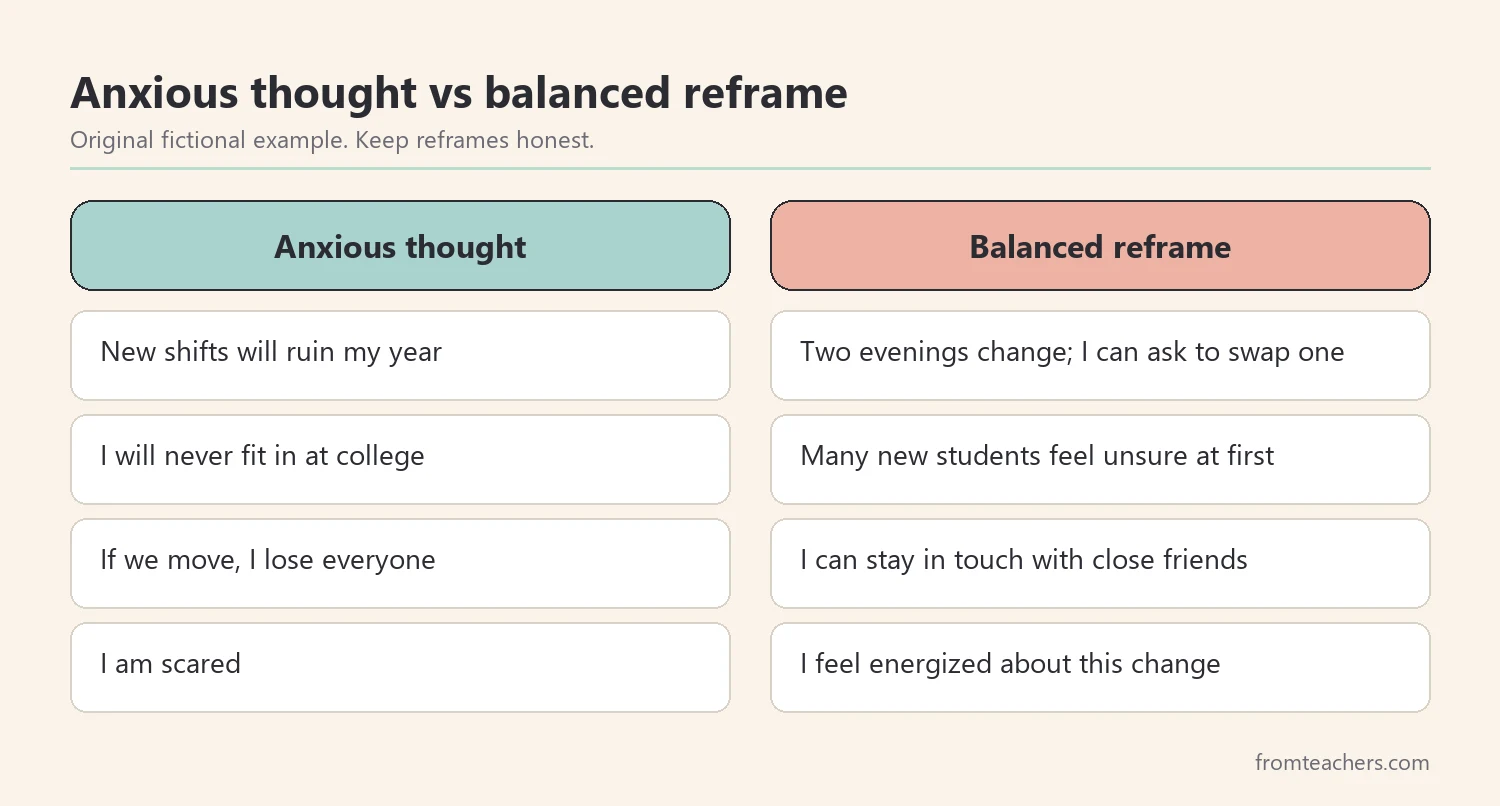
For example, Jordan’s first thought was, “The new shifts will ruin my whole senior year.” After working through the questions with Ms. Hale, she wrote, “The new shifts change two evenings a week. I can ask about swapping one of them.” The second thought was still honest, but it was smaller and more useful.
Similarly, a counselor or coach can model this process aloud. Hearing an adult say, “My first thought was the worst case, so let me check it,” shows that coping with uncertainty is something people practice, not something they are born knowing.
If you want structured pages for this kind of practice, the managing change and uncertainty toolkit for teens and adults includes an anxiety-to-excitement reframing log and an emotional response monitor built on the same Trigger, Action, Reason format.
3. Focus on what you control while coping with uncertainty
A lot of stress comes from trying to control things that are simply out of reach. When coping with uncertainty, it helps to sort the situation into two lists: what you can influence, and what you cannot.
First, write every worry about the change on a page. Next, draw two columns. Put each worry under “I can control or influence” or “I cannot control.” Be honest. Other people’s decisions, the economy, and the weather go in the second column. Your effort, your questions, your preparation, and your sleep usually go in the first.
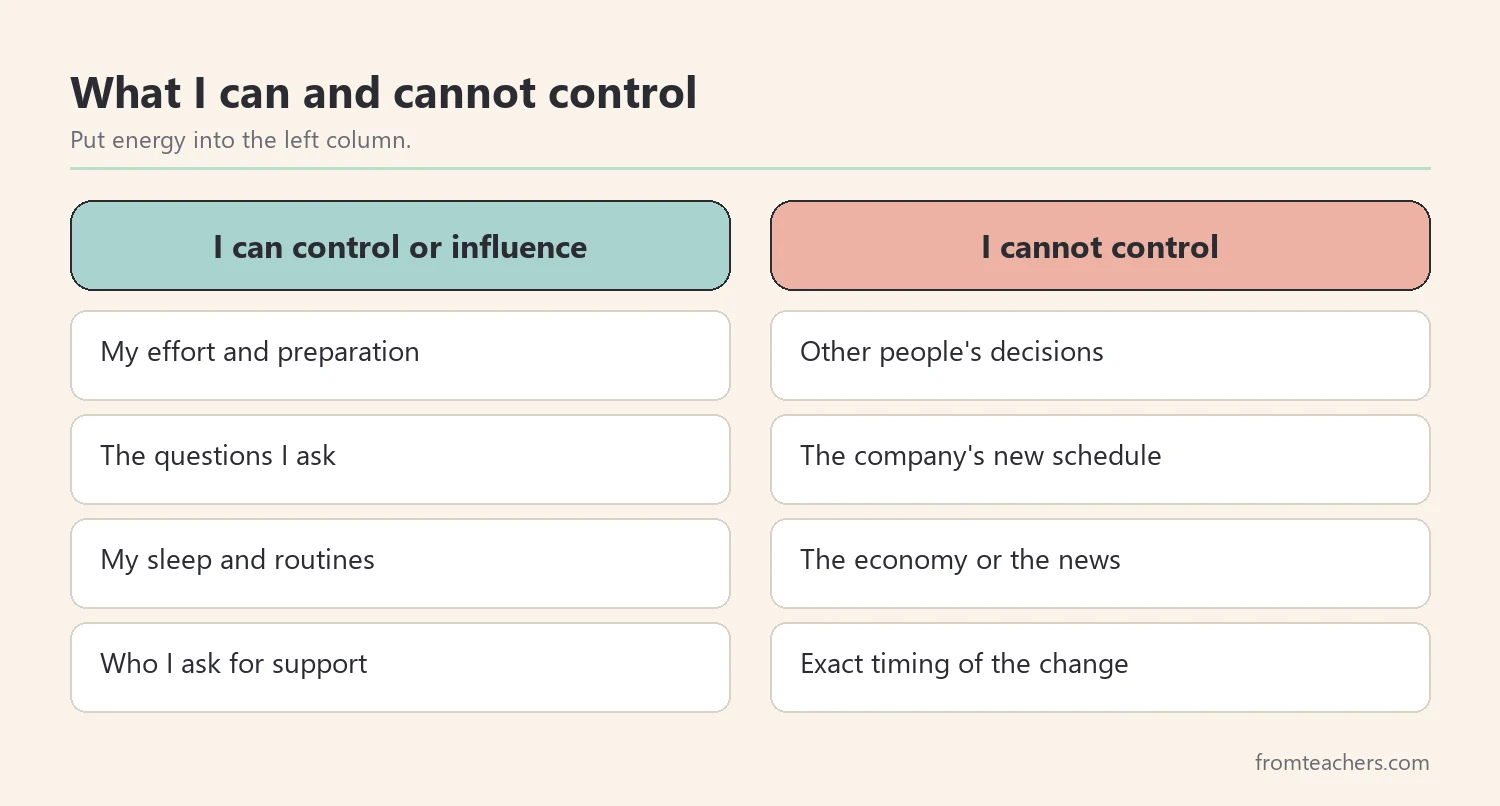
Notice that some worries sit in between. You may not control a decision, but you can influence it by asking a question, sharing information, or making a request. Put those in the first column with a note such as “influence only,” so you remember the outcome is not fully yours.
Then, pick one or two actions from the first column and schedule them. For the second column, choose a short phrase to use when those worries return, such as “That is not mine to decide.” This is not giving up. Instead, it frees energy for the things that actually respond to effort.
For example, Jordan listed four worries. Two landed in the “cannot control” column: the store’s new schedule and her family’s possible move. The other two landed in the “can control” column: finishing her college applications and keeping a steady bedtime. Even for the shift change, she found one small action, asking her manager about a swap, and she did it the next morning.
| Worry | Column | Next step |
|---|---|---|
| New work shifts | Cannot control | Accept, then ask about one swap |
| Family might move | Cannot control | Talk with parents once a week |
| College applications | Can control | Finish one section per day |
| Sleep schedule | Can control | Same bedtime on school nights |
4. Prepare for the new environment
Uncertainty often shrinks once a situation becomes familiar. So, the next step is to make the new environment a little less new before you arrive. Preparation turns unknowns into knowns.
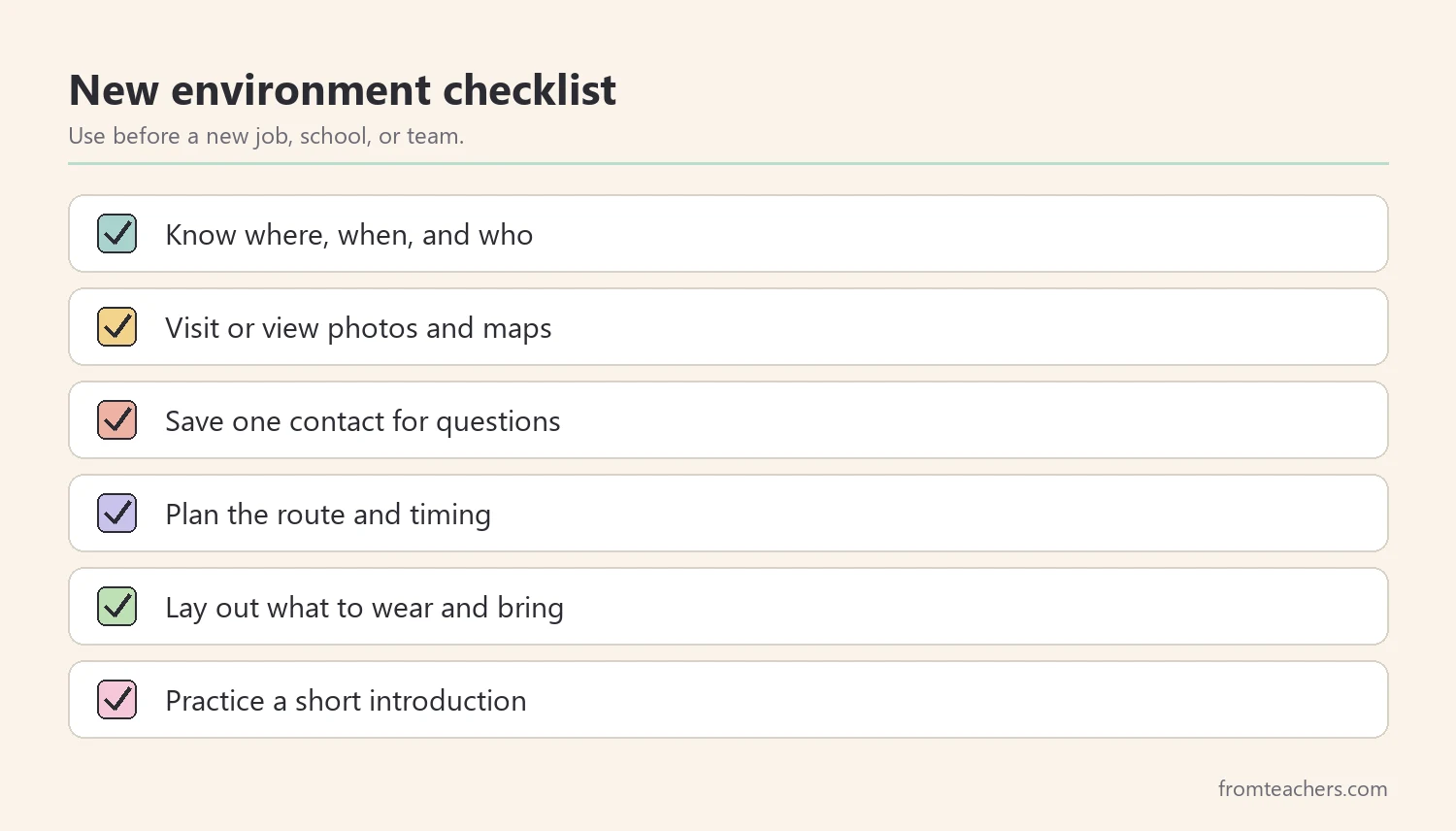
First, gather the basic facts: where, when, who, and what is expected. Next, visit in person or look at photos, maps, or schedules. Then, identify one person you can ask questions, such as a supervisor, mentor, or counselor.
In the workplace, the same approach helps adults facing a reorganization or a new role. Ask for the new team chart, a short list of priorities, and a check-in date with the new manager. Coping with uncertainty at work often comes down to replacing rumors with clear information.
Also, plan the first day in detail. Lay out what you will wear, how you will get there, and what you will bring. Practice a short introduction. Small rehearsals lower the load on your mind when the day comes.
For example, before her first shift on the new schedule, Jordan checked the posted roster, saved her manager’s number, and planned her bus route. She also asked a coworker which tasks were usually done on the new evening. Coping with uncertainty felt more manageable once the first shift had a clear shape.
5. Build resilience and check your readiness
Resilience is not a fixed trait. It grows through small, repeated habits that support your body and mind. Coping with uncertainty becomes easier when those habits are already in place before the next change arrives.
First, choose three or four habits to track. Common ones include regular sleep, physical activity, time with supportive people, and a few minutes of quiet reflection. Next, rate each habit once a week from 1 to 5. The aim is to notice trends, not to be perfect.
Then, check your readiness for the next change. Ask: How much energy do I have right now? Who can I lean on? What has helped before? A short self-assessment like this helps you decide whether to move forward now or build a little more support first.
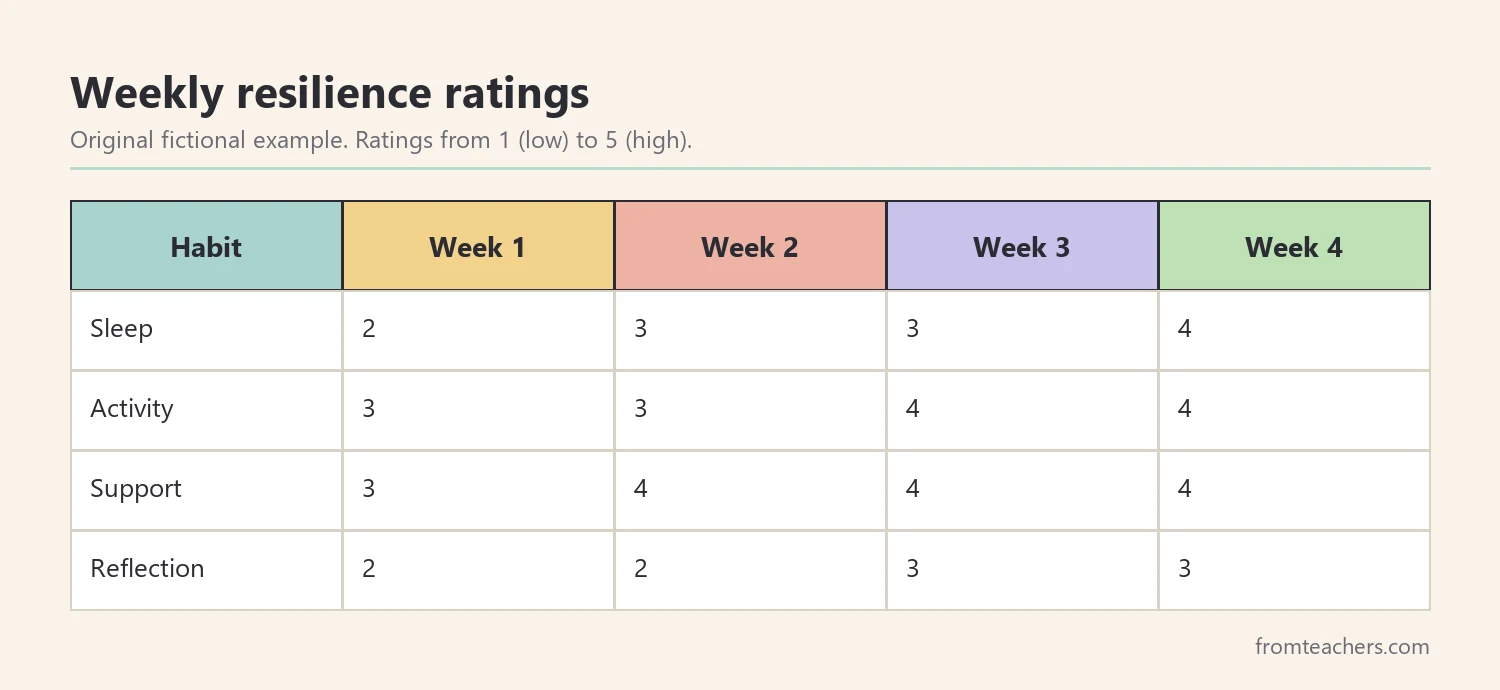
For example, Jordan’s sleep rating started at 2 out of 5 during the week the new shifts were announced. After keeping the same bedtime on school nights, it rose to 4 by week 4. She shared the tracker with Ms. Hale, and they used it to plan for her next big change, the move to college.
Above all, celebrate evidence that you have handled change before. Make a short list of past transitions you got through, such as a new school, a move, or a first job. Coping with uncertainty is easier when you can point to proof that you have done it already.
Finally, know when to ask for more help. If worry stays intense for a long time, affects sleep and eating, or makes daily life hard, talk with a doctor, counselor, or other qualified professional.
Common mistakes and how to avoid them
- Waiting for certainty before acting. Fix: take one small step from the “can control” column today.
- Trying to stop all worry. Fix: name the feeling and give it a short, planned time instead of fighting it all day.
- Using positive thinking to cover real problems. Fix: reframe honestly; a balanced thought includes the hard parts.
- Preparing for everything at once. Fix: use a short checklist and focus on the first day or week.
- Coping with uncertainty alone. Fix: name one person you can talk to and check in with them during the change.
- Dropping healthy habits during change. Fix: track three or four habits weekly so they do not quietly disappear.
Questions teachers and parents ask about coping with uncertainty
Is coping with uncertainty different for teens and adults?
The core tools are similar. Teens may face school transitions, first jobs, and family changes, while adults often face job changes and reorganizations. Adjust the examples and language to fit the person’s life.
How can a school counselor use these tools?
Counselors can introduce one tool per session, such as the controllables list, and ask the student to try it during the week. Reviewing the student’s own log together keeps the work practical and personal.
Does reframing mean ignoring real risks?
No. A good reframe is honest. It keeps the real risks in view while removing the exaggeration that anxiety adds. The goal is a thought that is accurate and useful.
How long does it take to feel better?
It varies widely from person to person. Many people notice small changes after practicing a tool for a week or two. If distress stays high, it is wise to talk with a qualified professional.
Can parents help with coping with uncertainty at home?
Yes. Parents can model naming feelings, sort worries together with their teen, and keep household routines steady during change. Listening without rushing to fix things is often one of the most helpful supports.
Related reading: Building Stronger School Counseling Programs: A Framework for Student Success, Navigating the Path to Adulthood: Building Essential Life Skills, and Building Workplace Readiness: Essential Skills for Career Success.
A companion resource for coping with uncertainty:
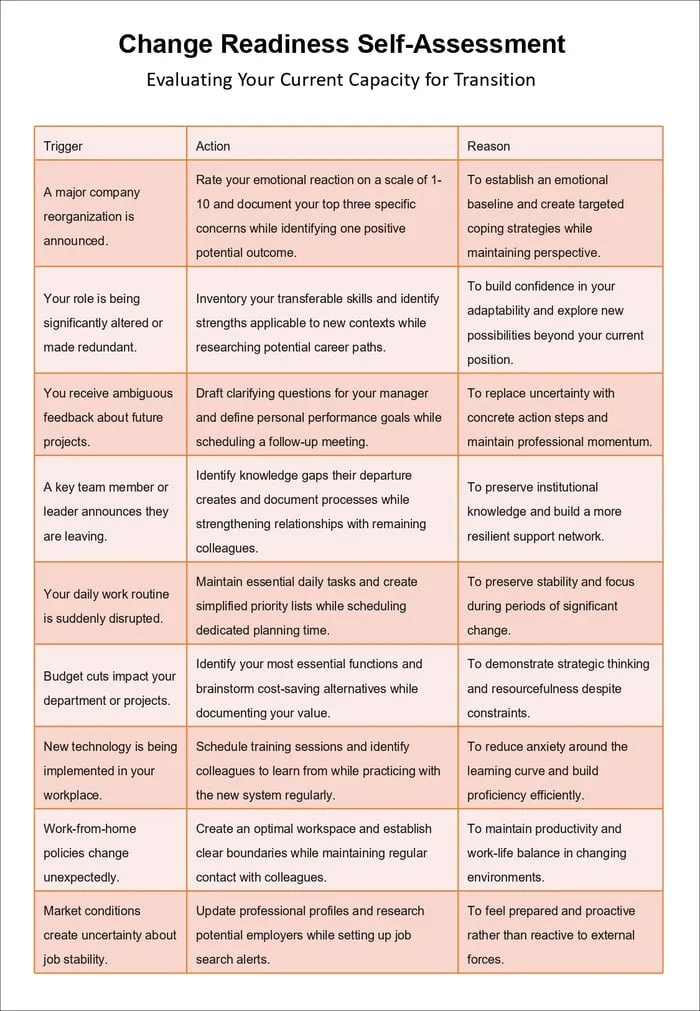
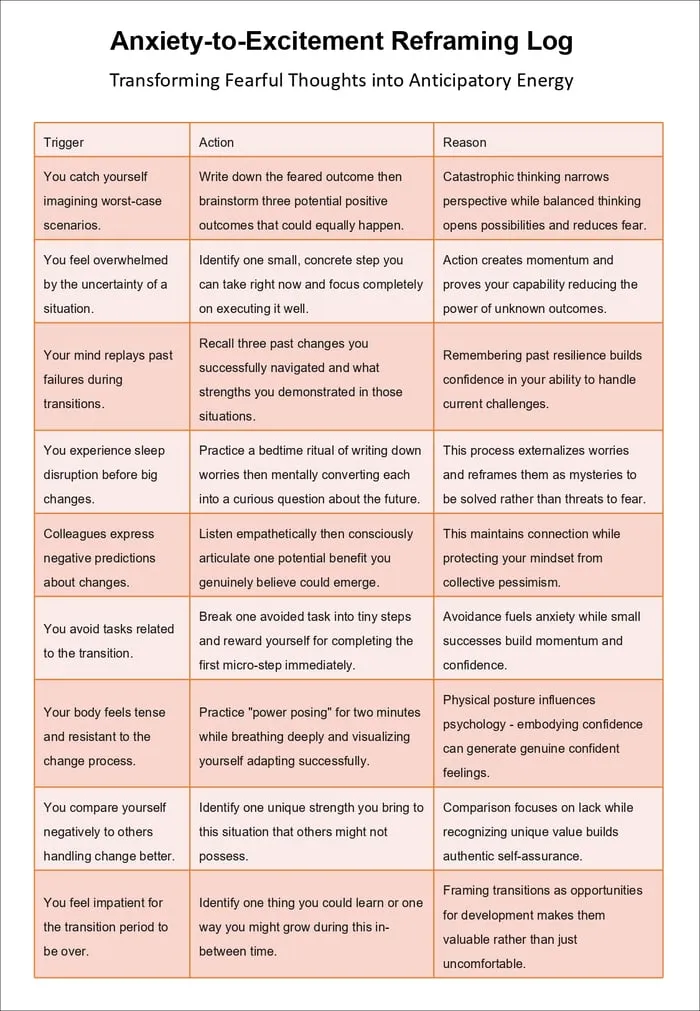
Managing Change and Uncertainty: A Toolkit for Teens and Adults: a 12-page printable toolkit with an emotional response monitor, an anxiety-to-excitement reframing log, a controllables inventory, a new environment checklist, a resilience tracker, and a change readiness self-assessment, all in a Trigger, Action, Reason format.
Sources and scope
- American Psychological Association (APA): public information on stress, anxiety, and resilience.
- National Institute of Mental Health (NIMH): general information on anxiety and when to seek help.
- American School Counselor Association (ASCA): resources for school counselors supporting students through transitions.
- CASEL: a framework for social and emotional learning, including self-awareness and self-management.
This guide offers practical self-help tools for everyday change and uncertainty in teens and adults. It does not diagnose or treat anxiety or any mental health condition, and it is not a substitute for care from a qualified professional.
Key takeaways
- Coping with uncertainty starts with naming the feeling in specific words.
- Question anxious thoughts and write a balanced, honest reframe.
- Spend energy on what you can control and let go of the rest.
- Prepare for new settings with a short, practical checklist.
- Track a few resilience habits weekly and ask for help when needed.










Leave a Comment