

An FBA summary report is the moment when weeks of behavior data finally turn into a plan. Picture a team meeting where the teacher brings ABC notes, the counselor brings an interview, the behavior specialist brings a tracker, and everyone stares at a pile of paper wondering what it all means. Without a clear summary, the team guesses, and the behavior plan that follows rests on that guess.
This guide shows you how to write the report in six steps: gather your sources, summarize each one in the same structure, find patterns, write a hypothesis, rate your confidence, and share the report so it leads to a behavior plan. By the end, you will be able to turn mixed data into one clear statement the team can act on.
Examples are fictional. Adapt to the student’s goals and agreed supports. This is guidance, not a diagnosis.
At a glance
- Collect every data source before you start writing.
- Summarize each source in the same structure so you can compare them side by side.
- Look for patterns that repeat across sources, not just one strong example.
- Write one hypothesis that names the setting event, antecedent, behavior, consequence, and function.
- Rate how confident the team is before moving to a behavior intervention plan.
1. Gather the sources for your FBA summary report
First, put every piece of information in one place. An FBA summary report is only as strong as the data behind it. A functional behavior assessment usually draws on several sources, and each one shows the behavior from a different angle.
Common sources include an ABC tracker summary, an interview with the teacher or staff, an ABC recording form filled in during real incidents, and sometimes another assessment such as a student interview or a rating scale. Indirect sources, like interviews, tell you what adults believe. Direct sources, like ABC recordings, tell you what was actually observed.
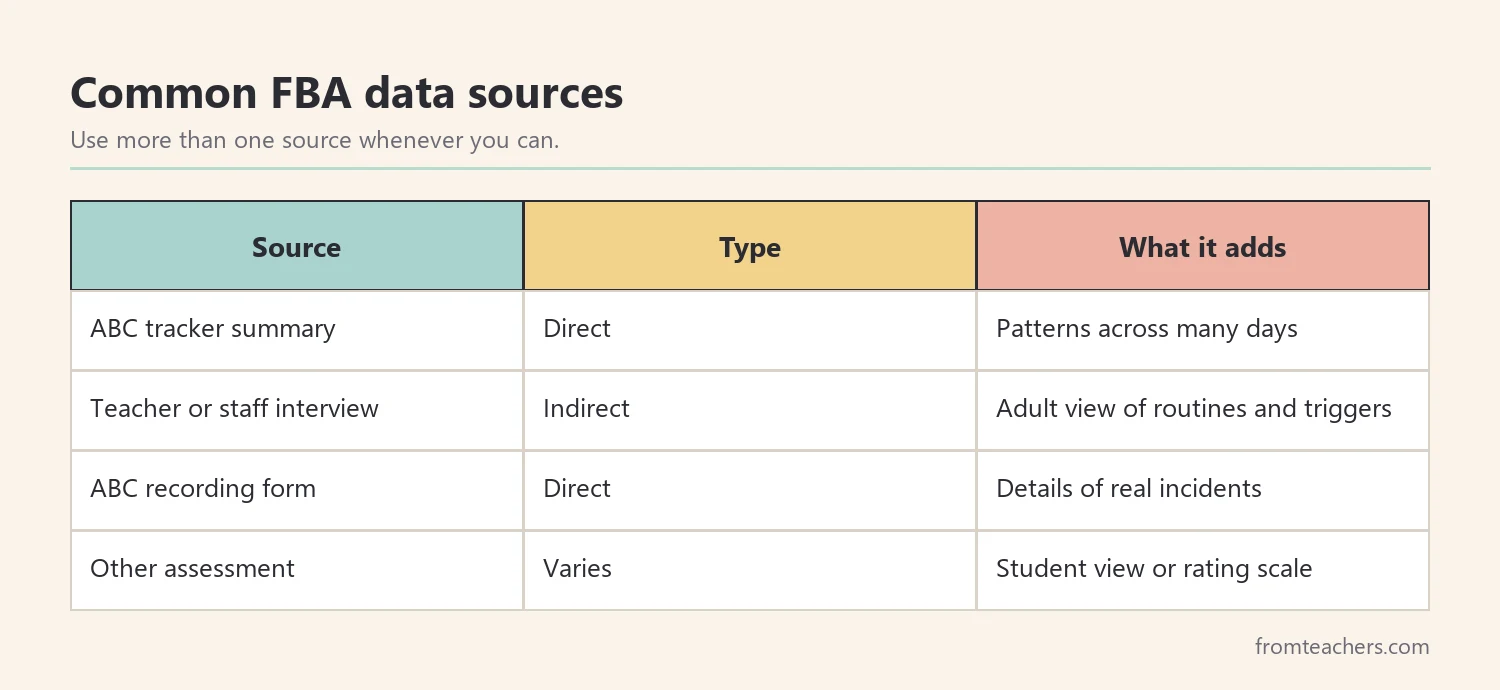
Meet Jordan, a fictional student in grade 5. His team is looking at one behavior: leaving his seat and walking out of the classroom without permission. The behavior specialist, Ms. Okafor, collected four sources over three weeks: an ABC tracker, an interview with his classroom teacher, ABC recording forms, and a short student interview.
Next, check that every source describes the same behavior. If the teacher interview talks about “disruption” while the ABC forms track “leaving the room,” the summary will be muddy. Agree on one clear, observable definition before you summarize anything.
Also, check how much data you have. A few incidents recorded on one or two days rarely support a confident FBA summary report. Several weeks of recordings across different days and routines give the team a much fairer picture of the behavior.
Finally, note the dates and who collected each source. That detail helps the team judge how recent and how complete the information is.
2. Summarize each source in the same structure
Next, summarize every source using one shared structure. This is the heart of a strong FBA summary report. When every source answers the same questions, you can line them up and compare them in seconds.
A practical structure has six parts. Routine is when and where the behavior happens. Setting event is something earlier that makes the behavior more likely, such as poor sleep or a hard morning. Antecedent is what happens right before. Behavior is what the student does. Consequence is what happens right after. Function is the likely purpose the behavior serves, such as escaping a task or getting attention.
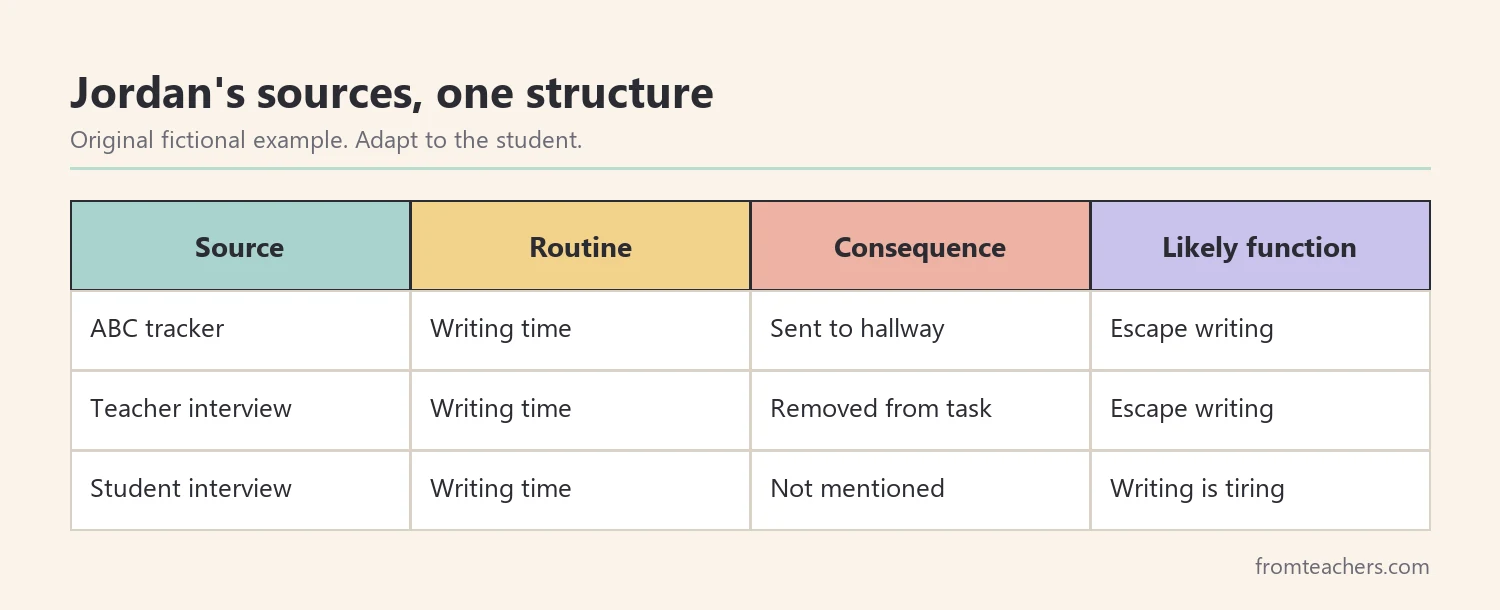
For example, Jordan’s ABC tracker points to writing time, a long written assignment as the antecedent, and being sent to the hallway or allowed to walk off as the consequence. His teacher interview describes the same routine and suggests he avoids writing. His student interview adds that writing “takes forever” and that his hand gets tired.
A ready-made template keeps this step tidy. The editable FBA summary form and ABC data template gives space to summarize up to four tools, each with routine, setting event, antecedent, behavior, consequence, and function fields, so your summaries always follow the same order.
In addition, write down what each source does not tell you. An interview may not mention consequences, or an ABC form may skip setting events. Listing those gaps inside the FBA summary report shows the team where information is thin.
Keep each summary short. One or two lines per field is enough. The goal is comparison, not a full rewrite of the raw data.
3. Find the patterns across sources
Once every source is summarized, look across the rows. Patterns that show up in more than one source are much stronger than a single dramatic incident. An FBA summary report should rest on what repeats.
Start with simple counts from your direct data. How many incidents happened in each routine? What came right before most of them? What usually happened right after? Counts keep the team honest and stop one memorable day from taking over the discussion.
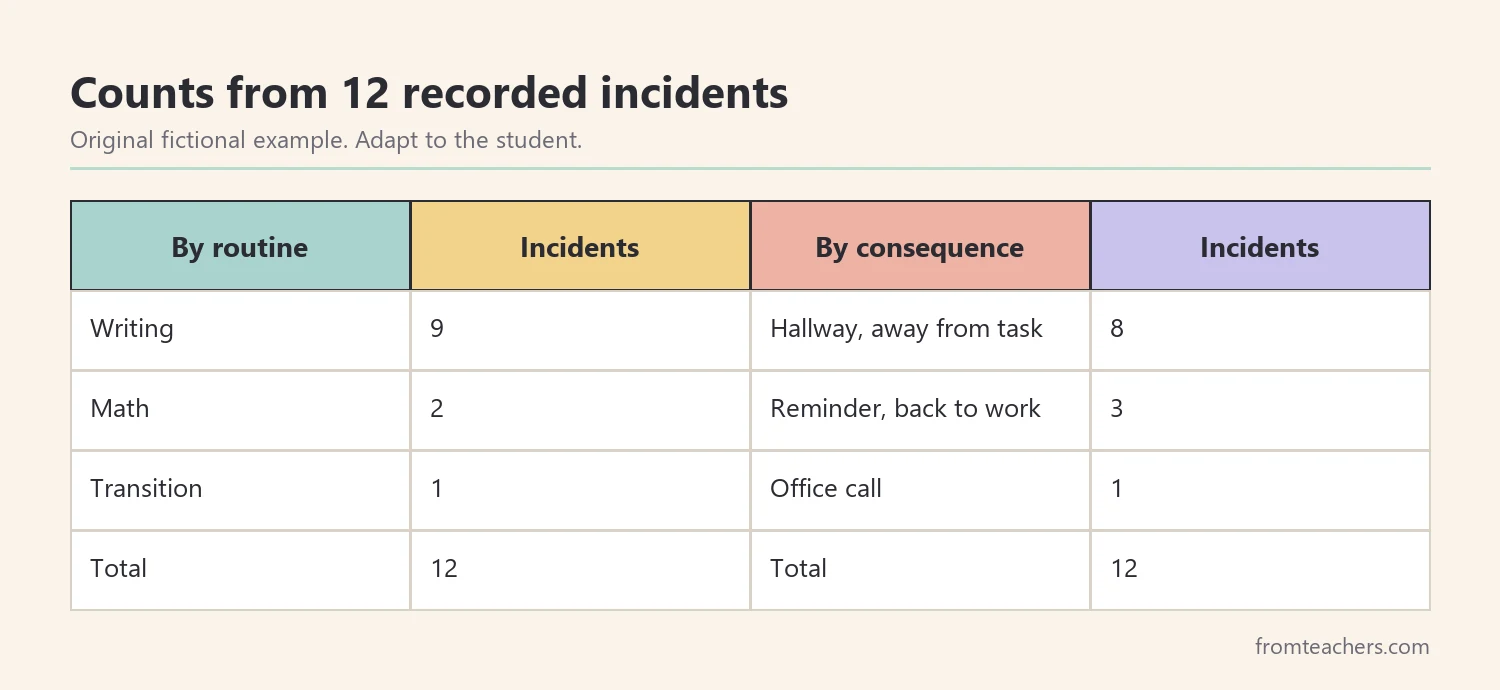
In Jordan’s fictional ABC forms, the team recorded 12 incidents over three weeks. Of those, 9 happened during writing, 2 during math, and 1 during a class transition. Looking at consequences, 8 of the 12 ended with Jordan in the hallway away from the task, 3 ended with a reminder and a return to work, and 1 ended with a call to the office.
Next, compare those counts with the indirect sources. The teacher interview and the student interview both point to writing. When direct and indirect data agree, your confidence goes up. When they disagree, that is a signal to collect more data or look more closely.
It also helps to look at when the behavior does not happen. Jordan rarely left the room during science labs or art, where tasks were hands-on and short. That contrast supports the idea that the demands of writing, not the classroom itself, are the key trigger.
Then, check setting events. In Jordan’s case, the team noticed that several incidents happened on Mondays, but the pattern was weak, so they listed it as something to keep watching rather than a firm finding.
4. Write the FBA summary report hypothesis
Now combine the patterns into one hypothesis statement. This sentence is the most important line in the FBA summary report, because the behavior plan will be built around it. It should be specific, observable, and testable.
A useful hypothesis follows the order of the behavior chain: setting event, antecedent, behavior, consequence, and function. Each part should come directly from your data.
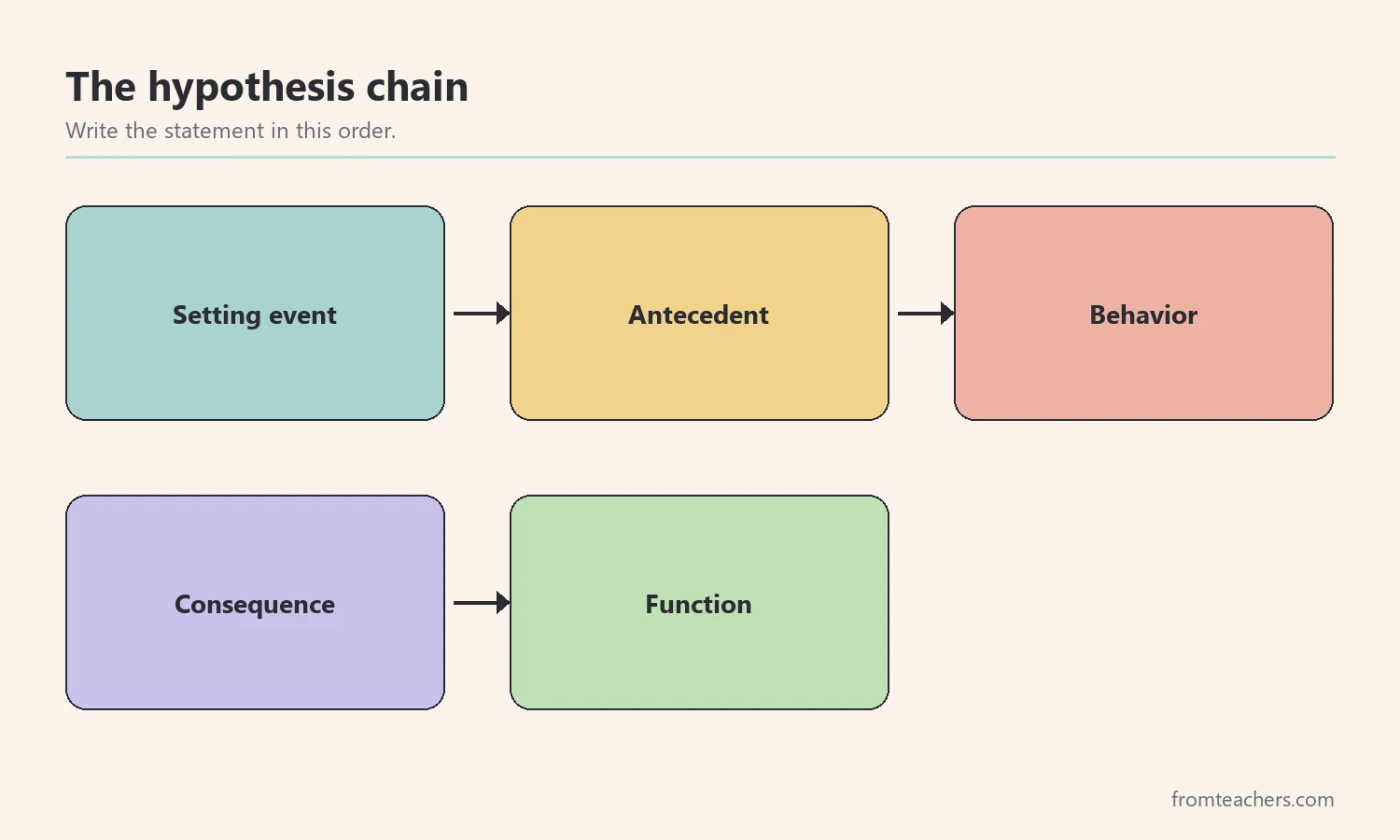
For example, Jordan’s team wrote: “During writing time, when given a long written assignment, Jordan leaves his seat and walks out of the classroom. He is then removed from the task. The behavior likely serves to escape demanding writing tasks.” Because the Monday pattern was weak, they noted it separately as a possible setting event.
Avoid vague words such as “defiant,” “attention-seeking,” or “lazy.” They describe opinions, not observations. Instead, describe what the student does and what happens next, then state the likely function.
Next, read the hypothesis aloud to the team. If a new staff member could read it and know exactly when to expect the behavior, the statement is clear enough for the FBA summary report.
Also, keep the hypothesis to one main behavior. If the student shows several behaviors, write a separate statement for each, or focus first on the one that matters most for learning and safety.
5. Rate confidence in the FBA summary report
Before you move on, pause and ask how sure the team really is. A confidence rating is a simple, honest check. It helps the team decide whether the summary is ready to guide a behavior plan or whether more data is needed.
Ask a few direct questions. Do at least two sources agree on the function? Is there enough direct observation? Does the hypothesis explain most incidents, or only some? Has the team considered other possible functions?
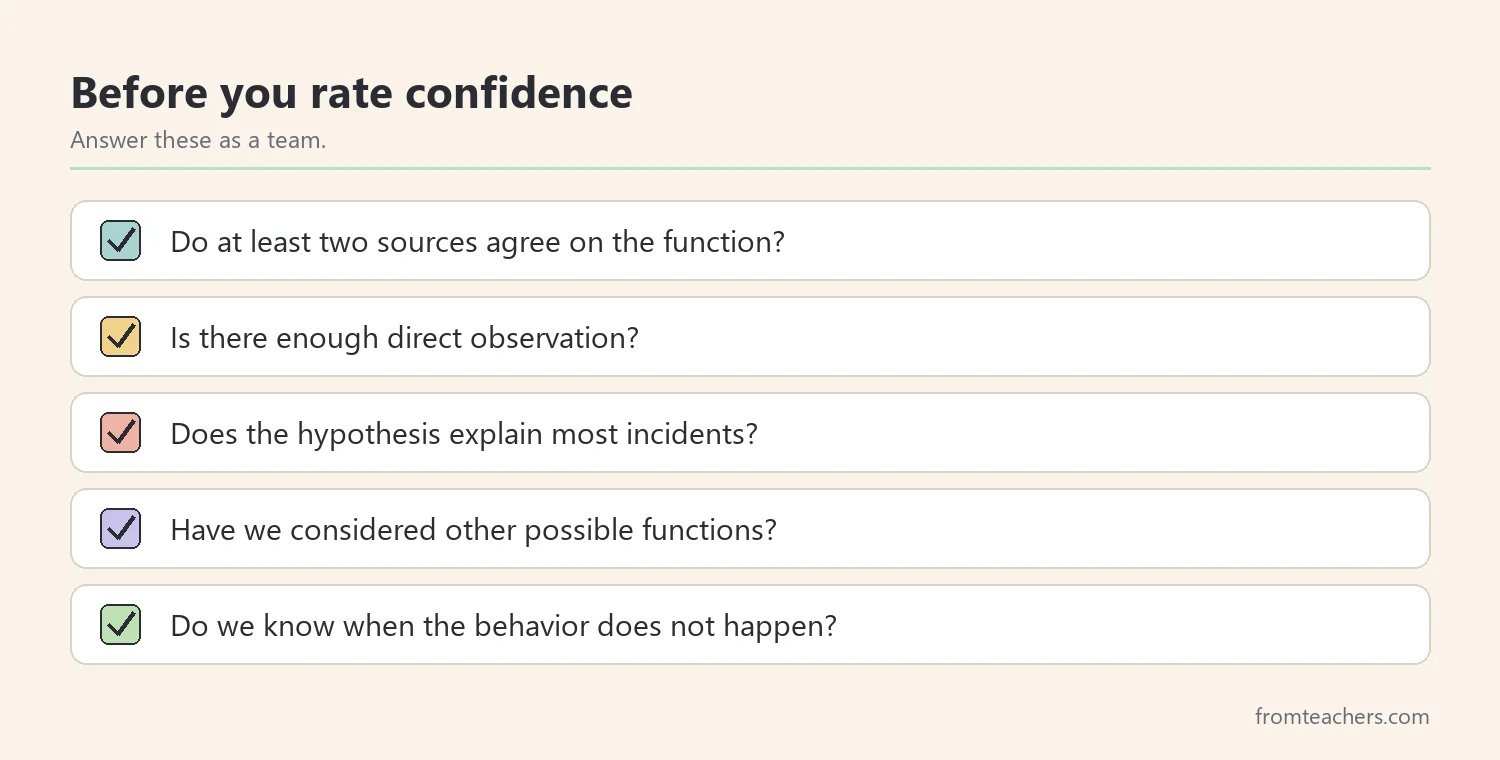
For instance, Jordan’s team agreed that the escape hypothesis explained 9 of 12 incidents and was supported by three sources. They rated their confidence as high for writing time. However, they rated it lower for the 2 math incidents and the 1 transition incident, and planned a short round of extra observation there.
A low rating is not a failure. It simply means the team should collect a little more information before investing in a full plan. Building a plan on a weak hypothesis often wastes more time than a week of extra data.
6. Share the report and connect it to the behavior plan
Finally, turn the FBA summary report into action. The report should be short enough that every team member, including the family, can read it before the meeting. One or two pages is often enough.
Include the behavior definition, a brief list of sources, the summarized patterns, the hypothesis, and the confidence rating. Then, link the hypothesis to ideas for the behavior intervention plan. If the function is escape from writing, the plan might teach a way to ask for a break, break writing into shorter chunks, and make sure walking out no longer removes the task.
For Jordan, the team agreed to try a break card, chunked writing assignments, and a speech-to-text option for longer pieces. They also agreed to keep collecting ABC data so they can see whether incidents drop.
Then, set a review date. Many teams look at new data four to six weeks after the plan starts. If the behavior is not changing, the FBA summary report and its hypothesis may need another look, rather than simply adding more consequences.
Above all, share the report with the family in plain language. Parents often add details about sleep, routines, or interests that strengthen both the summary and the plan.
Common mistakes and how to avoid them
- Writing before all data is in. Fix: gather every source first, then summarize.
- Each source summarized differently. Fix: use one shared structure for every source.
- Relying on one dramatic incident. Fix: count incidents and look for repeats across sources.
- Vague labels in the hypothesis. Fix: describe observable actions and the likely function.
- Skipping the confidence check. Fix: rate confidence and collect more data when it is low.
- A report nobody reads. Fix: keep the FBA summary report short and share it before the meeting.
Questions teachers and parents ask about an FBA summary report
Who writes the FBA summary report?
Usually a behavior specialist, school psychologist, or special education teacher leads the writing. However, the content should reflect input from the whole team, including the family.
How many data sources do we need?
There is no single required number, but using more than one source makes the summary stronger. A mix of direct observation and interviews is common. Many teams find that three or four sources give enough agreement to write a confident hypothesis.
What if the sources disagree?
Disagreement is useful information. Look for reasons, such as different settings or adults, and consider collecting more direct data before writing a final hypothesis.
How long should an FBA summary report be?
Short enough to read before a meeting. One or two pages with the key patterns, the hypothesis, and the confidence rating is often enough. Raw data can be attached separately.
What happens after the report is finished?
The team uses the hypothesis to build a behavior intervention plan. Then, they keep collecting data to see whether the plan reduces the behavior and builds new skills.
Related reading: Moving Beyond Shame and Behavior Charts: Positive Alternatives for Effective Classroom Management, The Power of Data Tracking in Special Education, and How Parents and Teachers Can Team Up for Special Education Success.
A companion resource for an FBA summary report:
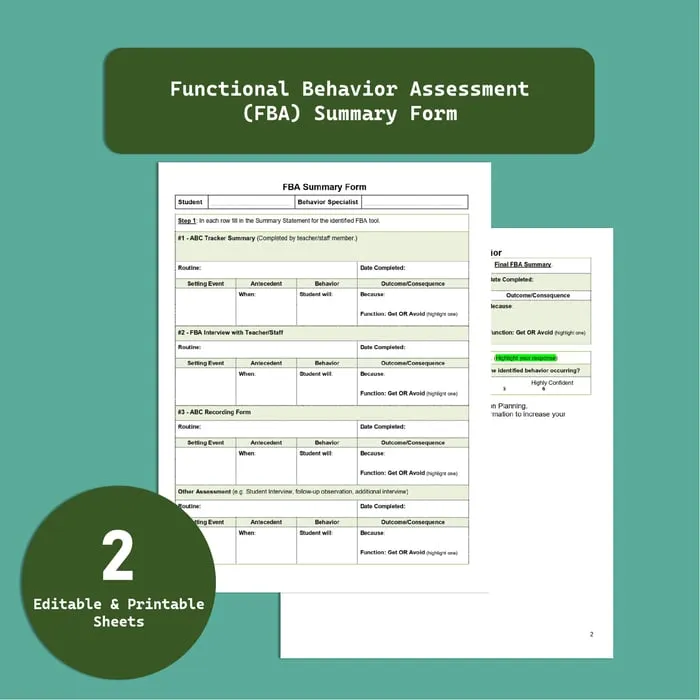
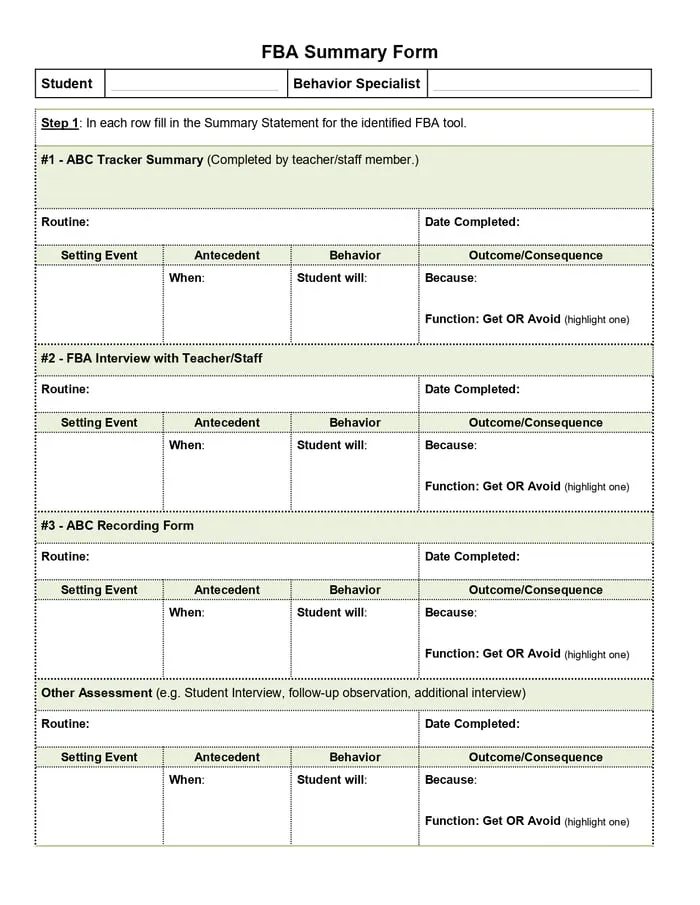
Functional Behavior Assessment Summary Form: an editable and printable two-page template to summarize up to four FBA tools in the same structure, write a final summary of behavior, and rate the team’s confidence.
Sources and scope
- Center on PBIS: resources on positive behavioral interventions and supports, including function-based support.
- IRIS Center, Vanderbilt University: free modules on functional behavioral assessment and behavior support.
- IDEA, U.S. Department of Education: the law behind special education services, including behavior-related provisions.
- What Works Clearinghouse: reviews of research on education programs and practices.
This guide covers how to organize FBA data into a clear summary and hypothesis. It does not replace your district’s FBA procedures, legal requirements, or the judgment of a qualified behavior professional.
Key takeaways
- An FBA summary report starts with every data source gathered in one place.
- Summarize each source with the same structure so patterns stand out.
- Count incidents and trust patterns that repeat across sources.
- Write one clear hypothesis that names the likely function.
- Rate confidence, share the report, and use it to build the behavior plan.










Leave a Comment