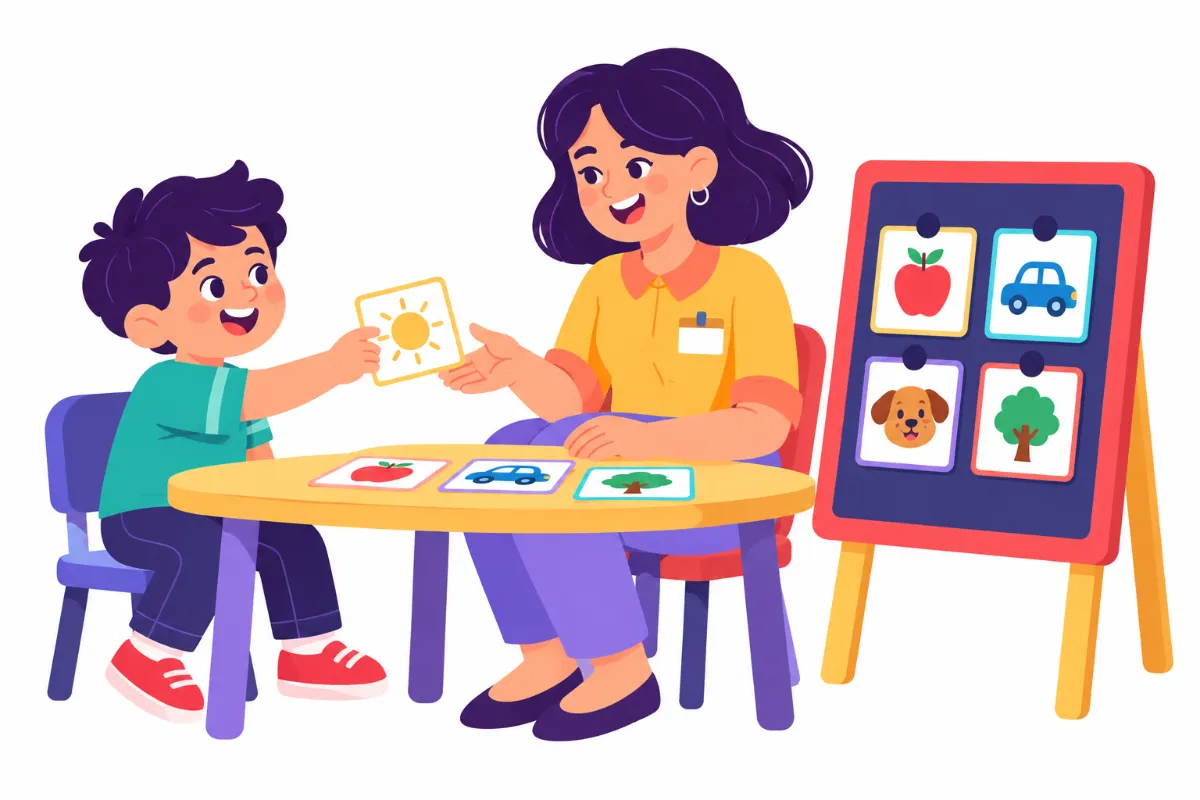

A PECS communication board gives a nonverbal or minimally verbal student a real way to ask, choose, and comment. Picture a kindergartner at snack time who wants crackers, cannot say the word, and starts to cry while the adults guess. A board on the wall cannot fix that moment by itself. It only works when it is set up well, when partners respond every time, and when the team watches what actually happens.
This guide walks you through six steps: set up the board, prepare communication partners, teach sentence strip use, encourage spontaneous requests, track growth, and review with the team. By the end, you will know how to observe board use in a way that shows real communication progress.
Examples are fictional. Adapt to the student’s goals and agreed supports. This is guidance, not a diagnosis.
At a glance
- Put the board where the requesting happens and within the student’s reach.
- Communication partners matter as much as the pictures on the board.
- Watch for spontaneous requests, not only prompted ones.
- Track a few simple numbers each week, such as requests and multi-icon messages.
- Review together with the SLP, teachers, aides, and family every few weeks.
1. Set up the PECS communication board for real use
First, think about where communication happens. A PECS communication board belongs where the student needs to ask for things, such as the snack table, the play area, or the art shelf. A board across the room is a board nobody uses.
PECS stands for Picture Exchange Communication System. In short, the student hands a picture to a partner to make a request, and the partner responds right away. The board is the home base for those pictures, and it often includes a sentence strip that starts with “I want.”
Next, check five setup basics. Can the student reach every icon without help? Is the board placed where requests naturally happen? Is there glare on laminated pictures? Are icons big enough to see and pick up? Do icons stay in the same spots, grouped by category?
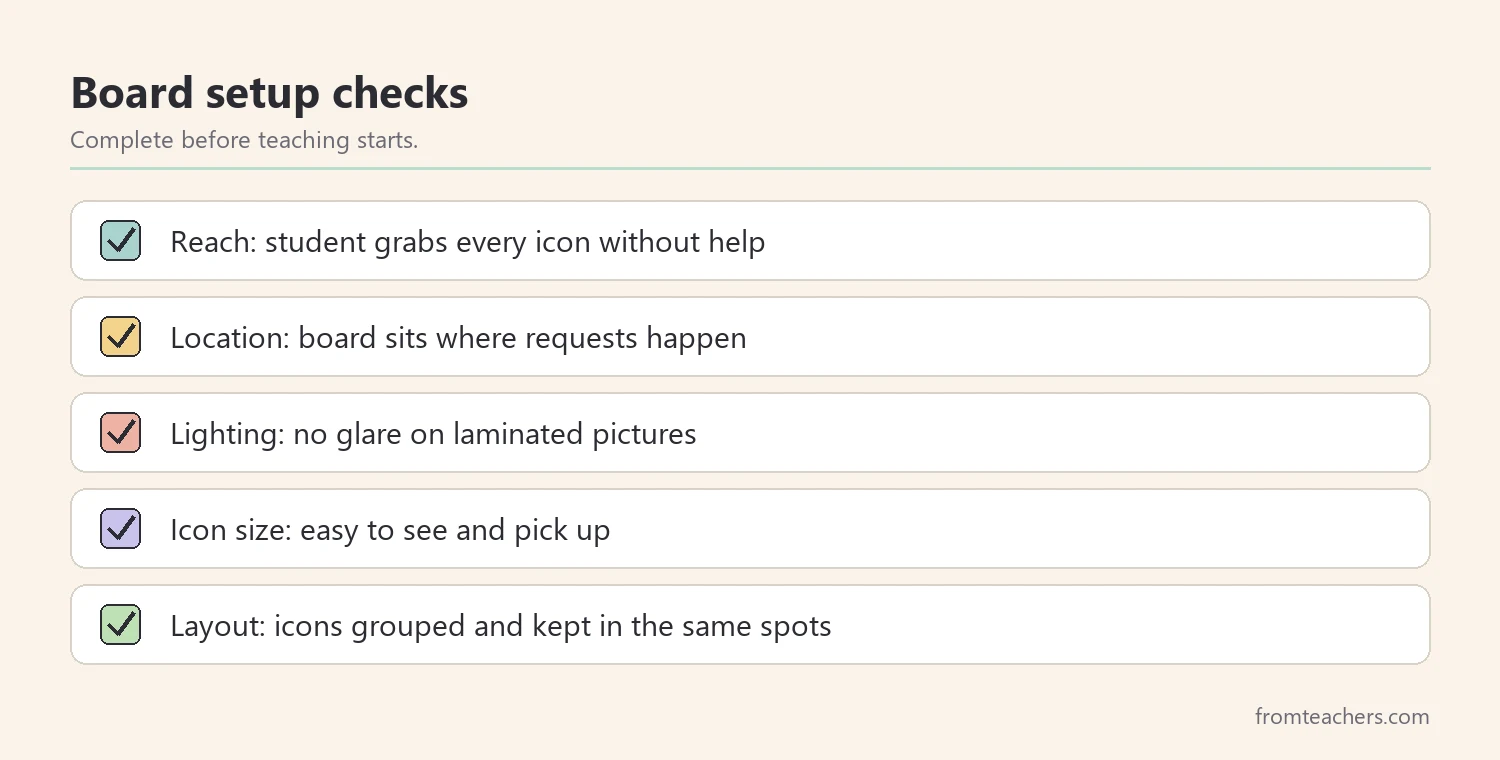
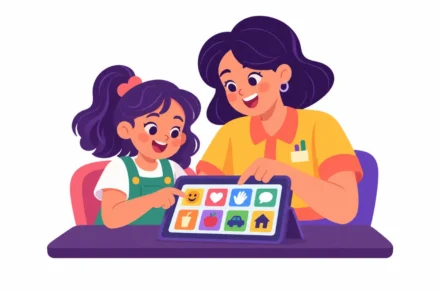
Meet Maya, a fictional kindergarten student who is minimally verbal. Her first board sits on the snack table, at her eye level, with six icons: crackers, apple, juice, water, bubbles, and a toy car. Her team chose these because Maya already showed strong interest in them.
Next, think about the icons themselves. Photos of the real items often work well for beginners, while clear line drawings may suit students who already recognize symbols. Whatever you choose, keep the style consistent across the PECS communication board so the student is not decoding a new picture style every time.
Start small. A board with a handful of highly motivating items gets more use than a board crowded with fifty icons. Then, add new icons slowly as the student shows interest in new things.
Finally, use a written setup checklist so every adult checks the same things. The Communication Boards and PECS Starter Kit observation checklists include a Board Setup and Accessibility page that covers location, icons, lighting, and student reach, with space for notes.
2. Prepare every communication partner
A PECS communication board is only half of the system. The other half is the person on the receiving end. If a partner is distracted, slow to respond, or asks the student to “say it,” the student learns that handing over a picture does not work.
Good partner readiness means being close, available, and holding items the student wants. Good partner delivery means responding right away, naming the item, and giving it without extra demands. Short, warm, and fast is the goal.
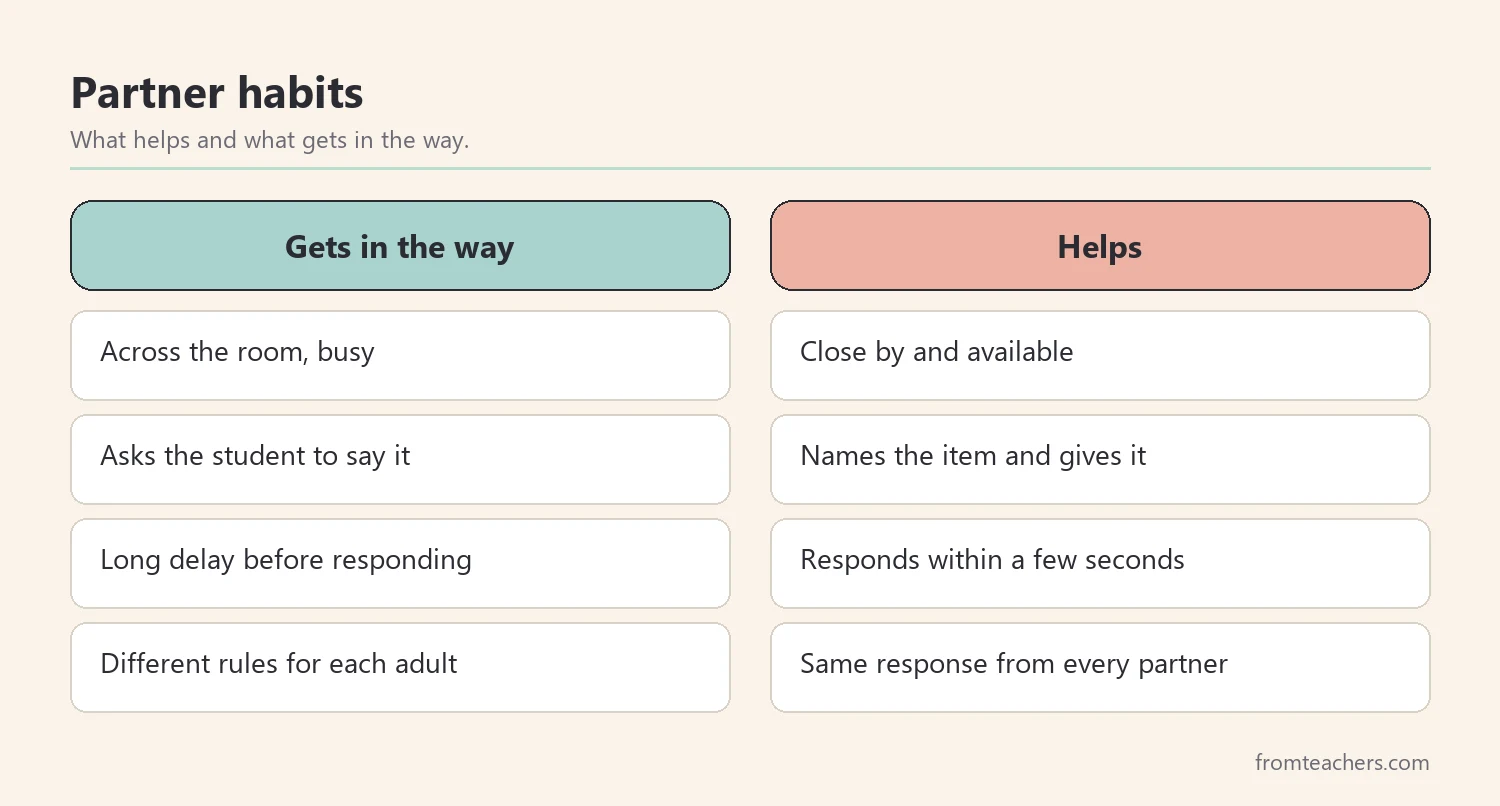
For example, when Maya hands over the crackers icon, her aide, Mr. Lee, says “Crackers!” and gives two crackers within a couple of seconds. He does not ask her to repeat the word or point again. The exchange itself is the success.
Next, train every adult who works with the student, including specialists, substitutes, and family members. A short demonstration and a one-page partner guide are usually enough. Consistency across partners helps the student trust the system.
In addition, make sure the board travels with the student when needed. A portable PECS communication board, such as a small binder with velcro strips, lets the student ask for things on the playground, in the cafeteria, or on a field trip.
Then, observe partners, not just the student. Watching how adults respond often explains why a student uses the board with one person and ignores it with another. That is information, not blame.
3. Teach sentence strip use on the PECS communication board
Once single-picture requests are steady, many teams move to a sentence strip. The strip lets the student build a short message, such as “I want” plus an item, and hand the whole strip to a partner. This is a bigger step, so teach it with patience.
The sequence is simple and stays the same every time:
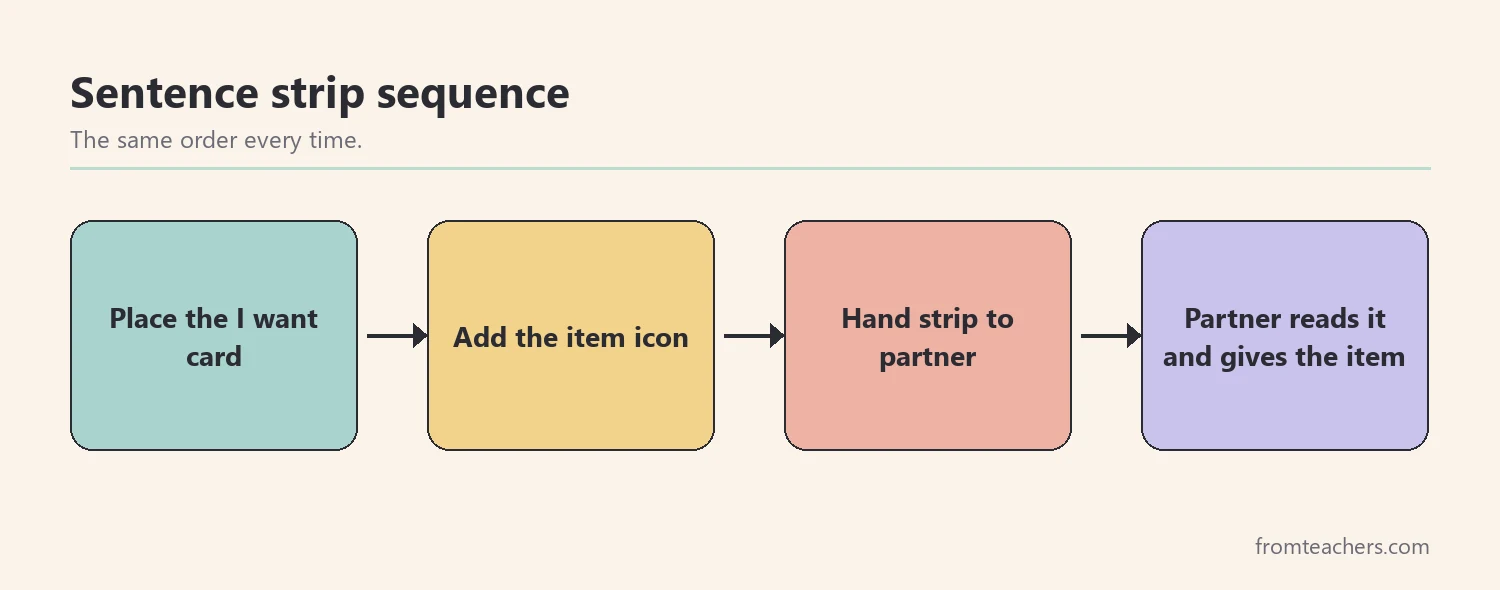
For instance, Maya places the “I want” card on the strip, adds the bubbles icon, and hands the strip to Mr. Lee. He points to each picture while saying “I want bubbles,” then blows bubbles right away. At first, he may guide her hand to the “I want” card, then fade that help over days.
During observation, note whether the student places the icons in order, whether the strip is handed to a partner, and how much help was needed. These details show where to focus next. If the student often skips the “I want” card, more practice on that piece is the natural next step.
Keep in mind that PECS is taught in structured phases, and formal training is available from the organization that developed it. If your team is new to PECS, consider training or consultation with your speech-language pathologist before moving through the phases.
4. Encourage spontaneous use
Spontaneous use means the student starts the exchange without a verbal cue such as “What do you want?” This is one of the most important signs of real communication. A student who only uses the PECS communication board when asked is responding, not yet initiating.
To encourage initiation, create reasons to communicate. Place favorite items in sight but out of reach. Give a small portion so the student asks for more. Pause during a fun routine, such as bubbles, and wait. These are sometimes called communication temptations.
Then, wait. Many adults jump in too quickly. A calm pause of several seconds gives the student time to reach for the board. If nothing happens, the team can follow its agreed prompting plan.
For example, during play Mr. Lee holds the toy car, smiles, and waits quietly. After a short pause, Maya walks to the board, picks the car icon, and hands it to him. That moment counts as a spontaneous request and goes in the record.
Moreover, keep a short list of the temptations that work best for this student. When every adult knows that Maya loves bubbles and toy cars, they can set up natural reasons to use the PECS communication board throughout the day, not only at snack time.
Also, look for spontaneous use with different people and in different places. Generalization, meaning using the skill with new partners, settings, and activities, shows that the skill is becoming the student’s own.
5. Track growth on the PECS communication board
Next, collect a few numbers each week. You do not need to record every exchange. A short sample, such as one snack and one play session per day, gives a clear picture over time.
Useful measures include total requests, how many of those were spontaneous, and how many used two or more icons, which is often called length of utterance. Spontaneous and multi-icon requests are part of the total, so they can never be higher than it.
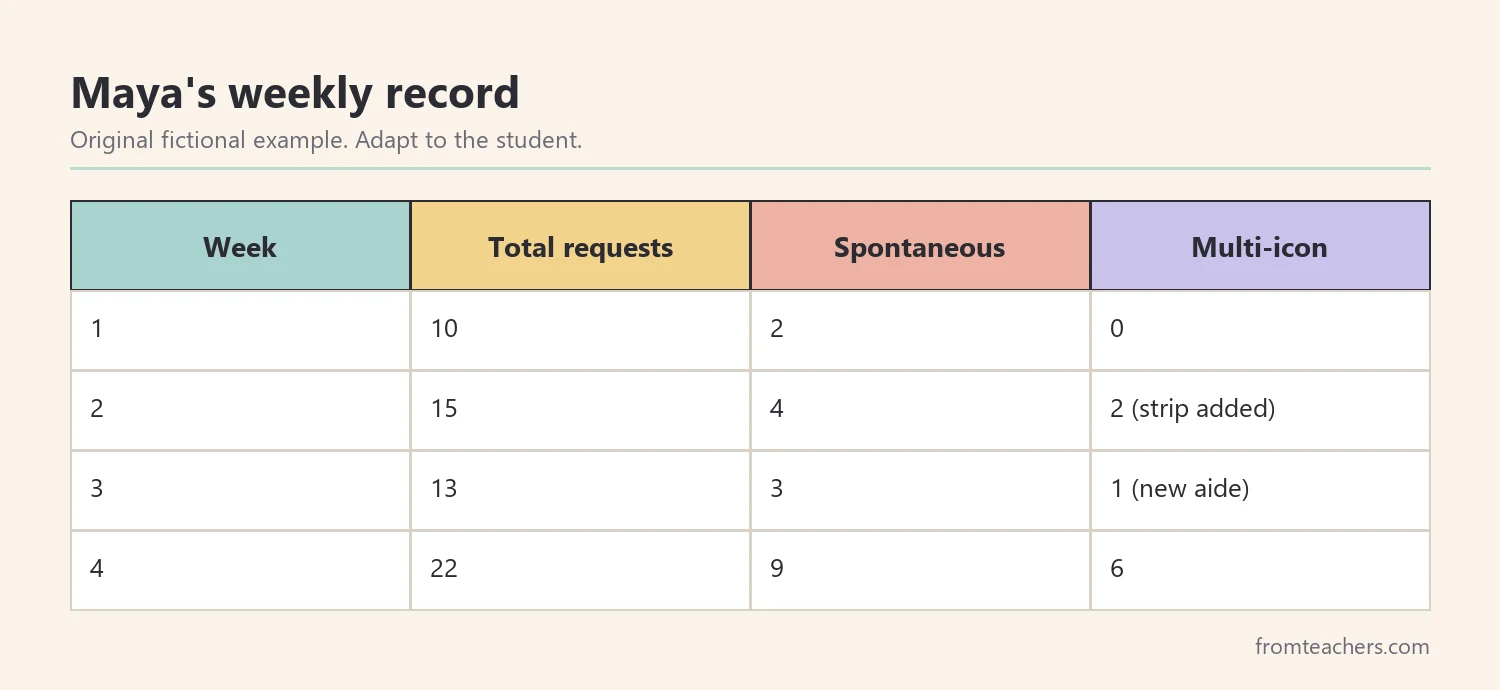
In Maya’s fictional record, total requests during sampled sessions rose from 10 in week 1 to 22 in week 4. Spontaneous requests grew from 2 to 9, and multi-icon requests grew from 0 to 6 once the sentence strip was introduced in week 2. In week 3 the numbers dipped slightly because a new aide joined the team, which the note column explains.
Also, record who the partner was and where the session happened. Over a few weeks, those two columns show whether the student uses the PECS communication board with only one familiar adult or with several people in several places.
Finally, use the same observation form every week. When every page has student name, date, observer, and the same areas, it is easy to compare weeks and partners. Consistent forms also make team meetings faster.
6. Review progress with the team
Every three to four weeks, bring the team together. Include the SLP, classroom teacher, aides, and family. Look at the numbers, the observation notes, and any examples worth sharing.
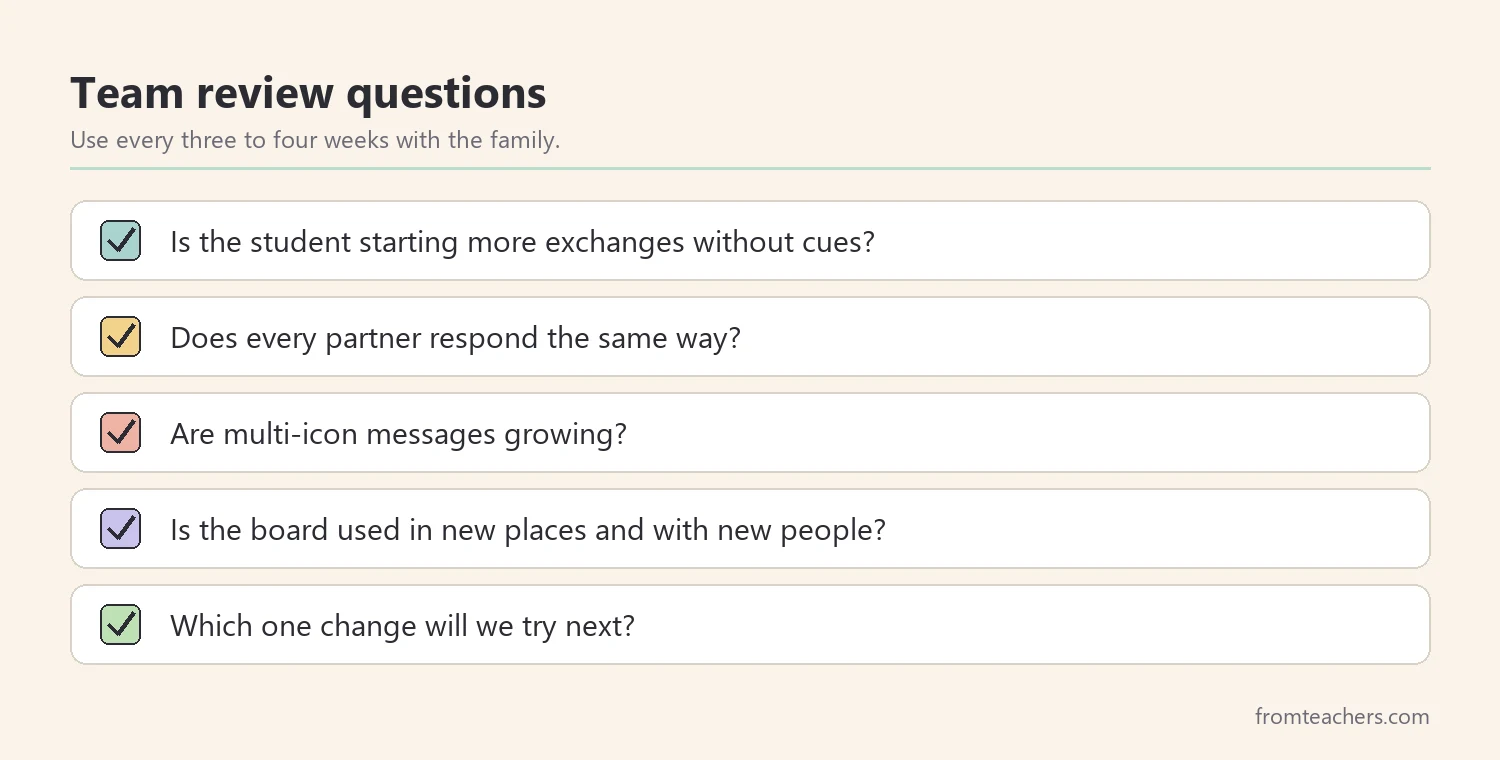
Then, decide on one or two next steps. Maybe the board needs new icons. One partner might need coaching. Maybe the student is ready to use the PECS communication board at home or in another classroom.
For example, at Maya’s review, the team noticed that most spontaneous requests happened at snack. They decided to add three play icons and to practice the same routine at home with her family, who already used a small board in the kitchen.
Also, ask the student’s family what they see at home. Parents often notice new requests or gestures that never appear at school, and those details can shape the next set of icons.
Above all, keep the focus on communication, not compliance. The goal is a student who can tell people what she wants and needs, in more places, with more people.
Common mistakes and how to avoid them
- Board out of reach. Fix: place the PECS communication board where requests happen and at the student’s level.
- Asking the student to say the word. Fix: respond to the picture exchange right away, and model the word yourself.
- Too many icons too soon. Fix: start with a few motivating items and add slowly.
- Prompting every exchange. Fix: create communication temptations and wait before helping.
- Only one adult uses the system. Fix: train every partner, including family members.
- No data, only impressions. Fix: sample a few sessions each week with the same form.
Questions teachers and parents ask about a PECS communication board
Will a PECS communication board stop my child from talking?
Many families worry about this. Picture-based systems are a form of augmentative and alternative communication, and professional groups such as ASHA describe AAC as a support for communication, not a replacement for speech. Talk with your SLP about your child’s specific goals.
How many icons should the first board have?
Start with a small number of highly motivating items. Add more when the student uses the first set reliably and shows interest in new things.
Who should be trained to use the board?
Everyone who spends time with the student. That includes teachers, aides, specialists, substitutes, and family members. Consistent responses help the student trust the system.
What counts as spontaneous use of a PECS communication board?
Spontaneous use means the student starts the exchange without a verbal cue such as “What do you want?” Gestures or pointing from an adult also count as prompts, so note them in your record.
How often should we observe and record?
A few short sessions per week are enough for most teams. Use the same form each time, and review the data together every three to four weeks.
Related reading: Best Assistive Technology for Special Education Classrooms, Autism Spectrum Disorder: A Guide to Early Signs, Support, and Effective Strategies, and The Power of Data Tracking in Special Education.
A companion resource for a PECS communication board:
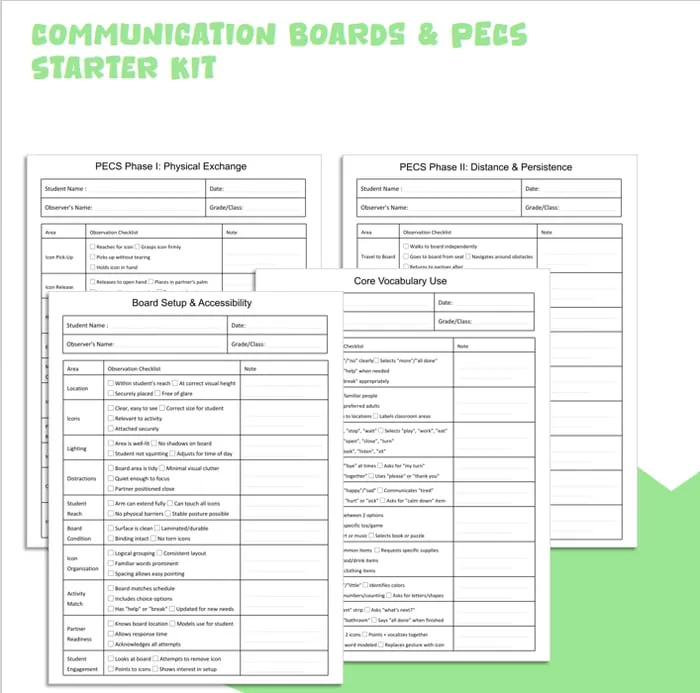
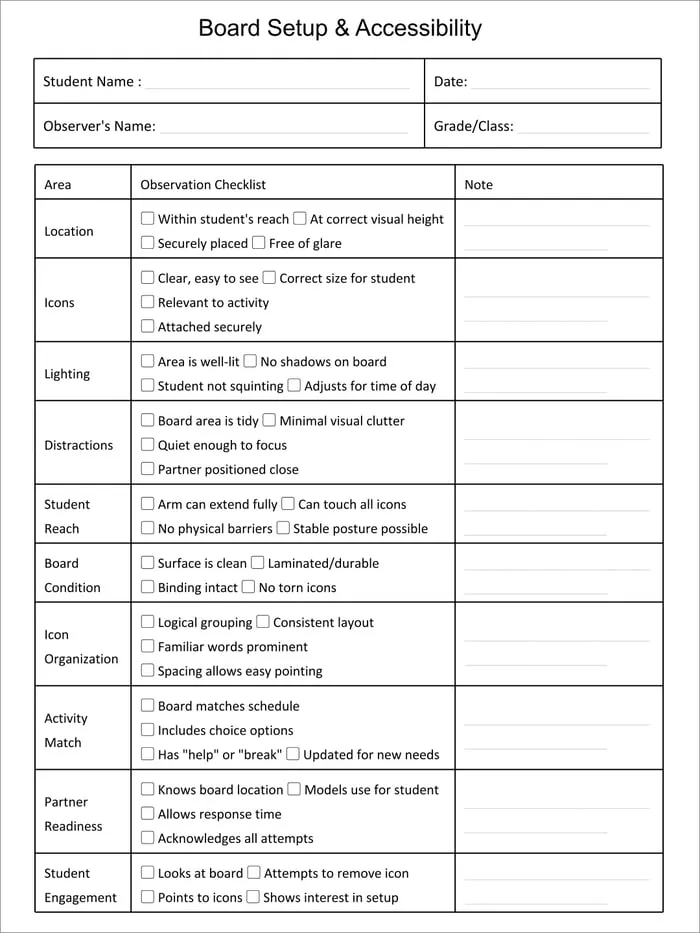
Communication Boards and PECS Starter Kit: 12 pages of blank, fillable observation checklists for board setup and accessibility, sentence strip use, partner delivery and readiness, spontaneous use, length of utterance, and generalization.
Sources and scope
- American Speech-Language-Hearing Association (ASHA): professional information on communication disorders and augmentative and alternative communication.
- Pyramid Educational Consultants: the organization that developed PECS and offers training on it.
- IRIS Center, Vanderbilt University: free modules on evidence-based practices for students with disabilities.
- IDEA, U.S. Department of Education: the law behind special education services, including assistive technology.
This guide covers board setup, partner skills, and observation for classroom teams. It does not replace formal PECS training or an individualized plan from a speech-language pathologist.
Key takeaways
- Place the PECS communication board where requests happen and within reach.
- Prepare every partner to respond quickly, warmly, and without extra demands.
- Teach the sentence strip with the same sequence every time.
- Track spontaneous and multi-icon requests on the PECS communication board, not just total exchanges.
- Review with the whole team and family every few weeks.






Leave a Comment