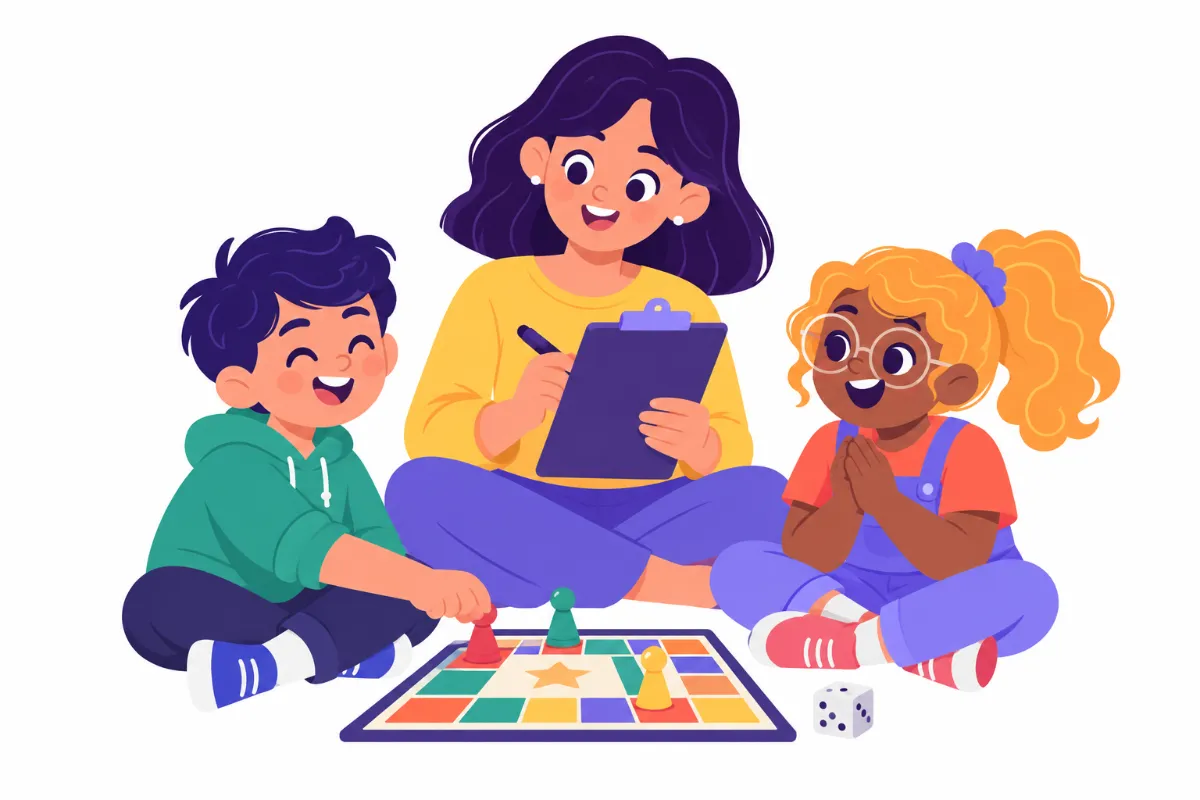

A social skills checklist helps when you know a student is struggling with peers but cannot yet say exactly where. Picture a third grader at indoor recess who hovers near a board game, watches for a few minutes, then walks away without asking to join. Later, a classmate says he “never wants to play.” You suspect that is not true, but you need more than a hunch to plan support.
This guide walks you through a five-step process: choose the skill areas to observe, plan your observations, record clear behaviors, turn the results into goals, and teach and re-check over time. By the end, you will know how to use a checklist as a real planning tool instead of a form that sits in a folder.
Examples are fictional. Adapt to the student’s goals and agreed supports. This is guidance, not a diagnosis.
At a glance
- Pick two or three skill areas to observe first, not every area at once.
- Observe in more than one setting, such as class, recess, and lunch.
- Write what you see and hear, not what you think it means.
- Turn the clearest gap into one small, measurable goal.
- Repeat the same checklist every few weeks to see real change.
1. Choose the social skills checklist areas to observe
First, decide what you are looking at. Social skills cover a wide range, from starting a conversation to reading a friend’s face. If you try to observe everything in one week, your notes will be thin everywhere and useful nowhere.
A well-built social skills checklist groups skills into clear areas. Common areas include conversation, turn-taking, nonverbal cues, emotion recognition, peer interaction, play, joint attention, and asking for help. Each area then lists specific behaviors you can actually see.
Next, choose two or three areas that match the concern you already have. Talk briefly with the family, the classroom teacher, and any specialist who knows the student. Ask one question: “Where do things seem to break down?” Their answers will point you to the right starting areas.
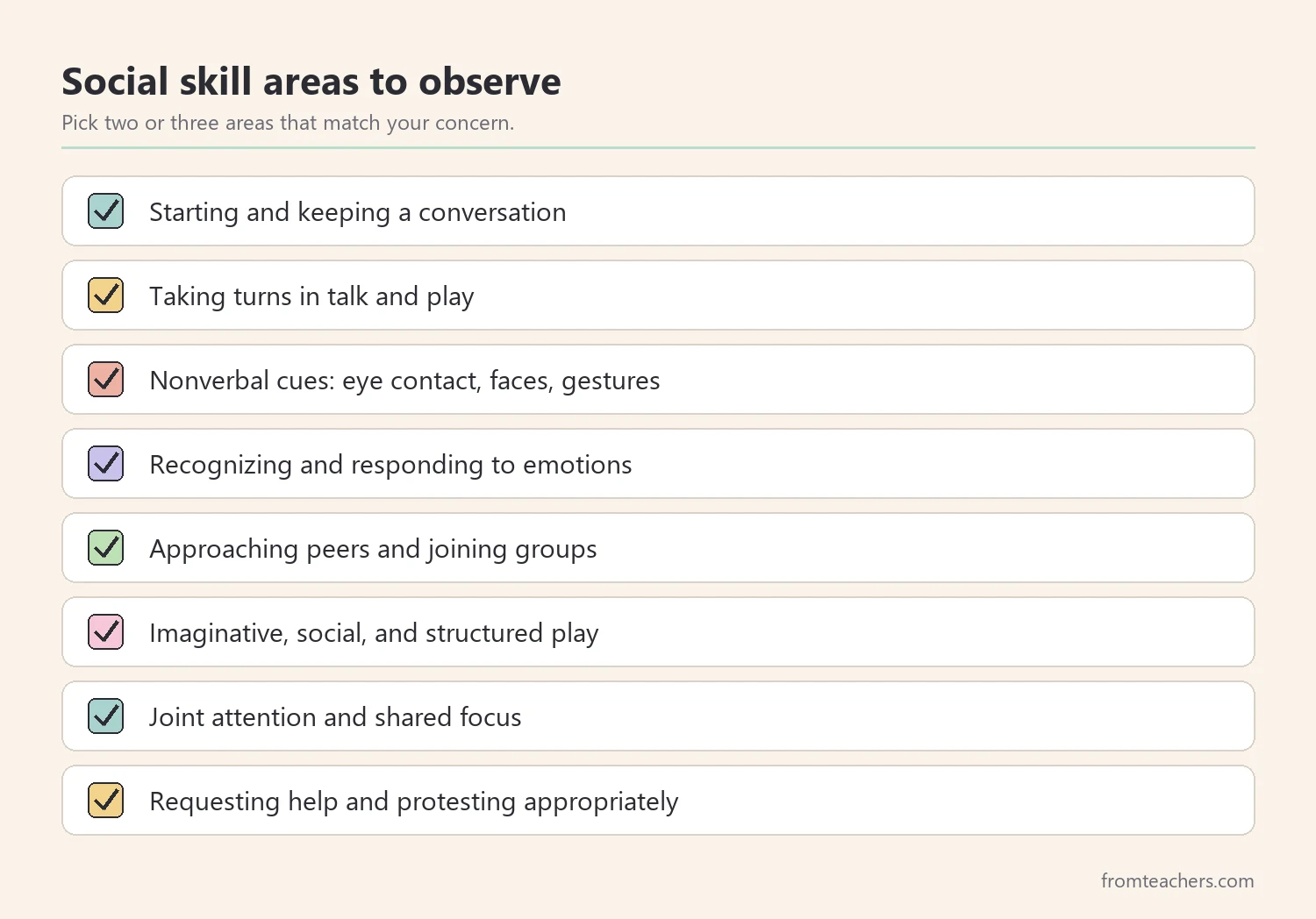
Worked example. Leo is a fictional student in grade 3. His teacher notices he rarely joins group games and often looks away when a peer speaks to him. His mother says he talks easily at home with his cousin. Therefore, the team chooses three areas for the first round: peer interaction, nonverbal cues, and conversation.
Before you begin, check that each item on your social skills checklist describes something you can see or hear. “Understands friendship” is hard to observe. By contrast, “invites a peer to play” or “responds when a peer says hello” can be marked yes or no in a few seconds.
| Hard to observe | Easy to observe |
|---|---|
| Is friendly | Greets a peer by name |
| Has empathy | Checks on a peer who looks upset |
| Is a good sport | Stays in the game after losing a turn |
In short, a narrow start gives you deep, clear notes. Later, you can widen the lens if the first round raises new questions.
2. Plan when and where to observe
Social behavior changes with the setting. A student who seems quiet in math may be lively at lunch. As a result, one observation in one place can give a misleading picture.
Plan at least three short sessions in different settings. Ten to fifteen minutes each is usually enough. Good choices include a structured lesson, an unstructured time like recess or lunch, and a small group or partner task. If possible, ask a second adult to observe one session so you can compare notes.
Then, write the plan down before you start. Note the day, the setting, the activity, and who will observe. This keeps you from observing only on easy days or only on hard ones.
| Session | Setting | Activity | Observer |
|---|---|---|---|
| Monday | Classroom | Partner reading | Teacher |
| Wednesday | Recess | Free play | Aide |
| Thursday | Lunch | Table talk | Teacher |
| Friday | Small group | Board game | Counselor |
Worked example. Leo’s team plans four sessions across one week, shown above. The aide, the teacher, and the school counselor each use the same social skills checklist, so their notes line up area by area.
Also, think about the peers in each setting. A student may join in easily with one familiar classmate but hold back in a group of five. Note who was nearby, because that detail often explains why a skill appeared in one session and not another.
Finally, keep sessions short and natural. The goal is to see typical behavior, so avoid announcing that you are watching or changing the activity for the observation.
3. Record specific, observable behaviors on the social skills checklist
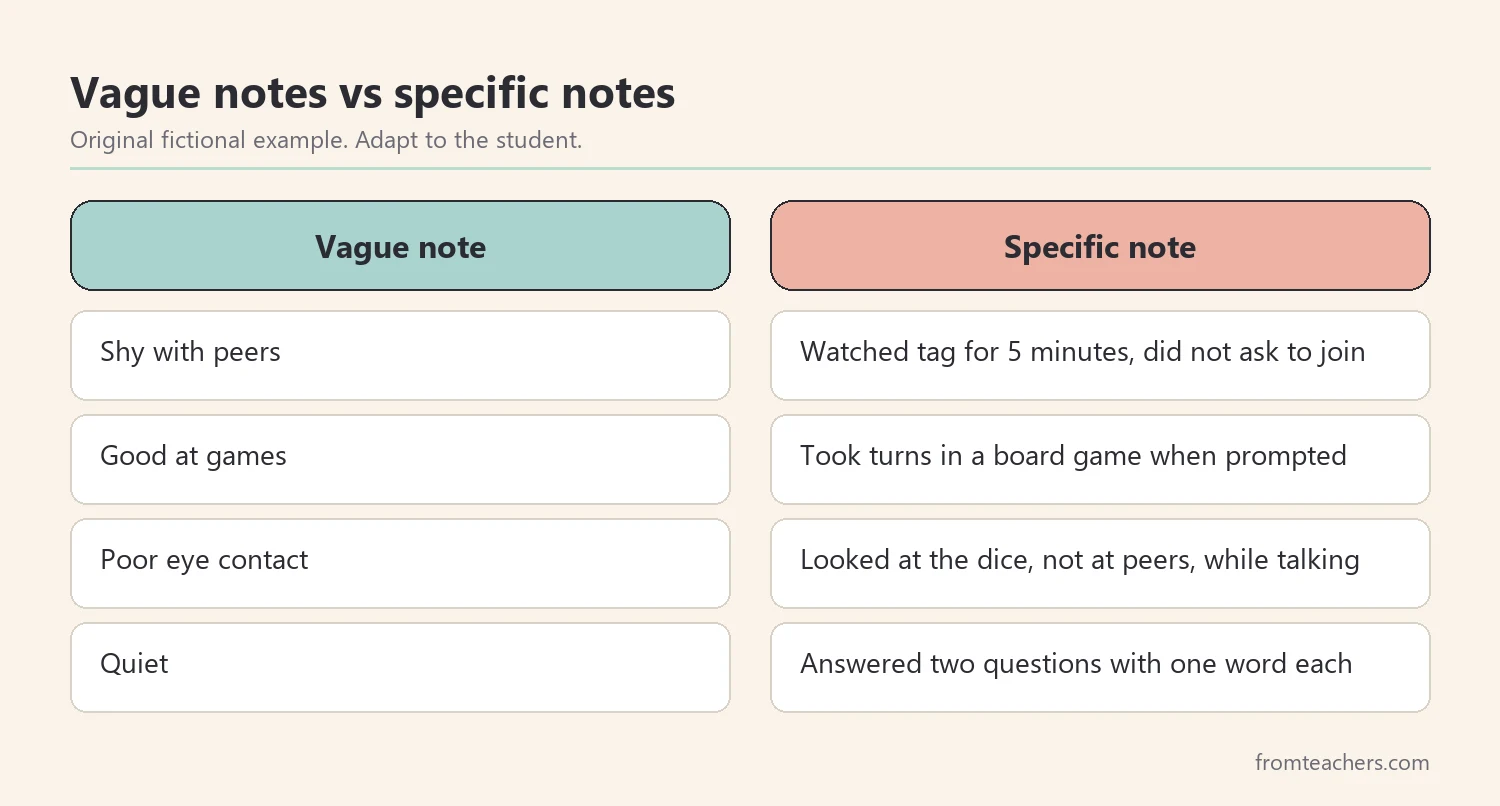
This step is where most checklists succeed or fail. A note like “shy with peers” tells the next reader very little. Instead, a note like “stood near the game for 4 minutes, did not ask to join” gives a clear picture anyone can understand.
Use the Notes column to write exactly what you saw and heard. Include who started the interaction, how long it lasted, and what happened next. When a skill shows up, write down the context too, because success tells you as much as difficulty.
Moreover, keep a simple rating next to each item if your checklist allows it, such as “seen often,” “seen sometimes,” and “not yet seen.” Ratings help you scan quickly, while notes explain the rating. A fillable social skills observation checklist set with student and observer fields and a Notes column makes this step faster, because every observer records in the same format.
Worked example. During Wednesday recess, the aide writes: “Watched four peers play tag for about 5 minutes. Smiled when one ran past. Did not ask to join. Walked to the bench when the bell rang.” On Friday, the counselor writes: “Took turns in the board game when prompted. Looked at the dice, not at peers. Answered two questions with one word.”
In other words, the notes show interest in peers and some turn-taking, but no starting of interactions and limited eye contact or reply length.
4. Turn social skills checklist results into goals
After the observations, bring all the checklists together. Look across settings and observers for patterns. A skill that is “not yet seen” in every setting is a stronger signal than one that is missing only once.
Next, sort what you found into three groups: strengths, emerging skills, and gaps. Strengths are skills seen often. Emerging skills appear sometimes or only with a prompt. Gaps are skills not yet seen in any setting.
Then, choose one emerging skill as the first goal. Emerging skills are often the best place to start, because the student already shows them sometimes. Write the goal in plain, measurable terms: what the student will do, in what setting, and how often.
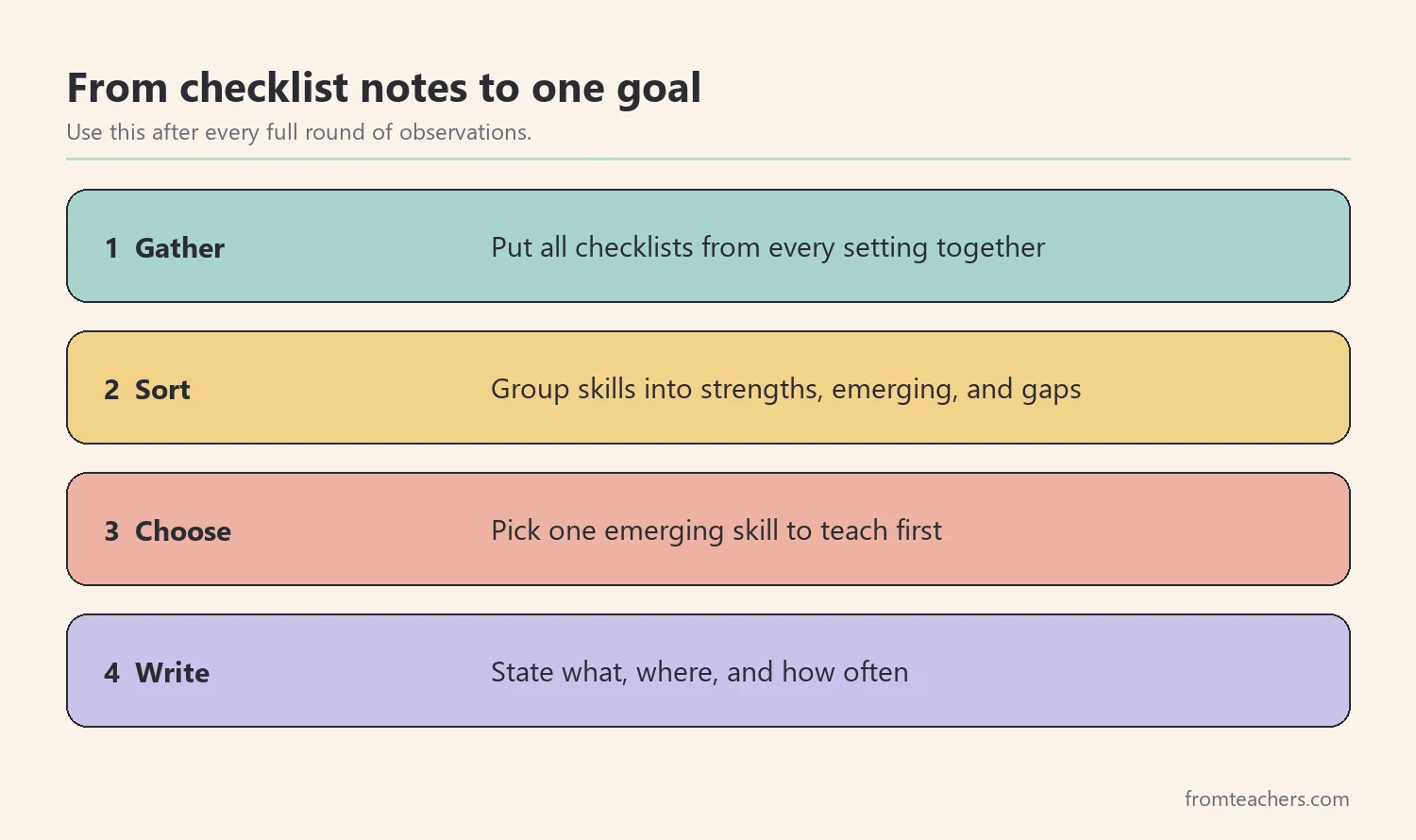
Worked example. Leo’s team sees a clear pattern. Turn-taking appears when prompted, so it is emerging. Asking to join a group is not yet seen in any of the four sessions, so it is a gap. Interest in peers is a strength. The team writes a first goal: “During recess and small group games, Leo will use a joining phrase, such as ‘Can I play?’, in 3 of 5 observed opportunities.”
Keep the first goal small enough to reach in a few weeks. A goal that feels too easy to adults is often just right for the student, because early success builds confidence for the harder skills that come next on the social skills checklist.
Furthermore, the team notes that the goal builds on a strength. Leo already watches peers closely, so the plan uses that interest instead of starting from zero. If your student has an IEP, share the checklist results with the full team, who decide on formal goals together.
5. Teach, practice, and re-check with the same checklist
A checklist is only useful if you use it again. Plan to teach the target skill directly, practice it in real settings, and then repeat the same social skills checklist after three to four weeks.
Start teaching with a short model. Show the skill, name it, and practice it in a low-pressure setting, such as a game with one familiar peer. Next, move practice into the real setting with a quiet reminder before the activity. Finally, fade the reminder as the skill becomes more consistent.
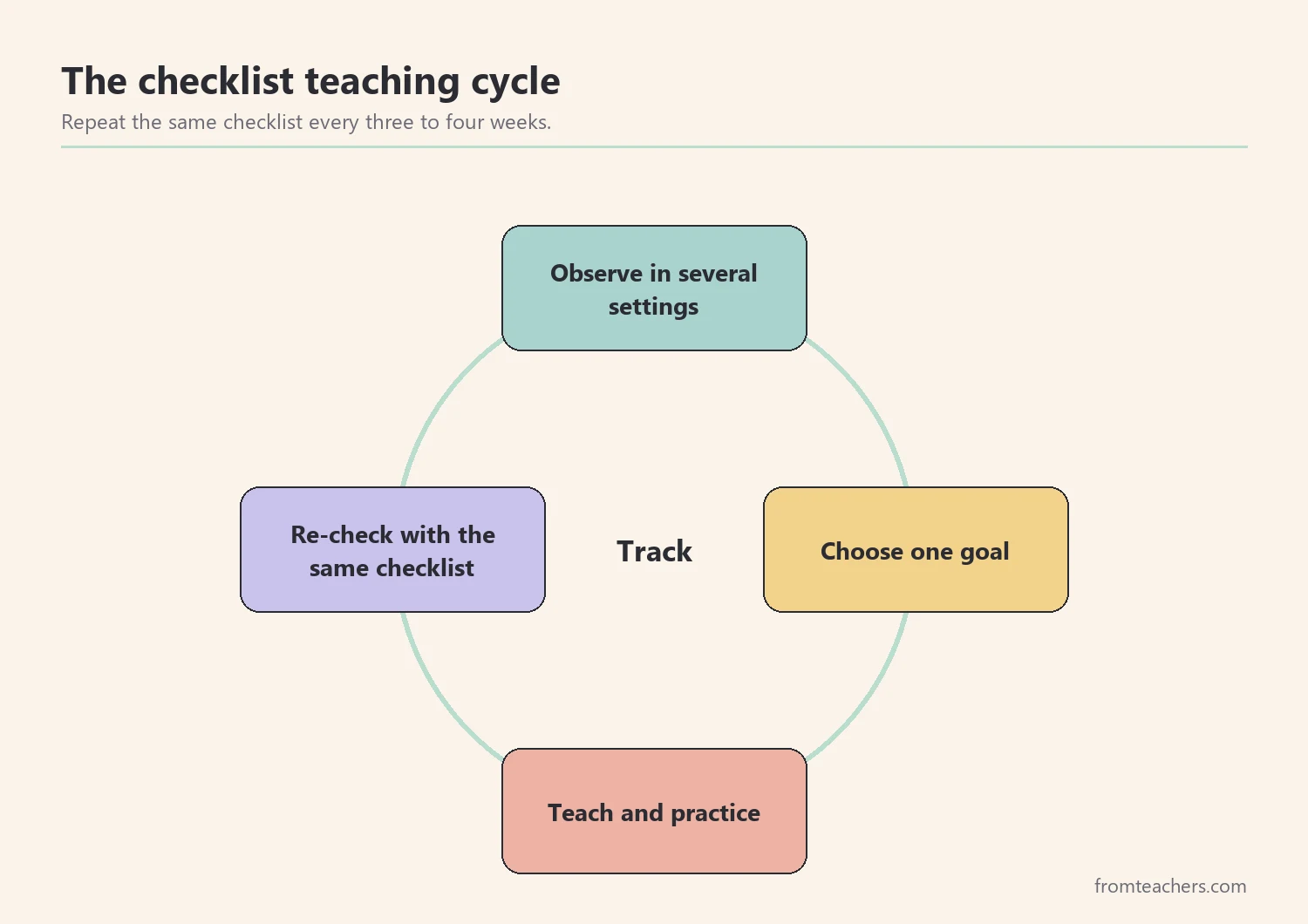
Also, keep a short tally between full re-checks. One line per session is enough: the date, the setting, the number of chances, and the number of times the skill appeared.
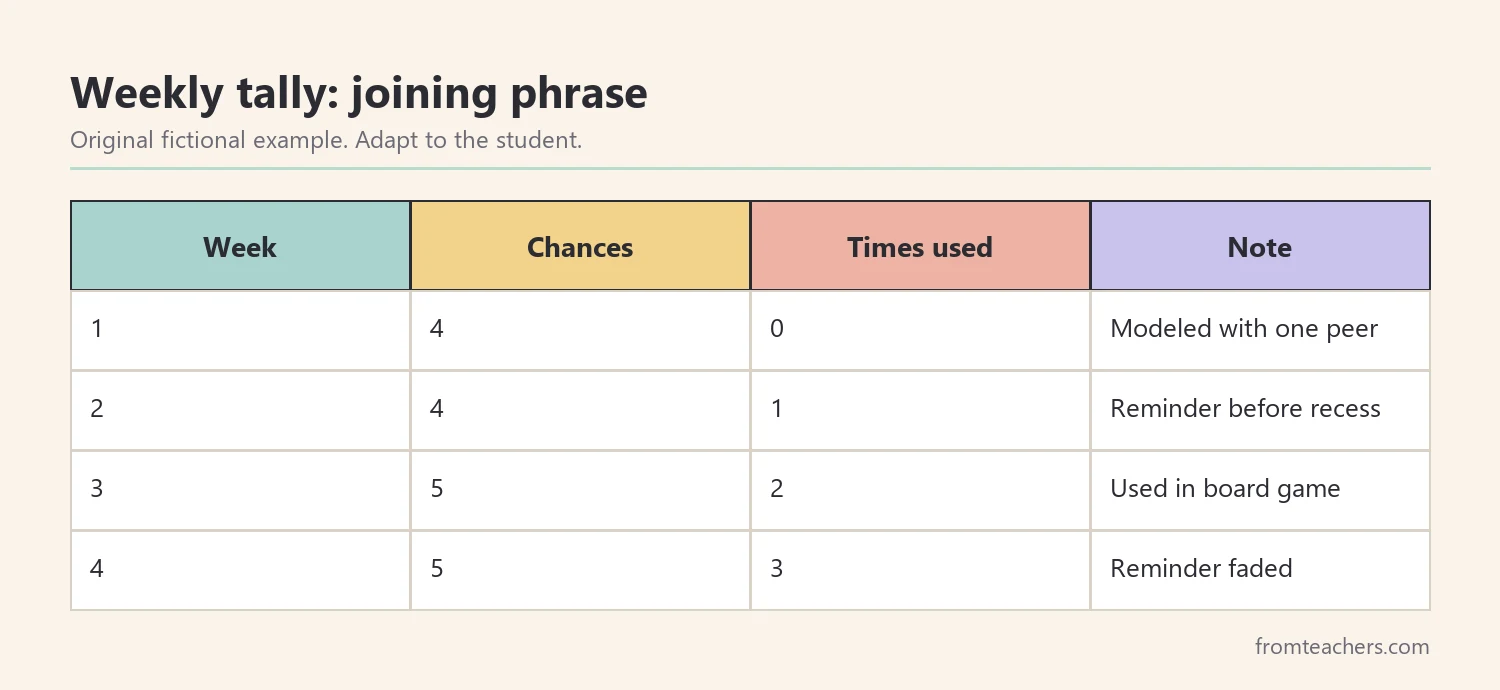
Worked example. Over four weeks, Leo practices “Can I play?” with one classmate during a structured game, then at recess. The weekly tally shows 0 of 4 chances in week 1, 1 of 4 in week 2, 2 of 5 in week 3, and 3 of 5 in week 4. At the re-check, the team repeats the same checklist in the same four settings. Asking to join now appears “sometimes,” and the team picks the next goal: keeping a conversation going for two turns.
Share the results with the family in plain words. Show the first and second social skills checklist side by side, point to the items that moved, and ask what they notice at home. This short conversation often reveals whether the new skill is starting to carry over beyond school.
As a result, the team has a clear record of change, not just a feeling that things are better.
Common mistakes and how to avoid them
- Observing every area at once. Fix: start with two or three areas tied to the concern, then widen later.
- Using one setting only. Fix: observe in at least three settings, including one unstructured time.
- Writing opinions instead of behaviors. Fix: write what you saw and heard, with time and context.
- Treating the checklist as a diagnosis. Fix: use it to plan teaching and share results with the team, who decide on any evaluation.
- Setting too many goals. Fix: choose one emerging skill first and add more once it is steady.
- Never repeating the checklist. Fix: schedule a re-check in three to four weeks with the same settings.
Questions teachers and parents ask about a social skills checklist
Who should fill out a social skills checklist?
Anyone who sees the student regularly can help, including teachers, aides, counselors, speech-language pathologists, and families. Using the same checklist across observers makes notes easier to compare. A family’s view of home behavior often adds information the school does not see.
How long does an observation take?
Ten to fifteen minutes per session is usually enough for a focused observation. Plan three or four short sessions across a week instead of one long one. Short, varied sessions give a more accurate picture.
Can a social skills checklist be used for a whole class?
Yes, though it works best for focused observation of one or a few students at a time. For a whole class, choose one area, such as turn-taking, and scan for students who may need more support. Then, observe those students more closely.
Is a checklist the same as a formal assessment?
No. A checklist is an informal observation tool that helps you describe behavior and plan teaching. Formal evaluations are carried out by qualified professionals through the school’s evaluation process.
How often should I repeat the checklist?
Every three to four weeks works well for most goals. Use the same settings and, if possible, the same observers. Between full rounds, a short weekly tally of the target skill keeps you on track.
Related reading: Autism Social Skills Development: Practical Strategies for Growth, The Power of Data Tracking in Special Education, and How Parents and Teachers Can Team Up for Special Education Success.
A companion resource for your social skills checklist:
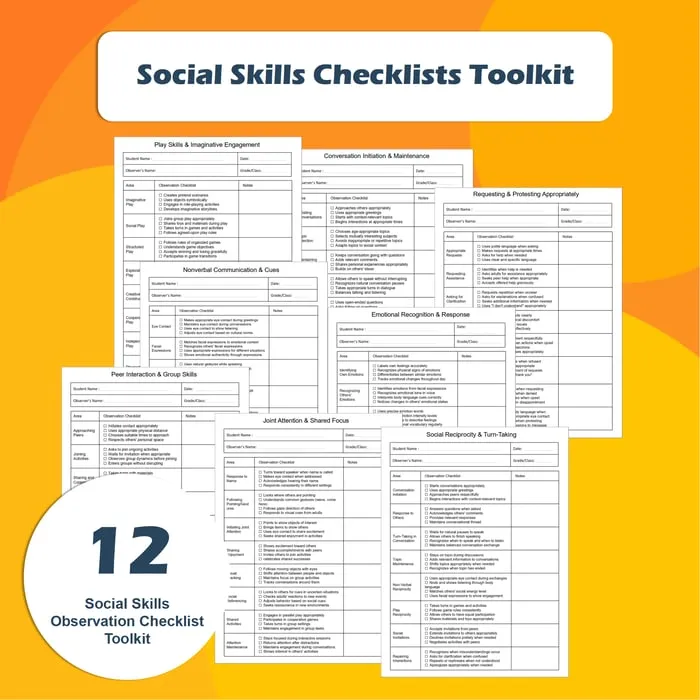
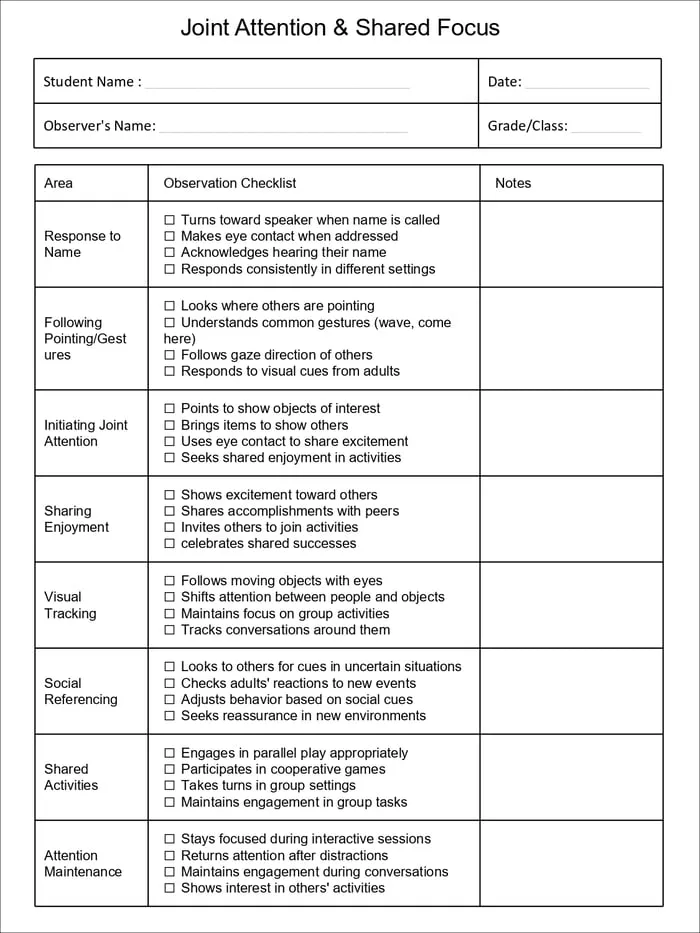
Social Skills Checklists Toolkit: a 12-page set of fillable observation checklists with student and observer fields and an Area, Observation Checklist, and Notes format. It covers conversation, turn-taking, nonverbal cues, emotion recognition, peer interaction, play, joint attention, and requesting help.
Sources and scope
- IRIS Center, Vanderbilt University: free modules on classroom behavior, data collection, and evidence-based practices.
- American Speech-Language-Hearing Association (ASHA): background on social communication and the role of speech-language pathologists.
- CASEL: a widely used framework for social and emotional learning in schools.
- IDEA, U.S. Department of Education: the law behind special education services, evaluations, and IEPs.
This guide covers using informal observation checklists to describe social behavior and plan teaching. It does not cover diagnosis or formal evaluation, which belong to qualified professionals and the student’s team.
Key takeaways
- A social skills checklist works best when you start with two or three focused areas.
- Observe in several settings, including at least one unstructured time.
- Write specific, observable notes so anyone can understand and compare them.
- Turn the clearest emerging skill into one measurable goal.
- Repeat the same social skills checklist every few weeks to track real growth.






Leave a Comment