

Summer regression can feel like watching months of hard work fade in a few weeks. Picture a first grader who could read 40 sight words in June and now stumbles over several of them in September. His teacher wonders what happened, and his parents wonder if they should have done more. Usually, nobody did anything wrong. The skills simply did not get enough practice during a long break.
This guide gives you a five-step plan to protect IEP progress over the summer. By the end, you will be able to pick the skills most at risk, build a short practice plan, set up simple home routines with families, keep motivation up, and check skills in the fall so you can respond quickly.
Examples are fictional. Adapt to the student’s goals and agreed supports. This is guidance, not a diagnosis.
At a glance
- Choose two or three skills to protect, not the whole IEP.
- Short, regular practice usually works better than long, rare sessions.
- Give families a simple plan, the materials, and one way to record practice.
- Plan for motivation dips and celebrate skills that hold steady.
- Check the same skills in June and in the fall, using the same measure.
1. Spot the skills most at risk of summer regression
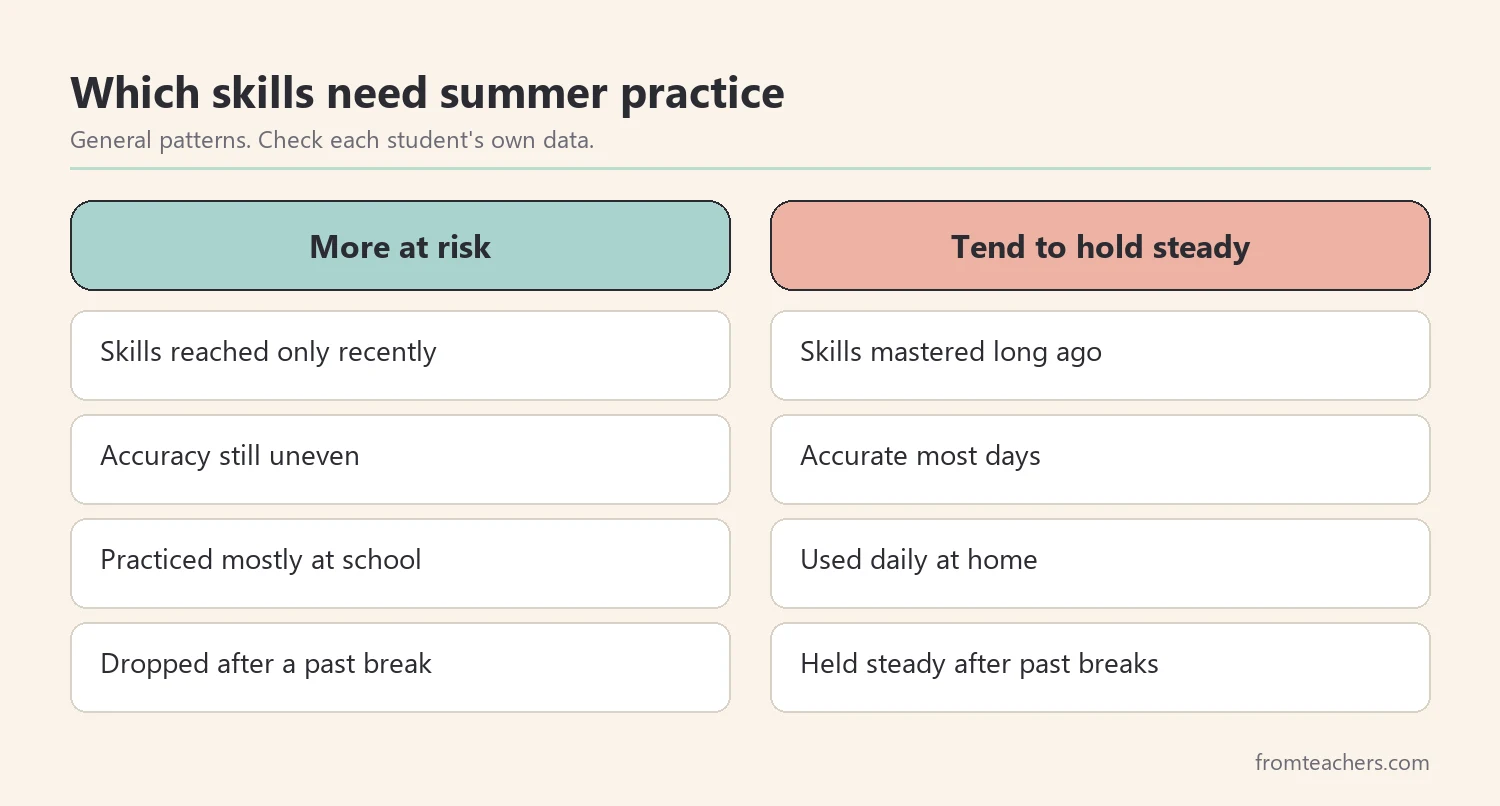
First, decide what to protect. Summer regression does not affect every skill in the same way. Skills that are new, not yet automatic, or practiced mostly at school are often the most fragile. In contrast, skills a student uses every day at home, such as asking for a snack, tend to hold up better.
Next, look back at past breaks. If you have data from last summer or from winter break, check which skills dropped and how long they took to return. Families can help here too. Ask, “After last summer, what seemed harder for your child in the fall?”
Signs a skill may need summer practice
- The student reached the goal only recently.
- Accuracy is still uneven from day to day.
- The skill needs prompts or cues to start.
- A past break led to a drop in this skill.
- The skill is rarely used outside school.
Then, choose two or three skills. A short list keeps the plan doable for families and makes fall checks quick. Also, record a clear June baseline for each skill, using a measure you can repeat in September.
Worked example. Omar is a fictional student in grade 1 with IEP goals in reading, math, and self-help skills. In June, he reads 40 of 50 sight words and answers 18 of 20 addition facts to 10. He also zips his jacket on his own every day at home. His teacher chooses sight words and addition facts for summer practice, because both are new and mostly practiced at school.
Also, share your choices with the family before the last week of school. Explain why these skills were chosen and what summer regression might look like at home, such as needing more help or taking longer to answer. Families who know what to watch for can tell you useful things in the fall.
In short, a focused list protects the skills that matter most without overwhelming the family.
2. Build a short summer practice plan
Once you know the skills, design the practice. A plan to limit summer regression should be short, regular, and easy to start. Ten minutes on most days often fits family life better than an hour once a week, and it keeps skills fresh.
For each skill, write one simple activity, how often to do it, and what success looks like. Use activities the student already knows from school, so families are not teaching something new. In addition, include a “too hard” option and a “too easy” option, so families can adjust without guessing.
| Skill | Activity | How often | Time |
|---|---|---|---|
| Sight words | Flash card game with the school word set | 4 days a week | 5 minutes |
| Addition to 10 | Dice game, add the two numbers | 4 days a week | 5 minutes |
| Reading together | Read a picture book aloud together | Most evenings | 10 minutes |
Then, check that the numbers make sense for the family. In this plan, the two skill games take 10 minutes on 4 days, which is 40 minutes a week. Reading together is extra and flexible. Ask the family whether this fits their summer schedule before you send it home.
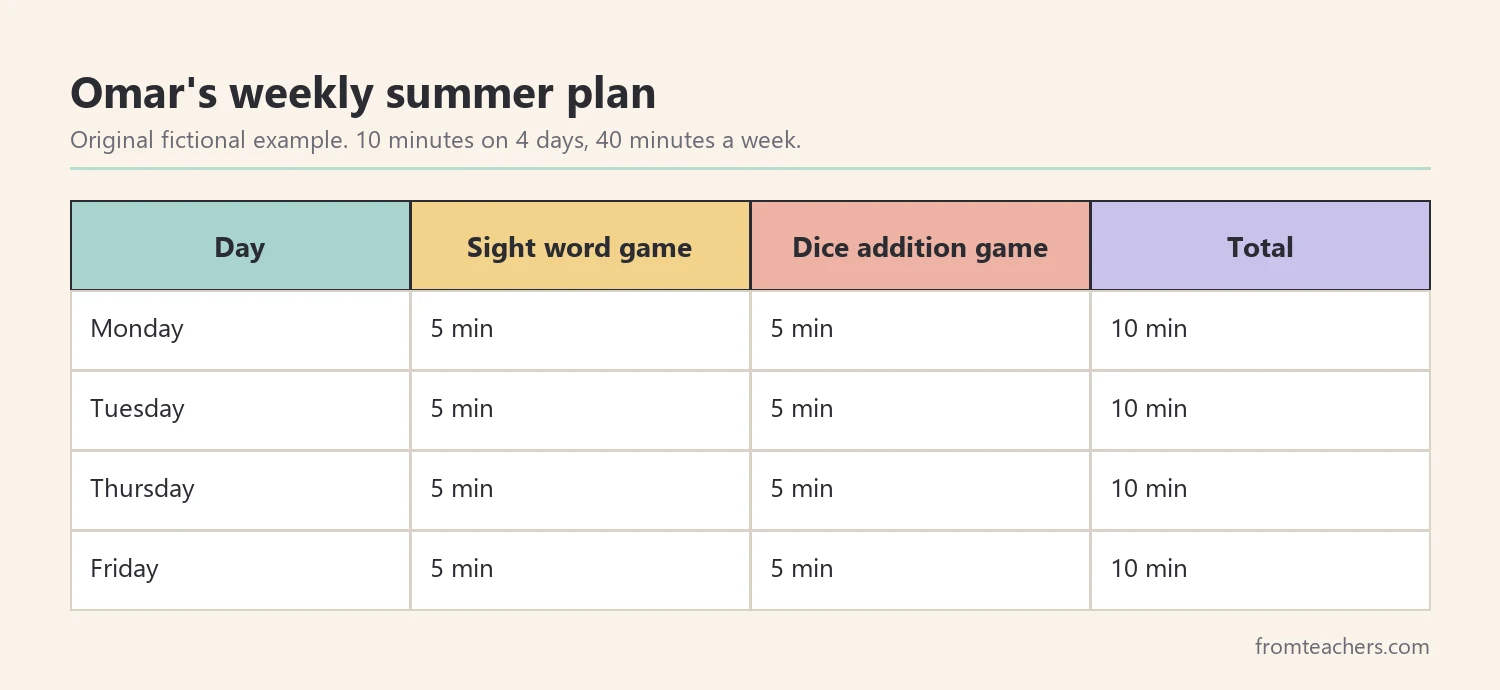
Worked example. Omar’s teacher prints his 50 sight words on cards and adds a pair of dice and a simple score sheet. She models both games with Omar in the last week of school. He plays each game with her twice, so he can show his parents how it works.
Put this step into practice
Finally, keep a copy of the plan in the student’s file. When you check for summer regression in the fall, you will want to know exactly what was practiced and how often.
As a result, the plan uses familiar materials and fits into ordinary family days.
3. Set up home routines with families to prevent summer regression
Next, make the plan easy to use at home. Families are the most important partners in preventing summer regression, but summers are busy and routines change. Therefore, keep instructions short, materials ready, and expectations realistic.
Send a one-page summer regression plan with pictures or simple steps. Include the materials in a labeled bag or folder. Also, suggest a regular time of day, such as after breakfast or before a favorite show, because practice is easier to remember when it is tied to something that already happens.
What to send home
- A one-page plan with the skills, activities, and times.
- All materials needed, labeled and ready to use.
- A simple calendar to check off practice days.
- Two or three tips for when the child resists.
- A contact or note about who to ask if questions come up.
In addition, be honest about flexibility. Trips, visitors, and illness happen. Let families know that missing a few days is normal and that starting again matters more than a perfect record. For more ideas on supporting practice at home, the summer IEP goal maintenance strategy tables include a page on helping parents support practice and another on correcting an inconsistent routine.
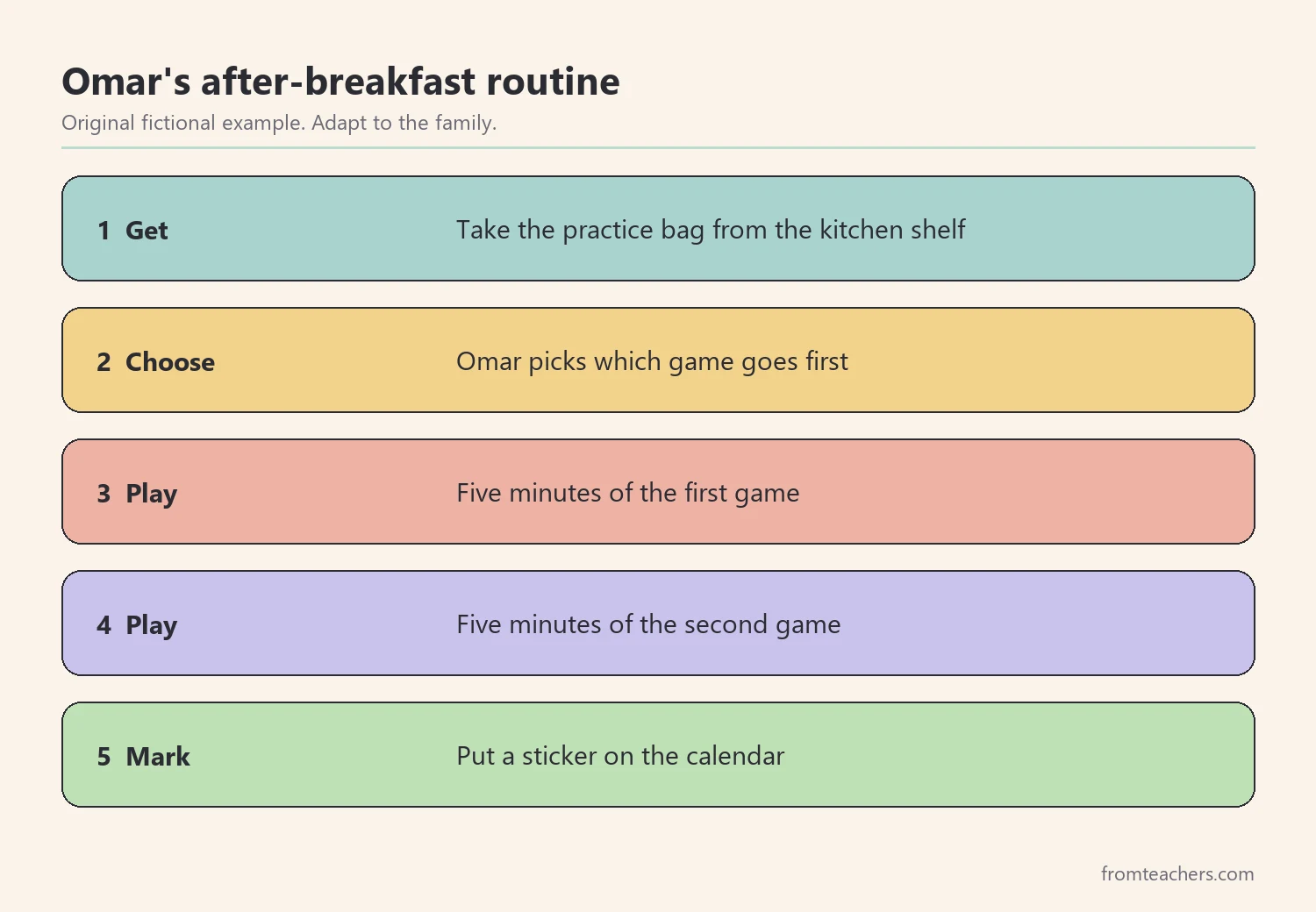
Worked example. Omar’s parents choose to practice right after breakfast. His mom keeps the bag on the kitchen shelf. Each practice day, Omar picks which game goes first, plays for 5 minutes on each, and puts a sticker on the calendar. On busy days, they skip the games and just read together.
4. Keep motivation up through the summer
Now, plan for the middle of the summer. Many families start strong and then slow down after a few weeks. Motivation dips are a normal part of any summer regression plan, so build in ways to keep practice fresh.
First, add choice and variety. The student might choose the order of games, the place to practice, or a new version of the same activity, such as a sight word scavenger hunt. Then, keep sessions short and end on success. A quick win at the end makes the next session easier to start.
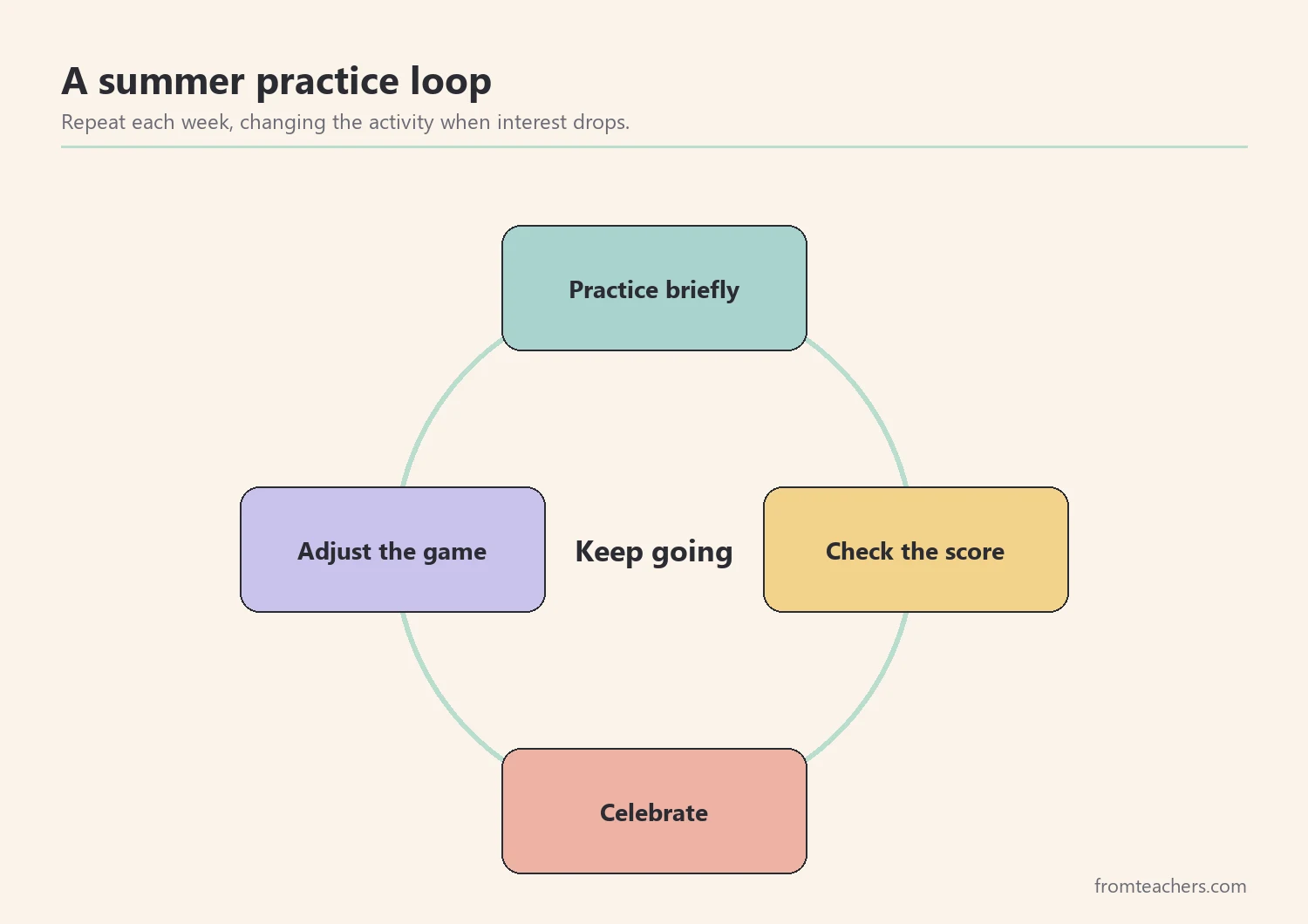
Also, celebrate skills that hold steady, not just new gains. In summer, keeping a skill is a real achievement. A simple chart, a photo sent to the teacher, or a small family reward can mark the moment. However, keep rewards small and tied to effort, so practice does not depend on prizes.
| Motivation dip | Quick fix |
|---|---|
| Child says the game is boring | Change the format, same skill |
| Practice keeps getting skipped | Move it to a different time of day |
| Child gets frustrated | Use the easier version, end on success |
| Family feels behind | Restart with fewer days, no guilt |
Worked example. By July, Omar groans when he sees the flash cards. His mom hides the cards around the living room for a scavenger hunt instead. He reads each word when he finds it. She sends his teacher a photo of the finished hunt, and the teacher replies with a short note of praise.
A quick classroom example
Meanwhile, a short mid-summer check-in from the teacher, by note or message, can remind families that the plan still matters. Keep it friendly and brief, and focus on what is going well. A small nudge often does more to limit summer regression than a long list of reminders.
In other words, the skill stays the same while the activity changes to keep interest high.
5. Check skills in the fall and respond to summer regression
Finally, measure the same skills when school starts. A quick fall check tells you whether summer regression happened, and how much. Use the same measure as in June, such as words read out of 50 or facts correct out of 20, so the numbers are easy to compare.
Next, give the student a short warm-up period before you judge summer regression. Some skills come back quickly with a few days of review. Therefore, check once in the first week, then again after one or two weeks of regular teaching before making bigger decisions.
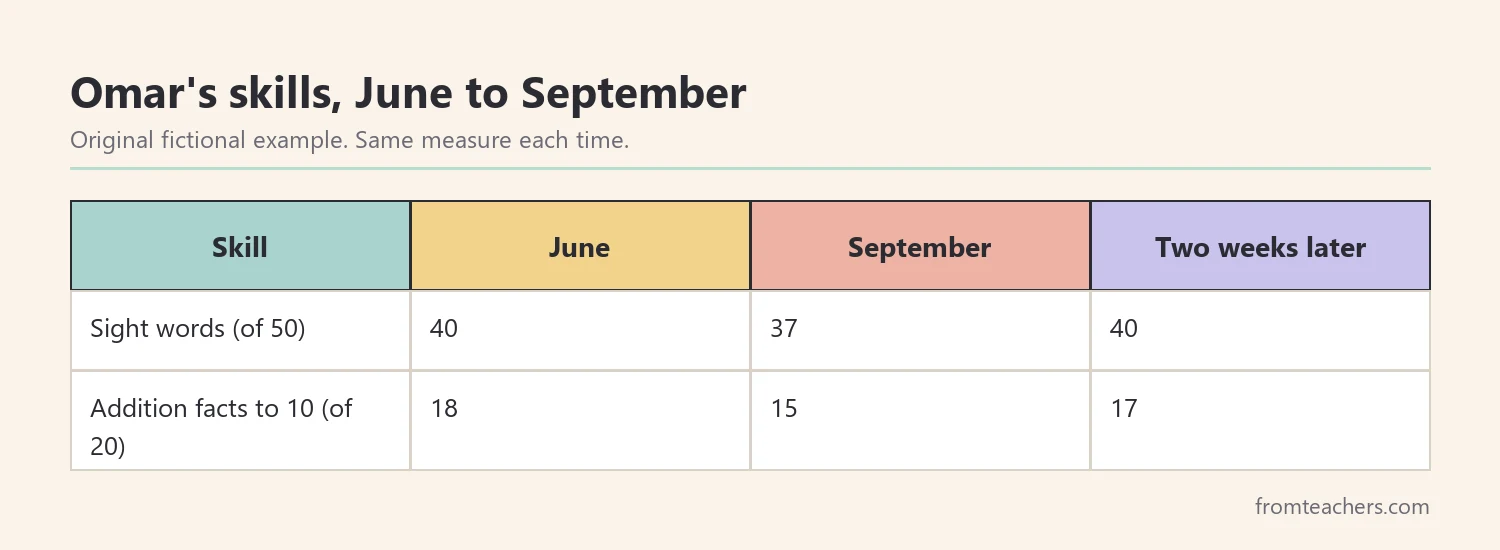
Then, respond to what you see, because summer regression looks different for each skill. If a skill returns quickly, continue as planned. If it stays lower, add short daily review and share the data with the team. If a student shows significant loss over breaks year after year, the IEP team may discuss whether extended school year (ESY) services should be considered. That decision belongs to the team, based on the student’s needs and your local guidelines.
Worked example. In September, Omar reads 37 of 50 sight words, compared with 40 in June. He answers 15 of 20 addition facts, compared with 18 in June. His teacher adds 5 minutes of daily review for both. Two weeks later, he is back to 40 sight words and 17 addition facts, so she keeps the review for math only.
Common mistakes and how to avoid them
- Sending home the whole IEP. Long lists overwhelm families. Fix: choose two or three skills that are most at risk.
- New activities the child has never seen. Families end up teaching instead of practicing. Fix: use games and materials the student already knows from school.
- No June baseline. Without a starting point, you cannot measure summer regression. Fix: record a clear score for each skill before the break.
- All-or-nothing expectations. Families stop after missing a week. Fix: say clearly that restarting matters more than a perfect calendar.
- Testing on the first day back. Early scores can look worse than they are. Fix: allow a short warm-up, then check again after regular teaching.
- Only celebrating new skills. Keeping a skill is easy to overlook. Fix: celebrate retained skills as real progress.
Questions teachers and parents ask about summer regression
Is summer regression the same for every student?
No. Some students keep most skills over a break, while others lose more and take longer to recover. That is why data from past breaks is so useful. It shows which skills and which students need the most support.
How much practice is enough over the summer?
There is no single right amount. Many families find that short sessions on most days are easier to keep up than long sessions. Start with a plan the family can realistically follow, then adjust based on how it goes.
What if the family cannot practice at home?
Some families have work schedules or other demands that make practice hard. Look for other options, such as summer programs, library activities, or simpler routines built into daily life. Talk with the family about what is possible, without judgment.
When should the team talk about extended school year services?
Extended school year decisions are made by the IEP team, based on the student’s needs and local guidelines. Data on how a student does over breaks, and how long skills take to return, is often part of that discussion. Bring your June and fall data to the meeting.
Can summer regression be fully prevented?
Not always, and that is okay. The goal is to reduce the loss and shorten the time it takes to recover. Even a small amount of regular practice can help skills return faster in the fall.
Related reading: The Power of Data Tracking in Special Education, How Parents and Teachers Can Team Up for Special Education Success, and How Teachers Communicate With Parents in Special Education: Building a Strong Partnership.
A companion resource for summer regression:
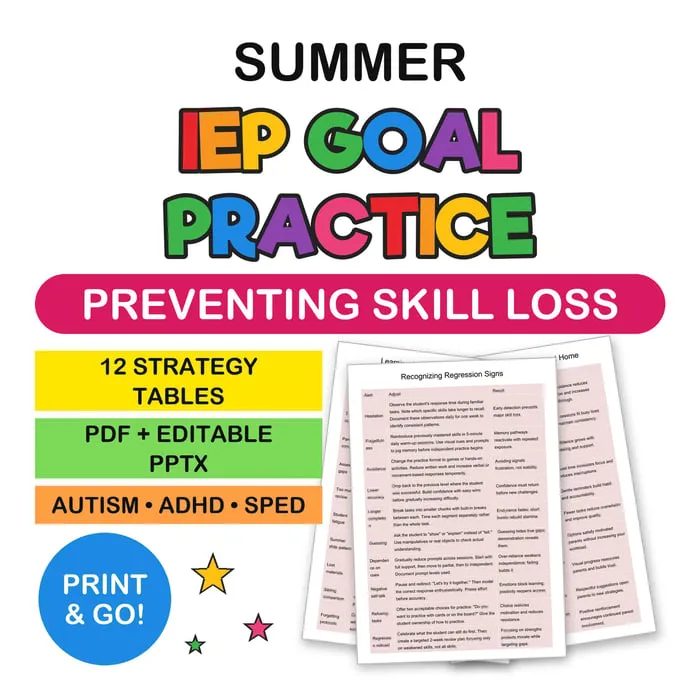
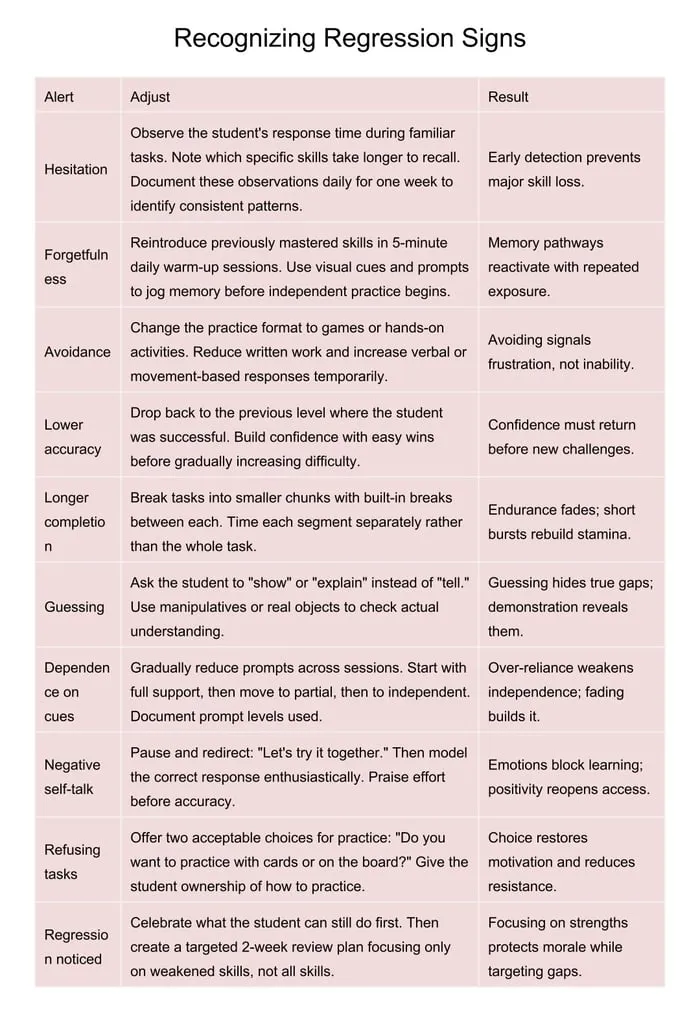
Summer IEP Goal Maintenance: Preventing Skill Loss During Break Strategy Tables: 12 strategy tables for teachers and parents, each focused on one real situation, such as recognizing regression signs, identifying motivation drops, helping parents support practice at home, and celebrating retained skills. Includes a PDF and an editable PowerPoint.
Sources and scope
- IDEA, U.S. Department of Education: the law behind IEPs, including the framework for extended school year services.
- IRIS Center, Vanderbilt University: free modules on progress monitoring and evidence-based practices.
- Understood.org: practical articles for families on summer learning and IEPs.
- Center for Parent Information and Resources: information for families about special education services and planning.
This guide covers practical ways to maintain IEP skills over a long break. It does not decide eligibility for extended school year services or replace decisions made by the student’s IEP team.
Key takeaways
- Summer regression is most likely for new, uneven, or school-only skills.
- Choose two or three skills and record a June baseline for each.
- Short, regular practice with familiar materials fits family life best.
- Plan for motivation dips and celebrate skills that hold steady.
- Check the same skills in the fall, allow a warm-up, then respond with the team.










Leave a Comment