

SPED classroom strategies are easy to find and surprisingly hard to use well. Picture a special education teacher at 7:45 a.m., with a new paraprofessional arriving, a student who melted down after yesterday’s fire drill, and a parent meeting at lunch. There are hundreds of ideas online, but the real question is which one to use right now, and how to explain it so every adult does it the same way.
This guide gives you a five-step method for choosing and using strategies with purpose. By the end, you will be able to name the need area, pick one strategy, write clear implementation steps, train your team, and use simple data to decide what to keep or change.
Examples are fictional. Adapt to the student’s goals and agreed supports. This is guidance, not a diagnosis.
At a glance
- Sort the problem into one need area before you choose a strategy.
- Pick one strategy at a time and write down why you are using it.
- Turn every strategy into short steps any adult in the room can follow.
- Train paraprofessionals and support staff so the strategy looks the same all day.
- Track one simple measure and review it every few weeks.
1. Sort the need before choosing SPED classroom strategies
First, name the area of need. SPED classroom strategies work best when they match the real problem, and many problems look alike on the surface. A student who leaves the group might be overwhelmed by noise, unsure of the task, avoiding a hard skill, or trying to tell you something without words.
Next, use a short list of need areas to sort what you see. Common areas include behavior, emotional regulation, sensory needs, academic support, communication, executive function, social skills, and life skills. You do not need a perfect label. You only need a best first guess that you can test.
Then, write one sentence that describes the moment. Include when it happens, during what activity, and what happens next. For example: “During the move from recess to reading, Jonah sits under the table and does not join the group for several minutes.”
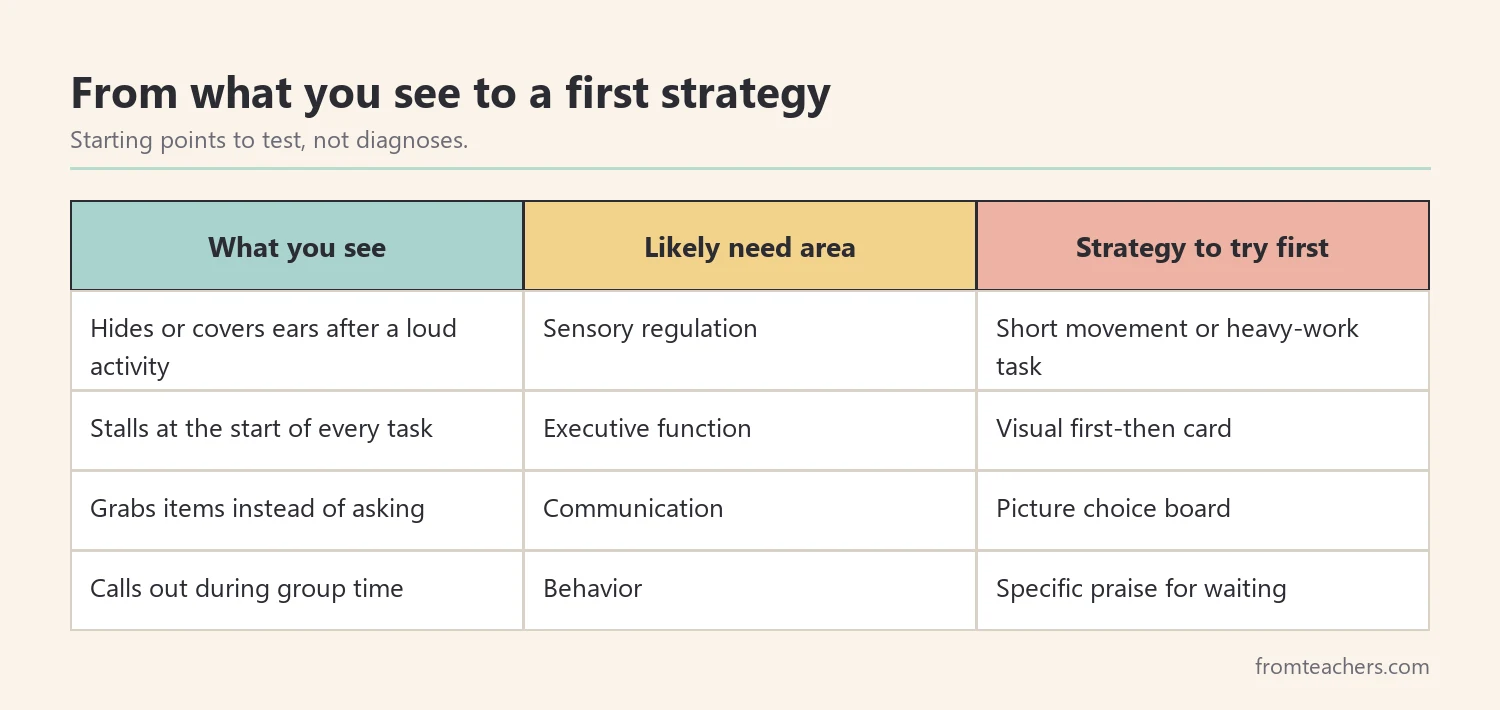
Worked example. Jonah is a fictional student in grade 2 in a self-contained classroom. His teacher notices that the hardest time of day is coming in from recess. He is loud and fast outside, then hides under a table when reading begins. She sorts this under sensory and emotional regulation, not under defiance, because he looks overwhelmed rather than angry.
Also, remember that one moment can involve more than one area. When that happens, start with the area that seems to drive the others. SPED classroom strategies for regulation often need to come first, because a student who feels overwhelmed cannot use an academic or communication support well.
In short, a clear need area keeps you from choosing a behavior plan for a sensory problem, or the other way around.
2. Choose one strategy and state its purpose
Once you know the need, pick one strategy. It is tempting to try several SPED classroom strategies at once, especially on a hard week. However, when you change five things together, you cannot tell which one helped.
For each strategy, write its purpose in one plain sentence. The purpose explains what the strategy is meant to change for the student. It also helps new staff understand why they are doing something that might look unusual, such as offering a heavy-work task before a lesson.
| Need area | Strategy | Purpose |
|---|---|---|
| Sensory regulation | Short movement or heavy-work task | Help the body calm before seated work |
| Executive function | Visual first-then card | Show what comes next and what follows |
| Communication | Picture choice board | Give a way to ask without words |
| Behavior | Specific praise for the target skill | Make the expected behavior more likely |
Also, check that the strategy fits the student’s plan. If the student has an IEP, look at the goals and listed supports. The best SPED classroom strategies connect directly to what the team has already agreed on.
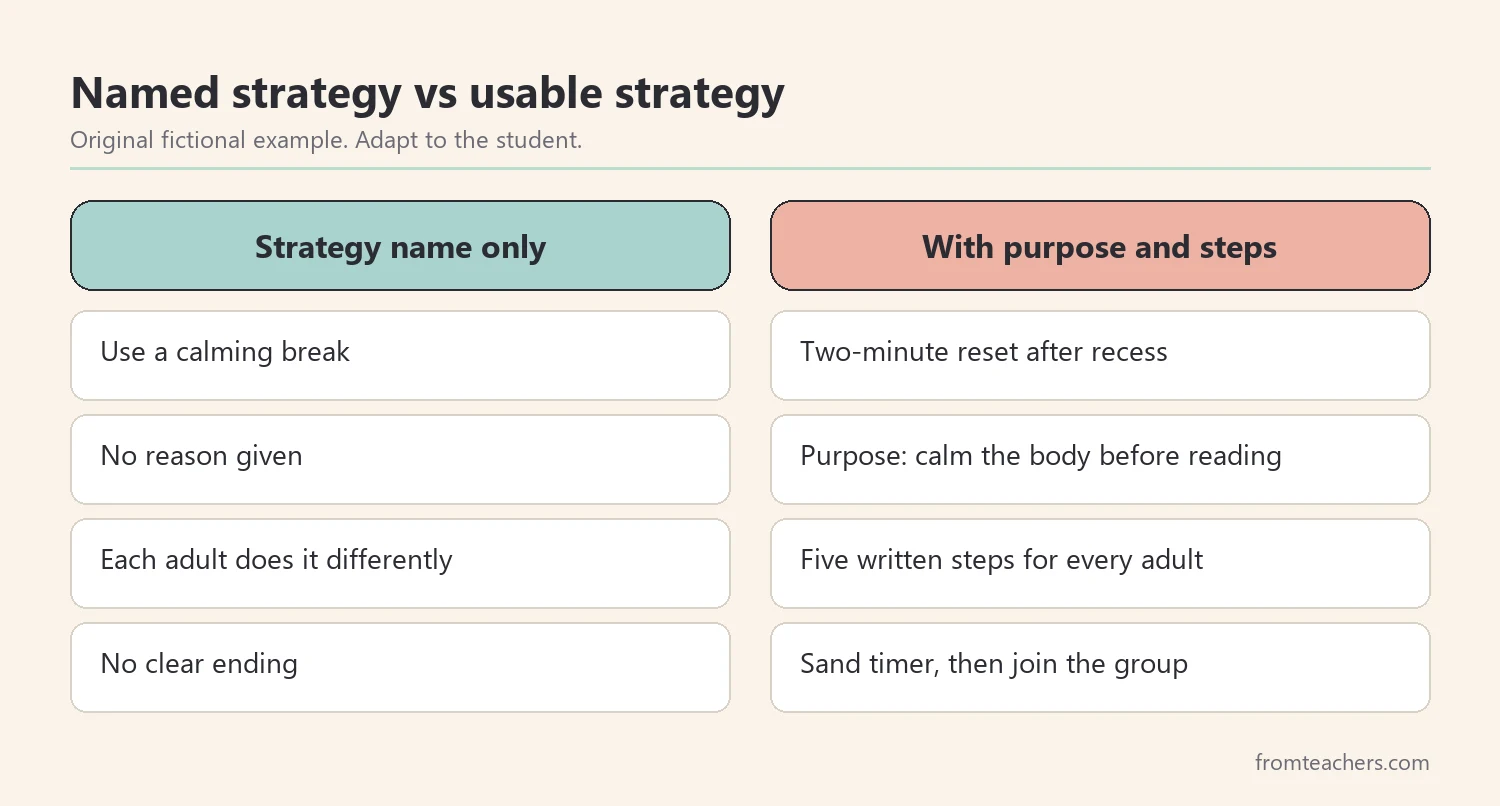
Worked example. Jonah’s teacher chooses a short reset routine after recess. Its purpose is to help his body move from playground energy to calm before the reading group starts. She decides to leave his reading task and seating the same for now, so she can see the effect of this one change.
3. Write clear implementation steps for SPED classroom strategies
Next, turn the strategy into steps. Many SPED classroom strategies fail not because the idea is wrong, but because each adult does it a little differently. Written steps make the strategy predictable for the student and easy to hand over to someone else.
Keep each step short and observable. Write what the adult says or does, what the student does, and what happens at the end. In addition, include a clear finish point, such as a timer, a final card, or a return to the group. Without an ending, a calming routine can stretch until it replaces the lesson.
Implementation checklist
- Is each step one clear action?
- Does it say who does what?
- Is there a visual or a set phrase the student can learn?
- Is there a clear end and a return to the task?
- Could a substitute follow it without asking you?
If you would rather start from a tested layout, a set of 20 SPED strategy tables breaks each approach into Strategy, Purpose, and Detailed Implementation columns, and the editable PowerPoint version lets you add your own wording and examples.
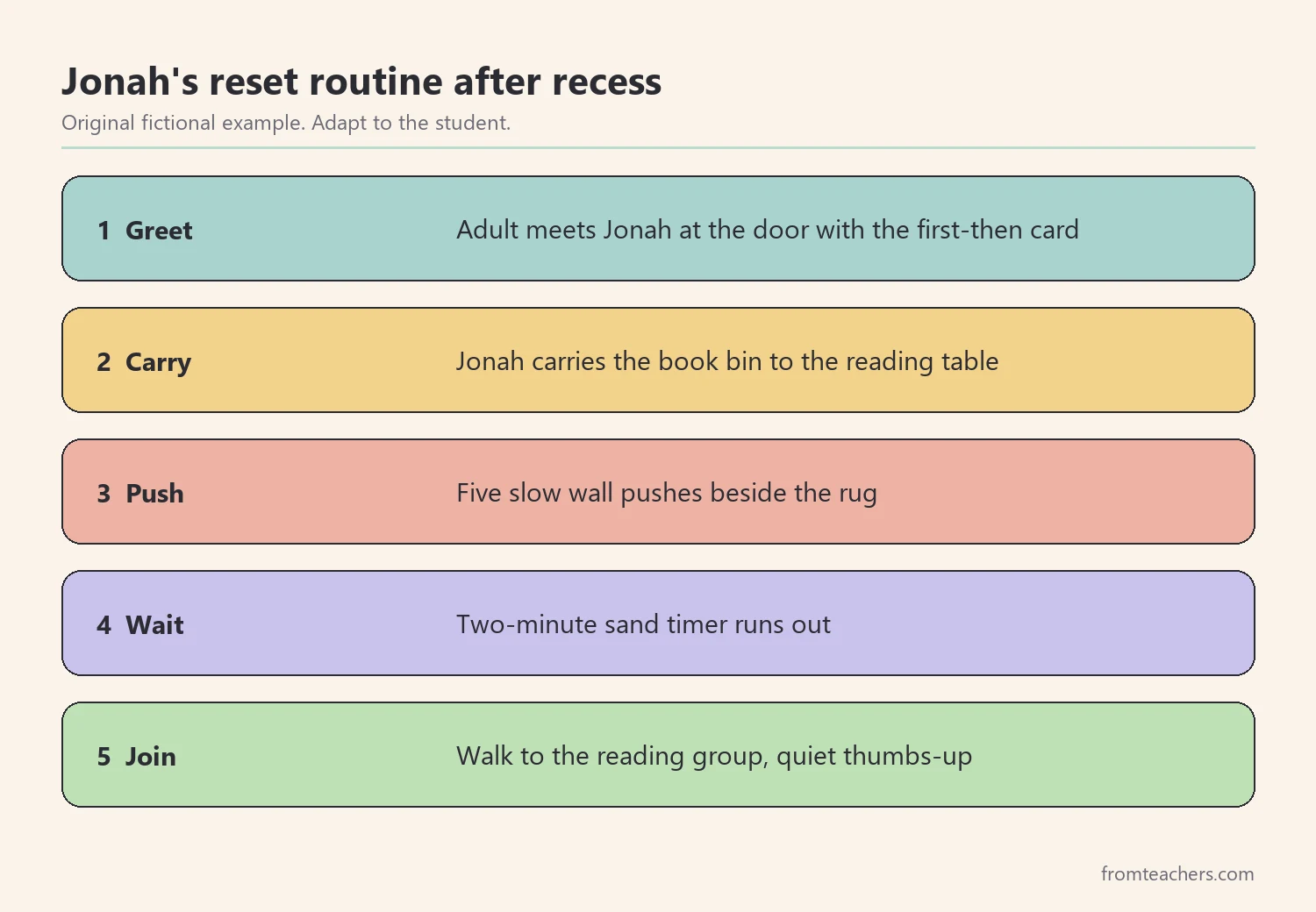
Worked example. Jonah’s reset routine has five steps. An adult meets him at the door with his first-then card showing “reset, then reading.” He carries the book bin to the reading table. He does five slow wall pushes beside the rug. When the two-minute sand timer ends, he walks to the reading group and receives a quiet thumbs-up.
Before you share the steps, try them yourself once with the student on a calm day. This quick test shows whether any step is confusing, too long, or missing. Good SPED classroom strategies often change slightly after the first run, and that is normal.
As a result, the routine is the same whether the teacher, the paraprofessional, or a substitute is at the door.
4. Train the team so every adult does it the same way
Now, share the strategy with every adult who works with the student. In many special education rooms, paraprofessionals, therapists, and specialists see the student as often as the teacher does. Consistent SPED classroom strategies depend on everyone knowing the steps, the purpose, and what to avoid.
Keep training short and practical. A ten-minute huddle before school is often enough. Explain the purpose, walk through the steps, and then role-play the moment once. Also, agree on the exact words to use, because small changes in language can confuse a student who relies on routine.
| Training step | What it looks like |
|---|---|
| Explain | Read the purpose and steps together |
| Model | Teacher shows the routine once |
| Practice | Staff member runs it while teacher watches |
| Feedback | One thing done well, one thing to adjust |
In addition, keep a printed copy where staff can see it. A strategy page clipped near the door or stored in a sub folder helps on busy days, when nobody has time to ask questions. Furthermore, share the purpose with the family, so they can tell you if a similar routine already works at home.
Worked example. Jonah’s teacher shows the reset routine to two paraprofessionals during a morning huddle. One plays Jonah while the other practices meeting him at the door. They agree on one phrase: “Reset first, then reading.” She clips the steps inside the classroom sub folder and sends a short note home describing the routine.
Finally, plan for days when staffing changes. Write a short version of the steps for substitutes and new staff, and point to the purpose line. Clear SPED classroom strategies should survive a sick day, not just a perfect day.
In other words, training turns a good idea into a shared habit.
5. Track results and adjust your SPED classroom strategies
Finally, decide how you will know the strategy is working. SPED classroom strategies need simple data, collected on the same days and in the same way. Choose one measure linked to the original problem, such as minutes to join the group, number of prompts needed, or tasks finished.
Keep the tool for tracking SPED classroom strategies simple. A tally sheet on a clipboard or a column in your data binder is enough. Also, write a short note when something unusual happens, such as an indoor recess or a new staff member. These notes help you explain changes in the numbers.
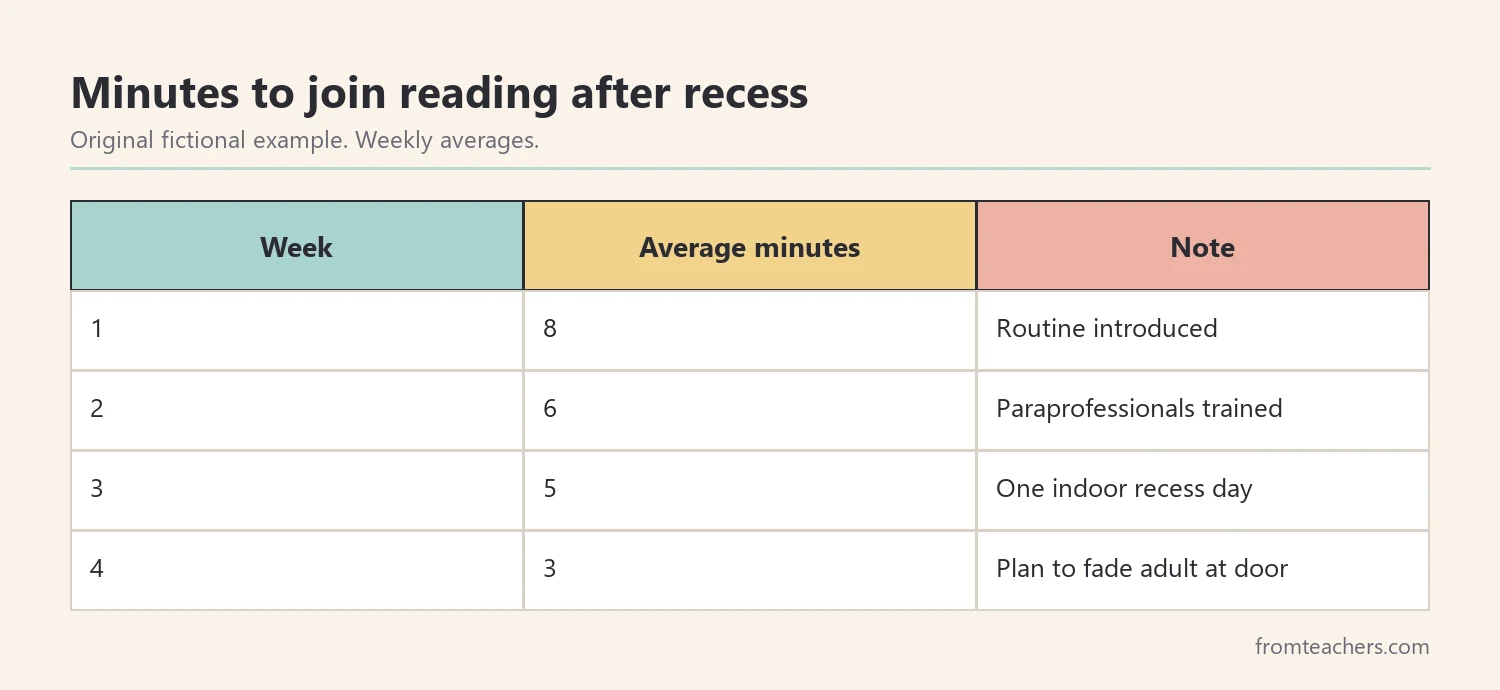
Then, review the data for your SPED classroom strategies every three to four weeks. Ask three questions: Is the measure moving in the right direction? Is the strategy being used as written? What is the next small change? If the strategy is working, plan how to fade adult support. If it is not, check consistency first, then try a different strategy from the same need area.
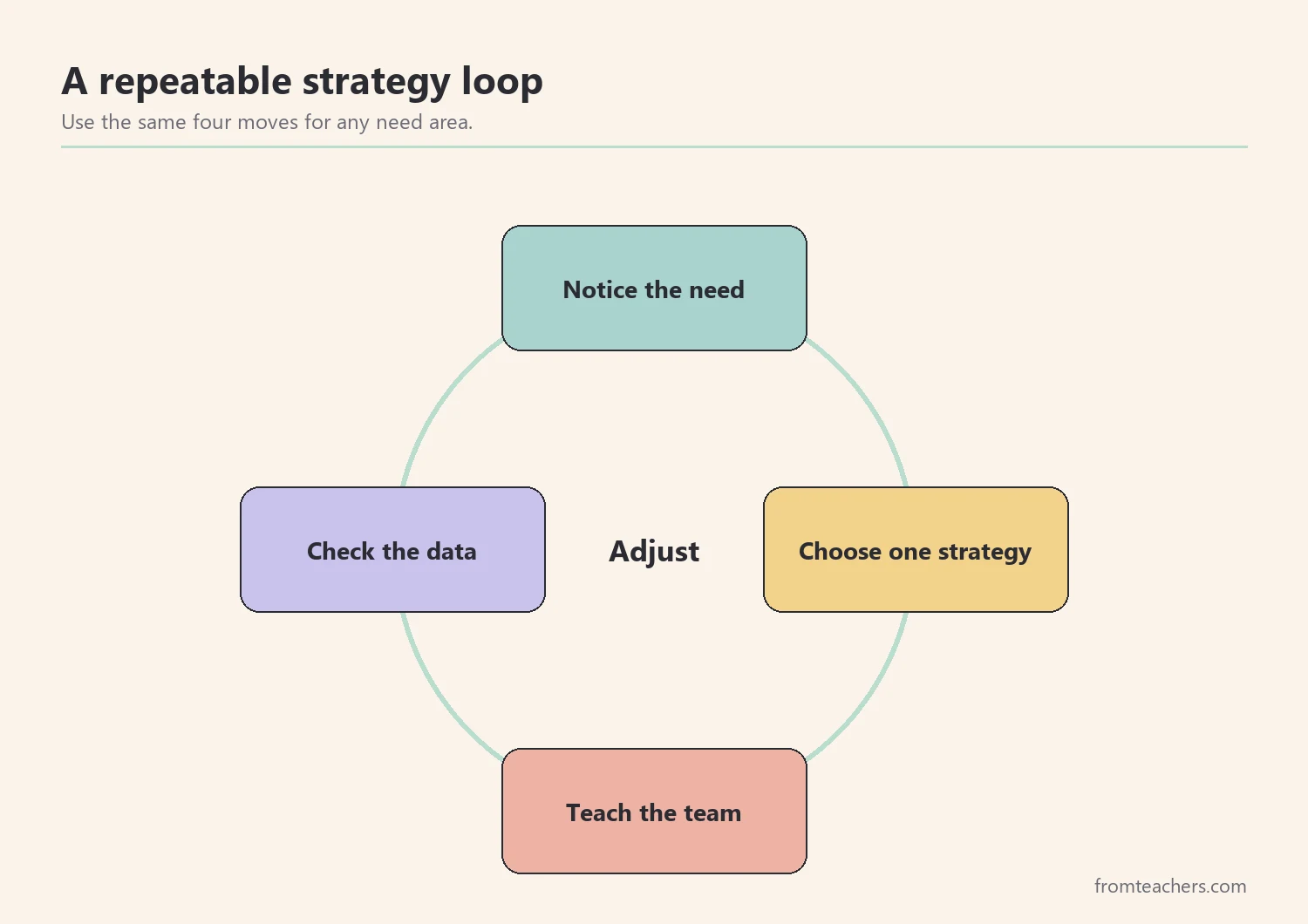
Worked example. Jonah’s team records how many minutes it takes him to join the reading group after recess. The weekly average drops from 8 minutes in week 1 to 6 in week 2, 5 in week 3, and 3 in week 4. In week 3, a note explains an indoor recess day. The team decides to keep the routine and to start fading the adult at the door in the next month.
Common mistakes and how to avoid them
- Picking a strategy before naming the need. A behavior chart will not fix a sensory problem. Fix: sort the moment into a need area first.
- Trying many SPED classroom strategies at once. You lose track of what helped. Fix: change one thing, track it, then add the next.
- Leaving out the purpose. Staff may stop a strategy that looks odd to them. Fix: write a one-sentence purpose and share it.
- No clear ending. Calming routines can grow longer each day. Fix: build in a timer or final step that leads back to the task.
- Training only the teacher. The student meets different versions of the routine. Fix: run a short huddle and role-play with all staff.
- Judging too quickly. New routines take practice. Fix: give the strategy a few weeks and look at the trend, not one hard day.
Questions teachers and parents ask about SPED classroom strategies
How many strategies should one student have at a time?
Start with one new strategy for the most important moment of the day. Once it is working and staff use it consistently, add another. Students may have several supports in place, but new ones are easier to judge when they are added one at a time.
Can SPED classroom strategies work in a general education class?
Yes, many of them can. Visual schedules, first-then cards, movement breaks, and specific praise often help the whole class. Talk with the general education teacher about which steps fit their room and routine.
What should a new paraprofessional learn first?
Start with the routines that happen every day, such as arrival, transitions, and breaks. Share the purpose and the exact steps, then let them practice with feedback. A printed strategy page helps them feel confident on their own.
How do I know if a strategy is not working?
Look at your data over a few weeks rather than a single day. If there is no change, check whether every adult is using the strategy the same way. If it is used consistently and still not helping, try another strategy from the same need area and talk with the team.
Should families use the same strategies at home?
Sharing strategies with families can help, especially for routines like transitions or calming. However, homes are different from classrooms, so invite families to adapt the steps. Ask what already works at home, because it may improve your classroom plan too.
Related reading: Special Education Strategies: 10 Powerful Ways Teachers Can Succeed, Managing Sensory Overload: Practical Strategies for Autism and ADHD, and The Power of Data Tracking in Special Education.
A companion resource for SPED classroom strategies:
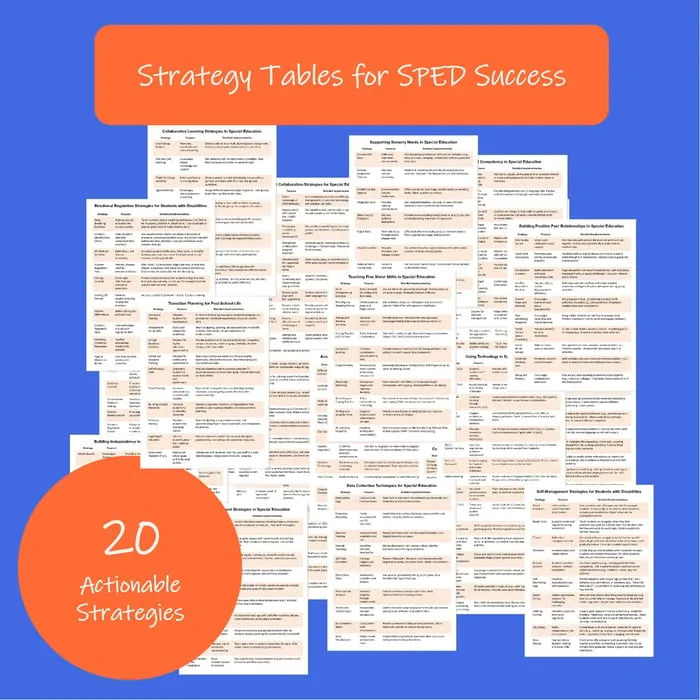
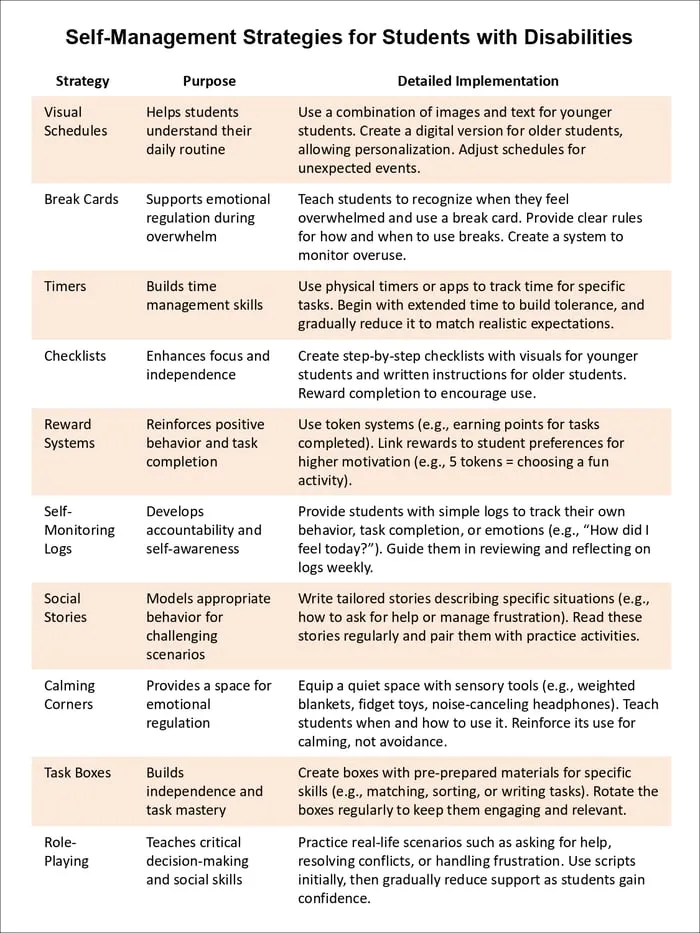
Special Education Teacher Toolkit: 20 All-In-One SPED Strategy Tables: twenty strategy tables covering areas such as behavior, sensory regulation, executive function, communication, life skills, transition planning, parent collaboration, and data collection, each organized by Strategy, Purpose, and Detailed Implementation, with an editable PowerPoint version.
Sources and scope
- IRIS Center, Vanderbilt University: free modules on classroom behavior, evidence-based practices, and working with paraprofessionals.
- IDEA, U.S. Department of Education: the law behind special education services and IEPs.
- What Works Clearinghouse: reviews of research on education programs and practices.
- CAST: Universal Design for Learning resources for planning flexible lessons.
This guide covers a practical process for choosing, teaching, and reviewing everyday classroom strategies. It does not replace individual evaluations, behavior assessments, or decisions made by the student’s IEP team.
Key takeaways
- SPED classroom strategies work best when they match a clearly named need area.
- Choose one strategy at a time and write its purpose in plain words.
- Short, written steps make a strategy consistent for every adult.
- Brief training and role-play turn a plan into a shared routine.
- Simple weekly data tells you when to keep, fade, or change a strategy.







Leave a Comment