

Supporting selective mutism in the classroom starts with one simple shift: the student is not refusing to talk, they feel stuck. Picture a second grader who chats with her sister at pickup, then goes completely silent the moment she walks into class. When the teacher asks her a direct question, she freezes, looks down, and the room waits. Everyone feels the pressure, and she feels it most.
This guide gives you a five-step plan: understand what is happening, remove speaking pressure, set up the room, offer ways to participate without words, and build confidence with very small steps tracked over time. By the end, you will have a calm, practical plan you can start this week.
Examples are fictional. Adapt to the student’s goals and agreed supports. This is guidance, not a diagnosis.
At a glance
- Silence is a freeze response, not defiance or a choice.
- Remove pressure to speak before you ask for anything new.
- Give the student clear ways to take part without talking.
- Build speaking confidence through tiny, planned steps.
- Work as one team with the family and every adult who sees the student.
1. Understand selective mutism in the classroom
First, get clear on what you are seeing. A student with selective mutism can speak, often freely, in some places and with some people. In other places, usually school, speech shuts down. This is commonly understood as an anxiety-related freeze, not stubbornness or shyness the student can simply push through.
Next, notice the pattern. Many students speak more easily with certain people, in certain places, or in certain activities. Others may nod, point, or write but not speak. Some may whisper to one friend but not to adults. These details matter, because they show you where the student already feels safe.
Then, talk with the family. Ask where and with whom the child talks comfortably, what helps, and what makes things harder. Families often know small details that save you weeks of guessing. If the student has a diagnosis or a support plan, ask what has been agreed.
| Question to ask | Why it helps |
|---|---|
| Where does your child talk easily? | Shows safe settings to build from |
| Who does your child talk to? | Shows possible bridge people |
| What helps on hard days? | Gives you calming tools |
| What has made it worse? | Shows what to avoid |
Worked example. Maya is a fictional student in grade 2. Her mother says Maya talks easily at home and with her cousin. At school, she has not spoken to any adult this year. However, she nods, points, and draws, and she sometimes whispers to her friend Lena during free play. That whisper is a strength the team can build on.
In short, understanding selective mutism in the classroom means looking for what already works, not only for what is missing.
2. Remove speaking pressure for selective mutism in the classroom
Pressure is the biggest barrier to progress with selective mutism in the classroom. Well-meaning moves like waiting in silence for an answer, offering a prize for talking, or saying “I know you can talk” often make the freeze stronger. As a result, the first job is to take the spotlight off speech.
Start with how you call on students, since this is where selective mutism in the classroom shows up most often. Avoid direct spoken questions in front of the class. Instead, ask questions the student can answer with a nod, a point, or a card, and move on quickly. Similarly, do not praise speech loudly if it happens. A calm, low-key response works better than a big reaction.
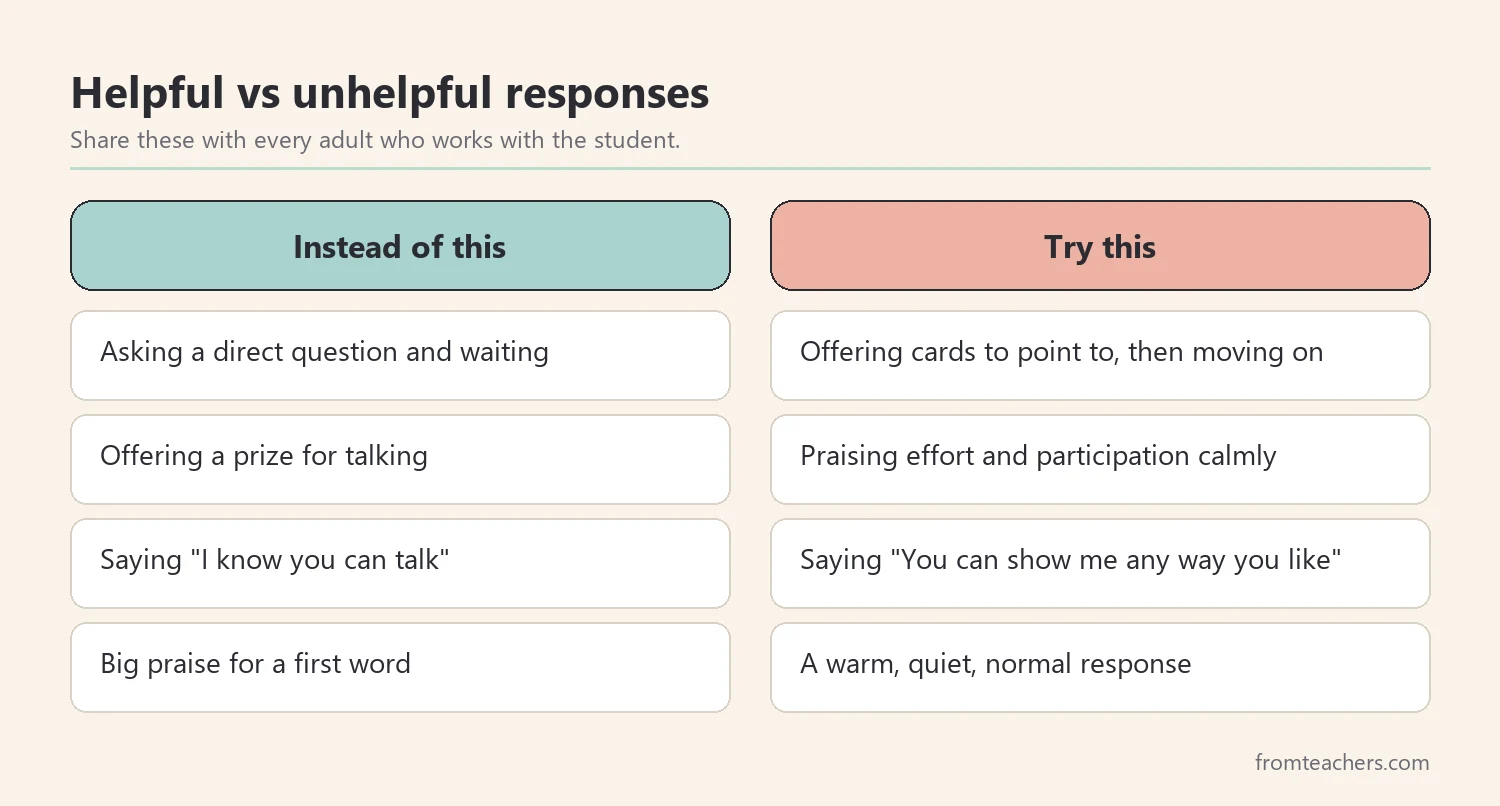
Also, watch what peers do. Classmates often answer for a quiet student or announce “She doesn’t talk.” Teach the class a simple rule: everyone can share in different ways, and we give each other time. Avoid talking for the student when a non-verbal answer is possible.
Worked example. During morning meeting, the teacher used to ask Maya, “How are you today?” and wait. Now, she holds up three feeling cards and Maya points to one. The teacher says, “Thanks, Maya,” and moves on. The morning check-in takes about five seconds, and Maya stays relaxed.
Moreover, think about greetings. A simple scripted greeting that needs no reply, such as “Good morning, Maya, glad you are here,” lets the student feel welcomed without being put on the spot. Over time, a wave back may follow on its own.
Finally, share these do’s and don’ts with every adult who works with the student, including aides, specialists, and substitutes. One adult pushing for speech can undo weeks of progress.
3. Set up a safe room for selective mutism in the classroom
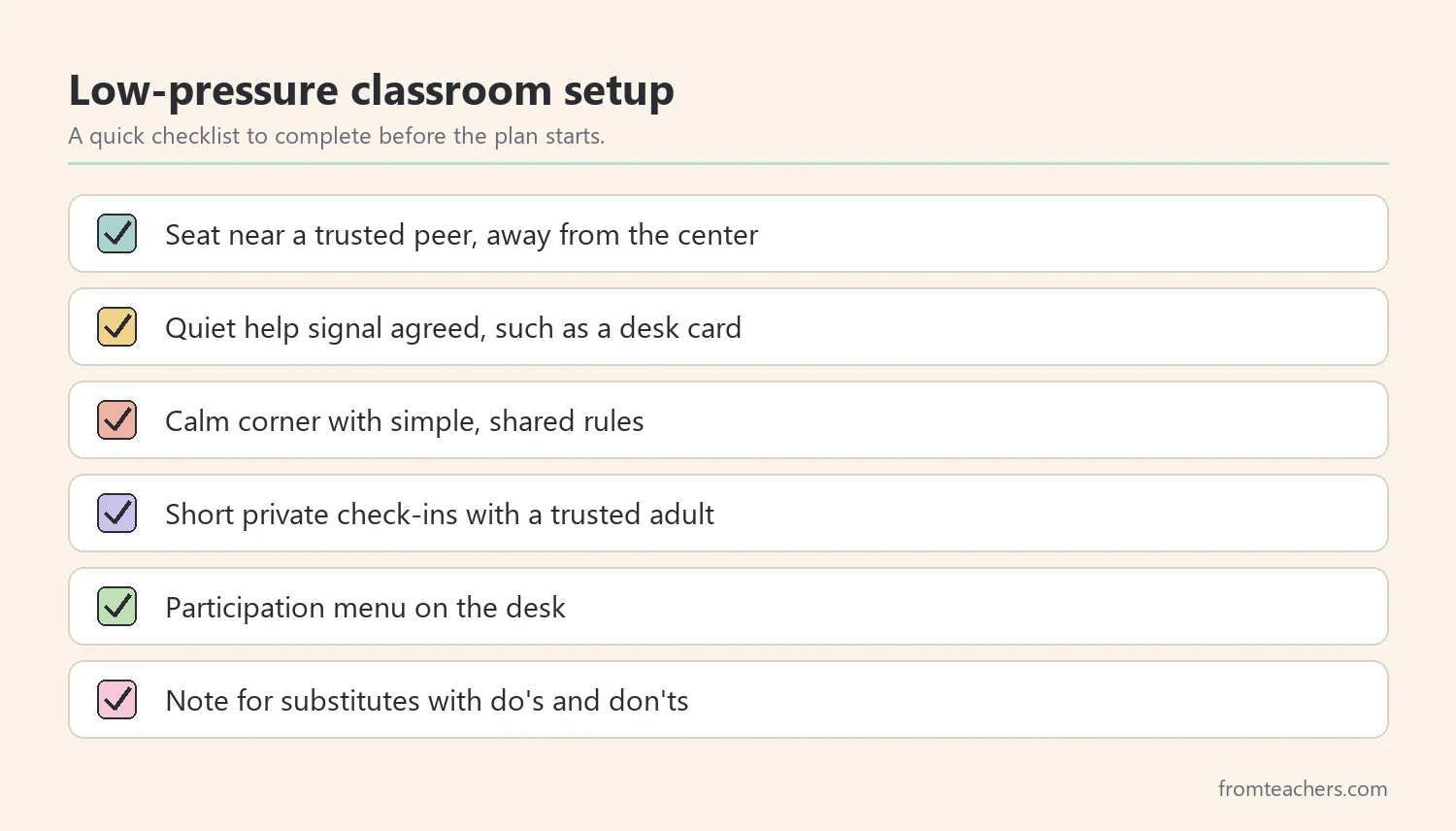
The room itself can lower anxiety for selective mutism in the classroom. Think about where the student sits, how they ask for help, and where they can go when they feel overwhelmed.
First, choose a seat near a trusted peer and away from the center of attention. Next, agree on a quiet signal for help, such as a card on the desk or a small hand sign. Then, set up a calm corner with clear rules so any student can use it briefly. Finally, plan short private check-ins, because one-to-one time with a trusted adult is often where the first small sounds or words appear.
A practical guide such as Selective Mutism Support: 50 Teacher Tips covers seating, quiet signals, calm corner rules, and private check-ins, so you can set up the room without starting from a blank page.
Worked example. Maya now sits next to Lena near the window. A green card on her desk means “I need help.” On Tuesdays and Thursdays, the teacher spends three minutes with Maya and Lena during free play, looking at a picture book together with no questions asked. The adult simply comments on the pictures.
In other words, the setup gives Maya predictable ways to get help and safe moments with a trusted adult.
4. Offer participation without speaking
A student who cannot speak at school can still learn, share ideas, and show what they know. The key is to give clear options that do not depend on talking. Plan these options before the lesson, not in the moment.
Useful options include response cards, mini whiteboards, pointing to choices, thumbs up or down, writing on a sticky note, or recording an answer at home if the family agrees. For partner work, let the student share through writing or gestures while the partner reads aloud. Moreover, offer these options to the whole class, so the student does not stand out.
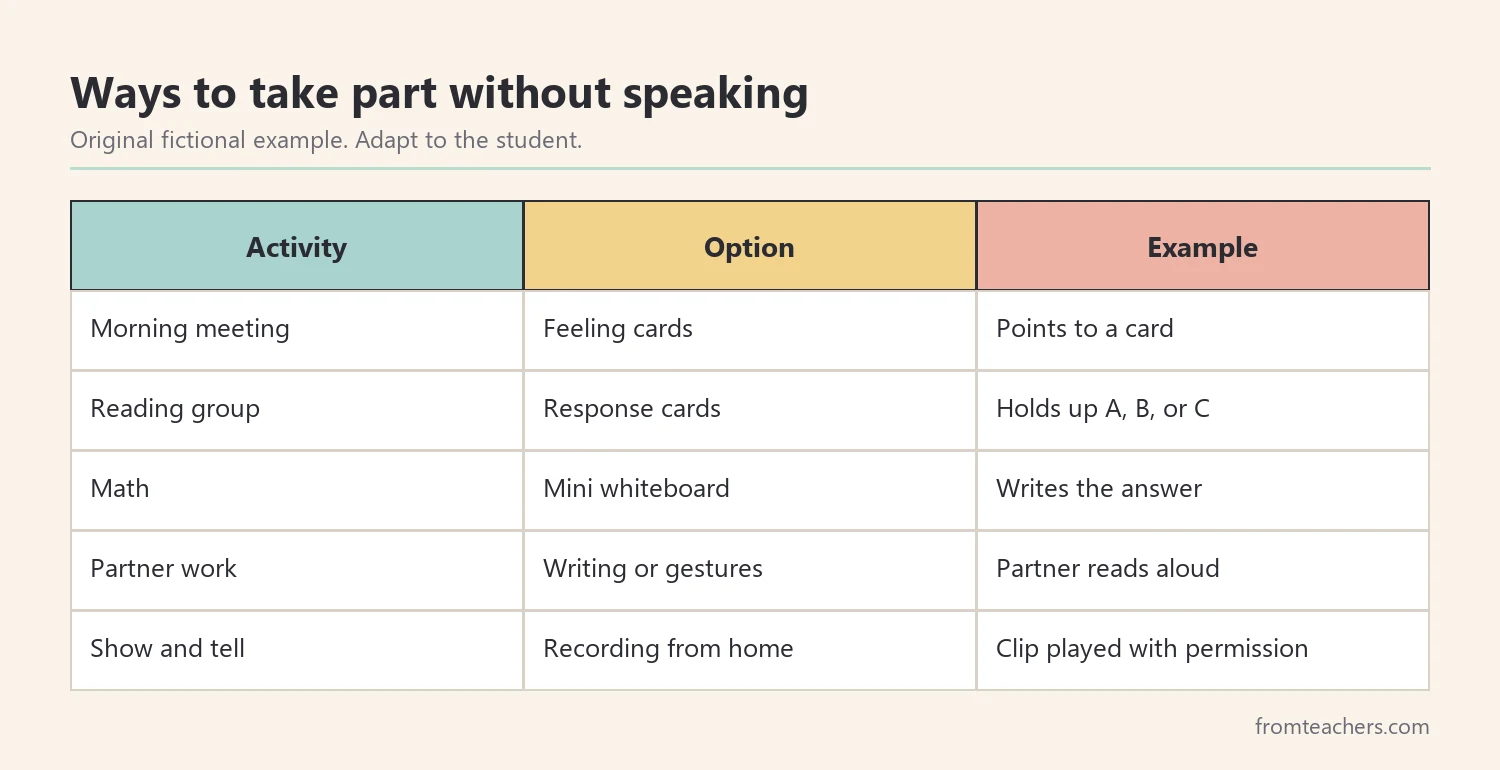
A participation menu is one of the simplest tools for selective mutism in the classroom. Keep a short “participation menu” on the student’s desk. It shows the options for each part of the day. This way, the student always knows how to take part, and adults can point to the menu instead of asking questions.
Worked example. In reading group, Maya holds up a card with A, B, or C to answer comprehension questions. In math, she writes answers on a mini whiteboard. During show and tell, her mother sends a short audio clip that the teacher plays for the class, with Maya’s permission. Maya smiles and points to her picture while the clip plays.
As a result, grades and participation reflect what Maya knows, not whether she can speak in front of the class.
5. Build small steps for selective mutism in the classroom and track them
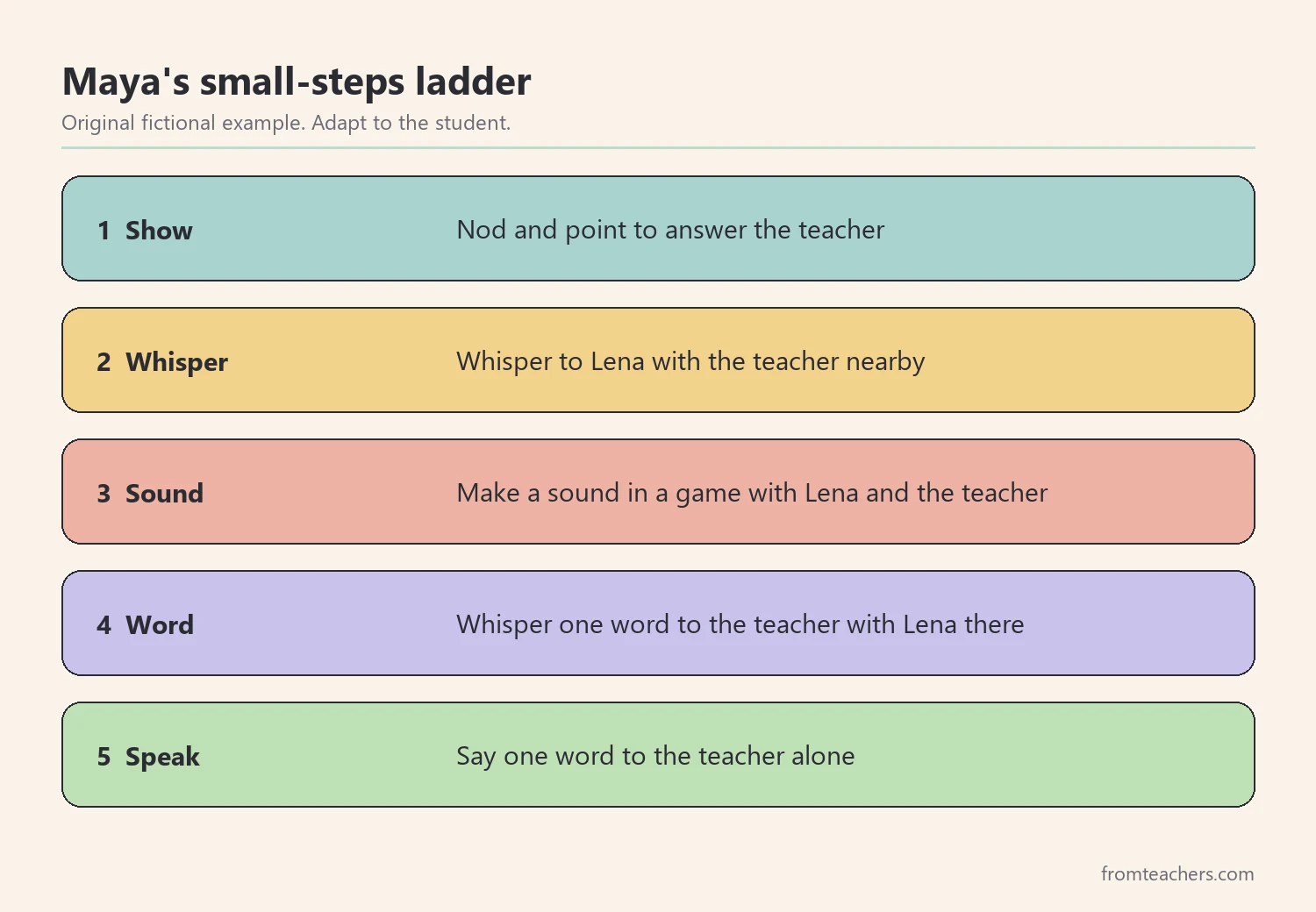
Once the student feels safe, you can begin building toward speech with very small steps. A “ladder” lists tiny goals, from easiest to hardest. The student moves up one rung only when the current rung feels easy, and can step back down on a hard day.
A ladder for selective mutism in the classroom should be built as a team. Build the ladder with the family and any specialist involved. Start from where the student is today. Typical rungs move from non-verbal responses, to sounds, to single words with a trusted person, and slowly to more people and places.
Next, track progress with a simple weekly record. Note the rung, how many chances the student had, how many times they did it, and any context. Share the record with the family every few weeks and adjust together.
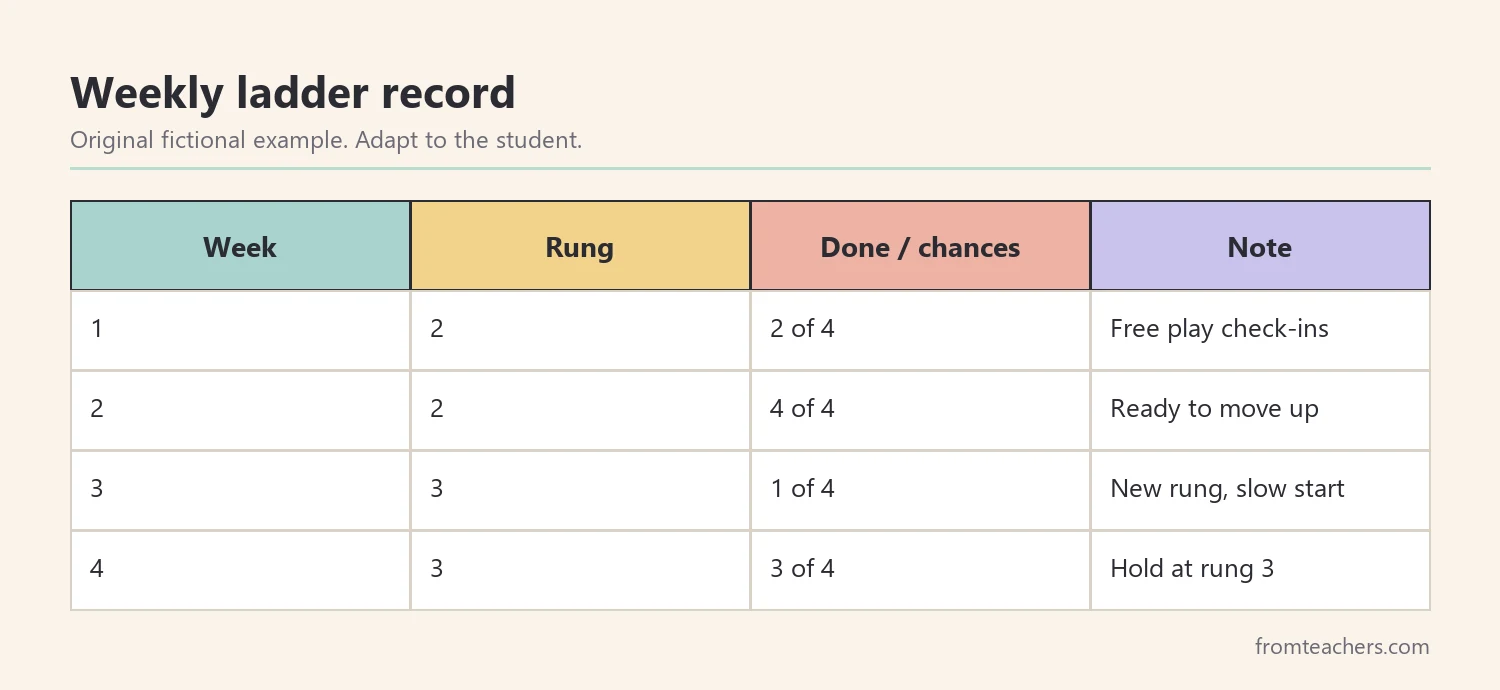
Worked example. Maya’s ladder has five rungs. She already does rung 1, nodding and pointing. In week 1, she whispers to Lena with the teacher nearby in 2 of 4 check-ins. By week 2, she does it in 4 of 4, so the team moves to rung 3, making a sound in a game with Lena and the teacher. She does this in 1 of 4 check-ins in week 3 and 3 of 4 in week 4. The team holds at rung 3 until it feels easy.
On hard days, step back down a rung without comment. Illness, a new adult, or a change in routine can all make a rung feel harder for a while. That is normal, and moving back down briefly is part of the plan, not a failure.
Also, plan for transitions. A new school year, a new teacher, or a move to a new building can reset some progress. Before a change, share the ladder, the participation menu, and the do’s and don’ts with the new adults so support for selective mutism in the classroom continues without a gap.
Above all, keep the pace slow. Small, steady steps with no pressure tend to last longer than a big push.
Common mistakes and how to avoid them
- Waiting in silence for an answer. Fix: offer a non-verbal choice and move on within a few seconds.
- Using rewards to get speech. Fix: keep rewards off speaking, and praise effort and participation calmly instead.
- Making a big deal of the first word. Fix: respond warmly but quietly, as if it were normal.
- Letting peers talk for the student. Fix: teach the class that everyone shares in different ways.
- Moving up the ladder too fast. Fix: wait until each rung feels easy before trying the next.
- Leaving substitutes out. Fix: add a short note on selective mutism in the classroom to the sub plans, with the do’s and don’ts.
Questions teachers and parents ask about selective mutism in the classroom
Is the student just being shy or stubborn?
No. Selective mutism is generally described as an anxiety-related condition where speech freezes in certain settings. The student usually wants to speak but feels unable to. Treating silence as defiance tends to increase anxiety.
Should I grade a student on oral participation?
Grading is a common worry with selective mutism in the classroom. Offer other ways to show the same skill, such as writing, pointing, or a recording made at home. Talk with the family and the student’s team about agreed supports. The goal is to measure learning, not speech.
What should I do if the student speaks for the first time?
First words are a big moment for selective mutism in the classroom, yet the best reaction is a small one. Stay calm and respond naturally, as you would to any student. Avoid announcing it to the class or making a big fuss. A quiet, warm reaction helps the student feel safe trying again.
How do I explain this to the rest of the class?
Keep it simple and general. For example, you might say that everyone shares in different ways and some friends use cards or writing. Avoid labels and check with the family before sharing anything personal.
When should the family seek outside help?
If silence at school continues, affects learning, or causes distress, the family may want to talk with the child’s doctor or a qualified mental health professional. The school team can also discuss whether an evaluation is appropriate. Teachers support the plan but do not diagnose.
Related reading: Essential Trauma-Informed Teaching Strategies for Modern Classrooms, How Teachers Communicate With Parents in Special Education, and Managing Sensory Overload: Practical Strategies for Autism and ADHD.
A companion resource for selective mutism in the classroom:
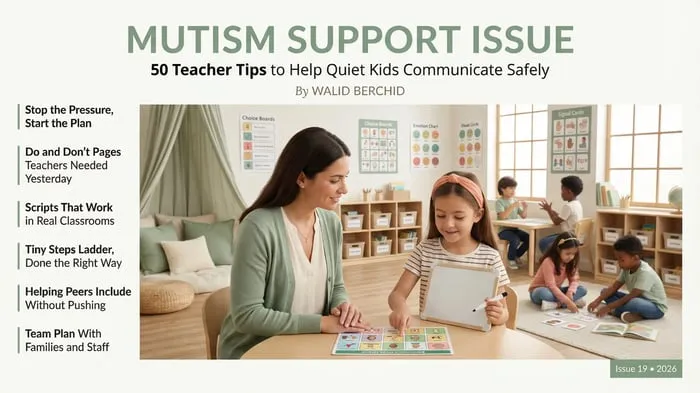
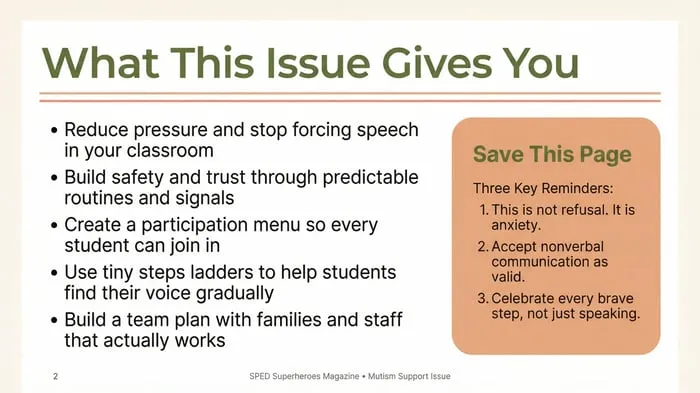
Selective Mutism Support: 50 Teacher Tips: a practical guide with do and don’t guidance, classroom setup, participation without speaking, a tiny steps ladder with templates, scripts for greetings, choices, peers, and substitutes, progress tracking, and a family and staff teamwork plan.
Sources and scope
- Selective Mutism Association: information and resources for families and educators.
- Child Mind Institute: general information on childhood anxiety and selective mutism.
- American Speech-Language-Hearing Association (ASHA): background on communication and the role of speech-language pathologists.
- IRIS Center, Vanderbilt University: free modules on classroom supports and evidence-based practices.
This guide covers everyday classroom strategies for lowering pressure and supporting participation. It does not cover diagnosis or treatment, which belong to qualified professionals working with the family and the student’s team.
Key takeaways
- Selective mutism in the classroom is a freeze response, not a choice.
- When handling selective mutism in the classroom, remove speaking pressure first and share the do’s and don’ts with every adult.
- Set up the room with a safe seat, a quiet help signal, and private check-ins.
- Offer clear ways to participate without speaking for every part of the day.
- Build speech slowly with a small-steps ladder and track it with the family.








Leave a Comment