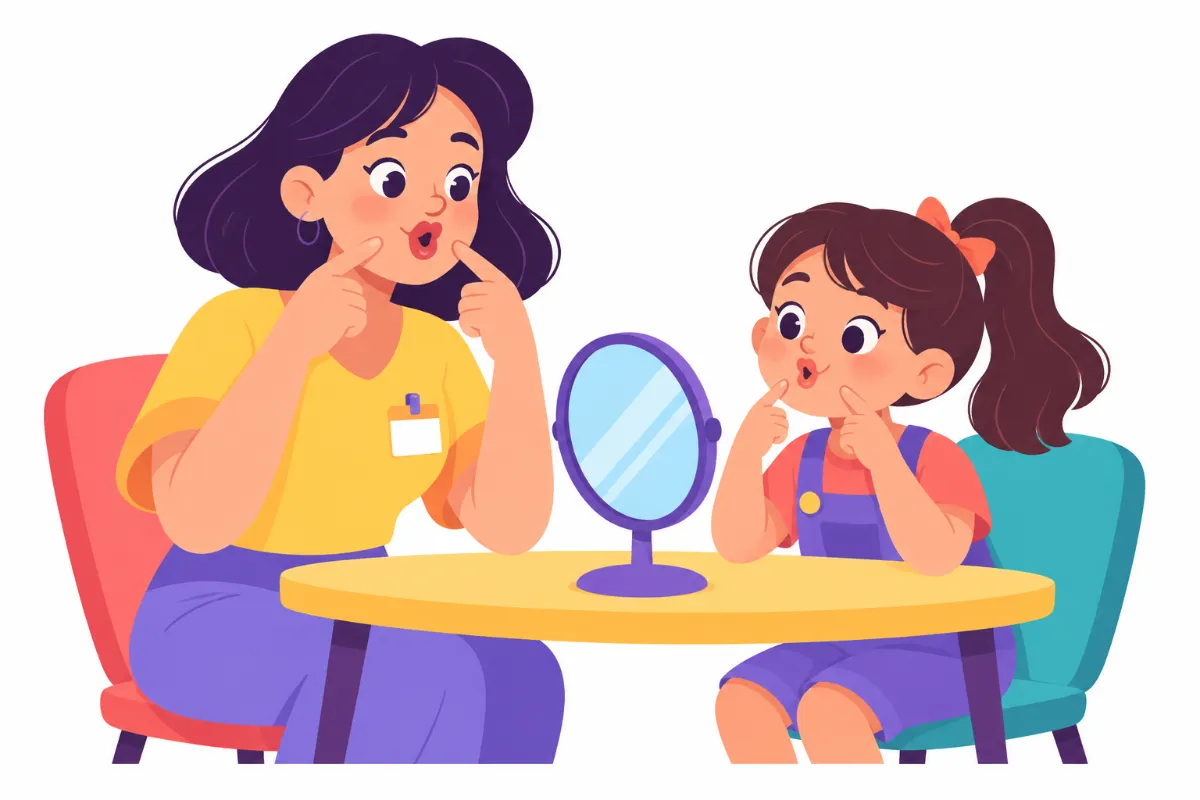

Childhood apraxia of speech often shows up in small, puzzling moments. A first grader says “cup” clearly at snack time, then a minute later struggles to say it again, moving his lips silently before a different sound comes out. Adults may wonder whether he is shy, distracted, or simply not trying. In most cases, none of those is the reason.
This guide gives teachers and parents a clear five-step process: understand what the speech disorder is, observe the patterns that matter, share notes with the speech-language pathologist (SLP), support communication in class, and build practice and carryover at home. By the end, you will know what to watch for, how to write it down, and how to help without adding pressure.
Examples are fictional. Adapt to the student’s goals and agreed supports. This is guidance, not a diagnosis.
At a glance
- Childhood apraxia of speech is a motor speech disorder: the child knows what to say but has trouble planning the movements.
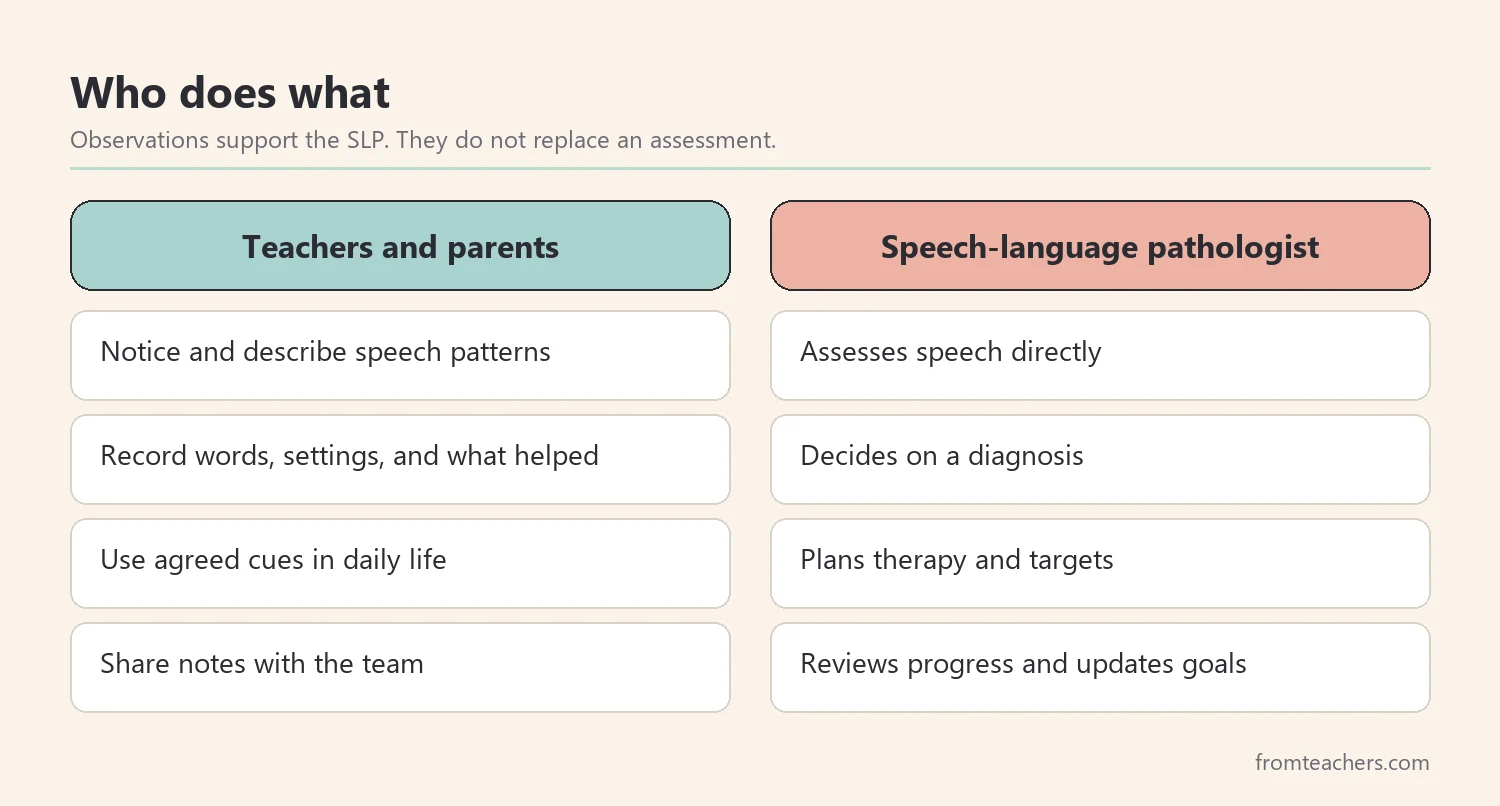
- Only a qualified SLP can diagnose it. Teachers and parents add valuable observations.
- Record patterns across days and settings, not single mistakes.
- Give time, cues, and other ways to communicate so the child is never stuck.
- Plan short, frequent practice and watch for carryover into everyday talk.
1. Understand what childhood apraxia of speech is
First, get the basic idea clear. Childhood apraxia of speech (often shortened to CAS) is a motor speech disorder. The child usually knows the word and wants to say it, but the brain has difficulty planning and sequencing the movements of the lips, jaw, and tongue. It is not caused by weak muscles, and it is not a sign of low effort or low intelligence.
Next, learn the features professionals listen for. The American Speech-Language-Hearing Association (ASHA) describes features such as inconsistent errors when the same word is repeated, difficulty moving smoothly from one sound or syllable to the next, and unusual stress or rhythm in speech. You may also see groping, where the mouth searches for the right position before the sound comes out.
Then, keep the line between noticing and diagnosing clear. Many children have speech sound errors that are not apraxia. A diagnosis comes from an SLP who assesses the child directly. Your role is to describe what you see and hear, as accurately as you can.
| You might notice | What it could mean |
|---|---|
| Same word said differently each time | Inconsistent errors |
| Short words clear, longer words break down | Trouble sequencing sounds |
| Silent mouth movements before speaking | Groping for the position |
| Speech sounds choppy or flat | Differences in prosody |
| “Hi” and “bye” easy, new words hard | Automatic vs planned speech |
Worked example. Leo is a fictional student in grade 1. His teacher notices that he says “dog” clearly in a familiar song but struggles to say “dog” when naming a picture. She also hears “banana” come out three different ways during one morning. She does not decide what this means. Instead, she writes down exactly what she heard and when.
In short, understanding the features helps you notice the right things. It does not make you the one who diagnoses.
2. Observe childhood apraxia of speech patterns over time
Patterns matter more than single moments in childhood apraxia of speech. Every child mispronounces words sometimes. With childhood apraxia of speech, the useful information is how speech changes across repeats, tasks, listeners, and settings.
Start with a few target words the child uses often, such as names of classmates, snack items, or classroom objects. Then, listen for the same word on different days and in different situations. Note whether it is clear, close, or hard to understand, and whether the child seemed to struggle to start.
Next, compare automatic and planned speech. Greetings, songs, and counting are often easier than naming a new picture or answering an open question. In addition, watch for effort: visible struggle, repeated attempts, or frustration after several tries. These details help the SLP see the whole picture.
What to record in each note
- Date, time, and setting (circle time, snack, small group).
- The exact word or phrase and how it sounded.
- Whether it was automatic (song, greeting) or planned (new answer).
- Any groping, restarts, or visible effort.
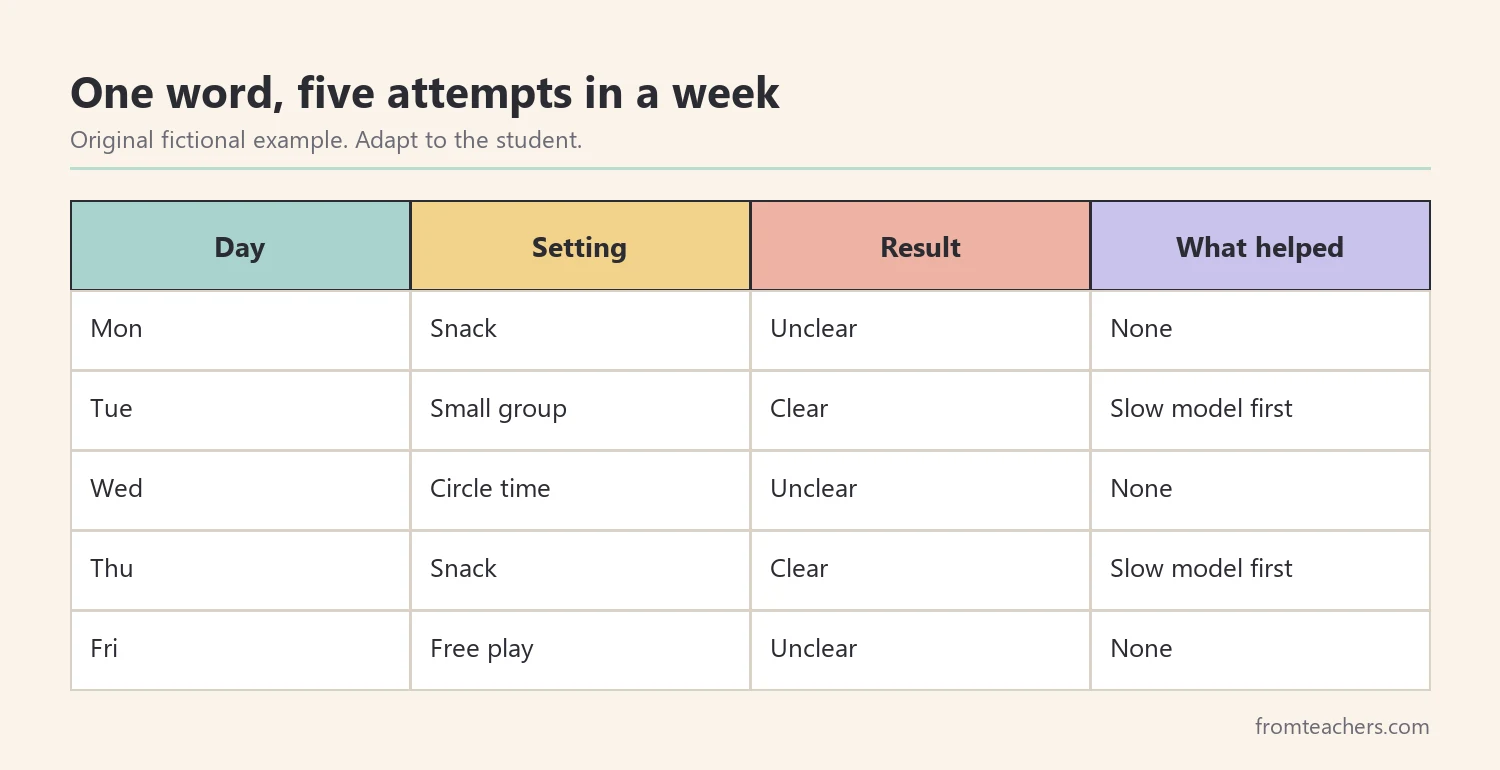
- What helped, such as a model, a gesture, or slowing down.
A structured form makes this much faster. The set of 12 childhood apraxia of speech observation checklists covers areas like inconsistent sound errors, transitions between sounds and syllables, prosody, automatic versus voluntary productions, and response to cueing, each with a notes column.
Worked example. Over one week, Leo’s teacher records “banana” five times. It is clear twice and unclear three times, for five attempts in all. Both clear attempts happen when she says the word first and Leo repeats it slowly. She also notes that Leo says “good morning” clearly every day during the class greeting.
As a result, her notes show a pattern, not just a mistake. That pattern is what the SLP needs.
3. Share observations with the SLP and team
Notes about childhood apraxia of speech only help when they reach the right people. So, plan how and when you will share them. A short, organized summary is more useful than a long story.
First, group your notes by area. For example, put all notes about inconsistent errors together, then notes about effort, then notes about what helped. Next, add one or two clear examples for each area. Finally, include settings: the SLP may only see the child in a quiet room, while you see the busy classroom.
Then, ask good questions. Which features should I keep watching? Which cues should I use in class? What should I avoid? In addition, ask how progress will be shared with you. Families should be part of this loop too, because they hear the child in many settings the school never sees.
Also, respect the process. If the child does not yet have an evaluation, families can ask the school about the evaluation process, or talk with their pediatrician or an SLP. If the child already has an IEP, bring your notes to the team so goals and supports reflect what happens in class.
| Area | Your example | Question for the SLP |
|---|---|---|
| Inconsistent errors | “Banana” said three ways | Which words should I track? |
| Effort | Silent mouth movements before naming | How long should I wait? |
| What helped | Slow model, then repeat | Which cue fits my class? |
Worked example. Leo’s teacher sends the SLP a one-page summary with three areas and two examples each, six examples in total. The SLP replies with two cues to use in class and asks her to keep tracking three words. The family adds that Leo is easier to understand at home when he is relaxed.
In other words, the team builds a shared picture. Each person adds what only they can see.
4. Support childhood apraxia of speech in the classroom
Next, make the classroom a place where a child with childhood apraxia of speech can communicate without fear. Speech practice belongs with the SLP plan, but the classroom shapes how safe the child feels to try.
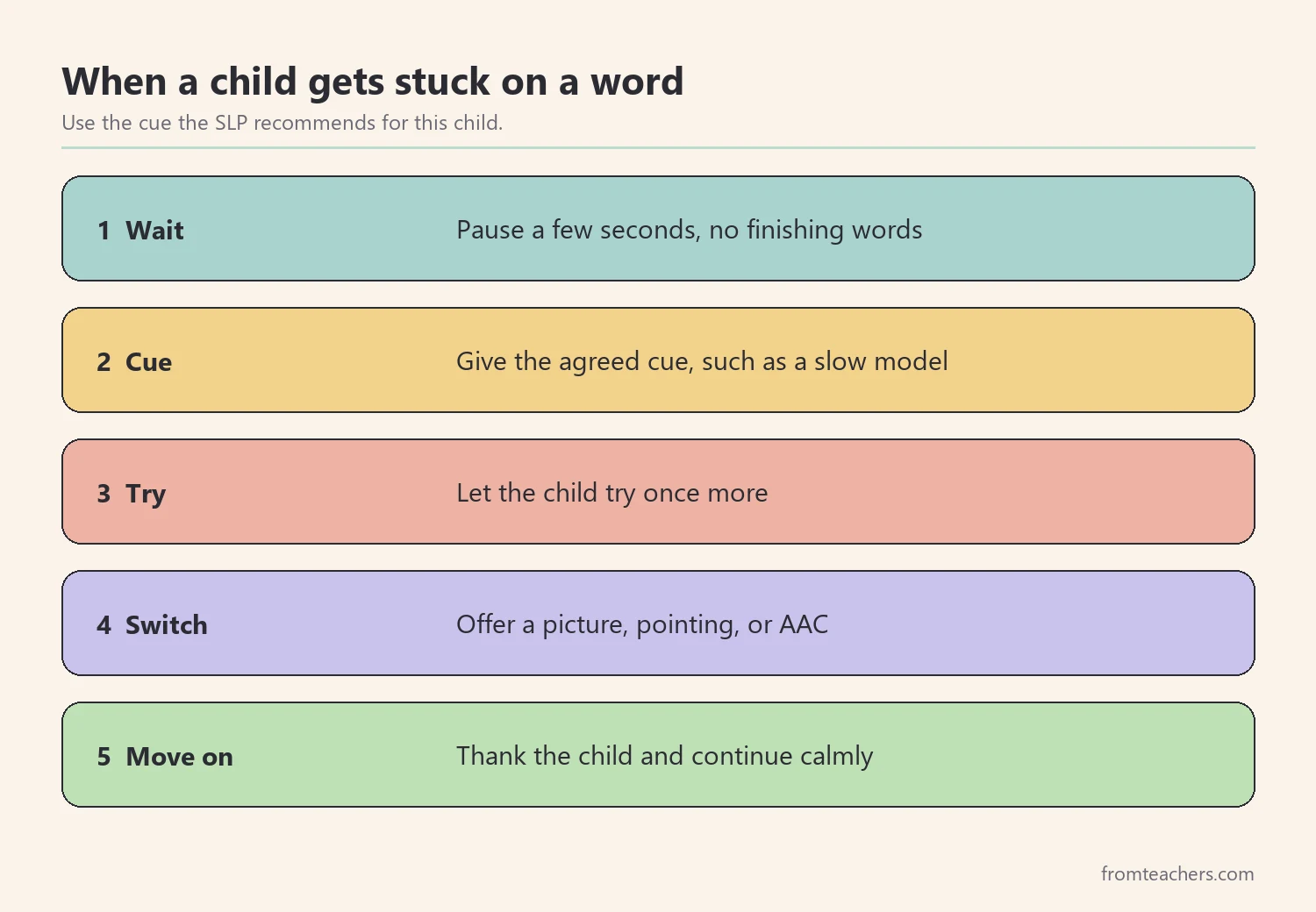
Give time first. Wait a few seconds after a question and resist finishing the child’s words. Then, offer the cue the SLP recommended, such as a slow spoken model, a gesture, or a visual of the mouth shape. Keep it calm and brief.
In addition, make sure the child always has another way to be understood. Picture cards, pointing, writing, or an augmentative and alternative communication (AAC) tool, if the team has agreed on one, let the child participate while speech develops. Using these tools does not stop speech from growing. Instead, they reduce frustration.
Also, plan participation on purpose. For example, let the child answer with a short phrase they have practiced, choose between two spoken options, or share with a partner before the whole class. These small steps build confidence.
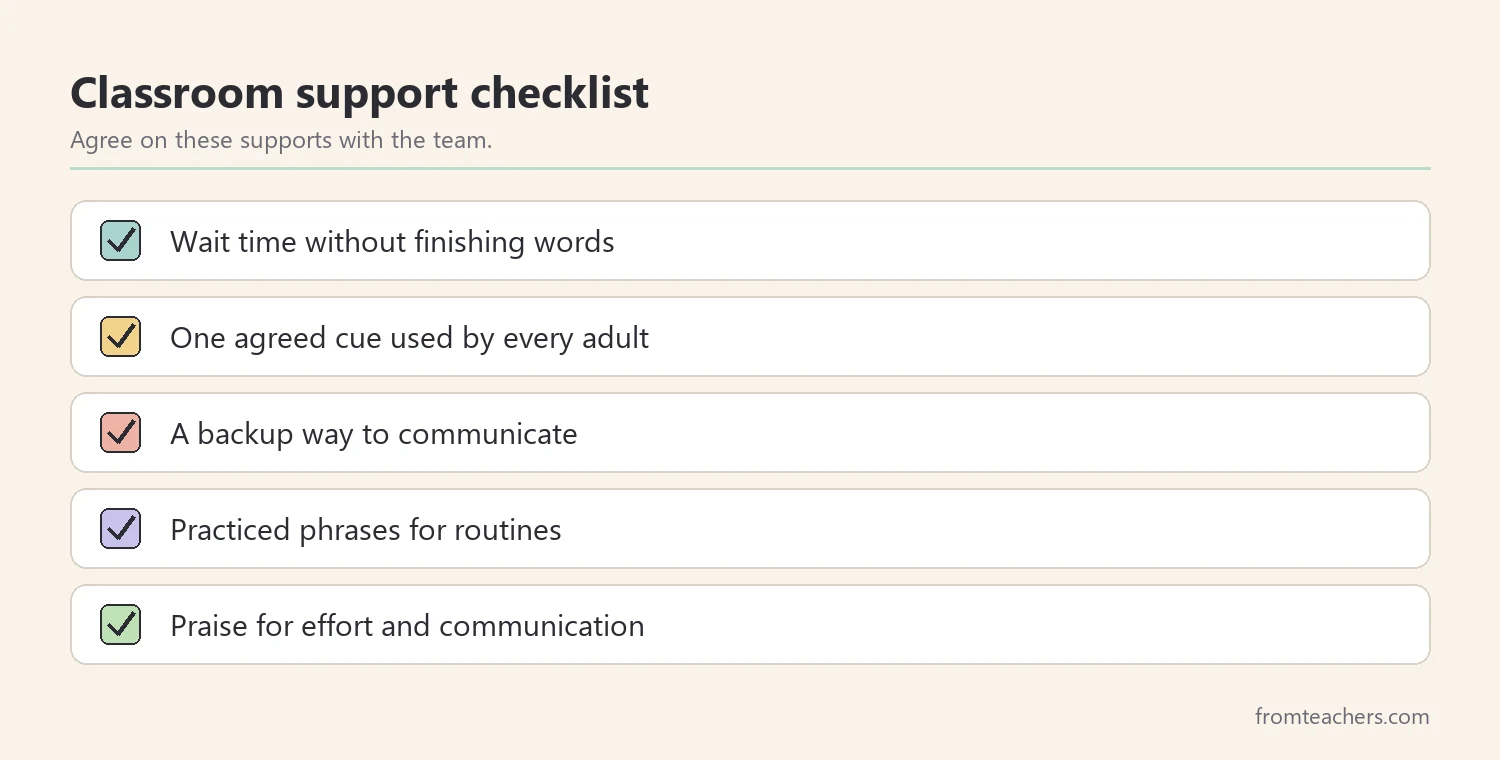
Classroom support checklist
- Wait time after questions, without finishing words.
- The SLP’s recommended cue, used the same way by every adult.
- A backup way to communicate: pictures, pointing, writing, or AAC.
- Practiced phrases for routines, like asking for help.
- Praise for effort and communication, not only clear speech.
Worked example. During morning meeting, Leo can answer with a picture card or a practiced phrase. When he gets stuck on a word, his teacher waits, then models it slowly and lets him try once more. If it is still hard, he points to the picture, and the class moves on. Leo now raises his hand more often than before.
Therefore, support for childhood apraxia of speech in class is about access and confidence, not drilling.
5. Practice childhood apraxia of speech targets at home
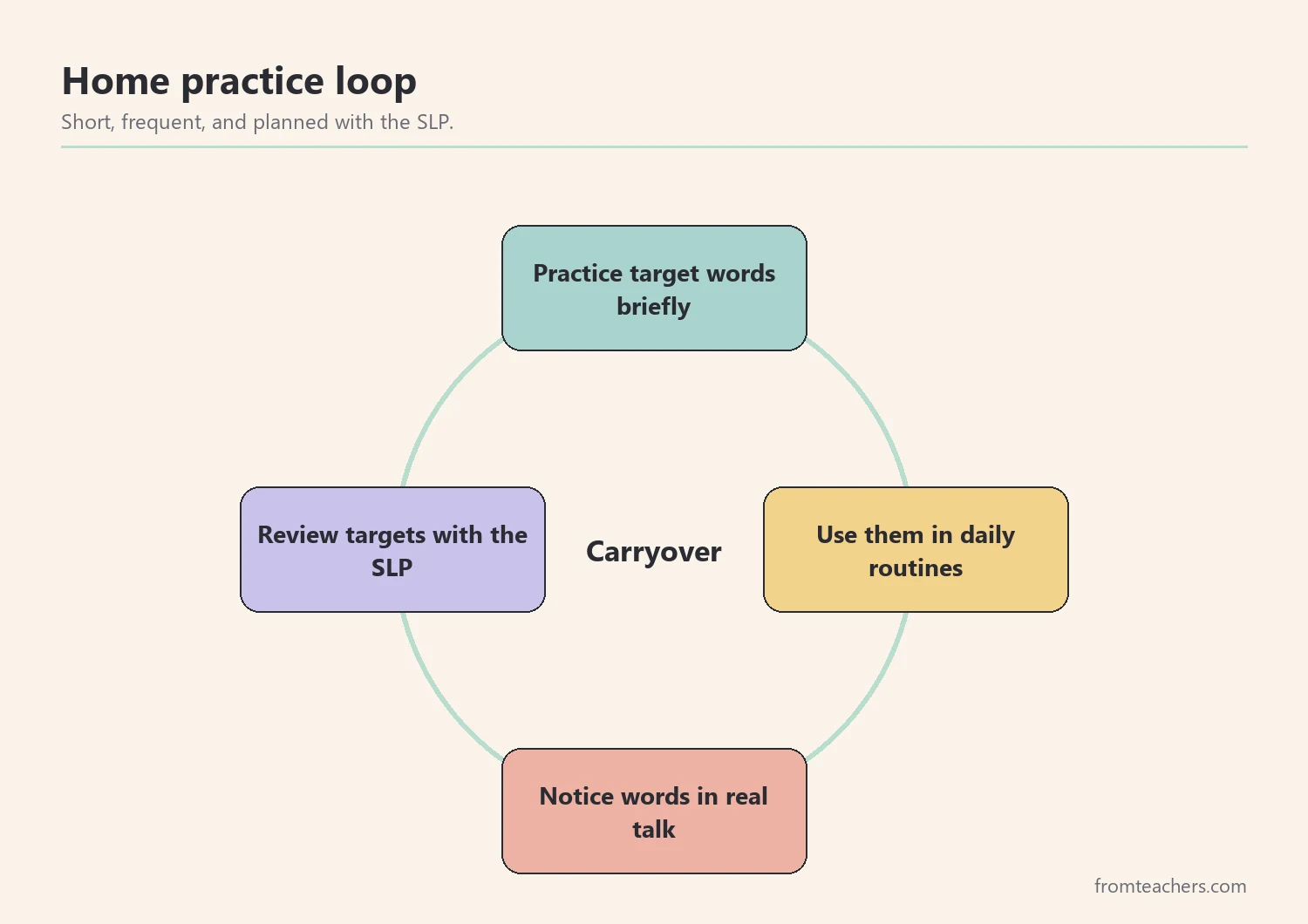
Finally, build practice into everyday life. Children with childhood apraxia of speech often benefit from short, frequent practice, as planned with their SLP. A few minutes on many days usually fits family life better than one long session.
Start with the SLP’s target words or phrases. Then, attach practice to routines: naming foods at dinner, saying a phrase while putting on shoes, or reading a short repeated book at bedtime. Keep it playful. If the child gets tired or upset, stop and try again later.
Next, watch for carryover. Carryover means a word practiced in therapy shows up in real conversation, in class, or with new people. This is often the hardest part, and it is a key sign of progress. So, write down when a target word appears on its own.
Then, review together every few weeks. Share what the family noticed at home and what the teacher noticed in class. Ask the SLP whether the targets should change.
Worked example. Leo’s family practices four target words at dinner, about three minutes a day. After three weeks, his teacher hears him say two of the four words clearly while playing with a friend, without a model. That leaves two words still in practice. She notes both carryover words and shares them with the SLP and family.
In the end, progress shows in real moments. Those moments are worth recording.
Common mistakes and how to avoid them
- Labeling the child too early. Speech errors have many causes. Fix: describe what you hear and leave childhood apraxia of speech diagnosis to the SLP.
- Recording only mistakes. It hides what helps. Fix: also note cues and settings that led to clear speech.
- Finishing the child’s words. It removes the chance to try. Fix: wait, then offer the agreed cue.
- Asking the child to “say it again” many times. It builds frustration. Fix: limit retries and offer another way to communicate.
- Different cues from different adults. It confuses the child. Fix: agree on one or two cues with the SLP and use them the same way.
- Long practice sessions. Tired children practice less well. Fix: keep practice short, frequent, and playful.
Questions teachers and parents ask about childhood apraxia of speech
Can a teacher tell if a child has childhood apraxia of speech?
No. A teacher can notice patterns and share them, but diagnosis comes from a qualified SLP. Your observations are still very useful, because they show how speech works in a busy classroom.
Will using pictures or AAC stop my child from talking?
Families often worry about this. Professional organizations such as ASHA describe AAC as a way to support communication, not replace speech. Ask the SLP how it fits your child’s plan.
How is this different from a typical speech delay?
Many speech delays follow common, consistent patterns. In childhood apraxia of speech, errors are often inconsistent and linked to planning movements. The SLP’s assessment explains which applies to a specific child.
How often should we practice at home?
Follow the SLP’s plan. Many families find a few minutes on most days easier than long sessions. Stop if the child is tired or upset.
What should I say to classmates who ask why a friend talks differently?
Keep it simple and kind. For example, “Leo’s mouth is still learning how to make some words, so we wait and listen.” Then, model patience yourself.
Related reading: The Power of Data Tracking in Special Education, How Teachers Communicate With Parents in Special Education: Building a Strong Partnership, and Best Assistive Technology for Special Education Classrooms.
A companion resource for childhood apraxia of speech:
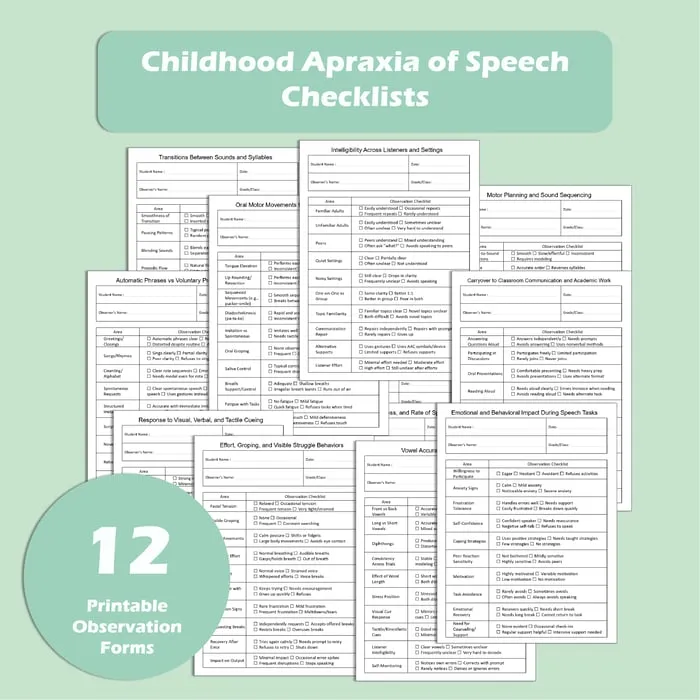
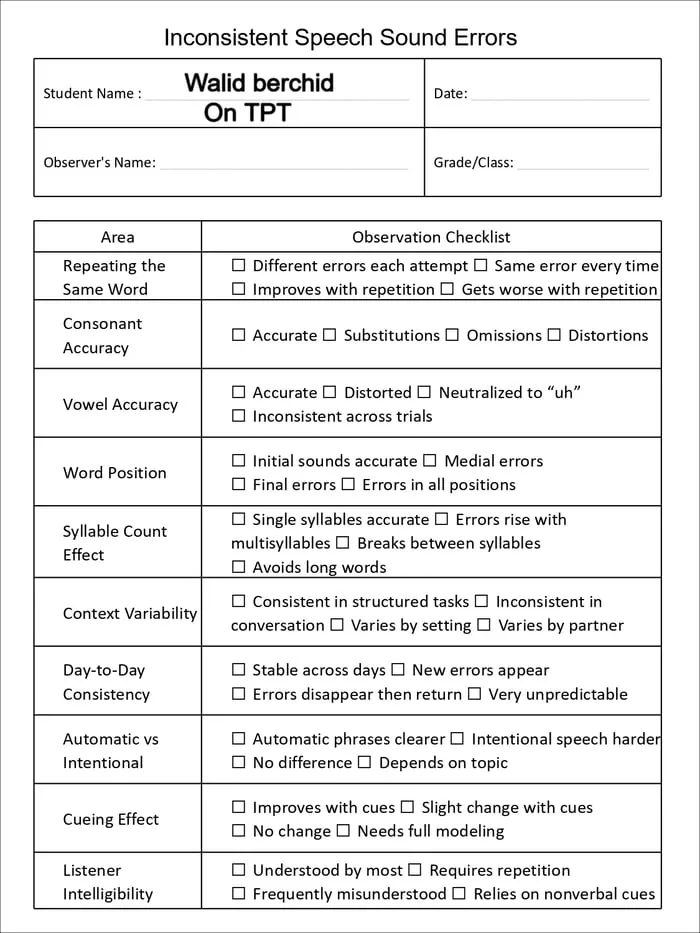
Childhood Apraxia of Speech (CAS) Observation Checklists: Set of 12: twelve check-box forms in print-ready PDF and editable PowerPoint, each with ten specific areas and a notes column, covering features such as inconsistent errors, sound sequencing, prosody, response to cueing, intelligibility, and carryover to the classroom.
Sources and scope
- American Speech-Language-Hearing Association (ASHA): the professional association for SLPs, with public information on speech disorders and AAC.
- National Institute on Deafness and Other Communication Disorders (NIDCD): federal health information on speech and language.
- Apraxia Kids: a nonprofit with family and educator resources on childhood apraxia of speech.
- IDEA, U.S. Department of Education: the law behind school evaluations, IEPs, and special education services.
This guide covers observation, team communication, and everyday support at school and home. It does not cover diagnosis or therapy methods, which belong to a qualified speech-language pathologist.
Key takeaways
- Childhood apraxia of speech is a motor planning disorder, diagnosed by an SLP.
- Record patterns across repeats, tasks, and settings, including what helped.
- Share short, organized summaries with the SLP and family.
- In class, give time, consistent cues, and another way to communicate.
- Keep home practice short and frequent, and record carryover.








Leave a Comment