

Dyscalculia accommodations matter most in the quiet moment when a capable student stares at a page of subtraction and does not write a single number. Picture a fourth grader who can explain a science experiment in detail, yet freezes when she has to subtract 47 from 82. She is not lazy, and she is not giving up on purpose. Instead, the way the task is presented is blocking her from showing what she knows.
This guide walks you through a five-step process: find where math breaks down, match each barrier to a fitting support, set up simple tools, adjust tests and assignments, and review the plan with the family. By the end, you will have a short, practical plan you can start using this week.
Examples are fictional. Adapt to the student’s goals and agreed supports. This is guidance, not a diagnosis.
At a glance
- Start by finding the exact point where math breaks down for the student.
- Match each barrier to one support instead of adding everything at once.
- Keep tools like number lines and fact charts visible and normal to use.
- Change how work is shown and timed, not what the student must learn.
- Track one simple measure and review it with the family every few weeks.
1. Find where math breaks down before choosing dyscalculia accommodations
First, resist the urge to pick supports from a long list. Good dyscalculia accommodations start with a clear picture of where the difficulty actually happens. A student may understand the idea of subtraction but lose track when the numbers are large, when the problem is read aloud quickly, or when a timer is running.
Next, collect a few work samples and watch the student solve two or three problems. Ask her to think aloud. Then, note the step where errors begin. Is it recalling a fact, lining up digits, keeping track of steps, or reading the word problem? Each answer points to a different kind of support.
Also, look at the setting. Many students do better with hands-on tasks than with dense worksheets. Others struggle most under time pressure. These patterns help you separate what the student knows from what the task demands.
| What you see | Possible barrier to test |
|---|---|
| Counts on fingers for small sums | Fact recall is slow |
| Digits drift out of columns | Place value and layout |
| Skips steps in longer problems | Working memory load |
| Freezes on timed quizzes | Time pressure and anxiety |
| Misreads plus and minus signs | Symbol confusion |
Worked example. Lina is a fictional student in grade 4. Her teacher watches her solve five subtraction problems. Lina understands that she is taking away, and she can model it with blocks. However, her digits drift out of their columns, and she counts on her fingers for facts like 12 minus 5. On a timed quiz, she leaves most problems blank.
In short, Lina has three clear barriers: fact recall, layout, and time pressure. As a result, her teacher now knows which supports to try first.
2. Match each barrier to one of the dyscalculia accommodations
Once you know the barriers, choose one support for each. Dyscalculia accommodations change how a student accesses or shows learning. They do not lower the goal. For example, a student who uses a fact chart still has to choose the right operation and solve the problem.
This difference matters. A modification changes what the student is expected to learn, such as a shorter list of skills or an easier standard. Decisions about modifications belong to the student’s team. In contrast, many accommodations can be tried in a regular classroom right away and then written into a plan if they help.
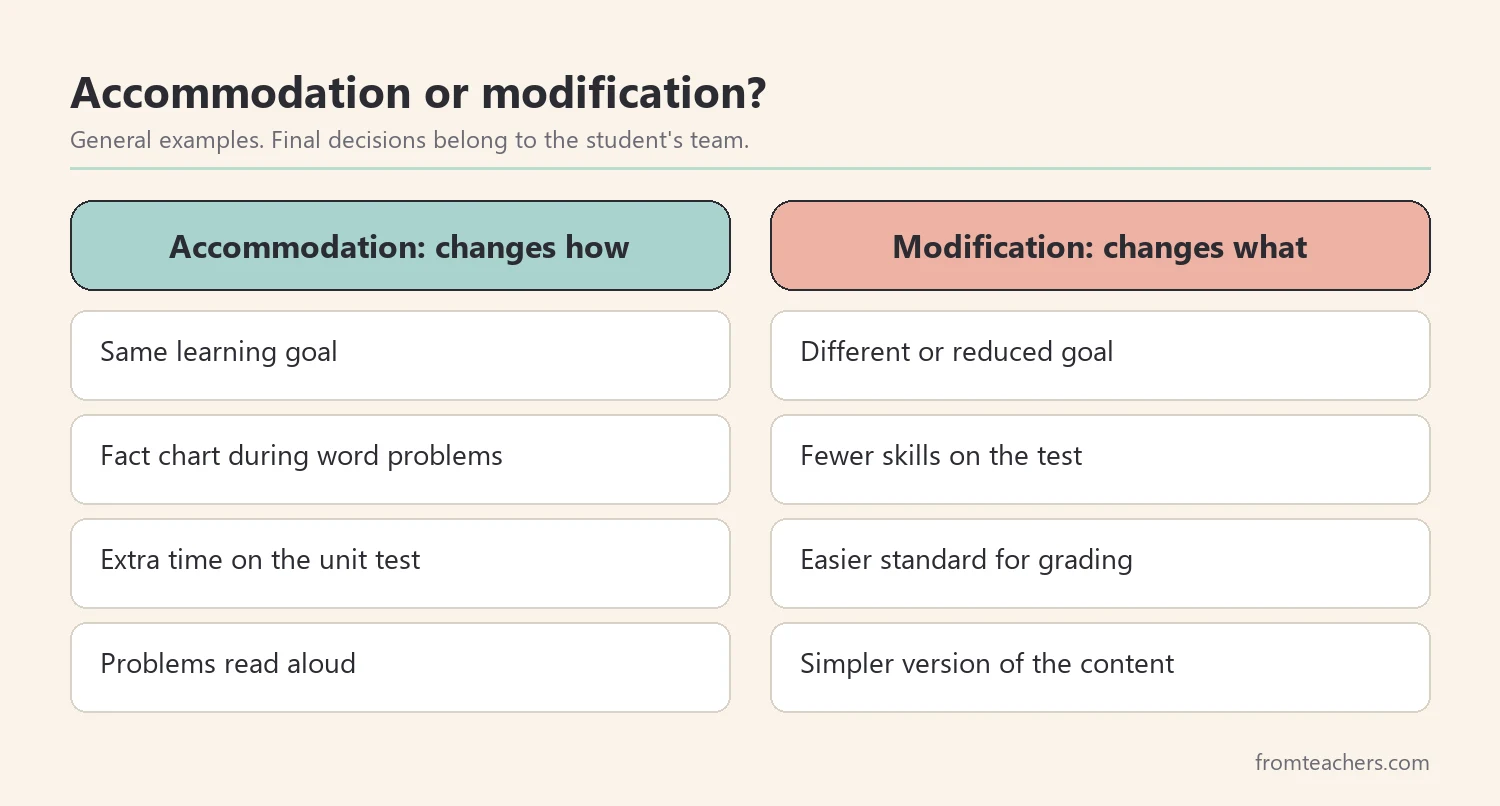
Next, keep the list short. Two or three well-chosen dyscalculia accommodations are easier to use consistently than ten. Then, write each one in plain words so every adult who works with the student uses it the same way.
| Barrier | Accommodation to try |
|---|---|
| Slow fact recall | Fact chart or number line on the desk |
| Digits out of columns | Graph paper or lined columns |
| Too many steps to hold | Written step card for the procedure |
| Time pressure | Extra time or untimed practice |
| Word problems | Problems read aloud, key words underlined |
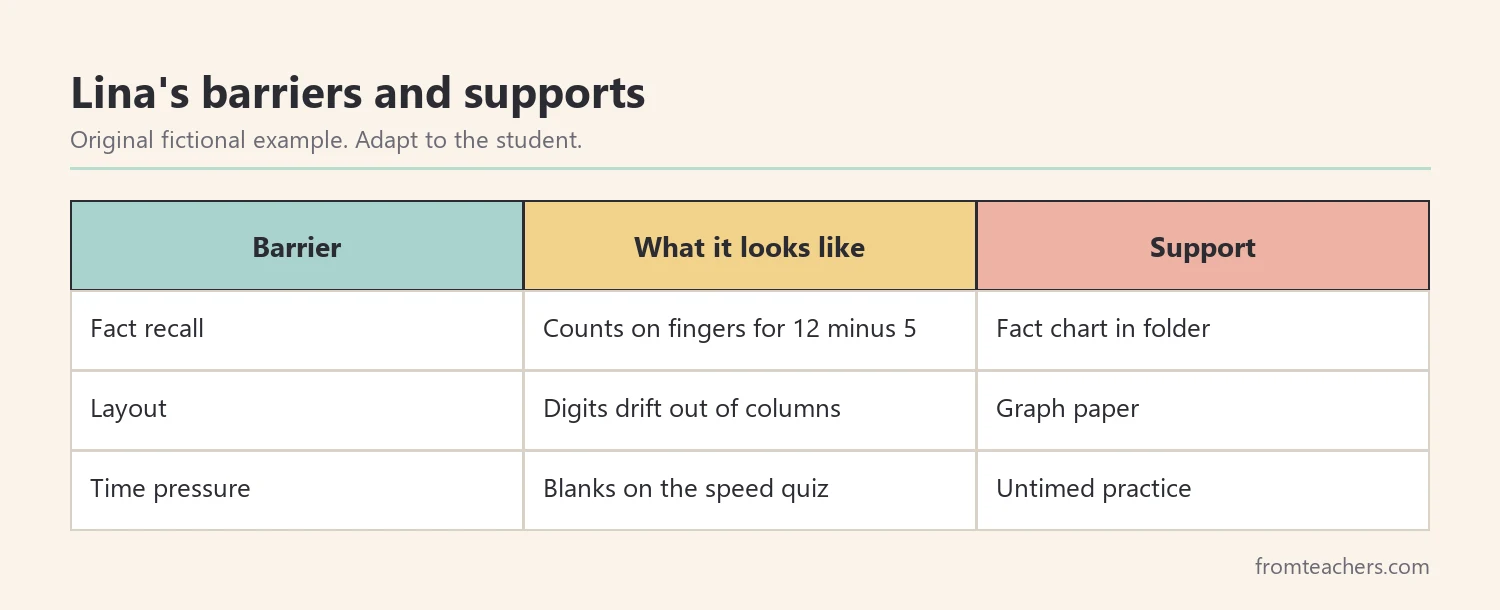
Worked example. Lina’s teacher picks three dyscalculia accommodations: a subtraction fact chart taped inside her folder, graph paper for written problems, and untimed practice instead of the class speed quiz. Lina still solves the same problems as her classmates.
3. Set up simple math tools and teach students to use them
Tools only help when the student knows how and when to use them. So, treat each tool as a skill you teach, model, and practice. A number line taped to a desk is useless if the student feels embarrassed to look at it.
Start with a small kit. Most dyscalculia accommodations in the classroom rely on a few familiar tools: a number line, a hundreds chart, base-ten blocks or other manipulatives, graph paper, a fact chart, and sometimes a calculator for tasks where computation is not the skill being taught. In addition, a step card that lists the procedure in order can reduce the load on working memory.
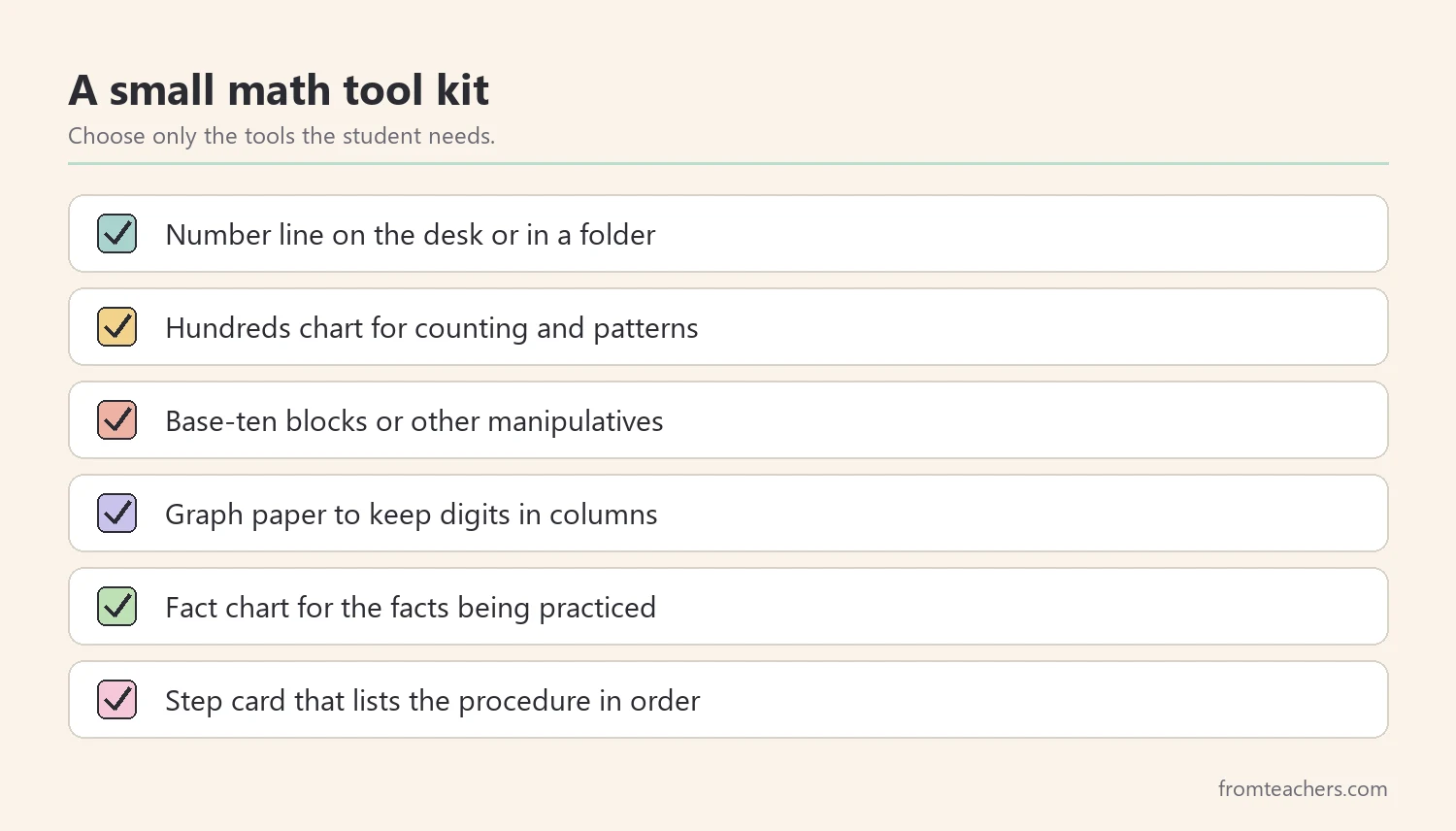
Next, make tools normal for everyone. When number lines and hundreds charts are available to the whole class, the student who needs them does not stand out. Also, model your own use of a tool during a lesson. Saying “Let me check this on the number line” shows that tools are part of good math thinking.
Then, plan when each tool fits. A calculator may help during a lesson on multi-step word problems, but not during a lesson on basic subtraction facts. Write this down so the support stays fair and consistent.
If you want a clear reference while you plan, the Dyscalculia Guide with strategies and accommodations explains how students with dyscalculia process numbers and which tools and supports can help in class.
Worked example. Lina’s teacher spends three short mini-lessons showing Lina how to find a fact on her chart and how to place one digit in each graph paper box. On the first day, Lina hesitates to use the chart. By the third day, she uses it without asking.
4. Adjust tests and assignments with dyscalculia accommodations
Tests and homework often show the biggest gap between what a student knows and what she can produce. Therefore, plan dyscalculia accommodations for assessments with the same care as for lessons. The goal is a fair picture of learning, not an easier test.
Consider changes to time, format, and setting. Extra time, a quieter space, problems read aloud, fewer problems per page, and more white space are common options. Also, allow the student to use the same tools on tests that she uses during practice, unless the test measures that exact skill.
| Area | Example adjustment |
|---|---|
| Time | Extra time or breaks between sections |
| Format | Fewer problems per page, larger print |
| Presentation | Directions and word problems read aloud |
| Response | Show work with drawings or manipulatives |
Next, look at homework. A long practice set can take a student with dyscalculia much longer than her peers. Instead, assign fewer problems that still cover each skill. For example, five well-chosen problems can show mastery as clearly as twenty.
However, keep the learning goal steady. If the goal is to subtract two-digit numbers with regrouping, every adjusted test should still include that skill. Only the way the student accesses and shows it changes.
Before test day, also tell the student exactly which supports she will have. Surprises add stress, and stress makes number recall even harder. A quick preview of the test format, the tools allowed, and where she will sit lets her spend her energy on the math itself. In addition, write the agreed dyscalculia accommodations on a short card for any adult who gives the test, so the supports do not depend on one person remembering them.
Worked example. For the unit test, Lina takes her test in a small group with extra time. The page shows four problems at a time on graph paper, and she may use her fact chart. She completes every problem and shows her regrouping steps clearly.
5. Track progress and review dyscalculia accommodations with the family
Without a record, it is hard to know which dyscalculia accommodations are helping. So, choose one simple measure linked to the original barrier and record it weekly. Good measures include problems attempted, problems correct, or minutes needed to finish a set.
Keep it quick. A short line in a notebook or a small table is enough. In addition, write a note when something unusual happens, such as a new tool or a substitute teacher.
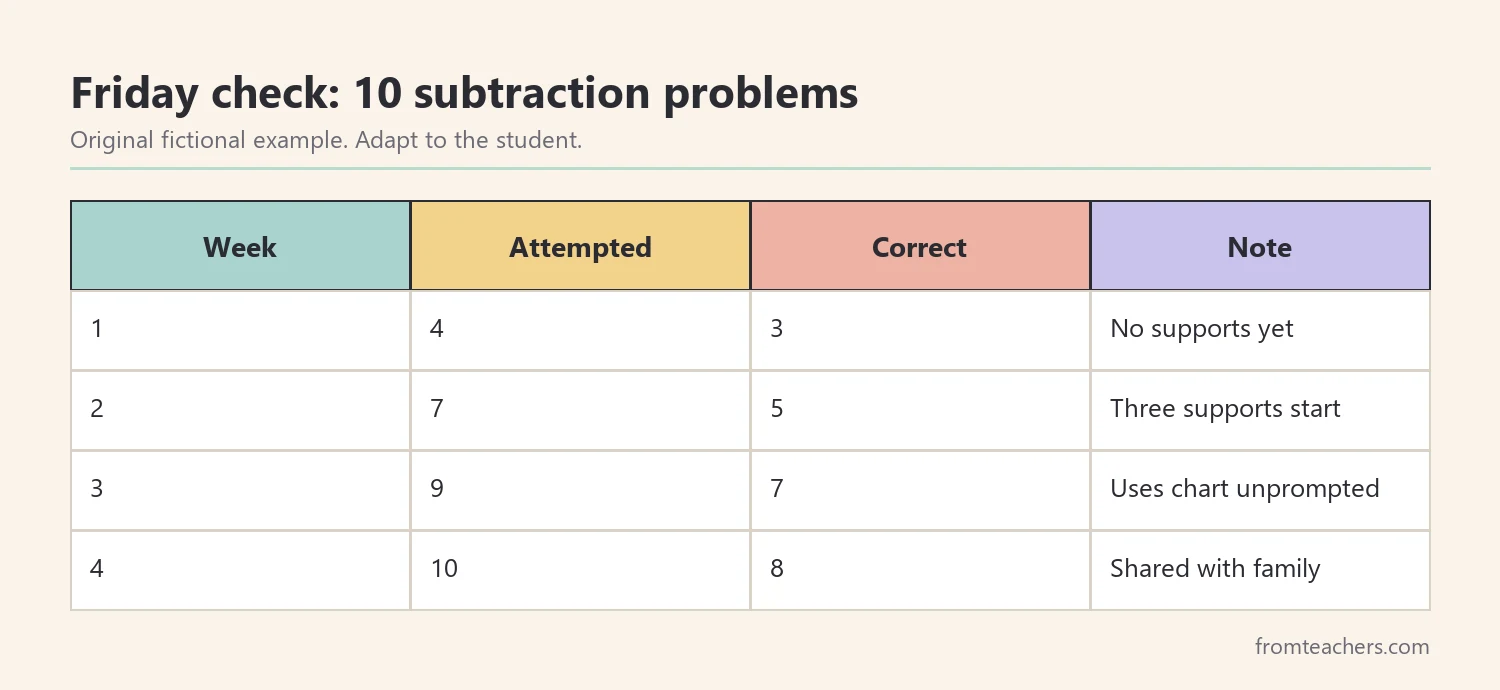
Worked example. Each Friday, Lina solves ten subtraction problems. In week 1, she attempts 4 and gets 3 correct. In week 2, once her three supports start, she attempts 7 and gets 5 correct. By week 4, she attempts all 10 and gets 8 correct. Her teacher shares the chart with Lina’s parents, who start using the same fact chart for homework.
Then, review the plan every three to four weeks. Ask what is working, what is not, and what to change next. Change one support at a time so you can see which one made the difference.
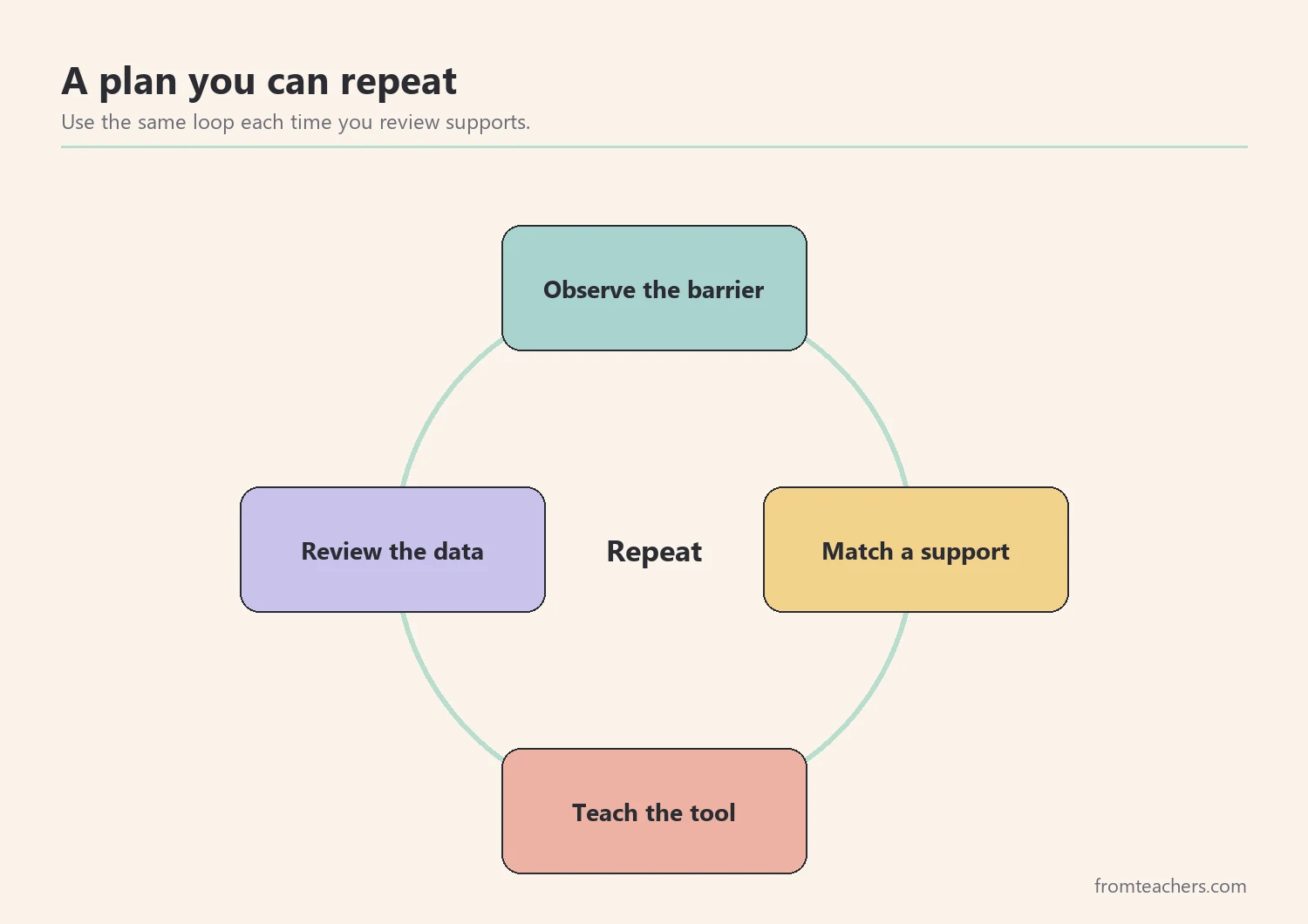
Also, share the plan with the family. Families often see math stress at home that teachers do not. A short note that shares one success and one goal builds trust. For students with an IEP or 504 plan, bring your data to the team meeting so the written dyscalculia accommodations stay current.
Common mistakes and how to avoid them
- Adding every support at once. Too many changes hide what helped. Fix: start with two or three, then add more only if needed.
- Confusing accommodations with modifications. Lowering the goal by accident can leave gaps. Fix: keep the learning goal the same and change only access.
- Handing over tools without teaching them. Students may avoid tools they do not understand. Fix: model each tool and practice it during calm moments.
- Using tools in class but not on tests. The student then loses support when it counts most. Fix: match test supports to daily practice unless the test measures that skill.
- Relying only on speed drills. Timed drills can increase anxiety without building understanding. Fix: use untimed practice and focus on strategies.
Questions teachers and parents ask about dyscalculia accommodations
Does a student need a diagnosis to get dyscalculia accommodations?
Formal plans such as an IEP or 504 plan follow an evaluation process set by the school. However, many classroom supports, like a number line or graph paper, can be offered to any student who needs them. Talk with your school team about the right process.
Will a calculator stop a student from learning math facts?
It depends on the lesson goal. If the goal is fact fluency, a calculator would remove the skill being taught. If the goal is solving a multi-step problem, a calculator can let the student focus on reasoning.
Is it fair to give one student extra time?
Fair means each student gets what they need to show learning. Extra time does not change the content of the test. Instead, it removes a barrier that is not part of the skill.
How can parents use dyscalculia accommodations at home?
Parents can use the same tools the school uses, such as a fact chart or number line, during homework. They can also break long assignments into short sets with breaks. A quick message to the teacher keeps home and school consistent.
How often should we change the plan?
Review it every few weeks using your simple data. Keep supports that help, drop ones the student no longer needs, and change one thing at a time.
Related reading: Accommodations vs Modifications in Special Education: The Difference Explained, Special Education Accommodation and Modification Tracker, and The Power of Data Tracking in Special Education.
A companion resource for dyscalculia accommodations:
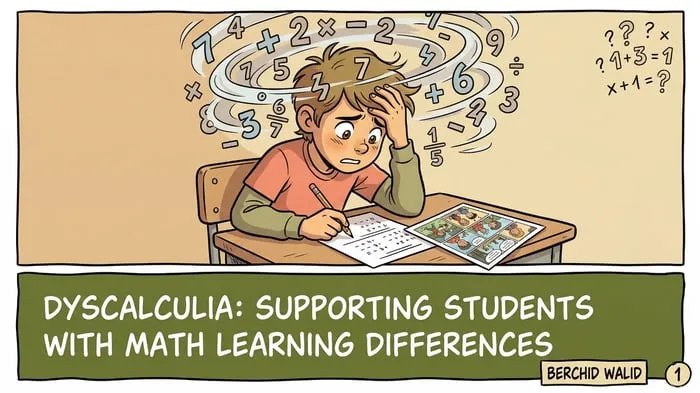
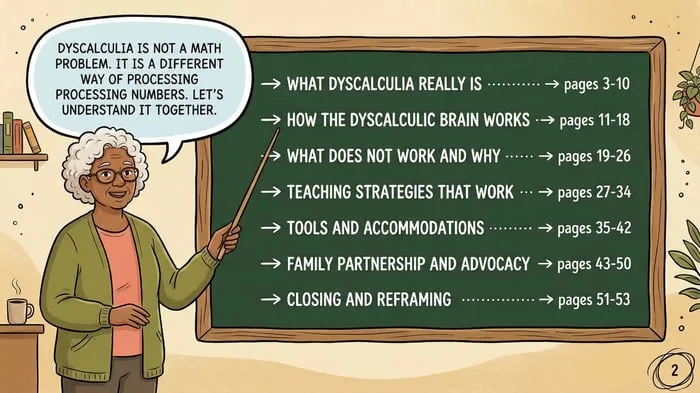
Dyscalculia Guide: Strategies and Accommodations for Teachers: a 53-page comic-style guide covering what dyscalculia is, how students with dyscalculia process numbers, approaches that do not work and why, teaching strategies that do, tools and accommodations, and partnering with families.
Sources and scope
- IRIS Center, Vanderbilt University: free modules on accommodations and evidence-based math instruction.
- Understood.org: practical articles for families and teachers on dyscalculia and learning differences.
- IDEA, U.S. Department of Education: the law behind special education services and IEPs.
- What Works Clearinghouse: reviews of research on education practices, including math interventions.
This guide covers everyday classroom and homework supports for students who struggle with numbers. It does not cover diagnosis, formal evaluation, or legal advice, which belong to qualified professionals and the student’s team.
Key takeaways
- Good dyscalculia accommodations start with finding the exact barrier.
- Match one support to each barrier and keep the list short.
- Teach tools like skills and make them normal for the whole class.
- Use the same supports on tests that the student uses in practice.
- Track one measure and review the plan with the family every few weeks.










Leave a Comment