

A behavior assessment consent form is often the first thing a family sees about a Functional Behavior Assessment, and first impressions matter. Picture a parent opening a backpack and finding a dense form full of acronyms that asks permission to “conduct an FBA.” Without context, it can feel like their child is in trouble. Many parents hesitate, delay, or say no simply because they do not understand what they are signing.
This guide walks you through a five-step process: explain the assessment first, prepare a clear form, walk the family through it, respect their decision, and follow up. By the end, you will know how to use the consent step to build trust and real parent buy-in, not just collect a signature.
Examples are fictional. Adapt to the student’s goals and agreed supports. This is guidance, not a diagnosis or legal advice. Follow your district’s procedures and state rules.
At a glance
- Talk with the family before the form goes home.
- Use plain language to explain what an FBA is and why it helps.
- Make the form clear: process, contact person, and a simple yes or no.
- Respect the family’s decision and answer every question.
- Follow up with a timeline and share results in a meeting.
1. Explain the assessment before the behavior assessment consent form goes home
First, never let the form be the first conversation. A short phone call or meeting before the form goes home changes everything. It gives the family a chance to hear your tone, ask questions, and understand that the goal is support, not blame.
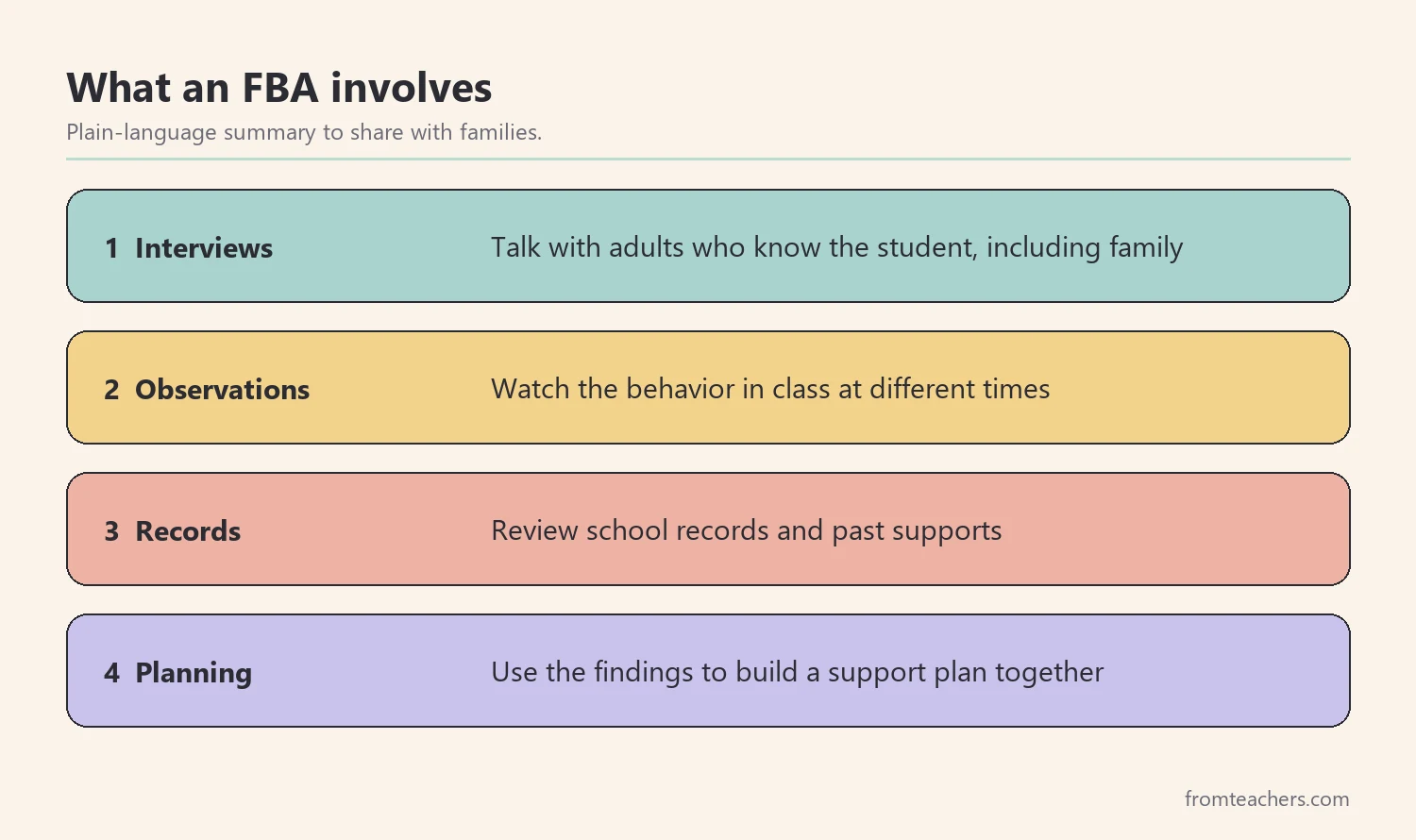
Next, explain the FBA in plain words. A Functional Behavior Assessment is a process for understanding why a behavior happens, so the team can plan better support. It usually includes interviews with adults who know the student, observations in class, and a review of school records. The results help the team build a behavior support plan.
Then, share what you have already noticed and what you have already tried. Families want to know the school has made an effort. Be specific and kind, and focus on what the student needs, not on how hard the behavior is for adults.
Worked example. Eli is a fictional student in grade 4. He often leaves the classroom during writing time. His teacher has tried a visual schedule and short breaks for three weeks with little change. Before sending any form, she calls Eli’s father: “We want to understand what makes writing so hard for Eli, so we can help. We’d like to do something called a behavior assessment. Can I explain what that involves?”
Also, choose who makes the call. Ideally, it is the adult the family already knows and trusts, often the classroom teacher or case manager. If language is a barrier, arrange an interpreter and translate the behavior assessment consent form before it goes home, so the family reads it in the language they use every day.
In short, a five-minute call before the behavior assessment consent form goes home often prevents weeks of confusion.
2. Prepare a clear behavior assessment consent form
A good form explains, not just asks. It should tell the family what the assessment involves, why the school wants to do it, who to contact, and what their choices are. Above all, it should be readable without a dictionary of school acronyms.
Check that your behavior assessment consent form includes the key parts. These usually are a warm explanation of what an FBA is, a breakdown of the process, a contact person with a phone number or email, a clear permission section, and lines for the parent or guardian’s name, signature, and date. Your district may require additional sections, so check local procedures.
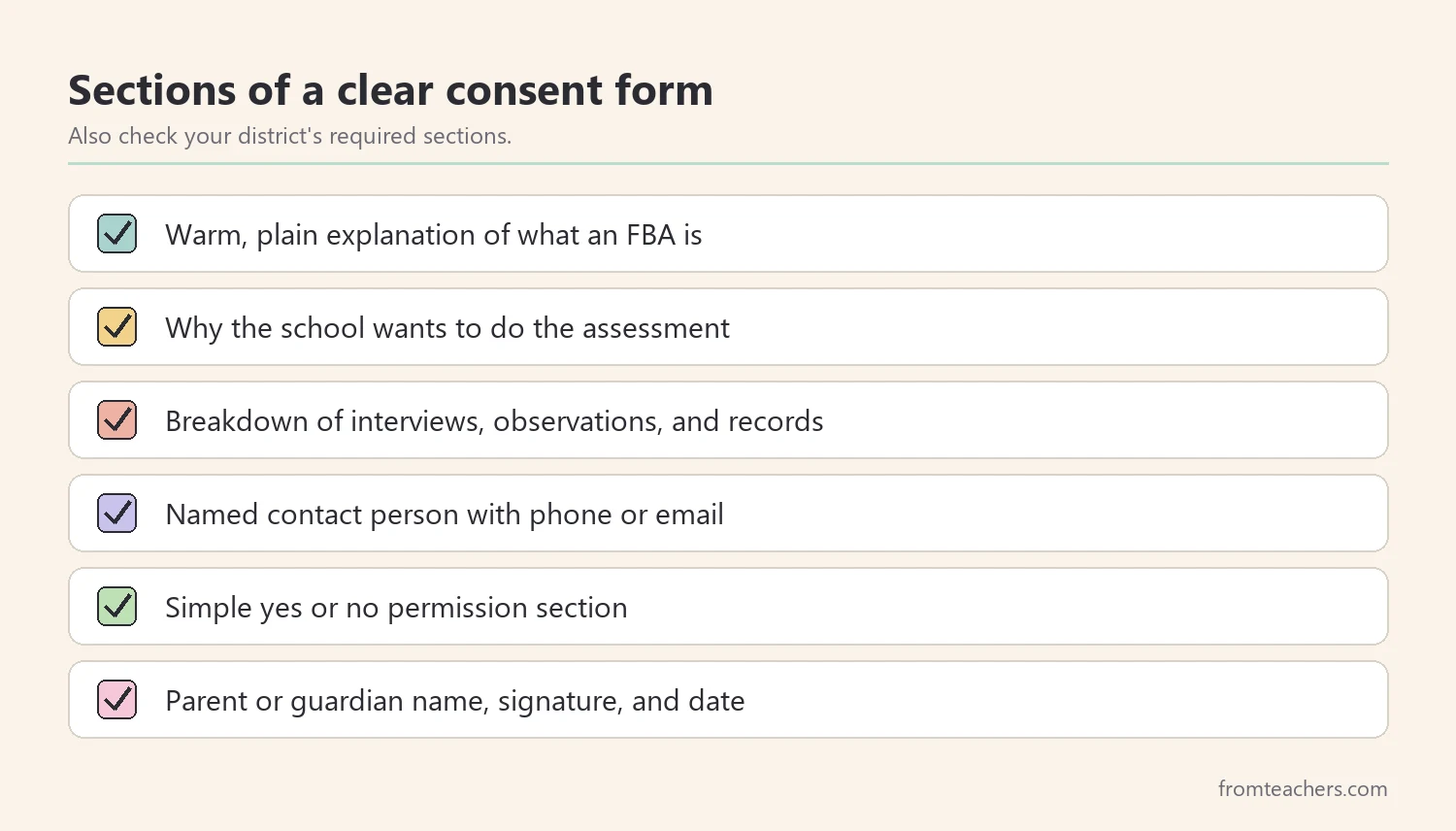
Also, think about format. A fillable form can be sent home electronically or printed, which helps families who prefer one or the other. A ready-made fillable parent consent form for FBA and behavior support planning already includes a family-friendly explanation, a process breakdown, a contact section, and a simple yes or no permission section.
Worked example. Eli’s teacher fills in the contact section with the school psychologist’s name and email, and adds Eli’s name to the permission section. She prints one copy for the meeting and sends a fillable copy by email, so Eli’s father can read it before they talk.
Before sending it, read your behavior assessment consent form as if you were the parent. Would you know what will happen, who to call, and what you are agreeing to? If any part feels unclear, rewrite it in shorter sentences. A colleague who does not work in special education can be a helpful test reader.
As a result, the family sees the form twice: once alone and once with someone who can answer questions.
3. Walk through the behavior assessment consent form together
Whenever possible, go over the form in person or by video call. Read through each section briefly and pause for questions. This turns a piece of paper into a conversation.
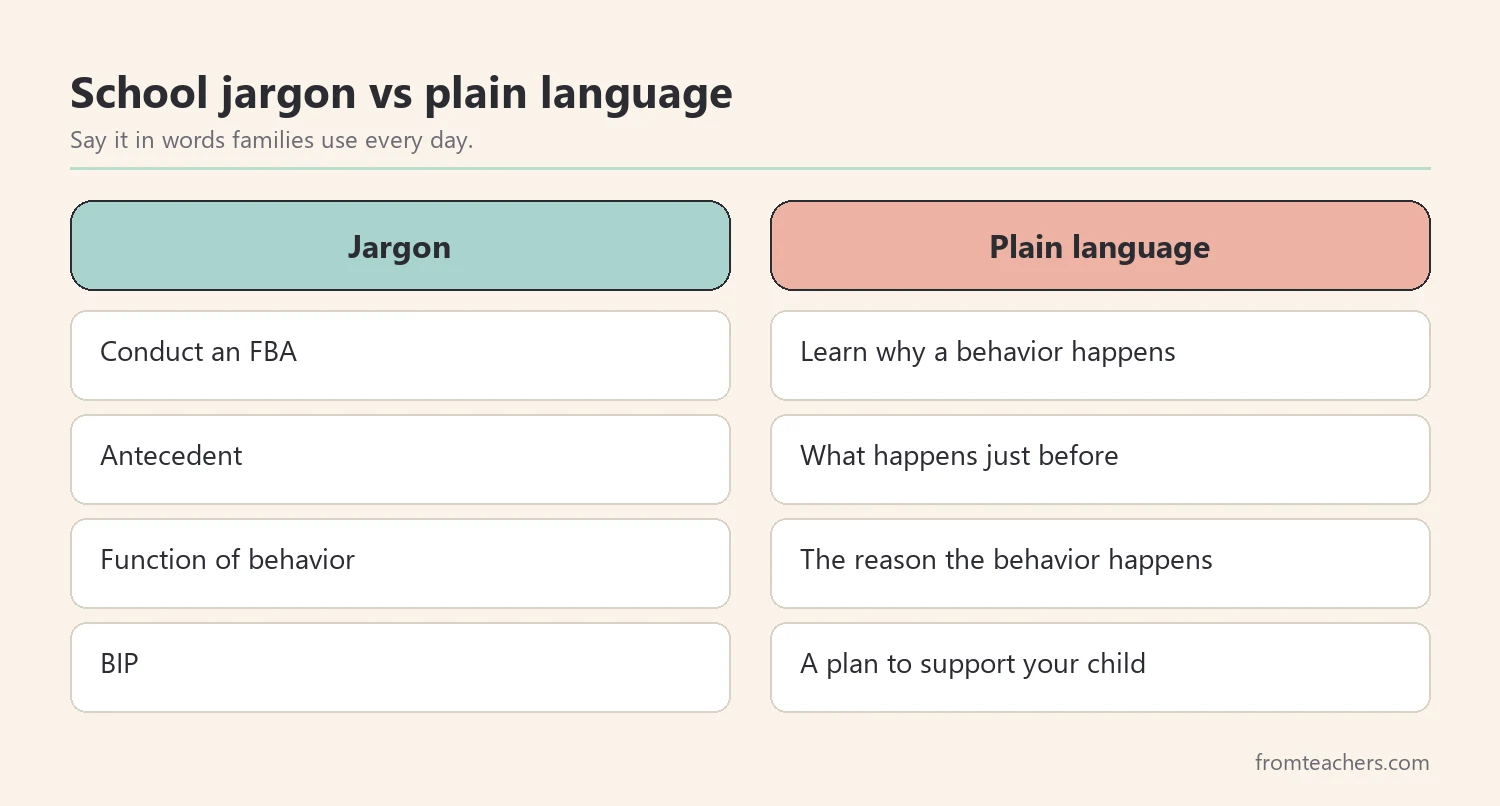
Replace jargon as you go. Many terms that feel normal to school staff, like “antecedent,” “function,” or “BIP,” mean nothing to most families. Say what they mean in everyday words, and invite the parent to stop you whenever something is unclear.
Keep the meeting short and calm. Twenty to thirty minutes is usually enough to go over a behavior assessment consent form and answer questions. Sit beside the family rather than across a long table, and give them their own copy to hold and write on.
Moreover, ask what the family sees at home. Parents often know triggers, calming strategies, and history the school does not. Tell them their input will be part of the assessment, because in most FBAs, family interviews are an important source of information.
Worked example. In the meeting, Eli’s father asks, “What does ‘function of behavior’ mean?” The school psychologist answers, “It means the reason the behavior happens, like getting a break from something hard or getting attention. We want to find Eli’s reason so we can help him in a better way.” The father mentions that Eli also avoids homework that involves writing. The team notes this as useful information.
In other words, the walkthrough did more than explain the form. It brought new information into the assessment and showed Eli’s father that his knowledge of his son matters to the team. That sense of partnership is what turns a signature into genuine buy-in.
4. Answer questions about the behavior assessment consent form and respect the decision
Families have the right to ask questions and to take time before deciding. Some will sign right away. Others will want to think it over, talk with someone else, or read more. Treat each response with the same respect.
Prepare for common questions. Parents often ask whether the FBA goes on a permanent record, whether it means a diagnosis, who will see the results, and how long it takes. Answer honestly, and if you do not know, say so and find out. Do not guess about legal rules or records policies.
| Common question | Helpful response |
|---|---|
| Does this mean my child has a diagnosis? | No. It looks at why a behavior happens, not at a diagnosis. |
| Who sees the results? | Explain your school’s team and records policy. |
| How long does it take? | Share your district’s usual timeline. |
| What if I say no? | Explain what support continues and how to revisit. |
Also, give the family a clear way to reach you after the meeting. The contact section on the behavior assessment consent form should list one named person, not just “the office.” Families are more likely to ask a follow-up question when they know exactly who will answer.
If a family declines, stay warm. Continue the supports already in place and keep communicating. Explain that they can revisit the decision later, and leave the door open. A “no” today is often a “not yet.”
Worked example. Eli’s father asks for two days to talk with Eli’s mother. The teacher agrees and says she will call on Thursday. On Thursday, the parents return the behavior assessment consent form with “yes” checked, plus a note asking to be included in the observation schedule.
5. Follow up after consent with a clear timeline
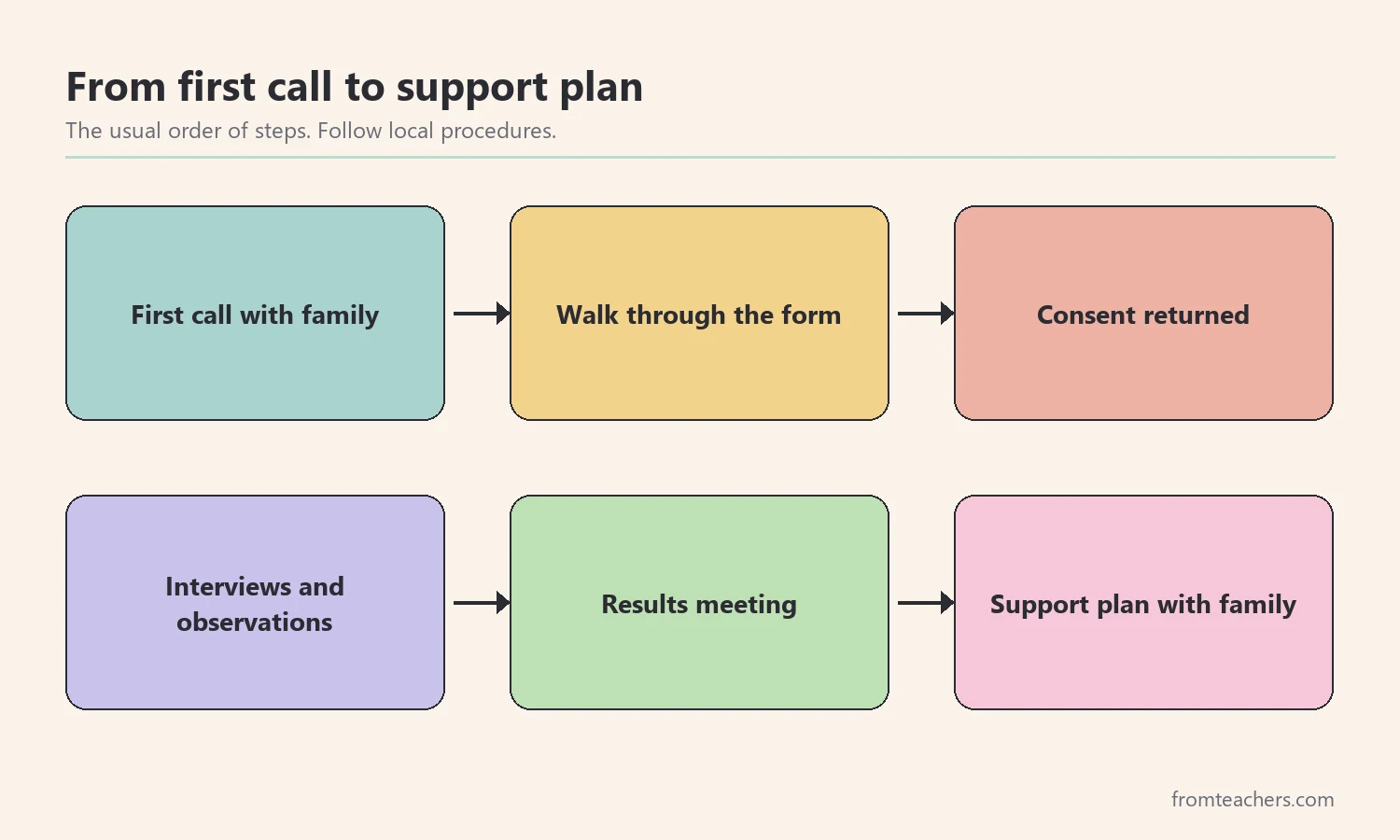
Consent is the start of a partnership, not the end of a task. After the form comes back, thank the family and share a simple timeline: when observations start, when interviews happen, and when the team will meet to share results.
Then, keep a short communication log. Note each contact with the family, what was shared, and any next step. This keeps everyone on the same page and shows the family the school is following through.
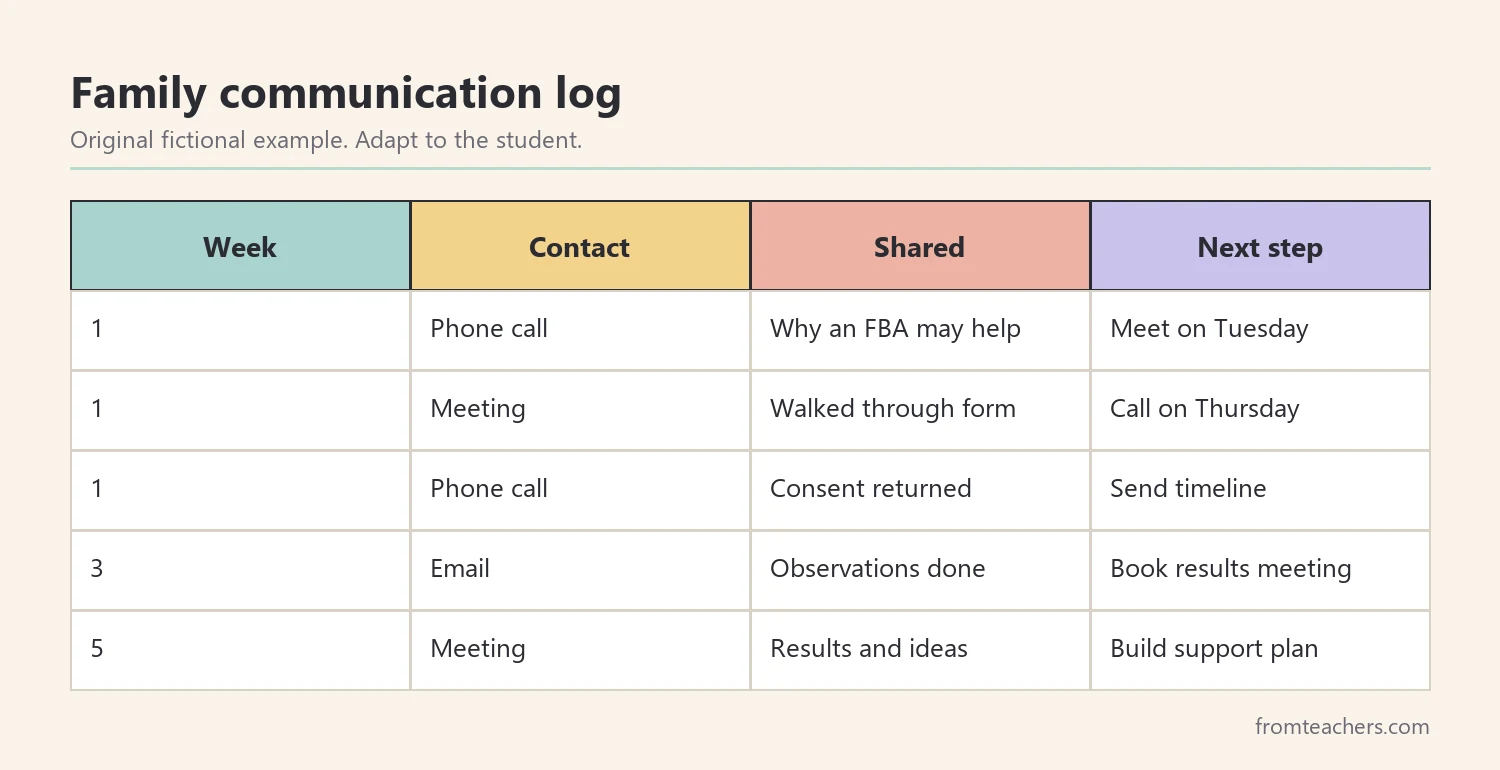
Worked example. Eli’s team logs five contacts over about five weeks: the first call, the consent meeting, the follow-up call when the form came back, a midpoint update after observations, and the results meeting. At the results meeting, the team shares that Eli’s leaving seems linked to avoiding long writing tasks, and the family helps plan supports like shorter writing chunks and a break card.
Above all, keep the family’s voice in the process after consent. Invite them to share whether they see the same pattern at home, and ask whether the planned supports feel realistic. Families who feel heard during the assessment are much more likely to stay involved when the support plan begins.
Finally, store the signed behavior assessment consent form according to your district’s records procedures, and give the family a copy.
Common mistakes and how to avoid them
- Sending the form home without a conversation. Fix: call or meet first, then send the behavior assessment consent form.
- Using school jargon. Fix: explain every term in everyday words.
- Focusing on how hard the behavior is for adults. Fix: focus on what the student needs.
- Pressuring families to sign quickly. Fix: offer time and a clear date to follow up.
- Going silent after consent. Fix: share a timeline and log every contact.
- Guessing about legal or records rules. Fix: check your district’s procedures and say “I’ll find out.”
Questions teachers and parents ask about a behavior assessment consent form
Why does the school need a behavior assessment consent form?
Schools generally ask for written permission before carrying out an assessment like an FBA. The exact rules depend on federal law, your state, and your district. A clear form also helps families understand what will happen and why.
Can parents say no?
Yes, families can decline. The school should explain what support continues and how the decision can be revisited. Check your district’s procedures for what happens next.
Will the FBA label my child?
An FBA is not a diagnosis. It looks at when, where, and why a behavior happens so the team can plan better support. Ask the team who will see the results and how they are stored.
How can parents take part in the FBA?
Parents usually share information through interviews or questionnaires about behavior at home. They can also ask to see the observation plan and attend the results meeting. Their input often makes the assessment more accurate.
What happens after the FBA is complete?
The team meets to share findings and, if needed, builds a behavior support plan with the family. That plan describes supports and skills to teach. Progress is reviewed over time.
Related reading: How Teachers Communicate With Parents in Special Education, Moving Beyond Shame and Behavior Charts: Positive Alternatives, and How Parents and Teachers Can Team Up for Special Education Success.
A companion resource for your behavior assessment consent form:
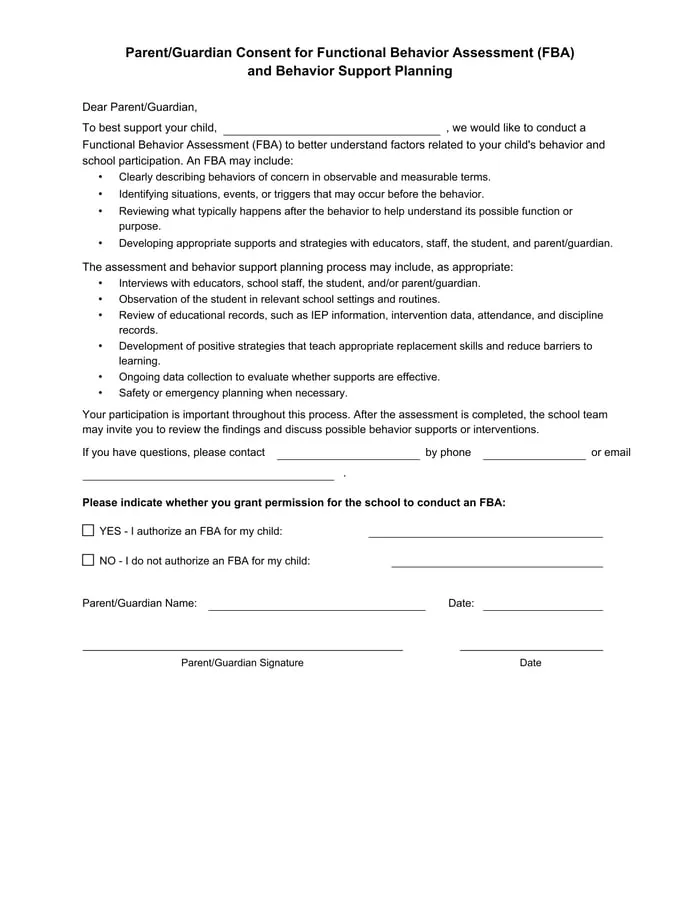
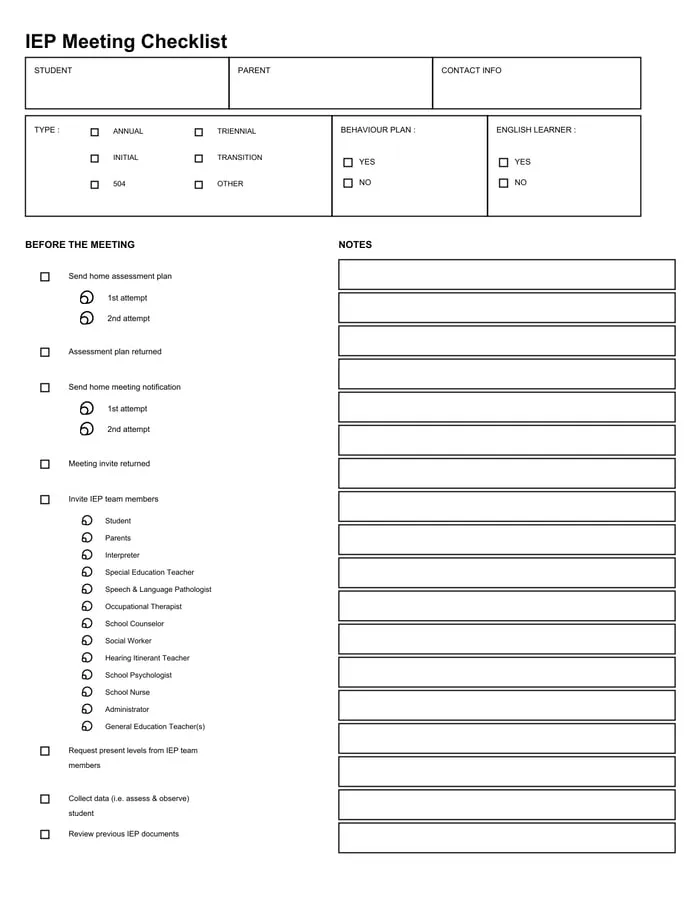
Parent/Guardian Consent for FBA and Behavior Support Planning: a fillable form with a warm explanation of what an FBA includes, a breakdown of interviews, observations, and record review, a contact section, a simple yes or no permission section, and signature and date lines.
Sources and scope
- IDEA, U.S. Department of Education: the law behind special education services, evaluations, and parent rights.
- IRIS Center, Vanderbilt University: free modules on behavior, including functional behavioral assessment.
- Center on PBIS: resources on positive behavioral interventions and supports in schools.
- Center for Parent Information and Resources: plain-language information for families on special education.
This guide covers communicating with families and using a consent form well before an FBA. It does not give legal advice or describe the full FBA method, which your district and qualified professionals guide.
Key takeaways
- A behavior assessment consent form works best after a real conversation.
- Explain the FBA in plain words and focus on what the student needs.
- Walk through the form together and replace every bit of jargon.
- Respect the family’s decision and give them time.
- Follow up with a timeline, a contact log, and a results meeting.










Leave a Comment