

Dysregulation vs defiance is one of the hardest calls a teacher makes, and it usually has to be made in seconds. A student pushes a worksheet off the desk and says “No.” Is that a choice to challenge you, or a nervous system that has run out of room?
This guide gives you a practical way to tell the two apart and respond to each. By the end, you will know which body signals to watch, how to look for triggers, how to keep yourself steady, and how to record patterns so your next response is better informed.
Examples are fictional. Adapt to the student’s goals and agreed supports. This is guidance, not a diagnosis.
At a glance
- Dysregulation is about capacity; defiance is about a choice the student can still make.
- Body signals often show dysregulation before words do.
- Look for triggers and patterns, not single moments.
- Calm first, teach later: your own regulation is part of the plan.
- Simple records help the team see what is really going on.
1. Understand dysregulation vs defiance in plain terms
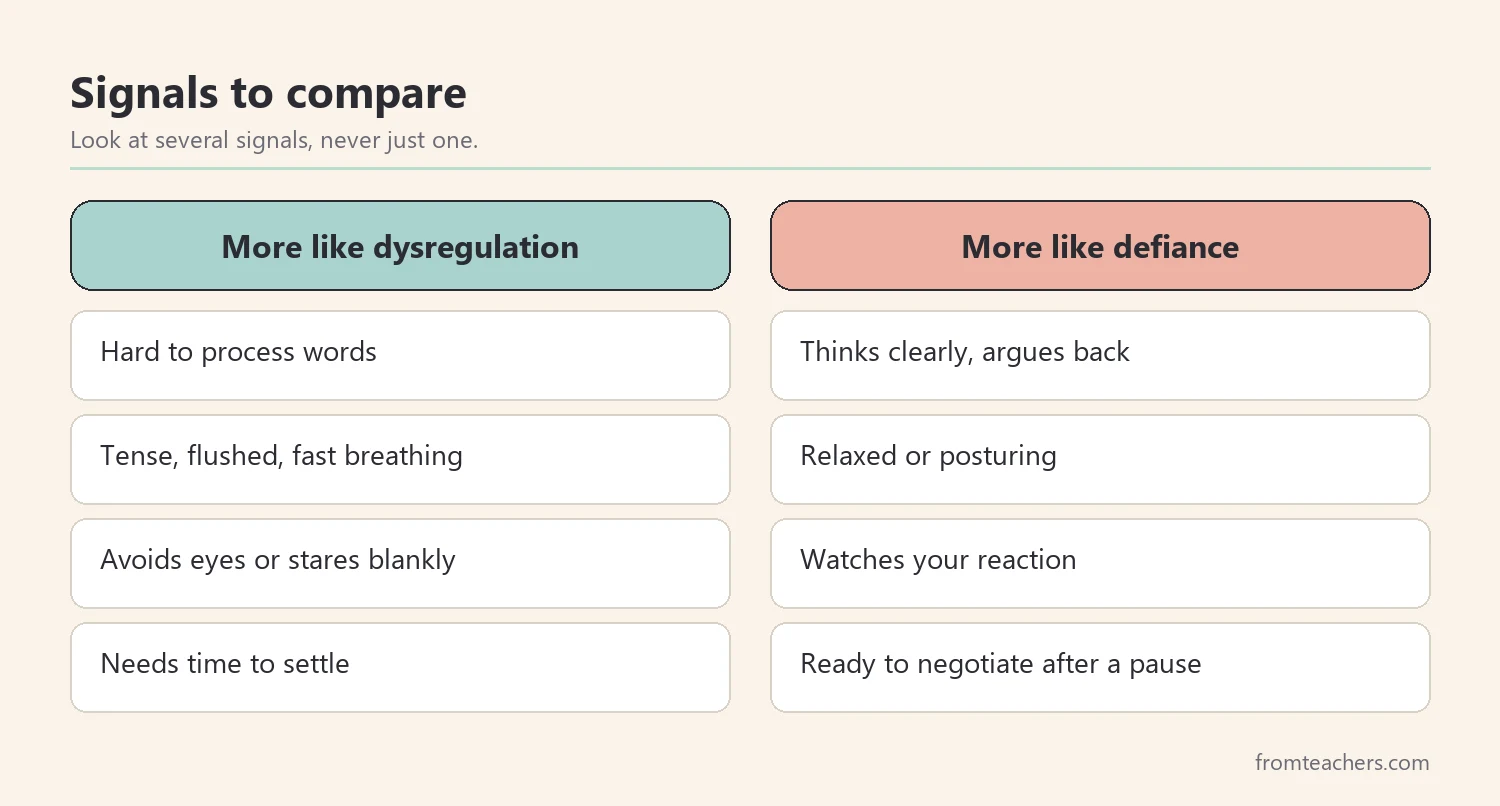
Before you can tell them apart, it helps to define each clearly. Dysregulation means the student’s stress response has taken over. Thinking, listening, and problem solving become hard because the body is in protect mode.
Defiance, on the other hand, describes a student who can think clearly but chooses not to follow a request. The student is usually calm enough to argue, bargain, or watch for your reaction.
The difference matters because the right response is opposite. A dysregulated student needs less talk, less demand, and more safety. A student showing defiance usually needs clear limits, calm follow-through, and a chance to save face.
However, real moments are messy. A student can start with a choice and slide into dysregulation when the conflict grows. That is why the question “dysregulation vs defiance?” is best asked again and again during an incident, not answered once.
Consider Amir, a fictional grade 4 student. During math, he shoves his paper away and says, “I’m not doing this.” His teacher, Ms. Okafor, notices his face is flushed and his hands are clenched. That is her first clue that this may not be a simple refusal.
Keep in mind that the labels describe moments, not children. No student is “a defiant kid” or “a dysregulated kid” all day. Thinking about dysregulation vs defiance as a question about this moment keeps you curious instead of stuck on a reputation.
| Feature | More like dysregulation | More like defiance |
|---|---|---|
| Thinking | Hard to process words | Clear, can argue back |
| Body | Tense, flushed, fast breathing | Relaxed or posturing |
| Eye contact | Avoids or stares blankly | Watches your reaction |
| After a pause | Needs time to settle | Often ready to negotiate |
2. Watch for body signals of dysregulation
Bodies often speak before words. When you learn a student’s early signals, you can respond before a moment escalates, which is much easier than calming a full storm.
Common signals include a flushed face, fast or shallow breathing, clenched fists or jaw, a frozen stare, pacing, covering ears, or putting the head down. Some students get very loud; others go silent and still.
Next, notice changes from the student’s usual self. A child who normally chats and suddenly goes quiet may be overwhelmed. Similarly, a usually calm student who starts tapping and shifting may be climbing toward overload.
Also, pay attention to “tunnel vision.” A dysregulated student may not hear the second half of your sentence or may not notice classmates around them. Repeating the instruction louder rarely helps when the brain is focused on threat.
Ms. Okafor starts a short list of Amir’s early signals. Over two weeks, she notices that he rubs his forehead and stops writing a minute or two before most hard moments. Now she has a cue to step in early with a quiet check-in.
Share these early signals with every adult who works with the student. When the aide, the specialist, and the classroom teacher all know the same cues, the student gets the same early help everywhere. That consistency matters more than any single strategy, and it makes later conversations about dysregulation vs defiance much more grounded in what people actually saw.
- Breathing: fast, shallow, or held.
- Face and hands: flushed skin, clenched fists or jaw.
- Movement: pacing, rocking, freezing, or hiding.
- Listening: missing parts of directions, staring past you.
3. Look for triggers before you name it defiance
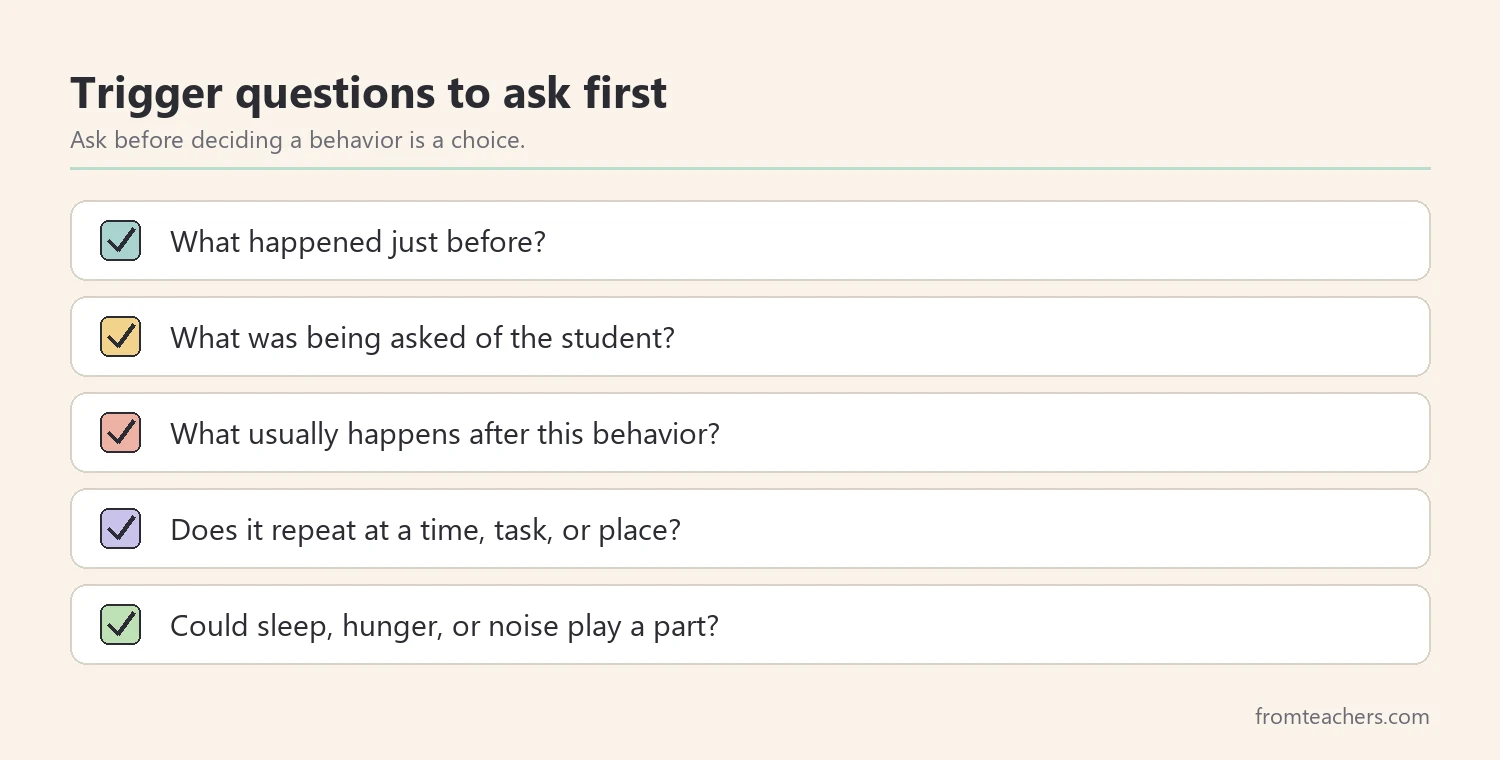
A trigger is anything that tips a student toward stress. It might be a task that feels too hard, a sudden change, noise, hunger, a peer comment, or a memory of past failure. Because triggers are often invisible, the behavior can look like defiance from the outside.
Ask three quick questions. What happened just before? What was being asked? What usually happens after this behavior? These questions help you see whether the student is escaping something overwhelming or testing a boundary.
Moreover, look for patterns across days. A single refusal tells you little. Five refusals that all happen right after a transition from recess tell you a lot.
When you think about dysregulation vs defiance this way, you shift from “Why won’t he?” to “What is getting in the way?” That change in question often changes the whole tone of the response.
In addition, remember that some triggers sit outside the classroom. A poor night of sleep, a skipped breakfast, or a worry from home can lower a student’s tolerance for the whole day. You do not need to fix these, but noticing them helps you read dysregulation vs defiance more fairly.
For Amir, Ms. Okafor notices that most hard moments happen when a new math page is handed out without an example. Her ready-made reference, a guide to emotional dysregulation vs behavioral defiance with Signal, Move, and Logic tables, helps her sort what she sees into signals and triggers instead of guessing.
4. Respond to dysregulation vs defiance differently
Once you have a working guess, match the response to it. Remember that this guess can change, so keep watching.
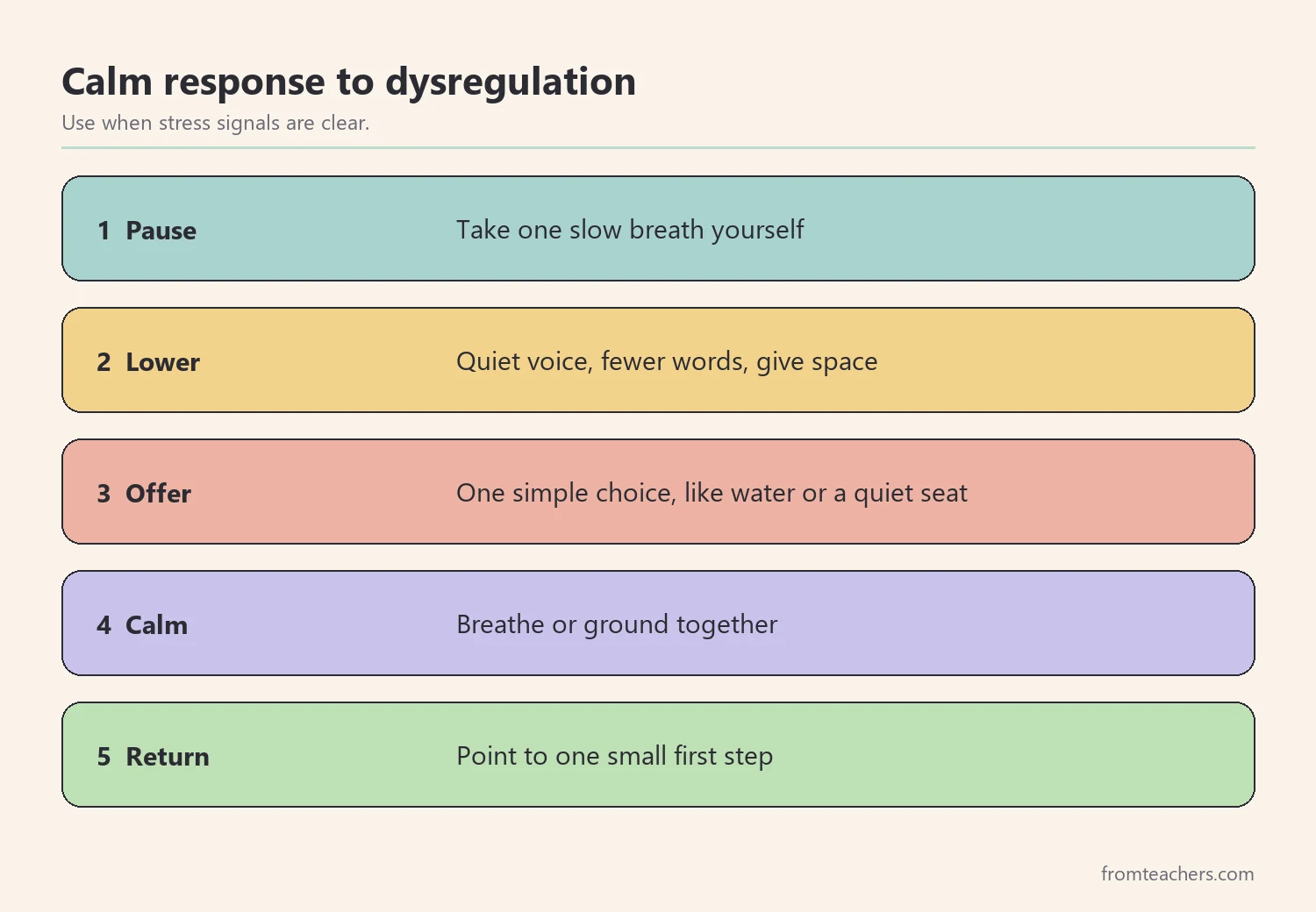
If the signs point to dysregulation, reduce demands and words. Lower your voice, give space, and offer one simple choice, such as “Water or a quiet seat?” Body-based calming can help: slow breath counts, pressing palms together, or noticing three things in the room to widen attention. Save the lesson for later.
If the signs point to defiance, stay calm and brief. State the expectation once, give a clear choice with a reasonable outcome, and step away to give the student a moment to decide. Avoid an audience, since public power struggles make backing down harder.
In both cases, avoid sarcasm, threats, and long lectures. These tend to raise stress for everyone and rarely change the behavior in the moment.
When Amir shoves his paper away and shows his usual signals, Ms. Okafor crouches beside him and says quietly, “Looks like a lot right now. Breathe with me.” They count four slow breaths. After a few minutes, she points to the first problem only. He picks up his pencil.
On a different day, Amir refuses a clean-up job while chatting and smiling at a friend. His body is relaxed and he is clearly following the conversation. Here, Ms. Okafor reads the moment as a choice. She says once, quietly, “Clean-up first, then free time,” and walks away. A minute later he starts stacking books. Seeing dysregulation vs defiance side by side in the same student shows why one fixed response never fits every moment.
5. Manage your own reaction first
When a student says “No” in front of the class, it can feel like a threat. That feeling is human. Still, your own stress response can push you toward the same tunnel vision you are trying to ease in the student.
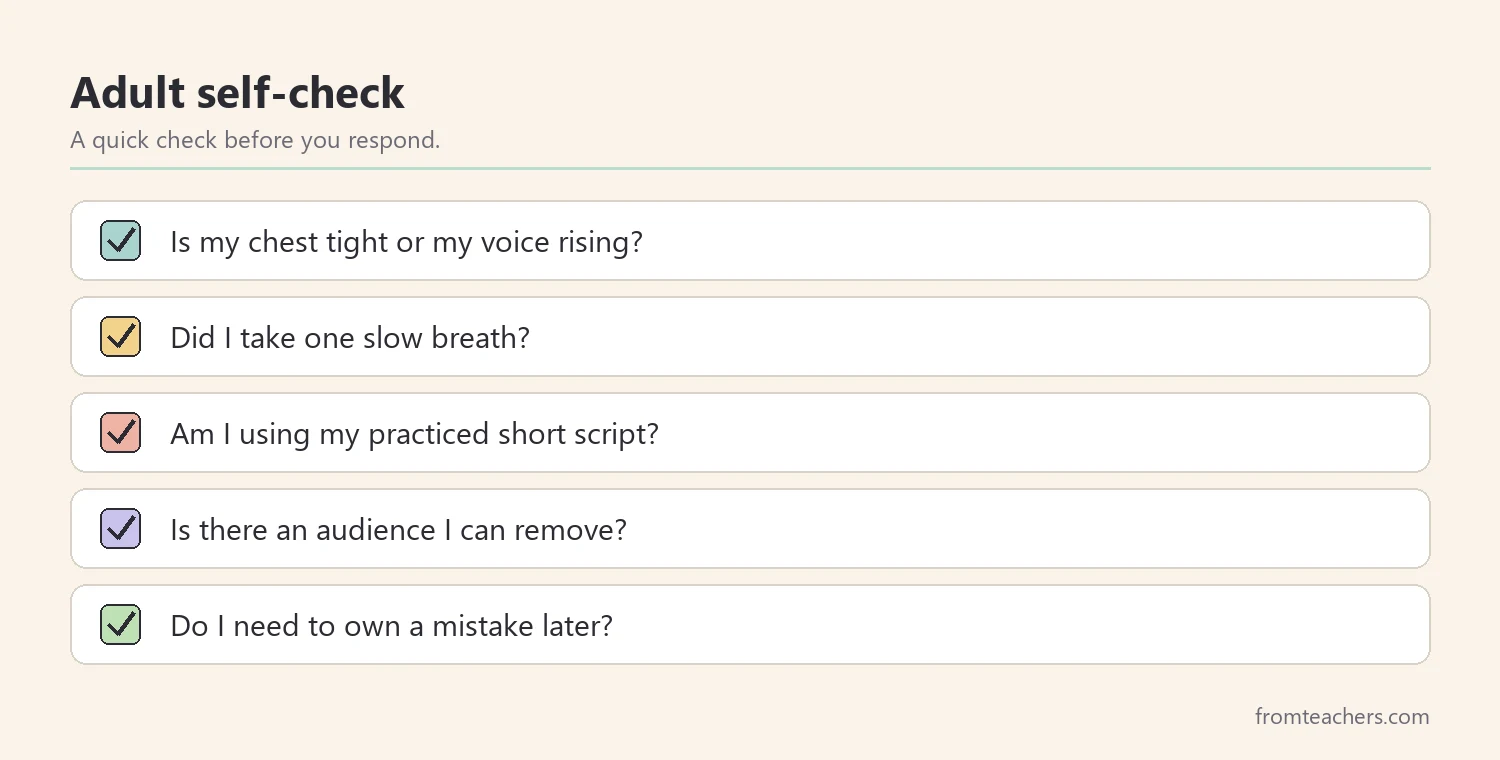
Start by noticing your body. A tight chest, a raised voice, or a strong urge to win the moment are signs that you need a breath before you speak. Taking one slow breath buys you a few seconds of clearer thinking.
Then, use a short script you have practiced ahead of time, such as “I’m here. We’ll sort this out.” Practiced words come out more easily under pressure than new ones.
Also, own your part when needed. If you raised your voice or rushed a demand, saying “I spoke too sharply, I’m sorry” models exactly the responsibility you hope students learn. This works for staff as much as for students.
Ms. Okafor notices that she gets tense when Amir refuses during an observation. She writes a reminder on a sticky note at her desk: “Breathe. Lower voice. One choice.” It helps her respond the same way every time.
6. Repair, record, and review patterns of dysregulation vs defiance
After the moment passes, reconnect. A short, warm check-in tells the student the relationship is intact. Later, when everyone is calm, you can talk about what happened and practice a better option together.
Next, record the incident briefly. Note the time, what happened before, the signals you saw, your response, and how long it took to settle. Keep it factual and short so you actually do it.
Then, review the records every week or two with the team and, where appropriate, the family. Patterns of dysregulation vs defiance often become clear only on paper. You may find that most moments happen at one time of day or after one kind of task.
Ms. Okafor logs Amir’s hard moments for one week. There are five in total. Four happen within ten minutes of a new math page with no example, and one happens during a game when he loses. She adds a worked example to the top of each math page and shares the pattern with his family.
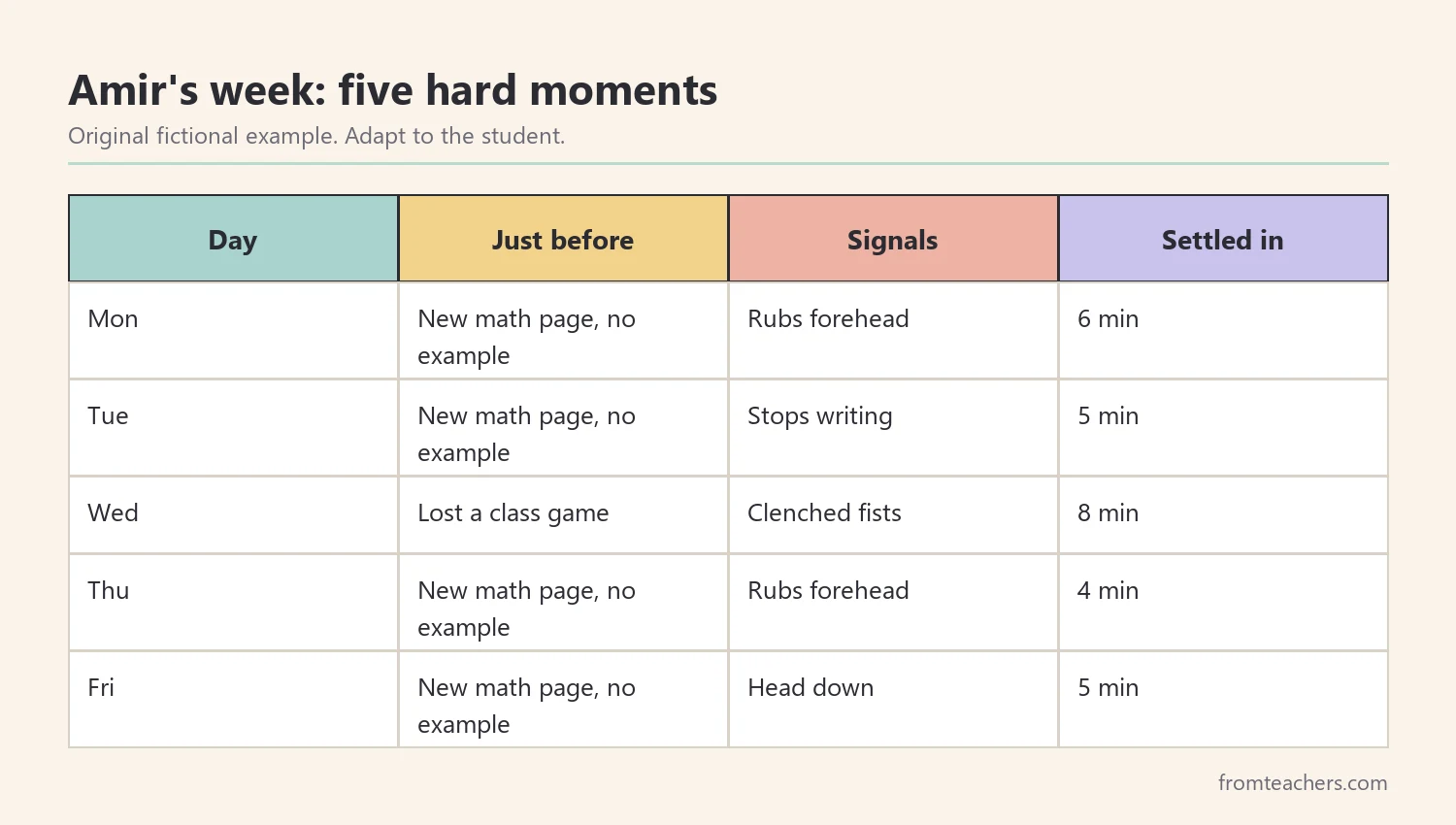
The next week, the log shows two hard moments instead of five. That is not a cure, but it is useful information, and it came from watching patterns instead of labeling a child.
Common mistakes and how to avoid them
- Deciding from one behavior. Fix: look at body signals, triggers, and what happens after a pause before you decide.
- Talking too much during a meltdown. Fix: use fewer words, a lower voice, and one simple choice.
- Turning a refusal into a public battle. Fix: give the expectation once, privately, then step back.
- Skipping repair. Fix: reconnect briefly after every hard moment, even a small one.
- Never writing anything down. Fix: keep a short log and review it every week or two.
- Ignoring your own stress. Fix: practice a breath and a script so your response stays steady.
Questions teachers and parents ask about dysregulation vs defiance
Can a student be both dysregulated and defiant?
Yes. A student may start by refusing on purpose and become dysregulated as the conflict grows. That is why it helps to keep asking the question during an incident and to lower demands as soon as stress signals appear.
Does responding gently to dysregulation reward bad behavior?
Calming a student is not the same as dropping expectations. You return to the task once the student can think again. In fact, a calm student is far more able to learn the skill you want.
How do I explain dysregulation vs defiance to parents?
Use plain words: “Sometimes he can’t, and sometimes he won’t, and they need different help.” Share specific examples from your log and ask what they see at home. Families often notice the same signals, and their view of dysregulation vs defiance at home can fill gaps in yours.
What if a student is unsafe?
Follow your school’s safety procedures and get support right away. Safety comes first. Afterward, use your records to plan with the team so the situation is less likely to repeat.
How long until patterns of dysregulation vs defiance become clear?
Often a week or two of short notes is enough to see a first pattern. Keep logging after you make a change, because the new data shows whether the change helped.
Related reading: Meltdowns vs Tantrums: A Guide to Understanding and Responding, Moving Beyond Shame and Behavior Charts: Positive Alternatives for Effective Classroom Management, and Essential Trauma-Informed Teaching Strategies for Modern Classrooms.
A companion resource for dysregulation vs defiance:
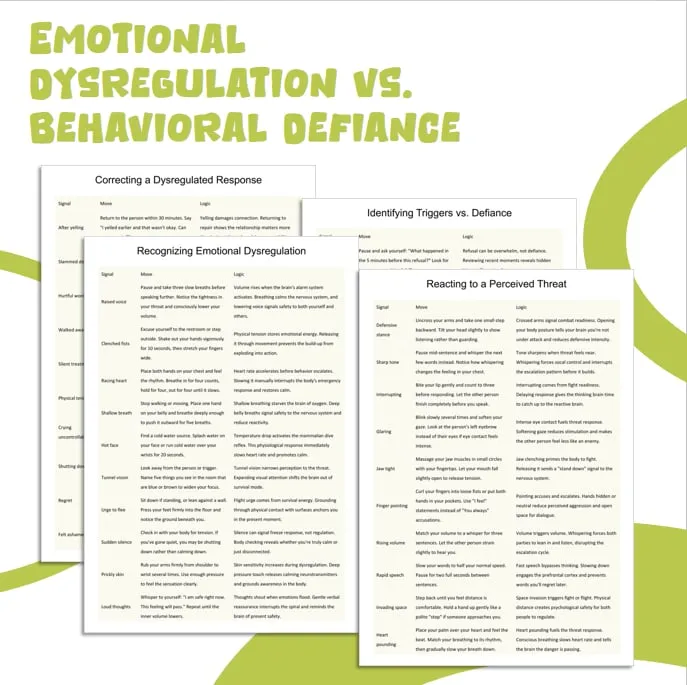
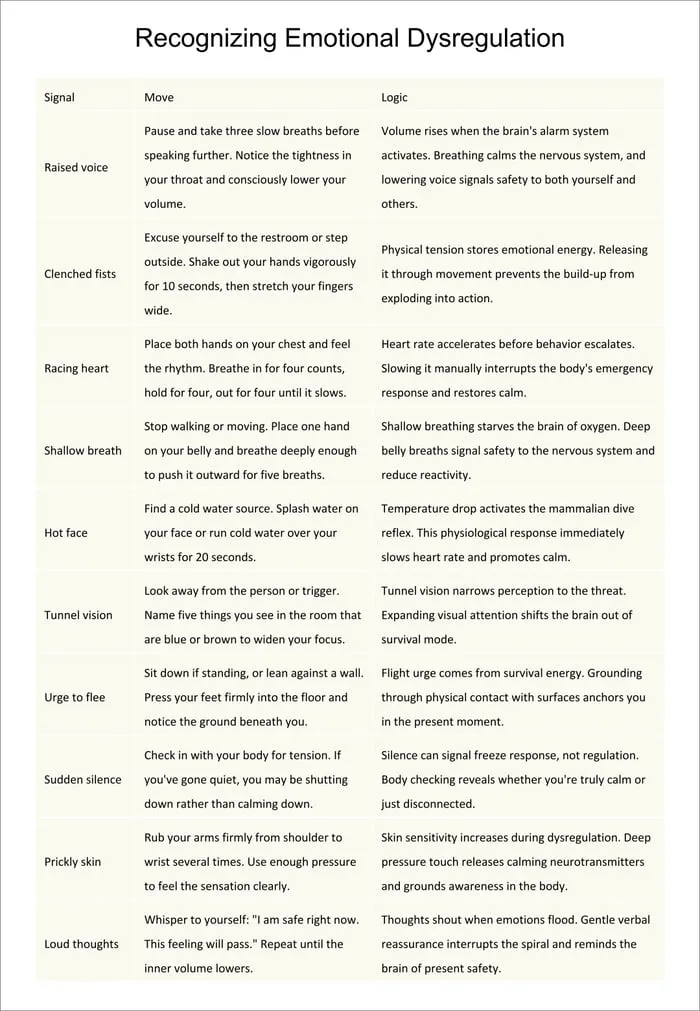
Emotional Dysregulation vs. Behavioral Defiance: 12 pages of Signal, Move, and Logic tables on recognizing dysregulation, telling triggers apart from defiance, reacting calmly to a perceived threat, and simple body-based calming techniques.
Sources and scope
- IRIS Center, Vanderbilt University: free modules on classroom behavior, de-escalation, and evidence-based practices.
- Center on PBIS: resources on positive behavioral interventions and supports in schools.
- CASEL: guidance on social and emotional learning, including self-management skills.
- Understood.org: practical articles for families and teachers on behavior and learning differences.
This guide covers everyday classroom observation and response for dysregulation and defiance. It does not cover diagnosis, crisis intervention training, or formal functional behavior assessment, which belong to qualified professionals and the student’s team.
Key takeaways
- Dysregulation vs defiance comes down to capacity versus choice in the moment.
- Learn each student’s early body signals and step in before escalation.
- Ask about triggers and patterns before deciding on dysregulation vs defiance.
- Regulate yourself first, then respond with few words and one clear choice.
- Repair, record, and review so the next response is better informed.










Leave a Comment