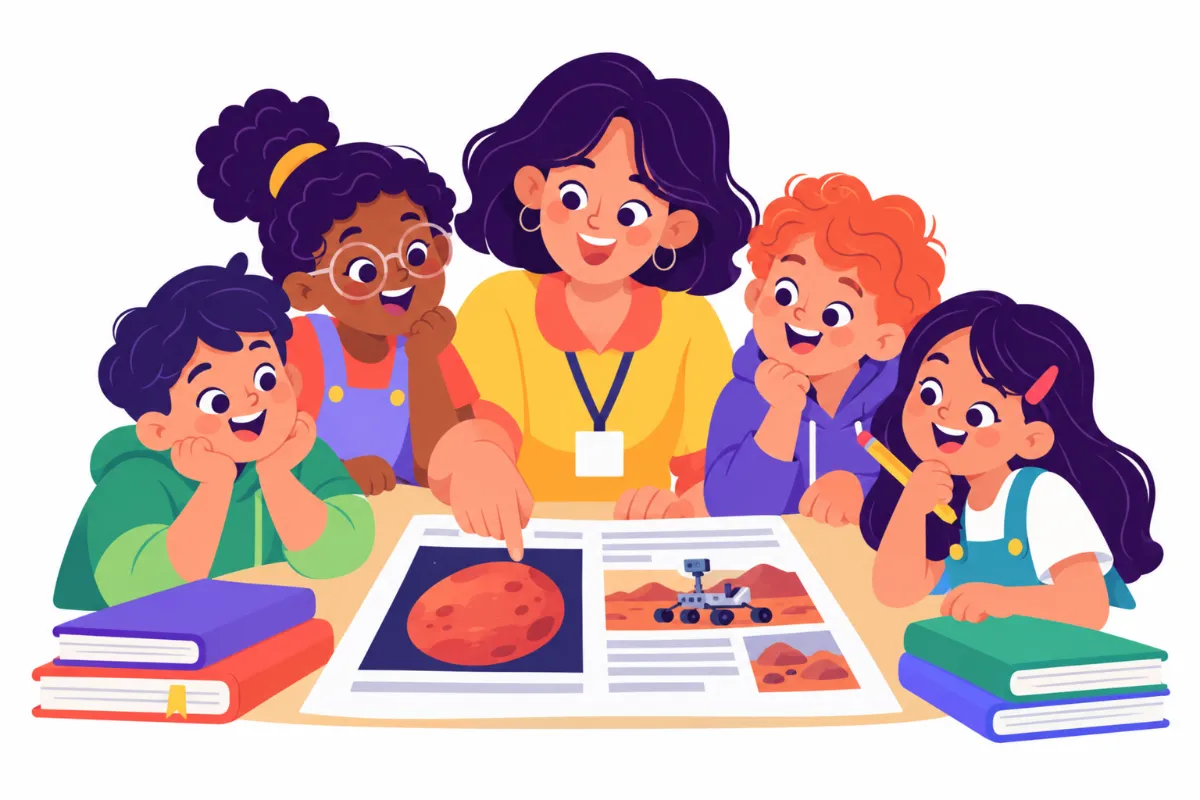

Current events reading passages can turn a sleepy first week of school into a room full of questions. Picture a third grade class on day two: one student spots a photo of a rover on a red, dusty planet and asks, “Is that real?” Suddenly, everyone wants to read the text to find out.
This guide shows you how to choose, teach, and assess short news-based texts with grades 2 to 5. By the end, you will have a simple weekly routine, a set of question types, and an easy way to track comprehension over time.
Examples are fictional. Adapt to the student’s goals and agreed supports. This is guidance, not a diagnosis.
At a glance
- Pick short passages on real topics that match your readers’ level and interests.
- Build a little background before reading so every student can enter the text.
- Use the same read, reread, and respond routine every week.
- Ask a mix of literal, inference, and opinion questions, always with evidence.
- Track a few scores per passage and review them every few weeks.
1. Choose current events reading passages that fit your readers
Not every news story works in an elementary classroom. The best current events reading passages are short, focused on one big idea, and about topics children can picture. Space, animals, oceans, inventions, and discoveries tend to hook young readers quickly.
Also, think about variety across a set. When you plan several current events reading passages for a unit, mix science, nature, and technology so different students find a topic they care about. A student who shrugs at robots may light up at sea turtles.
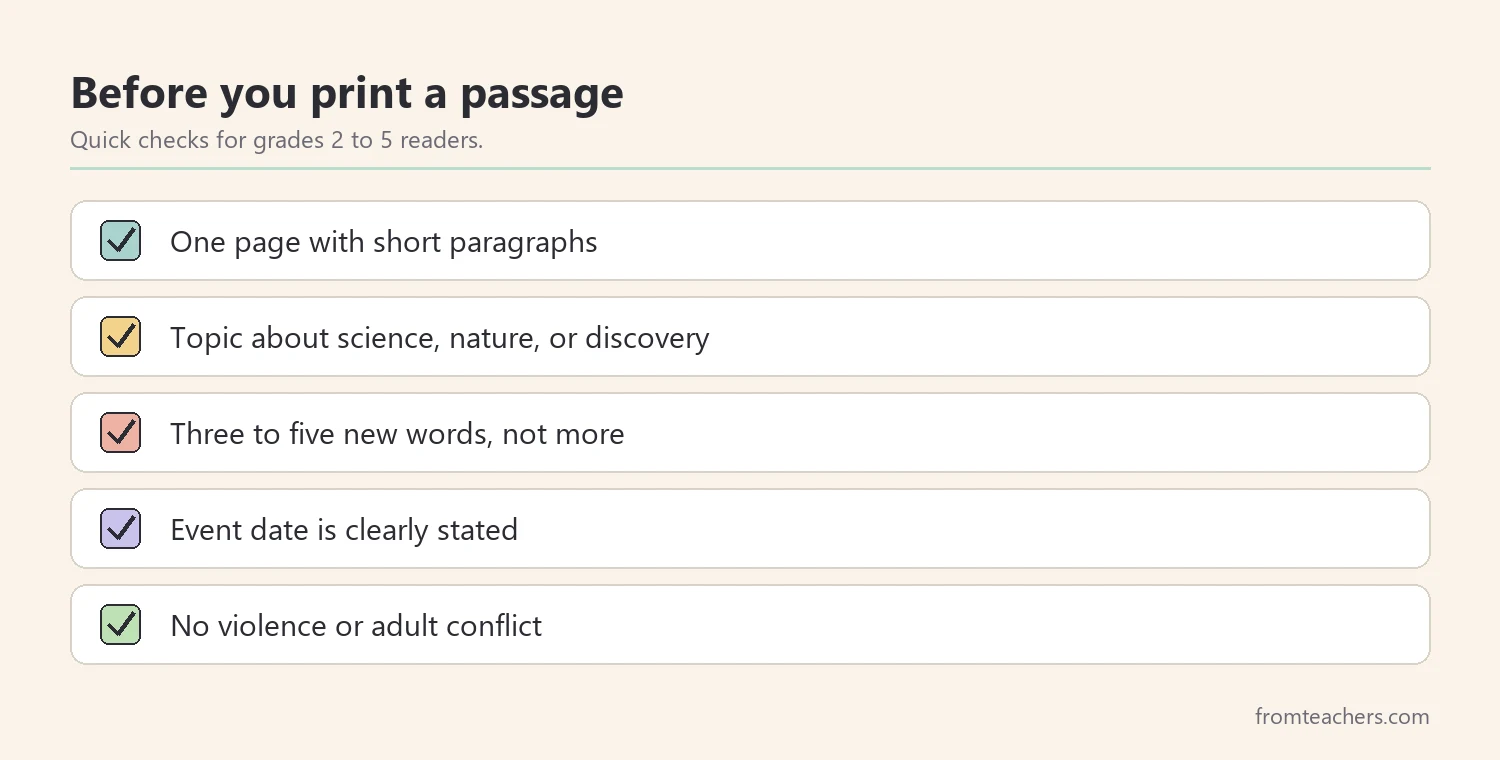
First, check length. For grades 2 and 3, one page with short paragraphs is usually enough. For grades 4 and 5, you can stretch to a longer page with a few key vocabulary words.
Put this step into practice
Next, check tone. Avoid stories about violence, disasters with loss of life, or adult political conflict. Instead, choose stories where the main question is “How does this work?” or “What did people find out?”
Finally, check the date. News ages fast. A passage about a past mission or discovery is still useful, but tell students when it happened so they learn that news has a time stamp.
For example, Ms. Rivera teaches a grade 3 class. In the first week, she picks four passages: one about Mars exploration, one about ocean plastic cleanup, one about a dinosaur discovery, and one about new computer technology. Her student Leo, a reluctant reader, chooses the dinosaur passage first because he already loves fossils.
| Check | Good sign | Warning sign |
|---|---|---|
| Length | One page, short paragraphs | Dense columns of text |
| Topic | Science, nature, discovery | Violence or adult conflict |
| Vocabulary | 3 to 5 new words | New word in every line |
| Date | Clearly stated | No time reference |
2. Build background before students read
Children understand more when they already know a little about a topic. Because news stories often assume background knowledge, a five-minute warm-up makes a big difference.
In addition, start with a picture. Show a photo or simple drawing connected to the passage and ask, “What do you notice? What do you wonder?” Write two or three student questions on the board. These become reasons to read.
Then, preview three to five key words. Say each word, show a picture or gesture, and use it in a short sentence. Keep it light, since the goal is access, not a vocabulary test.
A quick classroom example
Also, place the story on a map or timeline when it fits. A quick point to the Pacific Ocean or to South America helps students see that news happens in real places.
In Ms. Rivera’s class, she shows a photo of a large fossil bone before the dinosaur passage. Leo says it looks “as big as a couch.” She writes his question, “How do they know how big it was?”, on chart paper. She previews three words: fossil, species, and paleontologist. Now Leo has a reason to read and a few anchor words.
For example, keep in mind that background building is not the same as pre-teaching the whole passage. If you tell students everything first, current events reading passages lose their sense of discovery. Give just enough to open the door, then let the text do the rest.
- Show one image and collect two or three questions.
- Preview three to five words with pictures or gestures.
- Locate the place or time if it helps.
- Keep the warm-up to about five minutes.
3. Teach a read, reread, and respond routine with current events reading passages
A predictable routine lowers stress and frees attention for thinking. When students know what happens each time, they spend less energy wondering what comes next.
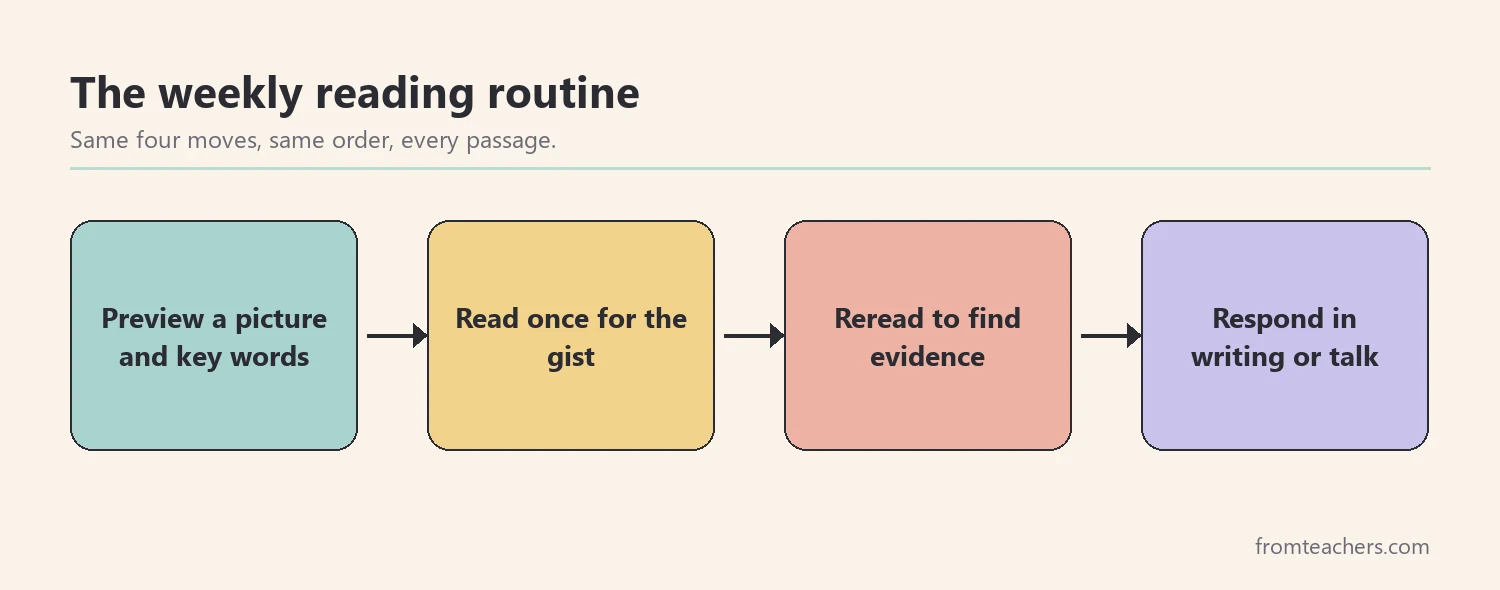
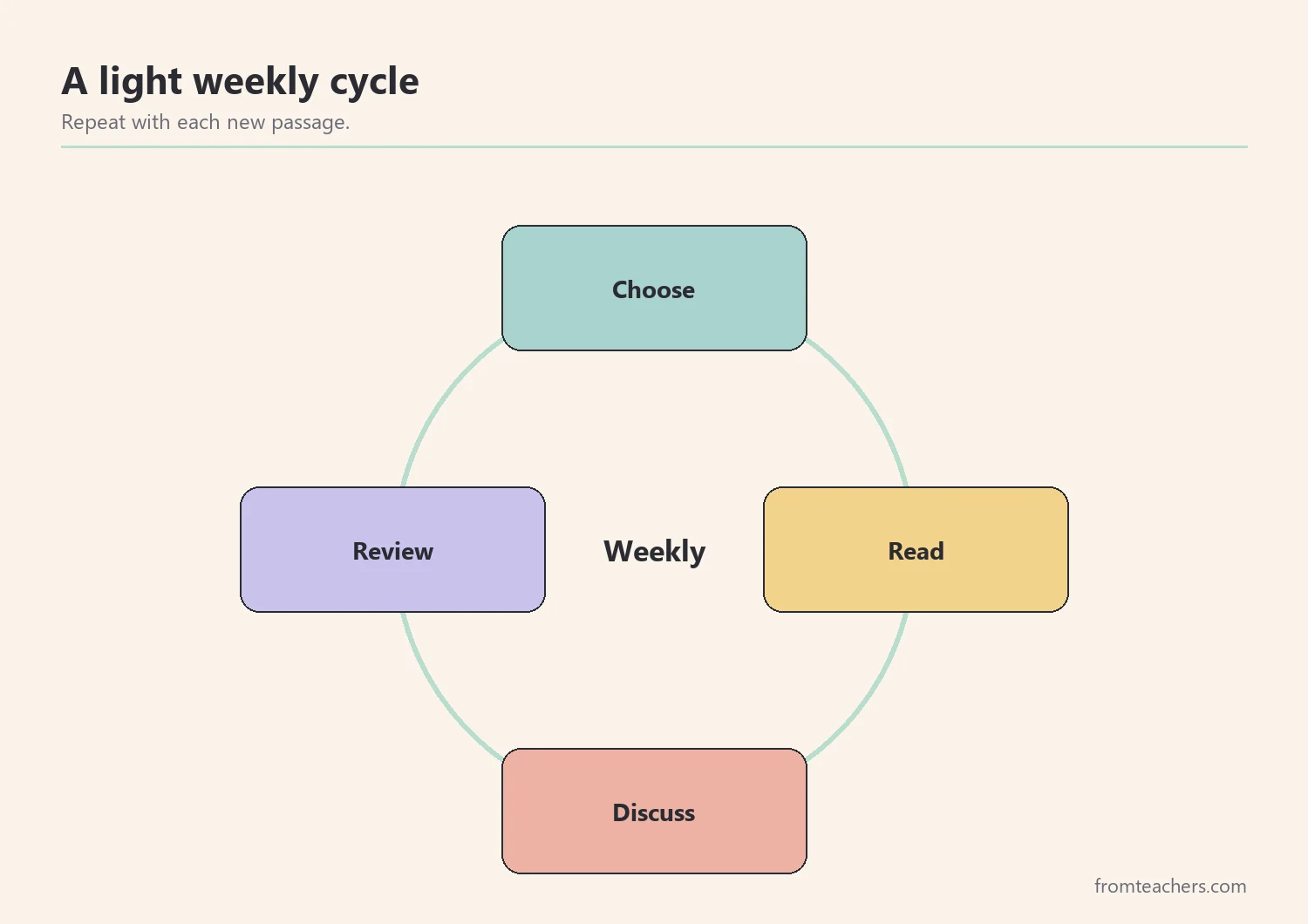
Next, use three short passes. On the first read, students read for the gist: what is this mostly about? During the second read, they hunt for the answer to one class question and underline it. On the third pass, they respond in writing or in a partner talk.
Model the first round yourself. Think aloud as you read: “This paragraph tells me where they found the bones. I am going to underline that.” Then, let partners try the next paragraph together before students work alone.
For younger or struggling readers, read the passage aloud first while they follow along. As a result, decoding does not block comprehension, and everyone can join the discussion. Over the year, gradually shift more of the reading to students.
Make it stick
Similarly, keep the response step short. Two or three written answers, or one partner discussion, is plenty. With current events reading passages, the goal is thoughtful reading, not a long worksheet that drains the energy the topic created.
Leo reads slowly, so Ms. Rivera pairs him with a confident partner for the first read. On the second read, Leo underlines the sentence that explains how scientists estimate size from bones. He answers his own question from the warm-up and grins.
4. Ask questions that check real understanding
Good questions do more than check whether students found a fact. They show whether students understood the main idea, made reasonable inferences, and can back up their thinking.
Aim for a mix. Include one or two literal questions (Who? Where? What happened?), one or two inference questions (Why do you think…? What might happen next?), and one opinion question that still requires a reason from the text.
Moreover, require evidence. Teach a short sentence frame such as “I know this because the text says…” Students can point, underline, or quote a few words. This habit transfers to every subject.
What this looks like day to day
In addition, vary who answers. Let partners discuss one question before writing, and let the class vote on the most interesting opinion question. Current events reading passages work best when students feel their ideas matter.
If you want ready-made practice, a back-to-school pack of current events reading passages with comprehension questions gives you four topics and five open-ended questions for each, which fits this mix well.
| Question type | Example stem | What it shows |
|---|---|---|
| Literal | Where did scientists find the fossils? | Locating facts |
| Vocabulary | What does “species” mean here? | Word meaning in context |
| Inference | Why might this discovery matter? | Reading between lines |
| Opinion | Would you join this project? Why? | Reasoning with evidence |
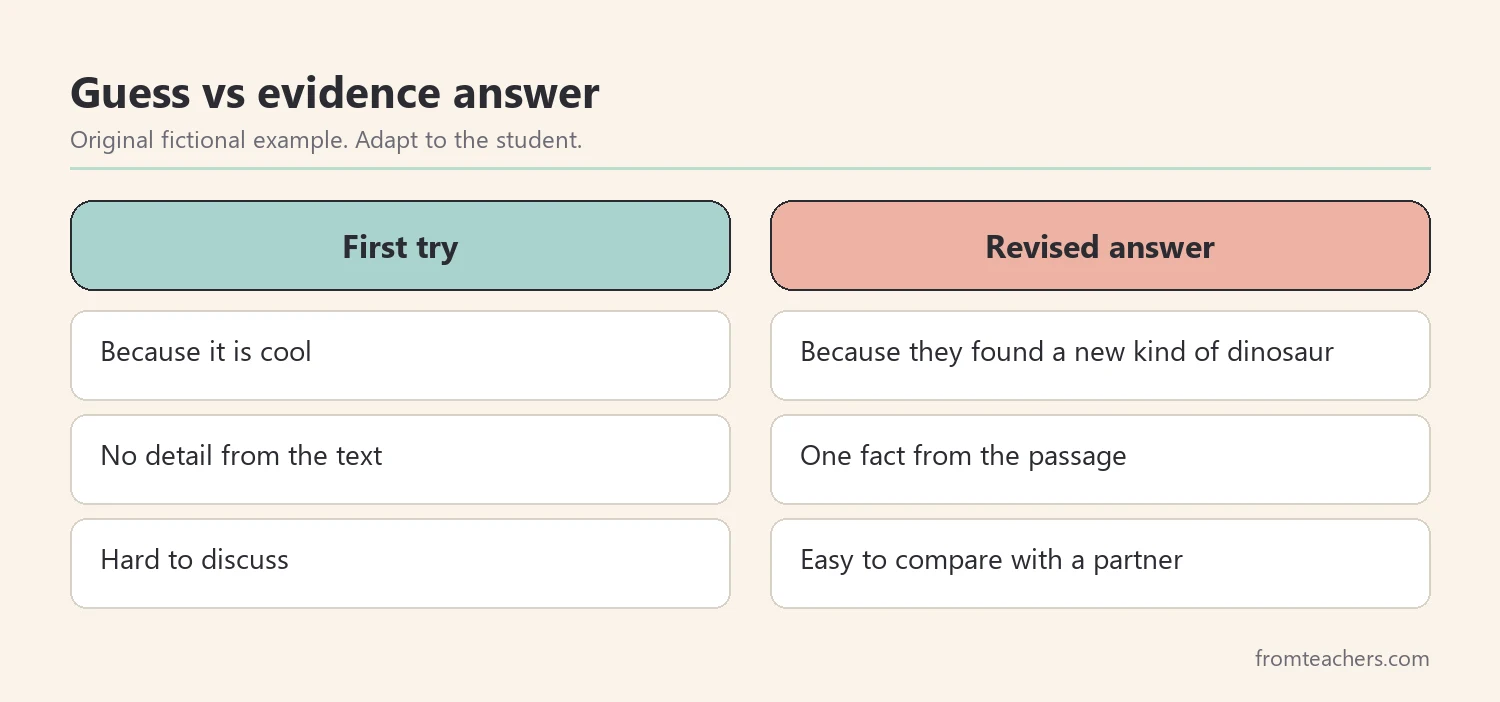
For instance, Leo answers the literal questions easily but writes “because it is cool” for the opinion question. Ms. Rivera asks him to add one fact from the text. His revised answer reads, “I would join because they found a new kind of dinosaur and I want to see the bones.”
5. Add a little news literacy
Current events are a natural place to start teaching how news works. Even young students can learn that a news story should tell who, what, when, and where, and that some sentences are facts while others are opinions.
Also, start with fact and opinion. After reading, give students two sentences, one from the passage and one you wrote, such as “The team removed plastic from the ocean” and “Ocean cleanup is the best job in the world.” Ask which one can be checked.
Next, talk about sources. Ask, “Who would know this information? A scientist? Maybe a news reporter? A friend?” This builds the habit of asking where information comes from.
However, keep it age-appropriate. The goal in grades 2 to 5 is curiosity and careful questions, not suspicion of everything. Celebrate good questions as much as correct answers.
Because current events reading passages describe real people and places, they are ideal for this kind of thinking. A made-up story cannot be fact-checked, but a news story can.
During the ocean passage, Leo sorts four sentences into “fact” and “opinion” columns. He gets three of four right on the first try. The one he misses, “This project is amazing,” becomes a short class discussion about feeling words.
- Sort two to four sentences into fact and opinion.
- Ask who would know this and how they found out.
- Notice dates and places in every story.
- Praise good questions, not only right answers.
6. Track and review progress with current events reading passages
A short record shows whether the routine is working. You do not need a complex system. One line per passage per student is often enough.
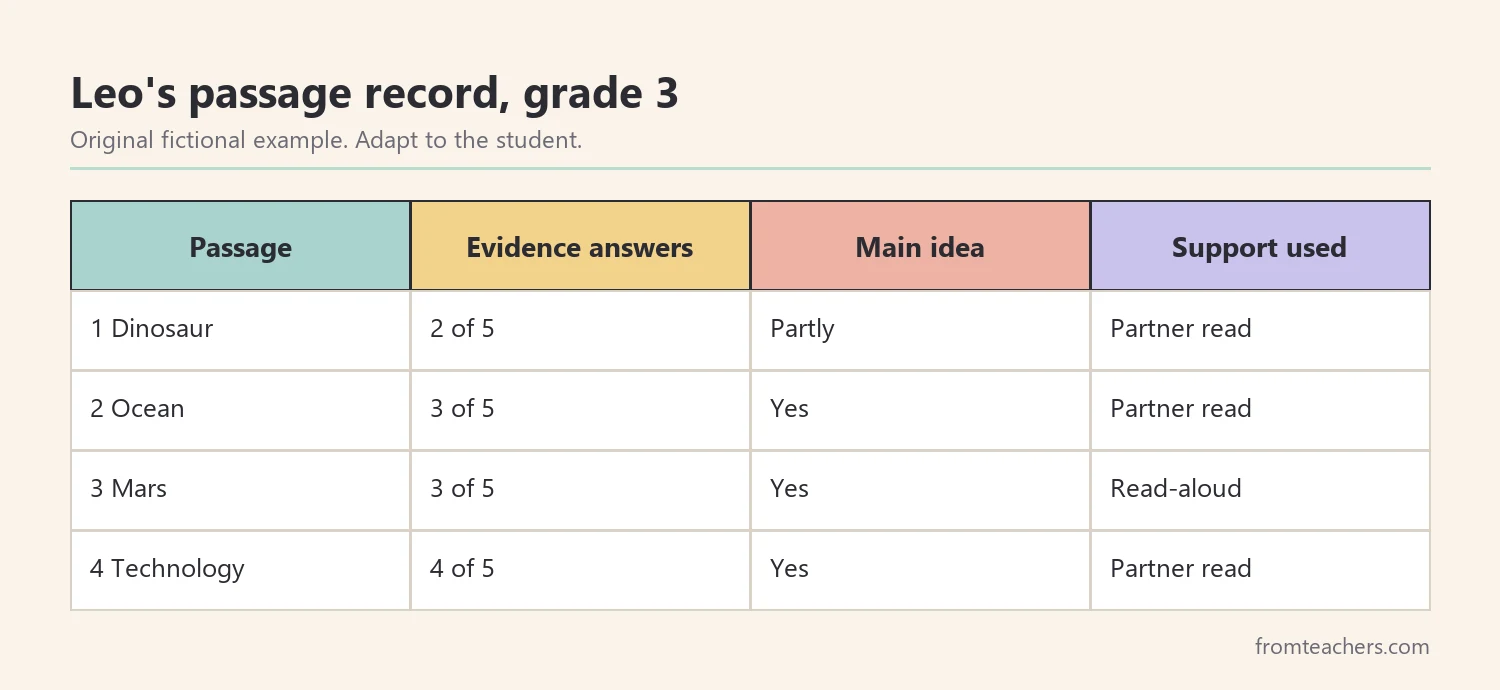
Record a few simple numbers: questions answered with evidence out of five, and whether the student could state the main idea. Add a short note about supports used, such as a partner read or read-aloud.
Then, review the record every three or four weeks. Look for patterns. Is the student stronger on literal than inference questions? Do scores rise when you preview vocabulary? Use what you see to adjust one thing at a time.
Ms. Rivera tracks Leo across the four passages. His evidence-based answers rise from 2 of 5 on the first passage to 4 of 5 on the fourth. She notes that partner reading helped most, so she keeps it for the next unit.
Over a semester, a simple log of current events reading passages also shows which topics engaged the class most. That helps you choose the next set with confidence.
Share a short summary with families when it helps. A note such as “Leo is now backing up most answers with a fact from the text” gives parents something specific to praise at home.
Common mistakes and how to avoid them
- Choosing stories that are too heavy. Fix: stick to science, nature, and discovery topics for young readers, and preview every passage yourself.
- Skipping the warm-up. Fix: spend five minutes on a picture and a few key words so every student can enter the text.
- Asking only literal questions. Fix: include at least one inference and one opinion question with a required reason.
- Accepting answers without evidence. Fix: teach one sentence frame and use it every time.
- Changing the routine every week. Fix: keep the same steps so students focus on thinking, not on directions.
- Collecting data you never use. Fix: track two numbers and review them every few weeks.
Questions teachers and parents ask about current events reading passages
Are current events reading passages good for the first week of school?
Yes, they can be a strong start. Real-world topics spark curiosity and conversation, and short passages give you a quick look at each student’s reading and writing. Keep the first one easy so everyone feels successful.
How often should I use current events reading passages?
Once a week works well for many classrooms. It is frequent enough to build a routine but leaves room for your core reading program. Some teachers use them as a Friday activity or a substitute plan.
What if the news in current events reading passages is no longer new?
That is fine for reading practice. Tell students when the event happened and, if you like, ask what they think has happened since. This also teaches that news is tied to a date.
How do I support students who struggle with current events reading passages?
Read the passage aloud first, use partner reading, and preview key vocabulary with pictures. Let students answer some questions orally or with drawings. Over time, shift more of the reading to them.
Can parents use current events reading passages at home?
Absolutely. Read one together, talk about what surprised you both, and ask one “why” question. A few minutes of shared reading about real topics builds background knowledge and conversation skills.
Related reading: 5 Practical Teaching Tips to Boost Classroom Focus and Learning, Learning Styles Student Success Guide, and Dyslexia Solutions in the Classroom.
A companion resource for current events reading passages:
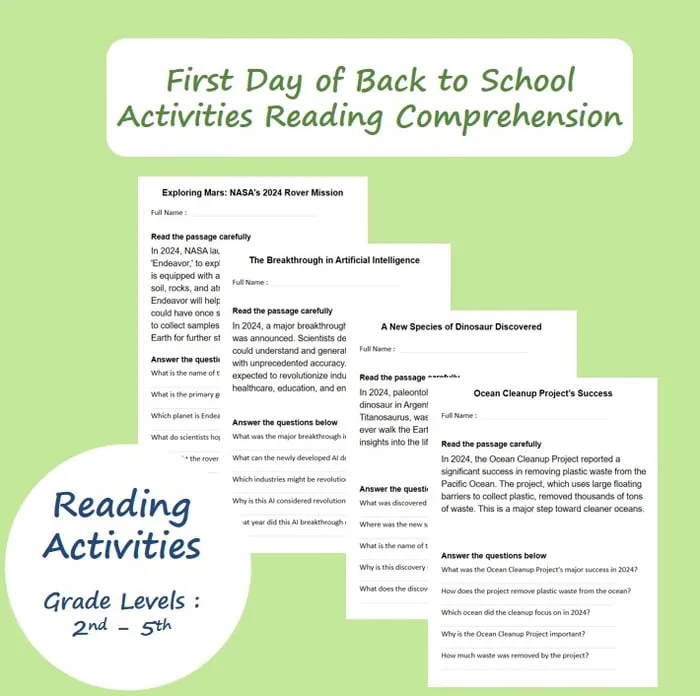
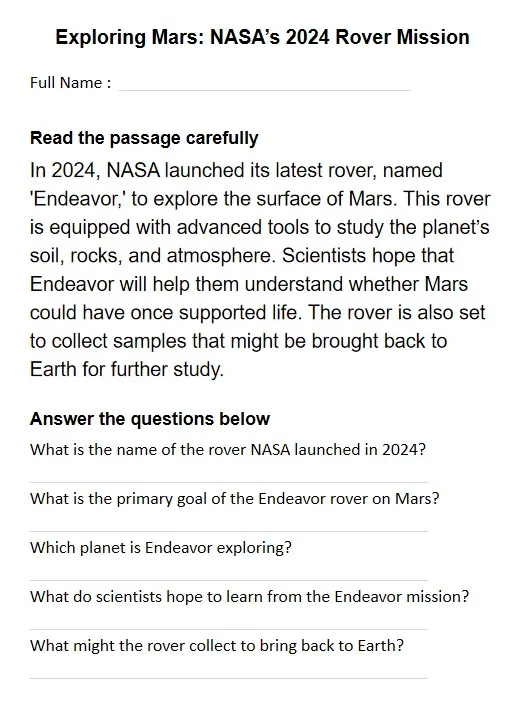
Back to School Reading Comprehension: Current Events Passages, Grades 2-5: four ready-to-print passages on real-world topics such as Mars exploration, artificial intelligence, ocean cleanup, and a dinosaur discovery, each with five open-ended comprehension questions.
Sources and scope
- Reading Rockets: free articles and strategies on comprehension, vocabulary, and background knowledge.
- International Literacy Association: a professional organization for literacy educators with resources on reading instruction.
- News Literacy Project: a nonprofit offering resources that help students judge the credibility of news and information.
- National Council of Teachers of English: professional guidance on reading, writing, and literacy teaching.
This guide covers using short news-based passages for reading comprehension in grades 2 to 5. It does not replace a core reading program, formal reading assessment, or instruction in foundational decoding skills.
Key takeaways
- Choose current events reading passages that are short, focused, and age-appropriate.
- Build background with a picture and a few key words before reading current events reading passages.
- Use the same read, reread, and respond routine every week.
- Mix literal, inference, and opinion questions and always ask for evidence.
- Track two simple numbers and adjust one thing at a time.
Leave a Comment